

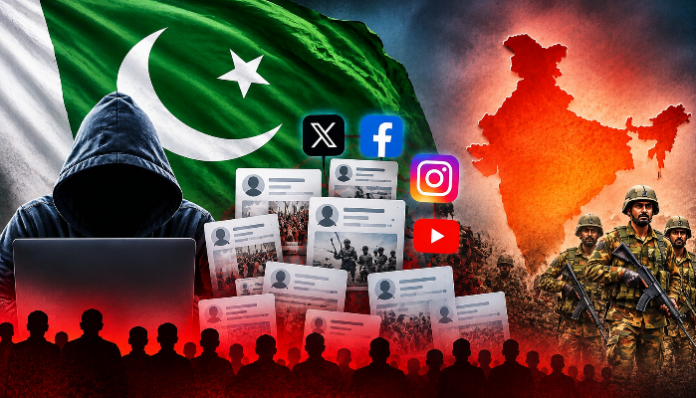
A massive disinformation campaign revolving around India’s political leadership, military establishment, security institutions and socio-cultural fault lines has been exposed by Firstpost. The propaganda operation is being orchestrated from Pakistan through thousands of social media accounts. Sources told the media house that a number of these accounts have been discovered and reported, after which they were disabled or removed, but fresh and nearly bot-like ones continue to pop up.
An insider revealed, “The activity is extensive, persistent and spread across multiple social media platforms. It involves the repeated circulation and amplification of narratives concerning the country’s senior leadership, armed forces, defence establishment and internal fault lines, including communal relations, protests, Kashmir, Manipur, Punjab, caste and regional divisions.”
Several examples of deceptive content, such as altered films, made-up claims, recycled footage, and accounts utilising fictitious Indian names to lend an air of authenticity to their posts, have been identified in an analysis compiled by the security establishment. The sources disclosed that the scope and variety of these efforts indicate a persistent attempt to take advantage of critical domestic situations, exacerbate already-existing divisions, and fabricate fake impressions of India’s internal stability and institutional efficiency.
A popular method to utilise real photos and videos from past incidents and pass them off as recent events by adding false dates, manipulated audio, deceptive captions, or phoney news tickers has been spotted in the research. In November, visuals from 2022 and 2024 from Madhya Pradesh, Jharkhand, and the Punjab-Haryana border were shared with bogus statements.
A concerted effort to malign India’s military establishment
The credibility of India’s armed forces and military leadership has been explicitly targeted by these accounts. A fraudulent video purporting to show that the Chief of Defence Staff acknowledged that Pakistan was superior to India in air, land, naval, and cyber warfare has been detected by the report.
National Security Adviser Ajit Doval was wrongly accused in another deepfake video of making comments about naked pictures of CJP leaders. Similar instances included the fabrication of a report that the Army Chief was going to be removed, as well as the exploitation of an irrelevant photograph and video to deceptively imply that a Sikh Regiment commander had been involved in an illegal occurrence in Mexico.
According to sources who spoke with Firstpost, such propaganda was meant to confuse people, erode public trust in the defence system, and raise questions about the legitimacy of the leadership of the Indian armed forces.
False reports of police firing on worshippers, mosque demolition, protester deaths, and attacks on religious groups are another common subject of this propaganda. Social media posts have claimed that cops had opened fire on worshippers and that five mosques in Ghaziabad had been destroyed. It was similarly alleged that 5 individuals were killed by police gunfire during prayers in Kolkata.
A source clarified, “The material reviewed did not establish these claims. Such examples illustrate how fabricated casualty figures and allegations of violence can inflame communal tensions.” The sources revealed to the platform that these narratives are intended to take advantage of religion, caste, and regional divisions and turn local incidents, including unconnected or historical developments, into national disputes.
A key aspect of this nefarious plan is the extensive employment of Indian names, regional identities, caste attributions, and local-news-style profiles to project these accounts as those of average Indians. A Pakistan-based account was caught using “Anushi Tiwari” to trick Indians. The account had @Proudindiannavi, @annu2030, and @cutegirlindia21 handles on X (formerly Twitter). It circulated bogus claims on many subjects, with the content being amplified by another account.
The account ‘Anushi Tiwari’ is based in Pakistan. Later, the admin of this account changed its location to South Asia. This account posts fake news against India on a daily basis. The claim that Indian Army entered Kolkata is fake news. What is stopping the Govt from taking action against such accounts?
— Anshul Saxena (@AskAnshul) May 5, 2026
According to sources, the propaganda has alternated between statements about the military, protests, Sikh identity, communal concerns, and Kashmir. The sources added that this shifting between unconnected yet sensitive areas is a part of a larger trend in which accounts aim to leverage fault lines in India.
The sources conveyed that deepfake posts and videos of popular anti-government figures and critics of the security apparatus are also being disseminated with ludicrous assertions to give them an illusion of legitimacy. Notably, the misleading original post is shared by others and even boosted by Pakistani media handles and websites to provide more visibility and portray that it has been independently confirmed by other sources.
ISPR’s role in the campaign
The Indian security officials mentioned that the Pakistani military’s media and public relations division is primarily behind the coordinated anti-Indian information campaign, per the media outlet. Inter-Services Public Relations (ISPR) has intensified its activities since about 2015 to enlist and involve youth in producing and propagating misinformation on social media that targets India. The approach includes an internship program for social media volunteers who are given particular tasks for the same.
These hires are asked to spot and flag content that could prove beneficial in this propaganda drive. Their mission includes producing memes, videos, and other digital content. Sources unveiled that the social media warfare module was started by former ISPR director general Lieutenant General Asim Saleem Bajwa (retired), which has grown and improved over time.
This allows Pakistan to draw on a wider network of contributors to serve its sinister interests without having to employ them all permanently.
The goal is to craft plots that appeal to the preexisting political, religious, caste, or regional convictions of the consumers. An insider expressed, “Multiple false claims are propagated that would appeal to your own belief systems, caste, religion or politics. The aim is to divide.” Indian security services are taking action against these accounts, but the exercise is challenging due to the emergence of new accounts.
