

In a significant step aimed at protecting female students’ rights in schools, the Italian Parliament has passed a law that will effectively ban burqas and niqabs in schools across Italy. The legislation was approved in the Italian Chamber of Deputies, the country’s lower house of Parliament, on November 26, 2026, with 142 votes in favour, 112 against and four abstentions.
The bill had already been cleared by the Senate on November 20, 2026, and now awaits the signature of President Sergio Mattarella. Following the final vote of approval on the legislation, Italian education minister Giuseppe Valditara said the government had acted in the name of genuine integration. “With this regulation, we offer concrete solutions to Italian families and strengthen every student’s right to achieve success in education,” the Education Minister said.
The legislation does not directly mention burqa or niqab, but it prohibits students from covering or concealing their faces in schools in any way that prevents identification. It does not prohibit hijab, which leaves the face visible, and also allows exceptions on health grounds.
The law states that students covering their faces would be barred from lessons and other school activities. Furthermore, it imposes fines ranging from €200 to €1,000 ($225 to $1,120), payable by parents when a minor student violates the law.
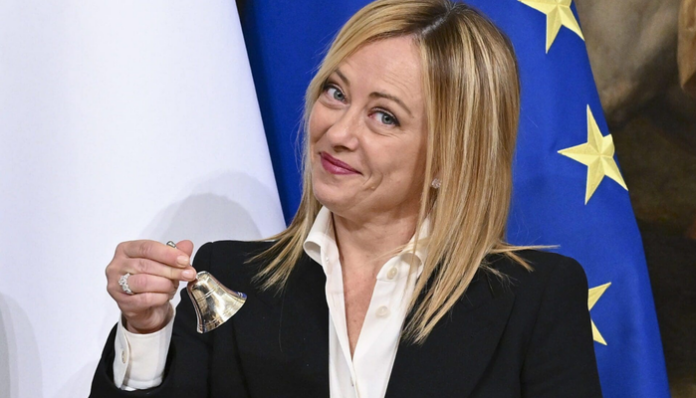
The legislation was approved amid protests by opposition members of Parliament, who held up placards declaring that nobody there was a foreigner. The Giorgia Meloni government has defended the legislation as a measure to ensure gender equality. Proposing the law on September 20, 2026, PM Meloni reportedly said that no one in the country could decide, “in the name of a real or supposed tradition”, that a young woman must hide her face.
She also said that people coming to Italy and wanting to build their future there must learn Italian, understand the country’s culture and follow its rules. Meloni described the legislation as containing common-sense measures which would support integration instead of division.
The law supports measures under the National Recovery and Resilience Plan (PNRR) and intends to promote the integration of foreign students. The integration measures include free Italian language courses for foreign parents. The law requires schools to report cases where parents’ persistent language difficulties hinder their child’s education or affect their behaviour in class or their compliance with commitments made to the school.
Besides, the law caps the proportion of foreign students with inadequate knowledge of Italian at 30% in the first-year classes, effective from the 2027-28 session. The rule, which was opposed by the European Commission, will be applicable to non-citizens born abroad who have not attended at least two years of Italian nursery school, or three years of Italian schooling at secondary level.
Under the new law, publishers of school and university textbooks will be required to offer digital versions of their publications at 50% of the price of their printed equivalents. The provision intends to make educational materials more accessible and ease the financial burden on families.
With the passing of the law, Italy has joined the league of European nations like France, Denmark and the Netherlands, which have banned full-face veils in public places. France banned wearing a burqa or a face veil in public in 2011. It was followed by Denmark, which introduced a similar ban in 2018 followed by the Netherlands that barred face veils in schools, hospitals and on public transport in 2019.
