

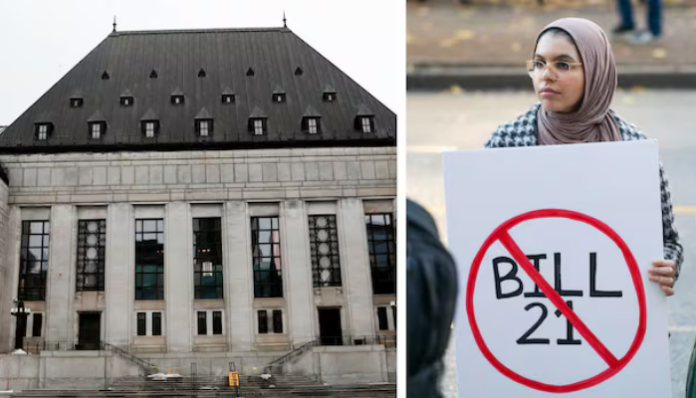
On 27th November (Friday), a Quebec law prohibiting public sector employees from using religious symbols, such as the hijab, has been upheld by the Supreme Court of Canada. The “notwithstanding clause,” a special feature of the Canadian Constitution that permits governments to issue such orders, was used by Quebec to adopt the bill in 2019. Certain provisions of the country’s Charter of Rights and Freedoms can be overridden through this Section 33 framework.
However, several groups, including female Muslim, Sikh, and Catholic teachers, filed legal challenges to the secularism bill, known as Bill 21, arguing it infringed upon their fundamental rights. The decision is a political triumph for the sovereigntist government of Quebec. Six out of seven justices determined that the government had successfully utilised the notwithstanding clause to protect Bill 21 from constitutional difficulties.
Chief Justice Richard Wagner expressed, “Bill 21 is rooted in Quebec’s legitimate and historical commitment to ensuring the laicity of the state in a free and democratic society.” The ruling implies that the government lawyers, police officers, and public school instructors will continue to be prohibited from donning religious symbols like hijab, turban, kippah or a cross while on duty.
However, the court unanimously decided that a different clause mandating elected members of Quebec’s National Assembly to carry out their responsibilities with their faces exposed trampled upon their constitutional democratic rights.
The four days of hearings in March were among the longest in Canada’s 151-year history, according to the country’s highest court. A record 51 interveners took part, including six solicitors general. The announcement of the judgement also caused the court’s website to crash.
In its ruling, the Supreme Court dismissed the majority of claims that Bill 21 breached parts of the Charter that are not covered by the notwithstanding clause, such as rights to education for Quebec’s English-speaking minority and obligations pertaining to gender equality.
Quebec outlined that the law is essential to maintaining the province’s secularism as a fundamental aspect of its identity. According to the leader of the federal party Bloc Quebecois, which supports Quebec’s sovereignty, the decision affirmed the province’s right to defend its principles.
Yves-Francois Blanchet conveyed, “We are now more than ever in a position to move forward with the preservation of the very elements that profoundly define the distinct nature of Quebec society.” The government has maintained that those in positions of authority should refrain from displaying their religious convictions while carrying out their official responsibilities. The law is intended to advocate for the preservation of a separate line between the state and religion.
The province enacted a second bill earlier this year that extended its secularism regulations to post-secondary schools and funded daycares. Additionally, it prohibited public prayer and imposed penalties for noncompliance.
Quebec’s Court of Appeal upheld the majority of the Act in February 2024, after which the matter made its way to the Supreme Court.
