Home Blog Page 1578

Gujarat’s Garba declared an Intangible Cultural Heritage by UNESCO

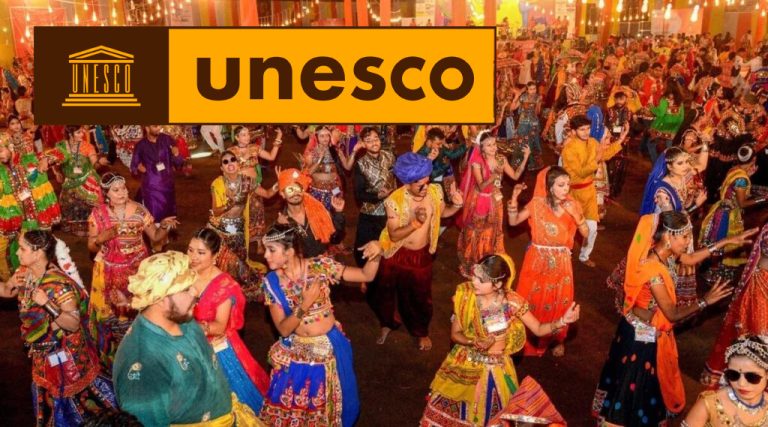
Garba, the famed traditional dance form of Gujarat has been declared as an Intangible Heritage by the United Nations Educational, Scientific and Cultural Organisation.

In a post on social media platform X (formerly Twitter) on Wednesday, UNESCO posted, “New inscription on the Intangible Heritage List: Garba of Gujarat, India. Congratulations!”

The decision was made during the 18th session of the Intergovernmental Committee for the Safeguarding of the Intangible Cultural Heritage, underway at the Cresta Mowana Resort in Kasane, Botswana.

The session, which began on December 4 is scheduled to go on till December 9, according to UNESCO.

Garba is a ritualistic and devotional dance that is performed on the occasion of the Hindu festival of Navaratri.

The dance takes place around a perforated earthenware pot lit with an oil lamp, or an image of the mother goddess Amba.

Participating dancers move around the centre in a counter-clockwise circle, using simple movements while singing and clapping their hands in unison.

The Gujarati dance starts with slow circular movements and the tempo slowly builds up to a frenzied whirling.

The practitioners and bearers of Garba include from the dancers to the musicians, social groups, craftspeople and religious figures involved in the festivities and preparations, according to a citation by UNESCO.

Garba is transmitted across generations in urban and rural areas through practice, performance, imitation, and observation, it said.

Apart from Garba, the Rickshaws and rickshaw painting in Dhaka, Bangladesh; Jamu wellness culture of Indonesia, Songkran in Thailand, the traditional Thai New Year festival, have also become new inscriptions on UNESCO’s Intangible Heritage List, amongst many others.

are some other elements from India on the Lists of Intangible Cultural Heritage.

As of January 2022, a total of 14 Intangible Cultural Heritage (ICH) elements are inscribed on UNESCO’s Representative List of Intangible Cultural Heritage of Humanity.

These include the traditional brass and copper craft of utensil making of the Thatheras of Jandiala Guru in Punjab, the Nawrouz festival, the Kumbh Mela, the Durga Puja of Kolkata, Ramlila and Vedic Chants.

(This news report is published from a syndicated feed. Except for the headline, the content has not been written or edited by OpIndia staff)

Pranab Mukherjee knew Sonia Gandhi would not make him PM, was upset over ‘politically immature’ Rahul Gandhi for tearing ordinance: Reveals Sharmistha Mukherjee

0

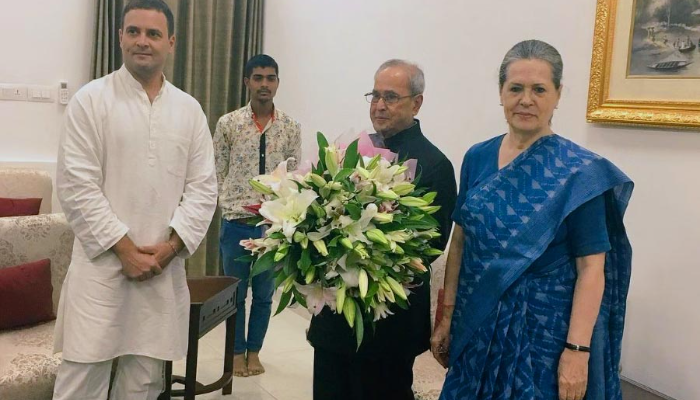
The late former President Pranab Mukherjee’s daughter, Sharmistha Mukherjee revealed that her father was disappointed about the way Rahul Gandhi disregarded an ordinance that had been brought in by the then-UPA (United Progressive Alliance) government in 2013 to spare convicted leaders like Rashtriya Janata Dal supremo Lalu Yadav from disqualification. He also knew that Sonia Gandhi would not make him the PM after renouncing the post in 2004. Sharmistha Mukherjee has made several such revelations in a new book, In Pranab, My Father: A Daughter Remembers, which is based on the diary entries of the former president.

“I’ll tell you what my opinion on the ordinance is. It’s complete nonsense. It should be torn up and thrown away. That is my personal opinion,” Rahul Gandhi declared while tearing the ordinance in a press conference held by another prominent Congress leader Ajay Maken who was defending the decision. The Congress scion had embarrassed the then-Manmohan Singh government hours before the prime minister met with President Barack Obama in Washington DC and publicly rebuked his party’s old guard.

The Congress spokeswoman talked about her new book, “In Pranab, My Father: A Daughter Remembers,” which includes intimate tales and experiences from her father, in an interview with India Today. The Gandhi scion’s observations, according to the now-deceased veteran Congress leader were “politically immature” and she stated that her father realised that the former was “losing the battle of perception.”

She revealed that following the party’s poor performance in the 2014 Lok Sabha elections, Pranab Mukherjee was particularly displeased with Rahul Gandhi’s frequent absences from Parliament. She divulged that her father had mentioned to a journalist during an interview that he did not anticipate being appointed prime minister by Sonia Gandhi.

Sharmistha Mukherjee unveiled, “In 2004 after Sonia Gandhi renounced her claim (of being the Prime Minister), there was media speculation about who would be the Prime Minister. The names of my father and Manmohan Singh were doing the rounds. I asked him excitedly if he would be the Prime Minister. But he said no and that Manmohan Singh would be the Prime Minister.” As per Sharmistha, Pranab Mukherjee told her, ‘No, she will not make me the PM. It’ll be Manmohan Singh,’ indicating that Sonia Gandhi will not make him the PM.

Rahul Gandhi, the current Lok Sabha MP from Wayanad voiced in a Congress Working Committee (CWC) meeting just before the 2009 general election that he was against a coalition government. Sharmistha Mukherjee claimed that her father wrote about this occurrence in his journal. She highlighted, “Baba (Pranab Mukherjee) said he (Rahul Gandhi) should put his thoughts coherently. Rahul Gandhi said he would meet him.” She noted that the UPA government from 2004 to 2014 did not witness much interaction between the two leaders.

Sharmistha Mukherjee remembered a day when her father mocked Rahul Gandhi for wanting to become prime minister. “Rahul Gandhi came to see baba while he was walking in the Mughal Gardens in the morning. He disliked being disturbed while walking or doing puja. But still, he met him. Later, I came to know that Rahul Gandhi was supposed to meet him in the evening.”

She added, “When I told baba about this, he was not amused. He sarcastically said if Rahul Gandhi’s office cannot differentiate between am and pm, how can he become the Prime Minister?”

Pranab Mukherjee served as India’s finance minister and subsequently became minister for External Affairs, Defence, Finance and Commerce. He was India’s 13th president (2012 to 2017). He died on August 31, 2020, at the age of 84. He was awarded India’s highest civilian honour, the Bharat Ratna in 2019 by his successor as president Ram Nath Kovind under the NDA (National Democratic Alliance) government led by Prime Minister Narendra Modi.

Maharashtra: Minor girl raped, blackmailed over personal photos and videos, accused Uvaish Ansari booked in Satara

0

On Monday (4th December), the Maharashtra Police booked an accused identified as Uvaish Ansari for sexually assaulting a minor girl and threatening her in the Satara district of Maharashtra. The accused clicked derogatory pictures of the minor girl and used them to blackmail her for further sexual exploitation, as per the complaint.

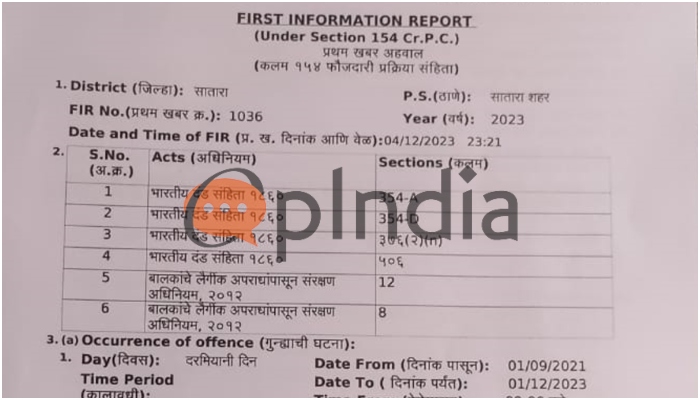
The FIR has been booked under sections 354A, 354D, 376(2)(n), and 506 of the Indian Penal Code, 1860. Sections of the POCSO Act have also been imposed against the accused.

As per the FIR copy obtained by OpIndia, the crime begun in the year 2021 when the girl was 17 years old. The girl mentioned in the complaint filed on 4th December this year that she met the accused while they played a PUB-G game online in the year 2021. The accused who is a resident of Hamidpur, Uttar Pradesh extended his hand of ‘friendship’ towards the girl. Later they began chatting on WhatsApp and also got engaged on other social media platforms.

This continued for around a year until February 2023, when the accused pressed to meet the girl in person. He arrived at Satara, Maharashtra after which the duo went to a nearby fort named the Ajinkyatara. The accused molested the girl after he met her and captured derogatory photos of her on his phone. He then blackmailed the girl using those photographs and dragged her to a local residency lodge. The accused sexually assaulted the girl and also recorded a derogatory video of her on his phone.

FIR copy obtained by OpIndia

He threatened the girl and said that he would show her photographs to her parents and other villagers if she failed to fulfill his sexual demands. After the incident in February, the accused returned to Hamidpur. However, he continued to threaten the girl over social media platforms. He would ask the girl to send her nude pictures to him over Snapchat, failing which he would threaten her saying that he would send her derogatory photos and videos to her parents.

The girl was scared all these months so she could not seek help from her parents or relatives. The incident came to the fore recently on 1st December after the accused called the girl and said that he was coming to Satara to ‘meet’ her. The girl then told her family about the sexual assault after which a legal complaint was filed by her family members at District Police Station.

The complaint has been filed under sections 354A, 354D, 376(2)(n), and 506 of the Indian Penal Code, 1860, and also under sections 12 and 8 of the Protection of Children from Sexual Offences Act, 2012. Further investigations into the case are underway.

It is worth noting that the number of crime cases against women has increased in the state of Maharashtra in the past year. The National Crime Records Bureau (NCRB) recently released a report in which it mentioned that the state had ranked fourth after Rajasthan, Madhya Pradesh, and Uttar Pradesh in recording rape cases against women. The state recorded 2,904 incidents of rape in 2022 and 2,295 cases of murder, the report said.

There was also a significant rise in the number of rioting cases in Maharashtra last year, which took the state to the top position in this category. These cases were registered under IPC sections 147 to 151 (about rioting and unlawful assembly) as per the NCRB report.

Indian Banks Association has submitted a proposal for 5-day work week with off on all Saturdays, confirms Finance Ministry in Parliament

On 5th December (Tuesday), the Union Finance Ministry confirmed in Parliament that the Indian banking sector has formally proposed to declare all Saturdays as official bank holidays. If the union govt accepts the proposal, banks in India will move to a five-day work week, a norm in most private sector companies.

As per reports, the Indian Banks Association (IBA) submitted the proposal, which has been seeking the implementation of a five-day work-week. Responding to queries about the IBA’s demand, Minister of State for Finance, Bhagwat Karad, affirmed that the IBA had submitted a proposal to this effect. 

It is important to note that the IBA represents a broad spectrum of banks in India. This includes public and private banks, foreign banks that maintain a presence in India, cooperative banks, regional rural banks (RRBs), and all Indian financial institutions. Over 1.5 million individuals are currently employed in the banking sector in the country. 

Currently, banks in India have been observing public holidays on the second and fourth Saturdays of every month, since 2015. Back in 2015, the government implemented the rule under the 10th Bipartite Settlement. It was signed with the RBI, for all banks in India to provide two extra holidays on two Saturdays in the month. This rule is mandatory and applies to both public and private banks across the country. Banks remain open on the first and third Saturdays, and the fifth, if there is one.

There has been a prolonged demand by the Indian banking sector, particularly from public banks, to implement a five-day work-week. The IBA formally approved the demand for a five-day work week in a meeting on 28th July this year. IBA had taken the step after repeated representations and petitions by various bank employee unions with the demand.

However, the response submitted by the Finance Ministry did not specify whether the proposal had been accepted or if it might be considered in the near future, India Today report added. However, Bankers are optimistic that their proposal will be approved by the finance ministry.

If implemented, the proposal could transform how the banking industry operates, affecting both employees and customers. According to sources familiar with the matter, if the IBA’s proposal is accepted then the transition to a five-day work week would be accompanied by extended working hours during the operational days. 

This implies that employees would work for five days a week but their daily working hours could be extended by 40 minutes.

Earlier, bank holidays had huge implications for the economy of the country. As all banking transactions were halted on bank holidays, it meant most of the economic activities came to a standstill. However, with the advent of online banking and digital transactions, the country is no longer completely dependent on bank branches remaining open. As online transactions take place 24 hours a day 7 days a week, the impact of a five-day bank work week will not be that much, in case the govt approves the proposal.

Delhi Riots 2020: Court summons ED special director over non-appearance of prosecution in PMLA case against Tahir Hussain

0

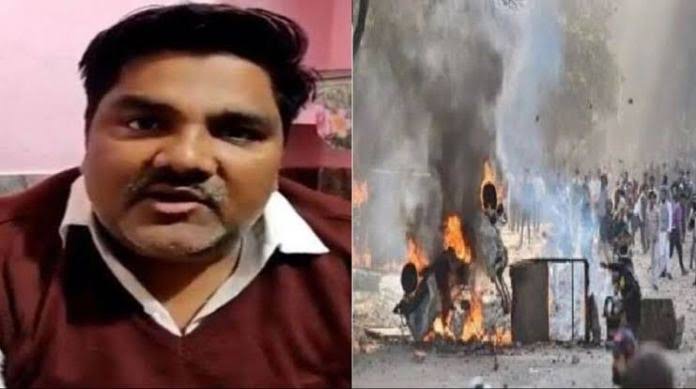
Delhi’s Karkardooma Court on Tuesday summoned the Special Director of Enforcement Directorate (ED) over the non-appearance of Prosecution in a money laundering case against Aam Aadmi Party’s former Councillor Tahir Hussain.

This case is related to the North-East Delhi Riots of 2020.

Additional Sessions Judge (ASJ) Amitabh Rawat summoned the Special Director of ED in person on December 8, 2023. The court said, “Previously also, there was non-appearance on behalf of the prosecution in the Court to file reply and supply of application/judgments/arguments. Though it was stated that such a thing would not happen again, however, it has again happened.”

The court noted that there was a direction to provide an advance copy to the counsel for the accused. However, neither an advance copy has been supplied nor even a reply has been filed in the Court. “In these circumstances, let the Special Director (Directorate of Enforcement) appear in person on the next date on December 8 at 2.00 PM,” ASJ Rawat ordered on December 5, 2023.

The court also directed to produce accused Tahir Hussain physically from Judicial Custody on the next date. The court passed the order while dealing with an application moved on behalf of Tahir Hussain. He had moved an application on November 18, 2023, for which the prosecution had sought time to file a reply.

His counsel advocate Naveen Kumar Malhotra submitted that he has not been provided with any advance copy of the reply of the said application. The court noted that the IO was not present in the court nor was anybody on behalf of the prosecution. “It is already 12.30 PM. The court has waited for around half an hour since 12 PM for somebody to appear on behalf of the prosecution,” the court observed.

On January 11, 2023, the court framed the charges against ex-MCD councillor Tahir Hussain in a money laundering case. He has been charged with the offence of funding the Delhi riots of 2020 through laundered money. He has not pleaded guilty and claimed trial.

The Delhi High Court had dismissed his plea challenging the trial court order framing of charges in a money laundering case. Earlier, the trial court had passed the order on framing of charges against Tahir Hussain and said, “Tahir Hussain, in a conspiracy to fraudulently withdraw money from the accounts of certain companies owned or controlled by him through bogus and malafide transactions with bogus entry operators on the strength of fake bills with him being the beneficiary and with intent putting it to use towards riots, then accused Tahir Hussain would be set to be deriving or obtaining property as a result of criminal activity associated with/relatable to the scheduled offence as the proceeds of crime and will be guilty of money laundering.”

Tahir Hussain is an accused and facing several cases in relation to North East Delhi Violence. Enforcement Directorate (ED) had registered a complaint against him in connection with alleged funding of riots. His counsel had submitted that no case of money laundering was made out against his client. He had argued that the basis of the Enforcement Directorate case is the alleged transaction of Rs. 1.5 crore on fake and bogus invoices.

He argued that in the light of the said transaction, only a case of GST is made out against him for transactions through fake and bogus invoices. According to the Delhi Police, Tahir Hussain is one of the prime accused in connection with North East Delhi Violence held in February 2020.

ED had registered a complaint against him and other accused in the Prevention of Money Laundering ( PMLA) Act.

(This news report is published from a syndicated feed. Except for the headline, the content has not been written or edited by OpIndia staff)

Did you know: 3,500 temples were demolished, and 2,400 Hindu women were raped in Bangladesh on suspicion of Babri demolition 2 years before karseva

December 6, 1992 – This is the date when Hindu organizations mark ‘Shaurya Diwas’. However, on this very day, the anti-Hindu ecosystem tries to make Hindus feel that they have destroyed the place of worship of another religion.

The truth is that that disputed structure was built by Islamic invaders after demolishing the Ram Temple. This same leftist-liberal gang forgets what was happening during this time in Bangladesh when Hindus were struggling for Ram Temple.

When the struggle for the Ram temple was underway in India and mere rumours about the demolition of the disputed Babri structure had spread (long before the demolition itself), violence against Hindus had already started in Bangladesh.

Hindus fought for 5 centuries and obtained the right to the Ram Temple through judicial means, but the Islamist crowd did not follow rules and regulations.

2nd November 1989 – This was the day when symbolically the first stone for the Ram Temple was laid at the disputed site. As soon as the news reached Bangladesh, violence began.

In October 1990, 26 months before the demolition, a rumour was spread by the media of Bangladesh that the disputed Babri structure had been demolished in India.

The media there also played a big role in this. The atmosphere in Bangladesh at that time can be understood from the fact that in 1988, the then-dictatorial President Hussain Muhammad Ershad declared Islam as the official religion of Bangladesh. Now comes the day of 30th October, 1990.

Irshad was addressing a youth conference at ‘Bang Bhawan’ that day. He was saying that while he is there there will be no violence against minorities.

At the same time, a mob of fundamentalist Muslims was attacking Hindu shops. The mob targeted Gauri Math, which was situated to the south of ‘Bang Bhawan’, that is, at a distance of a few kilometres from Ershad’s programme.

Properties belonging to Hindus were being set on fire. The ‘Human Rights Congress for Bangladesh Minorities’ (HRCBM) said in its report that all this happened in front of the police administration.

The report said that the violence against Hindus in Bangladesh in 1989-90 cannot be called a riot because it was carried out by a single party, like in 1964.

The then-ruling parties were also involved in these atrocities. In 1992, Jamaat-e-Islami, an ally of the ruling party BNP (Bangladesh Nationalist Party), was itself involved in the violence.

The report states that in 1989-90 alone, more than 1000 women were raped, hundreds of temples were demolished and houses of Hindu minorities were looted and set on fire.

On the night of 6th December 6, 1992, terror was unleashed on Hindus in Chittagong. 3 children were burnt alive in Qutubdia. After this, violence spread in the capital Dhaka and other parts of the country.

HBCUC (Hindu, Buddhist, Christian Unity Council) visited the ground and prepared a report and ascertained the damage. This report revealed that 28,000 houses, 3,500 temples/religious institutions and 2,500 commercial establishments of Hindus were either damaged or completely demolished.

Not a single Hindu shop was left in Shankhari Bazaar in Old Dhaka. In Sylhet district, the minorities were treated so badly that many of their future generations will remember this. Taufeed Ahmed, the then MP from Bhola and Narul Islam Nahid, Secretary of All Party Alliance, believed that the figures given above were less. Meaning the atrocities were more than this. The women were not only gang-raped but were also forced to walk naked on the streets.

Many underage girls were also raped, including girls as young as 5 years old. In some villages, no woman aged between 5 years and 70 years was left behind.

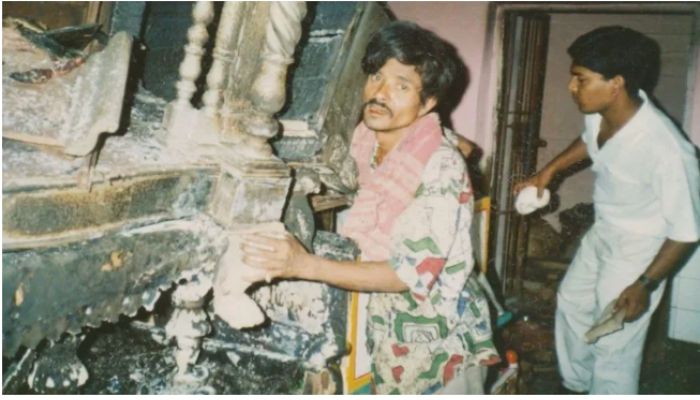
Taslima Nasreen has also mentioned in her novel ‘Lajja’ how the Dhakeshwari temple was attacked in 1992. The main temple was burnt.

The ‘Natmandir’ built for the entertainment of Gods and Goddesses was also set on fire. Sridam Ghosh located near the temple was also burnt.

Madhav Gudiya Math was also demolished. Jayakali temple was also not left out. Everything was destroyed after entering the premises of Brahmo Samaj.

Shoni Akhara temple was looted in Demra. There was devastation as far as the eye could see in Brihabhadra and Loki Bazaar. Shops selling umbrellas and jewelery were looted on Islampur Road. 300 terrorists together targeted 25 houses. The names of many Hindu shops were replaced with Urdu names.

Writer Taslima Nasreen has mentioned these incidents in ‘Lajja’. She writes how a sweet shop named ‘Moro Chand’ located on Nobabpur Road was demolished. Also, in the temple of Maa Kali located in Rayer Bazar, her statue was broken and thrown on the ground.

The Battali temple in Thathri Bazaar was destroyed and looted. Shops like ‘Kamdhon Poshari’ and ‘Shukla Mishthan Bhandar’ were looted in Nobabpur. A factory of Jatin & Company was set on fire.

Ratan Shankar Bazaar located on Sodorghat Road was destroyed. Similarly, the temple of Nag Devta was reduced to dust. Taslima Nasreen writes that these were not riots, because in a riot both sides fight.

Whereas this was oppression by one community on another community. Have you ever seen those who make a hue and cry about Babri mentioning this destruction? The Islamic mob that created havoc in Bangladesh in 1989-92 and tortured Hindus – why is this not talked about?

Durga Temple located on Lalbagh Road, Girigovardhan Jeetu Temple located on Pushparaj Saha Lane, Raghunath Jiu Akhara located on Harnath Ghosh Lane and Kamrangichar Crematorium located on Lalbagh – all of them were destroyed in 1990 itself.

Thousands of Muslims marched towards the Indian Embassy. The same India had given Independence to Bangladesh. During that time 14 temples were demolished in Sutrapur. 17 Hindus were stabbed in Beltoli Lane of the city.


‘I regret it’: DMK MP Senthilkumar expresses regret in Parliament for ‘Gaumutra’ remark after backlash, asks for the comment to be expunged

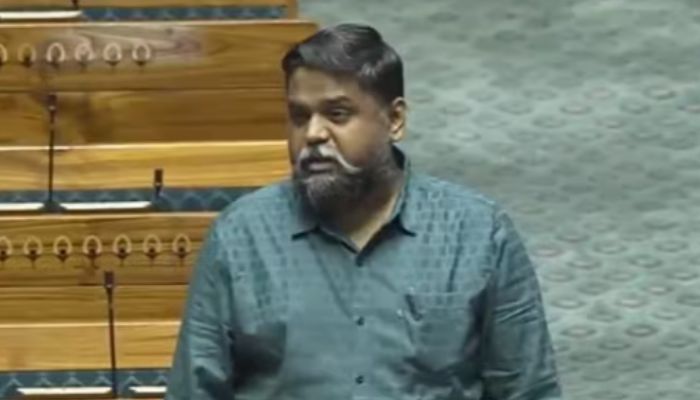
DMK MP Senthilkumar who stroked controversy a day earlier by making a pejorative ‘Gaumutra’ comment in Parliament, expressed regret for what he calls were “inadvertent remarks”. After facing backlash for his controversial statements in Parliament and issuing a half-hearted apology on Twitter, the DMK leader stood in Lok Sabha and withdrew his commentary. He also requested the Lok Sabha speaker to expunge his hurtful comments adding that he apologises if it hurt the sentiments of the people.    

“The statement made by me yesterday inadvertently, if it had hurt the sentiments of the Members and sections of the people, I would like to withdraw it. I request the words to be expunged…I regret it,” the DMK leader was quoted saying by News agency ANI. 

Reacting to his apology, Lok Sabha Chair Kirit Solanki noted that the hateful comments were already expunged from the House proceedings. 

Meanwhile, earlier on Tuesday (5th December), hours after throwing the Gaumutra jibe at the Hindi heartland states in Lok Sabha, DMK MP Senthil Kumar had made a half-hearted apology for his comments. Taking to X, he claimed that he did not use the term with ‘any intent’.

He tweeted, “Commenting on the results of the five recent state assembly elections, I have used a word in an inappropriate way. Not using that term with any intent, I apologize for sending the wrong meaning across.”

Pertinent to note that minutes after posting this lame apology, the DMK MP from Dharmapuri, Senthil Kumar was seen brazening his remarks out before media channels. 

When asked about what he meant by Gaumutra states, Senthil Kumar said, “See you look at the statement as such and then you come into things. I said they are very good at election manoeuvring. They are very good at where their strength is. They are good in the Hindi heartland. They are good in the Gaumutra states. But they cannot enter into four southern states because our principles and ideologies are different. So it is just basically meant to make an ideological statement about what they are good at and where we are. It is always said that unity in diversity is what we look at.”

Notably, the DMK leader has a history of taking Gaumutra jibe in the parliament house. He also cited that there was no outrage on the last occasion when he did so. He then used this argument to support his current insensitive remarks for which he has now expressed regret after facing massive backlash for his Hinduphobic remark. 

Further advancing in support of his statement, Senthil Kumar tried to give it an ideological cover by saying that the Gaumutra term (meaning cow’s urine) used by him has nothing to do with cows. 

He said, “I am not saying anything related to cows. It is only the principles and the ideology which you say. Gaumutra doesn’t translate into a cow. It doesn’t just translate into a sacred animal thing which people are saying. There is much more to it. There is a much more scientific and radical thing to it. It is not just what people want to interpret certainly. It is not the BJP that has made a thing out of it. Because there are other people in the house. It has got nothing to do with the alliance partners and the election results in the Hindi states. Elections are fought on certain principles and ideologies.”

A repeat offense of ‘deliberate’ utterance of ‘Gaumutra’ jibe popularised by Pulwama terrorists to dehumanise and mock Hindus

Evidently, on 5th December, the DMK MP from Dharmapuri Senthil Kumar made the pejorative ‘gaumutra’ remark to mock the Hindi-speaking states in the Northern part of India. While addressing the Parliament on ‘The Jammu and Kashmir Reorganisation (Amendment) Bill 2023’, the DMK leader referred to states in the Hindi heartland as “Gaumutra states”. 

He said, “The people of this country should think that the power of this BJP is only winning elections mainly in the heartland states of Hindi, what we generally call as the ‘Gaumutra states’.”

Previously, in February 2022, he mocked the BJP government by making the Hinduphobic ‘gaumutra’ comment in the parliament. In his speech on the Motion of Thanks to the President, Senthilkumar said that if the government at all wants to implement the National Education Policy, it should do it in their ‘Gaumutra’ states.

Furious over the execution of the National Education Policy in the state of Tamil Nadu, he had said, “According to NEP, gross enrollment ratio has to be 50% which Tamil Nadu has achieved long ago. If they want to implement this policy, they should implement the Dravidian model for the development of the country. Why is their policy being thrust upon us? We reject it. If they want to implement it, they should do it in their Gaumutra States.”

It is worth noting that the ‘Gaumutra’ jibe has been used by Islamists and their apologists as a racist, derogatory slur against Hindus. The Pulwama terrorist Adil Ahmed Dar had also said that he killed the CRPF soldiers to kill those who ‘drink cow urine’, to mock Indians, especially Hindus. 

In 2019, a Pakistan-backed Jaish-e-Muhammad terrorist in a suicide attack had killed as many as 40 CRPF soldiers in Pulwama. Following the attack, a video was released in which the terrorist Ahmed Dhar could be heard saying he wanted to punish and kill the ‘cow urine drinkers’ in the name of Allah.

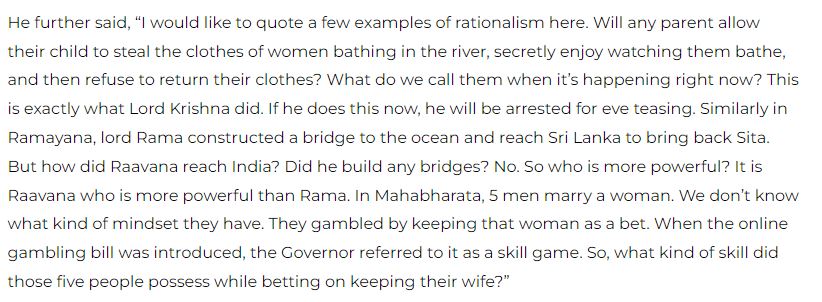
Earlier in May, the same MP had made derogatory remarks on Hindu gods and beliefs. Speaking at a Dravidar Viduthalai Kazhaagam, he had made derogatory comments on Krishna, Mahabharat, etc. He had also said that the people in BJP-ruled states have no brain.

Senthil Kumar’s comments on Hindu gods in May 2023

Furthermore, apart from the Hinduphobic ‘Gaumutra’ remarks, several old videos of DMK MP Senthilkumar have also resurfaced on the internet in which he could be heard mocking and abusing Hindu deities Shri Krishna and Shri Ram, Hindu epics Mahabharat and Ramayana as well as Hindu rituals. 

Love Jihad in UP: Dalit girl kidnapped, compelled to eat beef and converted to Islam by Shoaib

0

A case of love jihad has come to light in the Hardoi district of Uttar Pradesh where a man named Shoaib is accused of the forceful conversion of an 18-year-old Dalit girl to Islam. Her father disclosed that the victim suffered from sexual abuse and was force-fed beef. On 4 December, authorities informed that a case had been registered and an investigation was underway. Notably, women are also named among the perpetrators.

The instance is reportedly from a village in the Sursa police station neighbourhood of the Hardoi district. On 17 June the accused who is a resident of the Firozabad district abducted the girl from Sonepat. The family members searched for her but failed to find their daughter. Her father works in a factory in the Sonepat district of Haryana to support the family.

However, on 3 December she returned to her Hardoi hamlet on her own and revealed that the offender took her to Firozabad where she was compelled to embrace Islam and consume beef. Furthermore, she was forced to marry him after which he sexually violated her. Shoaib and his entire family subjected her to both physical and mental torture. The girl discovered an opportunity on 3 December and went to her aunt’s (mother’s sister) house first before returning to her village. She then narrated the entire ordeal to her family.

The culprit and his family began looking when they couldn’t find her inside the house and arrived at Hardoi. After a while, they forcefully started to take the teenager away from her home which led to a dispute between the two sides. The locals called the police on 112 to complain about the same. The cops immediately reached the location and arrested three persons who were arguing while other individuals fled from there after they saw them.

The police launched a case against Shoaib, Najma Khan, Aqib, Reshma and Mehraj along with five other unidentified people on the complaint of the victim under various sections of the Indian Penal Code, Scheduled Castes and the Scheduled Tribes (Prevention of Atrocities) Act and the Uttar Pradesh Law Against Religious Conversion Act. Three offenders are already in police custody.

According to Nripendra Singh, Additional Superintendent of Police of Hardoi the matter is being probed and appropriate legal action would be taken taken. He added that the police at present are searching for the absconding offenders.

National level athlete to Lawrence Bishnoi’s ‘manager’: Who is gangster Sampat Nehra who killed Rajput Karni Sena leader Sukhdev Singh Gogamedi

On Tuesday (December 5) Rashtriya Rajput Karni Sena leader Sukhdev Singh Gogamedi was shot dead by unknown assailants in Rajasthan’s Jaipur. After the killing, the Rajput community called a ‘Bandh’ in the state. It has now been reported that gangster Sampat Nehra who is currently lodged in Bathinda Jail masterminded the murder plot. Sampat Nehra is said to be an ally of gangster Lawrence Bishnoi. Reportedly, around ten months ago, Rajasthan Police had received information regarding conspiracy to kill Sukhdev Singh Gogamedi.

Once a national-level decathlon athlete, Sampat Nehra turned to the criminal world and became a dreaded gangster. During his college days, Nehra met Lawrence Bishnoi and the duo soon became good friends. It is said that after becoming a gangster, Bishnoi blindly trusted Nehra. He is seen as Lawrence Bishnoi’s top henchman. Sampat Nehra has been involved in numerous gang wars, weapon supply, and carrying out Hawala transactions.

Much like Lawrence Bishnoi, Nehra also controls a crime ring from behind bars. Sampat Nehra was tasked with finding fresh recruits for the Lawrence Bishroi gang and providing them with firearms. In a certain sense, Sampat Nehra is the ‘ manager’ of the Bishnoi gang. When he was released from prison he would commit crimes. Subsequently, he changed his name and fled to South India. He was apprehended for plotting to murder actor Salman Khan, whom Lawrence Bishnoi had earlier threatened multiple times.

Sampat Nehra is from Raigarh, Rajasthan, and his father, Ramchander, was an ASI in the Chandigarh Police. His youth was spent in Punjab. At Punjab University, he met Lawrence Bishnoi. In DAV College, he was Bishnoi’s junior. He won silver in the Decathlon Hurdle Race at the national level. Lawrence Bishnoi had founded a group in college called the Student Organisation of Punjab University (SOPU) which was headed by Sampat Nehra. He was arrested for the first time in 2016 for car robbery.

Notably, many extortion-related cases have been filed against Sampat Nehra. There are 25 cases registered against him, of which 12 are murder cases. He has a reward of Rs 2 lakh on him. Moreover, Nehra’s criminal activities were primarily centred in three states: Punjab, Rajasthan, and Haryana. Sampat Nehra also reconnoitred Salman Khan’s residence in Mumbai. It is said that Nehra had tasked Lawrence Bishnoi with assassinating Salman Khan. He also gave Rs 4 lakh to buy the rifle which would be used to kill the actor. 

Nehra was staying in Telangana under a false identity while conspiring to kill Salman Khan, however, before he could execute his plan, Haryana Police arrested him. Lawrence Bishnoi had threatened a bookie saying “I will chew you raw,” and his name had also surfaced in connection with the murder of Punjabi rapper/singer Sidhu Moosewala. In these cases, Delhi Police apprehended and questioned Sampat Nehra. It is said that some other Punjabi singers are also on the target of the Bishnoi gang. Sampat Nehra was previously imprisoned at Delhi’s Mandoli jail, where he said there was a threat to his life, before being transferred to Tihar.

Several other criminals belonging to the Lawrence Bishnoi gang are also imprisoned at Bathinda. In addition to the twelve murders, Nehra also has six cases of culpable homicide and five cases of dacoity registered against him. Moreover, three extortion cases have been filed against him. Sampat Nehra, arrested from Cyberabad, is also wanted in the murder of history-sheeter Ajay Jaitpura in Sadulpura court premises of Rajasthan on January 17, 2018. It took several days and painstaking efforts for the Haryana Police to arrest Nehra.

Haryana Police had to camp in Telangana for 15 days to arrest Nehra. The operation lasted three days. Nehra had taken a flat in Hyderabad with two MBA graduates. He has also admitted that he was involved with eight attempted murders. He was expanding his network in Gurugram by establishing a base in Manesar. He had banded up with Anil Chippi and the Kala Jatheri gang. He had plotted to depose the Kushal and Amit Dagar gang, who wielded power in Gurugram.

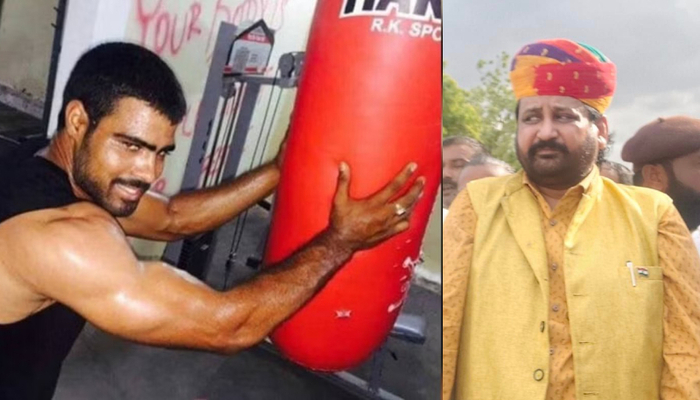
Sampat Nehra had pleaded in court five years ago requesting a bulletproof jacket for himself. He has stated that rival gangs may assassinate him. The court had directed the police to ensure security measures for him. When wrestler Suhail Kumar was imprisoned in Mandoli in a murder case, Sampat Nehra had claimed that his life was in danger. He was relocated at that point. Now he’s back in the news for the assassination of Karni Sena President Sukhdev Singh Gogamedi.

The police have detained Rohit Rathod, a resident of Jhotwara, Jaipur, in this case. He is originally from Makrana, Nagaur. Nitin Fauji, of Mahendragarh, Haryana, was also arrested. Protests are also going on in Barmer, Churu, and Rajsamand, with marketplaces being closed. As reported earlier, after breaking into Sukhdev Singh Gogamedi’s house in Shyam Nagar, Janpath and conversing with him, the assailants abruptly fired 17 shots in 20 seconds, inflicting fatal wounds on the Rajput leader. Sukhdev Singh was rushed to Metro Mass Hospital in Jaipur following the incident. However, he was declared dead by doctors at the hospital. Along with Sukhdev Singh, one of his associates has also received critical gunshot wounds.

BJP lodges police complaint against TMC leaders for insulting PM Narendra Modi and Home Minister Amit Shah

On 5th December, Bharatiya Janata Party (BJP) leader Suvendhu Adhikari said in a post on X that two FIRs had been registered by BJP’s Malati Rava Roy and Sikha Chatterjee for insulting Prime Minister Narendra Modi and Home Minister Amit Shah.

He said, “The TMC thieves had the audacity to try and smear Hon’ble PM’s & Hon’ble HM’s reputation by hurling all kinds of abuses and engaging in name-calling within the WB Assembly Premises. Two FIRs have been registered by Smt. Malati Rava Roy & Smt. Sikha Chatterjee in this regard. I am sure Mamata Police won’t lift a finger and take any action to bring these miscreants to justice. I would like to assure all these offenders, one day all of you will be taken to the task for this disrespectful behavior. Just wait for the day. Till then remember one thing; when you spit at the moon, it falls back on your face!” (sic)

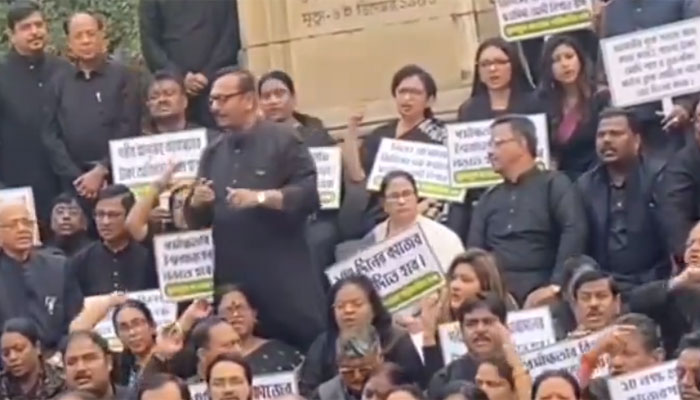
In her complaint, Roy said that on 20th November, TMC leaders were sitting on the premises of the Assembly House and protesting against the Central Government. During the protest, Ashima Patra and Mosaraf Hussain of TMC allegedly raised derogatory slogans against PM Modi and HM Shah. She added that other MLAs also joined them in raising the slogans. Roy named 60 MLAs in her complaint. She further alleged that the ‘criminal activity was conspired by Aroop Biswas, Janab Firhad Hakim and Chandrima Bhattacharya’.

Sikha Chatterjee filed a similar complaint against the TMC leaders. Adhikari also shared video of the derogatory slogans raised by the TMC leaders.

Complaint filed against BJP leaders by TMC

On 4th December, State Minister Chandrima Bhattacharya filed complaints against BJP leaders for wearing T-shirts with alleged derogatory remarks against West Bengal Chief Minister Mamata Banerjee. She claimed that BJP lawmakers undermined the dignity of West Bengal and its residents.