Home Blog Page 3654

Gharwapsi in Karnataka: Nine members of a Christian family revert to Hinduism in Jannapur’s Rama Bhajan Mandir

0

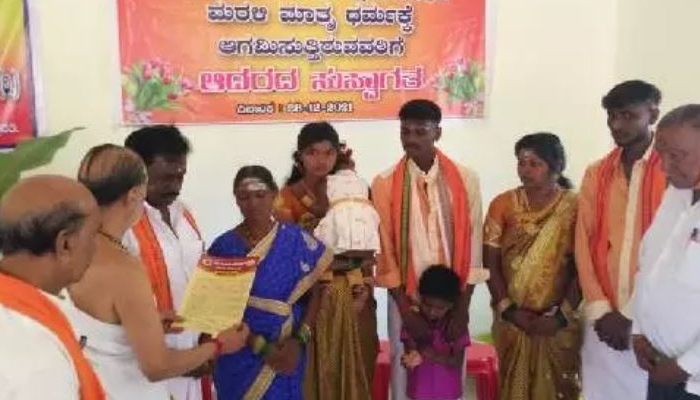
On Sunday, nine members of a Christian household re-converted to Hinduism. At an event at the Rama Bhajan Mandir in Jannapur, VHP and Bajrang Dal members took the initiative to convert them to Hinduism as part of ‘Gharwapsi.’ The development comes days after the Karnataka Government passed the Anti-Conversion Bill in the Legislative Assembly that provided for jail terms for those engaging in mass religious conversion.

Jayasheelan, his wife Jayamma, their sons Prabhakaran and Prakash, and their daughters-in-law Lalita Prabhakaran and Shwetha Prakash, all of Antaragange, are amongst those who have re-converted. Elumalai, Jayasheelan’s father, turned to Christianity 35 years ago but the family had continued to practice the Hindu religion.

Rajavan Vadivelu, a Bajrang Dal leader from Shivamogga and one of the organisers, said that more families are wanting to return to the folds of Hinduism.”These families were converted to Christianity many years back, and they wanted to return to Hinduism. But they had some kind of fear about the society accepting them and what the Christian community might think of them. So, we were in touch with them for the past six months and talked to them following which they were re-converted to Hinduism on Sunday. There are around 100 people who wish to reconvert, we are in touch with them and they will also return to Hinduism very soon. We will organise a grand event for their conversion,” said the BD leader.

On November 28, 23 persons from five Christian families in Karwar’s Haliyal taluk converted to Hinduism. Anant Kumar Hegde, MP for Uttara Kannada, presided over the occasion.

Reconverting Hindus the only option left for Hindus, says BJP leader Tejasvi Saurya in an event in Karnataka

Speaking at an event in Karnataka’s Udupi on December 25, the Bharatiya Janata Party (BJP) leader and Bangalore South MP Tejasvi Surya had said that, “The only option left for the Hindus is to re-convert all people who have gone out of Hindu fold. This does not come to us naturally but today we must evolve. This metamorphosis must come in our DNA.”

The BJP leaders remark snowballed into a major controversy following which he retracted it. “At a program held in Udupi Sri Krishna Mutt two days ago, I spoke on the subject of ‘Hindu Revival in Bharat’. Certain statements from my speech has regrettably created an avoidable controversy. I therefore unconditionally withdraw the statements”, Tejasvi Surya Tweeted.

In October this year, Karnataka’s BJP MLA Gulihatty D Shekhar had initiated the campaign to bring those who were converted into Christianity back into the Hindu fold. Talking about the systematic process these missionaries follow to forcefully bring people into the folds of Christianity, the MLA had revealed that his own mother was influenced and converted to Christianity by the missionaries. Gulihatti Shekhar had stated that she has been told by the missionaries not to apply Kumkum or Tilak on her forehead. So much is the extent of brainwashing and influence that his mother now does not want to even look at the idols of Hindu Gods and Goddesses, the MLA had said then.
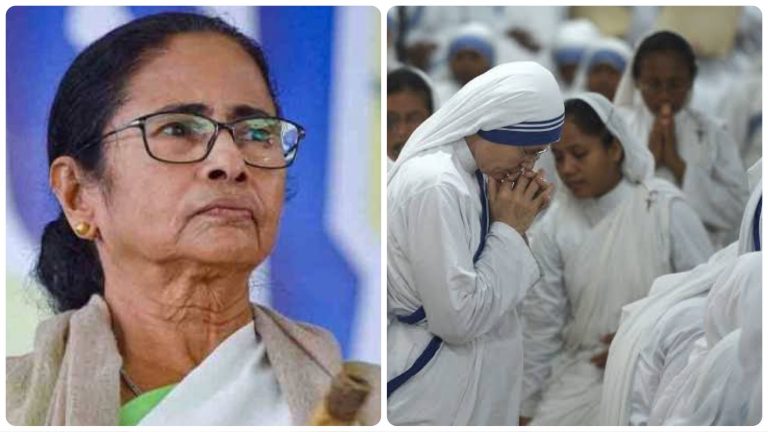
Missionaries of Charities itself says bank accounts not frozen by Centre after Mamata Banerjee raises a storm: Details

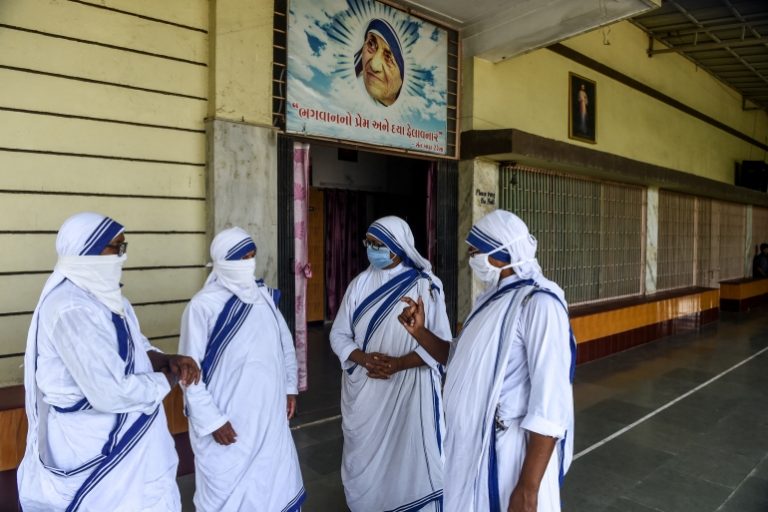
After West Bengal CM Mamata Banerjee’s claim that the central government froze all bank accounts of Mother Teresa’s Missionaries of Charity, the Ministry of Home Affairs (MHA) has stated that it did not freeze any accounts of Missionaries of Charity. MHA further revealed that it was the Missionaries of Charity people who sent a request to SBI, wanting the bank to freeze its accounts.

Additionally, MHA informed that Missionaries of Charity (MoC) was denied the permission to renew its FCRA registration under Foreign Contribution Regulation Act (FCRA) and the renewal application of MoC was rejected on the grounds of not meeting eligibility conditions under FCRA 2010 & Foreign Contribution Regulation Rules (FCRR), 2011.

After MHA, Missionaries of Charity issues clarification, says its FCRA registration has not been cancelled, suspended

The clarification from the Ministry of Home Affairs came in the wake of allegations levelled by Mamata Banerjee that the Centre had frozen the bank accounts of Mother Teresa’s Missionaries of Charity(MoC) in India. In addition to the MHA, even Missionaries of Charity have issued a statement over the matter. The group said its FCRA registration is neither cancelled nor suspended. Further, there is no freeze ordered by the MHA on any of the bank accounts, MoC said.

“We have been informed that our FCRA renewal application has not been approved. Therefore, as a measure to ensure there is no lapse, we have asked our centres not to operate any of the FC accounts until the matter is resolved,” MoC said in a statement.

Mamata Banerjee’s allegations

West Bengal CM Mamata Banerjee on Monday tweeted that the central government had frozen all bank accounts of Mother Teresa’s Missionaries of Charity in India. “Shocked to hear that on Christmas, Union Ministry FROZE ALL BANK ACCOUNTS of Mother Teresa’s Missionaries of Charity in India! Their 22,000 patients & employees have been left without food & medicines. While the law is paramount, humanitarian efforts must not be compromised,” Mamata Banerjee tweeted.

Similar claims were also made by CPI(M) state secretary and opposition leader Surjya Kanta Mishra who claimed that along with bank accounts, the government had also frozen cash in hands of the Missionaries of Charity.

Jharkhand: Dalit family forced to consume beef, ostracised by Christian villagers for refusing to embrace Christianity

The Gumla district in Jharkhand, one of the worse affected by left-wing extremism, has seen rampant religious conversion by Christian missionaries over the years, especially during the lockdown last year. The powerful Christian missionaries operating in the town threaten the poor and vulnerable locals, especially those belonging to the Scheduled Castes, with dire consequences if they do not pay heed to their demands. Many eventually, buckle under the pressure and convert to Christianity.

News 18 has reported about a group of families dwelling in the Gadtoli block, situated at a distance of 35 km from the Gumla district in Jharkhand, out of which a little less than half have been compelled to give up their Hindu Sarna faith to adopt Christianity due to the terror of the conversion gangs working in the area at the behest of Christian missionaries.

Out of the 55 families dwelling there, almost 30 families have converted to Christianity, reports News 18, which added that the conversion racket in this hamlet has been prevalent for the last 15 years.

The report further stated that now, there are these two families which are particularly being tortured to bow down to the demands of these Christian conversion gangs. One family belonging to that of a person named Salik Gop is said to have been ostracized by the Christian villagers for the last 6 months for not concurring with the demands of religious conversion. Salik Gop’s family has regularly been receiving death threats compelling them to think a hundred times even before leaving the house.

Salik Gop’s son Budheshwar, who is a paraprofessional teacher, has not been able to go for his work for the last 6 months.

Jharkhand Hindu family being forced to consume beef, barred from using the village well for declining conversion demands

Speaking to the media outlet, Salik Gop’s family claimed that, despite being a cowherd family, they are constantly pressured to eat beef. Leave alone farming, their family has been even barred from using the water from the village well. Their children have been forbidden to go to school, said Salik Gop.

The family’s entire source of income has been disrupted so that they acceded to the conversion demands of the influential Christian missionaries participating in proselytization in the area, but, Salik Gop said that no matter what happens, he will not submit to their demands.

It is appalling how these organisations have been openly running a parallel government in Jharkhand’s Gumla town for many years now. The majority of the events take place in the presence of the police administration, who do little to stop them.

Dalit woman files complaint against Christian villagers alleging torture

It may be recalled how in the month of September, OpIndia reported about a woman health worker of Jamdih village of Gumla district of Jharkhand approached the police with a complaint against the Christian villagers, accusing them of torturing her family members to accept Christianity. The complainant, who belonged to a Scheduled Caste, had also alleged that the assailants even sexually abused her daughter to mount pressure on the family to adopt Christianity. She had also said that accused persons instigated the villagers against her family.

Pune: Commissioner of Police Krishna Prakash sustains injuries while trying to catch a criminal gang

0

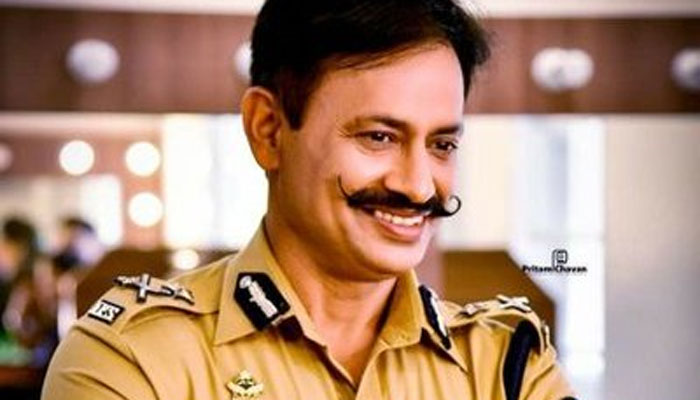
On the night of December 26, Krishna Prakash, Commissioner of Police, Pimpri Chinchwad, Pune, Maharashtra, sustained injuries while catching a three-member gang wanted in a shootout killing case. As per reports, the gang members opened fire at the police team led by the CoP.

The incident took place at around 11:30 PM on Sunday. The police team led by CoP had laid down a trap to catch the gang members based on a reliable tip-off. The Police came to know that the gang members were seen in the forest area 35 KM away from Chakan. DCP Manchak Ipper, in conversation with news agency IANS, said, “We had received a specific intel tip-off of the accused hiding in the vicinity and the police team led by CoP, an ACP, and others lay in wait for them. Suddenly, they started firing in the direction of the police party, which shot back in self-defence. There are no injuries in the firing.”

No bullet injuries, said DCP

Ipper further added that there were reports in local media that CoP and another policeman sustained bullet injuries which were not true. They both sustained injuries while chasing the criminals in the jungle. Both sides fired several rounds for over 30 minutes, after which the Police managed to apprehend the criminals.

The accused were wanted in the shootout killing of another local gangster, 37-year-old Yogesh R Jagtap. The shootout took place at Katepuram Chowk in the Pimple-Gurav area on December 18. Jagtap was a habitual criminal. He was shot four times by two assailants. So far, ten people have been arrested in the case. Further investigation is underway.

BJP formally announces alliance with Amarinder’s Punjab Lok Congress, Dhindsa’s SAD (Sanyukt)

0

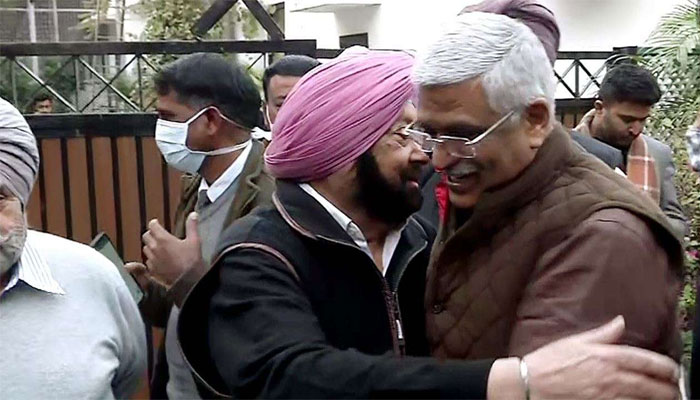
On December 27, Bharatiya Janata Party (BJP) has formally announced an alliance with Capt Amarinder’s newly formed party Punjab Lok Congress and Dhindsa’s party Shiromani Akali Dal (Sanyukt). All three parties will soon issue a joint manifesto. Union Minister Gajendra Shekhawat, the poll in charge of Punjab, said in a statement that all three parties would form a joint committee comprising of two leaders from each party to decide on the seat share for the upcoming assembly elections in the state.

While addressing the media, Shekhawat said, “A meeting attended by Union Home Minister Amit Shah, BJP president J P Nadda, Amarinder Singh and Sukhdev Singh Dhindsa was held here. And it was decided that the BJP, Singh’s party and Dhindsa’s party will jointly contest upcoming assembly polls in Punjab.”

Earlier today, Dhindsa, a Rajya Sabha MP and former Chief Minister of Punjab, Captain Amarinder Singh, had met top leaders of BJP, including Union Home Minister Amit Shah and BJP national president JP Nadda to discuss the poll strategy.

Punjab 2022 Assembly elections are going to be a nail biter

Since the last assembly elections, a lot has changed in the Political scenario of Punjab. The long term Congress leader Captain Amarinder Singh has to step down from the post of CM as the Congress’s Delhi leadership weighed on Congress leader Navjot Singh Sidhu. Singh later left the party and claimed that he felt humiliated by the way everything happened in the state. He later formed his own party and now have announced an alliance with BJP.

While BJP has faced severe backlash in Punjab in the last year due to the agriculture laws, they have joined hands with two prominent Sikh leaders in the state, it is possible that the three parties could give a promising fight to the other players.

BJP and SAD broke their long term alliance over the three agriculture laws soon after the laws were passed in Lok Sabha. Then Union Minister Harsimrat Kaur Badal also resigned from her post. SAD has now formed an alliance with Mayawati’s Bahujan Samaj Party to contest the upcoming assembly elections.

The farmer unions that protested against the three Agriculture laws for over a year have announced they would contest the upcoming assembly elections. They have also announced the formation of the party for the same. While some unions were not in favour of contesting the elections, the majority of the unions are going to show their “power” in 2022 state elections under the leadership of Balbir Singh Rajewal as CM face.

One more interesting aspect of the upcoming elections is the possibility of an alliance between the party formed by the farmer unions and the Aam Aadmi Party. In the last assembly elections, AAP showed better than expected results, and they are hoping to rise further in the state. Another important point that one must keep in mind is that the farmer unions announced their party at a very late stage. It is possible that if they contest the election in alliance with AAP, they either have to show their candidates as independent or have to fight the election under the banner of AAP.

Raid on perfume merchant Piyush Jain: 284 crores seized, ED may file money laundering case too

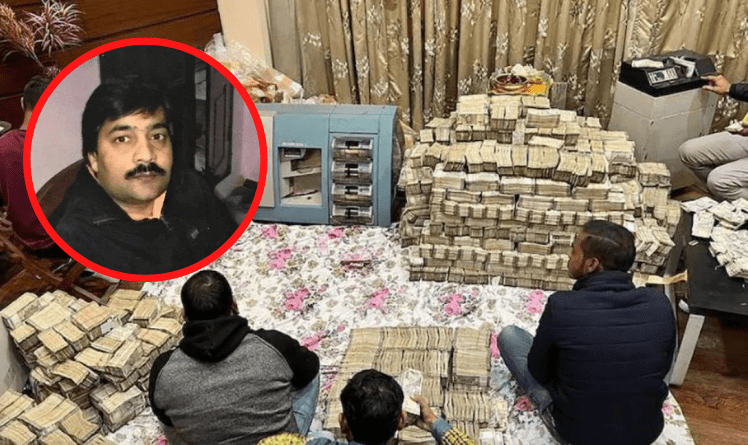
The ongoing raids conducted at the residences of Perfume Merchant Piyush Jain by the Directorate General of GST Intelligence (DGGI) and Income Tax department officials have further led to the recovery of 107 crores worth of unaccounted cash from Jain’s Kannauj House which would bring the total amount of unaccounted cash recovered during the raids to 284 crores, according to reports.

Rs 177 crores were recovered from Jain’s Anandnagar house in Kanpur, and another 107 crores were seized from his house at Kannauj, reported the Times of India.

Reportedly, the searches were conducted amidst high security in Kannuj by a combined unit of 50 tax officials from UP and Gujarat. Around 250 kgs of silver and 25kgs of gold were also seized from the residence of Piyush Jain, an alleged Samajwadi Party supporter who had earlier launched the Samajwadi Perfume.

Jain, who was arrested earlier, was brought to Kanpur’s transit court for further proceedings. As per reports, the ED may also lodge a money laundering case against the perfume baron.

Jain claims cash came from selling ancestral gold

As per reports, the unaccounted hidden fortune of cash and gold were recovered after breaking 20 locks and 15 cupboards. Officials used a gas cutter for opening up the vault. However, Piyush Jain claimed that the unaccounted money was collected through the sale of 400 kg of ancestral gold.

Tax Officials who conducted the raid informed that Jain was arrested on the account of tax evasion and creating multiple invoices using fake firms. Further according to an official, Jain said, “if you want, you can deduct the income tax and return the rest”. Piyush Jain has been booked under Section 69 of the Central Goods and Services Tax (CGST) Act. The raid on the premises of the perfume merchant went on for days, with mounds of cash being counted by multiple machines and with the help of SBI staff.

Earlier, the DGGI and the Income Tax department had raided several premises linked to Piyush Jain located in Mumbai, Kannauj and Gujarat and recovered unaccounted cash worth around 177 crores from Jain’s Kanpur residence. A total of 11 premises that belonged to Piyush Jain and his two close partners were examined by the officials during the two-day search operation. IT and DGGI officials raided the Piyush Jain’s offices which were spread across Mumbai, Gujarat, Kannauj including his petrol pumps and residences in a coordinated search operation.

Mamata Banerjee claims Centre froze all bank accounts of Mother Teresa’s Missionaries of Charity, church official reacts

The West Bengal CM Mamata Banerjee has taken to Twitter on Monday, December 27 to claim that the central government has frozen all bank accounts of Mother Teresa’s Missionaries of Charity.

“Shocked to hear that on Christmas, Union Ministry FROZE ALL BANK ACCOUNTS of Mother Teresa’s Missionaries of Charity in India! Their 22,000 patients & employees have been left without food & medicines. While the law is paramount, humanitarian efforts must not be compromised,” tweeted the West Bengal CM.

Mamata Banerjee’s Tweet came shortly after CPI(M) state secretary and Opposition leader Surjya Kanta Mishra also tweeted the same. “Yesterday,Christmas Day the Union Ministry FROZE ALL BANK ACCOUNTS of Mother Teresa’s Missionaries of Charity. The Govt has frozen all the accounts in India, including cash in hand. Their 22,000 patients, including employees, are left without food and medicines”, wrote the CPI(M) leader.

Local media house ABP Live has quoted sources as saying that all of the accounts of Missionaries of Charity have been frozen on the behest of the central authorities. Directions have been given to suspend all kinds of financial transactions taking place through all the accounts of the NGO.

Bengali ABP Live said that the officials at the Missionaries of Charity have agreed to be aware of the development but refused to divulge any details regarding the same.

Top Church official reacts to bank accounts of Missionaries of Charity being frozen

Though the reasons for the bank accounts being frozen are still unknown and there is no official confirmation about the same by the central government or the Home Ministry, Vicar General, Archdiocese of Calcutta, Fr Dominic Gomes issued a statement calling the action “a cruel Christmas gift to the poorest of the poor”.

The statement of Fr Dominic Gomes read:

In freezing the bank accounts of Missionaries of Charity Sisters and Brothers congregations, Government agencies have given a cruel Christmas gift to the poorest of the poor. Besides over 22000 direct dependants and beneficiaries at their centres across the country, MC Sisters and Brothers reach out to uplift tilousands and are often the only friends of the lepers and social outcast no one will even venture near. Overlooking the fact MCs of St. Mother Teresa give up all worldly goods, sleep on the floor and, and earn no money — giving whatever they have in service to the poorest in every corner of the earth, especially our poorest of Indians – this latest attack on the Christian Community and their social outreach is even more a dastardly attack on the poorest of India’s poor, who the MC congregation serves. We condemn the Government action against the MC and are appalled by the timing and lack of empathy to consider the humanitarian disaster this decision will cause.

Note: The bogey of “Conversion” always been raised as justification, is more than patently false, boggles the mind with its incredulity — had any Christian organisation seriously tried to “convert” with the efficiency they run their educational, medical and social intuitions; there would indeed be many more Christians converted in the 2000 years Christianity has been on Indian soil that the 2.3% minority today. Christianity, across the globe — is not defined by conversion, but by their unappalled love for their neighbour in action through their social outreach and social justice in society.

Scandals surrounding Mother Teresa’s NGO

After the Missionaries of Charity’s alleged babies sale scandal came to light in July 2018, Jharkhand CID had written to the state authorities recommending a CBI probe into alleged violations of the Foreign Contributions Regulation Act, 2010 by 88, mostly Christian missionary-backed NGOs including Missionaries of Charity.

According to reputable sources, NGOs under investigation were found to have reportedly broken many regulations. These NGOs had been reported to have received in excess of Rs 250 crore funding between 2013 and 2016 under the Foreign Contribution Regulation Act (FCRA). Moreover, there was evidence that some of these organisations were participating in proselytization.

In fact, recently, on the 14th of this month, the Makarpura police in Vadodara, Gujarat, has registered an FIR against Missionaries of Charity, an organization founded by Mother Teresa, on the charges of allegedly hurting Hindu religious sentiments and luring young girls to convert to Christianity. 

Thoothukudi people say they were cheated in the name of protests, want reopening of Sterlite Copper plant they got shut in 2018

People of Thoothukudi who actively participated in the protests that led to the closure of the Vedanta owned Sterlite copper plant now feel cheated after the shut down and want reopening of the plant, according to a Swarajya report.

As per the report, the team that visited Thoothukudi recorded the statements of various people who were involved in the protests against the Sterlite copper back in 2018 citing environmental issues. Shanmugalakshmi, a woman from South Veerapandiyapuram, Thoothukudi, who led the local families in the neighbourhoods during the Sterlite copper plants revealed how several strangers came to her village and spread propaganda against the plant that was a source of livelihood for the people.

She said that she was unaware who started the campaign against Sterlite Copper in the town but all she knew was that there was a very strong campaign against the plant which spread like wildfire. She revealed that some unknown people had come to the village and played multiple videos talking about ‘harmful effects’ of such factories. These people, she said, claimed that they would help them get rid of Sterlite. “We raised the pamphlets they gave and chanted the slogans they taught us. Only after the plant got shut, we understood that we were cheated,” she told Swarajya.

Shanmugalakshmi further lamented how Sterlite provided scholarships to children and students in the villages of Thoothukudi. She also mentioned the various social welfare and women empowerment schemes undertaken by Sterlite including medical facilities for sick people and planting trees in the city. Then Shanmugalakshmi admitted that the closure of the plant left the people helpless saying, “Now we are standing in the street like orphans without any support.”

Another woman protester named Sandanamari who was interviewed by the team regretted having participated in the Sterlite protests and closing down the very plant that supported her family. She said, “My husband used to work for Sterlite. The family was doing well till the company was operating. We unnecessarily fought against the plant and forced it to shut down. Now, my husband must go to work for wages, and it’s hard to support the family. We have two kids. They were all born here. If the allegations against Sterlite were true, then how could I and my family be still healthy? We didn’t understand this during the time of protest.”

Sandamari then added that the villagers and the people of Thoothukudi were slowly realizing that the protests against Sterlite were planned and the people were fooled in the name of protests. She further begged the authorities saying, “On behalf of the villagers, I beg the authorities to reopen the plant”.

In May 2018, Sterlite Copper plant in Thoothukudi owned by Vedanta was ultimately shut down by Tamil Nadu government following protests by the local people on the grounds of alleged environmental hazards caused by the plant. Shutdown of the Sterlite Copper plant dealt a huge blow to the the country’s copper trade and India slipped from being one of the top five exporters of the copper cathodes in 2017-2018 to become a net importer from 2018-2019.

Last month, owner of the Sterlite copper plant Vedanta had submitted an application to the supreme Court seeking permission to carry out maintenance work at the plant. Vedanta mentioned the prolonged rains in Tamil Nadu and stated that the plant “has been steeply deteriorating” after it remained in a shut down condition since Mat 2018.

What India should watch out for if the Russia Vs Ukraine war breaks out with China overseeing the fiasco

The important thing for a country to grow economically is to have buffer states between itself and its competitors. The Greeks, the Romans, USSR and even the USA always made sure either it has healthy relations with its neighbours or has a buffer state. If India wants to grow economically into a superpower, it has to think of such policies from now on.

Invasion of India has always taken place either from the west through the Hindu Kush (Hindu blood) mountain pass or from seas, but in modern times, our coastlines are safe while our neighbour in the west i.e. Pakistan, is no competitor so far as economic growth and being a superpower is concerned. The competitor lies in the north- the Chinese dragon, and unfortunately, the region that could have played the role of the buffer state, Tibet, is under Chinese occupation.

In 1720 the Qing Dynasty from Beijing invaded Tibet along with the greater eastern inner Asia and defeated the Dzungar Khanate. This was the first time the middle kingdom or “Zhongguo” took over the Mahāyāna Buddhism and all its influence throughout Central Asia. Some centuries later, another Chinese “Butcher” emperor Mao Zedong took over Tibet because of the fear that religion was the “opium of the masses”. The “Butcher” and all his successors had one nightmare – the rise of Dharma can bring down their empire of blood. 

Till today more than a million Tibetans have been butchered by the evil CCP dictatorship. Millions more are rotting in concentration camps, women are being sterilized at an unprecedented rate and much worse. Tibetans, the most hard-working people on earth, do not have a place called home and even if they do, they cannot speak or learn their own language and if they do, they are hunted.

The atrocity that CCP heaps on citizens are done while the leadership occupied chairs at the UN Human Rights Council. It is almost as if the western world, including the UN, which lectures the world about freedom and democracy, has traded Tibetan lives for cheap mobile phones and soft toys from China.

India has long acknowledged Tibet as a part of Chinese territory. The policy has not changed even in the current dispensation. However, one has to recognize that Tibet is a potent tool in the hand of India. Not just from a strategic point of view, even from an ideological and civilizational point of view of the current dispensation, a free Tibet would have been in India’s favour.

The idea of “Hindu Rashtra” has been a long-standing demand, yet to be fulfilled. What Chanakya and Chandragupta once dreamt of, was carried on by the struggle of Chhatrapati Shivaji, to the writings of Bankim Chandra Chattopadhyay, Chandra Nath Bose to the ideology of Vinayak Damodar Savarkar is yet to be fulfilled. The election of Narendra Modi perhaps gave Hindus a ray of hope after a long time.

In our quest for Hindu Rashtra, let us not forget that Hindus worship Shiva “The Destroyer” but his abode is under the occupation of the evil regime of CCP and the maintainers of that land are being persecuted on a daily basis.  To establish Hindu Rashtra, the land of Shiva “The Destroyer” must be freed from such evil atrocity.

While a direct battle with China might not be desirable, one must realise that India is in a great position today both economically and strategically. The USA based Western order is at loggerheads with the Chinese-Russian order and both have one common quest – India on their side. India because of its vast economic opportunity and its strategic location.

Today, the CCP is not the dragon we once imagined – the Wuhan Virus and eastern Ladakh standoff has shattered the myth of strong China. The USA and all its western allies are furious at China but President Biden and some of the other countries might not take China down decisively since, despite the right noises, there has been no strong policy shift.

Within four-five years the “Baby Boomer” generation of the USA is going to retire and with that, the retirees will place their assets on safe bets. Turkey is already seeing a capital outflow and crash of the Lira. If predictions are somewhat true, the US Dollar might be replaced with a Crypto-based currency as the World’s reserve currency, not entirely, but in part for sure. In that respect, India could be a game-changer. 

India’s population and the tech-informed urban population will benefit massively. Russia, which is incrementally becoming a satellite state of CCP needs India to survive, and China itself is facing shortcomings on every side, and if initial estimates are right, Evergrande, the Chinese real estate giant, can crash any day now sinking the CCP to the bottom of Gulf of Tonkin. 

China has only one option, to intimidate Taiwan and push Russia to an all-out war with Ukraine including the West. In the scenario that Russia invades Ukraine, the EU and USA will hit Russian Federation with so many sanctions that Kremlin might have to be sold brick by brick. 

Russia is desperate because of Chinese loans which account for nearly 50 billion USD, but it will not want to risk a nuclear war with the West. In any scenario, the China and Russia duo need to have India on its side, which is why, their leaders on a virtual meet on 15th December, agreed to have a trilateral talk that included India. President Putin appears to be trying very hard to mediate between Modi and Xi. In that case, the card is decked in favour of Prime Minister Modi.

If a chance arises in which Russia and China ask India to join their side or at least stay neutral India under Modi, it must push China to make compromises over Tibet. Could that moment arrive? We will have to see how geopolitics shapes in the year 2022. Who knows that this time an opportunity may come from the north, not a disaster like Covid-19?

As cryptocurrency exchanges up their PR campaign, NDTV deletes its ‘paid tweet’ encouraging people to leave their jobs to join crypto trading

After being accused of ceaselessly peddling fake news, NDTV has now been accused of luring its viewers into giving up their jobs and enlisting themselves into trading cryptocurrency, a virtual currency system that many analysts consider to be a more sophisticated version of Ponzi schemes.

NDTV, in its recent production “Coffee and Crypto”, a show in partnership with one of the popular cryptocurrency trade exchanges CoinSwitch, promoted the virtual currency system and urged its viewers to invest in the same by highlighting the story of one crypto trader whom the channel claimed had earned windfall gains through trading in cryptos.

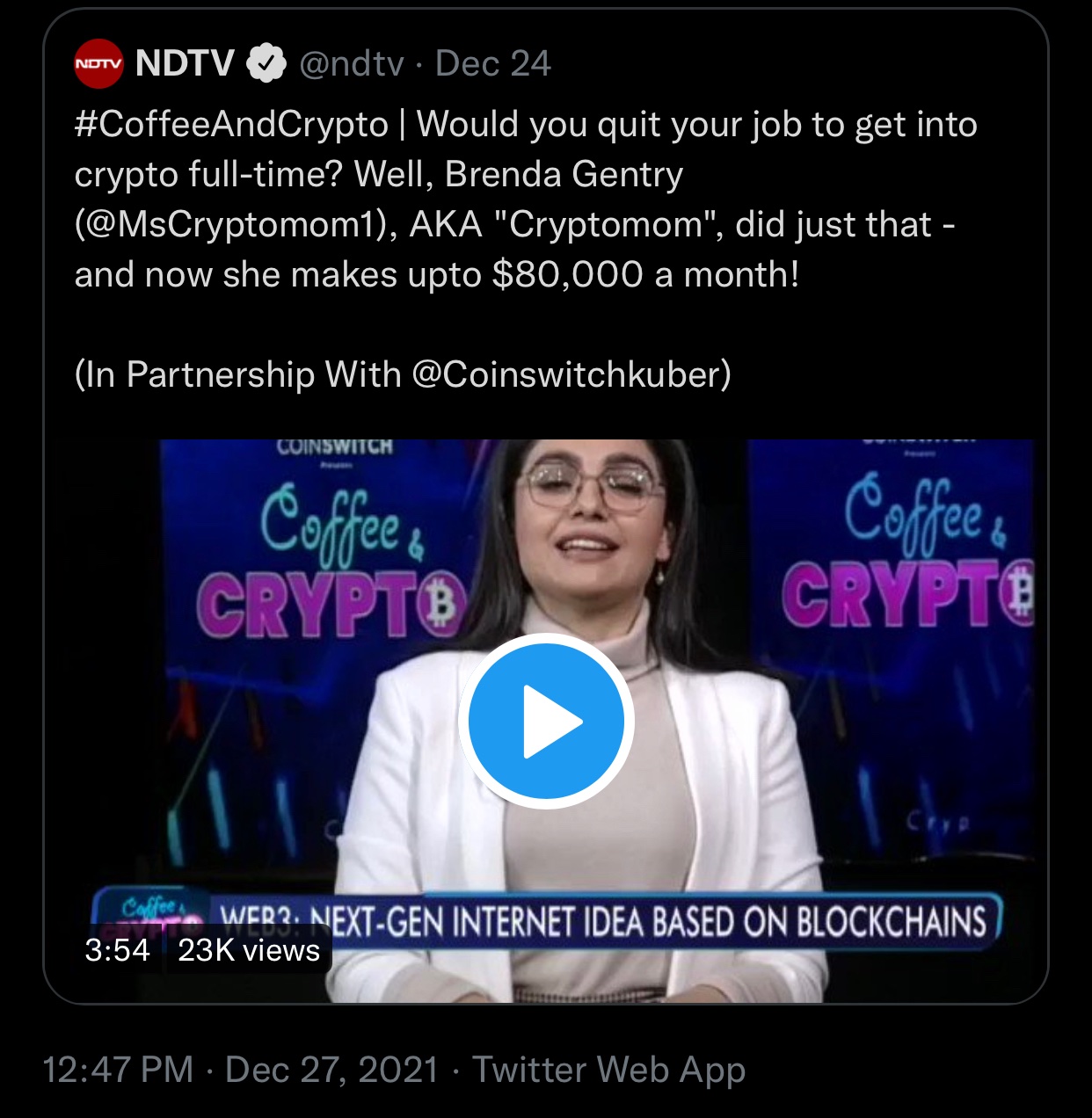
A clip of the show was shared on NDTV’s official Twitter account on December 24. In the video, the host of the show, Sonal Mehrotra Kapoor, goes on to rave about how a cryptocurrency trader, who goes by Twitter handle @MsCryptomom1, went on to make outsize earnings after leaving her job and entering into virtual currency trading full-time.

“Would you quit your job to get into crypto full-time?” Well, Brenda Gentry, (@MsCryptomom1), AKA “Cryptomom”, did just that—and now she makes up to $80,000 a month!” the NDTV tweet said along with the snippet from the show where Kapoor interviewed the said cryptocurrency trader.

Source: Twitter

NDTV deletes ‘paid tweet’ as netizens slam the channel for promoting Ponzi schemes

While the tweet was posted on December 24 and remained on Twitter for hours, it was abruptly pulled down after social media users pointed out how NDTV had been effectively urging unsuspecting viewers into leaving their gainful employment and pushing them into the uncertain world of gambling and Ponzi schemes.

“Please don’t peddle such narratives. Very dangerous,” tweeted a user who goes by Twitter handle @GabbbarSingh.

Author Harsh Madhusudhan also slammed the channel for encouraging people to leave their jobs for what he termed as “some pie in the sky quasi-Ponzi scheme.” Referring to CoinSwitch, Harsh asked, “How much did NDTV’s ‘partner’ pay for this plug?”. He also opined that SEBI, RBI, MoF and MoIB should investigate and have norms for such funding.

Others too slammed NDTV and its journalists for spurring people on to a dangerous path, asking how much the news channel got from its partner to such brazenly promote cryptocurrency.

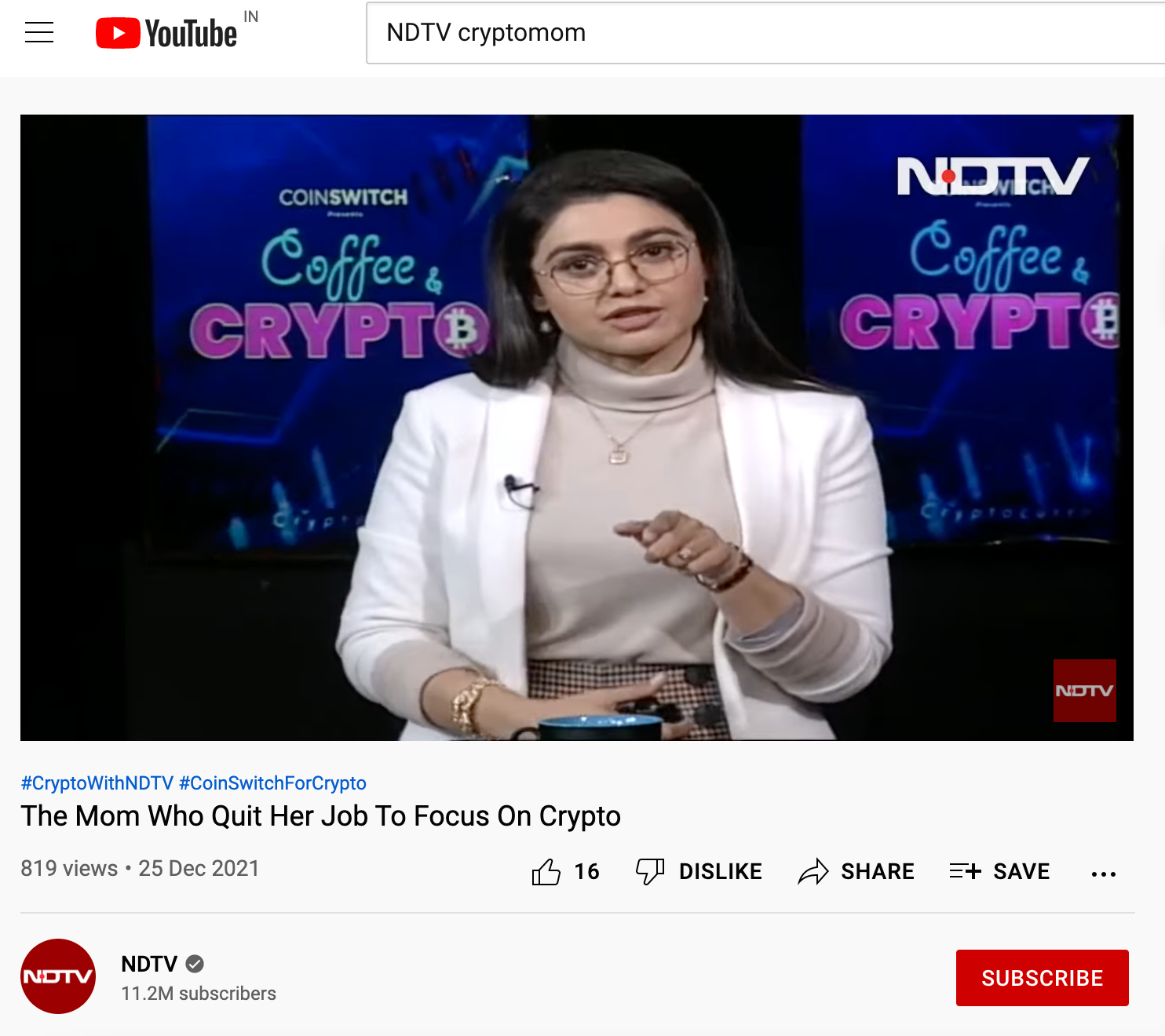
Though the ‘paid tweet’ was deleted by NDTV, the video of the entire show is still present on its YouTube channel.

Source: YouTube

Cryptocurrency exchanges up their PR campaign amidst uncertainty of their future in India

NDTV’s seemingly paid promotional campaign for cryptocurrency comes in the wake of an intensified PR campaign headed by various cryptocurrency trade exchanges as the Supreme Court and the Central government mulled over the decision of banning them or bringing in some kind of regulation to supervise the virtual currency system in the country.

As their fate hangs in balance, cryptocurrency exchanges currently active in the country have upped their PR campaign. They have been vigorously promoting themselves, sending out a message that their trade exchanges are completely safe, widely used and secure for investments. Notable personalities such as Ayushmann Khurrana, Amitabh Bachchan, Ranveer Singh, Janhavi Kapoor, Disha Patani and other actors have been roped in by various crypto exchanges to get more customers on their platform and possibly use them as leverage to influence the Centre and the top court’s stance on the matter.

Even though cryptocurrency companies paint a rosy picture of themselves, it is worth noting that investing in virtual currency is fraught with danger as fluctuations in cryptos are quite frequent and massive, capable of completely annihilating the hard-earned savings of investors. There are several challenges cryptocurrency poses, some of which are listed below.

Challenges posed by cryptocurrencies

The advent of cryptocurrency has brought with it a unique set of challenges. The most potent of them is the dilemma surrounding the legality of these digital currencies. 

Banks have been reluctant to let their customers deal with cryptocurrencies due to the uncertainty regarding the legitimacy of the virtual currency market. That concern among banks was somewhat assuaged after the RBI asked banks not to cite its 2018 order as a reason to deny banking services to customers who dealt in cryptocurrencies. RBI had stated that their 2018 order had been set aside by the Supreme Court of India.

In its April 2018 order, RBI had directed banks to make sure customers dealing in cryptocurrencies were not allowed access to banking services.

However, despite the apex court’s softened stance on cryptocurrencies, challenges still exist. One of the major concerns that have a significant impact legitimising the digital currency system is the volatility in several cryptocurrencies. Over the past several months, cryptocurrencies have proven to be extremely volatile, engendering concerns of wealth erosion and other risks involved in the trading of digital currencies. 

The illicit use of cryptocurrencies by criminals, most notably hackers and extortionists, have also sparked concerns among Indian authorities regarding its exploitation by offenders. The inherently decentralised nature that makes it difficult for government authorities to regulate has also added to the concern about cryptocurrencies. 

Cryptocurrency transactions are normally irreversible. In many of the transactions after a number of blocks, the transaction is confirmed. Therefore, if fraud is committed, it would be practically impossible to reverse the transaction. The lack of control over cryptocurrencies would mean the government will not be able to address the grievances of victims.

Traditional financial products usually have strong consumer protections. However, if any cryptocurrency is lost or stolen there is no intermediary with the power to limit consumer losses.

This is one of the reasons why not just the Indian government but governments of other countries have also taken a cautious approach towards cryptocurrencies, fearing their lack of central control and the ramifications they could have on the financial security of the country.

Other arguments that challenge the viability of cryptos include the security risk they entail, along with the lack of solution when it comes to ensuring its effective inheritance. There are also misgivings about possible asset bubbles around such currencies due to over-leveraging with possible newer types of derived products.