Home Blog Page 6849

Violence at Bulandshahar, Uttar Pradesh: Here is all that has happened so far

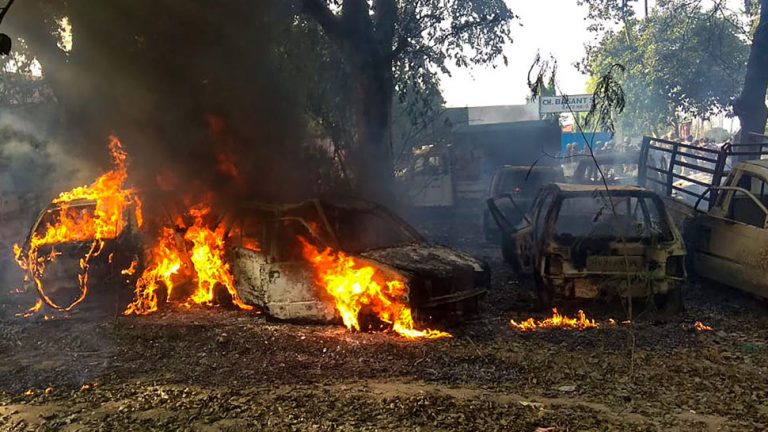
Bulandshahar has turned into a violent tinderbox after carcasses of cows were allegedly discovered by Hindus. As we have reported earlier, the Police allegedly turned a blind eye to people’s complaints following which the protesting crowd turned violent.

As per reports, protesters had gathered outside a police station claiming that they had discovered carcasses of cows in their locality. Angered with police inaction even after repeated complaints, they clashed with the police.

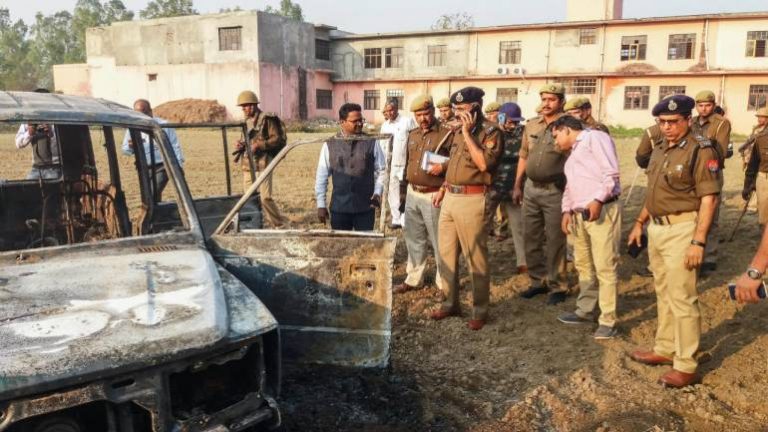
The police, as per reports, opened fire at the protesters. It is claimed that the police was forced to open fire after the protesters attacked them with stones. In the chaos, inspector Subodh Kumar Singh lost his life. A youth, Sumit, too, succumbed to injuries.

As per an eyewitness account of a Policeman who was trying to help Singh, he was forced to abandon the now deceased officer to save his own life. He said, “Sir was lying near the boundary. I managed to get him into the vehicle. The moment the vehicle started to move, the mob attacked us. We could hear chants of “Catch them! Beat them!” all around us. When everyone started to flee, even I jumped off and fled. There were bullets flying around but it wasn’t reaching us.”

According to reports, two FIRs have been registered in connection with the violence thus far. One is against the alleged cow slaughter and the other is against the perpetrators of the violence.


27 people have been named in the FIR, 60 unnamed people have also been mentioned.


Prashant Kumar, ADG Meerut Zone, has stated that an SIT inquiry has been formed to investigate the violence and to ascertain why police personnel left the deceased police officer alone. Main accused, Yogesh Raj, contrary to early media reports has not been arrested or detained. He is absconding right now as per the press conference held by police.

Sub-Inspector Suresh Kumar, who was injured as well, has claimed that 300-500 people had attacked the Police Force. He told ANI, “The crowd jammed the road and started throwing stones at the Police. There were around 300-500 people. The entire police force was attacked. I got hurt myself and after that, I do not know what happened.”

There are conspiracy theories floating around as well. Some prominent persons have been alleging that the deceased police officer was murdered because he was an investigating the Akhlaq lynching case. However, the inspector, Subodh Kumar Singh was the investigating officer only till 9th November 2015. He was later transferred to Varanasi and the charge sheet was filed in March 2016 by a different investigating officer. Singh was not investigating the case when he was killed yesterday.

Today, the police has clarified that there is no merit in the allegations that the policeman was slain because of his connection to the Akhlaq case. They have also denied reports of any sort of connivance of the police as alleged by the family.

Rapid Action Force has been deployed in the area and section 144 has been imposed. According to a report by ABP News, a retired army soldier is believed to have shot inspector Singh.

Chief Minister of Uttar Pradesh, Yogi Adityanath, has announced compensation for the family of the deceased police officer. The late police officer’s wife will receive Rs. 40 lakhs as compensation, his parents will receive Rs. 10 lakhs and a kin of his will be given a government job.


A 19-year old student has also died during the violence at Bulandshahar. Sumit Kumar Dalal was pursuing his B.A. degree from Amar Singh College Lakhaoti. The young Sumit was rushed to Anand Hospital at Meerut by family and Police where he was declared dead on arrival.

A political battle has also ensued in the state following the violence. UP Minister O.P. Rajbhar, who had previously told Yogi Adityanath not divide Gods along castes after the latter’s statement was misreported by the media, has come out and said that the violence was a pre-planned conspiracy by Hindu organizations.


Controversial Samajwadi Party leader Azam Khan has asserted that the presence of cow carcasses at Bulandshahar should also be investigated.


The possibility of massive political implications of the violence is extremely likely. There have also been reports of clashes between Hindus and Muslims who were returning from their ijtama. Things are still unclear as of now, more is expected to be known after the SIT officer submits his report tomorrow.

The police held a press conference and gave an update on the investigations. They said that Yogesh Raj’s family was also questioned in attempts to track him. They also asserted that the situation in Bulandshahar is now inching towards normalcy and they are to submit the SIT report in 48 hours.

Note: Contrary to media reports, main accused Yogesh Raj of Bajrang Dal has not yet been arrested or detained. He is currently absconding and the police is trying to apprehend him.

Poisonous ‘congress grass’, considered a gift of Congress to the nation, now creating havoc in Kullu

The poisonous and invasive parthenium, commonly known as ‘congress grass’ or ‘gajar ghas’ which has created nuisance in many parts of the world has now reached the Kullu villages where it is spreading rapidly. The weed, which is known to cause skin and respiratory diseases owing to its poisonous property, has already created havoc in many Indian states like Maharashtra and Andhra Pradesh among others.

The congress grass grows extremely fast along the roads in many villages and kills many other flora species on its way. The weed has managed to thrive even at places where other species of weeds have not survived and cattle, too, stay away from them. According to experts, the weed needs to be removed manually with hands before it escalates and reaches the next phase. The species is harmful to humans as well as animals.

The highly dangerous and absolutely useless congress plant has been silently killing the green cover and sucking nutrition from the soil in Andhra Pradesh and Telangana as well. Because of lack of precautionary measures, the weed now covers as much as 1/4th of the land in both the states and is spreading rapidly. This has also affected yield of crops, which has come down by as much as 26-27 per cent.

If uncontrolled the grass could cover an entire area is a span of 3-4 years. The plant grows about 5-6 feet in height and can produce as many as 5,000-10,000 seeds. The seeds, which are lightweight can spread far and wide with help of wind, rain and human and cattle movement, leading to uninterrupted growth.

During the 1950s after independence, India was facing a food shortage. To mitigate this crisis, the Congress government at the centre at that time decided to import wheat from the USA. The foodgrain was obtained under the PL 480 (food for peace) programme of the USA. But the wheat that was shipped to India was of inferior quality, and it was mixed with seeds of the parthenium weed. Thus from this shipment from the USA, the dangerous weed spread in India. Spotted first in Pune, five decades down the line, it can now even be found in Andaman-Nicobar islands. It is alleged that when the weed was first spotted, the government didn’t take any step to stop its spread. For this reason, people named the weed as ‘Congress grass’, considering it as a gift of the Congress government to the nation.

In Hindi, it is called gajar ghas because the plant resembles a carrot plant.

A highly successful weed, it is difficult to get full control. The only way to get rid of it is to remove the plant with the roots before they flower and set seeds. Cassia tora (Thounam macha), a legume, can also be introduce to reduce parthenium by 28% to 30%, according to studies.

42 days and counting. In jail for a joke: This is how Abhijit Iyer Mitra got caught in the mess

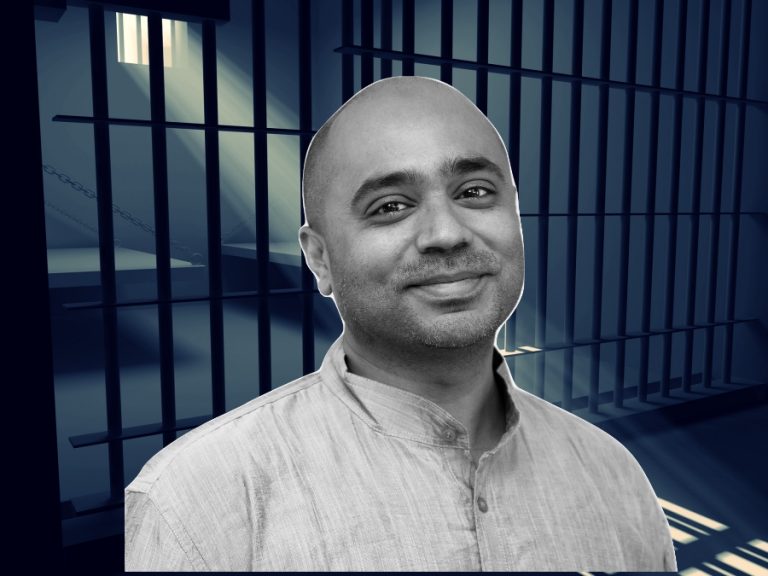
It’s the 42nd day today since Abhijit Iyer Mitra has been put in jail, his liberty suspended, his fate hangs in dark. All for cracking a joke, which was allegedly offensive. While a popular actor didn’t spend even 1 minute in jail after the court found him guilty and convicted him of culpable homicide, the state has ceased the freedom of a private person for mere allegedly offensive tweets posted more than a year ago, the charges for which are yet to be framed.

Read that slowly, register it, let it sink in and proceed.

Abhijit Iyer, a defence analyst with a popular think tank, visited Odisha last October with CM Naveen Patnaik’s bête noire Baijayant Panda. While on his Odisha visit, he posted a video to which some took offence. They are entitled to. The trouble didn’t start here.

During his visit, he also flew with Baijayant Panda on his chopper, over Chilika lake. State administration, in its overzealous attempt to fix Baijayanta Panda, smelt a rat here. They tried to implicate him over flouting environment norms and flying too low over Chilika, which “supposedly” is a no-flying zone. It isn’t by the way. However, they knew the case has no legs to stand on. The ploy was extended to incriminate those associated with Baijayant Panda.

The narrative was: how Baijayant Panda is bringing his friends to Odisha who have no respect for the native culture and derides our heritage.

Abhijit’s tweets from past years were dug up and a case was filed on a tweet he posted on 16th November 2017 charging him of hurting sentiments. The entire ecosystem came together. Media channels hosted primetime shows. Editorials were written. Twitter was abuzz with how an outsider has hurt our cultural sentiments. A villain was born overnight.

Abhijit, who was hardly known beyond Twitter Lutyens Zone was now a hate figure in Odisha. Media played a perfect partner to government’s witch hunting and helped in every sense to hype up public sentiment against Abhijit. Once, the tide turned against him, no politician worth his salt came forward help him because “Odia pride” was at stake. Abhijit was deserted and left to fight his battle all alone.

By now, Abhijit was facing a barrage of abuse on Twitter. It is at this moment that he did a fatal mistake of approaching the Supreme Court for anticipatory bail and to recuse him from personal appearance in Odisha fearing threat to his life. The honourable CJI thought that in the prevailing circumstances, jail is the safest place for him and that he must spend some time in jail. His life will be secure there. In any case, his comments invite religious feeling. He can’t he be entitled to bail. These were the exact words of the honourable CJI. This sealed his fate.

Abhijit had 3 separate cases filed against him. A privilege motion in Odisha assembly, a case pertaining to his year-old tweet in one of the Bhubaneswar police station and another one filed in Konark Police Station on his video shot at Konark temple.

Before we proceed, a quick word on few legalities. After police take cognisance of a crime, they take custody of the accused and forward him to a magistrate within 24 hours of arrest. In a non-bailable offence, bail isn’t a matter of right and hence not automatic, unlike bailable offence.

The prosecution may ask for police remand for custodial interrogation. In case where prosecution (Police) cannot defend its request to take remand or if they don’t ask for remand at all, the judge may grant bail or send the accused to judicial custody refusing bail. The reason for denying bail can be many. The reasons can be one among many but not limited to, where the accused is suspected to tamper with evidence, abscond, influence witnesses, not cooperate with the investigation or if his release his a threat to public order or morality.

Now let’s come back to Abhijit’s case. For the first case, i.e the privilege motion, he has already been pardoned by Odisha assembly after a written apology. For the third case, Konark police did ask for his police remand for 2 days which is now over. For the second case, Sahid Nagar police have not asked for his remand at all.

Abhijit has spent 42 days in jail because the judiciary has denied him bail. Let that be clear.

When the honourable Supreme Court opines that he should spend some time in jail as his offence isn’t entitled to a bail, in theory, it would be seen as a “shadow” contempt if an SDJM court grants him bail. So his chances of getting bail at the SDJM court were always faint. Another reason he spent so many days in jail was, Odisha HC was closed following a strike by lawyers for more than 3 months. Hence, he could not appeal against the SDJM verdict immediately. When he did, he got a date after weeks because of cases that have been piled up since these 3 months.

People ask, what were the options before administration?

What were the options before the judiciary?

What were the options before media, which was just presenting news as it happened in the state?

The administration could have chosen not to press charges at all since the charges were frivolous and the case seemed like a motivated propaganda. People do not get offended suddenly after a year. In any case, once the assembly pardoned him, the administration could have withdrawn sanction to prosecute under section 194 of CrPC, which they still can.

The judiciary could have been magnanimous in granting him bail as police didn’t ask for custodial interrogation and Abhijit is not known to tamper with evidence, abscond or influence a witness. His tweets didn’t incite any religious feelings or violence in 1 year, so it was unlikely it would have done so now.

And when it comes to media, they need to be a little pragmatic before sensationalising something. Your TRP can sound the death knell for someone. Be judicious in what you show but more importantly how you present it. Do not hype up public sentiment unnecessarily. You can report India losing to Australia in a Cricket match but “Match ka mujrim kaun” isn’t journalism.

Abhijit Iyer Mitra has complained of severe stomach pain and has been admitted to Capital Hospital, Bhubaneswar since Saturday. After 42 days of being lodged in jail, his health has started to deteriorate. He is no hardened criminal. His ‘crime’, doesn’t warrant this insensitive treatment.

His bail hearing in the High Court is due this week. As a Twitter user puts it succinctly, “even if you consider what he did as punishable, I don’t, but feel free to differ, he has suffered enough. The lordships should just grant him bail now. Let an unwell man go home; we can continue debating FoE ad infinitum”.

Karnataka government faces backlash for cancelling Hampi Utsav after lavish Tipu Jayanti Celebrations, reconsiders decision

Karnataka Water Resources Minister D K Shivakumar had announced about a week ago that in the light of the drought conditions in 100 taluks across the State, the government has decided not to celebrate Hampi Utsav.


The decision invoked backlash from the BJP which condemned the decision of the Karnataka government and called it pseudo secular.


Due to mounting pressure, the government has now decided to reconsider its decision. However, Shivkumar on Monday denied that the government is reconsidering the decision under pressure. He said, “Our MPs and leaders have expressed their concerns that they would like the festival to happen. But we should celebrate it in a befitting manner — one that showcases Hampi’s glorious past. Leaders like MP Prakash have been spearheading the demand to celebrate the festival, but we are suddenly seeing BJP MLA Somshekar Reddy take credit for it.”

BJP MLA Somashekar Reddy lashed out at the government and said that people want the Utsav to be a three-day event as always. “We will not accept any small event at Hampi. The Utsav should happen and it should be a mega event. If the government wants funds, we will raise the money by begging in Ballari, but there is no question of not celebrating the Utsav”, said Reddy while addressing the media.

The Karnataka government had faced heated protests by many Hindu groups and the opposition BJP regarding the decision to hold celebrations to honour the 18th-century king Tipu Sultan. The Karnataka Chief Minister decided to go ahead with the Tipu Jayanti celebrations saying that they will not stop the programmes started by the previous governments just because BJP opposed them. The government had even imposed section 144 to ensure smooth conduct of the celebrations.

Hampi, a place with the ruins of the glorious Vijayanagar Empire, is a UNESCO World Heritage site. Every year, a three-day festival is celebrated at Hampi usually in the month of November. The festival includes cultural events like musical shows, puppet shows and promotes regional and national artists as well as religious events associated with the temples. The Utsav attracts a large number of crowd to the place.

As inauguration of Statue of Unity completes a month, the mindless, illogical criticism doesn’t seem to end

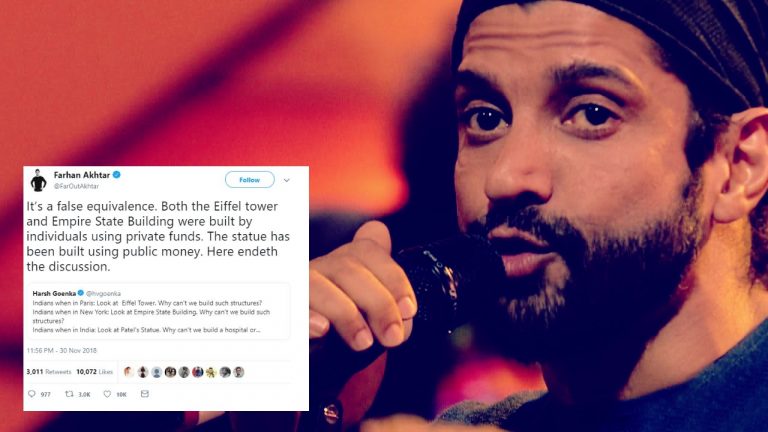
Its been a month since Sardar Vallabhai Patel’s Statue of Unity was inaugurated, yet the manufactured controversy surrounding it refuses to die down. In the last few days two well known public figures tweeted on the same:

This was a tweet by a prominent industrialist Mr Harsh Goenka, to which, naturally the leading light of the left-liberal (an oxymoron!), Mr Farhan Akhtar had to respond.

As epitomized here, the biggest grouse that the naysayers seem to have is surrounding the economics of the statue, namely: the money used to make the statue, should have been invested in alleviating poverty and that the other monuments so frequently quoted by nationalists are in developed countries, funded by private parties and not the government of the day.

This article is an attempt to rebut this facile argument.

The Statue of Unity, on the banks of the Narmada in Vadodara Gujarat, was constructed, for a sum of Rs 2,989 crores. It is currently the tallest statue in the world but is constantly compared with the Eiffel Tower, the Empire State Building and The Statue of Liberty. It is thus imperative to look at the other monuments which the Statue of Unity is being compared to one way or another.

Was there a controversy around Eiffel Tower?: Yes!

The Eiffel Tower, a global icon today, constructed between 1887-1889, as an entrance to the 1889 World’s fair, is 324 meters tall. During its construction, it too, much like the Statue of Unity faced criticism from a group of Artists, in France:

We, writers, painters, sculptors, architects and passionate devotees of the hitherto untouched beauty of Paris, protest with all our strength, with all our indignation in the name of slighted French taste, against the erection … of this useless and monstrous Eiffel Tower … To bring our arguments home, imagine for a moment a giddy, ridiculous tower dominating Paris like a gigantic black smokestack, crushing under its barbaric bulk Notre Dame, the Tour Saint-Jacques, the Louvre, the Dome of Les Invalides, the Arc de Triomphe, all of our humiliated monuments will disappear in this ghastly dream. And for twenty years … we shall see stretching like a blot of ink the hateful shadow of the hateful column of bolted sheet metal.

Was the Eiffel Tower cheap to construct? Was it constructed during times of Economic Prosperity?: No to both!

Originally the cost of the tower in 1889, was close to 8 million francs, which even in 1889 amounted to a sizable cost.

But what our perfunctorily read friends in opposition and their rag-tag coalition fail to acknowledge is that the year 1889, the year of the inauguration of Eiffel tower, was also the year when the largest Bank Bailout of that time happened in France. Without going into the nuts and bolts of the crisis, suffices to say that on the evening of 7th of March, the French Minister of Finance, at that time, met the leading bankers of the day to form a plan, now called “lifeboat bailout” to rescue the Banque De France and prevent a Bank Run from happening. This was just two months before the Eiffel Tower was opened to the public. It was certainly not a case of great economic prosperity and calm in the run-up to the inauguration of the monument, as our ill-read friends from left like to claim.

Was the Eiffel Tower Privately Funded?: It was project financed. So, it was complicated!

The charge that the Eiffel Tower was a privately funded monument and that the government of the day had nothing to do with it, is not entirely correct.

Eiffel Tower is not just a feat of engineering but a financial feat too, where the public and private authorities entered into a contract to privately fund the construction cost of the tower, and then recover the same from ticket sale over a period of time.

The monument overtime would revert to public ownership once the cost got recovered. It’s an example of project financing, which is widely used for a whole lot of infrastructure projects across the world. This sort of project financing is also known as the Build, Operate Transfer model and the Public-Private Partnership or the PPP model.

What’s the point of the controversy? : Now we get to the core of the grudge!

The larger point that the left-leaning couch-economist are trying to obfuscate about is that the monuments such as Eiffel Tower, Empire State Building, Statue of Liberty, make sound economic sense since over a period of time these monuments make money many times over their construction cost.

For instance, the Eiffel tower, between 2011-2015, generated between Euro 50-60 million per annum from ticket sale alone. The Statue of Unity, earned Rs 2.1 crores in the first 10 days itself.

Add to this the fillip it gives to the growth of dependent industries, tourism, logistics, and we are looking at an economic revival model that can be easily replicated across states, across countries.

Indeed, if one takes a closer look at the revenue generation by Statue of Unity, as on date, one can assume that over time it too, like its brethren monuments overseas will turn out to be a money- spinner, something that is definitely detrimental to the left model of governance.

Delhi: Nuts and bolts stolen from recently inaugurated Signature Bridge, officials fear for safety

The Delhi’s newly built Signature Bridge has been in the news in the past for all the wrong reasons.  After dangerous selfies and multiple accidents at the spot, it is now the turn of vandals, who have started lifting nuts and bolts at the Signature bridge which could pose a serious security risk in the future, reported Times of India.

According to reports, some thieves have resorted to stealing nuts and bolts installed at the bridge which connects the pylon with the surface. Each cable provides support to the bridge is supported by 12 such nuts and bolts, many of which were found missing on Monday.

Expressing shock over the incident, Delhi Tourism and Transportation Development Corporation (DTTDC) engineers said that they will be welding the whole section to avoid such incidents in the future. “These parts were not missing earlier, this is an extremely shocking act. If the sufficient number of bolts are removed, this seemingly simple act of vandalism can become a safety hazard. We will find a solution with stronger welding or by deploying guards,” the official said.

Reportedly, the work is still pending on upper segments where the viewing gallery will be built, hence the DTTDC has not yet handed over the bridge to the Public Works department. The DTTDC has planned to close down the bridge from 11 pm to 5 am for completing the unfinished work.

The vandalism at the Delhi’s Signature Bridge is not new as recently few transgenders were seen stripping, unclothing in the public and posing for photos near the Signature bridge which had resulted in unruly scenes at the spot.

The signature bridge since its inception has been mired in controversies after AAP MLA Amanatullah Khan was caught on camera pushing MP Manoj Tiwari at the inauguration event. Earlier, BJP Delhi chief Manoj Tiwari had clashed with Aam Aadmi Party supporters at the site of the inauguration when he was protesting against the alleged denial of invitation.

Bulandshahr violence: Four people arrested; two FIRs lodged

0

Four people have been arrested over violence in Bulandshahr, Uttar Pradesh. The protests, which were reportedly over police inaction after repeated complaints of illegal slaughterhouses, claimed two lives, a police inspector Subodh Kumar Singh as well as a youth named Sumit. Contrary to media reports, the police clarified that the main accused Bajrang Dal leader Yogesh Raj has still not been arrested till now.


Congress leader Kapil Sibal, commenting on the death of the police officer expressed shock that a mob had killed a police officer investigating the case.


Singh’s sister, too, alleged conspiracy by the police to kill his brother since he was investigating Akhlaq case. She also demanded that Singh be declared a martyr and a memorial be built in his name.


However, the inspector, Subodh Kumar Singh was only the initial investigating officer till 9th November 2015 in the Dadri mob lynching case which took place on 28th September 2015. Eventually, he was transferred to Varansari and the charge sheet was filed in March 2016 by a different investigating officer. Media reports suggest he was accused of biased investigation due to which he was transferred. Singh was not investigating the case when he was killed in mob violence yesterday.

Today, the police has clarified that there is no merit in the allegations that the policeman was slain because of his connection to the Akhlaq case. They have also denied reports of any sort of connivance of the police as alleged by the family.

The police has also lodged two separate FIRs in the current case, one against the alleged cattle slaughter and another against the protests which followed. A total of 27 people have been named and 60 unnamed persons are also mentioned in the FIRs. The police is currently probing the matter and raids are being conducted to arrest the accused.

Rapid Action Force has been deployed in Bulandshahr and section 144 which prevents unlawful assembly of more than four people in an area has been imposed. As reported by ABP News, a retired army soldier is believed to have shot inspector Singh.

On Monday, protesters gathered outside a police station claiming that they had discovered carcasses of cows in their locality. Angered with police inaction even after repeated complaints, they clashed with the police.

Things took violent turn after the police opened fire at the protesters. It is claimed that the police was forced to open fire after the protesters attacked them with stones. In the chaos, inspector Subodh Kumar Singh lost his life. A youth, Sumit, too, succumbed to injuries.

In a press conference held today, the police gave an update on the investigations. They said that the main accused Yogesh Raj’s family was also questioned in attempts to track him. They also asserted that the situation in Bulandshahar is now inching towards normalcy and they are to submit the SIT report in 48 hours.

Ashok Gehlot missing from Congress banner in Ajmer, party calls it a mistake

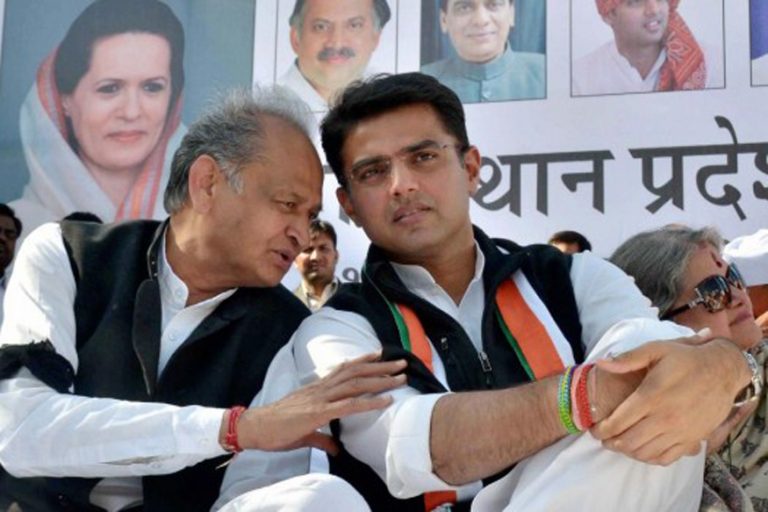
According to a report in Dainik Bhaskar, pictures of all prominent Congress leaders appeared on the banner which was showcased in the first AGM Political Reporter meeting, organised by PCC chief Sachin Pilot in Ajmer, Rajasthan, on Monday, except that of former Chief Minister, Ashok Gehlot.

Despite being one of the most senior Congress members, a former union minister and an ex-Chief Minister of Rajasthan, Gehlot’s picture not appearing on the banner became the prime topic of discussion throughout the meeting.

Congress’ names like, Sonia Gandhi, President Rahul Gandhi, All India Congress Committee’s Advisor Avinash Pandey, National Secretary and Rajasthan in-charge Vivek Bansal, PCC Chief Sachin Pilot, Member of Parliament Dr. Raghu Sharma, recently appointed State chief Lalit Bhati, Former MLA Dr. Srgopal Baheti, Dr. Rajkumar Jaipal, former mayor Kamal Bacolia, City Congress Committee president Vijay Jain, candidate of Ajmer North, Mahendra Singh Ralawatya, candidate of Ajmer South, Hemant Bhati, block president Kailash Komal, Rajkumar Tulsiani, Rakesh Sankhala and Imran Siddiqui, all appeared on the poster, which was displayed on the stage during the meeting. Congress stalwart Ashok Gehlot was the only important name which did not find a place on the Congress’ party poster.

Though City Congress committee President, Vijay Jain said that Gehlot’s picture missing from the poster was not intentional, the alleged rift between Sachin Pilot and Ashok Gehlot over the Chief Ministerial position in Rajasthan was being contemplated as the reason behind this blunder.

The Congress leader, who served thrice as Union minister under Indira Gandhi, Rajiv Gandhi, and Narasimha Rao, is pitted against PCC chief Sachin Pilot as a probable Congress CM candidate and both are contesting the state election.

Though the Congress’ intention of excluding the picture of a party veteran and former CM from the poster ahead of the Rajasthan assembly elections is still not clear, it would be interesting to see whether this internal party politics will have an adverse effect on the party’s electoral performance and future action.

Christianity’s verdict on Hinduism: It is incompatible with the ‘will of God’

Christian missionaries have always been clear about their intentions in India and religious conversions. They have been decreed by Jesus Christ himself to spread Christianity all over the world and they zealously believe that unless every group in the world has Christian representation, Judgment Day will not arrive.

In their bid to convert Hindus, missionaries have always maintained that it is essential to understand Hinduism and Hindu society. They have often wondered why despite their efforts, Hinduism hasn’t fallen to Christianity yet and reflect deeply on what their strategy should be going forward. Therefore, it is imperative for Hindus to understand how Christianity perceives them if they are to ward off the gravest threats to their way of life.

In the March 1934 issue of ‘Thought’ (Fordham University Quarterly), A.J. Siqueira wrote, “Our purpose has been to analyze the philosophical and theological complex of the Hindu mind in its attitude to Christ. Hinduism has no infallible exponent, no official interpreter, no authentic “catechism” of doctrine: quot capita tot sententiae. So we have drawn largely on Hindu sources, avoiding the intricacies of Hindu philosophy that would lead the uninitiated reader a merry dance. Indeed, the missionary who would preach Christ to the Hindu should understand the Hindu mentality, lest he beat the air in vain or betray his Master by a timid compromise.” Thus, they were clear that they needed to understand the Hindu mind to be able to make missionary work more effective.

The late Reverend Charles F. Aiken, who was a Professor of History of Religion at Catholic University, wrote of Hinduism, “Hinduism, in its narrower sense, is the conglomeration of religious beliefs and practices existing in India that have grown out of ancient Brahminism, (q.v.), and which stand in sharp contrast to orthodox, traditional Brahminism today. Hinduism is the popular, distorted, corrupted side of Brahminism.” Here, we see a clear effort to alienate Brahmins from Hinduism and to portray Hinduism as a derivative of ‘Brahminism’, contrary to all established fact. He writes further, “In the pantheistic all-god Brahma, the whole world of deities, spirits, and other objects of worship is contained, so that Hinduism adapts itself to every form of religion, from the lofty monotheism of the cultivated Brahmin to the degraded nature-worship of the ignorant, half savage peasant.” India, he says, “has much of value to learn from Christian civilization.”

Sir Monier-Williams, a renowned scholar, said of Hinduism in his book “Brahminism and Hinduism” (1891), “it holds out the right hand of brotherhood to nature-worshippers, demon-worshippers, animal-worshippers, tree-worshippers, fetish-worshippers. It does not scruple to permit the most grotesque forms of idolatry and the most degrading varieties of superstition. And it is to this latter fact that yet another remarkable peculiarity of Hinduism is mainly due—namely, that in no other system in the world is the chasm more vast which separates the religion of the higher, cultured, and thoughtful classes from that of the lower, uncultured and unthinking masses”. Thus, we have reason to suspect that the term ‘Brahminism’ as is currently discussed and understood in the academia has evangelical origins.

In fact, Christian missionaries paid special attention to the Brahmin caste. As per Catherine Cornille, Catholics in the 19th century firmly believed that conversion of Brahmans would lead to a conversion of the rest of the people of India.

Early missionary texts also reveal that Christian missionaries in the 19th century did not really view the caste system in as much of an evil as it does now. Jean-Antoine Dubois, in his book “Hindu manners, customs and ceremonies” that has come to be regarded as an authoritative figure of scholarship, wrote, “For my part, having lived many years on friendly terms with the Hindus, I have been able to study their national life and character closely, and I have arrived at a quite opposite decision on the subject of caste. I believe caste division to be in many respects the chef d’oeuvre, the happiest effort of Hindu legislation. I am persuaded that it is simply and solely due to the distribution of the people into castes that India did not lapse in the state of barbarism, and that she preserved and perfected the arts and sciences of civilization whilst most other nations of the earth remained in a state of barbarism.”

Thus, it appears that Christian demonization of the caste system occurred when they realized after careful introspection that they could use the caste fault-lines within Hindu society to convert the populace.

Alexander Duff, the first overseas missionary of the Church of Scotland to India, wrote, “Our present purpose not being to expose, but simply to exhibit the system of Hinduism, it has all along been taken for granted that in the eye of the intelligent Christian, its best confutation must be the extravagance and absurdity of its tenets.”

Anthony E. Clark, who teaches history at Whitworth University, in his article “All is Not One” elaborates on “Hinduism’s Incompatibility with Christian thought”. He says, “Catholic Christians are beholden to truth, and truth is our best defence against the claims of religious pluralism, which is the foundational assertion of Hinduism.” Clark also believes that there is a contradiction in the belief that “all religious traditions are different paths to the same end.” He states emphatically, “To assert that two conflicting positions are in fact correlative is not only irrational but untruthful. Christianity’s claim to be the only true faith, founded upon the natural and revealed certainties given by one God, cannot by sound reasoning fit into the ideals of religious pluralism.” He adds further, “One of the principal Catholic objections to the Hindu belief that all things are indistinguishable from one another is that it denies the possibility of a creator God. This and the notion of a Brahmanic pantheism are forcefully rejected in the Nicene Creed, in which Catholics proclaim, “I believe in one God, the Father almighty, maker of heaven and earth, of all things visible and invisible.””

Thus, we see clearly, contrary to the popular approach by Hindu spiritual leaders of asserting that Christianity is merely another path that leads to God, Christian intellectuals are very clear on the incompatibility between Hinduism and Christianity. They not only deny the virtues of religious pluralism but exalt Christianity’s rejection of it as one of the Abrahamic religion’s principle virtues.

The zeal of Christian missionaries can be gauged from the fact that the then Pope, John Paul II, exhorted Christian evangelicals to convert the region during his visit to India in 1999. The Chicago Tribune reported, “The 79-year-old pontiff exhorted a synod of Asian bishops to evangelize the region in the coming millennium. He told them to go forth and conquer the continent for Christ just as the church had done in Europe during the first millennium and in the Americas in the second.”

Christianity has always been against all forms of Hindu worship. It has a special enmity towards Yoga. The Nagaland Baptist Church Council, earlier this year, had directed its associate Churches to not practice Yoga as it is incompatible with Christianity. Christian parents in the USA have frequently objected to Yoga being taught in schools. Christian priests oppose Yoga because it puts the human soul in “jeopardy“. The Syro Malabar Church in Kerala asserted that Yoga is against Christian principles and should not be practised as a means to get “closer to God”. Even Cardinal Joseph Ratzinger himself, who would go on to become Pope Benedict XVI, warned Catholics against ‘eastern meditation practices’ such as Zen and Yoga in a letter to Bishops in 1989.

The Hindu response to Christian objection to Yoga has been to forfeit its claim to Yoga which directly plays into the hands of Christian missionaries. Hindus should not sacrifice their claim over spiritual practices if Christians object to them because it merely portrays the insecurity of Hindus.

Another Christian scholar says, “Hinduism lacks any understanding that God created this world for a good purpose. It is common for Hindus to speak of God bringing the universe into existence simply as a “playful” exercise of His power. Also lacking is a conception of God as infinitely holy and righteous and as the One to whom we as His creatures are accountable for the way we conduct our lives.”

One of the most fundamental issues Christians have with Hinduism is idolatry. The worship of idols is denounced in the holy scripture of the faith itself. Ed Stetzer asserts proudly on Christianity Today, “As our love for God increases, our tolerance for idolatry will decrease.” On the other hand, murthi-pujan is essential To Hinduism. Although, there are certain strains of Hinduism that decry idolatry, which could have emerged as a consequence of Christian influence in the medieval past, the majority of Hindus cannot imagine worship without idols.

Thus, we see that Christian missionaries have a clear critique of Hinduism based on their religious scriptures. To us, it appears bigotry but to them, it’s the commandment of their God. While Hindus tend to concede ground to not appear bigoted, they do not care about such indictments as they perceive themselves to be following the will of God.

Christians, based on their understanding of Hinduism, have devoted a great deal of time to perfecting the tactics used to convert Hindus. There are numerous websites on the internet which offer advise missionaries on how to convert Hindus. One such website says, “ Offer Jesus’ Forgiveness. Bakht Singh, a convert from Hinduism and an Indian evangelist, once said, “I have never yet failed to get a hearing if I talk to [Hindus] about forgiveness of sins and peace and rest in your heart” (Hesselgrave, 169). Forgiveness is certainly a need for Hindus because it is not available in their karma-based belief system. The law of karma is like a law of nature — every cause has its effect and there is no place for mercy. The fact that forgiveness is not available in Hinduism troubles many Hindus, for they are aware that the actions that bind them to this illusory realm keep accumulating, and the prospect of escape is hopelessly remote.”

Conclusion

We see in this article that Christians, through the centuries, have critiqued the fundamental tenets of Hinduism through the lens of Christianity. They do not perceive Hinduism as a valid path that leads to the Almighty but a deluded religion that grapples with superstition and absurd beliefs. Furthermore, they have evaluated Hindu society with the objective of conversions in mind.

They have also changed tactics depending on the situation at hand and at some point, realized that they could use the caste fault-lines to their benefit. Conversely, Hinduism views them as one of the many paths that lead to the attainment of salvation. Unfortunately, Christians haven’t accorded to them the same respect. They regard Hinduism as incompatible with Christianity and their missionary work is dedicated to eradicating it.

There has been, however, a Hindu intellectual response to the onslaught of Christianity. That will be the subject of a separate article.

Twitter informs critics of radical Islam that they have broken Pakistani laws

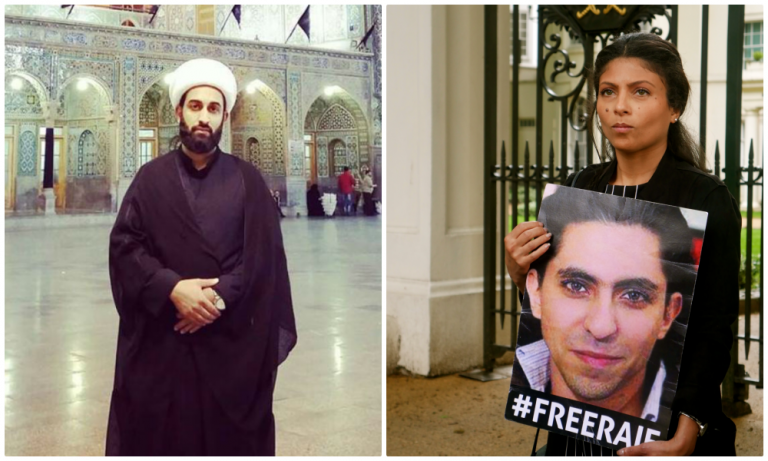
Twitter’s legal team has sent official correspondence to at least two very vocal critics of radical Islam ‘in violation of Pakistani law’. Imam Tawhidi, a progressive Muslim scholar from Australia received an email on 3rd December informing him that a particular tweet of his has broken Pakistani law.


His tweet was regarding the attack by a knife-wielding attacker in Melbourne who stabbed a few people hours after the Friday prayer. Below is the tweet for which Imam Tawhidi got the correspondence from Twitter.


Similarly, Ensaf Haider, a Canadian human rights activist and wife of Raif Badawi, a Saudi writer and dissident who has been imprisoned for his satirical blogs against Saudi regimes, too received similar notice of having violated Pakistani law.


Her tweet against niqab which triggered the legal correspondence is below.


In August this year, Pakistan’s Islamabad High Court had ordered blocking Twitter in the country if it does not comply Pakistani government’s request to block objectionable content within 15 days. The Pakistan government has its own notion of what is suitable for public consumption and what falls under the legitimate free speech. The Islamabad High Court had “taken notice of the increase in objectionable content posted on social media websites” following which the Senate Standing Committee had deliberated sending the final notice.

Hence, Twitter is following the law of the land by sending such notices to the said people. In India, too, Twitter has withheld tweets of scientist and columnist Anand Ranganathan and filmmaker and author Vivek Agnihotri which were critical of the Indian judiciary.

Pakistan has stringent blasphemy laws. It came to prominence recently when Asia Bibi, a Pakistani Christian who was convicted of blasphemy in 2010 and sentenced to death, was acquitted by the Pakistani Supreme Court in October 2018. She has since then gone into hiding.

Pakistan had earlier blocked Facebook in 2008 and then in 2010 again. In September 2012, Pakistan had also blocked YouTube for over two years.