Home Blog Page 6923

Judiciary sets off fireworks of overreach with the judgement on bursting firecrackers

This may be the third article this year which is trying to reiterate the problems associated with judicial overreach. But then again, what can one do if the saga of judicial overreach refuses to die down. There is a reason why we have a doctrine of separation of power; paramount of them being the need to ensure there is a strong system of checks and balances in place while the second one being to ensure that each institution can specialize within its own field of work and discharge its duties with utmost efficiency.

At the onset, it needs to be clarified that I have enormous respect for Judiciary as an institution and I believe that they attempt to make decisions with the best interests of the society in mind.

The problem, however, is that not all such decisions take popular consensus into consideration. This lack of consensus becomes a contentious issue when decisions are taken on governance matters as the will of people is not represented during the judicial process of decision making. The current article is with respect to the latest judgment that aims at reducing pollution in Delhi by capping the time duration for the bursting of firecrackers in Delhi.

Let me first state that I am against the extensive use of firecrackers during Diwali celebrations as my great-grandfather lost his life due to the rampant pollution that was caused by them. But, over time firecrackers became an integral part of the cultural celebration of Diwali so it must be respected. A lot of sentiment is associated with the practice of bursting crackers in Diwali so capping the time for this seems to be an order that should have ordinarily come from the executive and not the judiciary.

The good thing is that unlike last year, this time the courts didn’t outrightly ban firecrackers like last year. Last year when courts completely banned the sale of firecrackers, traders and the entire economic ecosystem around the economy was severely affected as the traders didn’t expect such an outcome and thus, they could not adjust their inventories. The least, I expected was that this year around Diwali, they’d be certain regulations that would be put in from the start of the year so that traders can form rationale demand projections before adjusting their inventories. Unfortunately, that didn’t take place while what we got is a two-hour window for the bursting of crackers.

Let me ask a few quick questions, will just banning firecrackers solve Delhi’s pollution problem? It will surely help a bit, but it will come at the cost of hurting the cultural sentiments of a significant proportion of people. That said, another major issue worth stressing upon is that the problem of pollution in Delhi requires a concentrated approach towards the improvement of air quality, water quality and cleanliness in India. This approach would require a concentrated approach from all stakeholders, something that only the Delhi Government can initiate and not the Courts.

A similar attempt to address Delhi’s pollution problem was done by the Courts when they ordered that all DTC buses be converted into CNG, however, the impact of such an intervention was only short-term as Delhi’s pollution problem only worsened over the years. This demonstrates why judicial action is difficult to have an impact when it is trying to address an executive or legislative matter.

The recent judgment by the court somehow doesn’t adequately capture the institutional constraints of the executive as it puts the onus to ensure no crackers are burst beyond the desired hours on to the police department. It reads that the Station House Officer (SHO) would be personally liable should there be a violation. This has severe problems as how does an SHO ensure the compliance with Court order as she/he does not have the adequate resources to monitor their entire area.

The judgement despite resolving the key debate that right to life supersedes the right to practice a religious belief puts in front a larger question of how we intend to fight the menace of pollution in our mega-cities and the answer to this cannot come from the Courts.

It is about time the Delhi Government takes cognizance of the need to find a solution to the chronic problem of pollution that the citizens face. Mere photo-ops like Odd-Even are not the long-term solution and there’s an urgent need for an executive intervention to ensure that there’s no governance gap that needs to be filled by a judicial intervention.
Watch: Video footage of Mor Mokut Sharma, DD journo who escaped death in Naxal attack yesterday

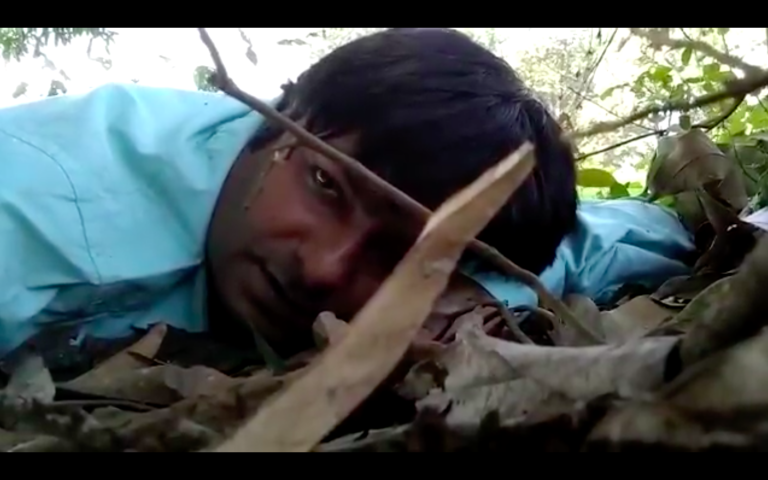
A day after the heartbreaking Naxal attack that claimed life of a Doordarshan journalist Achutyananda Sahu and two CRPF personnel, a chilling video footage shot by another Doordarshan crew member Mor Mukut Sharma has emerged which captures those terrifying moments.


In the video, Sharma could be heard saying that there is a terrorist attack and he is lying in that position to avoid detection. “We had come to Dantewada and were passing by and the army was with us. Suddenly we were surrounded by Naxals,” Sharma could be heard saying amidst gunshots.

When he thought he is going to die, he reached out to the one he loves the most, his mother. Speaking to his mother, he said he is not sure if he would come out of this terror attack alive. “Mummy I love you a lot. It is possible that I die in this attack. The situation is bad. I don’t know why, but despite seeing death right in the face, I am not afraid. It is difficult to come out alive out of this. There are 6-7 soldiers with us and we are surrounded (by Naxals) from every side,” he said in the 90 second video footage.

Sharma, thankfully, managed to come out alive out of the terror attack.

Delhi HC awards life imprisonment to 16 in the 1987 Hashimpura massacre during Rajiv Gandhi regime

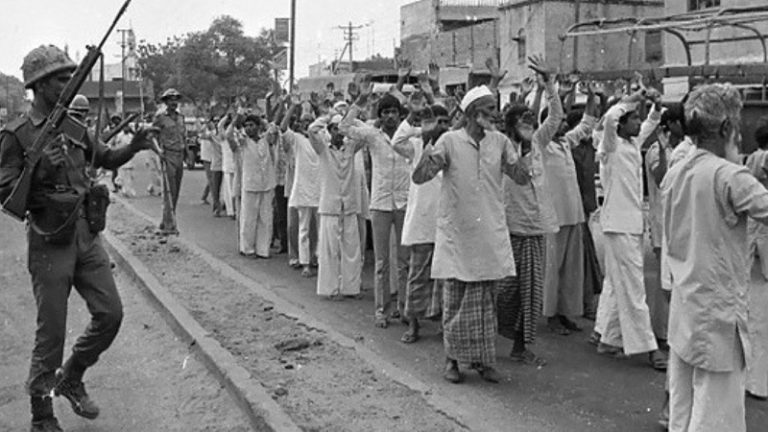
The Delhi High Court on Wednesday set aside a trial court judgment that had acquitted 16 Provincial Armed Constabulary (PAC) men in the 1987 Hashimpura massacre case and convicted all the accused and sentenced them to life imprisonment.

According to the reports, a Delhi High Court bench of Justices S Muralidhar and Vinod Goel cancelled the trial court’s verdict which had acquitted the accused. The judges came down strongly on the accused and said that the “massacre of 42 persons of a minority community in Hashimpura was targeted killing of unarmed and defenceless persons. Families had to wait 31 years for justice”.

The UP government had earlier approached the Delhi High Court following the trial court order in which the policemen were declared ‘not guilty’ of the charges of murder, attempt to murder, tampering with evidence and conspiracy in the massacre case in which 42 people were killed in Meerut city.

The UP government had appealed before the court that there were “lapses” in the trial court’s findings. The trial court had given the benefit of doubt and acquitted 16 ex-Provincial Armed Constabulary (PAC) personnel accused of killing 42 people in Meerut, citing lack of evidence to establish their involvement in the case.

The Delhi High Court has now convicted Suresh Chand Sharma, Niranjan Lal, Kamal Singh, Budhi Singh, Basant Ballab, Kunwar Pal Singh, Budha Singh, Rambir Singh, Leela Dhar, Hambir Singh, Mokam Singh, Shami Ullaha, Sarwan Kumar, Jaipal Singh, Mahesh Prasad and Ram Dhayan.

The shocking massacre took place on May 22, 1987, at Hashimpura in Uttar Pradesh when the town was under severe communal clashes for few days. On the night of May 22, some 19 police officials from the Uttar Pradesh Provincial Armed Constabulary (UP-PAC) entered the Hashimpura area and took around 50 young Muslim men in a truck. The PAC officials allegedly took them to the Upper Ganga Canal and shot them dead while tossing their bodies into the water, killing 42 young Muslim men.

It would seem unbelievable that the Uttar Pradesh government with had a Congress chief minister then, did not so much as order an inquiry into the incident until 1988.

The charge sheet in the case was filed before the Chief Judicial Magistrate Ghaziabad only in 1996. The case was transferred to Delhi in September 2002 on the order of the Supreme Court following a petition by the families of the massacre victims and survivors. In 2015, the court had acquitted all accused PAC personnel.

BJP MP Subramaniam Swamy had also approached the HC with an appeal to further investigate the role of P Chidambaram who was the union minister from 1986 to 1989.

Days after Amit Shah said he stands with Sabarimala devotees, Rahul Gandhi takes the opposite stand

Congress president Rahul Gandhi, on Tuesday, said that all women should be allowed inside the Sabarimala temple.

Speaking in Madhya Pradesh, Gandhi acknowledged that his viewpoint differs from that of his party workers who represent the sentiment of the people of Kerala. He said, “My opinion is different from that of my party on this issue. My party represents the feelings of the people in Kerala. However, my personal viewpoint is that all men and women are equal. The women should be allowed into Sabarimala temple and they have the freedom to go everywhere”.

Kerala Chief Minister Pinarayi Vijayan welcomed Gandhi’s statement and called the stand of the Kerala unit of Congress as unfortunate. “It is unfortunate that the Congress in Kerala does not have the same opinion as that of the party’s national leadership on the subject,” he said in a Facebook post.

Gandhi’s statement comes on the day when hundreds of BJP workers staged a “hunger strike” in front of the state police chief’s office in Thiruvananthapuram protesting the LDF government’s decision to implement the Supreme Court order allowing the entry of women of all ages inside the Sabarimala temple. The BJP has also announced that it would be taking out a ‘Rath Yatra’ from Kasargod to Pathanamthitta, from November 8 to 13 to “save the customs and traditions” of the hill shrine.

On Oct 27, the BJP president, Amit Shah in an address at Kannur, Kerala, had come out strongly in support of Sabarimala devotees and criticised the Left government’s handling of the matter. He also condemned the arrest of devotees. Shah had assured that karyakartas of the BJP will be standing beside the devotees of Lord Ayyappa like a rock in the battle to defend the tradition of Sabarimala.

The Kerala police had heaped atrocities on the protesting devotees arrested around 2000 devotees and had registered 450 cases against them as on Oct 26.

Many have tried their best to turn the Sabarimala flashpoint into a ‘women’s rights’ issue when it is actually about the right to pray and preserve traditions. They have misrepresented facts to insinuate that all women were disallowed whereas only women from the ages of 10 to 50 were not allowed to enter the temple. The devotees have been fighting for their right to preserve their tradition and have insisted that ways of Abrahamic religions where one rule prevails should not be imposed on a diverse religion like Hinduism where every temple and every deity has a different set of traditions, for example, there are some temples where men are also not allowed to enter.

Rajiv Malhotra: The reputed Hindu ideologue appointed as a visiting professor at JNU

Reputed Hindu ideologue is all set to deliver his first lecture at JNU as a visiting professor at the Centre for Media Studies on the 2nd of November. Malhotra’s appointment as a visiting professor at JNU reflects that winds of change are blowing across the university which has long been a leftist bastion. Apart from Malhotra, Swapan Dasgupta and Indian-American computer scientist Subhash Kak have also been provided positions at the university.

The author of books such “Being Different: An Indian Challenge to Western Universalism” and “The Battle for Sanskrit”, the writer is widely respected for his intellectual defence of Hinduism. In one of his notable books, “Breaking India”, Malhotra has highlighted a nexus of intellectuals, activists, people in the academia and other powers who are involved in a collision to delegitimize the spiritual and territorial integrity of India.

Malhotra writes in Breaking India, “Scholars in South Asian Studies departments and liberal think-tanks see India through a secular lens based on Western ideas of human rights. They deploy subaltern studies and postmodern theories to deconstruct the Indian state as a catastrophe constructed artificially by colonialism and to show its very nature as oppressive, undemocratic, inherently anti-minority, anti-women and anti-Dalit.

They export these models to their Indian counterparts, forming a self-sustaining system. They also feed these visions into media and government hearings. Thus, these two supposedly opposing intellectual streams converge to provide an image of India as a frontier necessitating Western intervention.”

In an interview with Swarajya, Malhotra makes the argument that although universalist ideas may be at war with each other in other parts of the world, they work as allies in our country. He states further, “India is the world largest territory, both geographically and by population, that is up for grabs by the expansionist, predatory ideological movements in the world. By that, I mean pan-Islam, right-wing expansionist Christianity, and left-wing forces which include post-modernism, Marxism and “liberalism”. These predators are expansionist and they want a global footprint. India is where the “clash of civilisations” is going to play out.”

From his books, it is quite clear that Malhotra, like quite a few other reputed intellectuals, views India as a civilizational state rather than a nation-state. In ‘Being Different’, Malhotra highlights the essential difference between the West, the foundation of which is monotheism and India, the soul of which is still defined by pagan Hinduism.

His grouse is with the intellectual elite who are trying to bulldoze their way trying to fit India’s diverse traditions and culture into the western framework. He writes, “India is more than a nation state. It is also a unique civilization with philosophies and cosmologies that are markedly distinct from the dominant culture of our times – the West. India’s spiritual traditions spring from dharma which has no exact equivalent in western frameworks. Unfortunately, in the rush to celebrate the growing popularity of India on the world stage, its civilizational matrix is being digested into western universalism, thereby diluting its distinctiveness and potential.”

‘Digestion’ of Hindu practices and rituals and knowledge into the western fold is a special concern for Malhotra. He believes the ‘digestion’ of Indic traditions could to prove to be the final nail in the coffin for Hinduism. This ‘digestion’ that is spoken of refers to efforts such as “Christian Yoga” and other attempts at secularizing Hindu knowledge without acknowledging their true origins and roots to rob Hinduism of its exclusive claim to the said practice or knowledge.

Malhotra has been a vociferous critic of western Indologists like Wendy Doniger. The problem, according to him, is that they are using a “Marxist lens, a Leftist lens, a Freudian lens” to interpret Hindu texts and scriptures, theories which are “completely inapplicable to the Indian way of life.” He is immensely sceptical of the impact such westerners are having on the country. “I feel that the Western mischief of intervening and creating disruption inside India is a sad thing because Indians have had a long history of being able to get along in a very pluralistic society,” he says, “When these Westerners get in and start making fun of gods and goddesses — all these vulgar writings about gods and goddess, all the vulgar writings about many of the symbols, the festivals, making fun of the gurus — obviously, they are instigating trouble. I see it in that way.”

In an article for OpIndia.com, Malhotra has warned against making liberal Muslims the face of Hindu resistance. “We must shoulder our own responsibilities and not try to escape the risk and burden of having our own adhikara,” he says. His contention is the conflict between liberals Muslims and the Muslim orthodoxy is battle between two internal camps of Islam and believes it is unwise to “hoist them as some sort of leaders of Hindus as far as ideas, policies, and strategies are concerned” as there is no assurance that they will sympathetic to Hindu concerns or even capable of understanding them.

The author is also involved with the Infinity Foundation as its founder-director at New Jersey, USA. The foundation’s mission primary area of focus includes “creating, disseminating, and expanding a body of knowledge which clarifies or integrates philosophy, religion, science, psychology and non-traditional mystical disciplines; and bridging Eastern philosophies with Western thought.” In India, the foundation seeks to establish a grand narrative of our civilization and trains scholars for the purpose. He also serves as Chairman of the Board of Governors of the Center for Indic Studies at the University of Massachusetts, Dartmouth, and is an adviser to various organizations.

Opinions on Malhotra differ widely. While his critics often denounce him claiming he indulges in wild conspiracy theories, his ideas have gained much prominence among those working towards a Hindu renaissance. He is often regarded as a strategic thinker whose work is monumental towards mounting a credible defence of our pagan civilizations dominated by monotheism. Malhotra is a true Hindu intellectual in the long line of thinkers in independent India along the lines of Sita Ram Goel and Ram Swarup who has identified and brought to the public consciousness the forces that gravely threaten our civilization.

Although certain people have been disappointed with Prime Minister Modi’s work on the civilizational front, Malhotra’s appointment as a visiting professor at JNU and the subtle changes brought about in the Left bastion is certain to bring a smile in the faces of many people.

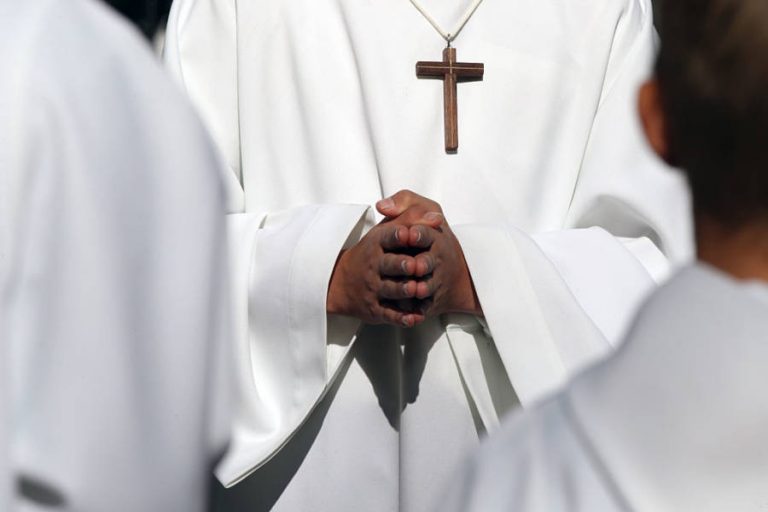
US Catholic Diocese removes Kerala priest from Michigan Church following sexual harassment allegation

0

A Kerala priest working with Catholic Diocese of Lansing in Michigan of the United States of America has been sacked from the facility after the church received complaints of sexual harassment against him.

Rev. Mathew Joseph, a priest of the Missionary Congregation of the Blessed Sacrament of Kerala has been sent back to India on August 18, 2018, after serving one month as a parochial vicar for St. John the Evangelist Catholic Church in Fenton, said the statement issued by the Catholic Diocese of Lansing.

“He was dismissed due to several complaints about his ministry, including a credible allegation of sexual harassment of an adult female,” the statement reads.

The Rev. Robert Copeland, the pastor of St. John spoke about the issue during a prayer meeting this weekend at the church. He further added that they are in contact with the lady who has made the allegations. “She is committed to challenging the Diocese and the parish to have higher standards and learning from this incident,” said Rev.Copeland.

Copeland said that Rev. Joseph had served with the Diocese of Saginaw for one year and came to Fenton with a good recommendation and was serving at the St. John church on a trial basis. Copeland said that Joseph had argued that the sexual harassment charges against him were a “miscommunication”. The church decided to send him back as soon as they found that “it wasn’t a misunderstanding”, said Copeland.

Michael Diebold, director of communications for the Diocese of Lansing, said the complaints made against priest Mathew Joseph were the reasons to send him back to India.

The church in its statement issued on October 25th, two months after Joseph was sent to India, has now decided to attach emails and phone numbers for a hotline for victims who have been abused or victimized by Joseph or someone representing the Catholic Church.

“We like to protect our brother priest, but we want to protect our people and our parish even more,” Copeland said.

It is notable here that in a similar incident earlier, the Diocese of Oooty had to face severe criticism internationally after reports had emerged that they had reinstated their priest Father Jeyapul. Jeyapul was convicted by a US court and had served prison time for raping a minor. The victim, a US citizen who was 15 at the time of her rape, had decided to sue the diocese.

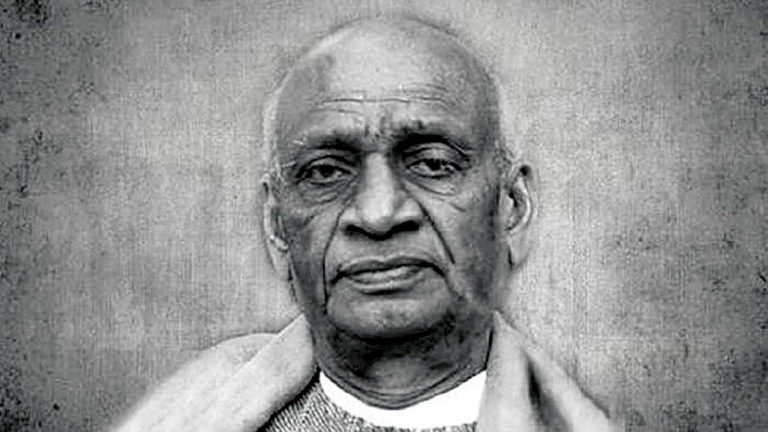
It was Sardar Patel who united India after the British left it in tatters

Amid the rush for the grand inauguration of the statue of Sardar Patel today, on 31st October which is also his birth anniversary, the torchbearers of the Nehru-Gandhi family have made some ridiculous statements. An attempt was made by former Vice President Hamid Ansari to tarnish the contribution of Sardar Patel in integrating India’s 500 odd Princely States into independent India by saying Patel is just as guilty as Mohammad Ali Jinnah for partition in 1947.


A larger propaganda is peddled by Left historians about the unity of India as a nation and civilization. The popular conception spread is that British united a disparate India and had it not been the British, India would never be a single unit. Imperial historians wrote theories calling India as a mere piece of geographical land with no common culture and history. They believe that it is under British that India was united as a nation. If British apparently united India, what was Patel doing?

So who actually united India? Both British and Sardar Patel can’t get the credit simultaneously.

Divide Et Impera- Divide and Rule!

Far from being unitors of India, the British actively ensured that the 500 odd Princely States stay different and totally isolated from India. The reason? British never believed that India was one nation. Sir John Strachey, the Finance Member in Viceroy’s Council used to say to his civil servant probationers that, “The first and most important thing to learn about India is that there is not and never was an India.”

By applying simple logic, if British began the conquest of India by defeating princely states like Marathas, Mysore, Nizam, Oudh and all, how difficult was it to abolish princely states altogether and unite entire India into one single administrative unit? But they didn’t. They ensured the royal families continue ruling these kingdoms but as puppets of British.

The British always kept the Princely States in isolation from the 11 provinces directly ruled by British- like Bombay, Madras, Bengal and so on. The princes were cultivated as loyal supporters of the British empire, hence ensuring that they remain divided from the rest of India. Constitutionally, the Princely States were not part of British India nor were their citizens seen as British subjects. Parliament could not legislate on the Princely States. Only the Viceroy had the executive power to deal with them.

As early as 1825, Sir John Malcolm said, “I am decidedly of an opinion that tranquillity of our vast oriental possessions is involved in the preservation of native principalities. They are so obviously at our mercy…that their coexistence with our rule is itself a source of political strength.”

Lord Mountstuart Elphinstone went a step ahead calling the Princely States as cess-pits to absorb all the miseries the British were bringing to India! After the Revolt of 1857, British realized the importance of Princely States being loyal to them in times of conflict. They began cultivating relations with them. A powerless Council of Princes was set up in 1921 by Lord Chelmsford to “advice” Viceroy on certain matters. All this without giving any powers to them.

Come the decade of the 1920s, the entire demand was to create an All-India Federation which will consist of 11 British Provinces and all Princely States. Basically, it was a plan to set up a federal government at union level consisting of provinces as well as the Princely States. The British acceded to this demand in the Government of India Act 1935. But fundamentally being opposed to any unity among Indians, the British deliberately left the question of financial independence of Princely States and constitutional reforms in them, unsolved and pending. As a result, no federation could be made. Moreover, Jinnah was opposed to it because such unity means Pakistan couldn’t be created. Being eternal patrons of Jinnah, the British abolished the All-India Federation in 1940 to appease Jinnah.

The last nail in the coffin was the decade of the 1940s when the British were negotiating their exit from India. Hasty deliberations took place in Cripps Mission (1942), Shimla Conference (1945) and Cabinet Mission (1946). The issue was that when the British had captured the Princely States, treaties were signed with them to protect them provided the States accepted British Paramountcy over them. So what would happen to these treaties if the British left? The question was- Once the British leave, should their Paramountcy over Princely States lapse or should they transfer it to the Independent Indian Government? If the latter happened, it would mean that the Princely States would be integrated with India. So the British deliberately said their Paramountcy over the States would lapse and they would be free to join either India or Pakistan or stay independent! Do note that the British were not insistent in saying the Princely States should compulsorily be integrated into Independent India. This itself proves that the British never really wanted to unite India as one unit, even when they were making it independent.

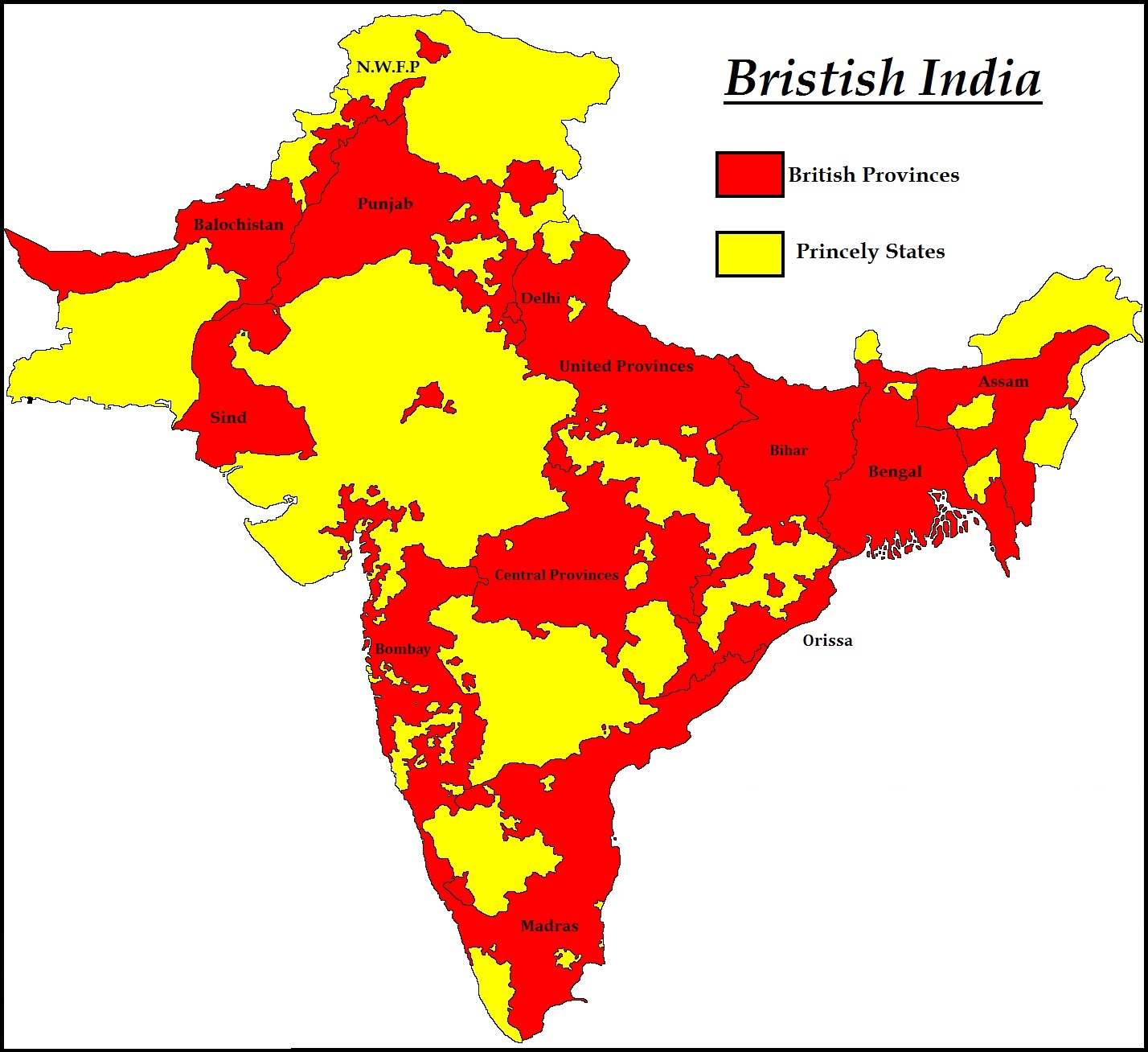
British created a recipe for disaster. And it did strike badly. The “great unitors” of India left in 1947 leaving India in the condition shown below.


Map of British ruled regions and princely states before independence of India

Patel To The Rescue

Patel accomplished which Nehru couldn’t, and which the British didn’t wish to. The civilizational consciousness was alive in the mind of Patel. He stood as a firm wall between us and anarchy.

After the interim government was sworn in July 1946, Patel became the Minister of State Affairs taking forward the tough task of integrating the Princely States into India (No Independence and No Pakistan). He used tactics of pressure and persuasion ensuring the integration of Princely States into India. The task was quite tough. Sardar’s deputy was V.P Menon who was sent for negotiations. An Instrument of Accession was to be signed by prices surrendering their rights and a Standstill Agreement was signed to maintain status quo till a new constitution was promulgated. The princes were to be paid fat privy purses and could be sent as High Commissioners and Ambassadors to foreign countries.

You can’t become the Loh Purush of India without facing challenging situations. Some Princely States understood persuasion. At times, the pressure was applied. Fear for the future of the Hindu community drove Rajput states to India. Once, a heated discussion led to the Raja of Jodhpur point his gun at V.P Menon.

The efforts of Travancore to become independent and seek recognition from United Nations were foiled. A plebiscite was taken in Junagarh leading to the fleeing of its Nawab to Pakistan. The pinnacle of Patel’s legacy was his Operation Polo leading to the surrender of Nizam of Hyderabad in 1948.

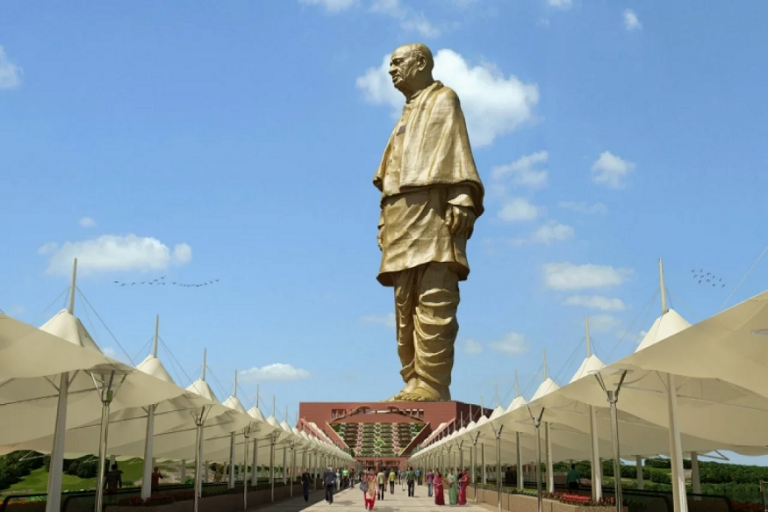
World’s tallest statue is just a small tribute we can give to this man.

As a parting note, let’s leave you with what the arrogant, stubborn and a foolhardy Nizam of Hyderabad was forced to do when Hyderabad was conquered. That’s what our Sardar was:

‘Judges sit in this cozy area where nobody comes to question them. People question me, I am responsible’: Delhi BJP chief to SC

The Supreme Court has reserved its order on the contempt proceedings against Delhi BJP chief Manoj Tiwari. Tiwari is alleged to have broken the seal of illegal premises that was sealed by the civic agency at Delhi.

Senior advocate Vikas Singh argued on behalf of Tiwari that the monitoring committee was carrying out sealing drives in unauthorised colonies and wanted “to terrorise the people of Delhi”. “The particular colony was never entrusted with the monitoring committee. It was beyond the jurisdiction of the committee. The monitoring committee is terrorising people of Delhi“, submitted Singh.

He further alleged that the monitoring committee and corrupt officials are running a “corruption racket in the capital”. He also added that the monitoring committee is not doing its work in a responsible manner.

The bench comprising Justices Madan B Lokur, S Abdul Nazeer and Deepak Gupta was further told that the act did not amount to contempt and that as a politician, he is answerable to the people. “Judges sit in this cozy area where nobody comes to question them. People question me, I am responsible,” Singh said arguing on behalf of Tiwari.

Singh also claimed that “there are numerous illegal constructions across Delhi but no action is taken against them” while adding that in a particular locality “seals were broken and the EDMC officials were beaten up but no case was registered against them.”

It was also argued that if Tiwari hadn’t broken the seal, the mob which had gathered may have resorted to violence. He has been asked to appear before the court again when it will pass the order.

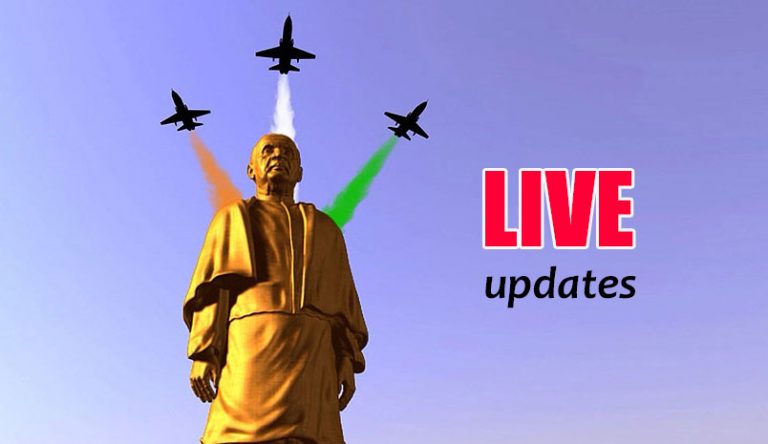
Statue of Unity inauguration Live updates: Had it not been for Sardar Patel, we’d need visa to see Gir lions, says PM Modi

As Prime Minister Narendra Modi inaugurates Statue of Unity – the tallest statue in the world dedicated to Sardar Patel – on his birth anniversary today, we bring you the latest updates in this live blog.

You don’t need to refresh this page to get the latest updates, just keep this window or tab open, and get all the relevant details. Please allow a moment for the live blog to load:

[arena_embed publisher=”opindia-com” event=”1540958868446″]

Gujarat gears up for inauguration of world’s tallest statue by PM Modi

0

To honour one of its greatest sons, the state of Gujarat is gearing up to the inauguration of World’s tallest statue- ‘The Statue of Unity’,  dedicated to Iron Man of India’ Sardar Vallabhbhai Patel on Sadhu Bet island.

On Wednesday, Prime Minister Narendra Modi will inaugurate the Statue of Unity, a memorial dedicated to India’s first Home Minister Sardar Patel. The statue stands tall at 182 metres from the ground and 240 metres from the Narmada river base, is touted to be the tallest statue in the world built at the cost of over Rs 3300 crore.

The Gujarat state government has planned various cultural events on the occasion of the ‘Rashtriya Ekta Diwas’ (National Unity Day) to mark the 143rd birth anniversary of India’s former Deputy Prime Minister Sardar Vallabhbhai Patel. The people of Gujarat have already arrived at Sadhu Bet island to witness the historic occasion. The Prime Minister Narendra Modi will inaugurate the statue by offering an ‘Abhishek’ of Narmada water and then address the gathering.

Reportedly, the BJP government has planned an event similar to the Republic Day to mark the unveiling of the Statue of Unity. The three-hour ceremony will include flypasts by the Indian Airforce, performances by ceremonial bands of the Army, Navy and the Indian Airforce. The folk artists from Punjab, Assam, Mizoram and Gujarat will also be performing at the event.

On this historic occasion, lakhs of people have also joined the ‘Run for Unity’ marathon held across the country to mark the birth anniversary of Sardar Patel. Union Home Minister Rajnath Singh inaugurated the ‘Run for Unity’ marathon from Major Dhyanchand Stadium in New Delhi. Union Minister Dharmendra Pradhan flagged off the event in Odhisa while Defence Minister Nirmala Sitharaman participated a ‘Run for Unity’ marathon in Chennai.