Home Blog Page 7048

Democratization of Information: The age of alternate media

0

To understand the current Indian media scenario, one has to look back to the time when it all started. In 1991 after the economy was ‘liberalised’ and Indian market opened up to institutions and investors around the world, the media industry flourished but not at par with other industries of the core kind. Coupled with the stunted initial years, government monopoly and red-tape over Indian broadcasting, private TV especially news suffered a substantial lot.

Slowly but surely it took off and now we have a situation where there are more than one hundred 24X7 news channels in 12 languages. This awe-inspiring number is in itself a dichotomy. On the one hand, this number ensures a pluralistic flow of information, on the other, this means the qualitative aspect of news goes down the drain. This was a matter of great debate since the broadcasting format takes away the required temper and approach of news and replaces it with haphazardly put together commercialized packages.

This was before the ever-increasing penetration of the Internet and along with it, the news websites. The core reason that the commercialization of news in broadcasting format is mentioned today, is to provide context for this section. News can make or break any political or social programme. This, in turn, makes the TV broadcasting format a very powerful institution, especially since Indian broadcasting companies decided to follow their American counterparts by making celebrities out of their anchors. This meant a huge amount of influence in the hands of a very few men.

Which was not the case right up to the early 2000’s but the trend shifted and with it the public perception of media and its credibility. In mass communication, there is a term – “gatekeepers” – who much like a gatekeeper at a complex, decides which news be made public and which not to. There are well-established metrics to measure one incident’s newsworthiness but in practice, it all came down to the gatekeepers, who we all know as editors or anchors in the broadcasting scenario.

A free press is believed to be a bellwether of a healthy democracy but when the talking points for a nation like India is decided by not more than thirty people then there is something seriously wrong with the setup. With the advent of the internet, the power to debate was restored to the masses. On the internet, people found a platform where they could skip the corporate structure and disseminate information without any hindrance from commercial interests. The initial online news dissemination was aimed at creating an alternative to the “mainstream media” in terms of fact-checking them, calling out their political bias, etc.

With the advent of various news portals, the allure of polished and suit-clad news anchors and Harvard English now lies in tatters. This medium has taught many Indian that speaking impeccable English or living in a metro city is not a pre-requisite for their opinions to matter and the portals are nothing but the actualization of their ambitions.

This is not an isolated event occurring in India, throughout the world the entire concept of media is being re-conceptualized. The portals are becoming the “The salons of Italy” or “The French restaurants” during the French revolution. More and more important topics are being discussed in these portals and their influence on real-life events are also increasing.

The ‘right’ leaning news portals are an example of this. Such portals have given a voice to many who would have otherwise been humiliated, name called and discounted simply because the established media is traditionally left-leaning and not predisposed to handling ideological diversity well.

Not long ago, the cost of communicating with thousands of people was an enormous and expensive endeavour but the internet has changed all of that. Many would call news portals a more structured form of citizen journalism, where citizens have taken back their representation from big corporate houses who are almost always burdened by economic considerations. As we all know, the media is to behave like a canary in the mine but if the canary is colluding with the mine owner then it is the workers who suffer.

Now, there are of course a few setbacks to this particular medium. The first and the most damaging one is the creation of ‘echo chambers.’ It is not entirely the fault of the consumer, the social media network’s algorithms track our likings and then floods our profiles with news related to that particular political or social lineage. This, in turn, creates a “fight reaction” where, everyone is an enemy and makes the user vulnerable to anger, conflict and paints a picture of a polarized world. Which in many cases is not the truth, the same for broadcasting is called “mean world syndrome”. This creates an unbalanced picture of the world to the consumer.

There is also another aspect that is extremely serious, one of ethics and editorial policy, where to draw the line between advocacy journalism and writing a petition. This is a serious issue both in TV and maybe more in social media because most of these institutions are still evolving and in process of creating their own editorial policies. If not done properly it could lead to loss of credibility. It is especially important for online portals as they are up against the big corporations who are just waiting for them to make a wrong move so that they can call for stricter regulation.

Going forward, the traditional media will continue to be on the decline and the alternative media will in time replace the traditional media. All said and done, the Indian media scenario has changed forever and one has to say for the better.
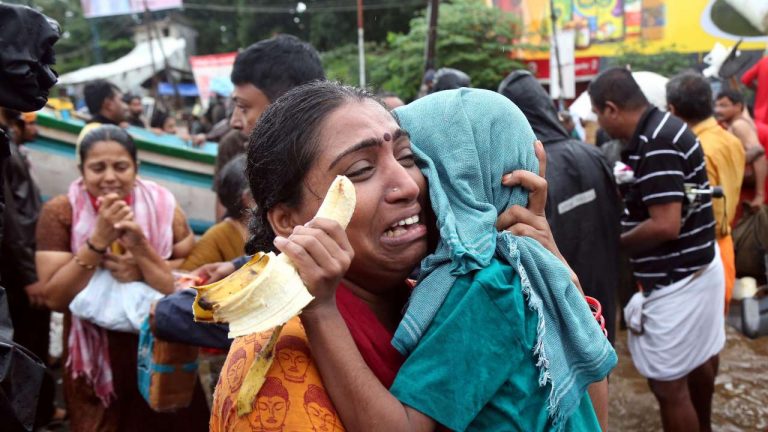
Kerala floods: Migrant workers discriminated against in providing relief, say reports

0

Even as relief and aid pours in from across the world for Kerala, which has faced one of the worst floods in decades, reports are emerging that non-Malayali workers are being discriminated against in relief camps in Kerala when it comes to providing relief material. As per reports, the migrant workers have been the ‘least priority’ for the locals in rescue operations where the rescue boats which came to evacuate people to the church came to them last. As if that was not enough, they were later on discriminated against food and supplies.

Few volunteers even reportedly refused to give aid to migrant workers and at many places asked to leave the camp. Migrants workers, mostly from West Bengal, were in the worst-affected areas of the flood in Ernakulam, Pathanamthitta, Wayanad and Palakkad districts. It is estimated that about 1 lakh migrant workers from Bengal are in helpless condition.

The condition of migrant workers in relief camps was so bad that authorities had to open exclusive camps for migrant workers. In a camp in Perumbavoor, the government had to set up a separate camp for migrants after locals refused to share space with them. While some employers paid the workers their dues, many didn’t and the migrant workers were left high and dry with no money, no food and no relief coming their way. 20% of migrant workforce comes from Bengal, 18% from Bihar, 17% from Assam and 15% from Uttar Pradesh. Some migrant workers also said that the state government did not effectively communicate to the migrants in low lying area for timely evacuation as most of the warning notices were in Malayalam.

Kerala faced one of the worst floods in decades where hundreds of people have lost their lives and thousands have been displaced. The state and central government have mobilised all possible resources towards relief and rescue operations. Unfortunately, even a natural calamity was used to settle political scores.

Nagaland Congress opposes immersion of Atal Bihari Vajpayee’s ashes in a ‘Christian majority state’

0

In another display of pettiness by the Congress, the Nagaland State Congress labelled the immersion of ashes of Former Prime Minister Atal Bihari Vajpayee as an imposition of ‘alien rituals’ on the state, which is a ‘Christian majority state’.

The Congress on Friday said the immersion of Vajpayee’s ashes in some selected rivers of the country had been turned into a “political circus” by BJP and its Nagaland unit.

“The activities of BJP Nagaland and particularly its state president displaying their eagerness to please their communal masters by following and observing rituals that are alien to our way of life is an insult to all right-thinking Nagas. While Nagas have been struggling for the past seven decades to protect our unique history, the all-out attempt by state BJP to assimilate themselves into a new alien culture as dictated by their high command is a severe assault on the aspirations of the Nagas and their future,” the Congress had said.

The party furthered, “Respecting others’ belief and culture should not be at the cost of compromising our very own belief and culture that forms the core foundation of our existence as an individual and a tribe. The zealous conduct of the State BJP president (Temjen Imna Along Longkumer) in propagating the Hindutva culture of the RSS in the State which is even despised by the majority of Hindus across the country, therefore, needs to be seriously condemned.”

However, Despite Nagaland State Congress’ acrimony over the move to immerse Vajpayee’s ashes in the Doyang river, the BJP state unit chief Temjen Imna Along Longkumer, undeterred, said the ashes would be immersed on Monday. “Yes, I will immerse the ashes in Doyang river on Monday,” he told The New Indian Express.

He had brought the ashes from New Delhi on Thursday and kept it at his residence in state capital Kohima.

Reacting to the criticism by the Congress on the issue, Longkumer said: “Congress is doing its job. There is no ritual, only respect to our departed leader”.

Meanwhile, in another Christian-majority state, Mizoram, Vajpayee’s ashes were immersed in Tlawng river.

The urn, containing the ashes, was brought to Aizawl from New Delhi by state BJP chief JV Hluna. The immersion followed a funeral with full Christian religious honour at BJP’s state head office.

The party in its attempt to ensure that admirers could pay floral tributes to the people’s leader had decided that the urns carrying late Vajpayeeji’s ashes travel to every taluka of the country.

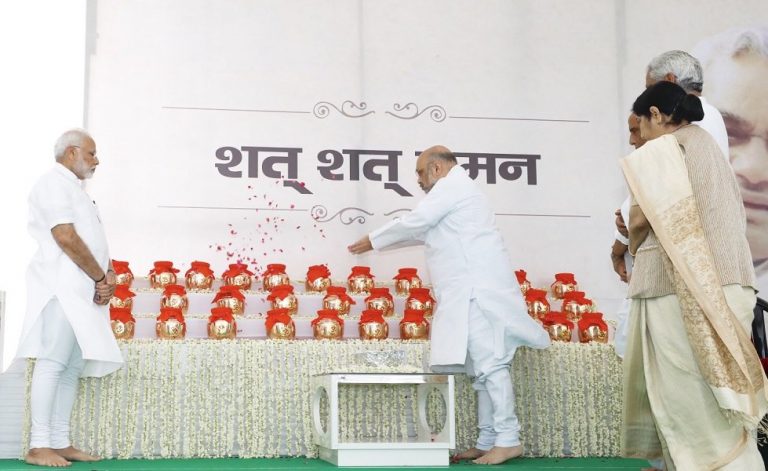
Last week, Prime Minister Narendra Modi, BJP President Amit Shah, Union Home Minister Rajnath Singh and External Affairs Minister Sushma Swaraj had gathered along with senior leader Ram Lal and Vajpayee’s family members at the old headquarters to hand over the urns to President’s of the party’s state units from all over the country.

The ‘Atal Ashti Kalash yatra’ will lead to the immersion of the former Prime Minister ashes in nearly 100 rivers across the country.

FIR against Madhya Pradesh Congress MLA Umang Singhar for assaulting a BJP worker

0

The Madhya Pradesh police have registered an FIR against the Congress MLA from Gandhwani, Umang Singhar and others for indulging in vandalism and threatening a BJP worker in Dhar district of Madhya Pradesh.

The incident took place on Saturday, when BJP MP Savitri Thakur, along with BJP leader Pradeep Gadiya and some officials were visiting the village to give the compensation cheque of Rs. 4 lakh to the family of a young girl who had died due to electrocution on Friday. The 8-year-old girl Pinky, daughter of Bhur Singh, died due to the open wire of light on the roadside in village Barda near Tanda.


The Congress MLA Umang Singhar and his supporters were also present at the village. It is reported that there was some heated arguments between the BJP and the Congress leaders. A video has gone viral, where Umang Singhar is seen snatching the cheque from Gadiya and slapping him. The incident took place in the presence of police officials.

The BJP leader Pradeep Gadiya has now filed an FIR against the Congress leader. Dhar SP Virendra Singh said the FIR had been lodged against the MLA. Gadiya has accused the Congress leader and his supporters for threatening to kill him. He also presented the video clip as evidence in his complaint. On Sunday, BJP MLAs and leaders had come out to the streets to protest against the Congress leaders and they demanded strict action against the legislator.

The fine line between Cultural Appropriation and Cultural Digestion

0

On 22nd August Quillette Magazine published an article on the subject of “Cultural Appropriation” which was written by Neema Parvini. Neema Parvini makes a passionate case for intercultural exchanges where she states a wide range of examples of wonderful cultural exchanges that have led to “curry being a ‘National Dish’ for the UK” to the Shakespearean Sonnet being created thanks to cultural exchanges with the Italians where the sonnet was invented “in the year 1235 by an Italian lawyer called Giacomo da Lentini and then popularised in the fourteenth century by Francis Petrarch.”According to Neema Parvini”.

The idea of ‘cultural appropriation’ is not only illiberal, it is spectacularly anti-progress (in the technological sense), anti-trade, and anti-global. With the exchange of goods and services across borders over the centuries has come also the flow and exchange of words and ideas.

I then watched Dave Rubin interview Jeffrey Tucker, where they discussed this matter for 6 minutes (Watch from the 14-minute mark to the 20-minute mark).

[youtube https://www.youtube.com/watch?v=FmsXeXpRPlk?start=840]

Jeffrey Tucker says “civilisation is nothing but cultural appropriation”. According to Tucker “if we had stayed isolated in our tribes we would have never progressed”. Cultures are infinitely reproducible and malleable and the beauty of the human race lies in this exchange of ideas and concepts.

Now I am in agreement with the larger points mentioned by Neema Parvini and Jefferey Tucker. But, I still feel some of the points which Rajiv Malhotra had raised in Being Different were valid and I have tried to use some of his arguments while adding my own little twist to it below. I don’t agree with Mr Malhotra’s conclusions completely, but some of the points he raises are very vital and important.

I feel dismissing cultural appropriation completely (lock stock and barrel) is not a fair assessment in my view. As a Dharmic Indian Skeptic/materialist/atheist who has lived in the West for a while and now is back in his motherland for the last 17 years I do understand the other side of the argument. We should all encourage the exchange of ideas and cultures. It makes us far richer and dynamic as a global society at large. But somewhere in all this outrage, we keep forgetting the basic reality that there is an asymmetry when it comes to cultural exchanges. When I as an Indian wear a pair of jeans they do not get called Indian clothing even if 5 generations of Indians wear jeans. But, on the other hand, if someone in the West was to make a slight modification to an Ethnic Indian garment and present it as an offshoot of something Indian eventually 3 to 4 generations down the line the connection to India will get completely forgotten/vanished.

The downside of that is that in the case of the latter, the appropriated idea or the idea which got inspired via an Indian dress basically got stuck and could not reap the benefits of further developments happening on the Indian side. While the Indian side gets constant benefits from the Western side because they never deny the origins of where the attire (jeans) came from. So I would like to differentiate between cultural appropriation (which is a healthy exchange) and cultural digestion (which is a onetime snatch and grab). I am using the term “digestion” used by Rajiv Malhotra in Being Different as a concept which is different from “appropriation”, while Rajiv Ji uses them in a far more overlapping way in his book Being Different in my assessment.

I could use another example from within my own culture. A lot of our current Indian cuisine uses a lot of vegetables that were gotten into India from Europe and other areas. I am glad Neema Parvini mentioned that in the article. But even today in India many Indians are very much aware of where those vegetables came from. In fact, the History Channel (if my memory serves me properly) had done a program where they gave a complete history of where our vegetables came from. But I have my doubts if the same thing happened in the West the average westerner would remember such a thing. Is there a power dynamic at play here? I hate to admit it but yes you could accuse me of using a slightly postmodern view here.

Someone might say how does all of this matter? And I hear you. While I hate the “you cannot celebrate another culture” crowd completely, I also find merit in the argument of paying respect to the sources. When we pay respect to the sources it leads to a much more healthy and balanced cultural exchange and leads to far greater societal benefits. To me, these are not minor quibbles, if you see it from the point of view of the other culture that is getting digested completely and all traces of the origins of the idea are being removed over time due to a variety of reasons.

I see a lot of that happening where Vipaasnaa becomes Mindfulness and eventually the average culture at large will not even know that a thing like Vipassana exists a few generations down the line. Or when Yoga Nidra gets called Lucid Dreaming without any mention to the original source i.e. the Indo-Tibetan culture.

Yoga could also get uprooted completely from its roots. There are attempts to disconnect Yoga from its ancient Hindu roots in the form of Christian Yoga here (https://holyyoga.net/). In my view, this is an intellectual property rights issue. We should all celebrate each other’s cultures and learn as much as we can from each other. But, at the end of the day what is the harm in acknowledging the real source of the knowledge? Is it ok if I start calling Richard Dawkins concept of “memes” or “Poppers Paradox of Tolerance” as some new fancy sounding Sanskrit name and spread it around without acknowledging the original source? Or to use an example from Neema Parvini’s article, can I state that the knife and fork are Indian inventions?

We have had a recent incident where newspapers outside India were rightfully mocking and taking objection to the outlandish claims made by an Indian politician about the internet being invented by Ancient Hindus. What if someone from the West comes and confronts me about it and I give them an answer “You should be happy that I am sharing the ideas that emanated from your culture because if you did it my people will not take it seriously. After all, I am presenting it in a much better/palatable way to my own audiences”.

The issue of recognising the true source matters a lot. It is a case of intellectual honesty and transparency. So while we should all dismiss the ridiculous concept of cultural appropriation as it is being presented by the modern western left, we should always stay vigilant about some of the points that I have raised above. In my view, if we really want a truly global/plural world we have to acknowledge the difference between appropriation and digestion. Appropriation is very good but Digestion is harmful because it impedes further progress.

Maybe the lines between appropriation and digestion need to be refined far more than what I have done above. I don’t claim to have nailed it completely. But, after reading the article and watching that video I felt this view is missing from the overall discourse. You are either for “all cultural appropriation is bad” or there is “no such thing as cultural appropriation”. To me, the differentiation between appropriation and digestion matters a lot.

Hope all of you who read this appreciate that I come from a place of intellectual curiosity and not malice. I am more than happy to see people from other cultures wearing Indian clothes, eating Indian food, celebrating Indian culture and benefitting from all the aspects of my culture. But all I demand in return is it stays at the level of healthy appropriation and does not become digestion.

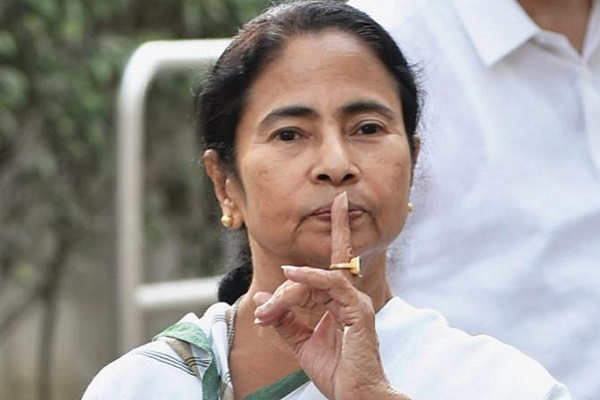
Mamata Banerjee labels Jharkhand BJP government ‘inhumane’ for stopping animal slaughter in public

0

West Bengal Chief Minister Mamata Banerjee continuing her attack on the Bharatiya Janata Party alleged that the BJP government in Jharkhand is responsible for the unrest in Pakur on Eid. Banerjee blamed the police for ‘targeting a particular community’ on the day of the festival. Police had to open fire on people after reports of people sacrificing a cow on the occasion of eid emerged. According to Banerjee, several injured people fled from Jharkhand to West Bengal after the incident occurred. These people are now being treated at hospitals in West Bengal she told reporters.

Tension flared on Wednesday when a dozen people in Dangapara village of Pakur in Jharkhand were injured after villagers clashed with police over reports of cow slaughter during Eid celebration in full public view. According to the police, the clashes occurred when police reached the village and tried to stop animal slaughter which was happening in public view. Five policemen were injured in the following clashes.

She also accused the incumbent Jharkhand government of targeting a specific community and of behavior which she categorized as ‘inhumane’.

The laws regarding cows and cattle slaughter differ from one state to the other. In some states, there is a blanket ban on cattle slaughter, including cow and buffalo. The Jharkhand government in 2015 had banned cow slaughter in the state.

The West Bengal chief minister also accused the BJP government in Jharkhand of dictating people’s food habits and that she would provide ‘shelter’ to the these ‘refugees’ and provide them healthcare.

Earlier this week, the West Bengal government filed an affidavit in the Calcutta High court stating that the state lacks the needed infrastructure to stop the animal slaughter. The affidavit was filed in response to the court order directing the TMC government to regulate animal slaughter during Bakri Eid.

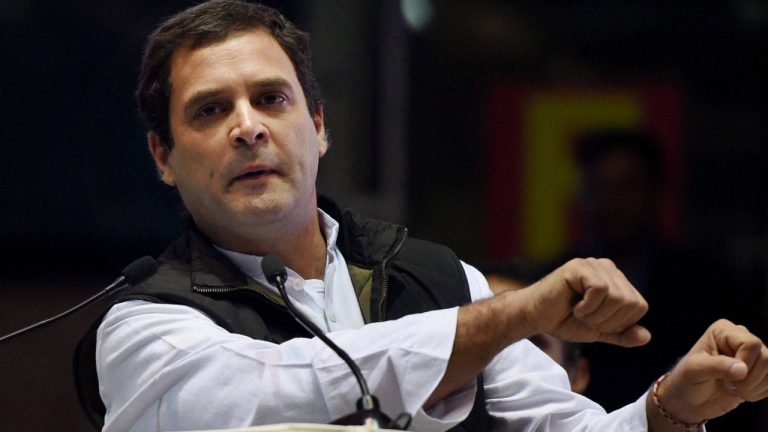
Did Congress President Rahul Gandhi just admit that UPA failed to generate jobs?

0

Days after advocating ISIS Rojgar Yojana, where he equated ISIS terrorists to ‘poor unemployed youth’, he has now upped his game. He has claimed that the reason people like Prime Minister Modi and US President Donald Trump got votes is because people were angry due to unemployment and had much expectations from them. Interacting with Indian Journalists’ Association in London, the Congress President said that people support Modi and Trump because they are ‘angry because they don’t have a job’.

For someone who aspires to be Prime Minister of India in 2019, Rahul Gandhi needs a refresher course. For ten years before Modi got elected, the UPA led by Congress, where his mother Sonia Gandhi is the chairperson, was in power. That senior Congress leader Dr. Manmohan Singh was the Prime Minister. So essentially, if what he is saying about people voting for Modi and Trump because they are angry due to unemployment, it is probably because UPA failed to generate jobs.

This statement of his came a days after he embarrassed himself on an international platform by admitting his ignorance on Doklam issue, while constantly criticising and questioning the government on the same on all forums.

This is not the first time Congress’ Prime Ministerial candidate has made a self goal. Earlier, in a bid to attack the PM earlier, Gandhi had inadvertently implied that the Nirav Modi-PNB scam was approved by Congress in 2011 when the UPA was in power. In January this year, to appear ‘woke’ on rising inequality, Gandhi ended up sharing an article which had damning indictment of UPA rule itself.

Anil Ambani files Rs. 5000 crore defamation suit against National Herald for ‘defamatory’ article on Rafale deal

0

Anil Ambani’s Reliance Group has filed a Rs. 5000 crore defamation lawsuit against National Herald for an alleged ‘libellous and derogatory’ article published on the Congress mouthpiece regarding the Rafale deal. We had reported earlier that Reliance had issued a ‘cease and desist’ notice to Congress leaders stating that freedom of expression does not give politicians license to make distorted statements to suit their political interests.

The civil defamation suit was filed by Anil Ambani’s Reliance Defence, Reliance Infrastructure and Reliance Aerostructure against the publisher of the National Herald, Associate Journals Limited, its editor in chief Zafar Agha and Vishwadeepak, the author of the article. The Companies further allege that the article titled ‘Anil Ambani floated Reliance Defence 10 days before Modi announced Rafale deal’ was libellous and defamatory and it “misleads the general public to believe that undue business favours are being extended to them by the government of the day”.

The defamation suit also claims that the article portrays a “negative image” and “adversely affects the public perception” of Reliance Group and its chairman Ambani. The article also caused “considerable damage” to the reputation and goodwill of the plaintiff firms.

The Congress party remains defiant and its national spokesperson, Priyanka Chaturvedi, has claimed that the defamation suit is a deliberate attempt to silence their voices.


The Congress party has maintained, despite significant evidence to the contrary, that the Rafale deal is a scam. Rafale chief Eric Trappier himself confirmed that the higher price was due to higher capabilities and nature of the contract between India and France. However, Congress President Rahul Gandhi refuses to heed a great deal of evidence and continues to target the Modi government using the Rafale deal.

Army veteran schools those who raise questions with regards to Doklam standoff

0

Rahul Gandhi, continuing his habit of scoring own goals, stated during an event in London at the International Institute of Strategic Studies that he has no details of Dokalm that is precisely why he wouldn’t be able to respond to the question of how different his approach would have been in solving the crisis. It was proven later, that aside from being a self-goal, Rahul Gandhi was also being untruthful about him not having all the details to comment on the Doklam issue.

Some would find such ignorance about a geopolitical issue from the president of the principal opposition party in the world’s largest democracy astonishing but Rahul has time and time again proved himself to be at best disconnected from facts and at worst misinformed.

Following Rahul Gandhi’s comment on Doklam, MJ Akbar, the MoS for External Affairs on Saturday took a jibe at Rahul Gandhi by questioning the IQ of those who criticized the government’s handling of the Doklam crisis.

The MoS stated that he wishes that some of the people who seem to be talking had a better sense of what ‘governance’ is.

“I seriously do not wish to use any harsh words because it may be inappropriate, but who clearly prove over and over again that they have no knowledge, no understanding, no IQ sense of what governance is all about,” he added.

It is not only the MoS who have taken an exception to Rahul’s comments. Lt. Gen(R) VG Khandare also took an exception to the ill-informed comments made by Rahul. The retired army man stated that during the stand-off the Indians were not sweating but the Chinese were. He refused to comment on it further as the bilateral relations between Indian and China are getting better.


The general also provided a very interesting explanation, he pointed out that there is a difference between opinions and informed opinions. Thus, people who are responsible for taking such decisions should be encouraged and one should have faith in that system.

Fact Check: Did Arnab Goswami really call Keralites shameless?

0

A video has been circulated on social media which claims that Chief Editor of Republic TV, Arnab Goswami, insulted the people of Kerala by calling them “the most shameless bunch of Indians I have ever seen”.


The video has inspired many to troll Arnab Goswami ruthlessly on the social network. The video was picked by the Malayali newspaper ‘Mathrubhumi’ who published a report on the issue with the headline, “Arnab Goswami calls Keralites ‘shameless’; Malayalis hit back with trolls”.

However, when one watches the video closely, it becomes obvious that Arnab Goswami is not calling Keralites shameless but those people who spread the lie about the 700 crore rupees aid from UAE. It’s them that he is calling anti-nationals, shameless and paid agents in the video. But several ‘trolls’ who used the Kerala floods to fan regionalist sentiments on social media and fuel a North-South divide, carefully twisted Arnab’s words to paint him as abusing Keralites. It is also interesting that Mathrubhumi did not carry out a basic fact-check and took the words of trolls on social media for gospel truth.

In the same debate itself, Arnab Goswami praises Keralites profusely and empathizes with them over the misery they have had to suffer. He says, “When the people of Kerala have been so physically vulnerable, because Ranjeev, the people of Kerala have been so psychologically resilient, you know, and I come from Assam which has been a flood-ravaged state myself, and I can therefore empathise. The people of Kerala, psychologically resilient. They have shown how great they are as people, how strong they are, and I am only saying, at this point in time that somebody is using fake news to manipulate them. Manipulating people at the time of tragedy is cheap. I have proven it that this was happening and the Congress hand is all over it. In fact, I will tell you one thing, I find less of a left hand in this but I see a very strong Congress hand if you analyse the number of tweets here. Gunja, do you manipulate people? Do you play on their sentiments? Will the people of Kerala forgive this?”


The video that was circulated to claim that Arnab Goswami insulted the people of Kerala was one where Goswami’s words were carefully taken out of context to accuse him of what communists from Kerala do on a daily basis, insult people on the basis of the state they come from. The lie about the flood aid from UAE has left communists deeply embarrassed as it was claimed by Chief Minister Pinarayi Vijayan himself. To deflect attention from their massive propaganda fail, Arnab Goswami is being targeted.

We have reported how the Kerala floods were used by a certain section of the political spectrum to fan separatist sentiments. The Flood aid lie was also used to accuse the Central government of being unsympathetic to Kerala and project foreign nations of being more generous towards the state North Indians. All of this appears to be a carefully constructed propaganda project to deflect attention from the man-made aspects of the flood as some experts have claimed and shift attention by blaming the central government, the state of Tamil Nadu and now a misinformation campaign against Arnab Goswami.