Home Blog Page 7064

National Herald: HC today to hear Rahul, Sonia Gandhi’s petition challenging reopening of tax assessment

0

On 8th August 2018, Rahul Gandhi had challenged Income Tax authority’s order to reopen his tax assessment related to the National Herald and Young Indian transactions. The tax authorities had told the High Court that informed the High Court that the AICC gave Rs 99 crores to Associate Journal Ltd and added that Rahul willfully chose not to disclose that he held the director’s post at Young India. Rahul Gandhi had also requested the HC to impose a media gag in the National Herald case. The court, however, had refused to grant any interim relief to Rahul Gandhi. The court had said that it will establish whether Rahul Gandhi was obligated to disclose his directorship.

The additional solicitor general (ASG) Tushar Mehta had objected to any interim order being passed regarding Rahul Gandhi’s petition and the High Court had set the date of hearing in Rahul’s case as today, 14th August.

A similar petition now has been moved by Sonia Gandhi and Oscar Fernandes. Sonia Gandhi and Fernandes have filed separate petitions challenging the reopening of their assessments by the Income-tax Department regarding the Young Indian-National Herald transactions and the petition is to be heard today.

The plea is listed for hearing before a bench of Justice S Ravindra Bhat and Justice A K Chawla. The same bench had on August 8 refused to grant interim relief to Rahul and had posted his petition for Tuesday.

As per the tax department, the shares Gandhi has in Young Indian would lead him to have an income of Rs 154 crore and not about Rs 68 lakh, as was assessed by it earlier and it had applied section 147 of the Income Tax Act, which provides for bringing under the tax net any income which has escaped assessment in the original assessment.

Sonia, Rahul, Young Indian (YI) and others were earlier summoned as accused by a trial court in the National Herald misappropriation of assets case. The crux of the case lies in the fact that the Indian National Congress/All India Congress Committee (AICC) had over the years advanced a loan of 90 crore rupees to Associated Journals Limited (AJL), which published its mouthpiece, the National Herald. These loans were later sold cheap for just 50 lakhs rupees and were used to give a 99% stake in AJL to the Gandhis, via the company Young Indian (YI), thus transferring the ownership of valuable assets owned by AJL to YI.

Earlier too, we had earlier covered how the Gandhis had tried to thwart the Income Tax’ investigation into the National Herald case. Congress had also earlier reportedly threatened tax officials with legal consequences for asking “irrelevant questions” during their investigations.

As the investigation proceeds, the Gandhi’s seem to be getting jittery and now it remains to be seen whether the High Court will grant relief to Sonia and Rahul Gandhi, or would Income Tax get to reopen their tax assessment case.


Govt takes exception to over half the names sent for High Court Judgeship based on IB report

0

With charges of nepotism already looming the country’s judiciary, it seems that the judiciary is in a state of flux. As reported by the Times of India, the government has yet again expressed reservations for over 50% of names sent for the appointment of HC judgeship.

The Central government is said to have expressed reservations over half of the recommended candidates for appointment as judges to the High Courts. The names of 126 names candidates were sent to the centre as a part of the process to appoint judges to the High Courts. The centre has expressed apprehensions about some candidates over issues like minimum income requirements, probity and competence.

It is reported that the government conveyed its disappointment after it received adverse reports from the Intelligence Bureau (IB). The IB does detail background check on all the candidates who are being considered for the post of High Court judges.

The process of appointment of judges to the High Courts is clearly spelt out by the Supreme Court in the ‘Supreme Court Advocates-on-Record Association vs Union of India’ in the year 1993. The collegium consisting of the chief justice of respective high courts and two other senior-most judges of the court identifies and recommends the names for the appointment of the judges. The shortlisted candidates are then scrutinized by a collegium of five senior-most judges of the SC headed by the Chief Justice of India. The Central government then conducts intelligence bureau-led inquiry if a lawyer is slated for elevation to a judge in the High Court and Supreme Court. The Centre can raise objections and seek clarifications, but cannot stop the appointment.

The Law Ministry has devised a mechanism to evaluate the judges recommended by the High Court collegium. The recommended candidates will be assessed for merit and integrity, judgments the candidates are involved in, minimum annual income and reputation in legal, professional and public life.

This evaluation process to thoroughly examine the nature of candidates was devised by the law ministry after a deadlock arose between the judiciary and the executive over the issue of a memorandum of procedure (MoP) for the appointment of judges to the higher judiciary.

It is reported that more than 30 to 40 candidates failed to meet the criteria on minimum income level requirements. Lawyers should be having an income of at least 7 lakhs per annum for the last five years to be considered for the selection. The Law Ministry officials have studied more than 1000-1200 judgements as part of the evaluation process.

The IB background checks revealed issues with personal and professional integrity and some cases of nepotism and favouritism among the sitting and retired judges of the higher courts.

The law ministry had received various complaints and after a background check by the IB, it had revealed that more than half of the candidates were someway related to former or sitting judges of the apex court and the high courts.

The government has asked the Supreme Court collegium to carefully consider these issues while making future recommendations.

We had earlier reported that how the present NDA government had given proof for “nepotism” in the judiciary after the IB report had revealed that more than half of the 33 recommended candidates for the Allahabad High Court judgeship found to be incompetent.

Setback for AAP: Kejriwal, Sisodia and 11 other AAP MLAs chargesheeted in Chief Secretary assault case

0

In a major blow to the Aam Aadmi Party, the Delhi Police today filed a chargesheet in connection with the Delhi Chief Secretary assault case, naming Delhi chief minister Arvind Kejriwal, deputy chief minister Manish Sisodia and 11 other AAP MLAs. As per reports, Kejriwal and Sisodia have been booked for criminal conspiracy and if convicted, they may face a jail term for a minimum of one year and maximum up to 3 years.

Nine other MLAs have also been booked under criminal conspiracy whereas other two MLAs, Prakash Jarwar and Amanatullah Khan, have been booked for an attack on a public servant, obstructing a public servant from performing his or her duty, threat, criminal intimidation and conspiracy.

Earlier this year in February, Delhi Chief Secretary Anshu Prakash had registered a complaint with the Delhi Lieutenant Governor (LG) that AAP MLAs, in front of Delhi CM Arvind Kejriwal, had assaulted him at the CM’s residence when he was there for a meeting. However, the CMO had denied the allegations. Following the accusations, not only there was no apology issued, but one of AAP MLAs justified the attack as well as appeared to be encouraging mob violence against people who were perceived as corrupt.

The IAS association, however, came out in solidarity with the Delhi Chief Secretary. Arvind Kejriwal has also accused the IAS officers of not working for 4 months, a claim that was refuted by officers in a press conference. But the turbulent relationship between Delhi Government and bureaucrats show no signs of improvement as just a few days back, the IAS officers had accused Delhi minister Kailash Gahlot of misbehaving with a woman IAS officer.

As ‘Liberals’ blame Arnab Goswami, eye witness claims Umar Khalid wasn’t even present at alleged firing site

0

(This is a developing story and we will update this article as more details emerge)

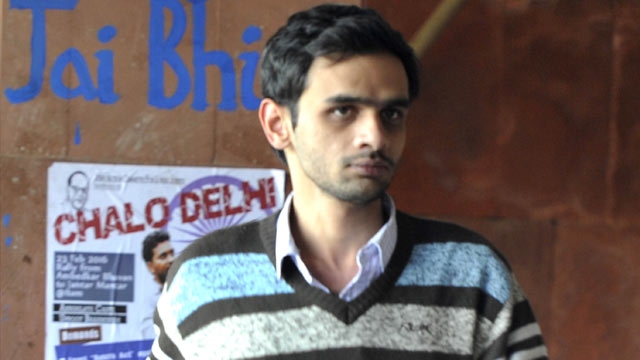
Today, news emerged that unidentified gunmen had opened fire at Umar Khalid, the now rusticated student of JNU who was also a part of the tukde-tukde gang. Indian Express tweeted Umar Khalid was safe and that the incident had occurred in front of constitution club.


Soon, ANI tweeted a “witness statement” where an ‘eyewitness’ was quoted as saying that they were at a tea-stall when a man in a white shirt came, pushed and “opened fire” at Umar Khalid.


No sooner had the news emerged, many started to blame Republic TV news anchor Arnab Goswami for this incident.

Controversial journalist Shivam Vij, who had earlier written about fanning caste tensions to displace Modi took to Twitter to assert that the blame for this “assassination attempt” lies squarely on Arnab Goswami. Although, he has now deleted his tweet.

Soon, Shehla Rashid, eternal rabble-rouser and JNU student activist also chimed in and said that while she has spoken to Umar Khalid and he is okay, the blame lies with Republic TV and other “hate media” who whipped up hate against Khalid, presumably, because they reported his political leanings and statements.

Swati Chaturvedi, the abusive troll who masquerades as a journalist with the leftist propaganda website ‘The Wire’ quoted Shehla’s tweet and agreed with her.

However, a senior journalist with India Today, Rajdeep Sardesai who more often than not agrees with the ones who jumped the gun today reported that the police has given a statement to India Today asserting that there was no firing incident at all. The police told India Today that two suspects were seen with pistols in the vicinity and they have been apprehended.


ANI has tweeted that the police is saying that the details are being verified. The police have mentioned that Umar Khalid claims that someone pounced on him and pushed, thereafter trying to fire at him.


An eyewitness account has now emerged that claims that Umar Khalid was not present at the claimed location at all. Vikas Bhadauria, a journalist with ABP tweeted a video of another journalist, Santosh Kumar with Dainik Bhaskar who was present when the entire incident happened.

Journalist Santosh Kumar says that he saw some men fighting. During the fight, one of them took a gun and tried to fire but the gun didn’t go off. Later, the person ran and fired the gun in the air. He claims that at that moment, Umar Khalid wasn’t present that the tea-stall at all. It was only later that Umar Khalid came out of the Constitution Club to the tea-stall.

However, Santosh Kumar has now said that he can’t be sure whether Umar Khalid was present or not.

Fact Check : Was PM Modi’s biogas comment just hot air?

For the last two days, some twitter handles tried to make fun of Prime Minister Narendra Modi regarding a particular part of a speech that he made at the inauguration of World Biofuel Day. In that speech, as an example of small-scale innovation, PM Modi said he read in a newspaper, the story of a tea-seller who makes tea using the biogas generated from an adjacent sewage as fuel. Quite a few troll handles and media-persons, many of whom spare no effort in defending claims of ‘connecting MRIs’ or ‘aloo ki factory’, tried to mock the PM for his ‘unscientific claims’.

Before we see why the PM’s anecdote is no laughing matter, here are some ill-informed tweets on the issue.

Journalist Shahid Siddiqui jumped to ridicule it.

Soon Sagarika Ghose endorsed Siddiqui.

Even Jansatta ran a superficial, uninformed report on how some people trolled PM Modi’s speech.

Not surprisingly, Delhi Chief Minister Arvind Kejriwal too jumped in. But the joke is really on Arvind Kejriwal as this IITian is ignorant about the fact that combustible gas is emanated by certain kinds of waste.

Here are some reports for the uninformed naysayers.

In 2013, The Hindu has reported about a village that has been using sewage gas for cooking.

If we need an example outside India, Chicago also has done it.

Even after knowing all the facts and possibilities about using sewage gas for cooking, if one tends to argue that it might only be possible in large scale but not on an individual scale as PM Modi narrated, then perhaps they are undermining the wisdom of the common people of this country. Here is a news report from CG Khabar dated 2014, that shows how the exact same thing that PM Modi mentioned has been done by a Chhattisgarh man.

There are also stories about people discovering energy sources in their fields such as this instance. This Madhya Pradesh family reportedly found combustible gas fuel in their long-unused borewell and have been using it for cooking. This is possibly methane.

There are many other such small-scale innovations possible as shown here and many people do this in a matter of fact way. Only those who have never ventured out to see would be ignorant of such possibilities.

When Prime Minister Modi spoke about a tea-seller who made use of sewage gas to make tea, he was essentially appreciating the innovative mind of common citizens. Trying to make fun of this, many turned themselves into a joke.

(the article was first published on www.thetruepicture.org)

Town near Tokyo was named after Goddess Lakshmi, but there’s more that bind Hinduism and Japanese Buddhism

0

Consul General of Japan, Takayuki Kitagawa, speaking to students and faculty of Dayanand Sagar on their graduation day in Bengaluru on Sunday, said that the town of Kichioji near Tokyo was named after Goddess Lakhsmi. “You will be surprised to know that the town near Tokyo has its origin from Lakshmi temple. Kichioji means Lakshmi temple in Japanese,” he said.

Elaborating on the cultural similarities between the two countries and the influence that India had on Japan, Kitagawa said, “There are many more Hindu gods who are revered in the Land of the Rising Sun. For ages, we have been praying to Hindu gods.” He added that it is not just the Indian culture, but even Indian languages that have influenced Japanese culture.

Japan worships a host of Hindus gods and goddesses although they may not always be aware of their origins. Japanese Buddhist goddess Benzaiten, the goddess of everything that flows: water, time, knowledge, music, has origins in the Hindu goddess Saraswati.

As can be seen, while goddess Saraswati, who is associated with knowledge, music, speech and wisdom, is holding a veena, while goddess Benzaiten is holding the Japanese traditional lute, a biwa, which is often used in storytelling. Similarly, Japanese goddess of fortune Kisshoten has her roots in Hindu goddess Lakshmi.

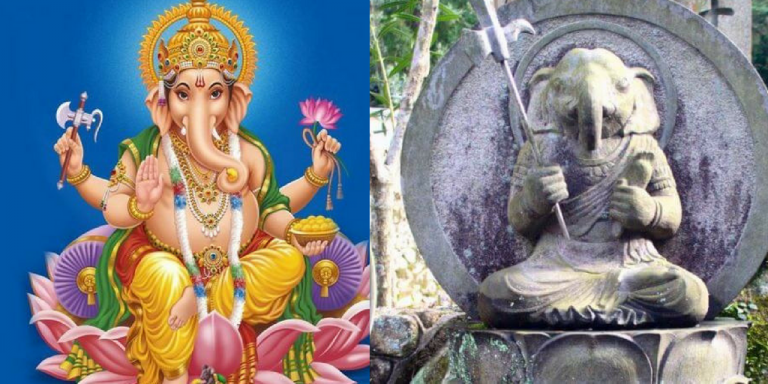
Hindu god Ganesha is also an inspiration for Japanese god Kangi-ten, of the Shingon and Tendai schools of Japanese Buddhism. He is also known as Binayaka-ten, derived from Vinayaka, Ganabachi (Ganapati) and Ganwha (Ganesha). He, like Ganesha, is the remover of obstacles and also bestows material fortunes, prosperity, success and health. Kangi-ten, like Ganesha, is also depicted as elephant-headed, but as a male and female pair.

Left: Ganesha. Right: Japanese god

Japanese god Daikokuten, which is the Japanese equivalent of ‘Mahakaal’ (which literally translates to great darkness) is the god of great darkness and has origins in the Hindu god Shiva. He is one of the Seven Lucky Gods and is associated with wealth and prosperity. Similarly, Hindu god Kubera, the lord of wealth has assimilated as Vaisravana (son of Vishrava) in Japanese Buddhism. While the origins of the Japanese god Vaisravana is Hinduism, the character traits, functions and associated myths are different.

Many books are written on the worship of Hindu gods in Japan and even today, it is claimed that Japan encourages a deeper study of Hindu gods.

After Narendra Modi assumed the seat of Prime Minister, the deep cultural and historical ties between India and Japan have contributed towards bringing the two countries together in the areas of defence, infrastructure and nuclear energy. Japan has also provided loans to India for Narendra Modi’s Bullet Train project at interest rates that can only be described as very generous.

‘Pehle Dharm, pehle Gau-Raksha, baad me Rajneeti’: BJP MLA Raja Singh resigns from party

0

BJP MLA from Goshamahal constituency, Bhagyanagar, Hyderabad, Raja Singh, has resigned as an MLA and party member to commit himself to Gauraksha. He has said that for him, Dharma and Gau-Raksha (cow protection) is more important than Politics.


In his video message on Twitter, Raja Singh has said that he has offered his resignation from the post of MLA and party membership because he doesn’t want the media to use his words and his actions to target Prime Minister Modi and BJP President Amith Shah.

He also stated that the government of Telangana is a ‘Gau-hatyari sarkar’ (cow-killer government). He also accused the Chief Minister of Telangana, K Chandrashekhar Rao, of planning to organize the slaughter of scores of cattle on Eid to get Muslims to vote for his party.

Raja Singh emphasized that ‘anything can happen’ when he takes to the roads for Gau-Raksha, hinting that violence is a very real possibility. He also emphasized that he doesn’t want any BJP member to be answerable for his actions and that is why he submitted his resignation from the party. At the end of the video, he claimed that he would not permit even one cow to be slaughtered in Telangana even if it meant sacrificing his life.

Watch Pallavi Joshi explain what the Rafale deal is in simple terms

0

The Rafale deal has created quite the stir in the country. The Congress party and its allies have been going hammer and tongs against the Narendra Modi led government alleging a scam in the purchase of Dassault Rafale jets despite several experts explaining threadbare why no scam exists. The Rafale chief himself had debunked Congress’ conspiracy theories as well and the Ministry of Defence too had issued statements.

Rahul Gandhi had even alleged on the floor of the house during the no-confidence motion against the Modi government that he had a private meeting with the French President Macron and Macron had himself told Rahul Gandhi that there is no confidentiality agreement and that the Indian government was free to disclose the price of the jets. However, even before the parliament session got over, the French government released a statement refuting Rahul Gandhi’s claims. Later, proof surfaced showing that the Congress government had itself signed the confidentiality agreement.

Even Anil Ambani had written a letter explaining the deal to Rahul Gandhi so he would stop with the platitudes and fear mongering. But to no avail.

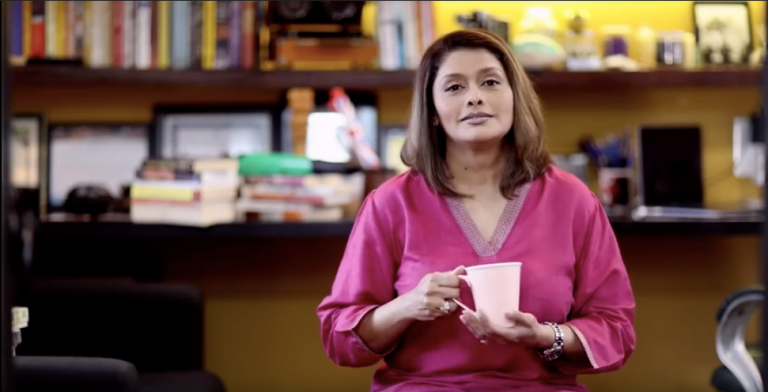
The deal, however, has inspired quite a bit of curiosity. Actress Pallavi Joshi has released a video that explains the Rafale deal in the simplest terms with an everyday example. If one wants to tear through the rhetoric and focus on the crux of the issue, this is certainly the video one must watch.

[youtube https://www.youtube.com/watch?v=TqCjQuKXD5k]

Kanhaiya’s close aide accuses him of being a casteist liar, quits AISF

0

Jayant Jigyasu, a ‘close friend’ and aide of leftist student leader and former JNUSU president Kanhaiya Kumar, has accused him of being a liar and casteist. As per reports, Jigyasu has resigned from the All India Students Federation (AISF), the student wing of the Communist Party of India. Kanhaiya Kumar was previously accused of raising anti-India slogans.

Jigyasu submitted his resignation from the AISF and the Communist Party of India to the CPI General Secretary S Sudhakar Reddy and has shared the resignation letter on Facebook. In that letter, Jigyasu has given a detailed account of how his concerns over the rights of backwards were sidelined and ridiculed by Kanhaiya Kumar over the years. He has also alleged that there exists a class bias and culture of discrimination against student leaders who come from backward backgrounds and from far-flung areas.

In his letter, Jigyasu has accused the leadership of having an aristocratic and casteist culture which destroys the core fabric of the party. He alleges that within the party, personal agendas are being preferred over the struggle for democratic values and leaders for backward castes are treated as bonded labour and are ridiculed regularly. Accusing Kanhaiya of having ‘class arrogance’ and destroying the students’ union for his personal ambitions, he added that Kanhaiya betrayed the JNU student community on several occasions and he is receiving political patronage despite voices in the student community being against him.

Referring to CPI as ‘Confused Party of India’, Jigyasu has accused the CPI of having a wide gap between its principles and behaviour. He has added that the party does not work for socio-economically downtrodden people as it preaches and the workers in the head-office are severely underpaid. He has added that the party hesitates from making a Dalit its general secretary and states that though D Raja is the national secretary, he does not have the leadership qualities or vision required to lead the party.

He has stated that in an attempt to support person-centric and class-biased agendas, the party has been sidelining dedicated and well-trained people. He added that many national and state level leaders have been resigning from AISF. He also added that he is being threatened and his life might be in danger from goons in the party who do not allow a dissenting voice. He has concluded by saying that he cannot compromise with his self-respect, he is unable to watch the moral and ideological destruction of the party and hence is submitting his resignation.

Police submits to mob rule? No permission for Tiranga Yatra in Kasganj

0

Not long back Kasganj was the epicentre of communal tension after an altercation during a Tiranga yatra on Republic Day claimed a life and led to cutting violence. This has led the officials with the district administration to deny permission for any such procession on Independence Day.

Security is also being beefed up with two companies of the Provincial Armed Constabulary (PAC) being deployed in the area to help maintain law and order, and 150 suspected “troublemakers” been bounded under Section 116 (3) of the Code of Criminal Procedure (CrPC), officials added. Section 144 of CrPC- the power to issue an order in urgent cases of nuisance or apprehended danger has also been imposed in Kasganj.

Taking signs from whatever occurred in January this year, district magistrate RP Singh said that though, various organizations had sought permission to organize Tiranga yatras on 15th August, claiming that it was a tradition, “We have not granted any permission for taking out Tiranga yatras, or any such rallies, in the district this Independence Day.”

RP Singh went on to confirm that various programmes were already being organized at schools and colleges, besides the one that will be held at the Collectorate, so anyone intending to celebrate Independence day was free to join the celebration at these places but no permission would be granted for the ‘Tiranga Yatra’ considering the communal violence which enveloped Kisganj during Republic day celebrations.

As per reports, on 26th January morning, ABVP volunteers were taking a bike rally on Republic Day. When the rally reached a Muslim locality, the volunteers started chanting “Vande Mataram” and “Bharat Mata Ki Jai”, on which some people of a particular community got irked. This sparked violence in which a 16-year-old boy, Chandan, was killed. Two more youths were injured in the violence. The district administration had imposed curfew in the area and subsequently cracked down heavily on the rioters, arresting about 121 people including the main accused Salim in Chandan’s death.

With the situation turning murkier, Chandan’s father who had claimed that his son was killed as he refused to chant “Pakistan Zindabad”, and had been proactive towards ensuring justice for his son, had later alleged that he had been at the receiving end of death threats. The media had indulged in quintessential double standards even as Chandan was killed.

A mob must not be allowed to dictate the mobility of Indian citizens. By disallowing the Tiranga Yatra, the police seems to have submitted to mob rule that asserts that it is allowed to indulge in the violence of the worst kind if something irks them. Law and order is to be maintained by police but not by giving in to the demands on violent elements.