Home Blog Page 7407

Congress leaders target Modi’s ‘chaiwala’ background, get exposed on social media

0

The Congress just does not seem to learn. Mani Shankar Aiyyar was one of the first Congress leaders to use the “chaiwala” jibe in a derogatory fashion against then PM aspirant Narendra Modi. Today, Modi is the PM and Aiyyar is in semi-retirement.

More recently, @yuvadesh, the official handle of the Indian Youth Congress’s online magazine, decided to tweet a meme which involved PM Modi. The characters in the meme condescendingly told Modi to “go sell tea”. There was huge uproar and BJP leaders made a big issue out of it, even going to the extent of distributing chai as a sign of protest, outside Congress headquarters in Surat, milking the issue to its fullest.

Now, a new set of Congress leaders have decided to stoke the chaiwala fire again. J & K Congress leader Salman Nizami, tweeted out some “facts”, which he believed punctured the entire claim that Modi had ever sold tea at the Vadnagar railway station:


The allegation was, how could Modi sell tea at a railway station, which was built after Modi left home. National Spokesperson of the Congress, Khusboo, added her comment to the above claim, stating sarcastically that Modi might have been selling tea in his dreams:


Soon the copy-paste factory started, with the same tweets being repeated by Congress supporting handles:


So had Nizami stumbled upon a hitherto unknown fact which debunks Modi’s claims of being a “chaiwala”? Firstly, this was not a new claim, but an oft repeated once, including by disgraced, bigoted cop Sanjiv Bhatt:


Secondly, the claim was fake. Twitter user Anuj Gupta countered the claims of Nizami, by producing evidence that the station at Vadnagar was in fact in existence from 1887:


Gupta, for that matter, is no ordinary twitter user. He is the OSD to the Railways Minister Piyush Goyal. His claim too checked out, as he himself provided the link to the Western Railways site, from where one could download the document stating the opening dates from ‘History of Indian Railways’. In the said document, it was clearly mentioned that a line existed between Mehsana and Vadnagar right from 1887.

And just like that, another lie of the Congress spread on social media is punctured. However, till the time of publishing this article, Nizami had not deleted his tweet.

‘Indic Activists’ appeal for funds to help a school in Tirunelvelli, Tamil Nadu

0

Set up in 2015, Indic Academy seeks to preserve protect and promote Indic Civilisational thought, identity and values. Towards its mission, over the last few years Indic Academy  has undertaken several initiatives including setting up of Indic Book Club a platform for Public Intellectuals to express themselves and become leaders of cultural thought and expression. Indic Academy has also provided several grants to individuals and institutions working in the area of preserving our heritage; some of them include supporting events conducted by  a. Conference by Chinmaya Vishwavidypeeth b. Inter Pathshala Vedic Competition by Om Charitable Trust c. SatSamhita Vedanga Workshop; while some are preservation projects for digitizing the Rig Veda, filming a documentary on the Kumbhmela. Scholarship grants for 40 students studying the Shastras were also made.

During this period and process several Activists have reached out to Indic Academy offering to volunteer their time and in some cases, money. In some instances appeals made by such individuals on social media after receiving an Institutional grant from Indic Academy, has received a significant response both as a result of their personal outreach as well as the fact that Indic Academy was also supporting that particular cause with its seed grant. In order to institutionalise this process and leverage on the collective strengths of Indic Academy and the Activists, Indic Activists was conceptualised and formally announced in the first week of August earlier this year. With an initial corpus of Rs. 10 Lacs from Indic Academy matched by an equivalent amount from another benefactor, Indic Activists now seeks to identify proposals from Individuals and Institutions, conduct a due diligence on their background and governance, mentor them when required, contribute part of their requirement and finally reach out to the larger population of public Intellectuals interested in supporting such causes. In a few months we are hoping to migrate to a crowdsourcing platform, where the entire process is raising the money and periodic reporting of the end uses is transparent and easily available.

Within Indic Academy, Indic Activists will be managed with a separate Board. The members of the initial board are Dr.Yogini Deshpande, Nupur J. Sharma, D.V.Sreedharan, Dimple Kaul, C. Surendranath, Srinivas Mulugu, Pramod Kumar along with a representative from IA Srinivas Udumudi.

Outlining the process and focus in greater detail, Dr. Yogini Deshpande, member of the Indic Activist Board, said that Indic Activists aims to mentor, contribute and promote such individuals and institutions that work tirelessly towards the preservation,protection and promotion of our heritage. “We think it is the collective responsibility of the society to uplift  such individuals and institutions both managerially and financially. Indic Activists aims to be the medium through which the society can collectively reach out to such individuals and institutions and extend their support and show they care about their heritage” she added.

The next steps that will be undertaken towards this mission are:

  1. Prepare a database of institutions and individuals involved in preserving, protection and promoting our Heritage
  2. Evaluate and rate them on the basis of defined criteria
  3. Train them in best management practices
  4. Invest up to 10% of their total requirement
  5. Create and promote fundraising campaigns for and on behalf of these causes
  6. Establish a monitoring mechanism to ensure periodic reporting of the end use of funds collected
  7. Establish a technology platform to achieve scale and transparency.

The Board of Indic Activists now present their first formal appeal for a school in Tirunelvelli, Tamil Nadu.

This is a story of our villages. It is a story of how a few people are struggling against all odds to ensure that our children get a fair chance at education.

The Village

Nestled amongst some of the oldest temple structures of Tamil Nadu, Mayamankurichi is a village in Alangulam Taluk, Tirunelveli district in Tamil Nadu. It is reasonably well-connected with the nearest town Tenkasi and Tirunelveli, a regional center, about 40 kilometres away.

The village is composed of some 3000 inhabitants. It is not irrigated by canals or tanks and agriculture has to make do with local waterbodies for irrigation. The village can thus have no more than 1 or 2 crops a year. Most inhabitants are small landholders or marginal agricultural labourers. During lean days for agriculture, the men migrate to nearby Kerala for daily wages. Bidi making is a perennial activity to sustain the village.

The village is mostly made up of the poor and marginalized whose children depend on the local school for an education.

The School

The only school in this village and for hamlets in a 3 km radius is the Hindu Higher Secondary School. Almost 700 children study here and there are 30 teachers. All instruction from the 1st to 12th Standard is in Tamil medium only.

The school was started by Gandhians Narasimha Iyer and Muthusamy. After their time, the family of Muthusamy has continued to run the school. The present management is led by Shri Kamaraj, the son of Muthusamy and his son, Shri Muthuselvan.

After 1993, the Government of Tamil Nadu stopped paying salaries of private school teachers for classes started after this point, citing budgetary constraints. As a result, the 8th to 12th Standards, which were started after 1993, are not financed by the Government.

It is extremely essential that the school remains functional, especially from Class VIII to class X. Failing which, the greatest loss would accrue to the girl child who generally don’t travel beyond 1-2 kms to attend school. If the School withdraws classes, needless to say, maximum number of drop-outs would belong to the Scheduled Caste category that constitute a large portion of the village population.

The school charges Rs 400 to 600 per annum as fees for classes from 8th to 10th. 11th and 12th standard students are charged Rs 2500 to Rs 3500 per annum, depending upon subjects chosen. Younger children upto 5th Standard are also provided a free van service, since distances are such that they cannot walk to school.

As a result, the school management finds a shortfall of Rs 70,000 every month.

Besides this, the primary class building, built in 1978, is also in need of renovation.

The larger middle school/high school needs to have a compound wall built, to avoid keep grazing goats and cattle out of classrooms.

The Environment

Other private schools are either English medium, in which case they can charge up to Rs 10,000 /15000 per annum or they are part of the TDTA, the Tirunelveli Dioceses, which functions under the CSI and is the largest diocese in Asia. The diocese runs 350-odd schools all over southern Tamil Nadu

Given that the population profile of Mayamankurichi is almost exclusively Hindu, the diocese may not be sufficiently incentivized to run a school here.

What can be done?

While the picture is not so appealing, hope exists.

In 2010, the then DMK Government had announced continuation of salaries to teachers in classes started later than 1993, but this was never taken up after the elections of 2011. We can petition the current AIADMK Government to take up funding for Tamil medium schools in rural areas. We can also petition the opposition leaders to take up this issue.

While petitioning the government or the opposition is a long-term plan, the school is in immediate need of funds to run till the end of this school year. The teacher salaries and sundry expenses come to about Rs. 2.1 lakhs. The cost of constructing a compound wall is Rs 2.4 lakhs. The cost of renovating the old primary school building is Rs 24 lakhs.

How We Help

Indic Activists has prepared this report and been in touch with school management to understand the requirements and immediate needs.Indic Activists through its volunteer network has planned to help the school management in a two-pronged approach. It has taken the responsibility of raising funds through their own contribution and by helping the school management reach out to donors through social media and the internet by promoting the school’s needs. It also plans to help the school get access to the Government by using its networking skills and contacts.

For this crowd funding effort  Indic Activists and some of its Board members in their individual capacity have already donated Rs One Lakh to the school management for immediate relief. This report is an appeal to all the readers to donate to the school on the address and details provided so that a Hindu school can survive in these harsh and difficult conditions. We hope that we can provide immediate relief of Rs Four Lakhs Forty Thousand to build the wall and sustain them till end of this school year. Any additional money collected will go towards the school building fund.

Account Details

Bank Name : Tamilnad Mercantile Bank Ltd

Place : Alangulam, Tirunelveli

State : Tamil Nadu

Email : [email protected]

WhatsApp number : +91-9597232224

(Once donations are made, donors should message or email details to receive receipt. Donors are also requested to not make anonymous donations.)

Disclaimer:  In this instant case Indic Activists are seeking donations to be deposited directly in the bank account of the institution. Indic Activists or any of its members are not connected with above mentioned institution in any manner. IA or any of its members will neither be the trustee nor the beneficiary of donations made to the above mentioned institution as a result of this appeal. While Indic Activists will endeavour to monitor the progress and seek periodic reports of the end use of the donations raised from this appeal, it cannot guarantee the same.


To right wingers : ‘Secular privilege’ and how to stop thinking about it

0

Being the political junkie that I am, I followed the results of the UP civic polls simultaneously on news portals and on Twitter. Before settling down to 14-2 in favor of BJP, the leads swung wildly in the course of counting.

After the first round or so, the BJP was leading all 16 and then suddenly its lead began to shrink. At one point, the BJP was leading just 9 and the BSP was leading 6. The mood on Twitter was constantly changing with each lead. The running joke was something like this : if BJP gets like 9-10, then its “massive blow for Modi”. If BJP goes above 13 or 14, then it’s “EVM rigging.”

Beneath this mockery of the opposition for its loser rhetoric, what right wingers were hiding was their very real pain and frustration. At the staunch refusal of India’s secular establishment to acknowledge BJP’s legitimate place at the helm of the nation. This anger, pain and frustration was coming out in the form of cynical humor.

Right wingers know by now that the BJP’s obvious success will be run down by “experts” no matter what. If BJP wins the mayor posts, they will look at the composition of municipal boards. If the BJP leads those, then they will check the nagar panchayats, the votes, the possible vote losses compared to any election since 1980 and so on. One way or another, the results will be dissected to uncover a “defeat” for the BJP.

Just as the right wingers on Twitter were expecting, soon after the results, one section of media has devoted itself to proving that BJP definitely did not “sweep” the election.

Untitled.png

The other section is busy giving media space to crazy EVM conspiracy theories. Instead of ignoring the sore losers, their so called theories are being discussed at length.

Untitled.png

We all understand how conspiracy theories work. The more they are discussed, or even debunked, the more compelling they become. And the media knows it all too well.

Right wingers on social media complain about “double standards” all the time. But what underlies this double standard? The problem, to put it in one sentence, is that the BJP lacks “secular privilege.” This underlies that which can only be described as apartheid against the Hindu right in intellectual and media circles.

Those with the “secular privilege” can do and say pretty much whatever they want. Take the most recent case of Congress’ official spokesperson boasting about Rahul Gandhi’s “janeu-dhaari Hindu” credentials. The casteist overtones of this remark went pretty much unreported in the media. If say, RSS chief Mohan Bhagwat had flaunted himself as a “janeu-dhaari Hindu,” we would never have heard the end of it in editorials, explaining how the RSS has a “savarna Manuvadi outlook.”

Similarly, Rabri Devi can declare openly that she has people ready to behead the Prime Minister of India and her son can threaten to skin Narendra Modi alive. It will never get as much play in the media as some small office bearer of Haryana BJP who made similar distasteful remarks against Deepika Padukone.

In case you have forgotten, the Prime Minister himself apologized in both Houses of Parliament for a junior minister referring to the opposition as “haramzada.” When former CM Rabri Devi talks of beheading Narendra Modi, well that’s just earthy humor, isn’t it?

Of course, because the BJP does not have “secular privilege” and it never will.

If Sonia Gandhi wins the 2004 election by a margin of 6 seats and getting 27% of the vote, it’s a historic victory. When the BJP wins 31% vote (with NDA winning a combined vote of 38.5%), and (more than) 6 times as many seats as the Congress in 2014, it is the fault of the First Past the Post Voting system.

But I’m here to tell you that it’s better that way.

Let me try to address right wingers directly for a moment.

At one level, right wingers have to understand that the hankering for respect from the intellectual establishment is self-defeating. When you hanker after their acknowledgement, you play their game. And they know this. This gives them power over you.

They are compromised stool pigeons of the old Congress establishment. No matter how many elections BJP wins and no matter how convincingly it wins, they will never give you the respect and awe that you wish for. But by making you run around in circles complaining about how they look down on you, they have sown in you the feelings of inadequacy.

If you really think about it, who are “they”? You right wingers already have the support of the people. The elite class only has the power that you give them. They are nobodies. They are a bunch of losers who have been handpicked by the Congress establishment precisely because they have the following three qualities:

(1) No backbone

(2) Incompetence

(3) Laziness.

Because who else would be reduced to earning their bread by singing praises of Rahul Gandhi? Think about it.

Once you internalize the fact that BJP will never have “secular privilege,” you can get past it. It was unnecessary anyways. The right-wing now has the reins of the country. Invest in an alternative narrative, in an alternative ecosystem.

It will make them hanker after you and try to copy your ways. See Gujarat. Instead of the BJP trying to win secular approval, it’s the Congress trying to secure Hindu approval. We have to make it so that one day this nation will have 29 Gujarats.

Hindu boy and Muslim girl killed by girl’s family members for falling in love

0

Four members of a Muslim family, including a woman, have been accused of killing a member of their own family – a teenage girl – because she fell in love with a Hindu boy, who was also killed by them. The killings took place in the West Champaran district of Bihar on the night of November 27.

The girl was named Noor Jehan Khatun and the boy was named Mukesh Kumar, and both were studying in class IX. They had been in love for a few months, to which the girl’s family was strongly opposed.

According to a report by The Hindu, boy’s father received an anonymous call that their son’s body was lying in a sugarcane field. The boy’s father and uncle immediately reached near the field and saw from a distance that bodies of a boy and a girl were indeed lying in the sugarcane filed surrounded by six-seven people.

The girl was still alive and gasping for breath when they reached the spot, Mukesh’s father claims, but they couldn’t gather courage to go in the field due to presence of those people. The following morning i.e. on November 28, they went to the field again but the bodies of the boy or the girl were not there.

The police also started investigating the case and later the mutilated bodies of both the boy and the girl were recovered from two different places away from the village. Later, on the basis of complaint by Mukesh’s father, police arrested the elder brother of the girl Allauddin Ansari, and her two uncles Gulsanovar and Ansari Miyan. Girl’s elder sister Shabnam Khatun is also accused, but absconding.

Mukesh Kumar killed for loving Noor Jehan Khatoon
Parents of the slain Hindu boy (picture courtesy: The Hindu)

According to a report in local Prabhat Khabar newspaper, Allauddin accepted the crime during interrogation by the police, and conceded that he, with help from his two uncles, had killed his sister and her lover.

This is not for the first time a Muslim girl or woman has been ‘punished’ with death by her family members for choosing a Hindu as her life partner. In June this year, a pregnant Muslim woman was burnt alive by her family in Karnataka for marrying a Hindu man, while a Hindu man and his Muslim wife were killed in broad daylight by woman’s brother in Uttar Pradesh in November 2014.

There have been other occasions when only the man has been ‘punished’ like in September this year when a Hindu man was killed in Andhra Pradesh for being in relationship with a Muslim girl. In March 2015, a Hindu man in Bihar was also killed as he ‘dared’ to marry a Muslim girl.

Freedom of Expression, Muslim appeasement and a brief history of 295(A)

0

“Hinduism faces no fetters on intellect: Man may think as far as he can; there is no blasphemy in investigation. There is nothing too sacred to be tested or questioned” writes John R de Lingen in his book “An Introduction to the Hindu Faith”, which fairly explains why there was never a blasphemy law or any such concept in India until 1927. But then what happened that pushed India back and in absolute opposition to the long-held Hindu belief of “Sarva Dharma Sama Bhava (meaning all religions are equal to or harmonious with each other)”?

A Blasphemy law in the guise of section 295 (A) was imposed on its people by the British government and surprisingly carried on by the Congress Government post Independence. This question cannot be answered in its entirety without knowing the history behind the Section 295(A) of the Indian Penal Code(IPC) 1860, the Congress’ policy of Muslim appeasement and the Left’s hollow claims of attack on Freedom of Expression.

Post-2014 we have been witnessing a hysterical campaign launched by the left in its bid to establish themselves as champions of Secularism and Free speech in India. By vehemently opposing anything that questions the ideology of the Separatists in Kashmir and up-voting the dogmatic and misogynistic medieval Islamic practices of Triple Talaq, Polygamy and Halala. Extending their overt and covert support to the fundamentalist Muslim organizations opposed to reforms, they have cemented their “Holy Alliance” for a crusade against the Modi government. The sad state of Indian democracy is such that a popular protest against the misrepresentation of a revered Hindu queen and a gross misappropriation of history draws widespread criticism from the liberal brigade, while a threat to skin the Prime Minister of the world’s largest democracy fails to stir even a mild gesture of criticism from them. Talking about the silence over the cause and effects of the Malda and Basirhat riots in Bengal and the butchering of Dalit activists for sticking to their political beliefs contrary to that of the ruling communist party, speaks volumes about their malicious intentions.

To understand their solemn ritual of selective outrage and to expose their nefarious hounding of Hindu Beliefs, it is necessary to dig into the History of Section 295 [A] of the Indian Penal Code (IPC) which was enacted in 1929. Amidst all the chest thumping by the Congress and Comrades, claiming to be the protectors and harbingers of “Free Speech”, it would be hard for a common citizen to believe that how a regressive law enacted by the British which says, “Whoever, with deliberate and malicious intention of outraging the religious feelings of any class of [citizens of India], [by words, either spoken or written, or by signs or by visible representations or otherwise], insults or attempts to insult the religion or the religious beliefs of that class, shall be punished with imprisonment of either description for a term which may extend to [three years], or with fine, or with both”, survived without any amendments.

With over a 100 amendments that the Indian constitution has been through since 1950, it is telling that this act managed to remain as it is since its enactment by the British in 1927, without even being questioned or opposed by the self-proclaimed custodians of “Free Speech”. It is also telling that this colonial law was protected and used as selectively in the course of history of Independent India by the Congress government, as their outrage against the Hindus reasserting their beliefs to break free from the colonial mindset which ruthlessly subjugated their identity and history. 

Why this draconian law aiding a meticulously designed vicious control methodology constricting and strangulating the progressive voices, was being used, only to suppress ideas that did not resonate with the ideology of a particular religion? The answers to these questions are important, as important it is to understand the faith of these seasonal crusaders of free speech.

Let us begin with the history of section 295 (A) and how this law came into existence. In 1927 a book called Rangeela Rasool was published from Lahore by a publisher Mahashey Rajpal. The book was about the life of Prophet Muhammed and it also had a commentary on some Hadiths of the radical Sunni sect of Islam. Originally written in Urdu, the book not only criticized the dogmatic beliefs and the miserable condition of women in the Islamic world but also talked about the married life of Mohammed and his wives. The book was widely seen as retaliation to a Nude painting of a Hindu goddess “Sita” which a Muslim group that year, in Lahore, had published and in which she was also referred to as a prostitute. Incidentally, it was not very different to what happened in Malda and Basirhat recently. Immediately after its publication there were widespread protests and the Muslim fundamentalists called for the beheading and sharia style punishment for the publisher.

Several cases were filed by the Muslims all over British India and the publisher was brought to trial. However, after a rigorous trial, Mahashey Rajpal was acquitted in 1929, as there was no law under which he could be punished. The court ruled that satirical writings about the life of a deceased cannot be a reason to punish somebody. Meanwhile between 1927 and 1929, there were several failed attempts to murder Rajpal, but eventually, on 6th April 1929, he was stabbed to death by a devout Muslim and fanatic Ilm-ud-Din.

The Muslim organizations and the community in general hailed him as their hero and a savior of Islam, legitimizing and sanctifying his act of murdering a Publisher. It was the time when the Muslim League and the Islamic fundamentalists were busy getting themselves inked in the good books of the ruling British furthering their agenda of demeaning Hindu symbols, and were claiming their right to the land (Modern India) invaded and ruled by the Islamist prior to the British. The Indian Muslim community supported by some Congress leaders demanded a law against any insult to their religious feelings and sentiments. This is how this draconian law came into existence and has been used time and again in Independent India by the Congress government to protect Muslim sentiments and their religious feelings from being hurt by progressive thoughts and critical thinking.

“Rangeela Rasool” remains banned in India, Pakistan, and Bangladesh till today. The brutal stabbing of Rajpal was no different from the Murders carried out at Charlie Hebdo (a french magazine’s) office, as both were carried out as a purely Islamic response to a work of satire that was so loaded with the truth that for the fragile beliefs of the Islamic fundamentalists it was too much to bear with.

Revisiting 60 years of the Congress rule we come across several instances when in a similar fashion the freedom of expression of prolific writers was curbed by encouraging and letting loose the fundamentalists and then unleashing this very rule that the British Government was forced to enact following the huge protests by the Muslims demanding a law to protect their tender religious sentiments.

The Indian communists, hand in gloves with the ruling Congress, also never agitated or came out in protest of this law in the entire history of postcolonial India, and if it (siding with the Muslim fundamentalists) was not a part of their strategy of Muslim appeasement which they diligently followed only to reap the clustered votes of Muslims, how do they explain the use of this law as a facilitator of their right to freedom of expression campaign?

In the last 70 years the Indian people’s colonial mindset was exploited to the fullest and they were so tamed to accept such laws that nobody raised an eyebrow on progressiveness of Late Mr. Rajiv Gandhi when India became the first country even ahead of other Islamic countries to ban Salman Rushdie’s Satanic Verses. What happened to Taslima Nasreen’s “Dwikhandito” and “Lajja” is well-known. The CPIM ruling the then Bengal basically bartered Taslima’s freedom of speech for Muslim votes. I am not going to talk about a recent incident where a Muslim Mob marching from a Mosque vandalized a News channels office because a mere tweet offended their hardcore beliefs; this is way too common and is nothing new. This has been happening since long, anything new or progressive is that after 2014 people have started questioning such radicalism and that the liberal brigade is mastering its art of playing ostrich as a part of their obedience to the Holy alliance with the Muslim fundamentalists.

At this point, it is also futile to ask them for an explanation, not because they have none, but because their answer to every question is the usual name-calling (Bhakt, Sanghi), Modi cribbing and Hindu bashing. It baffles me to see the ones who have a history of bullying create a ruckus in name of freedom of expression when there are many other important issues to talk about. It is one thing to be irresponsible (which the secular gang has been, more often now when in opposition, than while in the government). But precariously putting up a mask, haunting the very idea of India, calls for a strong and immediate resistance.

Eid Milad Ul Nabi procession turns violent after its participants indulge in rioting and vandalism

0

An Eid Milad Ul Nabi procession, also known as Barawafat, is taken out to mark the birthday of Prophet Muhammed, which was marked on 2nd December. One such procession in Uttar Pradesh’s Bahraich region turned violent, after its participants resorted to rioting and vandalism.

As per media reports, participants started rioting on Saturday morning by vandalising and looting from more than 15 homes and shops in the region. The rioters even proceeded to fire bullets and attack people with swords, which resulted in injuries to 8 people. The reports further claimed that even women were molested.

This incident was reported from the Gurgutta village in Nanpara Kotwali. Based on the testimony of 14 affected, a case was filed against the assailants. The trouble seems to have begun when the procession deviated from its traditional route and went straight towards a religious shrine. This resulted in a protest by people from another community, after which a few procession marchers decided to start violence.

The two police constables present with the procession tried to quell the violence but the rioters attacked and chased them away. These constables later informed their seniors, but before a police force could arrive, the rioters had already inflicted the damage. The houses and homes of at least 16 residents were attacked and the criminals even proceeded to burn bike and cars present outside the village homes.

The police team later arrived after tension spread in the region and a heavy police and para-military force has been deployed there. The police has since then arrested 15 people, from whose homes a heavy quantity of loot and swords have been obtained. Cases under SC/ST act also have been registered as those attacked included people from Dalit communities.

A Dainik Jagran report claims that the incident primarily went out of hand due to the lackadaisical attitude of the police. Owing to a mixed communal population, the festivals in this region are known to cause communal tension. But the police decided to leave this heavy crowd of procession marches in the hands of a mere two policemen.

Youth Congress leader suspected to be Lashkar agent arrested, Congress denies connection

0

The National Investigation Agency (NIA) has arrested a former NSUI (National Students’ Union of India) and Youth Congress leader Dhannu Raja based on information provided by a recently arrested Lashkar e Taiba agent. Media reports suggest that he himself is a suspected Lashkar agent .

Dhannu Raja (also known as Bedar Bakht), was arrested from Gopalganj in Bihar is said to be associated with the Congress’ student and youth wing. A resident of Saran, he is believed to have been active in local politics from the past 4-5 years. After his arrest, Raja has been taken to Patna by the NIA, to be placed in a transit remand. He will be later taken to Delhi.

As per reports, Raja, son of Firoz Alam, used to live with his maternal uncle Ismail. Raja’s father hails from the Aphaur village in Chhapra district and currents works in Saudi Arabia. Raja became active in NSUI politics after he relocated to his maternal uncle’s home.

Reports claim that as per Gopalganj SP Mrityunjay Kumar Chaudhari, Raja’s name came under the radar of the investigative agencies after the arrest of Lashkar operative Abdul Naeem Shaikh. Raja’s name emerged during Shaikh’s interrogation after which the NIA team reached Gopalganj on Thursday. It then arrested Raja from the city’s Jadopur road on Friday evening.

Since Raja’s arrest, the Gopalganj region has been placed on high alert. As a result of this, the police stations have been instructed to increase their vigilance and have also been asked to keep tabs on suspects.

After Raja’s arrest, Congress and NSUI seem to have plunged into damage control mode to deny any association with him.

As per Bihar Pradesh Congress Committee’s Gopalganj unit chief, Aftekhar Haider, Raja earlier used to be associated with the NSUI but had nothing to do with them in recent times.

NSUI’s district president Irshad Ali, in a press release has claimed that their organisation has an electoral process where winners are chosen as office bearers. He then claimed that Raja hadn’t taken the student union’s membership in the past 3-4 years.

However, Facebook profile of this Dhannu Raja though sings a completely different tune. As per this Facebook profile, Raja calls himself the General Secretary of Indian Youth Congress and a former district president of NSUI.

On his Facebook profile, Dhannu has listed various activities he had undertaken as active Youth Congress member and a supporter of the congress party. In a Facebook post as recent as on November 25, he identifies himself as office bearer of Youth Congress.

What further links his association with the Congress party is a newspaper clipping shared on his Facebook account on 11th June, which reports that Dhannu Raja had become the new Secretary of the Youth Congress in Gopalganj district:

Based on these developments, it remains to be seen if the authorities launch an investigation if Raja had a particular interest in infiltrating the political system and how active he was in supporting Lashkar or other terror organisations.

VIDEO : ‘The OpIndia Recap’ with Sam Sharma

0

Video killed the radio star and it’s on its way to maim an entire industry that delivers alternate news through the written letter.

The Indian opinion making landscape is going through a tectonic shift where the old guards of this well oiled elite industry find themselves becoming increasingly obsolete with the advent and rise of alternate media. Opindia has aimed to be one such medium that relentlessly and passionately tries to bring forth an alternate narrative that the conventional media turns a blind eye to.

While we have tried our best to deliver the ‘right’ perspective through our articles, we thought it was time to venture into the world of videos, that astutely and engagingly, rounds up the week’s news for our readers.

We are thus pleased to introduce ‘The Opindia Recap’ by Sam Sharma, an MBA student at the Roosevelt University, Chicago and a sales professional.

Sam is a remarkable commentator who will, every Saturday, aim to keep you abreast with all the interesting events that made headlines in the week past.

We hope you enjoy the first episode of our weekly show, ‘The Opindia Recap’.

[youtube https://www.youtube.com/watch?v=SJLbfGkA6ss]

We thank Sam for this collaboration!

Arun Jaitley lashes out at Congress’ latest soft Hinduvta strategy, fires salvo at Rahul

0

Arun Jaitley, Finance Minister of India, fired fresh salvo at not only the Congress party and Rahul Gandhi, but also Dr. Manmohan Singh, while addressing the media in Surat.

When asked about the controversy surrounding Rahul Gandhi’s faith, after his name was found entered in the ‘Non Hindu’ register at Somnath Temple, Arun Jaitley said :

“BJP has always been seen as a pro-Hindutva party so if an original is available why one would prefer a clone?”

It is widely believed that the Congress is owning Rahul’s “Hindu identity” so vociferously by calling him a “janeu dhaari Brahmin” because of the upcoming Gujarat elections. Arun Jaitley’s statement was perhaps to deride Congress’ strategic attempt at ‘Soft Hindutva’ right before the Gujarat assembly elections.

Arun Jaitley also said that even before the results are out, Congress is talking about EVM tampering as an excuse that can be used to justify their imminent loss.

He also took a potshot at Dr. Manmohan Singh. Jaitley was quoted as saying :

“The 10 years of governance before Modi Ji’s govt was the most corrupt govt we have ever seen. It was a leaderless government. It was said that the then PM is a PM in office but not in power.”

On the liberalisation reforms of the 1990s, Jaitley said that the reforms “were taken under compulsion”, he added that the reforms under the Modi government are taken “by conviction”.

Mr. Jaitley has been in the frontline criticising statements by Rahul Gandhi. On November 30th, Jaitley had tweeted against Rahul Gandhi’s comments on GST.


With Gujarat assembly elections just a few days away, the war of words is sure to heat up.

Prashant Jha’s book “How the BJP wins” shows he knows nothing about the topic

In 1951 Shyama Prasad Mukherjee founded a nationalistic political alternative to Congress called Bharatiya Jana Sangh. However, it never saw the electoral success to come across as a party to reckon with. It started with 3 seats in 1951 general elections and tallied 36 in 1967 as its best ever performance. In 1977, it merged with Janata Party to form government which lasted a little more than 2 years. After the poor show of Janata Party in 1980 elections, members of the former Jan Sangh separated to form another political party called Bharatiya Janata Party – BJP, and it’s fortune dwindled further. In the aftermath of Indira Gandhi’s assassination, the huge sympathy wave in favor of Congress left BJP with 2 members in parliament.

Little did one imagine that BJP would go onto become India’s largest political party in 2014. The Modi-Shah duo have created a well oiled election juggernaut which keeps rolling, virtually demolishing any competition on its way. Not only the 2014 general elections, where the BJP won a record 282 seats, a clear majority, something that happened after 30 years, but they have won 11 states on their own and ruling 7 other states through coalition with regional parties.

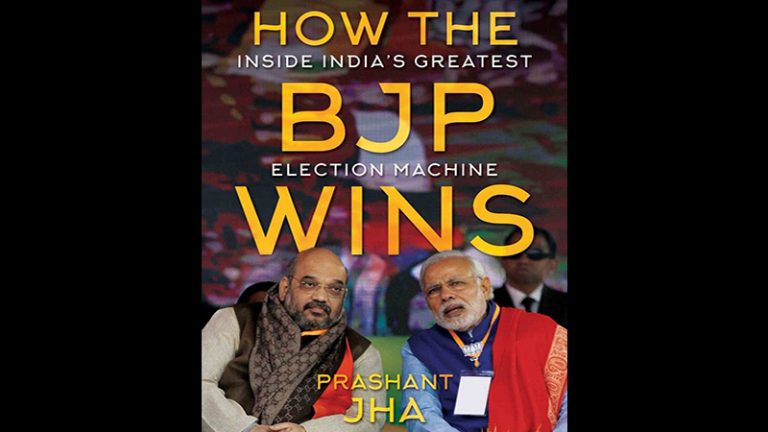
It is this astounding electoral success based on which, journalist and associate editor of Hindustan Times, Prashant Jha, has published his recent book, “How the BJP Wins”. The book tries to find the mantra behind this Modi-Shah magic.

At the outset, let me call out that this is not a book review. It’s an opinion piece on where the book has gone wrong.

The book starts with the “Modi hawa”, the man and his charisma and how despite being CM and PM for so long, there is virtually no anti-incumbency against Modi, rather it has added to his appeal. It then moves on to Shah’s Sangathan. His hunger and relentlessness in winning elections, his carefully planned strategy up to booth level, his boundless unlimited ambition helping BJP to chart the path to such electoral glory. The author also focuses on social engineering and caste consolidation in the Hindi heartland where once upon a time, BJP was seen as primarily a party of upper castes. The book tells us about the role of Sangh during election campaigns and how the sangh volunteers help the BJP to spread its message to the households. At this point, the book turns to “Communalising Indian elections” or the “H-M Chunav” as the author calls it in the book.

It is this chapter where the author seems to have moved away from facts and let his bias and/or inhibitions cloud his thought process.

Mr. Prashant begins by stating that, in UP, Bihar & WB, BJP starts with a -20% disadvantage because 20% are Muslims and no Muslim ever votes for BJP but more importantly, “BJP doesn’t care for their votes”. I assume, the author has insights into BJP’s war room meetings to be privy to this kind of information. However, the same publication where the author works, suggests that BJP has won 62 out of 82 assembly constituency where Muslims constitute one third or more of the population.

Anyways, the problems starts where the author starts accusing BJP of communalising elections. As per the author

  1. There was no politics of “Tushtikaran” or appeasement. Scholarships and laptops distributed favourably to Muslims was a lie propagated by BJP. Even PM Modi communalised further by raising “Shamsan vs Kabristan” debate.
  2. Migration at Kairana was, you guessed it right, again a “lie”
  3. Illegal slaughter houses being linked to environment and hygiene is BJP’s official spin
  4. And the most dubious narrative of the BJP was love Jihad. The anti romeo squad BJP promises is actually anti Salman and anti Naushad. Failure of law and order is again a BJP narrative.

Now let’s look at facts. And I am going to cite only ‘few’ examples. A customary Google search will tell you many more such examples exist.

  1. The state govt immediately after assuming power in 2012, started a scheme called “Hamari Beti Uska Kal” under which only Muslims girls were paid 30,000 after clearing class X. Here is a small list [pdf] of the beneficiaries. SP had sanctioned Rs 400 crores for constructing boundary walls around kabristan. Remember, this is a minuscule percentage of appeasement by state policy I am quoting. An analysis during the elections had shown that the argument of religious discrimination based on burial facilities, was backed with solid data.
  2. Next up is Kairana. The NHRC report in clear and unambiguous term states that, 250 Hindu families had indeed left the town due to fear of the members of a particular community which constitutes majority population in the area and allegedly enjoy political patronage.
  3. Last I checked, the National Green Tribunal was not a BJP or RSS functionary. Hence it can be said with conviction that the NGT order banned illegal slaughterhouses because they have an impact on environment & hygiene and certainly not because it was a BJP conspiracy.
  4. The author may think that Love jihad is a figment of imagination of the far right but the Kerala High Court certainly doesn’t think so. Also, the Kerala High Court and justice K.T. Sankaran are in no way related to the Sangh. The court must have asked the police to stop Love Jihad in its own wisdom, without getting influenced by the Sangh, by looking into the evidences at its disposal.
  5. Anti-romeo squad is actually anti-Salman and Anti-Naushad. Not necessarily, but the NHRC report is certainly adverse.

So if all this is false, propaganda and spins by BJP, how does it resonate with people? Why did people overwhelmingly vote for BJP which focussed only on imaginary issues? The author tells us why. This is because, BJP was successful in constructing a perception through relentless smear campaign using WhatsApp, images, texts and videos.

There, we have cracked it. The success to election, the insides of Indian’s greatest election machine, lies in WhatsApp, images, texts and videos. Even though, the issue doesn’t exist, BJP plays some kind of “Inception”, infiltrates into voter’s dreams, plants these imaginary things and furthers its propaganda.

Well, with the “Look East” policy, BJP has started a mission 120+ in Odisha. They held their national executive meet, 2017 in Bhubaneswar. Amit Shah and PM Modi have visited Odisha at least 6 times since 2014. But they must be fools not to raise any caste or religious overtones in their speech so far since the author has told us that BJP can win any elections by communalising the environment, doesn’t matter if the issue exists or not on the ground, whether people relate to it or not. Just infiltrate voter’s dream, plant communalism and bingo.

And if this is not true, alternatively, what the author is suggesting is, even though these exist, BJP should not raise its voice against this blatant communal appeasement because it will “communalise the environment”. Well, aisi secularism aap ko mubarak Prashant sahab.

From the Author’s own admission, he claims that he has done an extensive tour of Uttar Pradesh to understand its demography, aspirations and politics. Extensive tour is a 75 day tour with a continuous stay of 30 days during which he got to know about UP more than an MP representing people of Gorakhpur for last 20 years. He concludes by quoting someone at a coffee shop in Khan market, New Delhi, “It was an India – Pakistan election. India has won”

To summarise, in my humble opinion, to understand the aspirations of people you need to move a little beyond Khan market coffee shops. Otherwise, with your extensive research of 75 days, you will end up with imaginary pieces like “How BJP wins”.