Home Blog Page 7406

Case registered after video shows ‘Pakistan Zindabad’ being shouted in a BSP victory rally

0

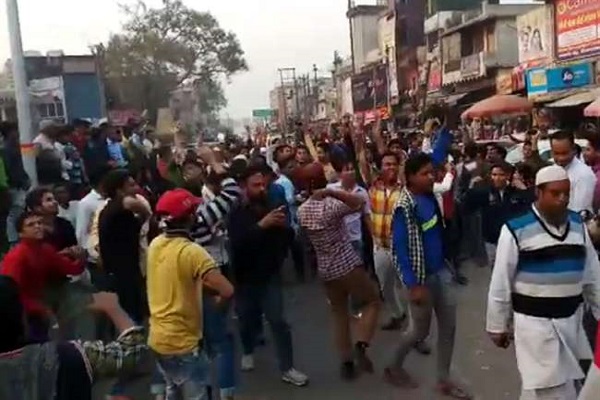
A case against 150 unidentified people have been registered after a viral video showed them shouting “Pakistan Zindabad” slogans during an election victory procession. The procession was being taken out by Bahujan Samaj Party (BSP) supporters on Friday in Bulandshahar district of Uttar Pradesh after a candidate Bubbo Parveen was declared victorious in local body polls.

Parveen was supported by the BSP and the victory procession was being taken out by the party supporters, where leaders of the party too were reportedly present. A video uploaded on YouTube by Amar Ujala newspaper shows “Pakistan Zindabad” slogans being shouted during the procession:

The above video is reported to have gone viral in the region in the past couple of days, leading to tensions. Once the video went viral leading to the police case, BSP is denying that its supporters raised the slogans. District head of the party has raised questions over authenticity of the video itself.

Police has not said anything about authenticity of the video, but a Dainik Jagran report today claims that two people have even been arrested in this case.

Reports claim that the victory procession itself was taken out without permission from local administration. The cases have been registered for violating model code of conduct and under section 153-B of IPC, which punishes spoken or written words that are prejudicial to national integration.

BSP is reported to have done comparatively well in the Muslim dominated areas in the Western Uttar Pradesh in the recently concluded local bodies polls, leading to resurgence of the party in the state, though some analysts believe that any such conclusion is not based on ground realities.

Of Rahul Gandhi and Aurangzeb – A striking similarity of Dynasties

0

Rahul Gandhi, the 47-year old scion of the Nehru dynasty, is all set to ascend the throne of the Congress Party. If things go as planned, he will succeed his mother, Smt Sonia Gandhi, and become the sixth member from the Nehru family to be coronated Congress party president.

The grand old party of Indian politics has seen five presidents since 1978. For all but seven of those thirty-nine years, a member of the Nehru dynasty has been its president. Mrs. Indira Gandhi, daughter of Pandit Nehru and grand-daughter of Motilal Nehru, both past presidents themselves, was party president from 1978 to 1984, till her assassination. She was succeeded by her son, Rajiv Gandhi, who was its president from 1985 to 1991, till his assassination. From 1998 to the present day, the Congress party’s president has been Italian-born Smt Sonia Gandhi, wife of Rajiv Gandhi, and mother of Rahul Gandhi.

Rahul Gandhi’s political acumen has been the matter of intense speculation, as has been his grasp of basic facts of Economics and Geography. But let’s leave that for another day. The latest bit of controversy came via Congress party senior politician, Mani Shankar Aiyar, who responded to a question on Rahul Gandhi’s pending elevation as Congress party president, by comparing it to the succession of the Mughal kings, and even going to the extent of making an indirect comparison of Rahul Gandhi to Aurangzeb. Aurangzeb, as most Indians will know from their history, was arguably the cruellest of all Mughal kings, a religious bigot, and who destroyed many temples out of a sense of religious hatred. One can watch a video clip of Mr Aiya’s comment on ABP here.

This is what Mani Shankar Aiyar said – “Firstly, when Shah Jahan took the place of Jahangir, did any election take place? When Aurangzeb took the place of Shah Jahan, did any election take place? No. It was known from the very beginning, that whoever is the child of the king, and would become the king, unless they fought amongst each other. BUT, in a democracy, elections take place. And I invite Shehzad Poonwala, that if he wants to stand for elections here, then let him please come, apply for the post, and have you heard of this name Shehzad Poonawala before?”

While some argue the second part of his statement is relevant, when juxtaposed with comments made in October 2017, it is evident that Aiyar indeed believes in the first half of his statement.

In October, 2017, he had said, “I think only two people can be Congress President, mother or son. Rahul already said he is ready to contest election.” His statement now, in December, are consistent with his line of thinking that only people worthy of being Congress party president are either mother or son. More can be read here.

But let’s leave the present behind and take a short tour down history lane, to the Mughal empire, to be precise. Since the Congress party loyalists have chosen to compare its presidents to the Mughal kings, it is but fair that we see what historians have written about this Mughal empire, especially of the occupiers of the throne after Aurangzeb.

“It was a period of clash of ambitions, of group rivalries, of base intrigues, of licentious orgies and, above all, of the decline of moral and ethical values. [Individuals] were permeated with callous indifference toward the interests of the very institution which was the main source of their honour and sustenance. These courtiers failed to realize that they were playing with fire…”

Of the foreigners who came from Persia and Transoxiana, at best it could be said that,

“they could only still boast of their pride of birth; as to their worth, it had become conspicuous by its absence among them. They had plenty of ambition; but they sought to satisfy it at the cost of the empire.”

Generally speaking, the assessment of Aurangzeb’s successors goes something like this –

“… the sovereigns who were expected to set the ideal, were immersed in licentiousness. Their vision hardly ever travelled beyond the four walls of their palaces. They spent most of their time in the harem making merry with the cup and their concubines, or in the gay company of poets and musicians in utter disregard to their own duty. Such debased specimens of humanity could hardly evoke sympathy or inspire respect.”

Of particular interest is the Mughal King who ascended the throne in 1712. The eldest of Mughal king Bahadur Shah’s four sons, Jahandar Shah became the Mughal king after dispatching his other three brothers in what was an obligatory fratricidal war. This, then, is what historians have to say about Jahandar Shah:

“Though about fifty year of age (note that Rahul Gandhi is forty-seven years old), he behaved like a frivolous young man of eighteen. His morals were highly depraved. He drank heavily and passed most of his time in the company of his mistress – Lal Kunwar, whose relations had obtained high posts in government service. Nor could his Vazir Zu’lfiqar fill in the void successfully. He had been overtaken by senile decay. He devolved his entire responsibility on his favourite, Sabha Chand.”

Sailendra Nath Sen, Professor of History at the University of Calcutta, has described Jahandar Shah as “a worthless debauch.” (A Textbook of Medieval Indian History. Primus Books. p. 193.)

How did Jahandar Shah’s reign come to an end? His nephew, Farrukh-siyar, combined forces with the Sayyid brothers, and met Jahandar Shah near Agra. Jahandar Shah, the Mughal emperor, fled to Delhi on a bullock cart, accompanied by his mistress, Lal Kunwar. He was duly betrayed, arrested, and after a month in confinement, was strangled to death.

And how did Farrukh-siyar die? The Sayyid brothers collaborated with Peshwa Balaji Vishwanath Bhat and deposed Farrukh-siyar, who was thrown into jail. After being “subjected to all sorts of torture by his jailors,” he was put out of his misery in 1719 by professional executioners who strangled him to death.

Do we detect a pattern here?

Let’s end with a brief evaluation of Muhammad Shah, the fourth son of Bahadur Shah, who was placed on the Mughal throne by the Sayyid brothers in 1719.

“Never before did a more care-free sovereign sit on the throne of Delhi. This lad of 17 had passed most of his time within the four walls of the palace, in the society of eunuchs and ladies of the harem. None had cared for his education, because few could foresee the good fortune which lay in store for him. … He was a lover of pleasure, indolent and addicted to loose habits. He made it a rul of his life never to decide anything for himself; his favourites did it for him. … He had no initiative, nor even the dash of some of his predecessors. Rustam Ali, the author of Tarikh-i-Hind, says that ‘Muhammad Shah was negligent of his duties; but the fat is that he did not know if he had any duties to perform.’”

With a senior Congress leader making a comparison between Rahul Gandhi and Mughal kings, it is perhaps only fitting that the nation know about the glorious nature of aforesaid Mughal kings.

It is truly said that history repeats itself – first as a tragedy, and then as a farce. We live in interesting times to be able to witness the farce, on live, prime-time television.

Reference:

Family converted to Islam 5 years ago, now reconverts to Hinduism

0

In a unique incident, a family from Saharanpur, Uttar Pradesh which had converted to Islam about 5 years ago, has now decided to reconvert to Hinduism.

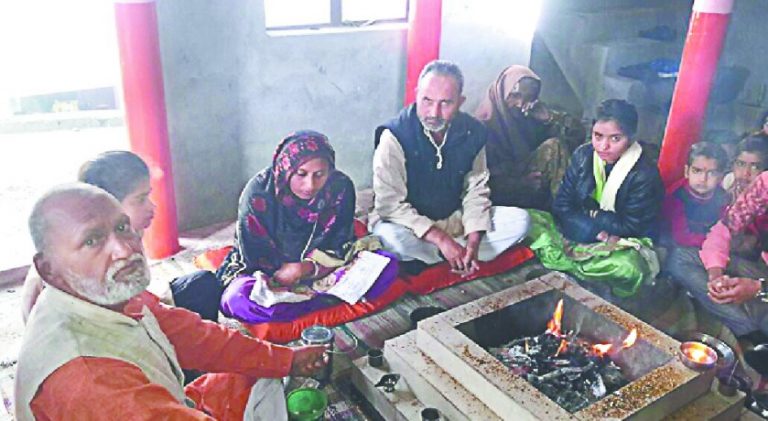
As per reports, Mohammed Shah (earlier called Dharamvir) along with his wife Mamata, daughter Shivani and two sons, had converted to Islam in 2012 owing to certain family reasons. As a result of this conversion, the names of the rest of his family too were changed to Mariyam for his wife and Jainab for his daughter.

Shah resides in Gangoh village of Saharanpur and runs a spare parts shop on the Lucknowti road of Gangoh.

As per him, he kept feeling uneasy for a long time and then finally decided to listen to his inner voice for making up his mind to rejoin Hinduism. Thus he decided to contact the people at Vishva Hindu Parishad after which his re-conversion was carried out at an Arya Samaj temple on Sunday.

The rituals involved included a Vedic havan and religious chants after which Shah, his wife and daughter rejoined Hinduism. Owing to the absence of his sons, they couldn’t take part in this ceremony. They are expected to be reconverted later.

The ceremony saw the presence of dignitaries like VHP’s District President Mangeram Tardhak and various office bearers of the BJP.

It remains to be seen whether this family faces any problems from radicals as a result of them forsaking Islam.

We had reported in the past how a mob had threatened to kill a Bihar advocate who had accepted Hinduism after renouncing Islam. Mohammed Anwar, a lawyer from Bihar’s Begusarai region after his conversion started getting death threats and was also surrounded by a mob of 15-20 people who threatened him and also hurled vile obscenities.

Such “gharwapsis” have had other issues. A Muslim family that had embraced Hindusim during the much publicized “Ghar Wapasi” program in 2014, went back a year later to being Muslims after they received threats and were boycotted by the local Muslim society.

One of the other prime reasons for their u-turn was Hindu groups’ ham-handedness in organising events like “ghar wapasi”. Without any social support, such programs turned out to be made-for-media-and-made-for-outrage events.

Kerala Love Jihad: Hadiya’s husband was in touch with ISIS operatives before marriage, claim reports

0

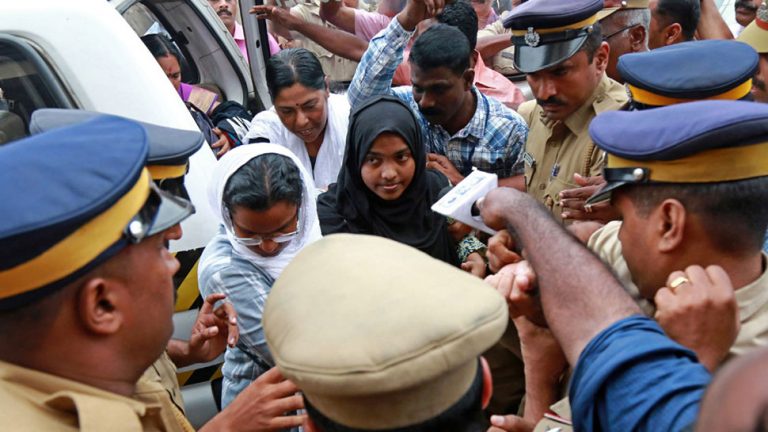
The Hadiya love jihad case has become a hotly debated topic, ever since it became highlighted in the national discourse.

The popular perception of this case is that, Akhila and Shafin Jahan case is that they married in December 2016 via a marriage portal named waytonikah.com. Akhila’s father later petitioned the Kerala High Court claiming that Shafin was trying to recruit her for terror activities and also wanted to take her to Syria.

The father had also alleged that she was forced to convert after being abducted and wrongly confined at an illegal Islamic conversion centre before her so called marriage on December 19th 2016. The court later annulled it due to various reasons, one of them being the marriage certificate not being valid.

Shafin Jahan later appealed it in the Supreme Court after which the apex court ordered a NIA probe into the matter to which Shafin’s counsel Kapil Sibal had objected. In a hearing on 30th October, the court had asked that Hadiya be brought in front of the court and when that happened she claimed that, she wasn’t forcibly converted and had married her husband out of free will.

The Supreme Court later ruled that Hadiya be ‘freed’ from her parents’ custody and be allowed to continue her studies, while she had asked that she be allowed to live with her husband.

Soon after this ruling by the Supreme Court, a disturbing fact has emerged regarding her husband.

As per a Times of India report, Shafin Jahan the husband of  Akhila Asokan was in touch with two key ISIS men who were chargesheeted in the Omar-al-Hind case.

Charges were pressed against Manseed and Safvan after they were arrested by the NIA in October, 2016 in connection with this Omar-al-Hind case which was believed to be a conspiracy hatched on the instructions of the ISIS handlers who wanted to target major political leaders, police officers and busy places in Southern India.

Media reports claim that as per NIA, Hadiya’s husband was in touch with this duo via a closed Facebook group and a messaging app. This Facebook group also included activists of SDPI the political arm of the radical Popular front of India (PFI).

The NIA has taken things a step further to claim that Manseed and SDPI were the ones who introduced Hadiya to Shafin, which is contradictory to the claim that the marriage portal waytonikah.com brought them together.

The logic provided to prove the same is that neither Hadiya nor Shafin had viewed each other’s profile on the matrimonial website before 31st December, by which time they were already married.

It remains to be seen whether the NIA, which is already scrutinising 32 love jihad cases from Kerala manages to find more full proof information regarding the matter.

Mani Shankar Aiyar’s bizarre ‘Aurangzeb’ statement: In favour of or against dynasty?

0

Rahul Gandhi on Monday filed the nomination papers in order to put in a bid to become the next Congress President thereby potentially taking over from his mother, Sonia Gandhi. Such a nomination resulted various people questioning the domination of dynasty politics in the party at the possible expense of merit based succession. An ABP news reporter thereby decided to pose this question to party leader Mani Shankar Aiyar who in the past has exhibited his sycophantic traits towards the “dynasty”.

Aiyyar gave a rather odd statement, and to make matters worse, a clip with only a part of the statement has become viral on social media. First, see the full question and answer to which Aiyyar was responding:

[youtube https://www.youtube.com/watch?v=BiQ1KnaC-CM]

A transcript of the question and answer:

Ques: But it is being said that this a form of dynastic politics, not legacy but dynasty, and Shehzad Poonwala has claimed that this not an election but a selection, how would you respond to this?

Ans: Firstly, when Shah Jahan took the place of Jahangir, did any election take place? When Aurangzeb took the place of Shah Jahan, did any election take place? No. It was known from the very beginning, that whoever is the child of the king, and would become the king, unless they fought amongst each other. BUT, in a democracy, elections take place. And I invite Shehzad Poonwala, that if he wants to stand for elections here, then let him please come, apply for the post, and have you heard of this name Shehzad Poonawala before?

The question is two-fold: What is Aiyyar’s response to the claim of dynastic politics and what is the his response to Poonawala’s claims. Aiyyar seems to be trying to show the difference between how a dynasty works, versus how a democracy works, in order to answer the first question. By bringing this contrast, he tries to prove that since elections are being held in the Congress party, you cannot call it a dynasty. Secondly, Aiyyar calls upon Poonawala to put his money where his mouth is, and contest the elections.

Aiyyar could have made the same point in a more clear and articulate manner. He could have used a few more words to clarify that he was showing how a dynasty (the Mughal dynasty) functioned, and how it is different from the Congress party’s procedures: i.e. Mughals did not have an election, whereas Congress has elections.

This defense in itself may be weak since everyone knows these elections are a farce and questions are being asked as to on what basis or what achievements was Rahul Gandhi considered to be worthy of being even a candidate in such a process. But however weak the defence maybe, Aiyyar’s half-statement has got a life of its own and has become the butt of jokes now:


He also mocked the usage of the term Badshah and called the Congress party rule as an Aurangzeb raj.

Like Modi, the people too decided to take on this remark of Aiyar:


People also used it as an opportunity to highlight the cruelty of the Mughals:


But there were some people, who refused to give Mani Shankar Aiyar a long rope, considering his past shenanigans and known unbridled loyalty towards the Dynasty.


While the twitterverse is divided over Mani Shankar Aiyar’s comments, in full or in part, it is necessary to go back a little in time and recall what he had said in October 2017. He said :

“I think only two people can be Congress President – mother or son. Rahul has already said he is ready to contest the election”.

“To contest election people are required. If there’s no one and there’s only one candidate, how will you conduct the election in the first place?” he added.

This Congress “election” for its topmost post, certainly seems to be a “democratic process” with the winner long declared.

The Royal Indian Navy Mutiny of 1946 and the Congress betrayal

0

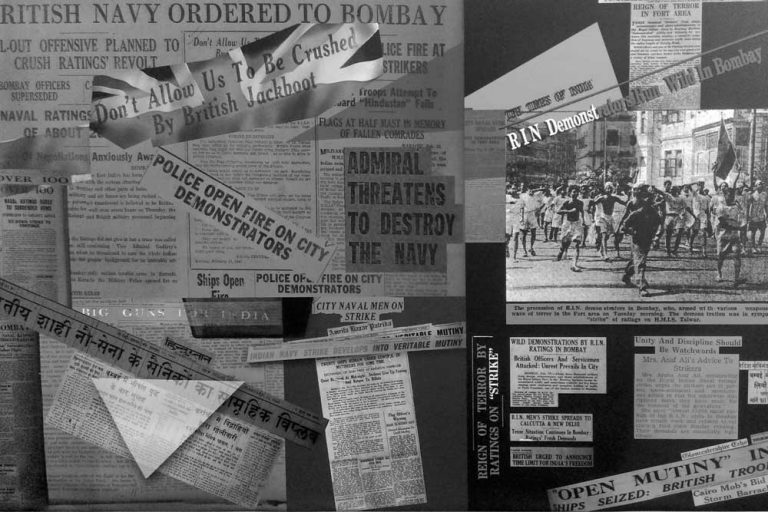
While India celebrates its Navy Day today, let’s do a remembrance to The Royal Indian Navy (RIN) Mutiny of 1946 which left colonial masters Britain with no choice but to leave India.

That there is little mention of this momentous event in Indian historiography is a striking indictment of establishment run by Congress who had turned its back on this spectacular mass uprising in that heady week of February (18-23).

British Prime Minister Clement Attlee accepted three weeks later that “the tide of nationalism is running very fast in India.” Britain had always feared united mass movements in India and RIN Mutiny was one such where Hindus, Muslims, Sikhs and Parsees had come under one banner. Indian masses came out on streets in support and hundreds spilled their blood on the street.

Salman Rushdie’s 1995 novel The Moor’s Last Sigh describes these momentous events on the streets of Bombay, through one of its character, thus:

“In February 1946, when Bombay, that super epic motion picture of a city, was transformed overnight into a motionless tableau by the great naval and landlubber strikes, when ships did not sail, steel was not milled, textile mills neither warped nor woofed, and in the movie studios there was neither turnover nor cut—the 21-year-old Aurora began to zoom around the paralyzed towns in his curtained Buick, directing her driver Hanuman to the heart of the act, or rather of all that great inaction, being set down outside factory gates and dockyards, venturing alone into the slum city of Dharavi, the rum-dens of Dhobi Talao, and the neon flesh pots of Falkland Road, armed only with a folding wooden stool and a sketchbook. Opening them both up, she set about capturing history in charcoal.”

Remember your history books and historians, your glorified political leaders and their progeny, all your Independence and Republic Day celebrations and after you’ve read of this great betrayal, don’t muffle but air-rend your full-throated cry which sends shockwave through this land of ours and warn these enemies “Not now and never again.”

And tell your children: “you would read history as it happened and not as it was doctored to your parents.”

The World War II had caused RIN to expand massively. It was 10 times larger than in 1939. Young men were enlisted in tens of thousands. Moving around the world, they could see the fire of nationalism against colonialism sweeping around the world. As these young men were hailed as liberators in Greece, Burma, Indo-China, Indonesia, Italy. It was logical they asked themselves: Why not India be free now?

The myth of British supremacy was receding. These young men could see how European forces were wilting across Asia under the Japanese aggression. The Indian National Army (INA) of Subhas Chandra Bose had captured their imagination. The trials of those arrested brethren and their humiliation had filled the natives in armed forces and on streets with revulsion and anger.

In January 1946, the airmen of Royal Air Force mutinied as a harbinger to the eventually bigger revolt. They seized the signaling equipment and spread their message to other servicemen. From Karachi, the agitation spread to places as far as Kanpur to Singapore. The Navy men were demanding delisting from the services. They were unwilling for fresh battles in Indonesia on behalf of the Dutch government as well as war in Vietnam, then under the rule of the French colonial government. The hands of British government were forced.

Meanwhile, trials of INA officers were on at the Red Fort. A young Naval Rating (enlisted officer), Balai Chandra Dutt, posted on HMIS Talwar in Bombay, began painting the ships and dockyard walls with messages in its support. HMIS Talwar had 1500 officers and ratings and was the second largest training center in the whole of British Empire. In the recollections, titled “Mutiny of the Innocent”, the mutineers detailed the squalor on board, the poor quality of food and the racism of British officers.

The mutineers first took out peaceful processions in Bombay, holding an image of Subhash Chandra Bose aloft. Chief Commanding Officer (CO) King called the rebellious “you son of bitches” and “sons of bloody junglees.” Rebels responded by deflating his car. The events of dockyards in Mumbai spread like a wildfire across the country. Ratings set up a INA Relief Fund and posted letters against CO King. On February 17, when the ratings again pressed their demand for good food, British officers called them “beggars.” This was the last straw.

On February 18th morning, 1500 ratings staged a protest in the mess. They also declared: “This is not a mere food riot. We are about the create history…a heritage of pride for free India.” A Naval Central Strike Committee (NCSC) was formed which decided to take over the RIN and place it in the command of national leaders. (That’s right!, they wanted India’s political class to be their guide and guardians).

The formal list of demands called for release of INA’s POWs and naval detainees, withdrawal of troops from Indonesia and Egypt, equal status of pay and allowances and quality Indian food. It also formally asked the British to quit India.

The strike soon spread to other naval establishments around the country. At its peak, 78 ships, 20 shore establishments an 20,000 ratings were involved in the uprising. HMS Talwar was coordinating the mutiny through signal communication equipment on its board.

Indian Naval personnel now began offering left-handed salutes to British officers. The orders of British superiors were ignored or defied. In Madras and Poona, the British garrisons faced unrest by the Indian Army. Widespread rioting began from Karachi to Calcutta. The joint banners of INA, Indian National Congress, Muslim League and Communist Party of India were hoisted on board HMIS Talwar.

Sadly, instead of support, the Indian National Congress condemned their actions. Mahatma Gandhi criticized the mutineers for revolting without any guidance from a political party. The Muslim League too denounced the mutineers, arguing that protests should be through constitutional methods alone.

Sensing that the political leaders were not supporting the uprising, the British government moved in for the kill. Admiral Godfrey tricked NCSC into returning to their respective ships and barracks. Within an hour, Godfrey had the army surround these barracks. Realizing they had been betrayed, NCSC got ready for open battle The NCSC appealed: “You, our people and our respected political leaders come to our aid…you must support us.”

But the political leaders could sense the dilution of their political authority in this mutiny. Never one consisting of mass leaders and made up mostly of elites, these political leaders had always been uncomfortable in face of a mass uprising. The Congress asked the people “to go about their work as usual.”

But the masses were now ready to defy their political leaders. Thousands of civilians brought milk, fruits, bread, vegetables and cooked food for the starving ratings to the Gateway of India. The ratings came by motorboats to collect the offerings. Hindu, Muslim and Iranian shops opened their eateries and asked the masses to take whatever they could for the suffering ratings. The Indian soldiers on duty didn’t stop them.

The city of Bombay went on strike on February 22. The public transport system was shut down; trains were burnt; roads were blocked; shops were closed. Eleven military trucks were torched. The city came to a grinding halt.

With no assistance from either the Congress or the Muslim League, the mutineers were doomed. British army and air bombers began closing in. At this stage, Congress assured the mutineers that their grievance would be looked in to. That they won’t be victimized. Jinnah asked the Muslim ratings to surrender. That sealed the fate of the mutiny.

Meanwhile, Bombay continued to burn the next day, February 23. The Army responded with indiscriminate firing. In just two days, 229 civilians and three policemen had died. Over 1000 people and 91 policemen/soldiers had been injured.

The ratings were court-martialled. More than 500 ratings were kept in Mulund (Bombay) and in Maliar (Karachi) in abominable conditions. They were dismissed and later sent home. Only in 1973 did the Indian government recognize a few as freedom fighters. Most claims for pensions were not responded to. Only in the 1990s, two of the navy’s tugboats were named after BC Dutt and Madan Singh.

In 2001, the uprising was commemorated with a statue in Colaba—a recognition which came more than half a century late!

Such is the story of great betrayal of Royal Naval Mutiny of 1946 by India’s political leaders. When 100s of ratings suffered in Mulund camp, nobody spoke up for them.

It’s time we pay our respect and homage to those braves who concluded their mutiny with the words:

“Our strike has been a historic event in the life of our nation. For the first time the blood of men in the Services and in the streets flowed together in a common cause. We in the Services will never forget this. We know also that you, our brothers and sisters, will not forget. Long live our great people. Jai Hind.”

We would never forget it: And repeat this great event of bravery to our children.

Time to take a vow.

Suspect in RSS leader’s murder escapes after UP villagers fire, pelt stones at NIA team

0

17th October Ravindra Gosai the chief of one of RSS’s shakhas in Ludhiana was shot dead in broad daylight by unknown assailants. This and the murder of another Hindu leader in Amritsar meant that a total of 5 Hindu leaders were murdered in the state in the last 2 years.

Gosai’s murder case was soon transferred to the NIA which had claimed that radical Sikh elements living abroad might be behind the murder to destabilise Punjab. Before transferring the case, the Punjab police had arrested Ramandeep Singh and Hardeep Singh in connection with the murder.

Now further sensationalism has been created in this murder probe after it was reported that a suspect in this murder case was able to escape after the locals decided to attack the raiding NIA team on Sunday.

This incident happened in Gaziabad’s Nahali village where the NIA team along with the UP ATS had reached to conduct a raid on a man called Malook who is suspected of supplying arms and ammunition used in the Punjab killing.

As per a statement issued by the NIA, a large crowd consisting of men and women tried to obstruct them while they were carrying out the raid. Some people in the mob then started to fire at the investigation team and even indulged in stone pelting. The mob then also created roadblocks in order to create further troubles for the cops.

In their defence, the NIA personnel and the cops fired in the air. In this attack by the locals, Constable Tahjib Khan of the UP Police suffered a leg injury and a police vehicle was vandalised by the mob.

In the ensuing chaos, Malook managed to jump out of the police jeep to escape from the area. Efforts are on to track him.

As per the village head named Rahees Ahmed, the suspect Malook was born and brought up in this village. The NIA team arrived at about 7 AM on Sunday to nab him after which Malook and his family called out for help. Hearing this a few women came to the spot and started pelting stones on the officials.

After this incident, the cops returned to the village thrice on that day to carry out the raids. The investigators were led to this village after getting the information about Malook from a few suspects they picked up during several raids in Meerut on 2-3 November.

As per TOI, soon after the incident, the police lodged a case of attempt to murder and rioting against 7 named and 50 unnamed men, which resulted in the arrest of a man named Nazim. The Hindustan Times report though claimed that a case was filed against 150 individuals including the family members of Malook.

Varun Gandhi as Congress President, would have been a win-win situation for all

0

Rahul Gandhi is expected to be appointed the President of Indian National Congress on 19th December. In fact, he has finally taken the plunge and filed his nomination today. It seems to be a foregone conclusion because as per media reports, ‘state returning officers were asked to ensure that the nomination papers proposing Mr. Gandhi for the party president post should be filled properly and there should be no lacunae in them.’

The instruction may seem funny but the problem lies elsewhere. A sense of déjà vu pervades in the followers camp, they are not dancing with joy, they aren’t beyond themselves in their ecstasy to see their beloved leader being anointed as the Party President. Instead, they are behaving more like a groom who committed to marry his girlfriend seven years ago. The marriage is scheduled now but the world has changed quite a bit in the these seven years and the bride does not seem to be the right choice but the option of saying ‘no’ is foreclosed by the sense of commitment.

Congress needed a different leader, no doubt about that. Though the noise to make Rahul Gandhi President of Congress was heard first in 2011; in the opinion pieces by friendly media and in the resolutions passed by some city level Congress committees, the image that got created over the years, in the minds of the cadre that Rahul Gandhi was an unwilling, diffident leader and the discomfort with him began showing itself in 2013 itself, with calls to Priyanka to take over. Ever since Rahul Gandhi’s coronation date was announced, the average worker is in a mental state where he is supposed to celebrate but is not sure whether he or she should? The problem Congress was facing could be defined as, “If not Rahul, who? It can’t be Priyanka because of taints carried by Robert Vadra and ownership of Congress cannot be handed over to any Khadge, Ramesh or Chidambaram.”

Congress needed a new leader and Varun Gandhi checked all the boxes.

Varun has a CV that matches the Congress requirements like a glove to a ‘hand’. He is a Gandhi, he is still young enough to be called a youth leader, he hasn’t done much of note in his life except inheriting the parliamentary seat from his mother so he comes with little unwanted baggage, he can claim to be a Hindu, a trait Congress in its new avatar of soft Hindutva, is looking for, he even has an anti Muslim speech to his credit that bolsters his credentials, he is married and has a son, so dynasty continuation is assured.

One quality that needs detailed explanation is that he carries no baggage of minority appeasement.

While Congress turned 180 degrees from its “Muslims have a first right on resources” to appeasing Hindus, It was funny (or plain ridiculous) when  Rahul Gandhi went on a temple run in Gujarat after celebrating Holi and Diwali. For one who has always believed that Muslim appeasement would win elections, and that Saffron terror was a bigger threat than Lashkar-e-toiba, his desperate attempts to portray himself as a Janeudhari Hindu lacked any credibility, whatsoever.

On the other hand, Varun Gandhi does not come with such handicaps. With an unproven but widely rumored and reported speech where he abused Muslims under his belt, he cannot be accused of Muslim appeasement and can be projected as a real Hindu leader, without inviting any mirth or sarcasm.

In short, Varun has all the qualities that Congress needs in its President.

Family’s hold is retained while conducting a mock election

There has been lot of noise about the undemocratic coronation (in Congress it is called election) of Rahul Gandhi as President of Congress party. Two local level leaders of Pune have even created a storm in a spoon by arranging a mock fight between themselves on this issue.

Now assume a scenario : Varun Gandhi joined Congress and was nominated as a candidate for the President position. There would have been a fight between a Gandhi and a Gandhi, the family would have sent a quiet word to delegates whom to vote for, with the consent of the other. An election would have been held, democracy would be restored, winner would be a Gandhi either way, family would not have lost anything, followers would get a new leader, and the media could have gone to town about how the winds of democracy are blowing in the new look Congress party. Everybody would have won.

It would have suited both Maneka and Varun Gandhi

Both mother and son have a diffident relationship with BJP. Analysts equate this relationship with a situation where some estranged royals are forced to leave their palace and are forced to live as the guests of a local trader. They do get their due respect but no one treats them like royalty. They always suspect that while trader’s servants make a show of respect, they are mocked behind their backs, a thought that makes them highly uncomfortable, and all this while, they are unwilling to bring themselves down to the level of commoners or to be accepted as one of them.

Given above paradigm, Maneka Gandhi would always remain on the periphery of the power structure, but never at the center of it. She would always have a position but not an influential one and would always get faux respect but never the fawning adulation that a royal gets. Varun too, would have to be content with remaining an MP of the inherited parliamentary seat as BJP would not be able to find a position that satisfies his aspirations. Basically, a position where he gets treated like a star but does not need hard work as a commoner.

BJP would not have lost much, may have instead made gains

BJP needed Sanjay Gandhi’s family when it was in the 160 seat zone, i.e. during the era of Vajpayee and Advani. Using the estranged mother son duo’s antipathy towards the ruling family (then) was a tactic that was a good irritant to Gandhis. It also helped BJP win a couple of seats in Uttar Pradesh where it was without a charismatic leader, after Kalyan Singh left for ‘greener’ pastures.

However now that both are moving towards a point where they become too frustrated after sitting on the sidelines for too long (does it remind us of Shatrughan Sinha too?) and come out in the open with their disagreements and contentious positions on issues that dominate the discourse. Normally, BJP is wary of taking any action against such disgruntled leaders as such action dilutes the democratic credentials of the party but it can definitely do without the bad press it generates, which is further used by all opposition and media, like it is happening in case of Arun Shourie and Yashwant Sinha.

The BJP would do well to get rid of both the leaders before they become a pain in the neck and this was the perfect opportunity.

Matchmaker needed

Of course, even if a suitable job and a suitable candidate exist in the same universe, a middleman is still needed. I hope that our esteemed journalists who used to fix the cabinet positions and mining deals during UPA era can take up this assignment. I am sure it would be a lucrative one. Maybe they could fix a family feud sometime in the future, after Rahul Gandhi loses yet another election and set the stage for Varun Gandhi to finally spare the BJP and migrate to the Congress, where he truly belongs? One can only hope.

Don’t fall for propaganda: ‘Write off’ of loans is not ‘Loan waiver’

0

Every few months, we witness hysteria on social media regarding loan write offs. Almost exactly a year ago, a social media rumour claimed that SBI had “waived off” Mallya’s and other wilful defaulters’ loans, to the tune of Rs 7000 crore. This was based on an article in DNA.

Now, a similar article has sparked off similar reactions. The Indian Express has carried a news article titled: “PSU banks write off Rs 55,356 crore in six months“. There may be nothing factually wrong with this, but readers and politically inclined people are either misunderstanding the term used, or are deliberately spinning it.

Yogendra Yadava and Comrade Yechury have compared these write-offs with waivers, indicating that while farm loan waivers are scorned upon, “waivers” given to corporates are fine:


Congress leader Arjun Modhwadia has used this news to land the “suit boot ki sarkar” jibe, indicating that these “waivers” are helping corporate India


A JNU-ite, displaying his knowledge, asks whether there is a “ghotala” (scam)


So what is this write-off? Is it really a loan waiver, a sweet deal given to errant corporates?

For this we need to understand what write-offs are. A balance sheet should reflect the real position of assets and liabilities. Hence Banks have to write off loans given to borrowers, which are “assets” to the banks, which have now shown signs of weakness. If they don’t write off loans, it is like claiming to hold a high quality asset, when actually the quality has deteriorated. Will you trust an entity that doesn’t give the true picture of its assets?

Secondly, if a loan is not written-off and is continued as a healthy asset (when it actually is an Non Performing Asset), then banks can continue to book interest income on the loan, on accrual basis of accounting. This has two impacts: Firstly, the bank is artificially increasing its income by booking interest on accrual basis, income which it may or may not receive (since the loan is actually an NPA). Secondly, the bank has to pay tax on such interest income. Both are undesirable. A write off prevents banks from doing this, since once a loan is “written-off”, income booking on the same is based on actual receipt of income, and not based on accrual. Banks do not stop earning interest on such loans, but now they can recognize it as income only when they receive it.

Hence write-offs are a purely technical, accounting entry. Loans, which may not be repaid by the borrower in normal course of business are written off. Even when these loans are written off, various recovery procedures like recovery suits filed before the DRT/ Court. and action initiated under SARFAESI Act continue. Now, the bank takes control of the assets secured against such loans and sells them off to recover the loans.

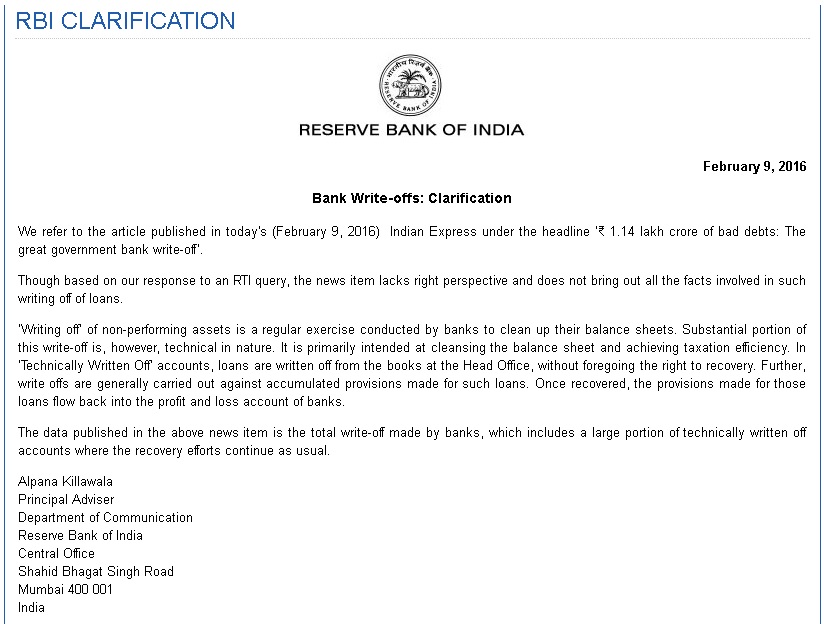
So a write off means the loan has been waived? Definitely not. Even the RBI had issued a clarification  in February 2016 (Raghuram Rajan headed the RBI then) stating exactly what we have explained above:

The RBI, now and even during Raghuram Rajan’s tenure, has been a big votary of this clean up process. The RBI has been constantly monitoring the write-offs by banks, and adding to the banks’ own write-off amounts whenever it has felt necessary. Rajan has recently stated that he felt banks were “scared” of writing-off loans, which they ideally should have written-off.

The people who have shared today’s Indian Express article, would have been better served if they had bothered to read the piece. The same report quotes an RBI explanatory  note which states that a substantial portion of the write-off is, technical in nature:

“It is primarily intended at cleansing the balance sheet and achieving taxation efficiency. In ‘Technically Written Off’ accounts, loans are written off from the books at the Head Office, without foregoing the right to recovery.”

Former chairman and MD of Indian Overseas Bank, M Narendra,’s views are also reported in the same piece:

“The write-off is just a technical book entry. Banks are not losing anything. It doesn’t mean banks are giving up those assets. They will continue with various recovery methods.”

In an ideal world, write-offs would not be needed. Loans given would be repaid back in time. But write-offs are needed right now since loans given earlier, are now showing signs of weakness, and accounting prudence, RBI guidelines, and Tax efficiency demand that such loans be “written off”. These “write-offs” are by no means a “waiver”.

Truth about UP civic polls : Did BJP win more seats with EVMs and less with Ballot Paper?

It might be time to run a remixed version of the hit track from The Jacksons’ from the 1970s:

Don’t blame it on the sunshine 
Don’t blame it on the moonlight
Don’t blame it on good times
Blame it on the EVM

The UP Civic polls results are out and people are out to discredit BJP’s performance. After the results, the first question on EVMs was raised by an independent candidate, which did not seem to hold much ground. Now, politicians from national parties have joined the chorus.

The theme has been: BJP’s win percentage is much higher in seats where EVMs were used and drops drastically in areas where ballot papers were used. There are no direct allegations but nudge-nudge-wink-wink allusions point to EVM fraud.

Take a look at a few tweets:

From Mr Zero Loss:


From the AAP MLA who brought a toy EVM to the Delhi assembly to show it can be hacked:


From Nitish babu’s estranged friend:


Another AAPian known to lie:


From the youth icon who got a thrashing earlier this year:


BSP’s Mayawati too claimed that if Lok Sabha polls for 2019 were held on ballot papers, BJP would not win. Figures may keep changing, but the assertion remains the same: EVM’s have been manipulated to make BJP win, and this BJP magic fails as soon as Ballot papers are introduced. So what is the truth?

Firstly it is important to know why these percentages are being thrown around. Elections for 16 nagar nigams (municipal corporations) were held through EVMs, while ballot papers were used for simultaneous polls to 198 nagar palika parishads (municipalities) and 439 nagar panchayats. All the figures are based on this demarcation.

Based on the data on the State Election Commission’s site, BJP’s win percentage in nagar nigams is 45.69%, whereas in nagar palikas and nagar panchayats combined, the win percentage drops to 15.36%. Till here, most of the above claims are true. But then how have other major parties fared in a similar comparison?

Click on the image for larger size

The above data can be understood as below: The columns marked in yellow shows the party-wise performance in areas where EVMs were used. The columns marked in green show the party-wise performance in areas where ballot papers were used. And the last column in blue shows the percentage decrease in win percentage when we move from EVM areas to ballot papers areas. Invalid and provisional results, as per the Election commission’s site (36 in total out of 12647) have been ignored.

BJP’s win percentage comes down from 46.39% to 15.55%, by around 66%. But Sibal’s Congress’ win percentage comes down by even more i.e 67%, from 8.37% to 2.74%, when we compare EVM results with Ballot paper results. Similarly, win rates of SP & BSP have also come down by 39% and 57% respectively.

EVM hacking theory busted
EVMs are not treating any particular party in a special manner

All in all, as one compares performances of parties, all parties have fared significantly worse in areas using ballot papers. What does this prove? Did all parties hack into EVMs which gave them better results in areas using EVMs? Did BJP tamper with the EVMs to pass on some good results to its competitors as well?

The above data will make sense when we see the last line of the puzzle: The performance of independents:

Click on the image for larger size

See the last row (in italics). While independents had just a 17.03% win rate in areas using EVMs, they won a whopping 66.22% seats in areas using ballot papers. A more sensible reading would be: Independents fared badly in Nagar Nigams, but thrived in Nagar Palikas and Nagar Panchayats, while all parties perished in such areas. An even more nuanced reading would be: Parties performed better in urban areas whereas they failed in semi-urban and rural areas, where Independents ruled the roost.

This brings us to the second point: While people are comparing EVM results vs Ballot paper results, they are comparing results in urban areas with those in semi-urban and rural areas, which is like comparing apples with oranges. Voting patterns and sensibilities are markedly different in urban and rural areas, and simplistic comparisons fail to grasp this. Instead of looking at conspiracy theories like EVM fraud, these trends indicate that party affiliation matters more to the urban voter whereas rural votes may be more personality driven than party driven.

While such analysis shows the obvious reasons for the fluctuation in win percentages, social media will be rife with such half-baked analysis as those peddled by the like of Akhilesh, Sibal, or AAP leaders. Media commentators often rue the lack of fact-checking when statements of politicians are reported. Will these same people take cognizance now?