Home Blog Page 7423

Fake picture of BS Yeddyurappa surfaces on social media in a bid to defame him

Karnataka is due for elections soon, and hence political hitjobs are an order of the day. Parties will try hard to upstage the other, and in the process, sometimes rely on dubious material. For example, last month, the Karnataka unit of the Congress claimed that BJP has in the past celebrated Tipu Jayanti. To prove this they circulated some pictures on social media. As it turns out, the pictures were of Iftar parties organised by the BJP minority morcha, and had nothing to do with Tipu Sultan.

Now, a similar rumour was seen floating on social media. Some users posted pictures of ex CM B S Yeddyurappa, and claimed that it was a picture of him celebrating Tipu Jayanti:


Co-founder of the alleged fact-checking site Altnews, a parody Facebook page tackily called Sususwamy too posted the picture, claiming that when Yeddyurappa was in power, he had celebrated Tipu Jayanti.

A reverse search of the image revealed that this was not a new allegation. Last year during the time of Tipu Jayanti celebrations, this picture was circulated, but that time, it was released by a JDS leader Basavraj Horatti. Yeddyurappa had even then rejected the allegation stating that he had the picture was from some other event.

A deeper reverse search revealed that the earliest instance of this picture on appearing online was the period between 30 March 2013 and 1 April 2013. Two stories on the internet used this picture (1) (2).

The first story claimed that the picture was from the Karnataka Janata Paksha (KJP) Minority Convention, organized in Bangalore on March. 30, 2013. KJP was the party formed by Yeddyurappa after he split from the BJP. This story was published on 1st April 2013.

Even before this, on 30 March 2013 itself, another site had uploaded the same picture, with the exact same description:

From the above pictures, it is clear that what was being spread (even by alleged fact-checkers), as a picture of BS Yeddyurappa celebrating Tipu Jayanti, was in fact a picture from a minority convention. Further, the claim that Yeddyurappa was in power, when he “celebrated Tipu Jayanti” also fails, because in March 2013, KJP had just been launched and was waiting to win its first seats in the May 2013 assembly elections.

Further, the practice of celebrating Tipu Jayanti in Karnataka, was started only in 2015. In November 2015, the Congress Government in Karnataka had announced that henceforth, Tipu Sultan’s birth anniversary will be celebrated. While one can expect political parties to spring such traps, and laymen to fall in them, it is odd how alleged self-proclaimed “fact-checkers” spread propaganda without verifying the facts.

Mob burns down 30 Hindu houses in Bangladesh over a Facebook post

0

In a case of rising atrocities against the Hindu minorities of Bangladesh, a violent mob set ablaze 30 Hindu homes at Thakurbari village in Rangpur Sadar upazila of Bangladesh. This village is about 300 kilometres from Dhaka.

The mob carried out such a violent attack after it was angered by a supposedly defamatory Facebook by a Hindu resident of that village. The police intervened in this matter after the mob had burnt 30 Hindu houses apart from vandalising and looting a sizeable number of houses.

The police later fired rubber bullets and tear gas shells against the mob in order to try and bring the situation under control.

Such an escalation was a result of a rumour that the Hindu villager had written a Facebook post defamatory against Prophet Mohammed, which brought out a 20,000 strong crowd to protest, a section of which later went berserk.

In the subsequent police action 6 people were injured and later one youth named Hamidul Islam succumbed to his injuries. A total of 33 people have been detained in connection with this whole incident.

The district administration has also formed a 3 member committee headed by Additional District Magistrate Abu Rafa Mohammad Rafiq, in order to investigate this incident. The Deputy Commissioner of Rangpur also claimed that they had arranged relief material for the affected Hindu families in the village.

Bangladesh has regularly seen such forms of atrocities against Hindus who now constitute a mere 10.7% of the total population.

Reports have claimed that about 98 Hindus were killed, 357 injured and 1,109 received death threats in 2016 alone. It also claimed that 711 Hindus left the country, 209 idols were damaged and 22 were stolen.

In October, 2016 there were reports that at-least 15 Hindu temples in Bangladesh’s Brahmanbarhia district were vandalised and 100 houses were looted over allegations that disrespect was shown towards Islam on Facebook.

2013 also saw immeasurable atrocities against Hindus. In the aftermath of the International crimes tribunal sentencing Delwar Hossain Sayeedi to death for war crimes during the 1971 Bangladesh liberation war, Hindu houses and temples were attacked by radical elements. This prompted the Bangladesh High Court to instruct the government to provide adequate security to the Hindus and repair the damage caused.

Violent attacks against Hindus over Facebook posts have also been witnessed in India’s West Bengal.

In the state’s Basirhat region, a Jihadi mob went on a rampage in July after it was incensed by a Facebook post made by a minor which allegedly denigrated their religion. The riots resulted in destruction of property, desecration of Hindu temples and also caused the death of a 65 year old man named Kartik Ghosh.

After bots, ‘fake girls’ seen trying to push Rahul Gandhi’s image on Twitter

0

The Social Media presence of Rahul Gandhi and the Congress party has come under increasing scrutiny in recent times.

Earlier it was famously reported how a high increase in the metrics of Rahul Gandhi’s twitter account was a result of Russia, Kazakhstan and Indonesia based bots engaging with his tweets. This had predictably caused quite a flutter with people accusing Rahul Gandhi’s social media team of deceiving the public especially considering the fact that an inordinate number of reports “Congress’ social media resurgence” were being published by the mainstream media.

Now it seems that the social media team might be playing an even murkier game if the claims of a twitter user are to be believed.

As per a twitter thread created by well known twitter user Ankur Singh, the Congress’s social media team is allegedly misusing pictures of girls in-order to promote the twitter account of Rahul Gandhi.

As per Ankur, fake accounts are being created of these girls which are then used to add comments on Rahul Gandhi’s tweets to possibly generate more social media traction. Ankur claimed that such accounts were made one to two months back.

These are the examples which he gave in order to prove his theory:

Under the tweet where Rahul Gandhi is seen doing poetry about LPG rate hike, a girl named Sunidhi Rajput is seen professing her romantic feelings for the Congress Vice-President. As investigated by Ankur, this particular twitter account was created this September and the picture of the girl seems to have been sourced from a website called unomatch.com/desiindiangirlspics:

Ankur furthered his theory by showing two other examples.

In the second case a girl named Neha Khan is seen appealing to the people to beat BJP leaders as a response to another attempt to poetry by Rahul Gandhi:

The picture of this so-called Neha Khan (joined October 2017) seems to be sourced from picture uploaded by a certain Meenal Khan in January 2016:

In the third case it is seen that a girl named Naina with RG is also seen letting twitter know about her love for Rahul Gandhi:

As checked by Ankur this picture actually appears to be of a girl named Ankita Jain:

This does raise the question as to whether Rahul Gandhi’s social media team is directly responsible for misusing pictures of women or whether its an act by some of his hardcore supporters.

It also remains to be seen whether the National Council of Women or the Women and Child development ministry swings into action mode in order to investigate this matter so as to nail the real culprits behind this misuse of pictures.

Frequent changes in GST regime: caught between a rock and a hard place

0

We are now more than 4 months into the GST regime, and there have been several changes announced by the GST Council at regular intervals. Changes can signify two things: The Government is receptive and ready to course correct, but that also means it is an admission that they were on the wrong course on some issues at least. While there are bound to be course corrections during the implementation of such a massive reform, it may be important to analyse the reasons behind the same.

In chemistry class, students often have to deal with classroom lectures known as “theory” and then lab experiments, known as “practical”. GST implementation can also be split into “theory” and “practical”. The “theory” part consists of the GST Act, the rules, the law which specifies which transactions are taxed, and how. The “practical” side of GST is the compliance requirements, the compliance interface, which the end users have to deal with.

The GST Act can also be split into 2 parts: The first being the actual law and the second being the GST rates on various goods and services.

A look at most of the changes made in the past few months would indicate that law related changes have not been too many, but we have seen many changes in the rate schedule, and also the compliance processes. There may be a reason for this.

The GST law although new, was a fairly evolved law. A draft model law was initially put up for public consultation. Then a revised draft law was brought in, which rectified many flaws in the original. Finally, the final GST Act was notified from 1st July 2017, which had further improved from the revised draft law. This process had begun many months prior to 1st July 2017.

In contrast, the rate schedule for goods and services was first released only in May 2017, less 50 days before the launch of GST. As a consequence, industry and consumer feedback was limited and hence the rate schedule had to be tinkered several times after 1st July 2017. The Government could have had apprehensions of hoarding etc, hence they may have delayed the rate schedule announcement.

The worst hit though was the compliance interface part of GST, the “practical” aspect. The task of developing he GST portal was given to the Goods and Service Tax Network (or GSTN), a non-profit, non-government organization. The contract for developing this vast technological backend was awarded to Infosys in September 2015.

While the law was released to the public months in advance, and the rate schedule came out days in advance, the GST portal was made operational for compliance matters only 24 days after launch of GST. Even then, many of the features which were provided for by the law, were not made ready on the portal. In fact even today, more than 4 months later, many features are still under development.

And this is the main reason why GST has had to undergo so many changes. Every-time a feature on the GST portal was delayed, due dates for the same had to be extended. Every-time it was noticed that certain mechanisms were not working as smoothly as they should have been, timelines were extended (and are being extended even today).

A massively overhauled IT system should have ideally been thrown open to public in advance, before the launch of GST, for testing and corrections. Instead, the actual users became the test cases and based on these tests, systems were constantly tinkered with.

Now, we are at a phase where there is no going back. It is a fact that GSTN has massively under-performed on its promises. But at the same time the Government has to deal with it. It is hard to say who is at fault: Was the Government given false assurances by the GSTN on the readiness of the system? Or was GSTN pushed too hard with inadequate time to release a stable GST portal?

In hindsight, the case may seem 20-20, and in hindsight, it would have served the Government much better to have started GST with a very easy set of compliances. Instead of rolling back complicated compliance requirements, and making way for simpler GST returns, the Government should have started with simple processes. Once the users were accustomed to it, they could have gradually stepped up.

This approach would have also given the GSTN adequate breathing space to develop the more complicated tools and programs needed to run and support complex processes. Instead, we see the Government constantly firefighting, dousing the flames ignited by the GSTN.

All this has left a bad after-taste among the business community. A poorly functioning IT system is terrible, but keeping track of constant changes is only slightly better. While the Government can claim to be responsive and ready to change, in the heart of hearts, it knows it is dodging bullets on a regular basis, and at some point of time, the dodging may just not be good enough.

Tipu Jayanthi celebrations show Indian secularism at its rotten worst

Indian secularism is rotten to the core. We all knew that already. But in recent years, there has not existed a more perfect example of votebank politics than the Tipu Jayanthi celebrations in Karnataka.

First let us talk about the history of Tipu Sultan. He was an important ruler of Mysore region, one who allied with French colonists against British colonists. If that is an example of fighting for “freedom of India”, so be it.

Now that Tipu Sultan has become an issue in the politics of Karnataka, “eminent” historians have doubtless taken the side of the hand that has fed them generously for seventy years. There are some arguments that they have repeated over and over again and I wish to point them out.

First, they say that Tipu Sultan should be judged in the context of the times he lived in and not in the context of modern times. They say that like almost all rulers in the eighteenth century, he was an autocrat, hungry for power, hungry to expand his power and ruthless in crushing rebellions.

In itself, that’s not an unfair argument. However, this raises the question of why eminent historians and even more eminent journalists never play by the same rules when judging say Manu Smriti. Isn’t Manu Smriti a two thousand year old text, at the very least? How come no historian speaks out on the foolishness of Manu Smriti being burned on a daily basis by modern leftists to protest views that were written 2000 years ago?

Apart from demanding that Tipu Sultan be judged by the values of 18th century and Manu be judged by the standards of postmodern feminism, historians and journalists have recently made it their life’s mission to point out that while Tipu broke some temples, he also patronized others.

The point they try to make is that both of these actions were guided by Tipu’s single aim of consolidating his power, rather than considerations of Hindu vs Muslim.

Again, this argument would hold water only if those advancing it could give examples of Hindu rulers, the Marathas for example, destroying mosques in order to consolidate their power.

Kings worldwide have attacked places of other faiths in order to establish their power. But Maratha kings didn’t destroy mosques. Eminent liberals wanted Tipu Sultan to be judged by the morals of 18th century India and so I did just that.

So, liberals have one of two choices : either Tipu Sultan was a brutal bigot or Hindus of India stand out in world history in being more enlightened than their Muslim or Christian counterparts. Which one is it?

But then Tipu Jayanthi was never about Tipu Sultan at all. As I said before, Tipu Jayanthi celebrations reflect everything that is rotten about Indian secularism.

Did Muslims of Karnataka ask for Tipu Jayanthi celebrations? In fact, Islam is somewhat uncomfortable observing birthdays altogether. Few years ago, the Deoband issued a fatwa against celebrating even the birthday of Prophet Mohammad. The Saudis, who observe the most radical and conservative version of Sunni Islam, deliberately do not have a holiday on the Prophet’s birthday.

Muslims didn’t ask for this. There is one and exactly one entity that should get 100% of the blame for the current fracas over Tipu Jayanthi : the Congress Party.

This is why Tipu Jayanthi reflects Indian secularism at its rotten worst : the Congress Party of Smt. Sonia Gandhi pretends to “give” something of absolutely no value to Muslims, something the Muslims never asked for and likely never wanted. 

But by pretending to “give” something to Muslims, Congress Party created a wedge issue where absolutely nothing existed.

Now, everyone in Karnataka is being forced to take a side on an issue they never cared about.

This has been the core of Congress politics of the last sixty years. Dividing the country in every which way possible. In Gujarat 2017 it is the Patidar Patels. In Gujarat of 2012,  the Congress was stoking Leuva Patel “anger”. Earlier this year, the Congress and its fellow travelers were busy fanning Jat “anger”. This was a deviation from their previous plan of exploiting Brahmin “anger” against our Prime Minister, who is from an OBC community. And we all know who is behind Maratha “anger” in Maharashtra.

The Congress party’s newest initiative in dividing the people is to promise the Lingayats of Karnataka the status of a separate religion distinct from Hindus.

Rather than copy pasting the British policy of divide and rule, imagine how much good the Congress could have done for this nation had they cared about the people even once during their six decades of power.  Now that they are out of power, the Congress is committed to playing this card even more viciously. And they will keep playing it till they can ride their way back to the PM’s residence, no matter in how many pieces that leaves our country.

This is a good article, with some #CreditToRahulGandhi

0

The GST council in its meeting on Friday slashed the rates on about 211 items which includes shifting 178 items from the 28% bracket to the 18% bracket.

While many consumer and business owners dependent on these goods breathed a sigh of relief, journalist Pallavi Ghosh who is known to be favourable to the Gandhi family came up with a pretty “interesting” tweet:


It was slightly amusing to note that the journalist decided to give credit to Rahul Gandhi out of the blue without taking advantage of the increased 280 character limit on twitter to explain as to how she reached this conclusion.

To any layman it seemed a little odd that Rahul Gandhi, and not the members of the GST council who actually reduced the rates, found a mention in her tweet.

Twitter users who were gearing up for a weekend, soon decided to have a bit of fun and started tweeting disjoint things or things unrelated to Rahul Gandhi under the #CreditToRahulGandhi hashtag, to sarcastically mirror Pallavi’s tweet:


Even though the GST tweet was possibly an innocuous attempt at sycophancy, far serious charges have been levelled against Pallavi Ghosh in the past.

We had reported how she had sent out a tweet alleging that a woman in Uttar Pradesh was gang raped for eating beef, without providing any additional information like the place of this incident. The UP police as a result of her tweet launched an investigation and later concluded that her tweet seemed fictional. She has till date not deleted that tweet.

Utterly prompt response to Amul’s Butterly request!

0

The Modi government is known for its efficient use of Social Media not just during elections, but also to deliver governance. We regularly see how Ministers reach out to people through Social Media. From Sushma Swaraj to now, Piyush Goyal.

It was on 23rd October 2017, that Amul tweeted to the official handle of the Railways Ministry and said they were interested in using refrigerated parcel vans to transport Amul butter across India. Asking for advice on how to proceed.

We wonder if Amul expected such prompt action for a request made on Twitter. On that day itself, Ministry of Railways asked Amul to provide name and number of the person who should be contacted. On 24th October, the next day after Amul tweeted its query, Amul responded saying they had a good meeting with Sr. DOM and Sr. DCM of Ahmedabad.

As so many such meetings go, we thought it would be months before Amul would see some concrete action. To our surprise, today Amul tweeted that the first refrigerated van with 17MT Amul butter was being flagged off from Palanpur to Delhi and thanked Ministry of Railway for its prompt action.


Piyush Goyal, the current Railway Minister responded with a heartfelt “From Gujarat to Delhi, made and transported with love”.


We applaud Piyush Goyal for setting such high standards in prompt governance. Way to go Mr. Goyal!

Controversial AAP leader Somnath Bharti caught spreading lies about PM Modi and President Kovind

0

Somnath Bharti, it may be argued is one of the more controversial leaders of the Aam Aadmi Party.

Before entering politics, Somnath was reported to have indulged in unethical spamming on the internet. Has has also been accused of making racist remarks against African women and has been accused of physically and verbally abusing his wife.

In recent days his name has surfaced in a assault and molestation case which was filed by a women against three AAP leaders namely Somnath Bharti, Jarnail Singh and Amanatullah Khan.

Now it seems that Somnath Bharti has chosen Twitter as a platform to notch another controversy against his name.

At about 3:37 AM IST, Somnath Bharti sent out a tweet where he expressed shock about protocol not being followed when it comes to the President of India Ramnath Kovind and criticised PM Modi for his behaviour:


In this video of a marriage ceremony, PM Modi is seen standing closest to the groom while a person who Bharti claims to be the President is standing beside him. Here Modi is later seen getting all the attention and the man who Bharti calls, President Kovind, is sidelined on the stage while getting sparse attention from the organisers.

This was used by Bharti to allege lack of protocol on part of PM Modi that he usurped the stage from the President.

This tweet of Bharti was also used as an opportunity by AAP leader Ashutosh to launch an attack:

But almost predictably, Bharti was completely wrong in this case as the person who he called as the President of India is actually Banwarilal Purohit, the Governor of Tamil Nadu.

This lie was also recently repeated by Human Rights activists Shabnam Hashmi who later deleted her tweet after people exposed the lie:

Screenshot Via @iAnkurSingh

Incidentally this isn’t the only time Twitter has landed Somnath Bharti into trouble. We had reported how Bharti had once sent out a tweet praising PM Modi and soon deleted it. He, in his defence claimed that his account was hacked.

GST on restaurants cut from 18% to 5%, but your bill may not reduce by 13%

0

In a major announcement, following the GST Council Meeting at Guwahati, Finance Minister Arun Jaitley announced that a decision was made to tax food at all stand-alone restaurants, AC and non-AC, at a uniform rate of 5%. This was a departure from the existing rates of 12% and 18%.

This apparent reduction in rates brought cheer to many on social media:


But will eating out really be cheaper by 13%? Lay people will not understand this, but the reduced rate of 5% comes with a rider. The press release stated the terms:

All stand-alone restaurants irrespective of air conditioned or otherwise, will attract 5% without ITC. Food parcels (or takeaways) will also attract 5% GST without ITC.

The words “without ITC” are key. ITC refers to Input Tax Credit. ITC basically is GST paid on purchase made. In the case of a restaurant, the GST which is charged on the rent it is paying, or on the groceries it is buying, is called ITC. This GST paid while purchasing items, can be utilized while making payment of GST which a restaurant collects from its customers.

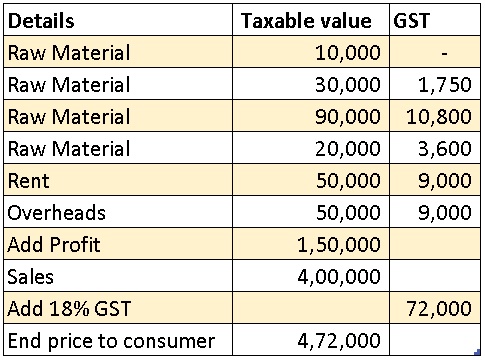
To take a very simple example: Let us assume that the monthly expenses of a restaurant are Rs 250000, on which, the restaurant is charged Rs 34150 GST by various suppliers. Thus the total purchase cost is Rs 284150. But, this Rs 34150 can be used as “ITC”. When the restaurant sells food, for egs for Rs 400000, it charges GST of 18% on the same, i.e. Rs 72000. This Rs 72000 which has been collected from customers, needs to be paid to the Government. At this point, a restaurant can utilise the ITC of Rs 34150, and instead of paying Rs 72000, can pay only Rs 37850. This can be explained with the following table:

In the sample data above, raw materials are assumed to be taxed at various GST rates such as 0,5,12 and 18% since food items are scattered all over the rates spectrum. Based on the above, if a restaurant can avail ITC, and if it charges 18% GST on sales, the end price to the consumer would be Rs 472000.

In the proposed amendment making the rate of GST as 5%, the benefit of ITC has been withdrawn. Thus, all the GST which was earlier sitting separately and was being adjusted against GST collected on sales, suddenly becomes useless. The restaurant has to now straightaway charge 5% on sales and pay that 5%, without any adjustment. So Does that mean the GST on sales would be 5% of Rs 400000 and end price to consumer would be just Rs 420000? No.

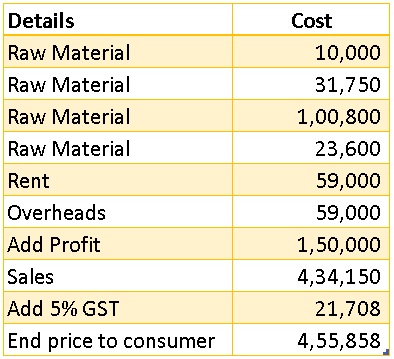
Since the GST on purchases (ITC) is now useless, it becomes part of the cost of the restaurant. As costs go up, and profit remains constant, the selling price also goes up. But this increase will be partly absorbed by reduction in the GST rate from 18% to 5%. Thus, holding all the data as above constant, and only changing the 2 conditions of ITC and 5% GST, we get this data:

Thus, although GST rate was reduced by 13%, other things being constant, the price to the end consumer reduced only by around 3.42%. This percentage can vary depending on the actual data of each specific case and the product mix, but in almost no situation will the reduction be near 13%.

At this point, it is important to understand why this change of reducing the rate from 18% to 5% was brought in. In the pre-GST era, ITC was restricted to very few items. All VAT or Service Tax paid or purchases was not freely available as ITC, and hence, lot of such tax component resided in the cost of products. As GST came in, the ITC rules were largely liberalised. Virtually any GST paid for business was allowed as ITC, thus reducing effective costs. Further, the excise embedded in goods was not available as ITC to specific industries like traders, restaurants etc, but under GST, the entire tax was available as ITC.

The Government expected that business would pass on these reduced costs to consumers by reducing selling prices. In certain well regulated sectors, and in companies run by big corporates, this price reduction was evident. Within days of GST being launched, FMCG companies either slashed the prices of goods or increased the grammage of the products. Auto companies too passed on the benefits by reducing prices.

Similarly, it was expected that restaurants and eateries would also slash prices. But do you remember eating out becoming visibly cheaper? Did the restaurants in your neighborhood reduce their prices? There may be a few, but most restaurants did not fall in line. The GST Council was also of the same view that most restaurants did not pass on the benefits of input tax credit to customers by reducing prices after GST was implemented from July 1.

Hence, since the restaurant industry was not playing fair, the Government went ahead and removed their eligibility to claim ITC, and also slashed the rate of GST to a flat 5%.

Thus, a visible fall in GST of 13% may not result in food at restaurants becoming cheaper by 13%. Worse, if restaurants continue the trend of playing hanky panky and decide to pocket the 3-5% odd benefits as shown above, then your restaurant bill may remain the same. The tax component may shrink but the overall cost may remain the same.

Media spreads lies about ‘only vegetarians being eligible for gold medal’ in Pune University

0

It was reported today by ABP Majha that Pune University has come up with a circular that says only vegetarians and non alcoholics would be eligible for the Gold Medal.


The order embedded in their article also said that the eligibility criteria include students having participated in blood donation, shramdaan meaning labor donation, environment protection, pollution control work, literacy, cleanliness drive, and aids awareness drive etc apart from being vegetarian and non addicts.

Soon, this news was picked up by other National news outlets without verifying the facts mentioned.


The same lie was repeated by ‘India Today’,  which had curated the ‘TheQuint’ report. Many other national media outlets also picked up this lie and ran with it without verifying facts.

Even Supriya Sule who is an MP from NCP, reacted to this false news and expressed her surprise

The lie took an ideological turn with the statements of Santosh Shinde, Pune district president of Sambhaji brigade who said, “We are condemning the circular issued by the university. In many government hostels, students are given non-veg food and even in midday meal, students get eggs to eat. While the education department is providing non-veg to students, the SPPU management is forcing students to go for veg. I feel the university management is following certain ideology.”

The truth, as reported by DNA is that this circular is a 10 year old circular and the conditions of eligibility are not decided by Pune University but the trust that sponsors the Yog Maharshi Shelarmama gold medal award.

Arvind Shaligram, registrar of Savitribai Phule Pune University (SPPU) said, “The circular was first issued in 2006 and since then every year, university is issuing the circular with the same content. The university has not given these conditions. All the conditions mentioned in the circular have been decided by the trust of Yog Maharshi Shelarmama who gives the gold medal award. These conditions were set ten years back only and every year, the university is only issuing the circular with the same content.”

Infact, if the Media houses truly wanted to verify facts, they could have simply searched circulars uploaded on the Pune University official website. We found the circulars (1) (2) from 2012. A circular from 2008 also says the same.

A 10 year old circular catching the media spotlight now, in 2017, certainly raises many suspicions. One wonders if these inconsequential details are being spun into lies simply to divide the nation and create fault lines. The fact that media houses can’t run basic check on fact is a scathing indictment of the falling standards of our National Media. A similar ploy was earlier run by sections of the media when past circulars were hyped up to create outrage.