Home Blog Page 7429

Why Muslims owe a lot to Sardar Patel

0

This is the centenary of the year when Sardar Vallabhbhai Patel first met Mahatma Gandhi and India got its unifier to create the nation we know today. His birth anniversary, which falls this week, was all but erased from public memory under the Congress continuance and the media/academia which controlled the public narrative. It’s only now that the man is being pulled out of history’s dusty racks.

History bears testimony how the birth centenary of Sardar Patel on October 31, 1975 was blocked from public consciousness by the dispensation of Indira Gandhi and the media/academia cabal. Contrast this with Pt. Jawaharlal Nehru’s who was festooned all over India in 1989 during his birth centenary.

You have Marxist historian Romila Thapar pointing out Sardar Patel’s role in reconstruction of legendary Somnath Temple after Independence, as an act of communal and not secular ideals of India by inference, though how Nehru pushed the passage of the Haj Committee Act in 1959 is better not questioned.

Congress loses no time in terming Sardar Patel as its own, and couldn’t care less about your protest that the “Iron Man” got Bharat Ratna only 44 years after India’s independence. Try telling them that no less than three Nehru-Gandhi icons were decorated with India’s highest civilian award in between (two of them, Nehru and Indira, while they were still alive). A few awardees in between, while Patel was kept in the storeroom, could be suitably embarrassed.

All this while Patel’s has been nuanced into an anti-Muslim persona. Be it agenda-driven websites which have mushroomed lately; the known Left’s stable such as The Hindu/Frontline or NDTV and even the mainstream media, Patel’s legacy has suffered at their hands. The man deserves truth even if respect eludes him from the indifferent amongst us. Sardar was no less than Bismarck—but India hasn’t been a match to Germany in gratitude.

The anti-Muslim narrative must seize our immediate attention. BJP has been tireless in pointing out Sardar’s role in India’s unification. Its been easy for the Indian ecosystem to club the two and project it as being anti-Muslim. One, it establishes their “secular” credentials and two, it kind of helps in explaining their wilful neglect of the towering Sardar.

Was Patel Anti-Muslim?

The one unethical method the intelligentsia adopts is to take a quote out of its context and use it to buttress its agenda. We have Rajmohan Gandhi writing in “Patel A Life” (P. 426) that “He (Patel) was unquestionably roused more by a report of 50 Hindu or Sikh deaths than by another 50 Muslim deaths.”

Another by Rajmohan Gandhi: “…Patel could not get over his anger against Muslims whom he held responsible for the Partition; they had brought this tragedy not only upon themselves but also on others.”

Patel has been blamed for introducing the Permit system which didn’t allow Muslims to claim their Indian citizenship even if they had gone to Pakistan for a visit after August 15, 1947. He is also burnt at the stake for slapping the Evacuee Property Law which meant the absorption of movable and immovable assets of Muslims who chose to leave for Pakistan. In both the instances, it was in retaliation to similar moves made in West and East Pakistan but such logic is usually lost in wilderness.

Quite a few of Sardar’s utterances are cited to hold him guilty of anti-Muslim bias. There is this speech in Hyderabad, just two months before his passing away in 1950, where he said: “I naturally begin to doubt whether Muslims here feel that their future lies in India.” (That his next sentence condemned some Hindus for celebrating Gandhi’s assassination, is studiously avoided). (Chopra, P.N., The Sardar of India, P.150)

There are these words of Sardar’s in Calcutta (now Kolkata) in January 1948: “The Muslims who are still in India, many of them helped in the creation of Pakistan…They (now) say why their loyalty is being questioned.”

When Pakistan invaded Kashmir, the same month, he addressed Muslims in Lucknow, thus: “I want to tell you frankly that mere declaration of loyalty to the Indian Union will not help you in this critical juncture…those who want to go to Pakistan can go there and live in peace.”

Contrast these words with the actions Patel took vis-à-vis the minority communities. He was instrumental, as chairman of the committee on minorities and fundamental rights, in allowing Muslims and Christians the right to:

  • Propagate their religion
  • The right to preserve their language and culture
  • The right to run their own educational institutions.[1]

Men like K.M. Munshi and Purushottam Das Tandon, protested that even in the 1931 Karachi session of the Congress, only the “right to profess and practice one’s religion,” and not propagation, had been allowed. But Patel would have none of it. He went by the reasoning of Christian and Muslim members that propagation of faith was central to their tenets. That’s how you have the word “propagate” in Article 25 of the Constitution. ]2]

It was also Patel who gifted Muslims and Christians, and other minorities, with Articles 29 and 30, that allowed them the right to pursue their language and culture as well as control their own educational institutions. These rights are enshrined in India’s Constitution. [3]

The first Chief Commissioner of Delhi that Patel appointed was Khurshid Alam Khan. The Inspector General of the Special Police Force was a Muslim and a close confidant of Sardar Patel. In September 1947, Patel had 10,000 or more Muslims shepherded to safety inside the Red Fort. During communal violence he had free kitchens opened for them.

Many senior civil servants and police officers have left a vivid account of Patel’s sense of justice. He once rushed out in person in the middle of a night to save the Dargah of Nizamuddin Auliya. Choudhary Khaliquzzaman writes in Pathway to Pakistan (P 395-396) how Patel ordered Section 144 Cr.P.C to save besieged Muslim lives.

It was in the sacred Constituent Assembly, that Patel had thundered: “…a discontented minority is a burden and a danger and that we must not do anything to injure the feelings of any minority so long as it is not unreasonable.” On another occasions he addressed Hindus thus: “If you think that you can go on constantly troubling loyal Muslims because they happen to be Muslims, then our freedom is not worthwhile.”

In 1949, the idol of Ram was installed inside the non-functioning Babri Masjid. Patel lost no time in writing to UP Chief Minister Pt. Govind Ballabh Pant that the mob must not be allowed to take law into its own hands. That the law-breakers must be met with force.

Rajaji wrote thus in “Swarajya” in 1971: “A myth had grown about Patel that he would be harsh towards Muslims. This was a wrong notion but it was a prevailing prejudice.”

In January 1948, Gandhi wrote: “Many Muslim friends had complained to me of the Sardar’s so-called anti-Muslim attitude. I was able to assure the critics they were wrong…the Sardar had a bluntness of speech which sometimes unintentionally hurt, though his heart was expansive enough to accommodate all.”

Thus here we are looking at a man who is more secular than those who employ it as a tool to push their own despicable agenda. Why would you think a man of such generosity and big-heartedness didn’t get his due from the establishment? In one short word: Nehru, his successors and the ecosystem which they spawned in their wake.

How the Economist uses lies and half truths to push their anti-Modi agenda

0

It is no secret that media outlets like the BBC  and the Economist have an anti India, anti-BJP or anti-Modi slant to their editorials and coverage. A recent article published by the Economist lays threadbare their modus oprendi to malign Modi. Use half truths and debunked lies while ignoring any shred of objectivity to spin their agenda.

The article titled, India’s prime minister focuses too much on appearances, starts with the assumption that:

Mr Modi’s recent setbacks, however, stem in large part from his preoccupation with presentation over substance.

The rest of the article does not speak about this topic and the assertion is not backed up with anything objective or even remotely provable. Let us go further down the rabbit hole that is this Economist article, where we are supposed to discover ‘setbacks’:

Start with the economy. Growth has slowed, from 9.1% year-on-year in the first quarter of last year to 5.7% in the second quarter of this year. That is in part because of his policy of “demonetisation”, in which 86% of the banknotes in circulation were abruptly voided.

This ignores the fact that growth had started to slow down before demonetisation was introduced. It also ignores the fact that early indicators suggest that the Indian economy has possibly turned a corner and the economy is bouncing back.

Further, the article says:

Mr Modi presented it as a crushing blow to gangsters and tax-dodgers, but in fact it caused great hardship and disruption, without any clear benefit.

This is a very amateurish attempt that fails to provide any context and simply assumes demonetisation to be a failure. It does not talk about how demonetisation has ‘nudged’ India and Indians from a cash attached society to on that is switching to digital payments with gusto.

Tax-dodgers are not off the hook as ‘Project Insight‘ is there, and The Economist presents no data or argument to believe that crimes based on illicit or black money is not down. In fact, data shows that demonetisation indeed broke the bone of some crime syndicates, especially human trafficking.

Ranting on without substance, the article further claims:

Mr Modi triumphantly declared the GST a “good and simple tax”. But he did not listen to his own advisers’ suggestions on how to make it so.

This one truly boggles the mind – does the venerable Economist not know that Mr Modi does not dictate policy like is an authoritarian ruler? GST in particular is a triumph of co-operative federalism and is driven by a council that determines the rate structure. That aside, there is not a shred of evidence to suggest that Mr Modi was recommended only 3 rates, and he single-handedly ‘imposed’ the current structure.

The article then harps about ‘rising intolerance’ and attack on ‘press freedom’:

It does not help that the government bridles at criticism and harries its critics. Media firms are anxious not to offend it; journalists who take it on often lose their jobs. The press has been asking awkward questions about the finances of a firm owned by the son of Amit Shah, the BJP’s number two; they were greeted with rebukes from ministers and a lawsuit.

I can’t think of names of any journalists who lost their jobs, on the other hand, most anti-Modi journalists are doing very well in their professional lives and are running well-funded and well-oiled media outlets.

The “awkward questions” that The Economist refers to were so fundamentally flawed and didn’t know the difference between revenue and profits. Besides, filing a law suit is perfectly within India’s democratic norms.

Having failed at establishing any facts, The Economist then goes into the real of pushing propaganda:

Even comedians who imitate Mr Modi have mysteriously disappeared from the airwaves.

Outright calumny that takes on darker tones. No The Economist, the comedian did not disappear from the airwaves, on the contrary, in an interview he openly says that neither Mr Modi nor the BJP had anything to do with him not being allowed to perform his mimicry act. It was a decision taken by the private TV channel.

Perhaps the ‘best’ part of The Economist article is this:

The new government in Uttar Pradesh, for example, has painted buildings and buses saffron—a shade associated with Hinduism—and picked fights with Muslims, leaving the Taj Mahal (built by a Muslim emperor) off a list of the state’s main attractions.

How did content like this even get past the ostensibly high standards editorial boards in this venerable magazine? What does this even mean? This is really shoddy journalism. Thank god that they did not mention banning illegal slaughterhouses as picking fights with Muslims, which the desi media had done. Maybe The Economist is late to the party.

Now that the article is into anti-BJP mode, this is what appears next:

The party’s overriding focus is extending its own authority. Earlier this year the defence minister, Manohar Parrikar, resigned to become chief minister of the tiny state of Goa. The BJP had lost ground there in recent state elections, and the allies it needed to form a government insisted they would join it only if Mr Parrikar, a former chief minister, returned. The finance minister, for whom making the GST work was apparently not a full-time job, took on the role of defence minister as well for the next six months—a period of tension with both China and Pakistan.

It is a democracy, and in a democracy, no one is indispensable. Besides, the tensions with China was managed effectively and the Doklam issue cooled down, so why this needless angst?

In summation, the article is high on subjectivity and opinion being pushed as objective journalism, this write-up even fails to make a link between the clickbaitey headline and the body and content of the article and leaves it to the reader to make these connections. One would definitely expect more from an organisation with the stature and reputation of The Economist.

After appointing Chidambaram as his govt’s lawyer, will Kejriwal delete these old tweets attacking him?

0

Arvind Kejriwal, the current chief minister of Delhi, gained national fame via his anti-corruption activism where he along with Anna Hazare spearheaded the India Against Corruption campaign.

During that time, and even after launching his Aam Aadmi Party, Kejriwal cultivated a common man image in order to take on the “high and mighty” of the Indian political scene. Back then, a common modus operandi of his was levelling a barrage of allegations against those at the power. Such a high octane attack though wasn’t always followed by action and his antics soon became labelled as “shoot and scoot” politics.

One of the persons at the receiving end of Kejriwal’s allegations was former Finance Minister and noted lawyer P Chidambaram. Kejriwal in a variety of tweets dating back to 2012 alleged that not just Chidambaram but also his wife was corrupt and that they will go to jail:


Come 2017, it seems Kejriwal’s perception of Chidambaram has changed a lot. Now not only is Kejriwal not following up on his corruption allegations, he has also decided to seek his legal help to try and win Delhi government’s feud against the Modi government.

As per reports, the Kejriwal government in Delhi has roped in P Chidambaram to fight its case against the centre in the Supreme Court. The petition in the Supreme Court was filed by the Kejriwal government, after it suffered a setback in 2016, when the Delhi High Court ruled that, the Lieutenant Governor (LG) is the administrative head of National Capital Territory of Delhi and he is not required to act on the advice of the Delhi Cabinet. Such a tug of war between the LG and the Kejriwal government is going on ever since it came to power.

After coming on board, Chidambaram has become one of the 9 lawyers who will argue the case before a 5 judge constitutional bench of the Supreme Court, on behalf of the Delhi government.

Such an appointment by the Kejriwal government seems to have amused Congress leaders the most, who didn’t shy away from taking potshots at Kejriwal:


Its certainly interesting to see that Kejriwal who once questioned the ethics of P Chidambaram has decided to put his trust in him when it comes to a very important legal matter involving his government. Also now that Kejriwal and and Chidambaram will have to interact on a daily basis, would the former delete his tweets attacking the latter and maybe even apologise for them so as to reduce any form of awkwardness between them?

Let’s wait and watch…

Kapil Mishra asks Kumar Vishwas to break his silence over rampant corruption and malpractices in AAP

0

AAP rebel leader Kapil Mishra today wrote a scathing open letter to AAP leader Kumar Vishwas asking him why he keeps quiet when he sees wrongdoings in Aam Aadmi Party, especially by AAP supremo Arvind Kejriwal.

Earlier, Vishwas had tweeted a poem, in which he had hinted at breaking silence:


Citing the above tweet, Mishra wrote a long letter to Vishwas asking him to break silence:


Reminding Vishwas that duty towards India trumps everything else, Mishra reminded him that he (Vishwas) had asked him (Mishra) to delete a tweet praising PM Modi’s demonetisation move last year. Mishra asked that why did a party, which was formed on the plank of fighting corruption, did not give a single statement for three days on demonetisation? Which ‘outsider’ did Kejriwal consult before deciding to oppose the move? Who funded the rallies the party had conducted to protest demonetisation?

Elaborating further, Mishra says that during the demonetisation, ED had conducted raid in GK in Delhi, where stacks of cash was found. Mishra had earlier alleged that lawyer Rohit Tandon, whose firm was raided in December last year, had helped Kejriwal with hawala transactions.

Mishra suggests that Vishwas knows all about the details of ED raid in GK, cash found, and details about the director whose company was raided. He alleges that right after filing nomination in Varanasi during 2014 General Elections, Rs. 2 crore were given to Kejriwal through hawala; yet Vishwas is still maintaining silence. He questioned Vishwas why is he quiet on the elections, funding and money coming through countries like UAE.

He further questions Arvind Kejriwal’s opposition to surgical strikes. Kejriwal had demanded a video proof of surgical strike carried out by Indian Army in Uri in September last year. Following the doubts Kejriwal raised against Indian Army, he was hailed as a hero by Pakistan. Mishra questions who was ‘consulted’ before taking the opposing stand on both, demonetisation and surgical strikes?

The letter by Mishra also wonders how does AAP get funding to send leaders to foreign countries and their long and elaborate stays. He alleges that during Punjab and Goa elections, the funding came from separatists and Kejriwal even allegedly stayed at a Khalistani militant’s place during his Punjab campaigning.

Mishra also questions Vishwas on why is he silent on allegedly fake companies set up by Delhi health minister Satyendra Jain. Jain has been accused of money laundering and shell companies.

Mishra says that during all elections, many AAP volunteers bring to Vishwas’ notice the rampant malpractices, but Vishwas still maintains radio silence on these allegations. He says he is trying to awaken Vishwas’ conscience and his sense of duty otherwise history will see him as a weak person. He says that ever since he has taken up the fight, he and his family is facing all sort of abuses and threats, but he is hopeful that at truth will prevail.

He urges Vishwas to take the first step of courage and speak up.

Will Vishwas speak up, and are we going to see another round of infighting in AAP?

Work at India’s 1st overseas atomic energy venture to begin from 30th November

Work at Rooppur Nuclear Power plant, India’s first foray into overseas atomic venture is set to begin from 30th November, if reports are to be believed.

This upcoming nuclear power plant is being built via an Indo-Russian collaboration and its “first pouring of concrete” ceremony would take place on 30th November. This has been conveyed to New Delhi and the ceremony would take place at Rooppur which is about 169 kilometres from Dhaka.

In the initial phase of development, India is scheduled to train professionals who would operate various facets of the power plant. India would also provide technical cooperation and share valuable information regarding nuclear safety and radiation protection. This is in line with the three nuclear energy agreements Dhaka and New Delhi signed in April 2015.

Russia on the other hand would be providing all the equipment related to the project. As per Reuters, the power plant would comprise of two nuclear reactors of 1,110 megawatt capacity and would be built by Russia’s nuclear giant, Rosatom. These two VVER-1200 type reactors are expected to be ready by 2024 and 2025. As per the report, the expected cost of these two reactors is pegged at $12.5 billion.

About a $1 billion of the total product cost will be funded via a $4.5 billion Line Of Credit (LOC) which India extended to Bangladesh at the start of this month. This amount will be used to develop the power evacuation facilities, that is a system to dissipate generated power from the nuclear plant to the national power grid.

This nuclear project might be a boon for Bangladesh, a country which as per reports is riddled with the issue of frequent power cuts. Bangladesh has supposedly been trying to build nuclear power plants since the 1960’s but efforts have been hampered due to lack of support among other factors.

After the Rooppur Nuclear Power plant is commissioned, it will contribute towards 10% of the nation’s energy consumption, which currently relies on sources like coal, hydro-electricity and expensive natural gas for its ever increasing power needs.

Delhi vs Mumbai vs Centre: Who gets the credit for Doing Business rank improvement

0

India just showed a massive jump in the World Bank’s Ease of Doing Business (EODB) ranking from being ranked #130 in the world to #100 in the world. Since then, the claims of the naysayers have differed: the rankings are fixed, the rankings are flawed, the rankings do not mean anything in light of the “mahaul”.

AAP, which is normally an adversary of the BJP, and would have joined the aforesaid chorus, but instead they chose to claim credit for the ranking boost by virtue of ruling Delhi, which was one of the two cities surveyed.

Social media had various “experts” pontificating on the possible reasons as well. One Newslaundry columnist – known for spreading bigotry and propaganda – claimed that rankings shot up as Delhi’s data was included by the World Bank “for the first time”:

This is a blatant untruth, because at least since 2015, EODB rankings have considered both Delhi and Mumbai:

Next, let us see, based on the latest EODB report, who helped the rankings rise the most. (The report is called DB 2018, although it refers to the year ended June 2017).

According to the report, out of 10 topics under study, India’s score improvement in 8 topics, helped it rise up in the ranks. In the balance 2 topics, India’s score improved, but not enough to push its rank up. One of these topics is “Getting electricity” in which India already has a very impressive score and a high rank of 29 in the entire world.

Out of the 8 which helped India, India’s score improved by 3% or more in 4 topics, as below. In the other 4 topics the improvement was below 3%.

click on the image for larger size

For each of the above, the EODB report gives a brief description of the specific reforms undertaken, which helped India’s score move up:

click on the image for larger size

The last sentence in each of the above snippets is important: “This reform applies to both Delhi and Mumbai“.

Further, if the DTF (Distance to Frontier) scores of Delhi and Mumbai are compared for all the above parameters, they are virtually the same:

Is this because both Delhi and Mumbai undertook reforms at the same level to achieve the score improvements? Or is it because the reforms, which helped India move up, via Delhi and Mumbai, were actually undertaken by the Central Government, thus applying to both Delhi and Mumbai?

Mandatory payment of EPF online was notified [pdf] by the Central Government. Corporate Income Tax is under the purview of the Central Government. The Insolvency and bankruptcy code was brought in by the Central Government. Protection of Minority Investors is being attributed by officials, to several reforms undertaken by the capital market regulator SEBI (Securities and Exchange Board of India), which again is under the Central Government.

Thus, all the measures mentioned in the snippet of the EODB report as above refer to steps taken by the Central Government, which had effect on business in Delhi and Mumbai.

To be sure, the EODB report also states that out of the 17 cities in India, Delhi ranks at the 6th place, while Mumbai comes in at 10th. But as seen above, the EODB report indicates the bulk of incremental reforms in the last one year, which pushed India up by 30 places, and almost all of them, are reforms undertaken by the Modi government at centre.

The one where a Twitter user decoded Rahul Gandhi’s PR strategy

0

Recently, Rahul Gandhi’s PR strategy has won accolades from mainstream media, complimenting Gandhi for singlehandedly breathing life in the otherwise irrelevant political party. As party pooper as we could be, a Twitter user by the name Pun_Starr has tweeted a breakdown of Rahul Gandhi’s PR strategy.

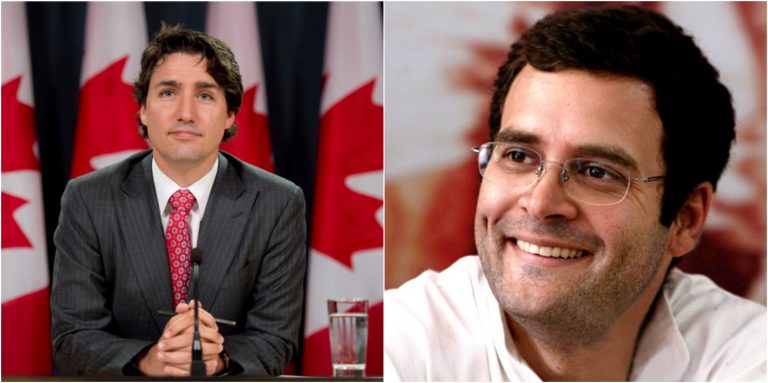
He states what many have already voiced that Gandhi’s new PR team seems to be building his image on the lines of Canadian Prime Minister Justin Trudeau, who has won the hearts of the liberals by being quirky and coming across more as a human and less as a larger than life political figure. He then further brings a comparative analysis on how in past six months the strategy has been panning out.


In September, mainstream media was abuzz with rumours of Rahul Gandhi speaking on Artificial Intelligence during his US trip. Of course, while Trudeau explained quantum computing to a room full of journalists, Rahul Gandhi, whose intelligence is widely known, embarrassed India instead by batting for dynasty.


Justin Trudeau has been portrayed as a very fit world leader, recently took to the boxing ring for charity. In a not so surprising move, Rahul Gandhi’s PR team released pictures of Rahul Gandhi, who claims to be a blackbelt in martial art form Aikido, making Aikido moves.


As the Twitter user points out, Justin Trudeau and his family introduced their dog to the world sometime in February last year, few months after assuming office. Last week, Rahul Gandhi had everyone fawning over his dog Pidi whom he introduced through a video. Former Congress leader from Assam, Himanta Biswa Sarma, slayed Gandhi by reminding him how Gandhi chose to play with the same Pidi when he would reach out to him with problems Assam was facing rather than taking things seriously.

Then there are tales of random act of kindness by Trudeau regularly featuring in the Canadian and global news space.


Recently, Indian media, too, has gone out of their way to see how Rahul Gandhi also indulges in such kind deeds.


Jyoti Singh was brutally gang raped by as many as six men in Delhi on 16th December, 2012. The nation came together to fight crime against women in the backdrop of this brutal case. Let me remind you how the then Prime Minister Dr. Manmohan Singh took over 10 days to condemn the brutal rape and murder of Jyoti. Justice Verma, former Chief Justice of India, led a committee to look at amendment of laws relating to sexual assault cases. He had asked the public at large to send across suggestions which could be incorporated in the law. Let me remind you how Congress President Sonia Gandhi, who was leading the UPA coalition, delivered her suggestions for amendments way past midnight, towards the end of period open for public suggestions. Justice Verma had also said former Prime Minister Manmohan Singh and former Union finance minister P Chidambaram, who were instrumental in setting up the committee, and former home minister Sushilkumar Shinde had not interacted with him even once during the entire exercise. So pardon me if I say this exercise of Rahul Gandhi reeks of nothing short of hypocrisy.

Rahul Gandhi, who is currently campaigning in poll-bound Gujarat, today stopped his bus to meet his ‘young fan’.


The video shared by Congress media co-ordinator shows someone from the team shouting, “bring that kid here, bring that little boy here,” and the video is posted as how Rahul Gandhi stopped the bus to meet a young fan. From the video it seems like after the bus was stopped, they were looking for a small boy who could be shown as a ‘young fan’. This, again is on the lines of Justin Trudeau’s PR strategy where Trudeau invited an 8 year old boy, who was crying as he could not be at a rally, into a media bus.

Whether or not there is a direct inspiration is something only the PR handlers can say, but similarities are rather too stark. Almost like Trump and Kejriwal.

Terrorists slit throat of a BJP Youth Leader in Shopian, Kashmir

0

On Thursday, Gowhar Ahmad Bhat a BJP youth leader was brutally killed by terrorists in the Shopian district of South Kashmir. As per reports, Bhat was abducted from his house in the Shopian town at about 6 PM.

His dead body was later recovered from a nearby village named Kiloora. As per the police which has started investigating the matter, Bhat’s body even bore torture marks.

Altaf Thakur, a BJP leader and media coordinator said that Bhat had joined the party 3 years ago and called him a dedicated leader. Thakur also heaped praise on him by stating that Bhat played a valuable role in organising BJP’s successful youth convention in Srinagar. Thakur also speculated that this could be one of the reasons why the terrorists killed him.

A resident of Bongam region in Shopian, Bhat was the president of BJP’s youth wing called Bhartiya Janata Yuva Morcha.

Soon after the incident was reported, senior BJP leaders like Amit Shah and Ram Madhav expressed their condolences:


Such a dastardly incident paints a very grim picture of the BJP-PDP coalition government in Jammu & Kashmir, when it comes to ensuring proper security for its party leaders and workers.

In recent days there have been other such attacks on politicians belonging to the BJP-PDP ruling dispensation:

  • On the night of 16th October, 3 terrorists turned up outside the house of Mohammad Ramzan Sheikh, a PDP worker, who was also a former sarpanch. The resulting scuffle resulted in Sheikh’s death.
  • On 14th October, a policeman was killed when a convoy of PDP MLA Noorabad Abdul Majid Padroo was attacked by terrorists.
  • In August a PDP worker was shot by terrorists outside his house in Anantnag district and was declared dead when he was brought to the hospital. The report also detailed that prior to this incident, 3 PDP workers were shot in 2017, in which 2 unfortunately died.

Government clamps down on those reporting ‘fake news’, says no advertisements for them

0

Narendra Modi led central government seems all set to amend clause 25 of the New Print Media Advertisement Policy, 2016 which deals with the issue of suspension and recovery. The amendment aims to stop the release of DAVP (Directorate of Advertising and Visual Publicity) advertisements to those outlets which indulge in “unethical” reporting.

It is reported that the proposed amendments to the clause include provisions to take punitive action against news published out of “bad intent” and “fake news”. While “bad intent” and “fake news” are not explicitly defined, whether a news report will invite punitive action remains open to interpretation by DAVP officials. It is reported that action can also be taken against a newspaper if the Press Council of India finds a publication indulging in “anti-national” activities.

Smriti Irani, the Union Minister for Information & Broadcasting has decided that she will not treat ‘fake news’ by the mainstream media outlets casually. Within days of her assuming charge of the ministry, she had taken news agency PTI to task for spreading fake pictures of flooded Ahmedabad airport.

PTI was taken to task again by the Press Information Bureau for spreading misleading information about compulsory Aadhar ID for obtaining death certificate, and they received flak from Ms. Irani yet again when they had tweeted an absurd photograph of Prime Minister Narendra Modi and Bihar Chief Minister Nitish Kumar.

In October, the ministry was back in action, and this time it is due to the newspaper The Hindu, which recently drew a lot of flak on social media for claiming that a dying woman – a victim of stampede at Elphinstone railway station of Mumbai suburban rail network – was molested by a bystander. Later, it was found that the bystander was actually trying to help the dying woman, not molest her. The Ministry of Information & Broadcasting expressed their displeasure at the whole turn of events and conveyed the same to Press Council of India, which is a central statutory authority for preserving freedom of the press and for maintaining and improving the standards of press in India.

FMCG companies see healthy sales growth signalling a revival in consumer demand

In the past few months, the Indian economy has had to withstand a peculiar kind of a challenge.

This challenge mainly comprised of various doomsayers publicly coming out and being highly pessimistic about Indian economy’s prospects. This pessimism included, former Finance Minister Yashwant Sinha making sweeping charges against the Modi government, its management of the Indian economy and reports indicating that India’s consumption demand might start falling.

The main fundamentals backing this morose outlook were India’s GDP growth numbers falling to a 3 year low of 5.7% in the 1st quarter of 2017 and the disruptive decisions taken by the Modi government in the form of GST and demonetisation.

The perception of the Indian market then soon got a boost, thanks to global financial giants like World Bank, IMF asserting that the Indian economy is on the right track. They also stated that the disruption caused by schemes like GST and demonetisation would only have a short term impact.

Soon after that, we saw consumers starting to speak with their pocket. With the advent of Diwali, a festival which spurs high consumer demand, reports came out about e-commerce firms expecting a 50% sales growth in October as compared to same time last year. Other reports included gold sales picking up before Diwali, and last minute shopping rush during the festival.

Now another report has surfaced indicating that consumer revival is very much on the cards, thanks to a surprise increase in sales volumes of consumer packaged goods and consumer durables. As per the report, the growth seen in FMCG companies include, Hindustan Unilever reporting a 4% growth for 3 months in the July to September quarter.

Also Dabur India, Marico and Godrej consumer products limited (GCPL) saw healthy growth rates of 7.2%, 8% and 10% respectively in the same period.

This was both commendable and surprising, considering Dabur and Marico clocked growth rates of -4.4% and -9% in the June quarter. Hindustan Unilever and GCPL had registered no growth in that period.

The report also claimed that apart from the urban markets, even rural markets are showing signs of a gradual recovery, despite having suffered more due to issues like cash crunch via demonetisation and supplies getting impacted because of the wholesale network running down its inventory ahead of GST’s implementation.

It remains to be seen if such cases result in an overall demand revival and also if the grim days (if there were any) are finally behind us.