That China is no ally of India, is very clear. We have seen the military aggression of China, such as the Doklam incident. China also adopts a diplomatic stance, which is against India, wherein it is repeatedly vetoing a bid in UN to list Masood Azhar as a global terrorist. In such circumstances, when Chinese propaganda reaches Indian media one needs to be careful.
In the recent past, the Indian Express was caught writing misleading headlines with Chinese propaganda. During the same time, Bhutanese media slammed an Indian publication, The Week, for a biased report helping China. Now, Hindustan Times has become the latest vehicle for Chinese propaganda.
China correspondent & Associate Editor at IndiaToday, Ananth Krishnan, today tweeted out the following:
HT today carries 4 pages of Chinese govt propaganda masquerading as news (a small print disclosure on just the first page doesn’t do much) pic.twitter.com/Siw2iuoV3e
And it is true. From page 11, to page 14 of today’s Hindustan Times, a “supplement” featuring China has been published on the Hindustan Times. What is being called a “supplement” is essentially what is known as an “advertorial” in media parlance. An advertorial itself is a bastardised advertisement, posing to be real news. The format and the presentation method of this “supplement” ensures that the reader does not easily realise that it is not real “news”:
The fact that these 4 pages are not news, but are an advertisement for China, is mentioned in just 0.25% of the area dedicated to the advertisement:
From this note, a question may arise: How is Hindustan Times being unethical if it has merely allowed another media publication named “China Daily” to insert 4 pages of its content into the Hindustan Times?
This can be answered by looking into what is this “China Daily”. China Daily, is a state-run media house, said to be owned by the Communist Party of China. According to a publication by a department of the State Commission Office for Public Sector Reform, the newspaper office was escrow to the State Council Information Office of China.
Based on the above, this “supplement prepared by China Daily”, is actually an advertisement for China, masquerading as a news item, planted in an Indian newspaper, by the Chinese Government, by using their state run media.
To be fair to Hindustan Times, advertorials are not very uncommon in the Media space, however ethically dubious they might be. But when it comes to publishing a hostile nation’s state-sponsored propaganda, do the readers of the Hindustan Times deserve more than just a small note covering 0.25% of the space dedicated to the advertorial? As is known, the Chinese media space is sparsely independent with strict government controls, similar to any communist nation. Do the Indian people deserve being fed such hostile nation sponsored propaganda by our own “independent” media?
The Wire of late has become the favourite leftist propaganda website of those who hate Hinduism and the idea of Hindu nationalism. In just last month, the propaganda website published a report with insinuations about BJP President Amit Shah’s son, spread lies about censorship by Modi government, spread faulty statistics about anti-dalit atrocities, and have generally published a string of propaganda stories.
Among the myriad of propaganda stories, was an article on the RSS’ role in the freedom struggle.
The article in the wire quotes :
“In 1942 also there was a strong sentiment in the hearts of many. At that time too, routine work of Sangh continued. Sangh vowed not to do anything directly.” This RSS ideologue clearly spells out that fighting against the British has not been part of their agenda, “We should remember that in our pledge we have talked of freedom of the country through defending religion and culture, there is no mention of departure of British from here.”
The above quote is gross misrepresentation of facts, as prominent leaders like Aruna Asaf Ali, Shivaram Rajguru etc were hosted in the houses of RSS leaders. Despite being a political opponent, Lala Hans Raj Gupta hosted Aruna Asaf Ali in her house while Shivaram Rajguru was hosted by doctorji himself.
The author also conveniently forgets about the role of RSS in Chimur Revolution where RSS workers were killed and were even sentenced to death. In a strong speech Guruji made on Varsha pratipada day in 1942, he said :
“It is our great good fortune that we are born in these dangerous times which we must view as most auspicious. The golden moment that arrives in the history of the nation after centuries, is coming our way. If we sleep at such a crucial hour no one would be more unfortunate than us. He only achieves immortal fame who stands up foursquare in the face of adversities. Let us therefore face the present adversity with serenity and determination. Consider it as an excellent opportunity to bring out the best in us.” “Rejuvenation of a fallen nation should be possible at the most within one generation. But what is our condition today? Even after 17 long years of strenuous efforts, our work has remained far too limited. The Sangh stands by the Truth and so it will certainly succeed and redeem its pledge. Once we give our word we shall have to prove its worth even if we have to sacrifice ourselves in the process. So keep aside all your thoughts about family and your personal fortunes for a period of at least one year. Adopt this life of treading on a razor’s edge. Be prepared to be hard to yourself. Concentrate all your time, all your thoughts and all your energy on this very task. We have to be vigilant about this and steel ourselves for achieving the success of our Cause”
(Shri Guruji-pioneer of a new era page 46-47)
In the speech, Guruji clearly saw the British rule as dangerous and considered a matter of great fortune to born in such times and thus, this speech itself bursts the bubble that The Wire wanted to build.
The Quit India movement was launched and the RSS did not participate in it, which later became a cause of ridicule and criticism.
Sangh believes that the Quit India movement was launched in a haste, which later went on to become a cause of partition of India. But that in no way meant the the sangh did not participate in, or care about, India’s independence movement.
In a speech to labour party leader Shri Thengadi Guruji said :
“Placed their views before Shri Guruji; the gist what he said in reply is as follows: Right from the beginning, the Sangh has decided to observe certain constraints in some matters. So, when Doctorji decided to participate in the satyagraha, he directed the Swayamsevaks to keep out of it and conduct the Shakha work with regularity. He had kept the Sangh as such out of the agitation. Still as such constraints can be kept aside at a critical time like this if by doing so it would help the attainment of freedom, because the work of the Sangh as also all such constraints are meant for achieving an ideal, and freedom is our immediate goal. It would have been good if the Congress had taken the Sangh and other such organizations into confidence before launching the movement. But it is not necessary to be put out merely because it did not do so. The freedom for which the movement is meant to achieve is freedom for all, not just for the Congressmen. So there is no place for institutional ego in such matters. However, the fact that the Congress leaders did not make what they considered adequate preparations before giving the necessary directive for the agitation is a matter of grave concern. As a result, the people had to confront the British Government quite unprepared. There was no well-thought-out-plan. Not that in times of revolution everything will happen as per the plan. Still, some plan is necessary, and if it needs to be changed the initiative should be with the leaders. Such is not the position today. So, the situation is not under the control of the leadership, nor is it in a position to guide and channelise the people’s upsurge of feelings and actions. For any revolutionary movement to be so very bereft of planning is highly suicidal. Despite all this, there should be no objection to the Sangh jumping into this agitation if only that would have helped in the attainment of the goal. But on careful thought, I have realised that we cannot reach our goal even if we took part in it with all our might. Some people have an exaggerated notion of the Sangh’s present strength. In particular, people in areas where the Sangh is strong imagine that it is equally strong in other parts of the country as well. But the fact is, it is not so. Along with your own adequate strength, some other favourable factors are also needed for the success of an agitation, – as for instance, active sympathy of the general public, resentment against the government in important departments like the army, the police etc. It is difficult to say how deeply concerned the people are, and how they would react when the time to act comes. But even if we assume that all such factors would be favourable for a revolution, I feel an agitation that we may conduct with all our might can succeed only in a limited area – say, from Belgaum to Gondia. So it is obvious that this would not take us to our goal. For, our area of influence is limited only to the middle of the country. In the event of a successful revolution the freed area would be attacked by enemy forces from all sides, and if the government forces entered the area their atrocities on the people would leave the people in deep despair. The result would be just the opposite of what was envisaged. “In such a situation, I think the Sangh’s participation in the movement would serve no purpose. I am not thinking of our safety as an organisation, but from the point of view of a strategy an agitation at this time, would lead to nothing but further frustration in the minds of the people.”
(Shri Guruji-Pioneer of a new era-page 48,49)
This reply from Guruji clearly shows that Guruji was not even concerned about the safety of swayamsewaks and thought that participation in such an event would not be strategically a good step.
Though concocted versions may say that RSS never participated in the freedom struggle, but the truth would always win over rhetoric and propaganda. But well tried The Wire. May you get more funding to continue your propaganda.
Editor’s note :
An earlier version of this article claimed that a quote included by ‘The Wire’ did not exist in the said book. After communicating with RSS functionaries, we realised that the quote does in fact exist and hence, we have updated this article accordingly.
However, as proven by this article, the Sangh did see the British rule as a dangerous phenomenon and something that needed to be fought. The non participation in the Quit India Movement was because the Sangh felt it was launched in haste and would result in partition.
We feel ‘The Wire’ did quote selectively to give a completely different picture to it’s readers.
In what might be an incident of “rising intolerance” under the Congress government of Karnataka, it has been reported that a police constable has been suspended for questioning CM Siddaramaiah’s “secular credentials” on Facebook.
Due to his Facebook post, disciplinary proceedings have also been initiated against the constable named Raj Shivappa who was attached with the Belthangady police station in Karnataka.
Raj, who became a police constable 6 years ago was purportedly right leaning and he has been working at the police station from the last 5 years.
As per the report, the Facebook post in question contained two pictures which lampooned CM Siddaramaiah’s public policy of being “secular”. Another post contained pictures of Modi visiting Sri Kshetra Dharmasthala and Siddaramaiah eating a fish. That post also praised PM Modi who as per Shivappa, follows Hindu traditions.
Local Congress leaders as a result didn’t lie this online behaviour of Shivappa and filed a case against him. This was then registered by the police.
Also to mention that it isn’t a solitary incident when it comes to CM Siddaramaiah.
It was reported in June, 2016 how a youth was arrested from Koppa in central Karnataka for posting an objectionable image of the CM on Facebook and also accompanying it with some comments. Another youth who shared it on WhatsApp was also arrested.
A software engineer was arrested this June in Bangalore, after he created a fake twitter handle of Siddaramaiah and started tweeting content on behalf of the Chief Minister’s office. The complaint in this case was lodged by Chief Minister’s media adviser.
Apart from not taking criticism too well, Siddaramaiah has also being accused of living a VVIP lifestyle at the cost of common people.
It was reported how on at-least two instances [1][2] the police had stopped ambulances in order to let Siddaramaiah’s convoy pass. In one of the instances, a critical patient was on board. After the media and the public started to create a furore over such instances, reports claimed that Siddaramaiah had allowed an ambulance to overtake his convoy. This though wasn’t before him boasting about it on twitter, for which he again was panned by people.
If all this wasn’t enough, he has also managed to notch various allegations of nepotism, abuse of powers and scams during his time as Chief Minister.
The influence of fundamental Islam in the state Kerala has grown substantially over the last few years and is a grave cause of concern for national security. Today, Kerala Police confirmed that 6 more youths from Kannur, who allegedly worked with the radical group Popular Front of India (PFI), have joined ISIS.
Kerala Police confirms that 6 more youngsters from Kannur have joined ISIS in Syria, says these people were active workers of PFI in Kerala.
The development comes amid police trying to confirm news about the death of five Islamic State sympathisers from the district in Syria. Three youths – Mithilaj, Abdul Razzak and Rashid – with suspected terror links to the ISIS were arrested by the Valapattinam police earlier this month. Their interrogations revealed that the terror outfit may also be spreading its links into Karnataka’s Kodagu district. These revelations come in after Kerala Police had confirmed the death of another five men in Syria, all from Kannur.
It is alleged that the youth worked with PFI, which is a radical group accused of carrying out ‘Love Jihad’ in the state of Kerala. Former Vice President Hamid Ansari came under a lot of fire for attending a program organised by the women’s wing of PFI.
The increasing Islamic radicalisation of Kerala is posing a threat to national security. Funding from radical organisations in Gulf countries has never been addressed in Kerala, this is a cause of concern especially given the illicit trade between the Gulf and Kerala. This can also be attributed due to appeasement politics, which was the hallmark of the previous Congress led alliance in Kerala, which ruled under the banner of the United Democratic Front. However, reports from the MHA and Wikileaks suggests that funding from the Gulf is immense- an example here states that India received Rs. 1,700 Crore funds from Saudi Arabia in 2015.
While the government has taken steps by cancelling the FCRA Licences of Muslim organisation with dubious transactions, however more seems to be done to address radicalisation. Proliferation of groups like Popular Front of India (PFI)- a radical Muslim organisation originating in Kerala pose a grave security threat to both Kerala and the rest of India due to their links with the terrorists outfits abroad. According to the report from National Investigative Agency (NIA), PFI have been receiving funds through clandestine means from the Gulf.
The NIA has claimed that PFI has also been allegedly involved in influencing the youth, many of whom have backgrounds in medicine and engineering to join ISIS and wage war in Afghanistan and the middle east. ISIS in Afghanistan has released videos commemorating ‘martyrs’ from Kerala and urging many more from the state to join them in their fight. In a strategic operation based on information about ISIS recruiters operating in northern Kerala, the Kerala police launched Operation Pigeon and saved 350 people from joining ISIS.
The assembly elections in Gujarat are approaching, and with this ‘Gujarat model of development’ is back in news. While Congress is trying to attack on development or ‘vikas’, BJP is reinforcing its traditional message that the party has taken Gujarat on a path of development during its regimes.
Not only the political parties and the news media, even the social media is abuzz with this debate. At least two video clips released by the BJP underlining its messages around ‘vikas’ have gone viral in recent times.
Now social media users too are jumping in with their perspective and recently a Twitter user named @Gujju_Er came up with a twitter thread, which listed comparative images about how Gujarat’s landmarks look today, as opposed to a few years back:
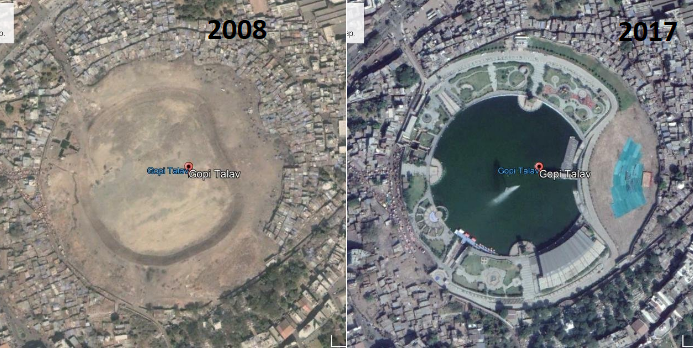
Gopi Talav in Surat, Gujarat, 2008 (left) vs 2017 (right):
Image via @Gujju_Er
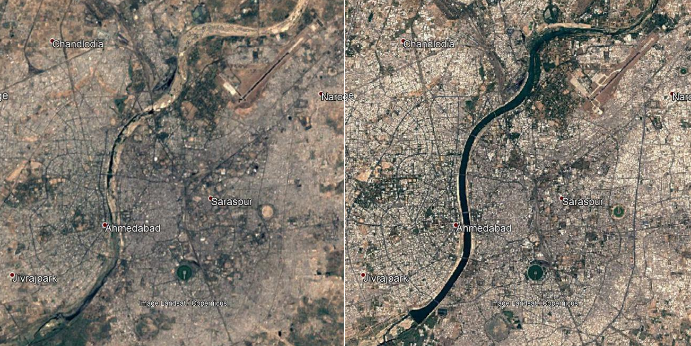
Sabarmati river, 2001 (left) vs 2016 (right):
Image via @Gujju_Er
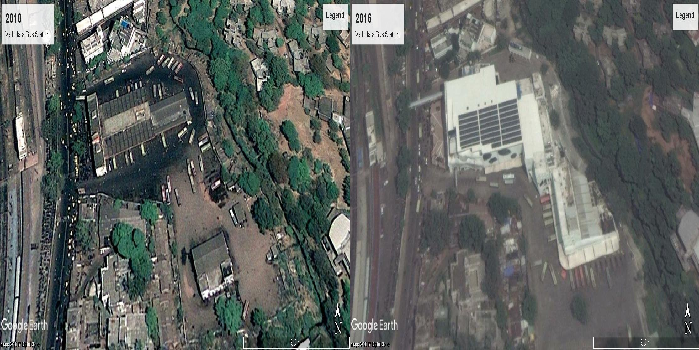
Vadodara Bus Station, 2010 (left) vs 2016 (right):
Image via @Gujju_Er
The above tweets detail how Gujarat’s urban landscape has changed over the years, which includes Sabarmati river which used to run dry, now remaining filled with Narmada’s water, the modernisation of the Vadodara Bus station to name a few.
So first of all is it accurate and how can we create a similar historical rendition of our area?
The software which he uses to list out these pictures is Google Earth:
In google earth there is a feature ‘show historical imagery’
This is a software developed by google which creates a 3D model of earth’s locations based on satellite images of the area. Apart from this, Google Earth also provide a 3D model of the moon, mars and the outer sky. The application ahas Google’s street view program and even a flight simulator game embedded into it.
The main feature which is used in order to see the historical changing of landscape is known as “Historical Imagery”. So after looking at @Gujju_Er’s twitter thread, we decided to check this application out and this is how you also can use it:
First download the desktop application of Google Earth. It even available on Android but seemingly doesn’t contain the Historical Imagery feature.
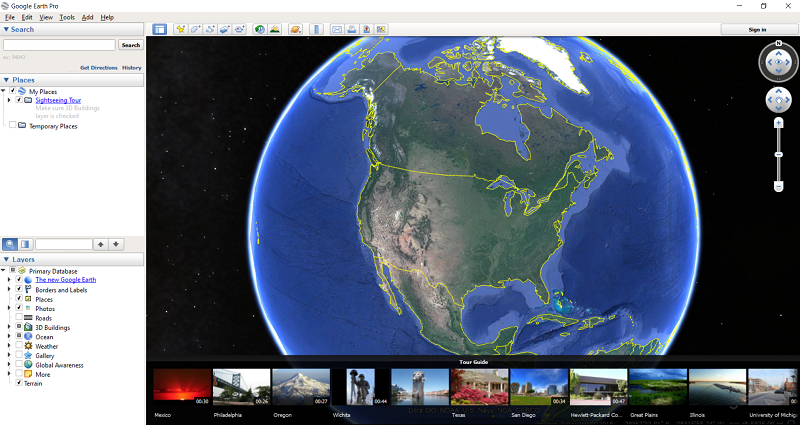
After installing, this is the main interface of the application:
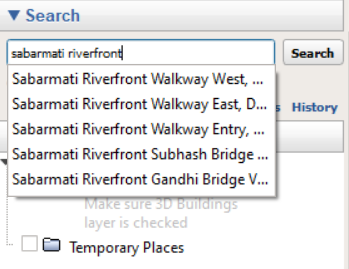
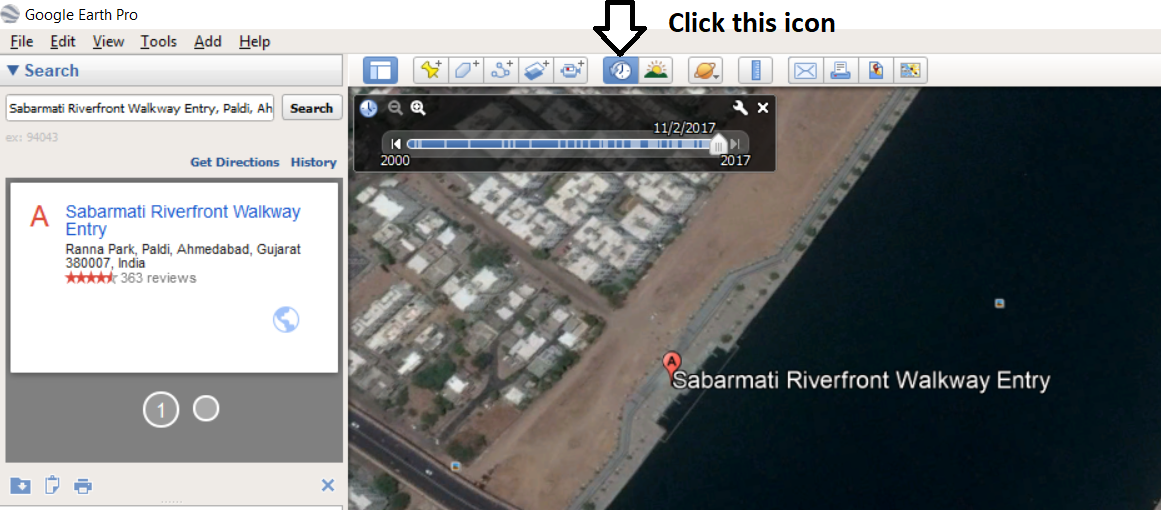
Now head over to the search bar and type the keywords of the location you are searching for (the app will show you suggestions):
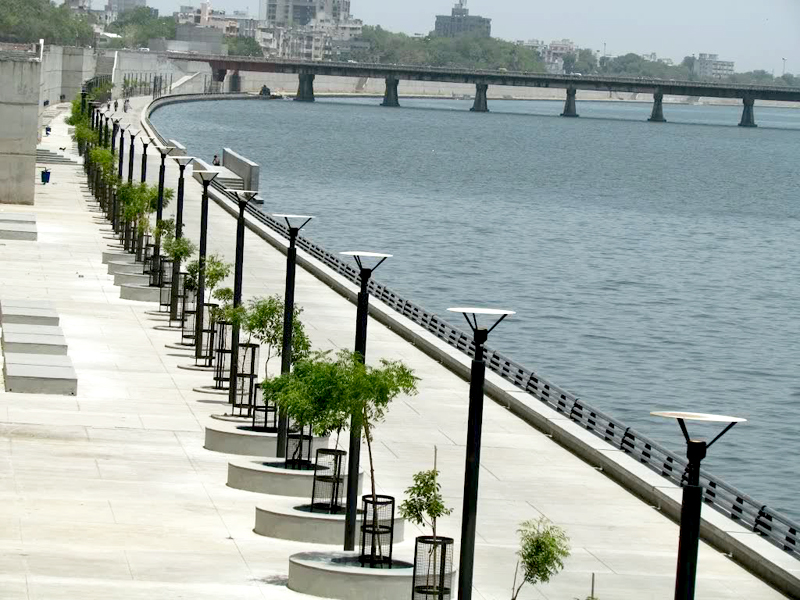
As our story focused on Gujarat, we searched for Sabarmati Riverfront Walkway Entry, this riverfront was one of the major projects of the Gujarat government while Modi was the CM:
A street image of the region
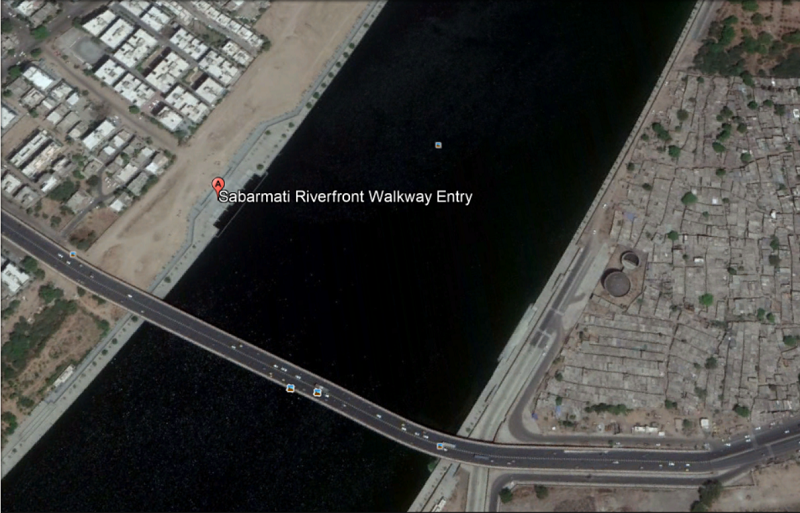
This is how the region shows up in the Google Earth application:
Now click on the Historical imagery option which will add a time frame bar on the screen:
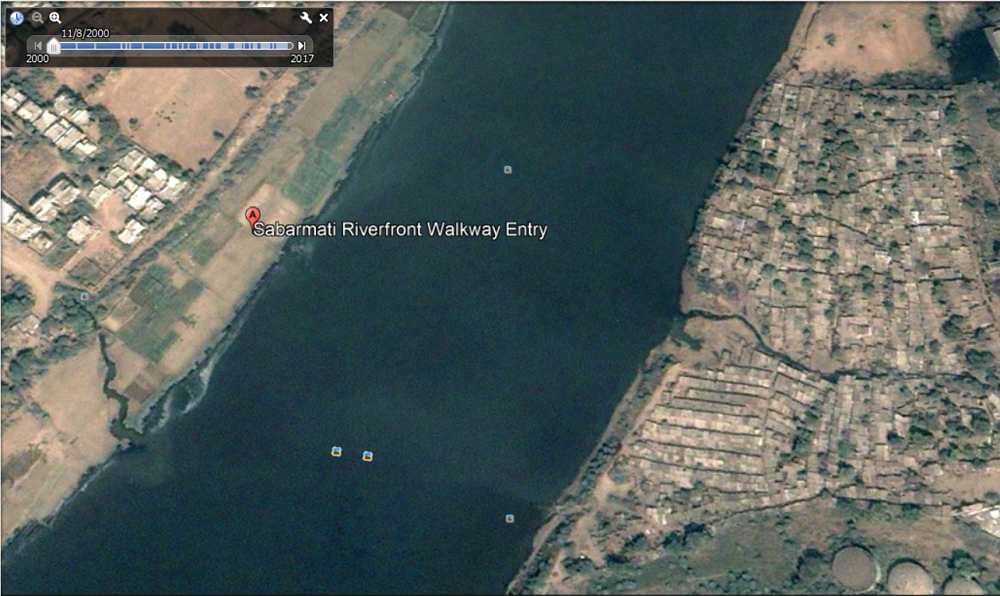
We then dragged on that that bar and compared it to a 2000 picture of the same region. This is what the area looked back then:
The footage from the year 2000
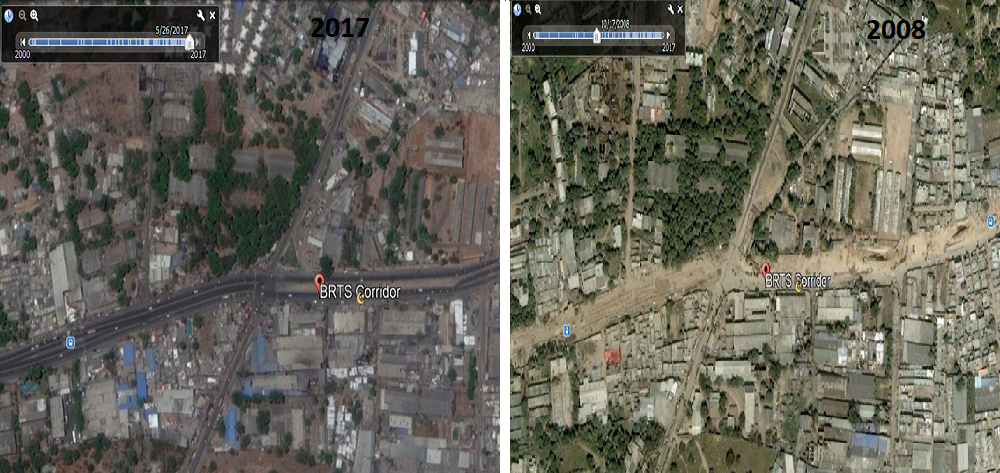
Noticed the difference? We decided to try it out on another newly developed location called Ahmedabad’s BRTS Corridor:
BRTS Corridor, Ahmedabad
Now coming to the technical side of things, how does Historical imagery work?
The images on google earth are derived via programs like Landsat, a USGS (United States Geological Survey) and NASA program which has been observing the earth surface since 1972 and other programs like Sentinel and MODIS.
Also it is evident from another similar program designed by Google named Timelapse (which lets you see how the earth has changed over a period of 32 years) that Google sources images from satellite data already gathered by space agencies from as early as 1972.
Taking a wild guess, storing the images of the region over the years and then using them as an input seem to be how this feature works.
Also one of the questions which struck us was that whether the changes were being recorded simply because Google’s mapping procedure has become more detailed?
Firstly, Google won’t be creating and most importantly continuing any feature, if it had such a overtly noticeable flaw.
Plus even though the quality of images used in Google has certainly improved, even a low quality image captured by a satellite would allow us to make out glaring differences, like the construction of a new bridge near the Sabarmati walkway. Also since many of these pics are from high altitude, the contrast captured is not primarily due to better tech, but due to actual changes on ground.
Having said that, this feature of Google Earth may not always work as development of this domain has been slow in India, with people even demanding in the past that the project be banned for security reasons. The same security concerns have also meant that Google has been unable to launch is very popular “Street view” feature in this country.
Whatever the case may be, citizens can certainly use such a feature to track the changing landscape of the country and ascertain whether we are indeed moving forward on a path of development.
Suffice to say that ever since the World Bank’s rankings showed an upward jump of 30 ranks for India, our liberal well wishers haven’t slept particularly well. I mean, imagine you had worked for … like 3 months round the clock … to spread all sorts of gloom and doom about the economy. Then, some foreigners from the World Bank come in and take it all away from you in a matter of hours. Well, you would be grumpy too.
The reaction of the Congress Party is both emotional and understandable.
And the reaction of the Congress Party’s camp followers is also highly predictable. Like Pidi, they were eager to show what they could do with a treat.
Soon enough, this led to pitched whining from media leftists about how the World Bank considered “only” Delhi and Mumbai.
Of course, it did not matter that the World Bank had, in fact, considered only one city in most other countries it surveyed. Or that the World Bank has been doing these rankings for a very long time.
What mattered is that the World Bank had taken a toy out of the liberals’ pram. And anybody who expected liberals not to be crybabies doesn’t know anything about liberals. Or babies.
How could anybody not have seen this coming ?
Modi wins 2014 = First Past the Post voting system (used since 1952) is flawed.
Modi wins UP 2017 = EVM machines are fixed (used at least since 1999) are fixed.
Modi govt leads India 30 places up = World Bank’s Rankings are fixed.
The third one fits very logically in the sequence, isn’t it? Of course they would question the World Bank now. Why should it matter only days ago, Rahul Gandhi was using the same World Bank’s forecast to castigate Modi government?
Think about it. Everyone in Rahul Gandhi’s family has won elections on the First Past the Post system. It’s been in place since 1952. But Rahul baba cannot figure out how to win an election, so suddenly it is the fault of the system. See?
This is the same Congress party and its same camp followers who were going around touting some misinterpretation of Global Hunger rankings from some hitherto unknown institute. It’s the same party and its same camp followers who were going around waving some imaginary rankings on Press Freedom.
But the World Bank’s rankings have been “fixed”, ha!
Dear liberals, step out of the pram and put on your big boy pants. Time to grow up and smell the coffee. Subah ho gayi mamu!
In what can be termed as nothing short of irony, Punjab Assembly’s Leader of Opposition, Aam Aadmi Party’s Sukhpal Singh Khaira has been issued summons by a local Punjab court in connection with drug case. Following the arrest of some alleged drug smugglers by police in Fazilka in 2015, Khaira’s name had come up. Admitting an application under Section 319 of the Criminal Procedure Code providing for including additional accused, the court of Additional District and Sessions Judge in Fazilka ordered issuance of summons to Khaira on Wednesday. Ironically, AAP had promised to make drug free as soon as they win.
As soon as AAP govt is formed in Punjab, strong action will be taken against Majithia and his allies in drug racket(2/2)
Despite the allegation, turns out the charges against Majithia don’t hold true.
Unconditional apology by Tribune to Bikram Majithia (AkaliDal) for prominent headlines. Allegations unsubstantiated & incorrect#MediaCaughtpic.twitter.com/H1L86Hkmj0
Pointing out the irony that AAP fought Punjab elections held earlier this year on drug menace plank, the BJP demanded resignation of Khaira as the Leader of Opposition. Addressing media persons, Punjab BJP leaders said that the development was not an ordinary one as Khaira has been issued summons by the court and not by an investigating agency or police.
Shiromani Akali Dal also said that Kejriwal should apologise to Punjab for appointing Khaira as Leader of Opposition despite alleged involvement in drug case, especially since Aam Aadmi Party had made such a huge hue and cry about the drug menace prior to elections. They also lashed out on Khaira for being the first and only leader of opposition to be asked to appear as accused in a trans-border heroin smuggling racket by a judicial court.
Khaira’s name cropped up due to his alleged association with Gurdev Singh, former chairman of the Market Committee, Dhilwan, who has been sentenced to 20 years’ imprisonment. Meanwhile, Khaira has alleged political vendetta by Punjab chief minister Captain Amarinder Singh through his politically motivated prosecution machinery.
In ten months since Congress government came to power in Punjab, the drug menace, which had misleadingly high figures, seems to have miraculously vanished. Perhaps this is a good time to take stock of the real situation and see who are the culprits.
It is becoming increasingly difficult these days to differentiate between fact and fiction, truth and propaganda. Hence, in the spirit of transparency, before going forth with my analysis, I would like to declare that I am a Central Government Employee and my father is an Assistant Engineer in Irrigation Department under the Uttar Pradesh Government.
This article is my observation of ground realities, far away from the gaze of main stream media. This might explain how BJP won 325 out of 403 seats in UP and where did those votes come from. The constituency I chose to analyse is Raebareli, Lok Sabha seat of Mrs. Sonia Gandhi.
Before we analyze the impact on the ground, lets go through the foundation laid down by a “DESI”, non-technocrat Prime Minister
Jan Dhan Yojna– Under this scheme banks were given the task of opening bank accounts of citizens with minimum documentation and zero balance.
The Payment of Wages (Amendment) Act 2017, mandates employers to pay wages to workers through cheque or by transferring their wage to their bank account without their written authorization.
Aadhaar (Targeted Delivery of Financial and other Subsidies, benefits and services) Act, 2016 makes the seeding of Aadhaar number for PDS and MNREGA. It is the foundation stone of Direct Benefit Transfer (DBT) .
In Raebareli, I met a gentleman who owned a Plywood factory with 200 odd workers. Earlier he used to pay them Rs.200 daily with their signature on vouchers made for the amount of Rs.450. He used to also show only 50 workers at labour commissioner’s office, when in reality he employed 200 workers, thus stealing PF of 150 workers. Now with mandatory bank transfer/cheque under The Payment of Wages (Amendment) Act 2017 there is no way to hide the number of workers from labour commissioner as payments have to be made directly to the bank accounts of all 200 workers. These accounts were opened under Jan Dhan Scheme. All those workers are now covered under EPF along with PM Social Security Schemes for Life as well as Accidental Insurance.
During his first year as Prime Minister, when Modi neither scrapped MNREGA nor reduced its funds, he was questioned by his own supporters. While the questions mounted, this is what the Prime Minister did with the scheme and why he thought it was necessary to retain MNREGA and maintain the funds allocated to it :
The relative who was hosting my stay, was in-charge of overseeing implementation of MNREGA. After DBT and AADHAAR, it’s a closed chamber with no leakages. Pictures of daily work have to be uploaded via an app which also captures geo-location. If 2 jobs are within a distance of less than 10 metre, It is not accepted and payments can’t be made. Payments are now made on daily basis after AADHAAR authentication of worker towards his account. No geo-location work can be repeated for 2 years.
This fact was further confirmed when I spoke to my father who is handling irrigation/water conservation projects funded by Central Government, in Lalitpur District of Bundelkhand. Payments are released only after verification of work via GIS by location obtained from uploaded pictures. All forged workers have been removed from system and the genuine workers are getting the full payment due to them.
Next gram sabha elections would be interesting to follow as the main source of funds for Pradhans have dried up due to AADHAAR-DBT implementation.
Next major effect is on PDS-AADHAAR. After Aadhaar feeding, more than 35% fake cards have been cancelled. The distribution is happening only through Aadhar POS machines. PDS shop owners have started asking for fixed monthly commission now while previously such demands were never made. When one analyses closely, one realises that the reason for such demands surfacing now is because the PDS-Aadhaar link has killed the main source of corruption in PDS as there are no incentives now for them.
Aadhaar-PDS (click on the image for larger size)
Another good news is a pilot project on DBT of Urea subsidy. I am sure when it is implemented pan India, it will transform the rural areas, since currently, unless one pays extra, one can’t get subsidised Urea from government shops. Here is the progress on the Pilot Project.
DBT implementation status (click on the image for larger size)
Two ministers who are performing exceptionally well and who would make a difference during the 2019 campaign are Mr. Piyush Goyal and Mr. Dharmendra Pradhan. The Power situation has vastly improved in just the last 3 years since the Modi Government came to power. It may be a low impact issue for urban middle class but in rural areas and in villages, IT IS THE ISSUE. Villages that were immersed in darkness for the last 65 years are now getting 16-18 hours of daily power supply. It has revolutionised the villages and has made android phones and televisions a household thing in areas that did not have access to these gadgets earlier.
For our urban elite, progress can be measured only when the lesser privileged own iPhones or Galaxy S8, but for people who had no access previously, a basic android phone with Whatsapp and cheap data, thanks to Jio, is enough. Even in poor households with 6-10 members, you will find at least 1 Android phone with WhatsApp. It has revolutionised the consumption of news too.
Pradhan Mantri Ujjwala Yojana is another trump card, changing the equations in Rural India. 5 years back, in my own village of 200 odd residents, only a paltry 10-15 people had LPG Connections. That mandate of 2014 changed it all. Now everyone has LPG connection. Those who could afford, got it due to easy availability, those who couldn’t afford, got it thanks to Pradhan Mantri Ujjwala Yojana.
With these revolutionary changes, one perhaps doesn’t even need to ask those MNREGA Workers, MSME workers and Villagers who they might vote for in 2019.
These are of course my personal observations. But I do believe the story wouldn’t be much different in any of the villages across the country. The country is marching ahead on the path of Vikaas. And while the urban elite might not see the changes, the changes are happening at a dizzying speed.
The Mumbai-Ahmedabad high speed rail corridor is probably one of the most ambitious transportation projects of the country. Under this project, India will get its first bullet train and is being funded by Japan via a generous loan deal.
Ever since the bullet train project was announced, it has borne the brunt of being opposed by the Congress party and has been at the receiving end of a malicious misinformation campaign.
In recent days media reports signalled that they were again up in arms against the project in general. The reports were titled:
Mumbai-Ahmedabad bullet train in the works but 40% seats on route go vacant: RTI [2]
Is PM Modi’s Mumbai-Ahmedabad bullet train project viable? Railways’ RTI reply offers a hint [3]
All these reports quoted a certain RTI query made by RTI activist Anil Galgali, as per which 40% of the seats on all the trains of this sector went vacant which causes huge losses to the Western Railway.
Naturally, if trains in any sector have a 40% vacancy, it would raise questions not only about the viability of the mega bullet train project, but would also bring in question as to why are so many trains currently running between these two stations.
But as has been the case with many news reports in the past, this conclusion too was drawn based on a malicious spin of the actual RTI query.
Soon after the 40% vacancy reports started gaining traction, Piyush Goyal put out a tweet which debunked the whole charge:
Contrary to media reports, Mumbai-Ahmedabad train section running at above 100% occupancy and will benefit immensely from Bullet train. pic.twitter.com/JXH8y34QVg
As per the clarification issued by the Western Railway, Ravinder Bhakar, their chief PRO clarified that the RTI reply by the railways was based on a specific query made about the number of passengers boarding at Mumbai Central and then alighting at Ahmedabad.
That is, it didn’t include the figures about other scenarios like:
Passengers boarding at Mumbai Central and getting down an an intermediary station before Ahmedabad
Passengers boarding at any other en-route station and getting down at Ahmedabad
Passengers boarding at an en-route station and alighting at an intermediary station
As per the railway press release, factoring in these scenarios, the total occupancy even in the off season of July to September was more than 100%. There are a total of 9 trains in between Mumbai and Ahmedabad which have a total berth potential of 8,03,150. With regards to that, the total booking from 1st July to 30th September was 8,30,978. The same was the case for the trains’ return journey.
Also when it comes to the 25 trains which ply from Mumbai and have Ahmedabad as an intermediary station, the total booking was 12,30,585 as opposed to the capacity of 10,70,719, which translates to a 115% occupancy. For the return journey the occupancy was 121%.
So clearly, not only do trains on this route not have a 40% vacancy, they actually have an excess demand.
This raises the question as to why did media not 1st check in with the Western Railway authorities before running the report, which could have avoided this whole situation.
On 31st October, Congress social media handle tweeted a video which tried to portray how under NDA, women representation in Parliament has gone down and crime against women has gone up.
The data comparison is between 2005 (a year after UPA 1 was formed in 2004) and 2015 (a year after NDA government was formed in 2014).
Scientist and writer Anand Ranganathan busted claims in a series of tweets. He showed how Congress had wilfully left out the figures of 2013, which are more recent and comparable to 2015 figures as against 2005 figures which are a decade old.
The data gathered from National Crime Record Bureau, the government agency responsible for collecting and analysing crime data for 2005, 2014 and 2015, show a different picture as compared to the one shown by Congress.
This shows that the instances of rape have actually come down in 2015 as compared to 2013, against what is claimed by Congress in the video. Rapes reported were 18,359 in 2005, went up to 33,707, an increase of 83%, in 2013 during UPA. In 2014, this figure stood at 36,735 which came down to 34,651, a decrease of 5% during NDA.
Next shows that while the percentage of kidnapping and abduction had gone up from 15,750 in 2005 to 51,881 in 2013, a staggering 229% rise, during the UPA. The figure stood at 57,311 in 2014 and has gone up to 59,277, an increase of 3.4%. So, this shows that while the crime rate has gone up, it has gone up at a decreasing rate.
Next up is molestation. This data is also misrepresented.
The 2013 figures which show a clearer picture of UPA being in power for 9 years are skipped for 2005 when UPA was just one year in power. Molestation instances stood at 34,175 in 2005 and went up to 70,739 in 2013, an increase of 106%. In 2015, molestation cases reported were 82,422, which is an increase of 0.2% from 82,235 in 2014.
Congress then claims dowry deaths have increased from 6,787 in 2005 to 7,634 in 2013.
Whereas in reality, the dowry death had increased to as much as 8083 in UPA in 2013. So, effectively, dowry related death have come down from 8,455 in 2014 to 7,634 in 2015 which marks a decrease of 10.4% in one year of NDA.
It is unfortunate that the grand old party of Indian politics would resort to distorting facts to suit their agenda.