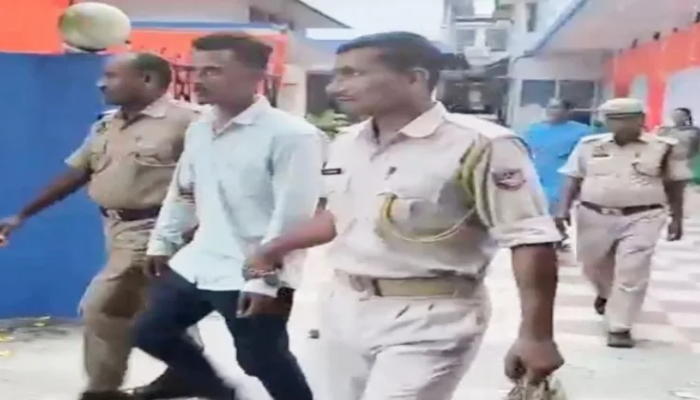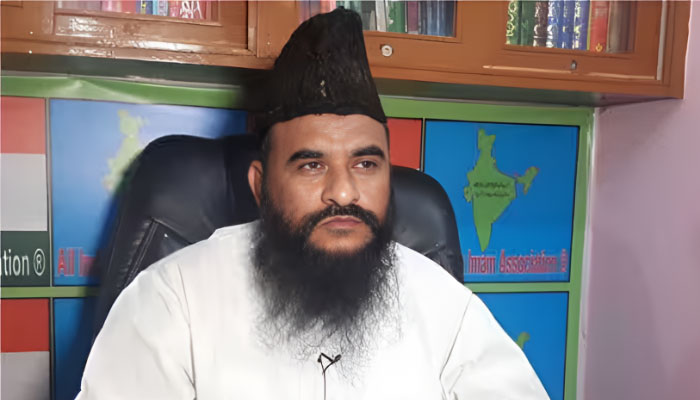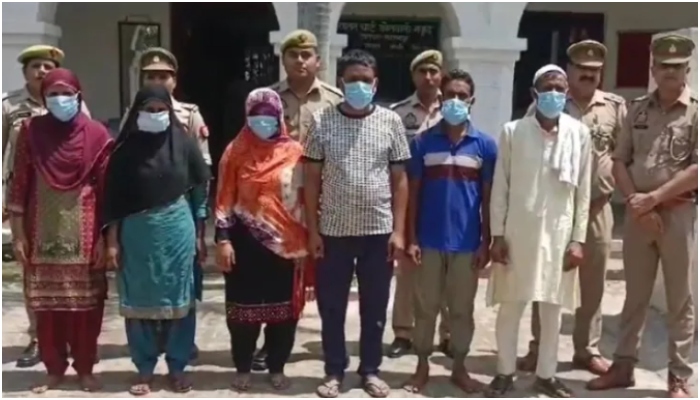
On Monday (22nd July), Uttar Pradesh’s Hapur Police arrested a Love Jihad accused Wasim Malik. It is alleged that he trapped a Hindu woman in a love affair by using a false Hindu name, Rahul. After developing a friendship, he spiked the victim’s drink and raped her in a hotel. It is also alleged that he recorded her obscene videos and used them to threaten the victim. Later, he forced the victim to accompany him to Delhi where he got her converted to Islam and married her at the Jama Masjid.
According to a report in Dainik Jagran, the Hindu victim was a widow who lost her husband in 2015. Wasim Malik, posing as Rahul, befriended the victim through Instagram and soon they started conversing with each other. According to reports, he used an Instagram ID named Black Commando. Meanwhile, as their conversations progressed, one day the victim reached Babugarh to meet him.
When she reached there, the accused took her to a hotel. It is alleged that he gave her a cold drink that was laced with intoxicants. The accused raped the victim and also recorded her obscene videos. According to reports, he started threatening the victim that he would leak her obscene videos on social media platforms. Later, he took her to Delhi where he got her converted. He also married the Hindu victim at the Jama Masjid.
#HapurPolice द्वारा जनपद में अपराध की रोकथाम एवं वांछित अभियुक्तों की गिरफ्तारी हेतु चलाए जा रहे अभियान के अन्तर्गत थाना बाबूगढ़ पुलिस ने थाने के मु0अ0सं0 224/2024 धारा 328,376,506,420 भादवि व 3/4 उ0प्र0 धर्म परिवर्तन अधिनियम से सम्बन्धित अभियुक्त को किया गिरफ्तार। pic.twitter.com/YWoviR6Uka
After learning about Wasim’s true identity, the woman lodged a case with the Police. According to the complaint, the victim was a victim and a resident of the Anna Mukadam area which falls in Western Maharashtra. Her husband died in 2015 and at that time, she was seven months pregnant. Later, she gave birth to a daughter.
According to the complaint, everything changed for them, after she met Wasim a few years ago. After she was forced to convert to Islam, her name was changed to Ayesha.
Wasim took her with him and they started living in the Baraula area in Gautam Buddha Nagar. It is also alleged that the accused was putting pressure on the victim’s daughter to convert to Islam.
According to the victim, the accused also defrauded her and swindled Rs 3 lakhs from her. Based on the victim’s complaint, the Police have registered a case against the accused Wasim Malik. Taking to X, Hapur Police stated that it has filed a case against the accused under IPC sections 328, 376, 506, and 420. Additionally, the Police have also invoked relevant sections of the Uttar Pradesh Religious Conversion Act against the accused.
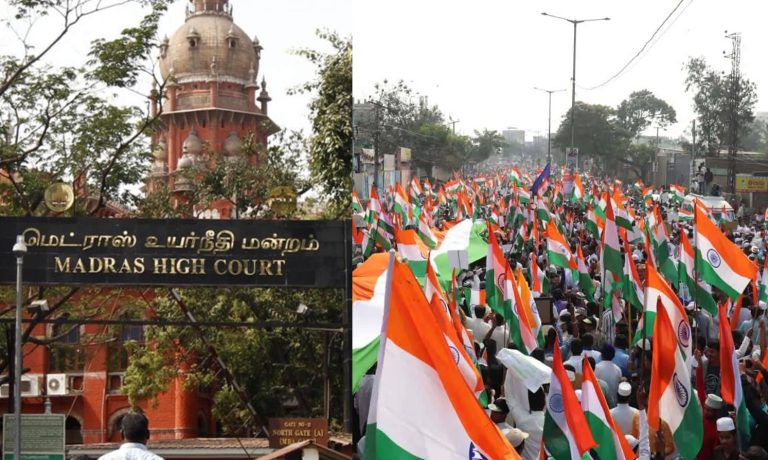
On Tuesday, 23rd July, Senior counsel Mathews Nedumpara came under fire from Chief Justice of India DY Chandrachud for interfering with the Supreme Court’s hearing on petitions on NEET-UG.
Nedumpara interrupted senior attorney Narender Hooda, who is defending one of the petitioners in the case, as she was laying out her arguments. “I have something to say,” said Nedumpara, cutting short Hooda’s argument. The Chief Justice then intervened and asked Nedumpara to speak after Hooda was done speaking.
To this Nedumpara said that he was the seniormost lawyer in the court and that he had all the rights to speak. “I am the seniormost here,” Nedumpara said.
The Chief Justice on this became enraged and cautioned Nedumpara, saying, “I am warning you. You’re not going to address the gallery. I am the court’s administrator. Call the security… have him removed.”
Court Mei Kalesh!
CJI Chandrachud on NEET hearing called security to remove Petitioner's lawyer Mathews Nedumpara.
Chandrachud : Please call security to have him removed.
Nedumpara stated that he was leaving anyway and that security need not be called. The Chief Justice said, “You do not have to say that. You can leave. I have seen the judiciary for the last 24 years. I cannot let lawyers dictate procedure in this court.”
Nedumpara stopped the conversation and said, “I have seen it since 1979.”
The Chief Justice told Nedumpara that he could have to issue a direction if he continued his behavior. “I may have to issue something which is not fair. You will not interrupt any other lawyer,” he said to Nedumpara.
The lawyer eventually departed. As reported by NDTV, he returned to the court later. “I apologize. I did not do anything wrong. I was treated unfairly,” the lawyer stated. He then declared he “forgives” the Chief Justice for “insulting” him, using the Biblical expression “Father, forgive them, for they do not know what they are doing.”
NTA’s legal representative, Solicitor General Tushar Mehta also criticized Nedumpara’s actions. “This is disdainful,” he declared.
This is not the first time Nedumpara has clashed with Chief Justice Chandrachud in the Supreme Court. Nedumpara disrupted the electoral bonds case hearing in March of this year, even though the Chief Justice had warned him not to.
Nedumpara was told by the Chief Justice not to yell at him. “This is not a Hyde Park corner meeting, you are in the court. If you want to move an application, file an application. You have got my decision as Chief Justice, we are not hearing you. If you want to file an application, move it to the email. That’s the rule in this court.”
In 2019, the Supreme Court accused Nedumpara of contempt of court and sentenced him to three months in jail. The court found him guilty of contempt for using the name of noted jurist Fali S Nariman, the father of then-Supreme Court Justice RF Nariman, to allege that sons and daughters of judges were given priority in awarding senior advocate’ designations, and claiming that he attempted to browbeat the courts.
However, after receiving Nedumpara’s unequivocal repentance, the judge suspended his punishment.
On Sunday (21st July), the police arrested a Bangladeshi national, who had been staying in India illegally using forged documents. The incident took place in Kanpur city of Uttar Pradesh.
As per reports, the accused was identified as Nazma. The police recovered a PAN card, ATM card, Dependent ID card, 2 white metal rings, 3 visiting cards, 5 mobile phones and a sum of ₹849 from her.
The arrest was made as part of ‘Operation Prabhat Prahari’ wherein police check suspicious vehicles and persons across the city. The police received a tip-off that Nazma and two of her roommates Reena and Jyoti had been planning to shift their residence.
Nazma was staying in the Radhapuram Kashyap Nagar area of Kanpur with the alias of a Hindu woman named ‘Pooja.’ During interrogation, the accused confessed that she was a Bangladeshi national and hailed from Comilla.
Nazma also told the cops that she secretly came to Kanpur from Bangladesh about 6 months ago. She was later questioned by local intelligence officials and the Crime Branch.
While speaking about the matter, ACP Kalyanpur Abhishek Pandey said, “When asked about her passport and VISA, Nazma could not produce these documents. On being questioned as to why she was living secretly in Kanpur, she said that she along with Jyoti and Reena was looking for work here. Investigations are on to ascertain the Bangladeshi national’s exact motive behind her stay in Kanpur.
Meanwhile, the police have also arrested Nazma’s roommates Reena and Jyoti in connection to the case.
On Tuesday (23rd July), the Supreme Court of India refused to order a retest for the National Eligibility Cum Entrance Test -Undergraduate (NEET-UG 2024) examination on the grounds of allegations of paper leak and malpractices. The bench led by Chief Justice of India DY Chandrachud rejected the batch of pleas that sought a re-test and cancellation of the exam results. It ruled that there was no material to conclude that exams were vitiated or that the leak was systemic which could have affected the sanctity of the entire exam.
A bench comprising Chief Justice of India DY Chandrachud, Justices JB Pardiwala, and Manoj Misra noted that ordering a re-examination would lead to serious consequences that would affect over 23 lakh students. The court stated that this would have led to disruption of the academic schedule and caused a cascading effect in the coming years.
It is pertinent to note that the NEET-UG 2024 exam was held on 5th May 2024. Days after the examinations, students approached the Courts alleging paper leaks and malpractice. The results of the exams were declared on 4th June.
The CJI-led bench acknowledged that cases of paper leaks took place at the centres in Hazaribag (Jharkhand) and Patna (Bihar). However, the Court noted that there was no sufficient material on record based on which it could be concluded that the results were vitiated in its entirety or that there was a systemic breach in the sanctity of the exam.
The court stated that data on record is not indicative of a systemic leak of the question paper which would indicate a disruption of the sanctity of the exam.
The court heard the arguments of both sides for over 4 days and immediately pronounced the judgement as it affected a large section of the students.
Dictating its order, the court concluded that there is no dispute that the paper leak took place in Hazaribagh (Jharkhand) and at Patna (Bihar).
The CBI probe is still ongoing. However, the CBI disclosures have indicated that about 155 students drawn from exam centres at Hazaribagh and Patna appeared to be beneficiaries of the scam.
#BREAKING CJI: Reasons for conclusion will follow. We conclude and hold:
1. fact that leak of NEET UG 2024 paper took place at hazaribagh and at patna is not in dispute 2. following transfer of investigation to it, CBI has filed its status reports dated July 10
The Supreme Court bench stated that it is also mindful of the fact that directing a fresh NEET-UG test for the present year would be replete with serious consequences for over 2 million students, including in particular –
Disruption of the admission schedule
Cascading effects on the course of medical education
Prejudicial impact on the availability of qualified medical professionals in the future
A serious element of disadvantage to the marginalised groups of students for whom reservations have been made in the allocation of seats.
On Saturday, 20th July, two Nihang Sikhs attacked a labourer who was collecting empty bottles near Dakkhana Chowk on Heritage Street in Amritsar. One of the Nihangs, who is only 13-years-old, has been arrested by the police while the other one fled the scene. The incident took place at around 4 PM. The injured labourer has no family in Amritsar and hails from Patna, Bihar.
Two Nihang Sikhs attacked a sweeper with a kirpan on the heritage corridor near Harimandir Sahib. ?️ ⚔️
The Nihangs assaulted the victim only on the allegation that he had tobacco in his pocket. Police have arrested one Nihang while the other is absconding. pic.twitter.com/EAKUhGQDB4
Reports suggest that the labourer, who has been identified as Shankar, was sitting on Heritage Street when two Nihangs came and attacked him. His arm broke after the attack. Nihangs claimed that he was consuming tobacco and when they noticed, they attacked him.
Shankar lives on the streets of Amritsar and collects empty plastic bottles to sell. He admitted he had a packet of tobacco in his pocket but denied consuming it at the time of the incident. Bhaskar’s report suggested that he was collecting bottles when two Nihangs got hold of him and asked if he was chewing tobacco. First, they attacked Shankar with a stick and then hit his arm with the kirpan. Speaking to the media, SHO Harsandeep Singh said one of the Nihangs, a 13-year-old boy, was arrested following the incident.
Police personnel were present near the spot where the incident happened and rushed to save Shankar. He was rushed to the hospital for treatment. He was admitted to the civil hospital for primary treatment and then shifted to Guru Nanak Dev Hospital for further treatment.
This is not the first time Nihang Sikhs attacked someone claiming sacrilege. On 10th July, it was reported a group of Nihang Sikhs stopped a TV serial shooting claiming sacrilege as a mock setup of Gurudwara was there at the shooting spot. On 5th July, Nihang Sikhs attacked 58-year-old Sandeep Thapar, also known as Gora, who is the chief of the Shiv Sena in Punjab outside the Ludhiana Civil Hospital.
OpIndia tried contacting police for further updates but could not connect.
In continuation with his tradition of committing gaffes every once in a while, senior Congress leader Rahul Gandhi today took to X, formerly Twitter, to lash out at the Union Budget 2024 announced by Finance Minister Nirmala Sitharaman.
Ridiculing the budget as the ‘Kursi Bachao’ budget, Gandhi, the leader of the opposition in Lok Sabha, asserted that the budget appeased cronies whom he referred to as ‘AA’ and appeased allies, claiming that hollow promises were made to them at the cost of other states.
But then, in the same tweet, Gandhi added that the budget is a ‘copy and paste’ of the Congress manifesto and previous budgets.
Source: X
As is often the case with the Gandhi scion, one is left to wonder what he is trying to speak and convey.
Let’s anyway still try to make sense of his tweet.
Gandhi labelled the budget as the ‘Kursi Bachao’ budget but then in the same breath he said it was a copy-paste of the Congress Manifesto. Does it mean that Congress endorsed appeasing allies and making “hollow promises” to them as alleged by the Wayanad MP?
It seems that Gandhi’s silence on the deaths in the Tamil Nadu hooch tragedy suggests that appeasing allies is at the centre of Congress’ politics, whether or not it is explicitly stated in their manifesto. So everyone in the Congress ecosystem goes hammer and tongs about violence in Manipur or a stray incident of a shop being ransacked because its owner tried to stoke communal feelings by uploading a provocative WhatsApp status but maintains radio silence on innocent people being killed in Tamil Nadu over consumption of spurious liquor.
About 65 people have already died in the Tamil Nadu hooch tragedy. But it has not sparked any reaction from the Leader of the Opposition, who perhaps thinks only the central government should be held to account and not the DMK-led state government in Tamil Nadu, because MK Stalin is after all, an important alliance member of the INDI bloc. The same goes for West Bengal. Congress leaders and its ecosystem turned a blind eye to the Chopra incident in West Bengal, where a goon in broad daylight mercilessly thrashed a woman.
Ironically, a complaint was lodged against BJP IT Cell head Amit Malviya for sharing the video online. Again, the Congress leaders and the ecosystem didn’t wail ‘democracy is in danger’ since the state under scanner was West Bengal, ruled by Mamata Banerjee-led Trinamool Congress.
And if the Modi 3.0 indeed had made “hollow promises” to their allies, shouldn’t Congress and other states be happy that their progress and development won’t be compromised? But Congress supporters on X aren’t expected to have that intellectual depth. The hiring policy at most places expects candidates to have a reasonable IQ. But not at the Congress IT cell, which probably employs the criteria of hiring the dumbest lot available so that their crown prince can appear more intelligent and smart.
Crucially, Gandhi also claimed that the government was working for the appeasement of cronies, referring to them as ‘AA’. Given his history of targeting Ambani and Adani with no evidence whatsoever to substantiate his claims, almost characterising profit-making as an evil vice, it is not hard to guess for intelligent folks to whom he was referring. Congress IT cell members would claim ‘he didn’t name anyone’ but that’s not their fault, their mental incapacity constrains them.
The reference comes just days after several senior Congress leaders, including Former Chief Ministers Digvijaya Singh and Kamal Nath, prominent Congress leaders from Madhya Pradesh, Salman Khurshid, Former Union Minister, and Kapil Sibal, were among those who attended the grand Ambani celebrations that took place in Mumbai. SP chief Akhilesh Yadav and his family were at the wedding events to bless the couple. And so was RJD supremo Lalu Prasad Yadav, another key member of the INDI bloc, who is out on bail on ‘medical grounds’ but was merrily attending the Anant-Radhika wedding with his entire family.
Were they all there to appease cronies? Who knows. Was it a part of the Congress manifesto? It is all too confusing and absurd, just Rahul Gandhi lambasting the budget and then saying it is a copy-paste of the Congress manifesto and previous budgets.
In Punjab’s Amritsar, three Christians have been arrested over cow slaughter. The accused persons used to butcher cows at their house and sell the meat. On Monday, 21st July, the police officials raided the premises and apprehended the accused. A substantial quantity of beef was retrieved from the possession of the three accused identified as Nishan Masih, Ajay Masih and Samuel Masih.
The incident unfolded in Dayal Bhatti village under Ramdas police station in Amritsar rural. The authorities received information that some people were surreptitiously slaughtering cows and selling meat. After this, the police decided to raid the house of the accused persons.
During the raid conducted by a team of Ramdas police station led by SI Naresh Kumar, nearly 160 kg of beef was recovered. In addition, the police also seized cow skin and other body parts. Subsequently, the police arrested accused Nishan Masih, Ajay Masih and Samuel Masih.
Speaking to OpIndia, the police said that the accused trio were arrested on 21st July and a case has been registered against them under relevant sections of BNS.
The police said that the accused persons were illegally selling cow meat in neighbouring areas despite a ban on sales of cow meat since 1955. The police added that further action will be taken against the accused trio in accordance with the court’s order.
On Tuesday (23rd July), Finance Minister Nirmala Sitharaman presented the Union Budget for AY 2025-26 introducing new slab rates and also increasing the standard deduction rate which will benefit around 4 crore salaried employees. Meanwhile, Sitharaman also imposed relief on Capital Gains benefitting the middle-class community and abolishing the angel tax to support the Indian start-up ecosystem.
Presenting her seventh consecutive Budget in Parliament, Sitharaman said that the Indian startup ecosystem has always been buzzing with innovation and ambition, but Angel Tax has often sparked debate. “To bolster the Indian start-up eco-system, boost the entrepreneurial spirit, and support innovation, I propose to abolish the so-called angel tax for all classes of investors,” the finance minister said.
Monetary limit for filing Tax appeals increased to Rs 60 lacs for ITAT, Rs 2 crores for High Courts and Rs 5 crores for Supreme Court. I propose to abolish the Angel tax abolished for all classes of investors. Corporate tax rate to be reduced on foreign companies from 40 to 35… pic.twitter.com/q0RGlR44GI
In the interim budget presented in February, the government had proposed extending tax breaks for startups and investments facilitated by sovereign wealth or pension funds for another year, until March 2025.
The “Angel Tax” is a charge imposed on the capital raised by unlisted firms through the issuance of shares to investors. This tax targets the premium paid by investors over the fair market value of shares, which is frequently categorized as “income from other sources” and taxed accordingly.
The Finance Act of 2012 made this substantial alteration to the Income Tax Act by adopting Section 56(2)(viib). This section focused on investments received by unlisted Indian enterprises. Under this clause, any investment valued beyond its fair market value is regarded as income and liable to taxation.
Congress’ P Chidambaram took cognizance of the event and targeted the govt for taking so long to abolish the so-called tax. He said that the Congress had pleaded for the abolition of the angel tax and finally the Finance Minister announced it today. “I was pleased to hear that the FM will abolish the Angel Tax. Congress has pleaded for the abolition for many years and most recently in the Congress Manifesto on page 31,” he said.
Ironically, it was Congress who had made changes in the Income Tax Act to introduce the Angel Tax. The concept of an angel tax was first proposed in the 2012 Union Budget by the then-Finance Minister Pranab Mukherjee. Later, in July 2012, Chidambaram who ‘pleaded’ to abolish the angel tax became the Finance Minster. The major goal of the angel tax imposition was to prevent money laundering through investing in startups and prosecuting fraudulent organizations after such cases emerged.
Several startups in the recent past registered unease regarding the angel tax. They described the tax as excessively unfriendly and unjust. They also noted that angel tax made a determination of the market value of any startup difficult. Some of the startups are said to have received angel tax notices where the amount of tax and late fees exceeded the initial financing amount.
At the peak of the angel tax controversy in 2019, a LocalCircles poll revealed that more than 73% of businesses in India that obtained money ranging from Rs 50 lakh to Rs 2 crore received angel tax notices from the income tax department.
In the 2019 Union Budget then, the government modified the angel tax requirements by exempting DPIIT-registered firms from the clause. However, the fine print indicated that it was not a general exemption for all such startups but was only applicable to those certified by the Inter-Ministerial Board (IMB).
Apart from Chidambaram, Congress’ Shashi Tharoor also praised the move that suggested the abolition of the angel tax. He also claimed that he had suggested the move to former Finance Minister Arun Jaitley. “I welcome only one provision which is the abolition of tax on angel investors. I had recommended it to Arun Jaitley ji 5 years ago. The overall budget was underwhelming,” he said to ANI.
An intentional attempt of abolition of Angel Tax has been made to position India as a global center of innovation. It is believed that the action is in line with India’s grandiose plan to build a $10 trillion economy by 2030, in which startups are expected to play a significant role. The present worth of the Indian startup ecosystem, which is projected to exceed $3 trillion, would rise dramatically as a result.
Additionally, India’s current ranking of 40th in the global innovation index would be strengthened. This would, in the long run, lessen reliance on technology and strengthen economic sovereignty while also promoting a more risk capital-friendly environment and, consequently, a higher likelihood of domestically produced global tech giants.
In a rare occurrence on Tuesday (23rd July), ‘journalist’ Rajdeep Sardesai, contrary to his track record and modus operandi, commended the Modi government for announcing pro-youth schemes and initiatives in the Budgetary speech. However, Sardesai soon edited his tweet to somehow credit the Congress party for it, alluding as if the scheme was a brainchild of the grand old party and the Modi government just stole and appropriated it.
Notably, India Today journalist and husband of TMC Rajya Sabha MP Sagarika Ghosh, Rajdeep Sardesai wrote a post which at around 11:21 AM read, “Employment linked incentives and skilling schemes for youth prioritised in FM speech. Good! (thumbs up emoji) it’s taken 10 years but the Modi Govt has hopefully moved out of being in denial mode on job challenge for youth! (folded hand emoji).”
It is pertinent to note that Sardesai, a cynical opponent of PM Modi, has been falsely projecting the Modi government as a failure on the employment generation front. However, through his initial post, he lauded the Modi government as in his opinion, the government had finally taken a major decision for the youths in the form of employment-linked incentives and skilling schemes.
However, at around 11:43 AM, Sardesai edited the post and inserted a line to project that the announcement made by the Modi government was similar to the one proposed in the Congress Manifesto (Nyay Patra), seemingly alleging that the Modi government stole or copied the idea from there and appropriated it as its own.
Employment linked incentives and skilling schemes for youth prioritised in FM speech . Internship scheme for 1 crore youth similar to Cong Nyay Patra on a right to apprenticeship. it’s taken 10 years but Modi Govt has hopefully moved out of being in denial mode on job challenge…
The edited post read, “Employment-linked incentives and skilling schemes for youth prioritised in FM speech. Internship scheme for 1 crore youth similar to Cong Nyay Patra on a right to apprenticeship. it’s taken 10 years but Modi Govt has hopefully moved out of being in denial mode on job challenge for youth! Good (with thumbs up and folded hand emoji)”
The attached image shows both the initial post and the edited tweet.
Notably, for first-timers, the Union government will provide one month’s wage to all persons newly entering the workforce in all formal sectors, benefitting 210 lakh youths. For Education loans, the government will directly give E-vouchers to 1 lakh students every year for an annual interest subvention of 3% of the loan amount. The details of all these schemes can be read from here.
Meanwhile, several X users slammed Sardesai for attempting to give Congress the credit for the scheme which has been announced in the Budget by the Modi government. Some of the users even claimed that he changed the content of his post to toe the line dictated by the Congress leaders who also alleged that these pro-youth schemes have been taken out of Congress’ booklet.
Aap chronology samjho :
Rajdeep praises Modi Govt for employment linked incentives for youth
Jairam Ramesh tweets saying this is taken from CONg
Rajdeep edits tweet to give credit to CONg & toes Jairam’s line
On Tuesday (23rd July), Finance Minister Nirmala Sitharaman presented the Annual Financial Statement (Budget 2024-25) before the Lok Sabha. As per the Budgetary announcement, the government has allocated Rs 1.52 lakh crores for Agriculture and allied sectors. An outlay of more than Rs 3 lakh crore has been marked to achieve Women-led development, and fund schemes benefiting women.
The government has also announced schemes and initiatives for employment, skill development, and other opportunities for 4.1 crore youth over the next 5 years. The total central outlay for this is around Rs 2 lakh crores. Additionally, Rs 2.66 lakh crore have been allocated for rural development, including rural infrastructure. Power projects, including setting up of a new 2,000 Megawatt plant will be taken up at a cost of Rs 21,400 crores. Customs duties on gold and silver have also been reduced to 6% and that on platinum to 6.4%.
Major announcements in the Budget
In a major relief for the Indian start-up ecosystem, the Finance Minister announced that “angel tax” for all classes of investors has been abolished. This has been done to boost the entrepreneurial spirit and support innovation.
The government has also proposed to increase the deduction of expenditure by employers towards NPS from 10 to 14 % of the employee’s salary. This has been done to improve social security benefits.
In a major relief for Income Tax payers, the Union government has increased the limit for Standard deduction from Rs 50,000 to Rs 75,000 and revised the tax slab under the New Tax regime. The new slab, under the new tax regime, is as follows – Rs 0-3 lakh – nil, Rs 3-7 lakh – 5%, Rs 7-10 lakh – 10%, Rs 10-12 lakh – 15%, Rs 12- 15 lakh – 20%, and above Rs 15 lakh – 30%.
Similarly, the deduction on family pension for pensioners is proposed to be enhanced from Rs 15,000/- to ₹ 25,000/-. This will provide relief to about 4 crore salaried individuals and pensioners
The government will also launch Pradhan Mantri Janjatiye Unnat Gram Abhiyan by adopting saturation coverage for tribal families in tribal majority villages and aspirational districts. This will cover 63,000 villages benefiting 5 crore tribal people. The Finance Minister noted that financial support will be made as necessary for building 3 crores additional Houses under PM Awas Yojana in rural and Urban areas of the country.
The government has also announced that it will formulate ‘Transit Oriented Development’ plans for 14 large cities with a population above 30 lakh.
According to the Budgetary announcement, India’s inflation continues to be low, stable, and moving towards the 4% target. Core inflation (non-food, non-fuel) currently is 3.1 %.
For Annadata (farmers), the government announced a higher MSP, a month ago, for all major crops, delivering on the promise of at least a 50 % margin over costs.
Financial assistance to the state of Bihar through multi-lateral banks
The Union government has also announced that new airports, medical colleges, and sports infrastructures will be developed in Bihar. An additional allocation to support capital investment will be provided. The request of the Bihar government for external assistance from Multi-lateral banks will also be expedited.
Financial assistance for Andra Pradesh
Recognising Andhra Pradesh’s need for capital, the Union government will facilitate special financial support through multi-lateral development agencies. In the current Financial Year, Rs 15,000 crores will be arranged with additional amounts in future years.
The government has also committed to financing and completion of the Polavaram irrigation project, the lifeline for Andhra Pradesh and its farmers. This will help the country’s food security as well. Under the act, for the promotion of Industrial development, funds will be provided for essential infrastructure such as water, power, roads, and railways.
(Video Courtesy – Sansad TV)
MSMEs in Budget
The government has announced that it will introduce a credit guarantee scheme for facilitating term loans to MSMEs so that they can purchase machinery and equipment without collateral or third-party guarantee.
A separately constituted self-financing guarantee fund will provide, to each applicant, a guarantee covering up to ₹ 100 crore. As per the Budgetary announcement, the Union government has increased the limit of Mudra loans from Rs 10 lakh to Rs 20 lakh. This will be available for all those entrepreneurs who have availed and successfully repaid previous loans under the ‘Tarun’ category.
The government will facilitate the development of investment-ready “plug and play” industrial parks with complete infrastructure in or near 100 cities. Further, 12 industrial parks under the National Industrial Corridor Development Program will also be sanctioned.
Indirect Taxes in the Budget
The government has assured to further simplify and rationalise the tax structure and expand it to the remaining sectors to multiply the benefits of GST. The Basic Customs Duty (BCD) on mobile phones, mobile PCBA, and mobile chargers will now be 15%.
The government has exempt Customs duties on 25 critical minerals for sectors like nuclear energy, renewable energy, space, defence, telecommunications, and high-tech electronics. BCD on certain broodstock, polychaete worms, shrimp, and fish feed has been reduced to 5%.
The government has exempted Customs duty on various inputs for the manufacture of shrimp and fish feed.
To increase value addition in the domestic electronics industry, BCD on oxygen free copper for manufacture of resistors has been removed.
To promote domestic aviation and boat & ship MRO, the period for export of goods imported for repairs has been extended from 6 months to 1 year.
Nine Priorities of the government
FM Nirmala Sitharaman listed productivity and resilience in agriculture, employment and skill development, inclusive human resource development and social justice, manufacturing and services, urban development, energy security, infrastructure, innovation, research and development, and next-generation reforms as nine priority areas for the government.
The priority areas for the government, as per the budgetary announcement are as follows –
Productivity and Resilience in Agriculture, transforming Agriculture research
The Union Government has announced that it will undertake a comprehensive review of the agriculture research setup and bring the focus on raising productivity and developing climate-resilient varieties. As per the budgetary announcement, new 109 varieties of climate-resilient and high-yield crops of 32 field and horticulture crops will be released for cultivation.
Priority 1: Productivity and Resilience in Agriculture, transforming Agriculture research
Our Government will undertake a comprehensive review of the agriculture research setup and bring the focus on raising productivity and developing climate-resilient varieties. Funding will…
In the next two years, 1 crore farmers across the country will be initiated into natural farming, supported by certification and branding. 10,000 need-based bio-input resource centres will be established, the Finance Minister announced.
The government declared its intent to achieve self-sufficiency (Atmanirbharta) in pulses and oil seeds and for that the government will strengthen their storage, production, and market under Missions for Pulses and Oil seeds. Vegetable production and supply chain: Large-scale clusters will be developed closer to major consumption centres.
Following the success of the Pilot project, the Union government in partnership with the states, will facilitate the implementation of the Digital Public Infrastructure (DPI) for Agriculture for coverage of farmers and their lands in three years.
During this year, crop surveys for Khareef will be taken up using DPI in 400 districts. The details of 6 crore farmers and their lands will be brought into the farmer and land registries. Further, the issuance of Jan Samarth-based Kisan Credit cards will be enabled in five states.
The Union government will bring out a National Cooperation Policy for the systematic, orderly, and all-round development of the cooperative sector.
Employment and Skill development
As part of the Prime Minister’s package, the Finance Minister announced that the Union government will implement three schemes for Employment-linked incentives.
Scheme A: For First timers – This scheme will provide one month wage to all persons newly entering the workforce in all formal sectors. Direct Benefit Transfer (DBT) of one month’s salary in three installments to first-time employees as registered in the EPFO. It will be up to Rs 15,000 and the eligibility limit will be a salary of Rs 1 lakh per month. The scheme is expected to benefit 210 lakh youths.
Scheme B: Job creation in manufacturing: The Union government will incentive additional job creation in the manufacturing sector linked to the employment of first-time employees. Incentives will be provided to both the employees and their employers corresponding to their EPFO contributions in the first four years of employment. This scheme is expected to benefit 30 lakh youth entering employment and their employers.
Scheme C: Support to employers: Employer focus schemes will cover additional employment in all sectors. All additional employment within the salary of Rs 1 lakh per month will be counted.
Under this, the government will reimburse employers up to Rs 3,000 per month for two years for each additional employee’s EPFO contributions. The scheme is expected to incentivize additional employment of 50 lakh persons.
Participation of the Women in the Workforce: Facilitate higher participation of Women in the workforce through setting up women hostels in collaboration with industries and creating partnerships to organize women-specific skilling programs and promotion of market access for women SHG enterprises.
Skill development program: The Union government has announced a new centrally sponsored scheme. As the fourth scheme under the Prime Minister’s package for skilling. In collaboration with states and industries, 20 lakh youth will be skilled over a five year period. 1,000 industrial training institutes will be upgraded in hub and spoke arrangements with outcome orientation and the course content will be aligned with the needs of the industry and new courses will be introduced for emerging needs.
Skill development loans: The model loan schemes will be revised to facilitate loans up to Rs 7.5 lakh with a guarantee from a government-promoted fund. This measure is expected to help 25,000 students every year.
Education loans: the government announced financial support for loans up to Rs 10 lakh for higher education in domestic institutions for those students who have not been eligible for any scheme or policy. E-vouchers will be directly given to 1 lakh students every year for annual interest subvention of 3% of the loan amount.
The 5th scheme under the Prime Minister’s package will be a comprehensive one for providing Internship opportunities in 500 top companies to 1 crore youth in 5 years.
Inclusive Human resource development and social justice: Saturation approach
The government asserted that it is committed to the all-round, all-pervasive, and all-inclusive development of people, particularly farmers, youth, women, and the poor. Current schemes that are already in operation like PM Vishwakarma, PM Swanidhi, National Livelihood missions, and Stand Up India will be stepped up.
Purvauyad for the all-round development of the Eastern part of the country covering Bihar, Jharkhand, West Bengal, Orissa, and Andra Pradesh. This will cover Human resource development, infrastructure, and generation of economic opportunities to make the region attain the role of engine for Viksit Bharat.
More than 1,00 branches of India Post Payment Banks will be set up in the North Eastern Region to expand the banking services.
On the Amritsar-Kolkata industrial corridor, the government will support the development of an industrial nod at Gaya in Bihar to catalyse Industrial development of the easter region. The Industrial node at Gaya will also be a good model for developing ancient centres of cultural importance into future centres of modern economy. This model shall show, Vikas bhi, Virasat bhi.
The government will also support the development of road connectivity projects
Patna -Purnea expressway,
Buxar- Bhagalpur highway,
Bodhgaya- Rajgir-Vaishali- Darbhanga
An additional two-lane bridge over river Ganga in Buxar at a total cost of Rs 26,000 crores.
Energy Security
To have a greater contribution of Nuclear energy in the energy mix for Viksit Bharat, the Union Government will partner with the private sector for setting up –
Bharat Small Reactors
Research & development of Bharat Small Modular Reactor,
Research & development of newer technologies for nuclear energy.
A joint venture between NTPC and BHEL will set up a full-scale 800 MW commercial plant using AUSC technology.
Infrastructure
The Union government will make a provision of Rs 1.5 lakh crore for long-term interest-free loans this year to support the states in their resource allocation. Phase IV of Pradhan Mantri Gramin Sadak Yojana (PMGSY) will be launched to provide all-weather connectivity to 25,000 rural habitations to those that have become eligible because of their population increase.
Innovation, Research & Development
The Union government will operationalize the Anusandhan National Research Fund for basic research and prototype development. Additionally, it will set up a mechanism for spurring private sector-driven research and innovation at a commercial scale with a financing pool of Rs 1 lakh crore in line with the announcement in the interim budget.
The government has made continued emphasis on expanding the space economy by 5 times in the next 10 years, and for this, a venture capital fund of ₹ 1,000 crore will be set up.
Next Generation Reforms
The government will incentivise states for Land-related reforms and actions within the next 3 years through appropriate fiscal support. In Urban areas, it will cover urban planning, usage, and building bylaws.
Rural land-related actions will include ULPIN or Bhu-Aadhaar for all lands, digitization of maps, a survey to map sub-divisions as per current ownership, the establishment of a land registry, and linking to the farmer’s registry. These actions will facilitate credit flow and other agri services.
Land records in urban areas will be digitized with GIS mapping. An IT-based system for property records and tax administration will be established. It will improve the financial position of Urban Local Bodies.
This Budget marks Finance Minister Nirmala Sitharaman’s seventh consecutive budget surpassing the late Moraji Desai’s record of six consecutive budgets.