Home Blog Page 964

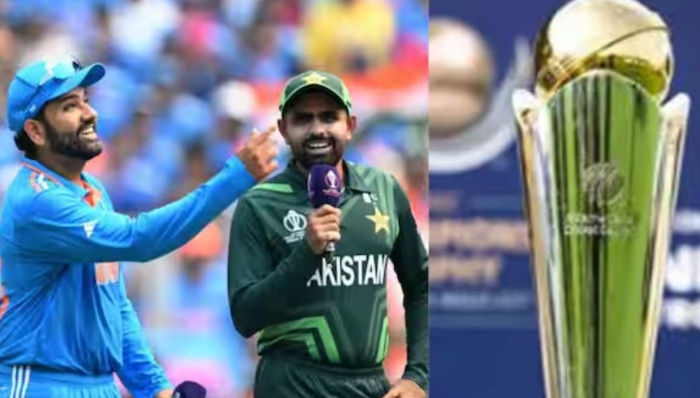
Indian Cricket team unlikely to travel to Pakistan for 2025 ICC Champions Trophy, BCCI to suggest hybrid model like last year’s Asia Cup: Report

The Indian team will not travel to Pakistan for the ICC Champions Trophy 2025 and will ask the International Cricket Council to hold its matches in Sri Lanka or Dubai, a BCCI source told ANI.

The ICC Champions Trophy will be held next year from February to March 2025 in Pakistan. Since 2008’s Asia Cup, India has not played any cricket tournaments in Pakistan due to tense relationships between both nations.

A bilateral series from December 2012 to January 2013 in India also marked the final bilateral series between the two nations. Since then, both nations have only clashed at ICC tournaments and the Asia Cup.

Uncertainty has been looming over India’s participation in the upcoming event due to the relationship between the two countries.

The Pakistan Cricket Board had proposed to India to play all its matches in one city. ESPNcricinfo had reported that Lahore was chosen as the location where India would play all of their matches. However, the Indian board is not interested in the prospect of travelling to Pakistan.

While addressing India’s participation in the BCCI source, told ANI, “India will not travel to Pakistan for the Champions Trophy 2025. Will tell ICC to hold its matches in Dubai or Sri Lanka.”

BCCI Vice-President Rajeev Shukla, in May, said that the Indian team would be sent to Pakistan for the tournament only if the central government permits it.

Speaking to the ANI, Shukla said, “In the case of the Champion Trophy, we will do whatever the Government of India will tell us to do. We send our team only when the Government of India permits us. So we will go according to the decision of the Indian government.”

A similar situation unfolded during last year’s Asia Cup, which was scheduled to be hosted in Pakistan.

However, PCB was compelled to use a hybrid strategy when hosting the Asia Cup last year, with all of India’s matches–including those against Pakistan–taking place in Sri Lanka.

The tournament final, which India won, took place in Colombo. Although Pakistan had hinted at the possibility of using a hybrid approach to participate in the ODI World Cup in India the previous year, it was never given any thought.

Pakistan are the defending champions of the Champions Trophy, last held in 2017.

(This news report is published from a syndicated feed. Except for the headline, the content has not been written or edited by OpIndia staff)

Rajasthan Govt led by BJP allocates 100 crores for development of Khatu Shyamji Mandir, to renovate 600 other temples: Key takeaways from the state budget

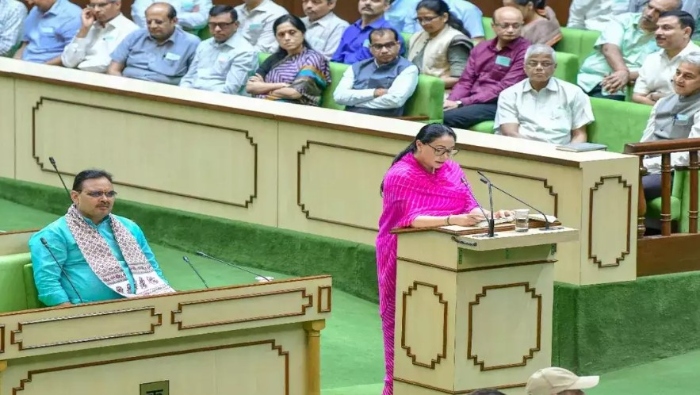
On Wednesday, July 10, Rajasthan Deputy Chief Minister and Finance Minister Diya Kumari presented the state budget in the Assembly. She made a series of announcements, including the proposal to allocate Rs 100 crores for the re-development of Khatu Sham Ji Mandir, one of the most revered Krishna temples in the state. She also announced plans to construct the Khatushyam Corridor, modelled after the Kashi Vishwanath Corridor, to enhance the infrastructure and facilities around this Hindu pilgrimage site. 

Besides, the Rajasthan government, led by the Bharatiya Janata Party (BJP), also proposed to carry out renovation work in 600 other Temples, including Jeenmata and Shakambari temples in Sikar. A total of Rs 13 crore has been allocated for the renovation of these Temples.

Besides focusing on the re-development of Temples, the state budget also had a lot to offer to the women, youths and farmers of the state.

Initiatives for women

Aiming to financially empower women across the state, the Rajasthan government announced the “Lakhpati Didi Yojana”. Under this initiative, as many as 15 lakh women in Rajasthan will be provided interest-free loans up to Rs 5 lakh to start their businesses and improve their economic condition.

Additionally, the state government has in its budget reduced VAT on cooking gas and CNG from 14.5 per cent to 10 per cent.

In the budget, the Deputy CM also committed to providing tap water to 25 lakh rural homes this year and for this, the state govt has allocated a budget of 15000 crore.

Along with Biopink toilets for women in urban areas, 67 Pink Toilets—at a cost of Rs. 17 crore—will be built in the first phase, she said.

Initiatives taken for the youth of the state

For the youths of the state, Deputy CM Diya Kumari proposed a new ‘Youth Policy-2024’ and announced apprenticeship/internship programmes and Artificial Intelligence-based counselling for over 1.5 lakh youth.

As part of a larger plan to fight unemployment and provide the youths of the state with more possibilities, a commitment to create 4 lakh new jobs over the next five years was made.

Furthermore, arrangements have been made for Atal Udyam Yojana for the youth. Rs 25 crore has been announced for startups.

Ajmer, Bikaner, and Bharatpur engineering institutions will combine to form the Rajasthan Institute of Technology, a 300 million rupee project. At Rs 350 crore, basic amenities like restrooms and libraries would be built in schools, the Deputy Chief Minister announced.

Rajasthan Govt’s support to farmers

The state is committed to developing a Detailed Project Report (DPR) to bring Yamuna water to Rajasthan via an underground pipeline and has allocated Rs 60 crore for this project.

The State govt also spoke about expanding the Rasidpura Mandi in Sikar and setting up sprinkler irrigation facilities in 33,000 hectares of the Chaudhary Kumbharam Arya Lift Canal area, a Rs 200 crore project.

In the budget, the MSP for wheat was increased by Rs 125 and the agriculture sector received financial approval for the first phase of the ERCP.

Other key takeaways

The Rajasthan Government announced that a Rs 200 crore Amrit Global Technology and Application Center will be built in Jaipur.

Electricity connections will be provided to 2,08,000 households in the next two years, with over 25 lakh smart meters installed.

In the budget, the government announced its plans to purchase 500 roadway buses and 300 electric buses. It further said that 800 buses would operate under a service model.

A defence manufacturing hub will be established, and a new data centre policy will be introduced.

Among the solar energy projects, the government proposed the construction of a 2 MW decentralized solar plant, the creation of a Model Solar Village in each district, and the solarization of all government buildings.

Dy CM further said that Rajasthan plans to construct nine greenfield expressways covering over 2,750 km.

The health sector received a budget allocation of Rs 27,000 crore.

Under a new tourism policy, the Deputy CM proposed setting up the state tourism development board as well as a heritage conservation board to develop archaeological places and heritage sites.

Rajasthan Mandapam will be developed on the lines of the Bharat Mandapam of Delhi.

Deputy CM Kumari further said that a ‘PM Unity Mall’ will be built in Jaipur to promote ODOP (one district one product). A budget of ₹ 100 crore has been allocated for this.

Also, a Rs 200-crore corpus fund will be created as an e-vehicle Promotion Fund under the Electric Vehicle Policy, she added.

The government estimates that it will receive Rs 2.64 lakh crore in income, spend Rs 2.90 lakh crore in revenue, and have a revenue deficit of Rs 25,758 crore in the budget. The fiscal deficit is estimated at 3.93 per cent of the GSDP (Gross State Domestic Product).


ITBP seizes 108 kg of gold biscuits at Eastern Ladakh, 2 persons arrested near border

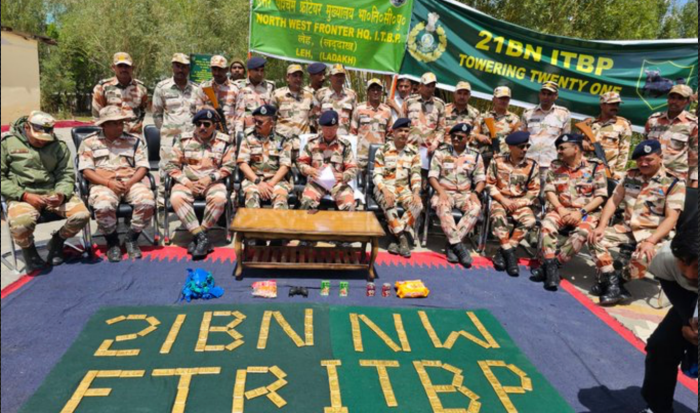
 In a significant bust, the Indo-Tibetan Border Police (ITBP) has seized 108 gold bars weighing 108.060 kgs and arrested two persons near the India-China border in Eastern Ladakh.

The seizure was made on July 9 during a Long Range Patrolling operation launched in the Southern Sub Sector, covering areas such as Chismule, Narbula top, Zakle, and Zakla. The ITBP team was deployed to check infiltration and smuggling attempts along the border.

“On 9th July, 2024 at around 01:30/02:00 PM 21st Battalion, ITBP launched a Long Range Patrolling (LRP) in the border areas in Southern Sub Sector in Eastern Ladakh of (in general area Chismule, Narbula top, Zakle and Zakla) to check infiltration as well smuggling as this is summer and activities are heightened around this season also some inputs of smuggling was received in the area near Sirigaple, Ladakh,” said the ITBP

The ITBP said its patrolling team while reaching the area of Sirigaple one km away from the International Border around at 13.20 am on July 9 came across two suspicious persons with mules.

“Patrol party chased the two persons down and took them to camping area as the suspects. Initially they told that they are collecting medicinal plants but later patrol party found huge quantity of Gold and other items. Patrol party took custody of both the suspects and seized items,” the ITBP said.

The arrested persons are Indian nationals and they have been identified as Tenzin Targy, 40, and Tsering Chamba, 69. The arrested individuals and the seized gold bars have been handed over to the customs authorities for further investigation.

Joint interrogation of the suspects will be carried out by Civil Police, Intelligence Bureau, customs and ITBP. The seizure along with the suspects have been handed over to custom department officers for further questioning and needful action as enshrined in the law. The ITBP said it has tightened vigilance along the border to prevent such illegal activities.

Besides the gold bars, two mobiles, one binocular, some Chinese food items ( one packet fragrant cake, one packet Lao Beijing, two Milk cane, two Milk Lassi, two Knives, two Ponies, one Torch-Wonder, one Hammer, and one Nose Plier was also seized from the possession of the arrested accused.

This significant seizure highlights the ITBP’s commitment to securing India’s borders and preventing smuggling attempts. The investigation is ongoing to uncover the source and intended destination of the seized gold.

The matter has been reported to higher headquarters and further investigation and action is in progress in coordination with sister organizations.

(With inputs from ANI)

NCPCR takes cognisance of complaint filed against Calvary Church Pastor for ‘cruelty’ on minor girl with kidney failure, directs police to initiate inquiry

On Wednesday, July 10, the Legal Rights Protection Forum (LRPF) took to X to inform that NCPCR had taken cognisance of the complaint it filed against Calvary Ministries in Telangana’s Bellampally region run by Christian Pastor R Praveen Kumar and Sharon. NCPCR directed the District Collector and Deputy Police Commissioner, Mancherial to initiate an inquiry into the activities carried out by the pastor in the name of ‘miracle’ healing.

@NCPCR_ directed the District Collector and Deputy Police Commissioner, Mancherial to initiate inquiry into activities of Calvary Ministries & register case against Pastor Praveen Kumar and Sister Sharon for violating provisions of JJ (C&P) Act, 2015, and other relevant laws, posted LRPF.

This comes a week after the Legal Rights Protection Forum (LRPF) filed a complaint against Calvary Ministries run by Christian Pastor R Praveen Kumar and Sharon. The complaint was filed after the Pastor was allegedly found imposing cruelty and medical negligence in the name of miracle healing towards a little girl who was suffering from kidney failure.

As per the LRPF, a video was posted on 16th May on the official YouTube channel of Pastor Praveen Kumar in which a mother of a little girl explained that her daughter was suffering from kidney damage. The mother could be seen crying in the video as she stated that her little girl had been under treatment at the Intensive Care Unit (ICU) of Niloufer Hospital, Hyderabad for the last 3 days and that she had got her to the Calvary Church’s Miracle Healing Show in Hyderabad for her life to be saved.

According to the girl’s mother, physicians advised them that the girl would not survive any longer, so they took her immediately from the ICU to the Calvary Church, despite the doctors’ warnings. She also stated that they signed an undertaking paper stating that doctors would not be responsible if anything happened to their daughter’s life. According to the mother’s statement, the girl was unable to move owing to kidney damage but can now walk.

“The act of cruelty by Pastor Praveen Kumar and Ms Sharon of Calvary Ministries towards the little girl who was suffering from serious kidney damage. Moreover, the video-graphed the minor girl child and uploaded it on their YouTube to project themselves as Miracle Healers. This is an act of causing damage to the dignity and privacy of the victim girl,” the organization added in the complaint.

It is crucial to note that the Pastor and his wife were booked in the year 2019 in a similar case. On 25th May 2019, an FIR was registered against the duo under sections 304-II, 420, and 34 of the Indian Penal Code, 1860 at Kasipet police, Bellampally after a 21-year-old person died due to negligence of the Pastor.

‘De-enroll them from school lest you want your daughter to become a pr*st*tute’: Pakistani Youtuber’s song against girl child education goes viral

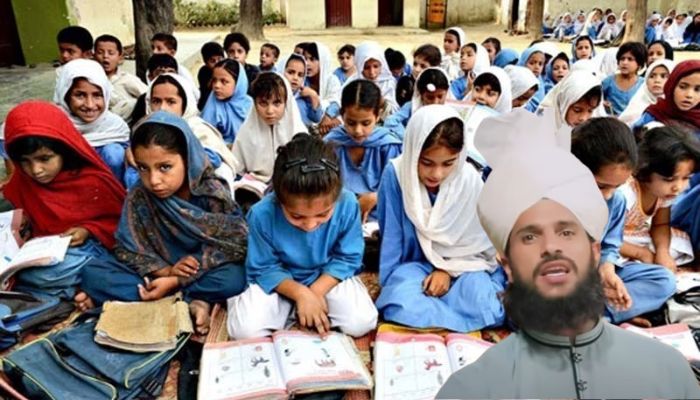
In Pakistan, a music video against education for girl children is going viral on social media. The video was uploaded by a YouTuber named Hafiz Hasan Iqbal Chishti. In the music video, he asks Pakistani citizens not to send their daughters to school as they would be dancing there which is considered an ‘un-Islamic act’ or Haram. He then goes on to say that if the parents want to make their daughter a Kanjari (a derogatory word for character assassinating a woman), they could send them to school.

The song was released a few weeks ago in June. The controversial song condemning girl child education is titled, “Apni dhi Schoolo Hata Le Othy Dance Kardi Payi Ae” (De-enroll your daughter from school she was spotted dancing there). 

The controversial song is laced with misogynistic lyrics that advices Pakistanis to de-register their daughters from school and make them sit at home behind veils unless they want their daughters to become prostitutes. 

The transcripts of an excerpt from the lyrics read, “Ghar parade vich bitaale, nahi te ye te gaal jehen chipaale othey dance kardi payi ae. Endi izzat gavaani chahne, je kanjiri banane chahne phir dhi school pada le…” (Translation – Keep your daughters at home, cover them up in veils otherwise she will be spotted dancing at school. If you wish to lose respect or want your daughter to become a prostitute, then send her to school to study). 

Another reads, “Nachdi school jaake, nahi aan dhi izzat bachaake…” (She dances at school, and returns home without her honour). 

The context behind making the video also finds mention. It shows footage of a dance competition that was organized in a school in Pakistan at the request of UNESCO. In response to this, YouTuber Hasan Iqbal Chishti is seen singing the controversial lyrics. Currently, it is the most-watched video on his YouTube Channel which was uploaded on 19th June 2024. So far, it has garnered over 1 lakh 77 thousand views and over 2.9 thousand users have liked it. 

In the comment section, many educated Pakistani citizens condemned the lyrics and their intention and asked in which direction Pakistan was heading. A user took a dig at Chishti’s controversial music video. He released a video on a YouTube channel named Ex-Muslim Zafar Heretic. Condemning the song and trolling Chisti, the YouTuber said, “Let me tell the song creator that music too is Haram in Islam.”

(Video Courtesy – Ex-Muslim Zafar Heretic YouTube Channel)

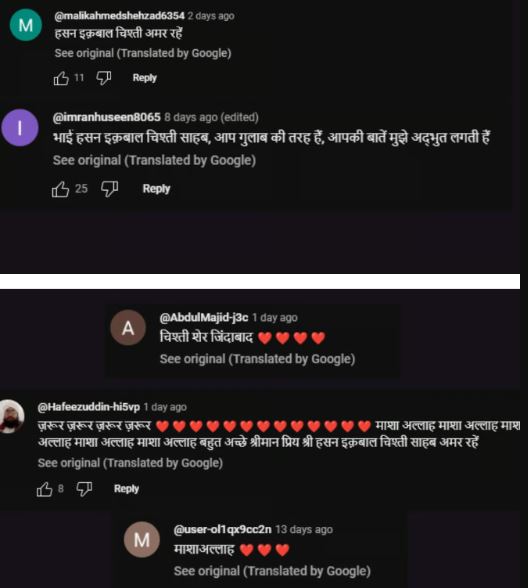
However, many users appreciated Hasan Chisti for making the song. Some commented that they agreed with his observation and advice, some thanked him for uploading the song while many hailed him saying ‘Long Live Hasan Iqbal Chisti’.  

(Comments on the Video, Image Courtesy – Free press Journal)

Talibani mindset against female education

It is pertinent to note that people like Hasan Iqbal Chisti and ilk only harm society and lead it to a pitfall. Today, in every developing country, emphasis is laid on education of all children so that educated females empower society. However this is not the case in Islamic countries. They lay their focus on how to deprive females of their basic rights. In countries where pursuing basic education is a challenging task, higher education for girls seems a near impossibility. 

According to a report in Balochistan’s English-language online newspaper, Balochistan Voices, “a woman is termed to be a prostitute when she goes outside, gets an education, speaks for herself. The prostitute blame is also extended to how women dress or walk even.” 

In multiple instances, the Taliban had completely restricted female education and banned it in the Afghan-Taliban region.

In 2022, female students were stopped from appearing for University exams. They led a massive protest against this decision. Back then, Taliban’s Education Minister Nida Mohammad Nadim had defended the Taliban rule. 

He said, “Islam does not allow women to engage in adultery under the pretext of education and that banning female education is in line with the Prophet’s decree and that woman is obliged to produce children & serve her man, not to get educated.”

Taliban also claimed that female students in the universities did not follow the Taliban dress code and used to go to study dressed up as if they were going to a wedding ceremony. They also banned education arguing that men and women could meet freely in universities.

Now, the same regressive mindset of ending girl-child education has come to the fore from Pakistan which is fast marching on the Talibani path. 

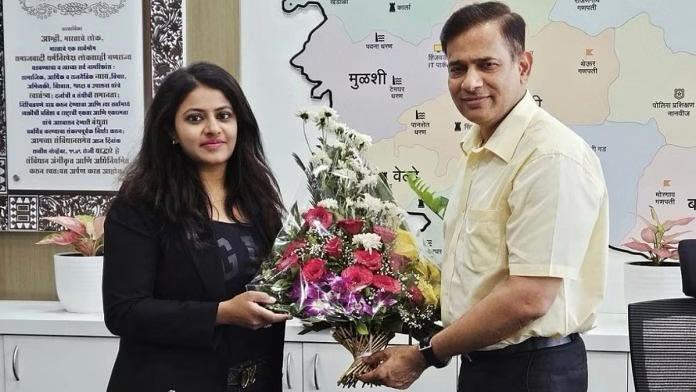
Trainee IAS officer Puja Khedkar, transferred for making VIP demands, reportedly faked mental disability to gain concessions in the Civil Services process

Probationary IAS officer Puja Khedkar has made headlines after being transferred from Pune due to alleged misuse of power. The controversy has brought to light details about her civil services exam attempts, showing that she claimed to be visually impaired and mentally ill in her affidavit to the Union Public Service Commission.

In an affidavit to the Union Public Service Commission, Khedkar asserted that she was visually and mentally impaired to gain concessions in the selection process. She refused to undergo a required medical examination six times to verify her disabilities. It remains uncertain how or why she was appointed if she repeatedly declined to take the examination. Ms Khedkar, originally from Ahmednagar, is an IAS officer from the 2023 batch.

According to unverified reports, her initial test was scheduled at Delhi’s All India Institute of Medical Sciences in April 2022, which she missed, claiming she had tested positive for COVID-19.

She also missed two scheduled appointments in the following month, including those in July and August. In September, she only partially attended a sixth appointment, failing to undergo an MRI test to assess her vision loss.

The Commission later contested her selection, and in February 2023, a tribunal ruled against her. However, she still managed to have her civil service appointment confirmed.

Additionally, there are concerns regarding Ms Khedkar’s claim of OBC (Other Backward Classes) status.

Her falsified statements and the resulting concessions enabled Ms Khedkar to pass the highly competitive Civil Services Exam despite achieving a relatively low all-India rank of 841.

Ms Khedkar was transferred from Pune to Washim after her actions, including using a siren on her private Audi sedan, were exposed. Pune Collector Suhas Divase had written to the Chief Secretary of the Maharashtra government requesting her reassignment.

“The 2023 batch IAS officer will serve the remainder of her probation as Supernumerary Assistant Collector in Washim district,” stated the order.

In addition to using a siren, VIP number plates, and a “Government of Maharashtra” sticker, Ms Khedkar had been found using Pune Additional Collector Ajay More’s office in his absence. She reportedly removed his nameplate and furniture and even demanded letterheads.

These privileges are not available to junior officers on probation for 24 months. Reports suggest her father, a retired administrative officer, had advocated for her demands to be met.

‘Go away else I will kill the baby inside your womb’: Imran posing as Aman impregnates a Hindu girl, forces her to convert; was in contact with 35 more girls

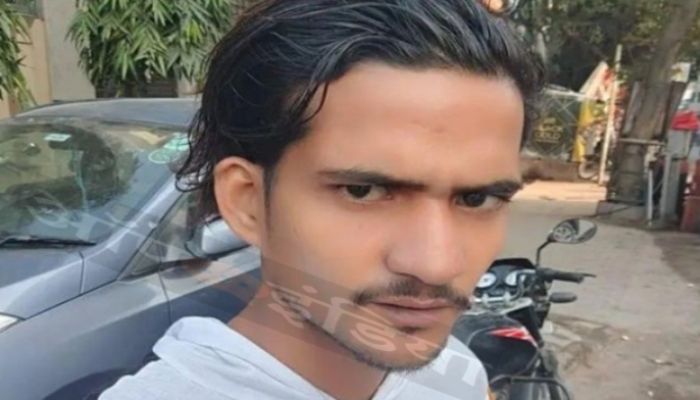
A case of Love Jihad has come to light from the Kanpur district of Uttar Pradesh. The accused identified as Imran trapped a Hindu girl in his love affair by posing as Aman. It is alleged that he sexually assaulted the girl for more than four years and recently impregnated her. When the girl asked him to marry her, the accused revealed his real identity and started forcing her to convert and do Nikah. When she refused, he brutally assaulted her and threatened to kill her along with her fetus. Following his arrest, the Police investigation revealed that Imran was in contact with more than 35 girls through social media. It is alleged that he made many girls his victims.   

According to reports, the incident took place in the Colonelganj police station area of Kanpur city. On Monday (8th July), the victim lodged a complaint at the Colonelganj police station. 

In her complaint, the victim stated that in 2019, she received a friend request from an Instagram ID of a person named Aman. The accused Imran had created the Instagram ID. On his handle, he used to share pictures in luxury cars and hotels. Soon, they shared each other’s mobile numbers and developed a friendship. 

According to the victim, four years ago, when Imran (posing as Aman) came to meet her for the first time he had a tilak on his forehead. He was wearing a Saffron Kurta and had Kalawa in his hand. He also took the victim to the temple for darshan. 

It is alleged that he sexually exploited the victim for more than 4 years on the pretext of marriage and raped the victim in hotels and at the residence of his relatives. He used to pacify the victim’s resistance by promising to marry her. He recently impregnated the victim who is two months pregnant. When she started asking the accused to marry her, he immediately refused.  

According to the victim, the accused then revealed his real identity and stated that he was not a Hindu but rather a Muslim. He also told her that his real name is Imran. He then asked the victim to convert to marry him. When she protested against the betrayal, Imran brutally assaulted her and threatened to kill her and her baby.   

Imran told the victim, “I will not marry you. Run away, you b**ch, else I will kill the baby inside your womb.” 

She then narrated everything to her family members and filed a Police complaint. In her complaint, the victim described Imran as a fraud and demanded strict action against the accused.

Police have registered an FIR against the accused Imran on charges of rape, assault, threatening to kill and under the UP Prohibition of Unlawful Religious Conversion Act-2021. OpIndia has the FIR copy.

Additionally, after arresting the accused Imran, the Police produced him before the court on Wednesday from where he was sent to jail. 

The Police also seized his mobile phone. During the investigation, Police found out that the accused was in contact with more than 35 girls on Instagram, Facebook, and other social media platforms. He had taken their numbers and had been conversing and flirting with them. He has preyed on many girls and made them his victims in a similar manner. The Police have contacted other girls asking them to lodge a complaint so that strict action can be taken against the accused.

Telecom industry seeks reduction in license fees, duties on equipment, exemption from GST for payments made to DoT and others in union budget

Ahead of the first Modi 3.0 budget, the Cellular Operators Association of India (COAI), an industry body, on Wednesday listed several recommendations addressed to the Union Ministry of Finance.

The industry body sought exemptions on custom duties on telecom equipment, sexemption from GST under Reverse Charge Mechanism on payments made to DoT for license fees, spectrum usage charges, and spectrum acquired in auctions among other recommendations.

COAI also recommended that the license fee be reduced from 3 per cent to 1 per cent, relieving the telecom service providers from additional financial burden.

The much-awaited full Budget for 2024-25 is scheduled to be tabled on July 23 – the first Budget under Modi 3.0. The budget session of Parliament is scheduled to commence on July 22 and conclude on August 12.

Considering the huge capital that Telecom Service Providers (TSPs) have to invest in the current scenario, especially for the deployment of 5G, the industry body has recommended abolition of Universal Service Obligation Fund (USOF) levy.

Alternatively, it suggested that the government may consider suspension of the USO contribution of 5 per cent of Adjusted Gross Revenue till the existing USO corpus of approximately Rs 80,000 crore is exhausted.

COAI stated that it is also concerned over the definition of gross revenue (GR). According to the industry body, under the present definition revenue from all telecom activities is covered.

This, it argued, has created ambiguity because the term telecom activity is not defined clearly, so it may include revenue from activities believed to be incidental to telecom activity.

COAI thus recommended that the definition of gross revenue be made precise, stipulating that the revenue from activities for which no license is required should not be a part of gross revenue.

“We hope the government will consider these recommendations in the upcoming budget and help the industry navigate through these prolonged challenges,” said Lt. Gen (retd), Dr SP Kochhar, Director General, COAI.

Owing to the intense price competition in the market, the telecom industry in India has consolidated from over 10 companies in 2017 to three private and one public sector company.

Coming to customs duty, over the past 5 to 6 years, the government has gradually increased the customs duty on telecom equipment to 20 per cent, which the industry says significantly impacted the rollout of 5G services in India.

COAI has requested exemptions on customs duties for certain telecom equipment to alleviate the cost challenges associated with deploying this critical infrastructure.

“The industry body recommends that the customs duty be reduced to zero and then gradually increased depending on creation of ecosystem for manufacturing of telecom gear in India. Until high-quality equipment is available domestically at competitive prices, COAI urges the government to reduce customs duties for 4G and 5G network products, as well as other related items, to nil,” COAI said.

Faced with tight market dynamics, the telecom operators, Jio, Airtel, and Vodafone Idea, raised prepaid tariffs in a range of 10-25 per cent, invariably, a few days ago.


 (This news report is published from a syndicated feed. Except for the headline, the content has not been written or edited by OpIndia staff)

‘Kingpin’ Arvind Kejriwal’s close associate directly involved in handling Rs 25 crore bribe money for AAP: ED chargesheet

In a major development in the Delhi Excise Policy case, the Enforcement Directorate’s latest chargesheet alleges that Delhi Chief Minister Arvind Kejriwal was aware of and complicit in the use of bribe money in the Goa elections. The ED’s chargesheet included details about Arvind Kejriwal’s WhatsApp discussion with accused Vinod Chauhan.

The chargesheet also adds that K Kavitha’s PA had sent more than Rs 25 crore to the Aam Aadmi Party through Vinod during the Goa elections. The WhatsApp chat indicates that Chauhan had cordial relations with the AAP supremo.

ED has alleged that “accused number 37” Arvind Kejriwal colluded with members of the ‘South Group’ and others, including Vijay Nair, to get kickbacks of Rs 100 crore for “providing undue benefits to private entities by formulating and putting in use a tailor-made liquor policy.” According to the ED, Nair acted on behalf of Kejriwal and AAP’s other top leaders

According to the chargesheet, the AAP received Rs 45 crore of the Rs100 crore payment, which was funnelled through hawala routes for campaigning in the Goa Assembly polls. Vinod Chauhan, Kejriwal’s close aide, dealt directly with the hawala dealers and was responsible for sending Rs 25 crore for the Goa elections,  the chargesheet adds.

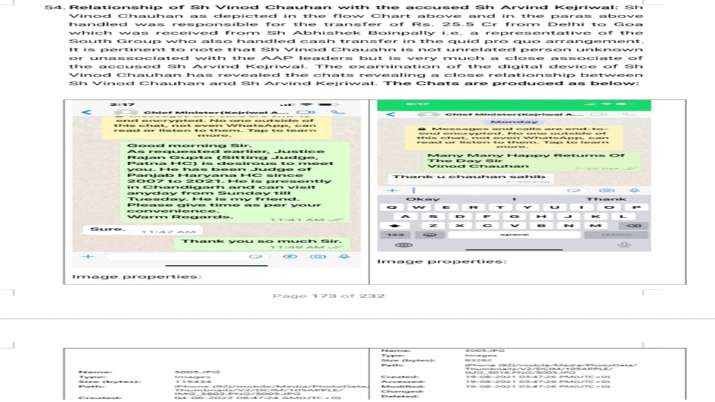
“Relationship of Sh Vinod Chauhan with the accused Sh Arvind Kejriwal: Sh Vinod Chauhan as depicted in the flow Chart above and in the paras above handled was responsible for the transfer of Rs. 25.5 Cr from Delhi to Goa which was received from Sh Abhishek Boinpally e a representative of the South Group who also handled cash transfer in the quid pro quo arrangement. It is pertinent to note that Sh Vinod Chaughn is not an unrelated person unknown or unassociated with the AAP leaders but is very much a close associate of the accused Sh Arvind Kejriwal The examination of the digital device of SH Vinod Chauhan has revealed the chats revealing a close relationship between Sh Vinod Chauhan and Sh Arvind Kejriwal, the chargesheet accessed by IndiaTV reads.

Source: IndiaTV

The ED chargesheet also attached screenshots of the WhatsApp chats between Kejriwal and Vinod Chauhan. In one such chat, Chauhan said that a Patna High Court judge Rajan Gupta wanted to meet Kejriwal and sought time for the meeting. In response, Kejriwal replied, “Sure”. In another screenshot, Chauhan sent birthday wishes to Kejriwal.

“In this manner, Arvind Kejriwal is directly, knowingly and involved in the generation, acquisition and possession of the proceeds of crime of Rs 100 crore…Arvind Kejriwal has concealed the proceeds of crime by way of using cash transfers/Hawala transfers from the point of generation till the use. Hence, the accused Arvind Kejriwal, is actually and knowingly involved in the different processes and activities connected with the offence of money laundering, i.e. generation, acquisition, possession, concealment, transfer, use and claiming it to be untainted as defined u/s 3 of PMLA, 2002,” the chargesheet adds.

According to the ED chargesheet, Chanpreet Singh, a Chariot Productions employee, managed the money that reached Goa via hawala. Singh, who worked on the AAP’s Goa campaign as a freelancer, was paid by the party with Rs 1 lakh, IndiaToday reported.

ED also mentioned chats between Arvind Kejriwal and C Arvind, former secretary of AAP leader Manish Sisodia, to demonstrate how the CM Kejriwal allegedly attempted to mislead the probe. The probe agency also stated that a large amount of evidence was destroyed.

Right to freedom of religion doesn’t encompass the right to convert others: Allahabad HC

The Allahabad High Court recently announced that the freedom of Indians to freely practice and spread their faith does not entail a collective right to convert others. The court upheld the same constitutional right to religious freedom for both the person deciding to convert and the one being converted. Judge Rohit Ranjan Agarwal’s bench further stated that every person has the freedom to choose, practice and express their religious beliefs owing to the constitution’s guarantee of individual freedom of conscience, however, this right does not apply to the collective right to proselytize, which is the act of trying to convert others to one’s religion.

He conveyed, “The Constitution confers on each individual the fundamental right to profess, practice and propagate his religion. However, the individual right to freedom of conscience and religion cannot be extended to construe a collective right to proselytize; the right to religious freedom belongs equally to the person converting and the individual seeking to be converted.”

The court further emphasized that the purpose of the Uttar Pradesh Prohibition of Unlawful Conversion of Religion Act, 2021 was to protect the constitutional prohibition against unauthorised religious conversions. The court was considering a bail request submitted by a person named Shriniwas Rav Nayak in connection with a case that was filed at the Nichlaul police station in the Maharajganj district under Sections 3/5 (1) of the Uttar Pradesh Prohibition of Unlawful Conversion of Religion Act, 2021.

The informant was invited to co-accused Vishwanath’s home on 15th February, where a large number of villagers mostly from Scheduled Castes were present, according to the First Information Report. Ravindra, Vishwanath, his brother Brijlal (the applicant) and Shriniwas Rav Nayak persuaded him to abandon Hinduism and become a Christian by luring him with the promise of a better life and an end to his problems. A few locals had already embraced Christianity and begun to pray. After making an excuse, the informant called the police to report the occurrence.

Legal representation for the bail applicant contended that his client from Andhra Pradesh was not involved in the purported conversion and was only providing domestic assistance to one of the co-accused. The attorney added that there was no undue influence and the witness statements could not be believed because the official complaint did not name any converter per the 2021 Act. Furthermore, no one who became a Christian has complained.

Additional government advocate mentioned that the applicant arrived at the location, Maharajganj, where the conversion was happening, and was actively involved in the illegal act of converting from one religion to another. The court highlighted, “The Constitution clearly envisages and permits its citizens right to freedom of religion in respect to their professing, practising and propagating its religion. It does not allow or permit any citizen to convert any citizen from one religion to another religion.”

The court pointed out that Section 3 of the 2021 Act expressly forbids conversion to another religion on the grounds of deception, compulsion, fraud, undue influence and seduction. It stated that the Act forbids aiding, abetting or collaborating to such conversion and stipulates penalties for violating the section’s prohibitions. The court further declared that the Act was passed with consideration for Article 25 of the Indian Constitution, which prohibits any citizen from converting another citizen to their own religion.

Considering the accusations levelled against the accused, the court observed that the informant had been coerced into converting to a different religion. This alone was sufficient grounds for denying the applicant bail, as it demonstrated that a conversion program was underway, including several Scheduled Castes villagers being converted from Hinduism to Christianity. The court ruled that in this instance, the state’s counter-affidavit, which was supported by the police’s recordings of comments from unaffiliated witnesses, proved that a conversion event had transpired.

It pronounced, “In the instant case, the informant was persuaded to convert to another religion, which is prima facie sufficient to decline bail to the applicant as it establishes that a conversion programme was going on where many villagers belonging to Scheduled Castes community were being converted from Hindu religion to Christianity. There arises no occasion as to why the informant would rope in the applicant, who is a resident of Andhra Pradesh, falsely in a case of unlawful religious conversion. Neither in the bail application nor during the argument, it has been submitted that there stood any enmity between the informant and the applicant.”

As a result, the court decided that there was sufficient evidence to establish an illicit religious conversion under the Act of 2021 and denied bail to the applicant-accused.