Home Blog Page 7636

Ashok Chakradhar hits out at award returnees, asks them to see through TRP game and politics

0

Renowned Hindi poet and author Ashok Chakradhar has hit out at those returning Sahitya Akademi awards to protest against alleged rising intolerance in the country. In a Facebook post, especially aimed at his colleague and one of the award returnees Munawwar Rana, Mr. Chakradhar has questioned the wisdom of those who are taking this route to protest against the claimed issues of tolerance and free speech.

Ashok Chakradhar wonders why Munawwar Rana, who himself had declared that those returning awards were “tired” people who had given up faith on their writing, suddenly did the same a few days later.

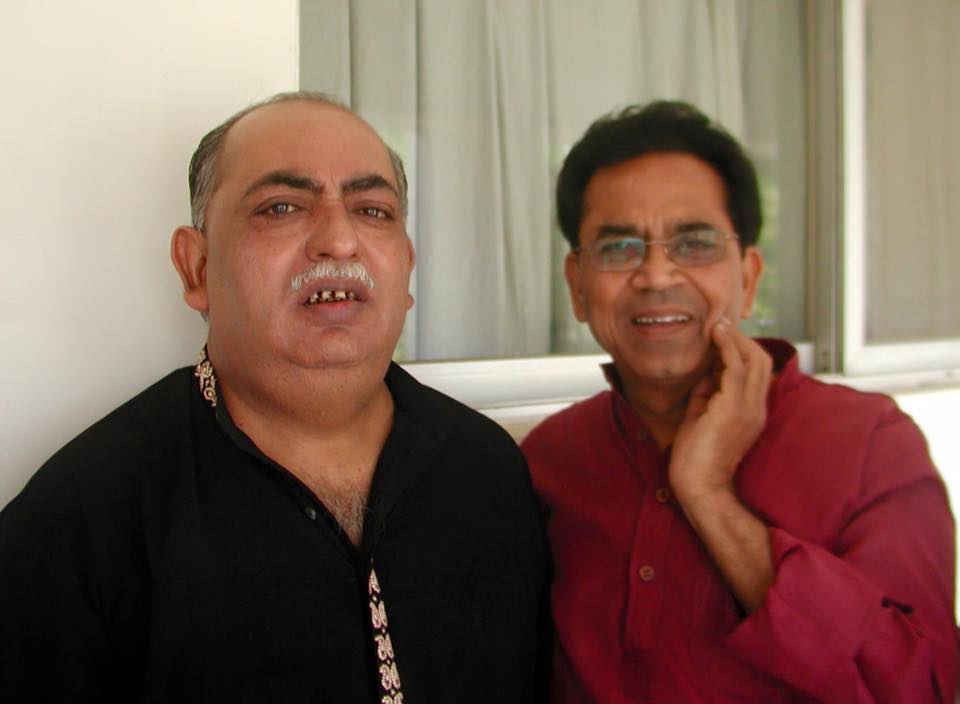
Ashock Chakradhar and Munawwar Rana
Ashok Chakradhar with Munawwar Rana (photo credit: Facebook post by Mr. Chakradhar)

Chakradhar suspects that there was mix of political and communal pressure on Rana, which forced him to go back on his own conviction and return his Sahitya Akademi award. In his post, Chakradhar claims that minds of Muslims have been poisoned into believing that they are not safe in India, and this aspect might have forced Rana to return the award.

Ashok Chakradhar reminds Munawwar Rana what Rana had replied when someone in Pakistan had asked him if he, a Muslim, felt safe in Hindu majority India. Then Rana had said that he had nothing to fear because ‘70 crore Hindus were ready to defend him’.

Chakradhar asks Rana why he has suddenly lost faith on those 70 crore Hindus and had become afraid of just 70 odd hate mongers.

Ashok Chakradhar then makes a public appeal to Munawwar Rana to not let this discourse of fear become the fear of one community. He reminds everyone that it is the duty of poets and writers to make sure that there is peace and brotherhood in the country even if some people were indulged in hate mongering.

Mr. Chakradhar says that poets and writers should neither get overwhelmed by any fear nor let anyone else get overwhelmed by it. Fear should be resisted, not exaggerated, he says. Divisive politics has to be fought with pen, not by getting consumed by it or by being paranoid, he further says.

Chakradhar also indirectly blames the media for exaggerating events and creating an atmosphere of fear in the country. He says that poets and writers should make common people aware of this ‘game of TRP’. Perhaps that is the reason this statement by Ashok Chakradhar has not made headlines yet in the mainstream media.

Series | Decoding Indian Belief Systems: Circle versus Line

India is currently in a state of huge flux. There is a widening gap between generations, and every five years now looks like a new generation gap. The cause of this gap is not just technology, which is a mere enabler of communicating thought, but also the change in the collective thought of generations which has undergone dramatic shifts in the past few decades.

Born with a traditional faith-based upbringing but educated in contemporary material and Western scientific values, some of us were constantly at odds trying to make sense of the Universe around us. Is there a God? Rather, how many Gods are there in this Universe? If there are God(s), are they the Hindu or the Muslim or the Christian or the Jain or the Parsi one(s)? If God is omnipresent, is he present in the Devil too? If we are children of this God, why do we need to please him or her? That too with absurd traditions like a plate decorated with flowers, burning camphor or incense sticks and circling the plate around the idol of a God? What is the sense of the poojas and the yagnas, except for the yummy prashad we received at the end? Aren’t these rituals just blind superstitions of the past when man was dependent more on nature than technology?

Why do Indians blindly follow spiritual gurus? Why are women not allowed in temples during menstruation? Why is there such a discriminatory caste system in this country? Why do our Gods have multiple hands – sometimes, 4, sometimes 8, sometimes 100? Why do we worship a monkey-face or an elephant-face God? Are Ramayana and Mahabharata adaptations of true stories, or pure myth? Why is sex such a taboo in the land of the Kamasutra or the Khajuraho temple?

Questions like these filled a mind attracted to science and intrigued by tradition. While some people took the easy path of either rejecting tradition altogether calling it superstition, others took the decision of accepting tradition and faith as it appealed to them. There was a third category too: people who were open to knowing more, but didn’t know where to look for answers.

In this series on the Indian tradition, we try and look at some of these questions to figure out what they were probably intended for, and what they mean today. For sake of convenience, we use the term Indian tradition or philosophy to refer to philosophies which originated in India like Hinduism, Buddhism, or Jainism. The idea is not to say that traditions which didn’t originate in this country are not Indian; rather it is the contrary – to understand how being Indian in the philosophical sense enables us to widen our worldview to accept all philosophies in our midst.

In this series on Indian tradition, our attempt is not to judge the traditions as right or wrong, good or bad, scientific or unscientific. It is just to highlight the other side of the coin – looking at traditions from the lens through which they were probably created. In the end, one is free to take a call of their liking, but hopefully this series will open us up to understanding why people do what they do. Hopefully, this will help increase empathy in a society which sees newer acts of intolerance every day.

We begin with one of the most crucial differences in the Indian worldview as compared to the West: our understanding of life. While in India, life has traditionally been viewed as an endless circle, in the West it has been seen as a line with a definite starting and ending point. In his TED video, Devdutt Pattanaik, the Chief Belief Officer of the Future Group, establishes this significant difference between the Indian and the Western perspectives. This difference is key to our understanding of the philosophy and the multiple ideologies of these worldviews, and their underlying assumptions.

In his TED talk, Devdutt, one of the most knowledgeable speakers on Indian mythology who uses his understanding of ancient stories to solve an organization’s contemporary problems, talks about two myths or stories which have shaped a disproportionate amount of Indian and Western thought. This is the metaphysical perspective on life in the two parts of the world.

In the West, the story goes as this: You live a single life, and after dying you cross a river. After you cross the river, you will be valued on the basis of your achievements on earth and thus you will either go to the ‘Land of the Heroes’ or to the ‘Land of the Commons’. In the East however, the story is slightly different: Once your lifetime on earth is complete, you cross a river and then take a new form and come back to earth for another lifetime. This cyclical process goes on and on for lifetimes.

So, both philosophies give very different answers to the one very basic question surrounding human existence: What is the purpose of life? While one says achieving greatness would make life more meaningful, another says realizing the hollowness of it all, and attainment of freedom from the cycle of birth and death is the ultimate raison d’etre.

Thus, the major difference between the Western and the Eastern thought is on how they view life: as a line or as a circle. Though seemingly it is just a philosophical difference, it is incredible how this single point of difference has shaped the cultures, values, beliefs, traditions, ideologies, and social structures of society in these regions. In this series on Indian belief systems, we will start from this very point of origin and over the next few weeks, try to decode why our systems and beliefs evolved the way they did, and why our culture is distinct (neither superior nor inferior to the West) with its unique identity, and how do we come to terms with the seeming contradictions between our ancient roots and the ways of modern life.

written by – @shreyansmehta

Journalist and old friend of Sanjiv Bhatt asks: Did you use me Sanjiv Sahab?

0

This piece is about two people. One a politician who is the Prime Minister of India and the other a Gujarat cop – now dismissed. From a reader’s perspective there are always different ways of looking at a writer/blogger. On the other hand, bloggers too preserve their rights and prejudices too.

Narendra Modi has been a politician and a chief protagonist of my three books on his state and him. But Modi was never a friend though I had always admired him for certain traits as an administrator in Gujarat and as a ‘grounded’ leader who looked decisive on many matters chiefly working on developmental projects.

On the other hand, Sanjiv Bhatt was a good friend and more a ‘good source’ in Gujarat police when I was deputed by Press Trust of India (PTI) there to cover the year’s toughest assignment the post-Godhra mayhem of 2002. I always believed Sanjiv or our ‘Sanjiv Sahab’ never lied to me. I will continue to cherish this belief.

But on October 13, 2015, none other than the Supreme Court of India had choicest of words and phrases for him. “We are not impressed by aforesaid submissions. It cannot be said that the petitioner (Sanjiv Bhatt) has come to this Court with clean hands,” the court of Chief Justice of India H L Dattu and Justice Arun Mishra ruled.

I continued to be in a mystified stage as the reports of the court proceedings came in. Of course, I knew from 2009-10 that Sanjiv Bhatt was perhaps erroneous in his handling of the entire episode wherein he had filed an affidavit claiming Modi as Chief Minister of Gujarat told select few senior police officials (on February 27, 2002) that the Hindu rioters should be allowed to avenge the injustice of Godhra train inferno. Other police officials, including the then DGP K Chakravarthy had denied that Sanjiv Bhatt had attended such a meeting. There was no police record to substantiate Sanjiv’s claims too. The official version being – he was too junior to be summoned for such a high-level meeting.

Despite regarding him a friend and ‘reliable source’ – to use a journalistic cliche – I was somehow not convinced about Sanjiv Bhatt’s version. I was often ridiculed in the established secular lobby of New Delhi and Ahmedabad journalism for my ‘not trusting’ a friend and backing a Hindutva leader, NaMo.

I probably went by my instincts and thought Sanjiv Bhatt must have fallen into some wrong hands. The official claim that Sanjiv Bhatt was too junior to attend such a meeting somehow worked for me. One reason for the same being, only ‘trusted’ senior cops would be convened for a high-level meeting with a Chief Minister. I knew from my experience in Nagaland, mere seniority does not make you win a Chief Minister’s trust. S C Jamir, the former Nagaland Chief Minister and the present Odisha Governor, had tutored me a few tricks of running an administration.

So my argument was: Even if Sanjiv Bhatt was authorized to go to such a meeting (in the absence of his senior), there was no surety the Chief Minister would trust a junior fellow. To say that Sanjiv Bhatt did not know this would be wrong again.

Nevertheless, the detailed ruling from the apex court of the land and that too telling in as many words that  Sanjiv Bhatt has used ‘media card’ and was only a tool to Modi’s political detractors was a sad affair overall.

The court had ruled, “He (Sanjiv) had exchanged e-mails with rival political party leaders and was being tutored by the  lawyer of NGO and its activist. Ghost questions and answers were also prepared as to what the petitioner was required to speak before Justice Nanavati Commission. Petitioner has used the media card, has even sent the e-mails to influence the judicial proceedings of a  3-Judge Bench of this Court (Supreme Court) and has tried to influence the amicus  curiae. The e-mails also indicate that he tried pressure groups and  tried to invoke media pressure”.

I felt let down. Did Sanjiv use some of his media friends too and needless to add – by basking in the ‘glory’ of being one-man against Modi – Sanjiv’s friend circles in media had changed by then? His onetime ‘babu moshai from Mumbai’ (this blogger) was hardly in the inner circle! And thus during December 2012 election campaign for the state assembly, my interaction with Sanjiv Bhatt – when his wife Shweta was contesting against Modi from Maninagar assembly segment – was minimum and more of a courtesy meeting. Sanjiv’s friends now were high flying journos, TV anchors and Padma Shri awardees.

On October 14, a day after the apex court ruling, I confided in my wife and few close friends in Delhi and Mumbai and also with one special friend on Facebook that overall it was a ‘sad’ affair. Sanjiv has been slammed – this time not by BJP’s battery of spokespersons but by the Supreme Court itself. And if Sanjiv sahab had any ‘media card’ – our profession has been misused.

I have stated earlier of the apprehension I had about him falling into ‘wrong hands’ – for essentially I thought and many journalists who have served in Ahmedabad would believe that he was a sharp cop. I still have a few fond memories of his genuine friendship and helping me in discharge of my duties as a journalist for a highly demanding wire agency Press Trust of India (PTI).

But, I am afraid, one cannot sympathise with him further. So, rather one is convinced to take the harsh but candid line of a noisy TV anchor that ‘the credibility of Sanjiv Bhatt is over’. This is perhaps a big casualty of the 2002 Godhra train inferno and the subsequent politics perpetrated from either side.

On a broader larger scale, what angers me most is that the ‘credibility’ of a police official has been hit. It demonstrates gross abuse of police force, IPS cadre and a brilliant police officer by the Congress party and the NGOs — the permanent Modi detractors. This judgement of the Supreme Court, according to me, has made our friend Sanjiv Bhatt the Man-of-the-year 2015 – of course for the wrong reasons. Is Sanjiv Bhatt a case of abuse of a ‘weakest’ link by Congress party and the NGO brigade?

We know in a contest of unbalanced confrontation, like the story of David and Goliath; the weakest has to outsmart the strongest. My friend just could not. Sanjiv sahab is still active in social networking. He has the right to do so. But he needs to pull himself back for a while. And I sincerely feel so.

Now, the bigger question is should there be a probe into Congress-Sanjiv Bhatt nexus in the entire episode — to dig out the truth?

– by @nirendev1
(Nirendra Dev is a Spl. Representative with The Statesman, New Delhi and author of books including
‘Modi to Moditva – An Uncensored Truth’ and ‘Godhra – A Journey to Mayhem’)

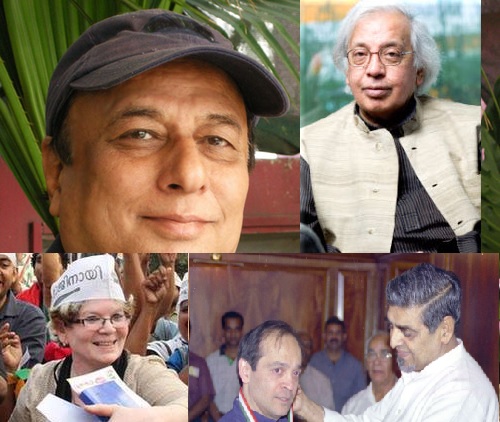
Meet your Sahitya Akademi Award Returnees

0

Numerous authors and poets have decided to return their Sahitya Akademi awards to protest, what they see as “rise of intolerance” in India. All these people are stalwarts and their work speaks for them so we need not assess their literary work and bring attention to the part that is common knowledge. We will only focus on the not-so-commonly known aspects:

1 . Uday Prakash

The author who started it all. He is a product of the JNU university and is described as a “Marxist” here. He has been a “passionate young member” of the CPI and later the CPM. He received his Sahitya Akademi award in 2010. In 2006, Arundhati Roy had rejected a Sahitya Akademi award. These were his views on the Akademi then:

“They call the Akademi autonomous, but it’s like what all statist institutions are, full of brokers, compromisers, people fleecing the system for personal gains, awards, recognitions, fellowship holders, those holding plum posts. She speaks her mind, how many of our writers dare to do that against the corrupt, power mafia? She has shown the truth of not only corruption in these institutions, but also how global capital has squeezed us, is squeezing us dry everyday in this new era where everything has become so cruel and money-centric”

2. Nayantara Sahgal.

Sahgal is Nehru’s niece who received her Sahitya Akademi award in 1986, when Nehru’s grandson Rajiv Gandhi was in power. Of course this was just 2 years after the gruesome 1984 Sikh pogrom. She also shares her roots with Kashmiri Pandits, but did not feel it necessary to return her award when Kashmiri Pandits were exposed to violent crimes like rapes, murders and other atrocities in the 1990s.

3. Kashinath Singh

He received his Sahitya Akademi award in 2011. More recently, in September 2015, he had no qualms about receiving the Bharat Bharti Award, UP’s highest literary award from UP CM Akhilesh Yadav who had presided over the Muzzafarnagar riots 2013. In 2014, in the run up to the Lok Sabha elections, Kashinath Singh was one of the “Intellectuals from around India” who flocked “to Varanasi to join campaign against Modi”. What is even more interesting is that he might have taken an anti-Modi stance based on threats from fellow writers. It was reported that:

“(Kashinath Singh) has been threatened by fellow writers that they would boycott him, if he did not distance himself from BJP’s PM nominee Narendra Modi. As a result, the litterateur has now done a U-turn and has been saying many things now against the BJP’s PM nominee, the most recent being that “Varanasi will lose if Modi wins.”

4. Sayyad Munawwar Ali Rana

His Sahitya Akademi award was declared in 2014 (under “fascist” Modi Government) for his “Shehdaba”, a collection of ghazals and nazms (long poems). One of the poems in Shehdaba, was on Sonia Gandhi, which was written when Sonia Gandhi, despite winning with a thumping majority, refused the chair of the prime ministership. An article in The Hindu says:

Yet, the poet in him grieves; she always faced unwarranted criticism from those who refused to see her sacrifice and only remembered that she is a foreigner. “It is not easy to turn down a PM’s chair, I had guessed she will do so, the soil of Raebareli has the grace and strength to turn down coveted positions. Even the legendary poet ‘Jaysi’ turned down an award from none other than Emperor Sher Shah Suri,” so saying, the poet recites a few lines from the poem on Sonia, titled ‘ Mere darwaze pe likh do ’

Áik benam si chahat ke liye aayi thi

Aap logon ki muhabbat ke liye aayi thi

Main badhe boodhon ki khidmat ke liye aayi thi

Kaun kehta hai hukommt ke liye aayi thi?

Amusingly, just days before Rana returned his award, he had slammed fellow awardees for returning their awards. This is what he had said:

“All those who have returned the awards are outdated people, though I share their concern. Returning awards is like child’s play for me. I would rather suggest all the writers to stage a hunger strike in which I will also participate. These people have clearly lost hope in the power of pen I think the awards are being returned to make ground for bigger awards in the next government”

The report also mentioned that Rana alleged that apart from the ‘increasing level of intolerance’, these writers were also upset with the present government for they were not given any importance.

5. Ashok Vajpeyi

He got his Sahitya Akademi award in 1994. As an Outlook piece titled “The Literary Mafia” says:

Consistently patronised by Arjun Singh in Madhya Pradesh, Vajpeyi’s power grew when Arjun Singh became chief minister in the ’80s and he became the state culture secretary. He set up 11 cultural institutions, 10 of them in Bhopal itself.

The same piece tells us what another Sahitya Akademi winner (and returnee) Uday Prakash though of him:

Hindi poet and short story writer Uday Prakash finds Vajpeyi unworthy of the two awards and calls him a “power broker” disguised as a poet. “Nobody takes Vajpeyi seriously in Hindi literature. History will remember him as a culture czar who doled out patronage”

Also, in the run-up to the Lok Sabha elections 2014, Vajpeyi openly campaigned against Modi along with other known Modi haters such as U R Ananthamurthy. In 2005 too, Vajpeyi was one of the signatories to a petition to dismiss Modi’s Gujarat Government.

6. K. Satchidanandan

Satchidanandan was one of the signatories, along with Vajpeyi above, to the statement in April 2014, which was openly campaigning against Modi. In 2010, in his home state of Kerala, when a professor was attacked by Islamic fundamentalists for producing a a dialogue on Muhammed and God, Satchidanandan was asked for his response to the incident which saw the professor’s hand being cut. His response:

“I cannot comment on this without studying the context of this whole incident – What was the source of the controversial dialogue, how it became part of a book, how it became a textbook and how it appeared in a question paper. While reiterating that this was a barbaric attack, I will say that the whole episode contributes to demonizing Muslims (as I mentioned in the Sufia Madani case earlier).”

7. Sarah Joseph

She received her award in 2011, and in the 2014 Lok Sabha elections, was the Aam Aadmi Party’s candidate in Thrissur, Kerala. (Edit: As on at least 10th of October 2015, she continued to hold the post of State Convenor of Kerala AAP Unit)

Embedded image permalink


8 & 9: Ajmer Aulakh and Atamjit Singh

Both are Punjabi writers and both had signed what was called an “Anti Modi appeal” in April 2014 in the run up to the Lok Sabha elections

Honourable Mention:

1. Vikram Seth

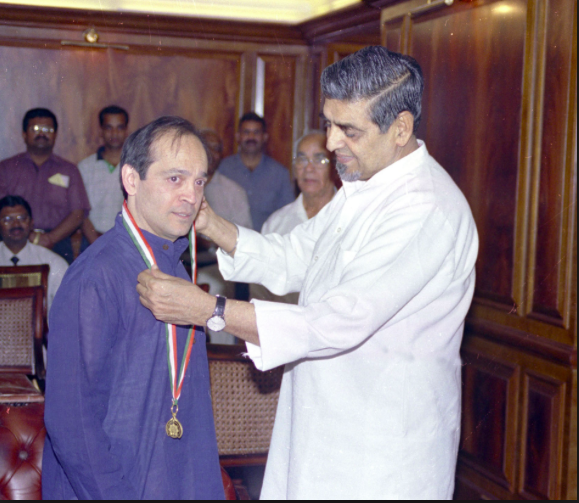
Seth has not yet returned any awards but has threatened to the join the stir and return his award.  Seth however had no qualms while receiving the “Pravasi Bhartiya Samman” award from the hands of Jagdish Tytler, who is accused of being responsible for the 1984 pogrom.

Embedded image permalink

Now for some poetry by these talented poets.

Two sides to the coin which is flung in Dance Bars

0

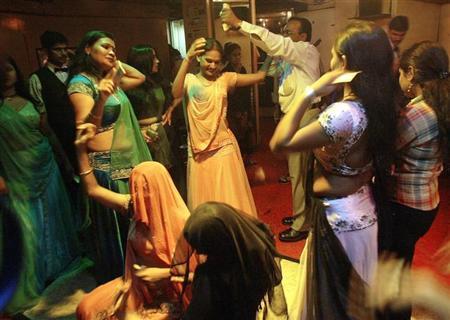
The dance bar case is a peculiar one. On the one hand, courts and media totally favour their existence and the right of bar dancers to their livelihood. On the other, politicians are hell bent to ban them due to various social and moral reasons. Finally, the Supreme Court has decided to set aside the ban on these dance bars, on very strong legal grounds. Yet, the Maharashtra government has said that they support this ban and a fresh media outrage has begun.

I have fortunately been in a position to learn about the case very intimately due to two factors: One, I practised for a decade in an area close to a hotbed of dance bars in Chembur and with my better half, ran a small nursing home there, treating hundreds of bargirls, their relatives, their clients, employees and their owners too. Two, my mother, who is a renowned advocate fought successfully for AHAR (the association of hotel and restaurant owners) and the bargirls’ association in the High Court, and her arguments have been now upheld by the Supreme Court.

My home in the meantime became a veritable battlefield: having seen the kind of havoc dance bars were creating first hand, I whole heartedly supported the ban, while my mother pointed out very strong legal arguments which made it obvious that the ban was not legally sustainable and would definitely be set aside. It is to her credit that she kept all personal beliefs aside and obtained a historic order from the Courts.

My personal experiences with the dance bar industry

I saw family after family devastated by dance bars. They served not just the rich: men from lower middle class and middle class families were their biggest clients, men who would blow up everything they had on bargirls and bankrupt themselves while transferring their wealth to bar owners who consequently became filthy rich, raking in hundreds of crores of unaccounted for wealth.

Having been inside a dance bar as well, I could not understand what it was about them that made people behave in this manner. This was nothing but an addiction much more lethal than tobacco or alcohol that devastate an individual – this addiction ruined the entire family emotionally, morally and financially. The better off customers entered into stable relationships with bargirls – most of these guys were married, and on one occasion there was even a shouting match in our nursing home when a patron getting his keptbargirl treated was spotted by his wife who had come for her treatment.

I witnessed the destruction of hundreds of happy families due to their male members’ addiction to dance bars. Daughters of fathers who were destroying themselves in dance bars went on their own personal rebellions which were no better than what their own parent was doing. To say that there was massive local opposition to dance bars would be an understatement.

It is not true that bargirls were forced into it: most of them had their families staying with them, and they thrived on the substantial income these girls got.Their patron would pay for illnesses of their family members too, and look after their every need. We often hear that due to loss of livelihood many of them would be forced into prostitution. But this again was not true: local nursing homes thrived on MTPs (pregnancy termination) of bargirls who were already de facto prostitutes, and who knew the rates and bargained hard. What was even more shocking, several parents and relatives of bargirls were also diagnosed with STDs and HIV.

The legal arguments against the ban

The ban on dance bars was the brainchild of R RPatil. A worse drafted act probably cannot be found. It stated that illegal dance bars were sprouting up across the state and this menace needed to be stopped. However, this was a body blow to the Government as (a) the Government had accepted that hundreds of illegal dance bars were running without licenses and that nothing had been done to curb them, which was a failure of the state (b) the bars that were sought to be closed were the ones which were running with all legal permissions and not the illegal ones. The ban also excluded five star hotels and other high profile establishments, which was obviously discriminatory – if girls could dance in elite pubs and hotels, why couldn’t they do the same in other establishments? This was a violation of their rights.

The Government had several legal options. They could have simply refused to renew the licenses as it is the prerogative of the Government to issue them. They could have stopped dance performances of this nature across the board instead of bringing in a typically UPA-style discriminatory and badly worded law. They had been repeatedly warned that this law in its current form would be struck down by the court. However, sane advice was ignored.

 The Fall of R R Patil

What made it even worse was Mr Patil took the defeat in court very personally and all appeals before him in the capacity of minister were rejected. Several orders passed by him were also set aside by the courts, which passed many strictures against him, to the extent that Patil then stopped conducting hearings himself and appointed a junior officer, who continued in the same vein. The nadir came when Patil started posting police constables in bars every night. They would sit in a corner doing nothing, but their presence was intimidating for customers, many of whom would move out thinking the worst. Moreover, a huge chunk of police force locked up in bars meant they weren’t on the streets doing their job. Frustrated, the bar owners decided to strike back with a simple trick: they got the constables to sign in a register and produced it before the court, which proceeded to give Patil another hammering.

 No easy solution

All this happened over several years, and the media slept peacefully through it. But then comes along a statement by the current Maharashtra government that they are against allowing dance bars to function and all hell breaks loose. Dance bars should not exist, but then tobacco, alcohol and drugs shouldn’t either. My personal view in this matter is that the Courts are right, but so are the politicians. Dance bars are a curse of society, and a preventable one. They should not exist, but the means to stop them cannot be a ban.The solution isn’t the kind R RPatil tried to force, and the methods to tackle this social evil need much more deliberation than is currently being done. This is not a matter of livelihood of a few thousand people but of the destruction of several thousand families. A more balanced approach in this regard is desperately needed.

Contributed by: Dr Amit Thadhani (Consulting General & Laparoscopic Surgeon)

Mother Teresa’s orphanages not de-recognized, but victim of own religious illiberalism

0

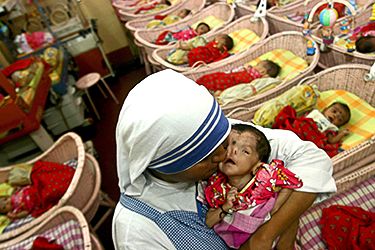
Some media reports have been emerging in the past few days which are in the same vein as “Christians under attack” bogey raised a few months back. This time, the reports suggest: “Central government may de-recognise Mother Teresa’s orphanage homes“. These reports have appeared in media outlets such as  The Week and India.com. So is this true? Is the Modi Government following in the footsteps of RSS chief Bhagwat, who had remarked that “conversion was Mother Teresa’s main goal”?

First let us understand the new developments which have brought the Government and Missionaries of Charity (MoC) at loggerheads.

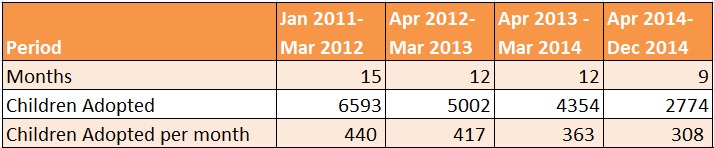
As per this Washington Post report titled “Mother Teresa’s orphanages end adoptions because of new liberal rules in India” this stir has been caused because the Central Government has moved to overhaul India’s failed adoption policy. A look at the data presented by Union minister of Women & Child development, Maneka Gandhi, shows the abysmal failure of the current policy.

1

As is evident, the number of children being adopted in India is steadily falling in last 4 years. For those who do not like data, Washington Post has an anecdote:

When Shreya Roy applied to adopt an orphan in New Delhi in 2012, she was told that the wait could be at least three years — if she was lucky.“We called about 25 children’s adoption homes in the city. They kept saying, ‘There are no babies, there are no babies,’ ” said Roy, a 35-year-old public relations professional. “It just did not make sense. Just look around — there are so many abandoned and poor babies.”

This lethargic pace of the adoption process, is coupled with a “thriving illegal market that funnels abandoned infants from hospitals directly to couples”, says Washington Post.

To tackle this problem, Maneka Gandhi has made multiple efforts. In July last year, she wrote 700 letters to to chief justices of high courts and district judges all across the country, requesting them to expedite the adoption cases pending with them or received by them. She followed this up with efforts to remove red-tape and simplify adoption rules.

And the new rules did see the light of day. In August, the Ministry notified the revised ‘Guidelines Governing Adoption of Children 2015’ formulated after almost a year-long stakeholders’ consultation process. “The revised guidelines coupled with the new IT enabled adoption system – CARINGS, provide a transparent process of adoption under which all the child care institutions of the country have been brought into an integrated system” says the PIB press release.

The main bone of contention between MoC and the Government is a part of the policy which allows single parents to adopt children. This is not a new rule per se, and existed since 2011 at least, but it did not apply to MoC. The Missionaries previously had the freedom to accept or reject prospective parents at will. Now the government has required orphanages to submit records of children to a central authority ( Central Adoption Resource Authority (CARA)) that maintains a database. Prospective parents will now register with the authority, whose automated system will match them with children.

This means children from any orphanage, including MoC, can potentially be matched with single parents anywhere in the country. And this is where the problem arises. Sister Amala from a New Delhi orphanage run by the Missionaries of Charity says:

“The new guidelines hurt our conscience. They are certainly not for religious people like us, may be they are for secular people as the minister says. But we are concerned about children and their future. What if the single parent who we give our baby turns out to be gay or lesbian. What security or moral upbringing will these children get? Our rules allow only married couples to adopt,”

Incidentally, a ministry official has said that this issue came to the fore when they received complaints from two prospective single parents from Assam and Bihar. “The Missionaries of Charity refused to give them children for adoption on the grounds that they were single,” said the official.

Another issue with which MoC claims to have a problem with is a new rule which provides for allowing prospective parents to choose from among six babies. Sister Amala has said on this aspect:

“Mother’s idea was adoption to counter abortion. When a woman gives birth to a baby, is she allowed a choice? She gets what God gifts her.”

Selection of children seems to be a standard practice in the United Kingdom though. In fact David Cameron, who had once claimed he was “evangelical about Christian faith”, unveiled the changed measures in 2012, which allowed parents to choose the child they would like to adopt.

And it is for these religious reasons that the Missionaries of Charity, “have voluntarily given up” their recognized status to run adoption centers. Yes, “voluntarily” and not “de-recognized by Modi Goverment”. This stand of MoC is clear from the statement of MoC dated 10th October 2015:

It was two months ago that the Missionaries of Charity decided to discontinue all our adoption work in India. We have voluntarily given up our recognized status to run adoption centers. If we were to continue the work set up by Mother Teresa, complying with all the provisions would have been difficult for us.

So this blatant disinformation campaign run by certain sections of the press stands clearly exposed. Perhaps there is “confusion” among the press because it is hard for it to reconcile and report that a Modi led Government has brought in a “liberal” (as stated by Washington Post) adoption policy, and which is being opposed by the “secular” Missionaries of Charity, on religious grounds.

The Ministry on its part, has made its stand clear via a press release:

The Ministry recognizes the good work done by organizations like Missionaries of Charity. However, it is reiterated that the new guidelines, prepared after an elaborate consultation process, have to be followed by all child care institutions involved in the process of adoption.

Did a BJP leader own a meat factory, or was he even a BJP leader? A fact check on media reports

0

The Dadri incident and subsequent developments have yet again raised some disturbing questions on the role of Main Stream Media (MSM), described as the fourth estate and the flag-bearers of truth. Despite the fact that their credibility has eroded in the last few years because of the numerous scandals that some of the eminent scribes have found themselves in, there are still many who look upon them hoping against hope that they will change. But all that we saw in the days of Dadri were shrill headlines, which according to many tarnished India’s image internationally and could even have led to a communal strife.

So, did the media really play mischief with facts post Dadri? What better way to understand than to scrutinise one of the stories that were pushed amidst the chaos. So here we take a closer look at the story of BJP MP Sangeet Som and the meat factory.

It all started with this tweet by leading New Delhi-based newspaper Hindustan Times. “#BeefBan votary Sangeet Som is director of meat processing unit’’.
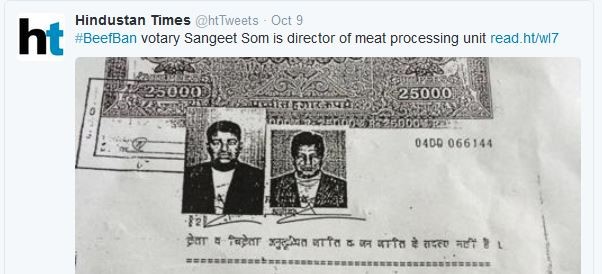
som1

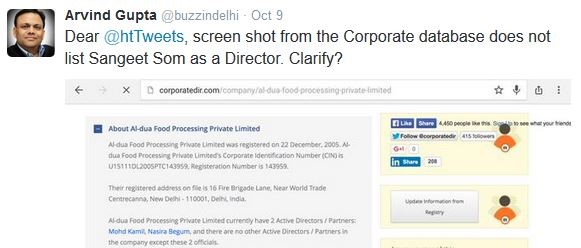
Coming at a time the BJP and Prime Minister Narendra Modi were being targeted over Dadri, the story had all it takes to stir a storm. But a twist in the tale came when a little later, BJP Social Media man Arvind Gupta tweeted a reply. “Dear @httweets, screen shot from the Corporate database does not list Sangeet Som as a Director. Clarify?’’
som2


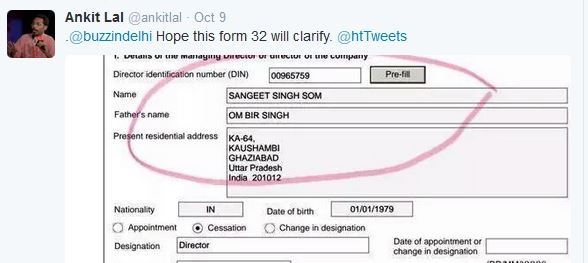
While Gupta waited for an answer, Ankit Lal, the Social Media head of Aam Aadmi Party came up with this. “Hope this form 32 will clarify”.
som3

(Form 32 is filed with the Registrar of Companies at the time of appointment of MD, Director, secretary etc of a company or while effecting any changes among them)

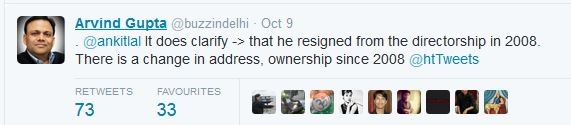
But Gupta was quick to question Lal’s `findings’. “It does clarify -> that he resigned from the directorship in 2008. There is a change in address, ownership since 2008’’, he tweeted.
som4

Gupta was in all probability referring to the last part of the form 32 – tweeted by Lal. It reads as follows.

som5

But Lal was in no mood to give up. “Yes. At the same time it also proves that he was director of the beef-producing company Al-Dua till 2008,’’ he retorted.

som6

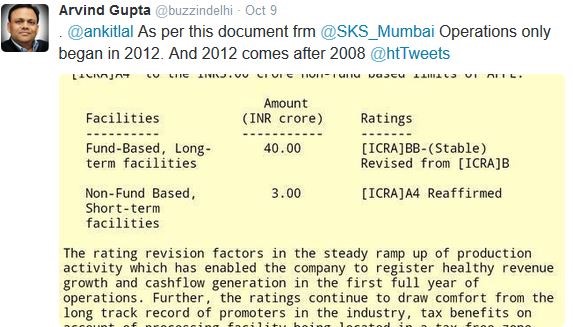
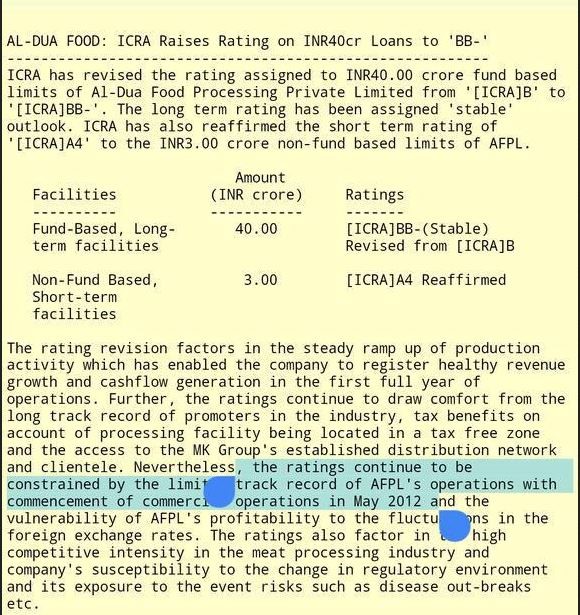
But then lies have limited shelf life. So it was Gupta’s turn to call the bluff. He tweeted, “As per this document from @SKS_Mumbai Operations only began in 2012. And 2012 comes after 2008.’’
som7

Here is a more detailed view of the document.
som8

And phew, that ended the war of words.

In the meanwhile, HT seemed to have had realised its blunder and corrected its copy. A new story under the header “BJP MLA Sangeet Som purchased land for meat processing unit in UP’’ appeared online and had this note of apology at the end, “An earlier version of this report erroneously stated that the land in Aligarh was purchased in 2009 and that Sangeet Som is currently a director of Al-Dua Food Processing Private Limited. The errors are regretted.’’

The damage, however, had already been done. Modi-bashers retweeted the story and shared it on Facebook in frenzy. But then we can’t blame it all on those social media users alone, can we? The mischief seems to have come from none other than newspaper which filed the report. How? Read the story again.

  It says som10In short, Som, according to information that HT provides, was associated with the project from 2005 till March 2008.

So what really is the mischief here? The problem is that the news story doesn’t say (for whatsoever reason) anything at all about Som’s political affiliation during the period from December 2005 when he reportedly bought the property or in March 2008 when he resigned as Director of Al-Dua.

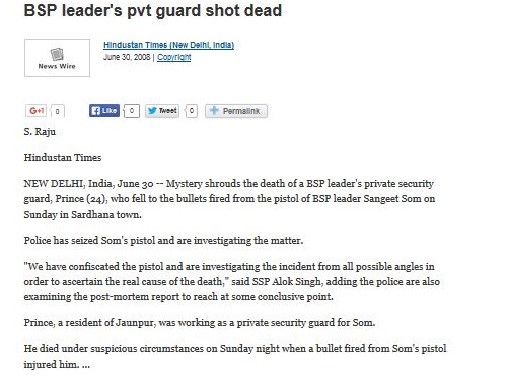
Maybe he didn’t have any political affiliations at all then. So let’s not risk making any wild guesses either. But hey, look what a simple Google search threw up – a report dated June 30, 2008, by the same reporter (S Raju whose byline appears in the meat factory story) and in the same newspaper (Hindustan Times).
som11

(Link here: http://www.highbeam.com/doc/1P3-1502926451.html)

Is the Sangeet Som mentioned in this story dated June 30, 2008, and BJP MLA Sangeet Som one and the same person? I cannot vouch for it. So I request HT to clarify that. But if yes, then it means he was a leader of the Bahujan Samaj Party (BSP) in June 2008, i.e. even three months after he had resigned as director of Al-Dua.

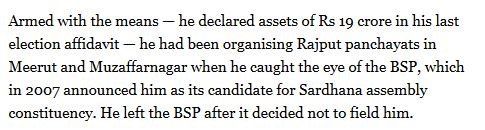
Surprisingly, no other report available online, except this one in the Indian Express,  gives any hint of Som’s political affiliations before he joined BJP. According to this, BSP announced his name for Sardhana Assembly seat in 2007 but did not field him.
som12

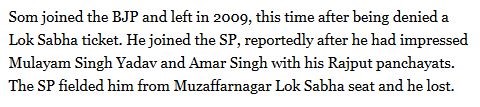
The report also says he “joined the BJP and Left in 2009’’ and “rejoined the party in December 2011.
som13

Would it have served the cause of objective journalism more had those reporters on the ground given us that little additional piece of information about Som’s political affiliation during the period 2005-2008? But they didn’t. Why?

I rest my case. The object of this exercise was not to draw any conclusions or impute motives or malign reputations, but only to bring some new facts to light. As for interpretations and drawing conclusions, that’s up to the readers.

P.S: Scroll.in also did a story on Sangeet Som claiming that he was an additional director in another company for 4 months of 2008, but they too did not mention that he was affiliated with BSP at the time

(Disclaimer. This report was compiled solely from material available online and nothing offline.)

(This post first appeared here.)
Editor’s note: Media’s reporting around Dadri has come for criticism, and this incident shows how media has often been found lacking fact check


Digital India could create a problem for Swacch Bharat

0

As the Swachh Bharat mission completes its first year, an important aspect seems to have escaped the mission’s radar: E-waste, short for electronic waste. As technology advances and replacements are brought in, where do the old devices land up? Do the owners keep it? Maybe they sell it or donate it? Or they might junk it. The last one presents the problem called e-waste that looms large.

To understand how junking an electronic device poses a problem, a few stats may help. According to the site dosomething.org  although e-waste constitutes only 2% of the total waste in the USA, it accounts for 70% of its toxic waste! And that is just one side of the story. According to the STEP Initiative, globally up to 6 million tonnes of e-waste are unaccounted for i.e there is no record of how and where their disposal was effected!

Now consider India’s problem. In particular, two initiatives by the Central and State Governments have a strong link to the problem. One is the Digital India initiative of the Government of India. Second, is the distribution of – initially – television sets and more recently laptops to students by the Government of Tamil Nadu. Such practices are going on in other states as well. Schemes like the Digital India would not only require substantial infrastructure to network the country but also devices for people to benefit from it. The downstream problem of disposal of these devices (mobile phones, laptops, tablets etc.) once technology overtakes their capabilities is one that requires immediate and urgent thought if the country has to tackle the problem with any degree of effectiveness.

Let us examine, for example, mobile phones. The headline of this news article in Business Insider says, for the first time in 20 years, sales of mobile phones registered a drop. This was for the first quarter of 2015 compared against final quarter of 2014 – 53 million as against 62 million. Mind boggling numbers to say the least and if these numbers continue, around 200 million mobile phones may be sold in one year! With this in mind, let us turn our attention to another fact from dosomething.org. It says, by recycling 1 million cell phones approximately 16000 kg of copper, 350 kg of silver, 34 kg of gold and 15 kg of palladium can be recovered. Those numbers multiplied by 200 if all the cell phones sold in India in just one year are recycled. And that is just cell phones!

At this point, it is important to address an argument that may come to mind. One might say, the assumption that all of the 200 million phones are going to be junked is absurd and Indians have long had the habit of handing their phones down to others they know. This is true of course. However, can we deny that by now, most people have phones and we are increasingly becoming a society that refuses to accept hand me downs. With the spending power of the population increasing, the number of people wishing to change to the newest and greatest offering from any given manufacturer on a yearly basis is also increasing. Consequently, in a few years time even the people accepting hand me downs will have replacements available on their hands and the junk will start to grow. Exponentially at that!

The important question therefore is – is the country ready? One conversation between a customer and a shop representative of a leading multi brand retail chain dealing in mobile phones went along these lines:

Customer: I wish to change the battery of this phone please.

Representative: Sure, will cost you Rs.1000.

Customer: Ok, go ahead and change. What can I do with the old battery? Can I leave it with you?

Representative: You can if you want.

Customer:  What are you going to do with it?

Representative: Throw it in the dust bin.

Customer: What! You are not supposed to do so. In fact the manufacturer has indicated that it should not be thrown in a dust bin. [points out the sign]

Representative: What else can be done?

Customer: You can send it back to the manufacturer along with other similar products. They can then recycle it.

Representative: [stares at the customer in bewilderment for few seconds and then finally] We cannot do all that.

Customer: In that case, I will retain the battery with me till I am able to dispose it properly [settles the bill and walks out]

The above conversation was a personal experience of the writer. And, the battery continues to remain in his house. The important conclusion from the conversation was, the representative while adept at explaining the features of any given mobile phone in the shop was blissfully unaware of the e-waste problem. And that is where the problem needs to be addressed.

Unfortunately, in India, we have a habit of expecting the Government of the day to tackle problems like these. Sure, in a way the Government is responsible too. It can impose penalties on erring companies. Maybe the Prime Minister can allocate some time in his Maan-Ki-Baat to spread awareness of the problem.

However, why should companies not proactively lead the way in tackling the growing e-waste problem? Why give the space for a problem to crop up in the first place? Is it too much to ask 1 in 1000 advertisements to focus on recycling which could easily be a part of their CSR (Corporate Social Responsibility) policy. Why not have their exclusive dealerships as drop off points of e-waste generated by customers? And why is not possible for multi brand retail firms to include in their policy – mandatory sensitization of their employees on the importance of recycling? Can they not also use their stores as drop off points for e-waste and co-ordinate with manufacturers to ensure recycling of used products?

Do these companies care? Do they realize that by doing business in the country they are also ethically responsible for giving back to the society that gave them the space? The questions are endless but it is high time that, for the good of the country, we begin answering at least the basic ones.

–@prathapkrishnan

Post-Script:

As this article was being written, the writer found out that the Dept of Information Technology, India has started an “Awareness Programme on Environmental Hazards of Electronic Waste under ‘Digital India Initiative’”. Sincerest hopes that it takes off.

Modi’s clothing subjected to another hit-job by Indian media

0

For some reason, some sections of the media, and some politicians have developed a weird fetish of discussing Prime Minister Modi’s clothes. The first instance of this was seen when Modi wore the rather garish monogrammed suit. Sure it deserved some attention, but fashionistas on Twitter went ahead to cook up estimated costs of the suit from absolute thin air. As per twitter intelligentsia, the cost was then estimated to be Rs 10 lakhs odd, and as per Rahul Gandhi’s unquestionable memory and mathematical skills, just last week, the cost escalated to Rs 15 lakhs. Of course we had discussed earlier how both these figures are pure lies.

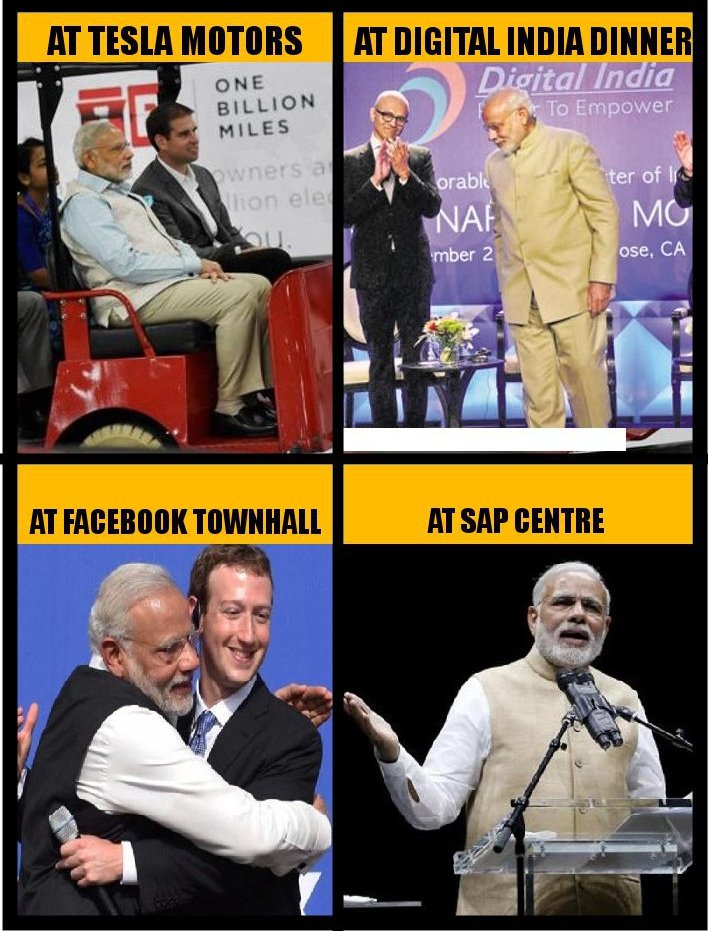
Ordinarily we would not be giving attention to such purile topics, but we have to so, to call out yet another media lie. In a post from September, titled “You are what you wear: Modi changes clothes four times in a day“, Hindustan Times chose to devote an article to Modi’s clothes during his US trip. As the title suggests, they claimed Modi changed clothes 4 times on a single day. According to HT, these are the four events which took placec on one day, and these are his four sets of clothes:

UntitleSDd

No only did HT choose to focus on something only Rahul Gandhi focuses on, the article itself showed how poor the background work was. Unfortunately for HT and fortunately for us, Vikas Swarup, Official Spokesperson, Ministry of External Affairs, India was live tweeting Modi’s entire USA visit with pictures. And the facts just don’t support HT’s claim that Modi changed clothes four times in a day!

All the above events are from San Jose, so it would be sufficient only to focus on that leg of Modi’s US trip to expose HT’s shoddy reporting. Just from his tweets, we can rebuild Modi’s itinerary (all pics from Official MEA handle):

IST 27 September 2015 4.01 am (local time 26 September 3.31 pm): Modi arrives at Tesla Motors

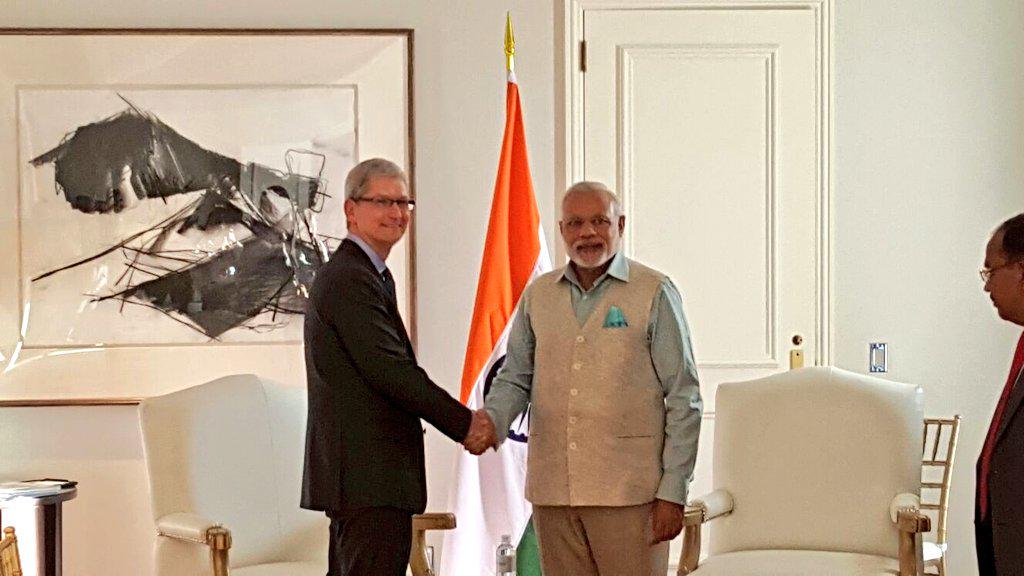
IST 27 September 2015 5.46 am (local time 26 September 5.16 pm): Modi meets Tim cook

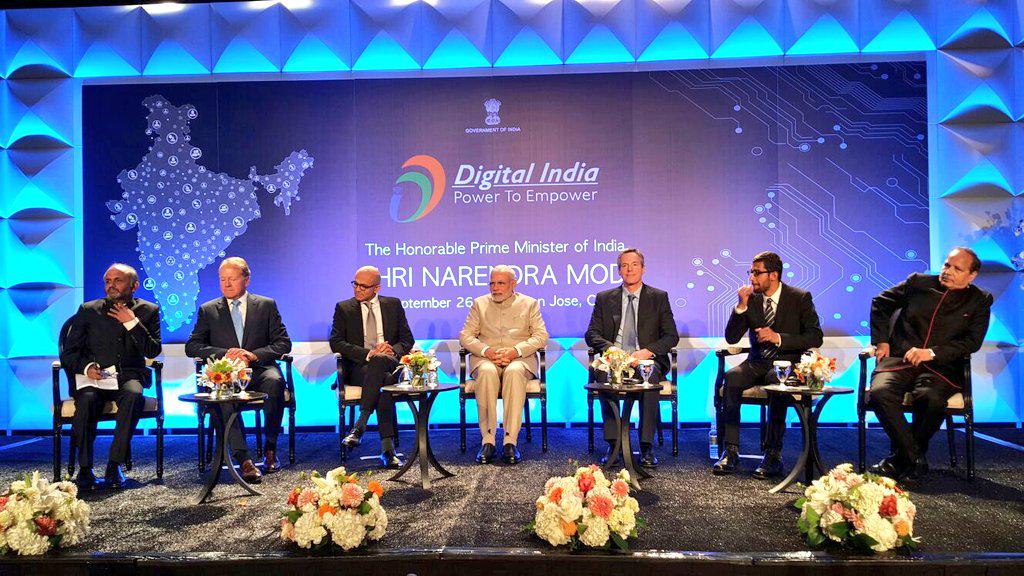
IST 27 September 2015 8.01 am  (local time 26 September 7.31 pm): Modi at Digital India Dinner

IST 27 September 2015 9.56 pm (local time 27 September 9.26 am): Modi arrives at Facebook Townhall

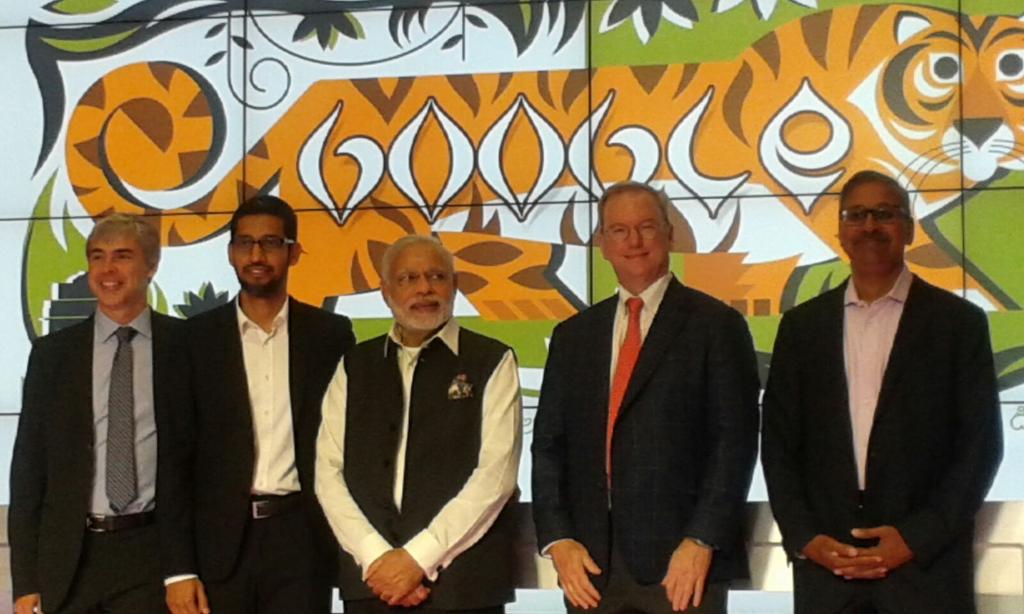
IST 27 September 2015 11.43 pm (local time 27 September 11.13 am): Modi at Google headquarters

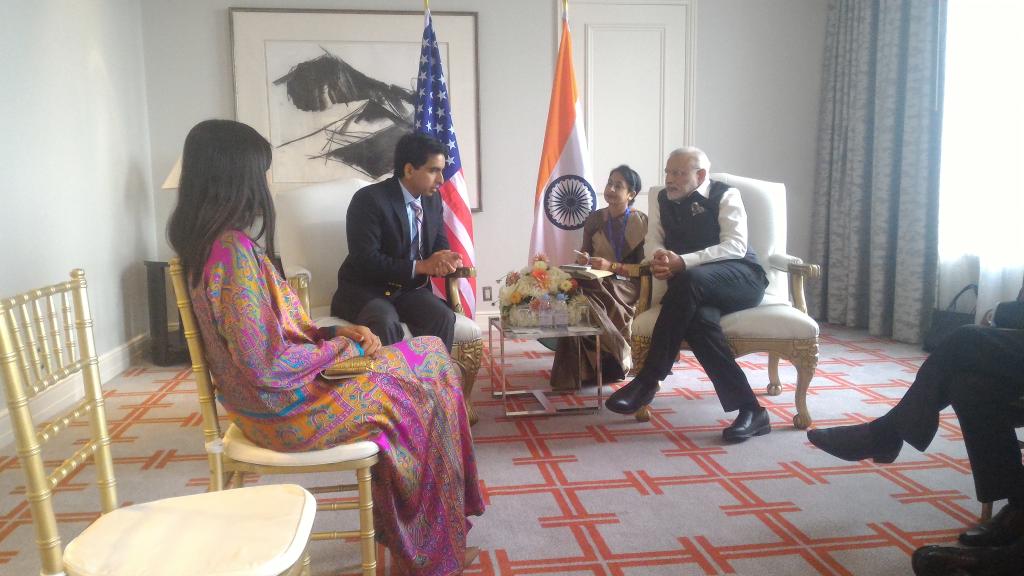
IST 28 September 2015 5.25 am (local time 27 September 4.55 pm): Modi meets founder of Khan Academy

IST 28 September 2015 7.12 am  (local time 27 September 6.42 pm): Modi arrives at SAP center

From the above, it is clear that contrary to HT’s claims, Modi was at Tesla Motors and Digital India meet on Day 1, and was at Facebook Townhall and SAP centre on Day 2. From this and the pics it is clear that Modi in fact changed his clothes only twice per day and 4 times if you add both the days, but for some reason HT chose to claim that all these events were on the same day. Yes we reiterate this is a very idiotic point to be discussing but it must be discussed only to call out Hindustan Times’ poor reporting

Another interesting trend though is, not only does Media misreport on Modi’s clothes, Rahul Gandhi too uses that a spring-board and leaps into his imaginary land. In the case of the monogrammed suit, Media came up with an arbitrary figure of Rs 10 lakhs, and Rahul Gandhi promptly distorted it to Rs 15 lacs. In this case too, HT wrongly claimed that Modi changed clothes 4 times in a day, and Rahul Gandhi in Bihar claims that Modi changed clothes 16 times while in USA. Is this a coincidence? On two occasions media misreports and Rahul Gandhi repeats it ad nauseum making it an urban legend.

Whatever the motives behind such malicious news reports, media should attack Modi on valid points, instead of focussing on trivial issues such as this. This will also be helpful to us, and we can stop focussing on such trashy articles by MSM.

P.S. Thanks to this twitter user for the tip-off

Dear Media, attack the PM for the right reasons

0

My favourite Nasreddin Hodja story goes like this:

One late evening Nasreddin was seen outside his home upset about something. Just then a young man comes along and sees the Mullah’s distress.

“Mullah, please tell me: What is wrong?”

“Ah, my friend, I seem to have lost my keys. Would you help me search them? I know I had them when I left the tea house.”

So, he helps Nasreddin with the search for the keys. For quite a while the man is searching here and there but no keys are to be found. He looks over to Nasreddin and finds him searching only a small area around a street lamp.

“Mullah, why are you only searching there?”

“Why would I search where there is no light?”

Some segments of our English language media are today behaving like Mullah Nasreddin. After staying silent during the 10 years of UPA plunder and exposes like Radia-gate, the chief protagonists of these segments are desperately trying to regain credibility. But they refuse to venture into the darkness where they lost their halo and instead have limited themselves to searching under the warm, familiar light of upholding the ‘values of a secular India’. Hence it isn’t surprising that instead of rebuilding their image, they have become the byword for incompetence, bias & unintentional comedy.

Let us assume for a moment that it is acceptable for journalists to be so ideologically rooted that reporting the truth becomes secondary to propagating a pre-determined agenda. Even with this overtly generous assumption, one is hard-pressed to appreciate the botched attempts by our English media elites to hurt their enemy number one – Prime Minister Narendra Modi. The media’s coverage of isolated and unrelated events has been so comically hysterical, boringly repetitive and depressingly fact-free that instead of the events, it is the media’s obvious bias which has now become the perpetual story.  Even Don Quixote met with more success while battling the windmills compared to our star journalists’ attempts at creating a picture of a new fascist India under Modi.

The recent tragedy in Dadri was yet another symptom of the absence of any semblance of law in a state (mis)ruled by the Mulayam Singh Yadav family. However the media, which continues to remind us on a daily basis that Narendra Modi was Chief Minister of Gujarat in 2002, pretended as if Akhilesh Yadav doesn’t even exist. Instead it made the incident all about ‘growing intolerance’ in India and then stretching it a step further, transformed it into a debate about beef consumption. It was odd because the facts of the case were still being established.

Mohammad Akhlaq’s death was widely discussed by pretentious media divas in their comfortable studios while accompanied by a free flow of insincere tears. The images reeked of exploitation as we all know that Akhlaq’s family members will never be inquired of ever again. They have served their purpose and the attention-seeking vultures will fly off to devour cadavers in other unfortunate tragedies. We know that because it isn’t the first time our media divas have used tragedies as crutches to further their agenda.

We remember how the Vyapam victims were discussed before they were dropped like hot potatoes as it began to emerge how Congress honchos were deeply embroiled in the scam. We remember how Lalit Modi hogged the headlines before the accusations started reaching Sonia Gandhi’s doorsteps. We remember how the raped nun from Bengal was the country’s biggest tragedy before facts emerged to show that the attacks was carried out by illegal Bangladeshis & not by non-existent local Hindutva forces.

A prime example of the media’s idiocy & intellectual laziness is its comical penchant of exclaiming how this is not the India they ‘grew up in’ while at the same time supporting the consumption of beef in the provinces they disparagingly term as the cow-belt. They need to stop pretending to know India because they obviously don’t understand something as fundamental as the importance of the cow in rural India.  They also need to stop saying that India is changing for the worse because that betrays their ignorance of India’s violent history.

In their umpteenth lethargic attempt to paint the Modi Government as the epitome of intolerance, they have converted a case of murder into an informal referendum on the importance of the cow in a deeply religious and Hindu society. Instead of damaging the Prime Minister’s image, they gifted him and his party an issue which they can use to break down the bewildering caste arithmetic of Bihar and romp to an electoral victory which previously seemed difficult. No wonder the paragons of secularism like Laloo Yadav and Digvijay Singh are now tying themselves up in knots while trying to out-do each other on who loves cows more. If this is how the media is planning to take down Modi, the PM’s amused silence is not surprising. Such bungling by the media gives credence to the theory that the media’s incompetent hounding of the Prime Minister is second only to Rahul Gandhi’s stand-up comedy when it comes to factors which has helped cement Modi’s grip on power in India.

The Indian upper middle class- the main consumer of the English language media, may be a distracted, self-centered lot but its members are not lobotomized. When the media hollers only about ‘Hindu fascism’ in the same day when Christian bishops shut down the staging of plays, the obvious prejudice is not lost on the people. When media stars proudly tweet about eating beef, they should remember that the memory of them rationalizing Charlie Hebdo murders as somewhat justified are still fresh in the minds of their followers.

In their frantic efforts to tarnish the Prime Minister, these journalists have ended up being unambiguously anti-Hindu & in multiple issues, anti-India.  The media has been so intensely hysterical while propagating falsehoods & half-truths that their hypocrisy has seared into the psyche of their viewers. The biggest tragedy resulting from such reckless behavior is that is when genuine hate crimes against minorities occur, and they do, Indians will struggle to differentiate them from the fake stories which the media has been thrusting into their faces. Thanks to its lazy, exploitative and cynical ‘journalism’, the media has not only manipulated victims of tragedies, it has also condemned the stories of future victims to being viewed with suspicion.

Inspite of the above, allow me to float a controversial idea by saying that it is important we encourage the media to continue to attack the PM. It is important because as citizens we want the government to be on its toes and not get complacent. But to improve the current state of affairs, we should help the media to understand how it should do its job. I would like to share some unsolicited advice with these insidious segments of India’s English language media.

Dear stars of the English media. Please stop embarrassing yourself. Instead of rushing to some inconsequential Sadhvi for lazy headlines, please work hard to build your case against the prime minister. That will only be possible when you stop pursuing this communal bogey and instead attack the gaps in the PM’s development and governance agenda.

Deride Arun Jaitley for failing to even manage the deadlines for IT returns.

Grill Suresh Prabhu about the multiple train accidents.

Ask Radhamohan Singh how he has responded to farmer suicides.

Follow up with Sushma Swaraj about how India is keeping the multiple promises the PM made to foreign countries.

Verify the statistics being put out by Nitin Gadkari & Piyush Goyal.

Question JP Nadda about what he has done to battle the dengue outbreak.

These stories hold the real potential to dent the Prime Ministers halo. But this also means you have to work hard, research and meet people outside your studios and away from your cameras. And in the end you will have to draw logically coherent conclusions. These are things which you may not be used to doing but if you really hate the Prime Minister from the bottom of your heart, this is the only way. Anything else you do will only increase the PM’s bench strength in the Rajya Sabha.