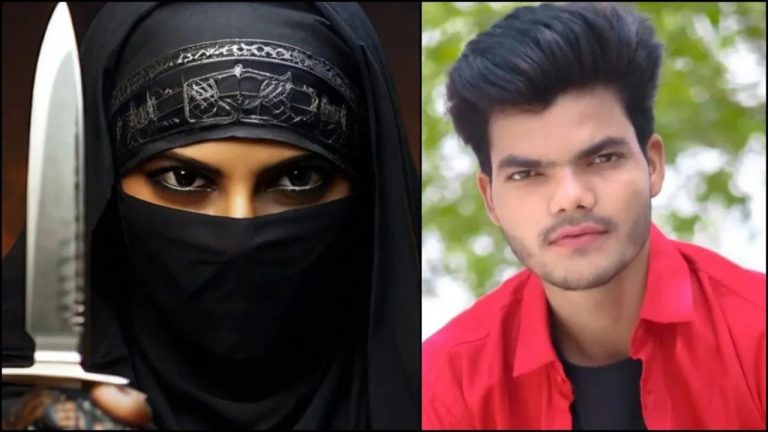
A shocking case of betrayal and murder has come to light in Delhi where 31-year-old Habib (or Hashib) Khan and his 29-year-old wife Samina (or Sameena) Begum murdered 22-year-old Sachin Kumar on 31st March, and his naked body was thrown in Uttar Pradesh’s Hindon river. Habib murdered Sachin after suspecting him of having an extramarital affair with Samina. The pair has been taken into custody.
The victim was a resident of Aligarh in Uttar Pradesh and was employed as a cook at a restaurant in Connaught Place a few days ago. He previously worked at Hashib Khan’s T-shirt manufacturing unit in south Delhi’s Sangam Vihar. Habib believed Sachin had a relationship with his spouse, which often led to arguments between the couple. The conflict even escalated to divorce. Habib sacked Sachin in February, but he doubted that he was still in contact with Samina and they talked regularly. Sachin had also taken a loan of Rs 2 lakh from the accused.
He then decided to end the youngster’s life who was working at the famous “Jain Chawal Wale.” Habib continued to search for Sachin and told his wife to call him on the fateful day, and she directed him to come to an isolated area where he was made to sit in a car. The couple afterwards killed him with a knife before tossing the corpse into the Hindon River and then washing the vehicle.
According to some reports, he was called to the couple’s residence where he was killed and then discarded in a jungle area in Dasna in Uttar Pradesh, while others claimed that Habib murdered Sachin with the help of a relative. The three men first drank alcohol, after which Sachin was stabbed to death in a moving automobile by the other two, and his body was recovered from Dasana after the duo dumped it there. After the arrest of Habib and Samina, the hunt is on to arrest the third culprit.
According to Deputy Commissioner of Police (New Delhi), Devesh Kumar Mahla, the police filed a kidnapping case based on the complaint of the young man’s family after he went missing from Connaught Place. When he did not return until late at night and had turned off his phone, his family approached the Delhi Police.
The authorities reported that to track Sachin, they took out the call details, which provided them with a lead and pinpointed Habib Khan after they showed that he was last seen near Sangam Vihar, following which the perpetrators were apprehended and confessed to killing him during the questioning. Habib also disclosed the reason for the crime, which was based on his belief that Sachin and Samina were having an illicit affair.
The police suspect that more people may have been involved in the murder and are trying to trace them through interrogation. The police have handed over the body to his family members after the post-mortem. A First Information Report has also been registered. According to his brother Mohit, who lives in Aligarh, Sachin had been employed at Habib Khan’s Sangam Vihar plant for more than a year before quitting due to a financial disagreement. They used to threaten him over the phone for more money, he added, even though he had repaid one lakh.
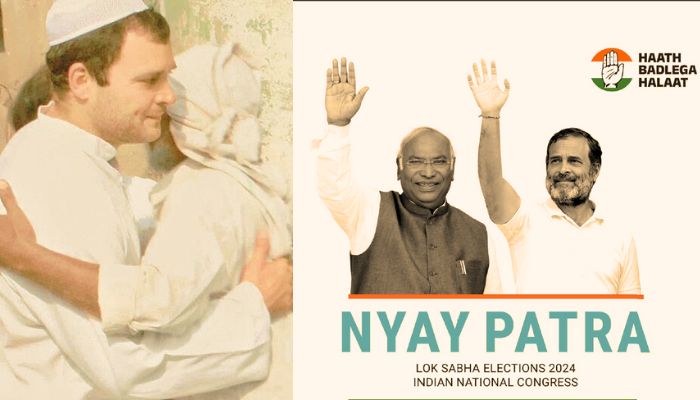
The Congress party on Saturday released its manifesto for the Lok Sabha Elections, titled Nyay Patra. In the economy section of the manifesto, the party had accused the BJP government of not achieving desired economic growth, and said that it is committed to rapid growth and generation of wealth.
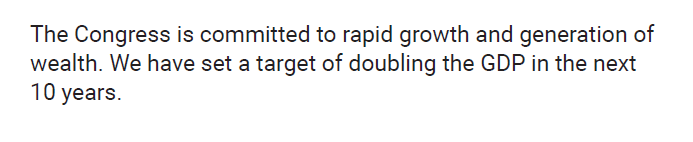
In the Nyay Patra, the Congress party has said that it will double India’s GDP in the next 10 years. It says, “We have set a target of doubling the GDP in the next 10 years.” Doubling GDP in 10 years sounds impressive, the authors of the manifesto must have thought. But the fact is, this target means that Congress is expecting a much slower GDP growth if it comes to power.
Screenshot from Nyay Patra
The current size of India’s GDP is over $3.7 trillion, and as per all estimates, it will grow by 7%-8% for the next several years. The Modi government has estimated that India’s GDP will reach $7 trillion by 2030. Which means, the GDP will more than double in the next 6 years, but the Congress party is promising to achieve the same feat in 10 years.
The country’s GDP is expected to reach $5 trillion in the next 3 years itself, becoming the 3rd largest economy. India is well set to reach $7 trillion GDP by 2030. Finance Minister Nirmala Sitharaman in January this year said that India can aspire to become a $7 trillion economy by 2030. She also added that the Modi government has set a higher goal of becoming a developed country by 2047.
A report titled “The Indian Economy: A Review” written by V Anantha Nageswaran, Chief Economic Adviser to the government, has also said that India can aspire to become a $7 trillion economy by 2030. The finance ministry expects the size of GDP to reach $7.3 trillion by the end of the decade.
It is not that only government of India is targeting $7 trillion economy by 2030, many other organisations have also made similar predictions. James Sullivan, Managing Director, Asia Pacific Equity Research at JPMorgan, said last year that the size of Indian economy will double to $7 trillion by 2030. -S&P Global Ratings also made similar projections, and have said that India will remain the fastest-growing major economy for at least the next three years.
Industry body PHD Chamber of Commerce and Industry (PHDCCI) also said in January this year that India is expected to grow into a $7 trillion economy by the year 2030, establishing itself as the second-largest economy in the Asia-Pacific region and the third-largest globally.
Therefore, while the Indian economy is set to double by 2030, the Congress party in its manifesto targets to achieve this in 10 years. In effect, the party is promising to slow down the growth of economy from its current rate.
The Congress manifesto Nyay Patra has also promises to write off all due amounts in student loans, including interests. The party has promised that the banks will be compensated by the government for writing off student loans.
Italian financial police on Thursday said that it has arrested 22 people and seized assets worth more than 600 million Euros (USD 650 million) in connection with alleged fraud linked to the European Union’s post-pandemic recovery fund, CNN reported on Friday.
Following the arrests from Italy, Austria, Romania and Slovakia and an investigation by the EU prosecutor, eight people were detained, 14 were placed under house arrest and two others were barred from practicing their profession.
The assets that were seized during dozens of raids on homes and offices included Lamborghinis, Porsches, Rolexes, Cartier jewelry, cryptocurrencies, luxury villas, and other items.
The alleged fraud is likely to renew concerns about the misuse of the EU’s 800-billion euro recovery fund to help revive the bloc’s economy. Italy was the largest beneficiary of the fund, with grants of more than 194 billion euros.
The European Public Prosecutor’s Office (EPPO) said a criminal organization is suspected of running a fraud scheme between 2021 and 2023 to swindle Italy’s recovery packages.
In 2021, the group applied to receive non-repayable grants, the EPPO said, ostensibly to support small- and medium-sized companies, but later cooked up false balance sheets “to show that the companies were active and profitable, whereas in fact they were non-active, fictitious companies.”
After getting hold of some 600 million Euros in funds from the Italian National Recovery and Resilience Plan (NRRP), the group then transferred the funds to their bank accounts in Austria, Romania, and Slovakia, the EPPO said, CNN reported.
The prosecutor’s office claimed the group used cryptocurrencies, artificial intelligence and offshore cloud servers to carry out and conceal the fraud.
The United States has also attempted to crack down on alleged fraud involving Covid-19 relief resources. A federal watchdog warned in June that the Small Business Administration distributed more than USD 200 billion in potentially fraudulent post-pandemic funds.
(This news report is published from a syndicated feed. Except for the headline, the content has not been written or edited by OpIndia staff)
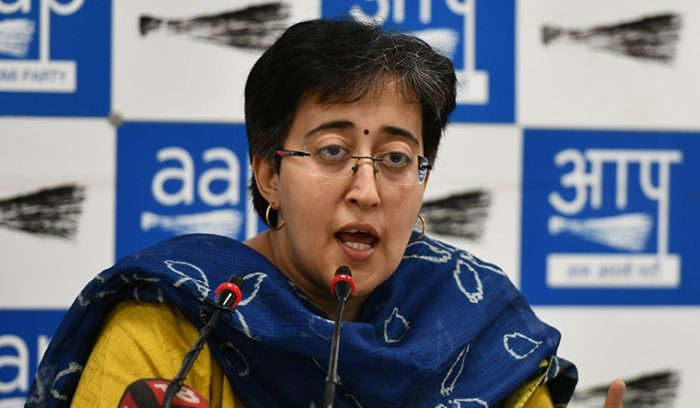
The Election Commission (EC) on Friday sent a notice to AAP leader and Delhi Minister Atishi over her claim that the BJP approached her for membership through one of her ‘close’ aides.
The poll panel asked the AAP leader to respond to its notice by noon on April 8.
“Criticism of other political parties, when made, shall be confined to their policies and programme, past record and work. Parties and Candidates shall refrain from criticism of all aspects of private life, not connected with the public activities of the leaders or workers of other parties. Criticism of other parties or their workers based on unverified allegations or distortion shall be avoided,” the notice by the EC read.
“The political parties and leaders shall not make false statements, utterances without factual basis aimed at misleading the voters. Criticism of other parties or their workers on the basis of unverified allegations or on distortions shall be avoided,” it added.
Denying that she was approached with an offer to join the party, the BJP earlier demanded that Atishi furnish evidence to support her claim.
The poll panel added in its notice that it received a complaint on April 4 from the BJP that Atishi made “misleading and unverified statements” during her press conference on April 2.
The AAP leader claimed that she was asked to join the BJP or face arrest.
“The BJP, through one of my close aides, approached me to join their party to save my political career. I was told that if I do not join the BJP, I will be arrested by the ED,” Atishi claimed.
However, the BJP dismissed her allegations as ‘baseless’.
BJP MP Manoj Tiwari, who is seeking a fresh term in the Lok Sabha from North East Delhi, spoke on the EC notice, saying, “She came up with baseless allegations. We warned her of action but she did not apologise. We took up this matter with the Election Commission. it has now issued a notice.”
“AAP leaders, especially Atishi, are in the habit of maligning the BJP,” he added.
This news report is published from a syndicated feed. Except for the headline, the content has not been written or edited by OpIndia staff)
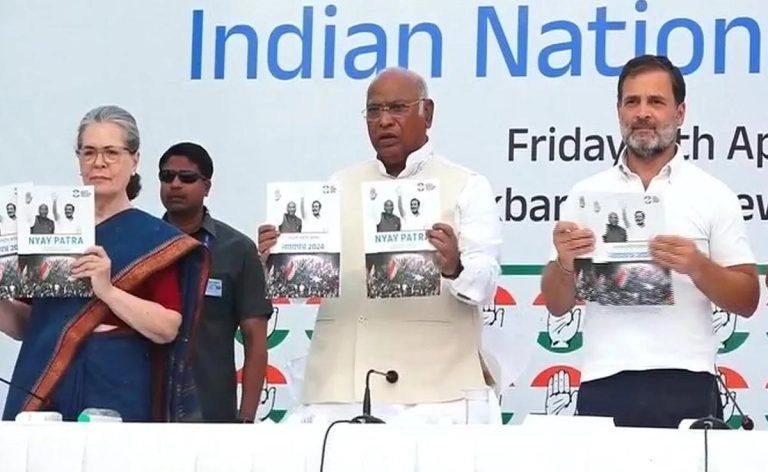
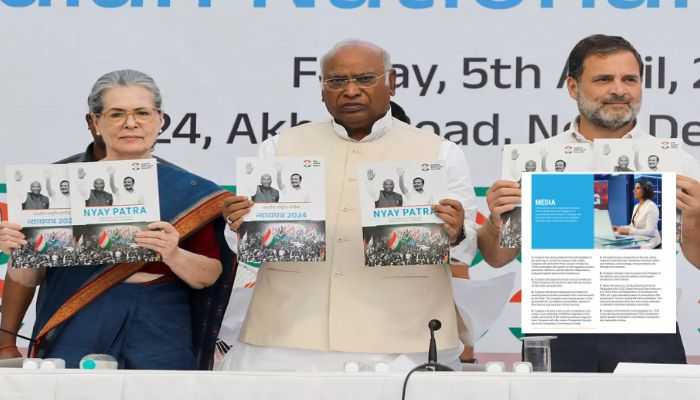
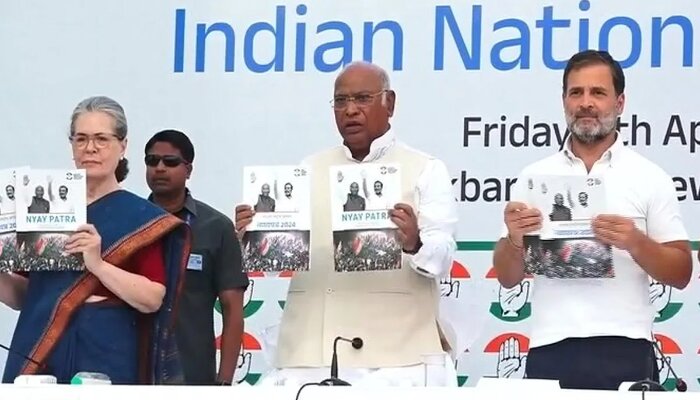
On Friday, the Congress unveiled its manifesto, titled ‘Nyay Patra,’ for the 2024 Lok Sabha elections at the AICC headquarters in New Delhi. Leading figures of the Congress, such as party chief Mallikarjun Kharge and former presidents Sonia Gandhi and Rahul Gandhi, presented the election blueprint, just days ahead of the general elections.
The Congress manifesto highlighted the importance of ‘Paanch Nyay’ or the ‘five pillars of justice,’ which include ‘Yuva Nyay,’ ‘Naari Nyay,’ ‘Kisaan Nyay,’ ‘Shramik Nyay,’ and ‘Hissedari Nyay.’ These pillars and the party’s commitments and guarantees to the people form a significant part of its election promises for the Lok Sabha polls.
However, underneath the web of jargon that Congress seems to weave, there is a sinister agenda underway that seeks to legitimise love jihad, beef-eating, control of investigating agencies and freeing of criminals, among other things. Here are 7 points in the Congress manifesto that point towards dangerous times:-
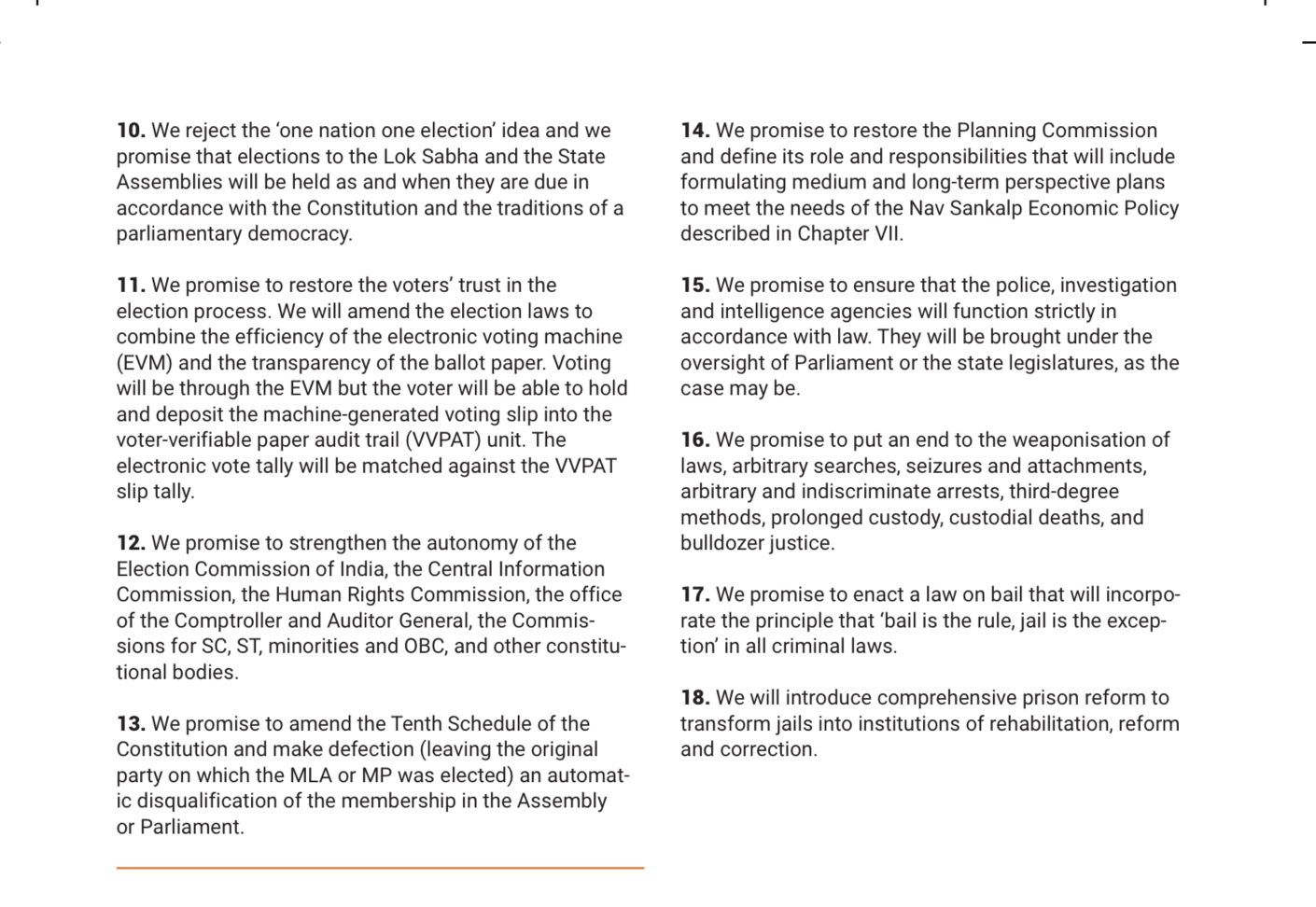
1. No ‘one nation, one election’
The Congress party has promised that there will be no ‘one nation, one election’—an idea floated by the incumbent Modi government to minimise the state exchequer on election procedures and provide governments more time to fulfil promises made to their subjects. However, the Congress party has promised that it wants to stick to the old fashion of conducting Lok Sabha and State Assembly elections as per the existing methods and tie up the entire state machinery in holding elections throughout the 5-year tenure of the central government, which often hinders them from fulfilling their poll objectives and promises through the imposition of the Model Code of Conduct (MCC).
2. Hinting at bringing back paper ballots
The Congress manifesto also spoke about bringing back paper ballots alongside EVM machines. The manifesto claims that voting will be held through EVMs but voters will be able to hold and deposit the machine-generated audit trail into the VVPAT unit. This would not only complicate the process but also provide opportunities for booth hacking where a candidate unlikely of winning an election can employ illegal means to either rig the elections or get them cancelled.
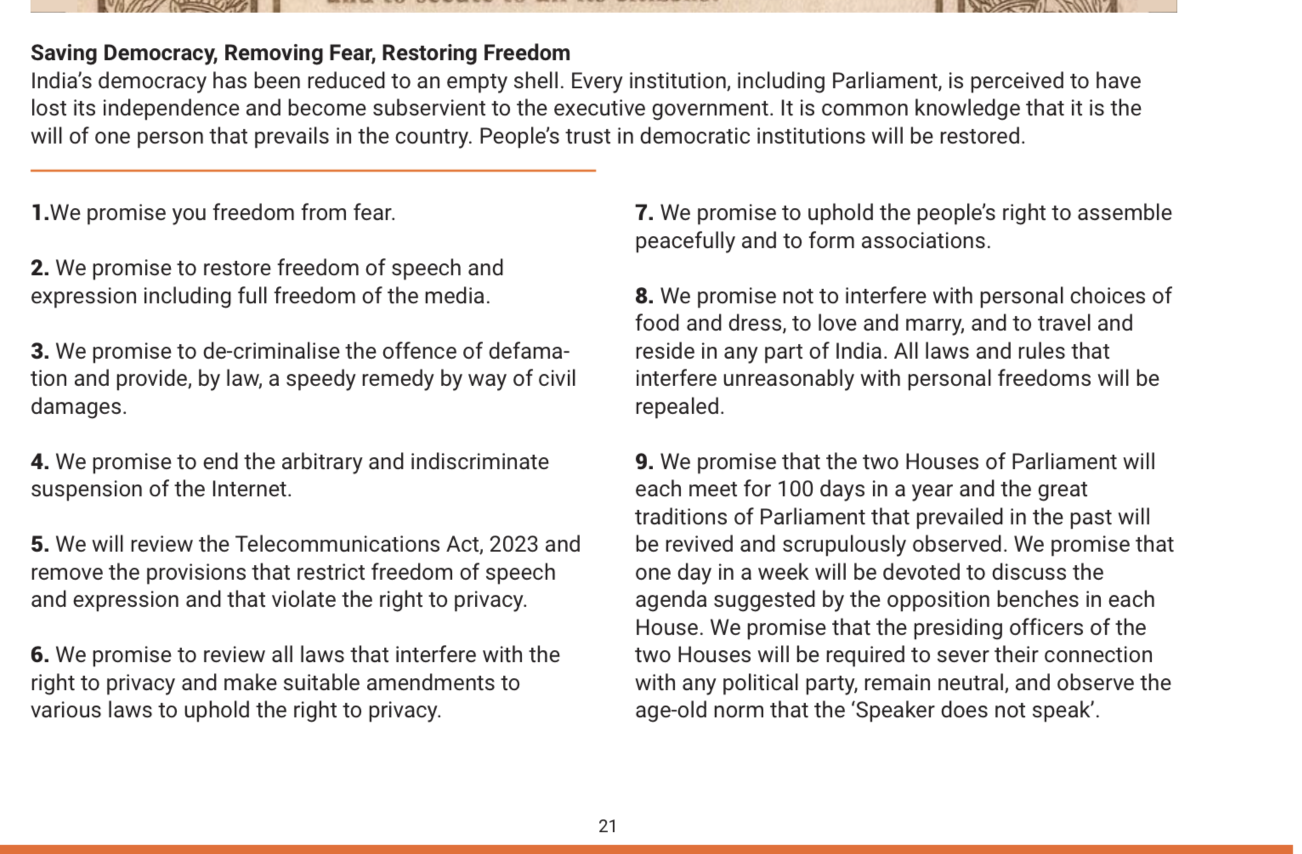
Congress’ ‘Save the Constitution’ document
3. Bringing investigating agencies under parliamentary oversight
Perhaps among the most sinister of the promises made in the Congress manifesto is bringing the police, investigation and intelligence agencies under the purview of the parliament. This would ultimately rob the agencies of their independence and make them susceptible to intereference from lawmakers, rendering them into a puppet of the government of the day.
It is worth noting such efforts to bring investigating agencies under parliamentary control were done during UPA II regime as well. In 2012, a draft legislation, introduced by a private member, was presented in parliament. This proposed law had aimed to establish the snooping agencies as statutory bodies and make them accountable to a committee under the prime minister’s authority.
The proposed billed aimed to place the Intelligence Bureau (IB), India’s domestic intelligence agency, the Research and Analysis Wing (RAW), its external espionage unit, and the technical intelligence collector National Technical Research Organisation (NTRO) under the purview of parliament.
4. ‘Bail is the rule, jail is an exception’ to be implemented
The Congress party has promised to enact laws that would ensure the principle of ‘bail is the rule, jail is an exception’ is applied to all criminal laws. The implication of such a law would be such that UAPA accused like Umar Khalid and Sharjeel Imam would be out on bail, with investigating agencies, under the purview of the parliament, hard-pressed to gather evidence against them and record their depositions that would link crucial links in conspiracies hatched to create public unrest and violence.
5. Promise to end suspension of internet
The internet is a powerful tool, which has both positives and negatives attached to it, which makes it all the important for the administration to regulate it and ensure it is not being exploited for ulterior means. The Congress party has promised to end suspension of internet, a tool which is often used in Jammu and Kashmir to prevent mobilisation of stone pelters trying to impede combing operations launched by armed forces.
Congress’ ‘Save the Constitution’ document
6. Uphold people’s right to assemble
The Congress party has also promised to uphold people’s right to assembly and protest, which in crude terms means protesters get the sanction of the law to squat on busy public roads and cause grave inconvenience to commuters such as witnessed during Shaheen Bagh protests and Farmers’ protests.
7. Legitimising Love Jihad and beef consumption
Another insidious promise that Congress made in its manifesto is related to consumption of food and an individual’s choice to love and marry. Although it sounds anodyne, it is worth noting that such promises indirectly legitimise beef consumption and perennial menace of love jihad, which the Congress leaders have sought to dismiss it as figment of right-wing imagination even as hundreds of cases keep emerging almost on a daily basis.
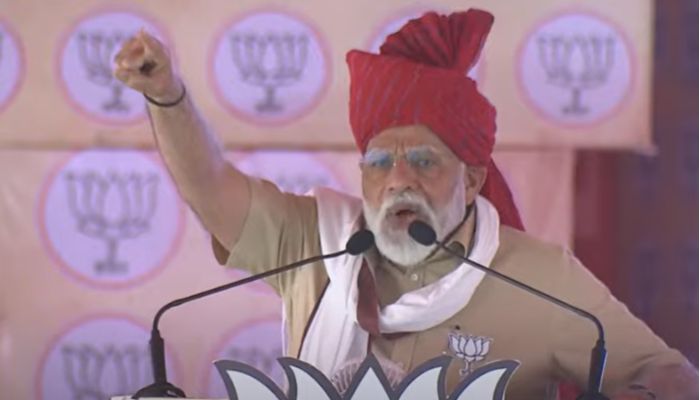
Prime Minister Narendra Modi on Friday, 5th April, addressed a rally in Rajasthan’s Churu. He said that the country has witnessed a change in the last ten years of his government.
The Prime Minister recalled his visit to Churu on 26th February 2019, the same day when India conducted the Balakote air strikes. “We had taught a lesson to terrorists,” he said.
“The words that I had said on the land of Churu that day, I want to reiterate those sentiments today on the land of the braves. I had said here ‘Saugandh mujhe iss mitti ki, main desh nahin mitne dunga, main desh nahin rukne dunga, main desh nahin khukne dunga, mera vachan hai Bharat Maa ko, tera sheesh nahin jhukne dunga’,” PM Modi said amid rousing applauds and sloganeering by the crowd.
#WATCH | Churu, Rajasthan: PM Narendra Modi says, "Aaj dushman ko bhi pata hai yeh Modi hain, yeh naya Bharat hai, yeh naya Bharat ghar mein ghus kar maarta hain…" pic.twitter.com/WBnI8O9iah
The Prime Minister recalled the insult by Congress to the nation and the Indian forces. “The people of this arrogant alliance were demanding proof of bravery from our Army,” he said adding that insulting the forces and dividing the nation is the characteristic of the Congress party.
He further said, “Aaj dushman ko bhi pata hai yeh Modi hai, yeh naya Bharat hai, yeh naya Bharat ghar mein ghus kar maarta hai (Today even the enemy knows that this is Modi, this is New India, this New India breaks in and attacks).”
PM Modi’s statement comes just hours after British newspaper The Guardian published a contentious article on Thursday (4th April) titled ‘Indian government ordered killings in Pakistan, intelligence officials claim.’
It relied heavily on anonymous sources, particularly from the Pakistani intelligence, to demonise PM Modi as a facilitator of ‘extra-territorial killings.’ In doing so, The Guardian ended up acknowledging him as a defender of India’s security interests from external threats.
The article has been authored by anti-India propagandist Hannah Ellis-Petersen, Aakash Hassan and Pakistani ‘journalist’ Shah Meer Baloch. At the very onset, it described Pakistani terrorists as ‘individuals’ who were supposedly assassinated by the Indian government.
On Friday (5th April), the Congress party courted controversy after it announced several schemes in its election manifesto to appease the Muslim community ahead of the upcoming Lok Sabha elections.
The grand-old party has vowed to send Muslim students abroad and increase their scholarships.
Interestingly, Congress has hinted at repealing the triple talaq act, allowing personal laws to supersede uniformity and entertain the wearing of non-essential religious clothing in educational institutes under the garb of the Right to Freedom of Religion.
All of these happen to be the talking points of the All India Muslim Personal Law Board (AIMPLB), which has previously opposed the Uniform Civil Code (UCC) in Uttarakhand. Page 8 of the Congress manifesto reads –
4. We will restore the Maulana Azad Scholarships for study abroad and increase the number of scholarships
7. Congress will ensure that, like every citizen, minorities have the freedom of choice of dress, food, language and personal laws.
Congress Party manifesto: Congress will ensure that, like every citizen, minorities have the freedom of choice of dress, food, language and personal laws. We will encourage reform of personal laws. Such reform must be undertaken with the participation and consent of the… pic.twitter.com/Os8C0CuWcr
The Congress promised to appoint more judges, belonging to the Muslim community, to the High Courts and the Supreme Court. It has assured to strengthen the ‘autonomy’ of the Commissions for SC, ST, minorities and OBC.
Page 24 of the manifesto says –
5. More women and persons belonging to the SC, ST, OBC and minorities will be appointed as judges of the High Courts and the Supreme Court.
Page 22 of the manifesto says-
12. We promise to strengthen the autonomy of the Election Commission of India, the Central Information Commission, the Human Rights Commission, the office of the Comptroller and Auditor General, the Commissions for SC, ST, minorities and OBC, and other constitutional bodies.
Congress has also assured to provide collateral-free education loans up to 7.5 lakhs. Page 13 of the manifesto reads –
17. Congress will revive the Education Loan programme to college students implemented under the UPA government and instruct banks to extend collateral-free education loans up to ₹7.5 lakhs especially to students belonging to the SC, ST, OBC, EWS and minorities.
1.Congress will put down with a firm hand hate speeches, hate crimes and communal conflicts. According to NCRB data, crimes against women, SC, ST and minorities have increased. We will identify the perpetrators of such crimes as well as their sponsors and punish them in accordance with law.
2. Congress is firmly opposed to extra-judicial illegal measures like mob lynching, police encounter killings and bulldozer justice. We will stop them immediately and punish the perpetrators in accordance with law.
The Supreme Court on Friday (April 5) stayed the Allahabad High Court’s March 22 order striking down the ‘Uttar Pradesh Board of Madarsa Education Act 2004’ as unconstitutional. The apex court observed that the high court misunderstood the provisions of the act and erred in declaring it unconstitutional.
A bench of Chief Justice of India DY Chandracuhd, Justice JB Pardiwala and Manoj Misra said that the UP Madarsa Act is actually regulatory in nature, and therefore it does not breach secularism.
The court said, “In striking down the Act, the High Court prima facie misconstrued the provisions of the Act. The Act does not provide for any religious instruction. The object and purpose of the Statute is regulatory in character.”
The apex court stated that if the concern was about the quality education in the madarsas, the remedy would not lie in striking down the Madarsa Act but in issuing suitable directions to ensure that the students are not deprived of quality education.
“We are of the view that the issues raised in the petitions merit closer reflection. We are inclined to issue notice,” the Court said. The bench then issued notices to Centre and the Uttar Pradesh government on the pleas challenging the high court order.
The court was hearing five Special Leave Petitions filed against the High Court’s judgment filed by Anjum Kadari, Managers Association Madaris Arabiya(UP), All India Teachers Association Madaris Arabiya (New Delhi), Manager Association Arbi Madarsa Nai Bazar and Teachers Association Madaris Arabiya Kanpur. The Court posted the petitions for final disposal in the second week of July 2024.
Additional Solicitor General KM Nataraj, appearing for the State of Uttar Pradesh, said that the State is accepting the High Court judgment. When Supreme Court asked why the state is not defending its own legislation after defending the same in the High Court, the SG said that after the HC judgement, the govt has decided to accept it.
The Union of India, represented by Attorney General for India R Venkataramani, also supported the Allahabad High Court judgment.
Senior Advocate Abhishek Manu Singhi appeared for the Managers Association Madaris, and said that the HC judgement is affecting 17 lakh students and 10,000 teachers. He refused the High Court’s observation that modern subjects were not taught in the Madrasas and submitted that Maths, Science, Hindi, English etc are taught.
The petitioners also argued that teaching religion means religious instruction and it violates secularism. “Religious education does not mean religious instruction,” Singhvi argued. The petitioners further said that all madarsas in Uttar Pradesh are not funded by the state, and that the embargo of Article 28 will apply only if the institution is “wholly maintained out of State funds”.
On 22 March, the Lucknow bench of the Allahabad High Court pronounced the ‘UP Board of Madarsa Education Act 2004’ as unconstitutional, saying that it infringes the fundamental principles of secularism. While holding the legislation to be ultra vires, the Division, led by Justice Vivek Chaudhary and Justice Subhash Vidyarthi, also instructed the Uttar Pradesh government to devise a plan to accommodate students currently enrolled in madrasas in the formal education system.
The High Court’s decision came in response to a writ petition filed by Anshuman Singh Rathore challenging the authority of the UP Madarsa Board, as well as objecting to Madarsa’s management by the Minority Welfare Department.
On the 5th of April, the Congress party released its manifesto for the coming Lok Sabha elections. In its manifesto ‘Nyay Patra’, the Congress party has listed out steps it would take to ‘fix’ the media and make it ‘re-discover’ the freedom it enjoys under the constitution. Congress has promised to amend the Press Council of India Act 1978 if voted to power.
The party asserts that this move will ‘empower’ the Council to ‘deal’ with the fake and paid news.
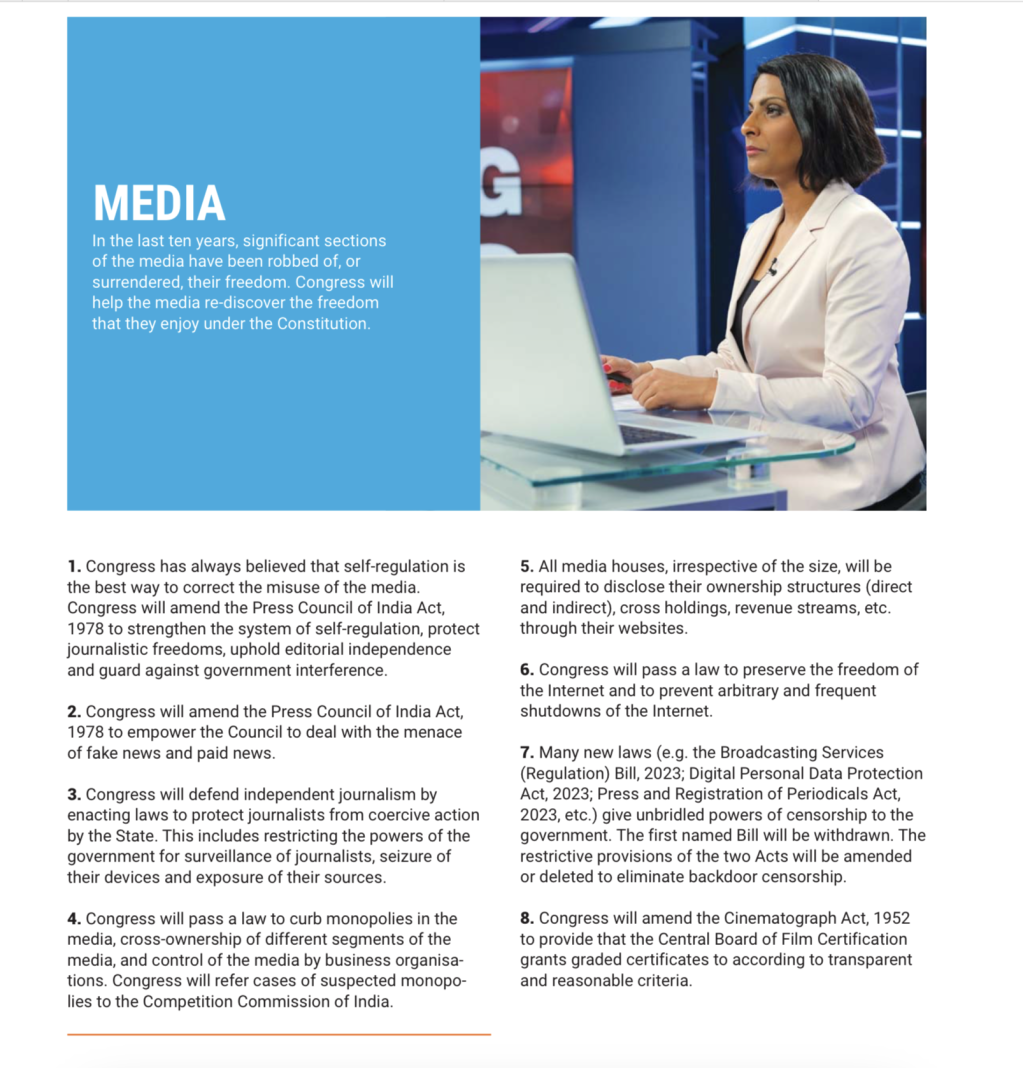
Congress has said that it will ‘protect’ journalists from coercive action by the State in its bid to ‘defend’ journalistic freedom. “This includes restricting the powers of the government for surveillance of journalists, seizure of their devices and exposure of their sources,” the manifesto reads.
Upon hearing the Congress pledge to “restrict the powers of the government for surveillance of journalists” and “seizures of their devices,” one must quickly consider what the Congress actually intends to do. In the event that the Congress party is voted into power, these promises cast doubt on the party’s strategies of making sure that cases against media outlets, such as the one against the Chinese-funded propaganda source NewsClick fall flat.
It may be recalled that when the enforcement agencies had in November last year conducted raids on journalists associated with Chinese-funded propaganda outlet NewsClick, they had seized around 250 electronic devices, including phones, hard disks, laptops and even passports, of over 90 journalists.
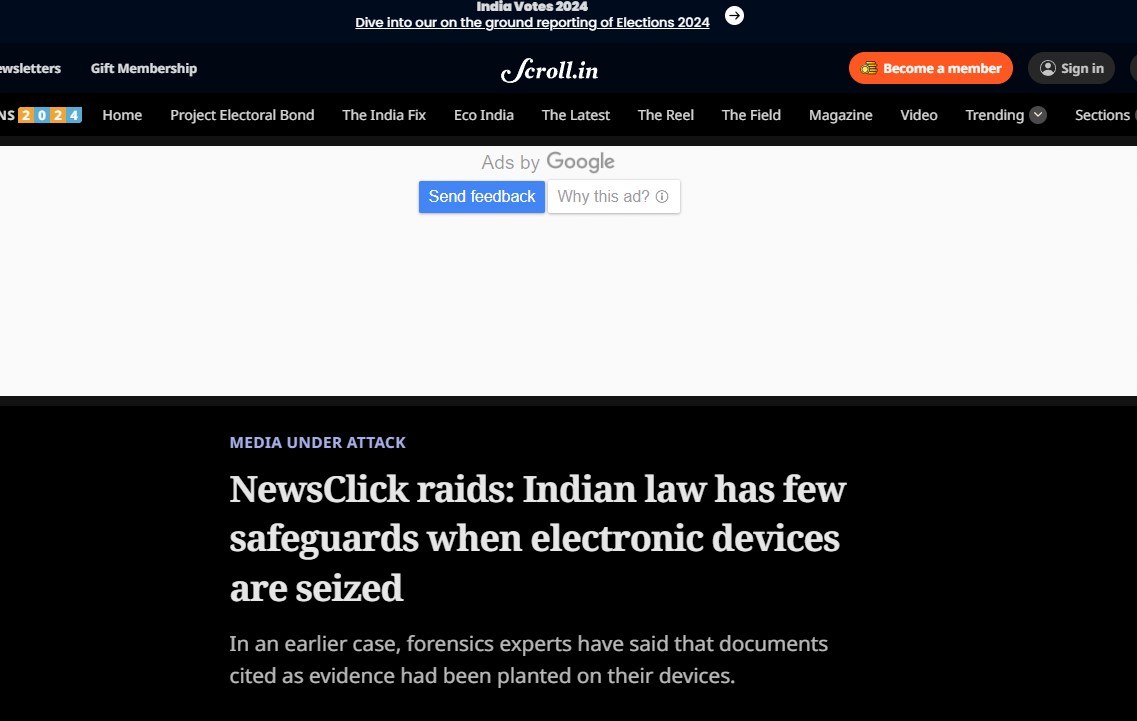
Leftist media outlets like Scroll and The Wire had been railing against the lack of rules against device seizures at the time. The Scroll article mentioned the NewsClick raid to lament how controversial it is to seize electronic devices as evidence in cases that are perceived as ‘politically motivated in India’, and that there have been claims that the police frequently abuse their authority when conducting searches and seizures.
The Congress-friendly media had also suggested that the police frequently plant documents used as evidence on the devices during the seizure in order to frame the accused.
Moreover, after the raids, the Congress party had come out in support of the portal under scrutiny for alleged links with China. Presenting the developments as an assault on the free speech of dissenters, the grand old party accused PM Modi of harassing opposition leaders and journalists who “speak the truth”.
Similarly, in the case of ‘journalist’ Siddique Kappan, who was detained in October 2020 under the Prevention of Money Laundering Act (PMLA) by the Enforcement Directorate (ED), we saw how Rahul Gandhi had extended his help to him.
Rahul Gandhi had said that the Congress party observed the “illegal detention” of PFI member masquerading as journalist Siddique Kappan as a serious matter and promised his party delegation that he would look into the issue of Kappan’s arrest.
Now that Congress has pledged to “protect” journalists from coercive action by the State and limit government authority over journalist monitoring and device seizure, one can be certain that anti-national media outlets like Newsclick and self-proclaimed media professionals like Siddique Kappan are going to be let go easily simply because their ideologies align with that of the grand old party.
Source: inc.in
What is even more ironic is that the Congress party itself has a history of violating press freedom and taking coercive action against media outlets and journalists, like in the case of Zee News journalist Rohit Ranjan, where Chhattisgarh police arrested the journalist for a mistake in airing news related to Rahul Gandhi or that of Raipur based journalist Nilesh Sharma, who was arrested for his political satire after Congress accused him of spreading ‘fake news’.
Further, the grand old party has also promised to curb monopoly in the media industry, cross-ownership of multiple segments as well as control of media by business organisations by bringing a law.
Congress while talking about curbing monopoly and control of media, however, forgot that the party itself owns and runs a media publication rather—National Herald, the financial operations of which are being investigated by the central probe agencies.
“Congress will pass a law to curb monopolies in the media, cross-ownership of different segments of the media, and control of the media by business organisations. Congress will refer cases of suspected monopolies to the Competition Commission of India,” the party said.
The grand old party has also promised to make media houses disclose their ownership structures, and cross holdings in addition to revenue streams on their website.
“All media houses, irrespective of the size, will be required to disclose their ownership structures (direct and indirect), cross holdings, revenue streams, etc. through their websites,” Congress said.
The Congress party also promised to bring a law to “preserve the freedom of the Internet and to prevent arbitrary and frequent shutdowns of the Internet.”
Asserting that the Broadcasting Services (Regulation) Bill 2023 among others brought by the Modi government give “unbridled powers” of censorship to the government, Congress said it will “withdraw” the Broadcasting Services (Regulation) Bill 2023.
Moreover, Congress will “amend or delete” what it calls ‘restrictive’ provisions of two other acts—Digital Personal Data Protection Act, 2023; Press and Registration of Periodicals Act, 2023 in its bid to end backdoor censorship.
“Many new laws (e.g. the Broadcasting Services (Regulation) Bill, 2023; Digital Personal Data Protection Act, 2023; Press and Registration of Periodicals Act, 2023, etc.) give unbridled powers of censorship to the government. The first named Bill will be withdrawn. The restrictive provisions of the two Acts will be amended or deleted to eliminate backdoor censorship,” the party manifesto reads.
Furthermore, the party promised to amend the Cinematograph Act, 1952 saying that it will ensure that the Central Board of Film Certification (CBFC) would grant graded certificates based on “transparent and reasonable criteria”.
“Congress will amend the Cinematograph Act, 1952 to provide that the Central Board of Film Certification grants graded certificates to according to transparent and reasonable criteria,” Congress’s manifesto reads.
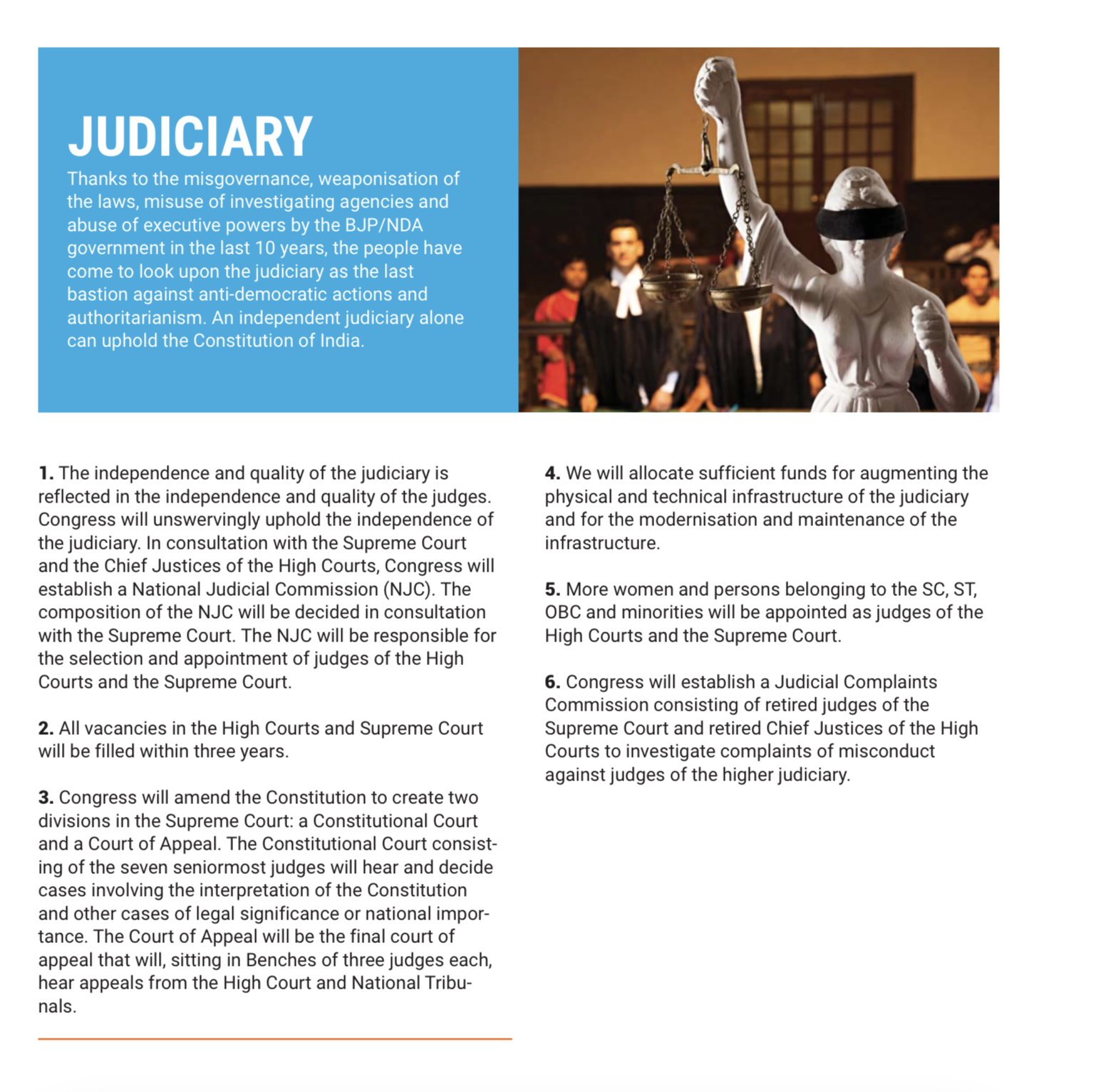
On 5th April, the Congress party released its manifesto for the 2024 Lok Sabha elections. Consistent with its past political strategies and assertions, the party has made grandiose promises in an attempt to win the populace and claimed to deliver if voted to power in the centre. As part of of the party’s recent emphasis on caste politics and reservations, the party has promised to introduce reservations for the appointment of judges also.
In the “Judiciary” section of its manifesto, the Congress party has begun by blaming the ruling party and claimed, “Thanks to the misgovernance, weaponisation of the laws, misuse of investigating agencies and abuse of executive powers by the BJP/NDA government in the last 10 years, the people have come to look upon the judiciary as the last bastion against anti-democratic actions and authoritarianism. An independent judiciary alone can uphold the Constitution of India.”
Congress has expressed its intentions to amend the Constitution “to create two divisions in the Supreme Court, a Constitutional Court and a Court of Appeal,” at point number 3 of its “Judiciary section.” The manifesto claimed, “The Constitutional Court consisting of the seven seniormost judges will hear and decide cases involving the interpretation of the Constitution and other cases of legal significance or national importance. The Court of Appeal will be the final court of appeal that will, sitting in Benches of three judges each, hear appeals from the High Court and National Tribunals.”
Interestingly, in point number 5, the party also declared, “More women and persons belonging to the SC, ST, OBC and minorities will be appointed as judges of the High Courts and the Supreme Court,” implying that the judiciary would be subject to reservations. However, the party’s manifesto does not explain how it will appoint backwards class people to the posts of judges in high courts and supreme court, because the government has no control over these appointments, which is done by the collegium of judges.
However, the party has promised to form a National Judicial Commission, which will be responsible for the selection and appointment of judges of the High Courts and the Supreme Court. It promises to form the NJC with the consultation with the Supreme Court. Notably, the first Modi government had passed the National Judicial Appointments Commission with the similar goal, but it was struck down by the Supreme Court.
The manifesto further claimed, “Congress will establish a Judicial Complaints Commission consisting of retired judges of the Supreme Court and retired Chief Justices of the High Courts to investigate complaints of misconduct against judges of the higher judiciary.”
The manifesto also added, “The independence and quality of the judiciary is reflected in the independence and quality of the judges. Congress will unswervingly uphold the independence of the judiciary. In consultation with the Supreme Court and the Chief Justices of the High Courts, Congress will establish a National Judicial Commission (NJC). The composition of the NJC will be decided in consultation with the Supreme Court. The NJC will be responsible for the selection and appointment of judges of the High Courts and the Supreme Court.”
The party did not, however, address the plan for achieving its objectives. Additionally, it pledged to “allocate sufficient funds to augment the physical and technical infrastructure of the judiciary and for the modernization and maintenance of the infrastructure,” as well as to “fulfil all vacancies in the High Courts and Supreme Court within the next three years,” among other things that while appealing on the surface, would amount to nothing in the absence of a reasonable and viable strategy, which the party failed to present.
The sole plan the party offered appeared to be an election ploy to win over its minority support base while also attempting to curry favour over some scheduled castes, scheduled tribes, and other lower-class communities, as well as women, by promising to increase their proportion in the judiciary. Nonetheless, the party did allude to the introduction of reservations in the courts.