Home Blog Page 1195

‘Systematic invisibilizing of the Muslims’: Rajdeep Sardesai’s veiled tirade against BJP, makes bizarre comparisons between the party and his colony

Several dignitaries from multiple fields including Prime Minister Narendra Modi and Union Home Miniter Amit Shah graced the 21st edition of the India Today Conclave 2024 in New Delhi. A number of ‘experts’ also expressed their opinions, during an interactive session with journalist Rahul Kanwal on “How Will India Change In Next 5 Years.” Notably, another India Today journalist Rajdeep Sardesai, by force of his habit, couldn’t let the opportunity pass without using religious tropes and bringing up “Hindu-Muslim” while attacking the ruling dispensation, the Bharatiya Janata Party (BJP) led National Democratic Alliance (NDA).

He alleged, “Just think about it. We are talking about ‘Ab ki baar 400 paar, 350 paar.’ This government at the moment in parliament doesn’t have a single Muslim MP. This 350 or 400 paar is also probably not going to have a single Muslim MP. 13% of your population in a way is being invisibilized. I don’t want to say it in this room also but I know in my own colony, which is an affluent and upmarket colony, how many Muslims live there today? There is a systematic invisibilizing of the Muslims.”

He reiterated, “I am not blaming an individual for it but this is the nature of it. An indoctrination has set in and I think since we are in a media conclave, we in the media should also look inside. How much have we done to spread these kinds of stereotypes, prejudice and the worst kind of hate politics that targets people because of the community they belong to? Nothing can be more dangerous for India in the future, the country with the third-largest Muslim population if the party in power with 400 MPs can not throw up a single Muslim MP or cannot actually actively promote a sense of genuine cooperation between communities. Don’t blame anyone and we in the media need to look inward.”

Interestingly, the veteran ‘journalist’ kept attacking the Bharatiya Janata Party while claiming not to “blame anyone.” However, he didn’t present nor was he asked to support his outrageous accusations of “Muslim invisibilisation or marginalisation” with any empirical data. On the other hand, there are hundreds of incidents where Muslims have demonstrated how non-marginalised they are by attacking Hindus and displaying their street strength by making a mockery of law and order.

When the “invisible” community acted due its helplessness

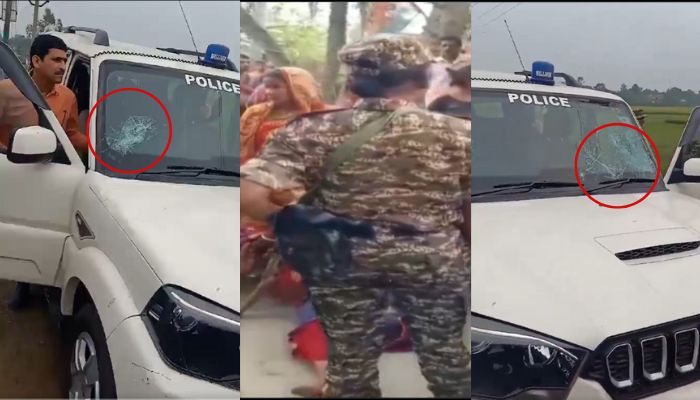
Social and mainstream media in India is rife with stories of Muslim attacks on Hindus over the most trivial of matters, which serve as justification for more killing and violence against the majority community. The nation’s collective memory continues to carry the graphic violence that occurred in Haldwani, Uttarakhand, where police officers, both men and women, were attacked by a vicious Muslim mob because the authorities were there to lawfully demolish an unauthorized madrasa and mosque in the Banbhoolpura area.

According to OpIndia’s ground reports, victims and eyewitnesses revealed that the rioters were purportedly sparing the Muslims while hitting journalists, police officers, administrators, and regular individuals after demanding their identities. They even attempted to burn journalists and police officers alive as well.

The country is still grappling with the aftermath of a double murder in Uttar Pradesh’s Badaun where barber Sajid and his brother Javed murdered 11-year-old Aayush and 6-year-old Ahaan also known as Honey and reportedly drank their blood. They also attacked 6-year-old Piyush but he managed to survive the assault, unlike his siblings. Sajid was killed in retaliatory firing when he attacked the police as he tried to escape while Javed was still absconding.

A Hindu shop owner named Mukesh in Karnataka’s Bengaluru was beaten only because he played “Hanuman Chalisa” and other Hindu devotional songs in his shop which was near a mosque. Bhajans infuriated the members of the ‘marginalised community’ that forces non-Muslims to listen to the Islamic call to prayer, known as Azaan, five times a day over loudspeakers to such an extent that they thrashed an innocent Hindu in order to assert their dominance.

Another recent instance transpired in the national capital’s Inderlok area where Sub-Inspector Manoj Tomar stopped Muslims from blocking the road and reading Namaz there as it caused inconvenience to the commuters. He kicked a praying man after none of them paid any heed to the repeated requests. However, instead of realising that they were in the wrong, the hostile throng assaulted the police personnel and hurled abuses at them.

Hindu holidays have witnessed an alarming increase in violent attacks. Radical Muslims consistently attacked Hindus and their festivals despite the many attempts of the secular media and liberals to propagate the myths of the “marginalisation of Muslims” and turned the shocking events into a new normal in the land of “Sanatan-Dharma.”

Notably, Islamists and their liberal cronies accuse Hindus of being responsible for the attacks, stating that these occurrences transpire because there are “Muslim areas” in the nation that are virtually off-limits to Hindus and that violators suffer repercussions. These areas are referred to as “Muslim areas” due to the majority religion of the residents yet if one were to apply the same reasoning to all of India, these same people foam at the mouth and label others “Sanghi” and “Hindutvavadi.” They want “no-go zones” with a Muslim population in a Hindu majority “secular” India.

Another prime illustration of the “vulnerability” of “marginalized Muslims” was the riots that swept the nation and were perpetrated under the guise of Citizenship Amendment Act (CAA) 2019 protests when the agitators held the entire country to ransom for a legislature that had no bearing on them. Even Delhi wasn’t immune to the unrest and on the 24th and 25th of February 2020, Muslim mobs attacked Hindus which resulted in the death of 53 people while more than 200 people were left injured. An Intelligence Bureau Constable was murdered in the riots along with a Head Constable of the Delhi Police. 

These are but a few instances of the actions of Muslims in India that are frequently characterized as marginalized by individuals like Rajdeep Sardesai and his ilk when the reality is quite contrary to their claims. Muslims are indeed very much visible and they utilise most cruel methods to establish their supremacy which frequently results in violence and disregard for law and order. Rajdeep Sardesai doesn’t see any Muslims in his locality but not because it is inaccessible to them, however, the country has places where Hindus aren’t allowed to visit because they are “Muslim areas.”

Rajdeep Sadesai went so far as to hold the media accountable for the state of Muslims in the nation. However, he and his liberal media allies have persisted in portraying Hindus as the aggressors and Muslims as the victims, even in cases of the most terrible crimes. How can one forget that Islamists went on the rampage in the streets of numerous cities throughout the nation in response to BJP leader Nupur Sharma’s remarks after Mohammed Zubair of AltNews published an altered video of her and Tasleem Rehmnai who was abusing Lord Shiva during the Times Now debate? The edited footage ignited the fire that eventually grew out of control. Many Hindus including Kanhaiya Lal and Umesh Kolhe were killed for supporting Nupur Sharma.

Minority communities benefitted most from welfare schemes under Modi govt

The Economic Advisory Council to the Prime Minister (EAC-PM) released a working paper last year that showed that the poorest twenty per cent of Muslim households in India have benefited the most from Indian government policies. Between 2015 and 2021, the study examined self-reported data from over 1.2 million households across many criteria, including access to necessities.

The research underlined that there is no proof of discrimination against any social, religious, or geographic group when it comes to the supply of basic utilities. Minority communities have sometimes benefited more than majority populations. According to the research, access to basic utilities has significantly improved for all religious communities in India. Notably, the report did not rely on the rhetorical jargon of a self-professed liberal mindset, but rather on real facts and a reflection of the impartial approach of the Modi government.

The umpteenth initiatives launched by the centre including Pradhan Mantri Awas Yojana and Jal Jeevan Mission among others are being provided to each and every citizen without any discrimination. The accusation that the Bharatiya Janata Party does not provide tickets to Muslims, however, is unfounded because, similar to other political parties, the BJP also gives a candidate’s “winnability” priority when selecting its nominee.

The party needs to prioritize its political interests over meeting the fictitious demands of a random journalist whose spouse is a prominent figure in an opposition party. “Our ticket distribution is on the basis of winnability. If the media creates a wedge between the minorities and the BJP, and as it intensifies, there will not be any candidate who can win. We do hope that this gap ends,” Amit Shah has also repeatedly clarified the same.

Conclusion

The party that has done the most for Muslims is portrayed as a villain while being asked to do even more for the community, which is an irony that doesn’t escape anyone. The truth is that the opposition, liberals and Islamists would continue to relentlessly attack the BJP. They will never receive recognition or gratitude for everything they do. The BJP will have to prepare for many such attacks akin to those that occurred in 2014 and 2019 especially now when the election dates are announced.

Meanwhile, if Rajdeep Sardesai and any of his liberal peers wish to witness the real “invisibilazation of minorities,” all they have to do is observe the situation of minorities in Afghanistan, Bangladesh, and Pakistan, where their numbers are dwindling so quickly that they are almost wiped-out and on the verge of becoming invisible. The same minorities to whom liberals and Islamists oppose granting citizenship under the CAA after they migrated to India to protect their lives and dignity from Muslim extremists.

Watch the entire video below:

Sadhguru Jaggi Vasudev hospitalised, undergoes emergency brain surgery at Apollo Delhi

0

Popular spiritual guru Sadhguru Jaggi Vasudev has been hospitalised and has undergone emergency brain surgery at Apollo Delhi. As per reports, he was admitted to Apollo Delhi after a massive swelling and bleeding in his brain was detected on March 17.

Journalist Anand Narasimhan shared an update on Sadhguru’s health, stating that Sadhguru was suffering from severe headaches for the past several days.

As per reports, Sadhguru Jaggi Vasudev was examined by Dr Vinit Suri and was advised an MRI, where massive bleeding in his brain was detected.

His health rapidly deteriorated and on 17th March, he was admitted after recurrent vomiting and a worsening headache. A CT scan revealed a critical swelling in his brain along with the bleeding.

A team of doctors from Apollo Delhi Dr Vinit Suri, Dr Pranav Kumar, Dr Sudheer Tyagi and Dr S Chatterjee performed an emergency surgery on him. Following the surgery, Sadhguru was weaned off the ventilator and has been recovering well. His brain, body and vital parameters are showing steady improvement following the surgery, as per Narasimhan’s update.

With the inauguration of Statue of Valour by PM Modi, Lachit Borphukan finally gets the much-deserved honour after he was cancelled by ‘historians’

Prime Minister Narendra Modi unveiled the Statue of Valour as a bronze monument measuring 125 ft high in memory of the distinguished Ahom military general Lachit Borphukan at Hollongapar in Jorhat, Assam, on 09 March 2024. This monument of respect for a military commander who defeated the Mughals in the Ahom-Mughal War, especially in the crucial Battle of Saraighat in 1671, took centuries to come to be.

Even after the independence of India, the story of courage and fearlessness of Lachit Borphukan could not percolate the ideologically determined filters of history. In the grand narrative of Independent India and its historiography, Borphukan found no space. He remained a regional hero, and his victory over the Mughals secured no space even in the footnotes of modern Indian history.

His valour against the expansionist Mughals was exceptional and exemplified the pride of India. This victory was antithetical to the line of historiography that foregrounded the stories of defeats. Therefore, it suffered from deliberate inattention because this contested narrative disturbed the narrative of selectivism designed by the ’eminent historians’ (to borrow the phrase from Arun Shourie).

This kind of historiography made history an ideological project, not a space of objectivity. This exercise embodied the discontent because it practised exclusion. The exclusivity status was given to a chosen few who fit into their scheme of things or framework, but others whose merits are tested by history are pushed to anonymity.

Lachit Borphukan suffered this fate and was cancelled from the written history of Independent India. This history that remained unquestioned and assumed the power of irreversibility has finally experienced the test of truth. With the Bharatiya Janata Party (BJP) at the helm of politics with a thumping majority since 2014, the scope for revisiting history has become a reality.

It develops a scope for correcting the errors of historiography and recognising the suppressed voices and heroes who have contributed to this country’s unity, akhandata and civilisational prabah nityata. The Statue Of Unity for Sardar Vallabhbhai Patel, statue of Equality for Ramanujacharya, the Statue Of Valour for Lachit Borphukan, the project of unsung heroes of Bharat, etc., are the instances of effective response to the intentional errors of historiography.

PM Modi’s imagination of Viksit Bharat embodies the vision of justice that ensures the correction of errors. This exercise presents the dividend in the form of a development of a grand narrative that projects Bharat the way it ought to be and instils in Indians a sense of pride, confidence, and trust in their history.

Therefore, the history of India is not a history of continuous defeat. It inheres the stories of defeat, victory and unceasing resistance. The civilisational continuity of Bharat establishes the truth of defiance, intransigence, struggle and sacrifice.

The deeds of Lachit Borphukan are the instances of grit, courage and determination that ensured the civilisational continuity of Bharat at the teeth of annihilation and predatory forces that threatened Bharat’s civilisational existence. Therefore, the project of the ideology-loaded historiography that believed in imposing a film of frustration through the convoluted narration of Bharat’s history through lies and fraudulence finds its antithesis in the writings of Vikram Sampath, Meenakshi Jain, Rajiv Malhotra, Anand Ranganathan and so on.

The truths of history long suppressed finally find utterance. This utterance leads the nation towards a Viksit Bharat where the heroes of Bharat’s history are given the respect and recognition that they deserved for so long. To the question of the importance of building monuments, it may be argued that the monuments are necessary because their visual presence develops in the current generation and the generations to come a sense of history and pride in Bharat’s past.

From this pride comes the confidence of unity and the formation of a formidable identity. A nation without a strong sense of history is destined to repeat the mistakes of history. The Battle of Saraighat and the valour of Lachit Borphukan will now resonate in the minds of all Indians, and the monument built in his memory will remind them of the fierce resistance of their ancestors against the Mughals.

The example of patriotism that he personified by showing his deepest love for the land will continue to inspire Indians for generations. He has become a symbol of courage, and through courage, the impossible is made achievable. So, Lachit Borphukan is a national hero.

However, it may appear too late to recognise him as a national hero by giving him the honour he long deserved. Knowing the historiographic process that the aftermath of India’s independence experienced, the delay does not surprise many. What is important in this connection is the monument built finally in his honour, which will immortalise him and his deeds in the collective imagination of the Indians.

Finally, the history that experienced suffocation and lack of articulation for not falling within a specific ideological basket has found expression and national recognition. This is the new India that has taken up the journey of Viksit Bharat. 


Dr. Chandan K. Panda is an Assistant Professor in the Department of English at Rajiv Gandhi University (A Central University), Itanagar. Email: [email protected]

Mumbai: Inquilab Khan attacks 5 Hindus with knife during Ramzan for objecting to encroachment near Mandir, arrested and illegal construction razed

On Tuesday (19th March), the Brihanmumbai Municipal Corporation (BMC) razed down the illegal property of an individual identified as Inquilab Khan after he attacked 5 Hindu persons from the Sakinaka area of the Mumbai region. The incident is said to have happened amid Ramzan on 14th March where the accused Khan brutally attacked 5 Hindus for complaining against his illegal encroachment adjacent to a Hindu temple.

The victims attacked by the accused have been identified as Siddhesh Prakash Ghorpade (23), Rajesh Tangaraj Chettiyar (28), Tangaraj Chettiyar (58), Laxmi Chettiyar (52) and Vikki (30). All these victims have suffered severe injuries and have been admitted to the Sion hospital. The injured individuals are all believed to be the residents of the Ambedkar Nagar area in Jarimari.

Reportedly, the accused attacked the victims with a knife after they complained about his illegal encroachment in the Sakinaka area adjacent to a Hindu temple. According to reports, he harassed local Hindus who routinely worshipped at an adjacent temple to disrupt peace. People had filed numerous complaints against him, but local officials allegedly refused to act.

On March 14, Khan carried out a knife attack on those who had complained against him. The event aroused uproar in the community, and the victims’ family members sought his arrest.

However, the accused used the same knife to injure himself and was admitted to a hospital. He stabbed himself several times and admitted himself to the Rajawadi Hospital in Ghatkopar. On 19th March, 5 days after the incident Mumbai Suburban Guardian Minister Mangal Prabhat Lodha ordered the demolition of illegal property owned by the accused.

As per the orders provided by the minister, the civic body tore down the rest of the structure and only let the ground floor stand. “After reviewing the incident that took place in Saki Naka, we realized that the Malvani pattern of harassing and torturing Hindus is going on here too. Hence appropriate action was taken. Injustice is being done to the sons of the soil here, which will not be tolerated anymore,” Lodha said after he ordered the demolition of the illegal property.

Illegal property razed to ground by the BMC (News18)

Khan is reportedly facing numerous allegations, including drug-related offences.

In the given case, the accused has been removed by the Police from the Rajawadi Hospital in Ghatkopar and has been arrested under section 307 (attempt to murder) of the Indian Penal Code, 1860.

Further investigations are underway.

How Modi Hacks EVMs, Part 5: Focus on financial systems, along with Big Bang Reforms and simultaneous benefits to middle-class, economically weaker sections

The double-digit inflation for many years is often listed as one of the most stellar achievements of Sonia Gandhi’s rule (2004 to 2014). Another double-digit achievement during her rule, that is often not given the due it deserves, is the home loan interest rates. The aspiring middle class was investing in buying a home for themselves. Please note that I am talking about the aspiring middle class like you and me. Not about the Rajdeep Sardesai-type middle class who will buy a 25-crore house in the year 2007 itself. This aspiring middle class was witness to a steady increase in home loan interest rates from 2005 onwards; rates that were 7.5% in 2003-04 leapfrogged to 10-11% in 2008-11 years; and then peaked in the 2012-2013 years. Headline after headline told us how the increase in home loan rates was burdening the middle class. At one point in time, we were also paying more than 11% interest on our home loans. 

Enter Prime Minister Modi. The home loan interest rates steadily came down from 2015 onwards; came down to below 8% for the first time since 2005, and even reached a low of ~6.75% at one point! Even after the disastrous COVID pandemic, the interest rates haven’t gone as high as when Sonia Gandhi’s economists were at the helm.  The closest graph I could find for a trend from the year 2000 onwards is below (Home loan rates vary from bank to bank, but we are more interested in the trend, so this graph is very illustrative of the same) 

Let’s assume you took a 10-year, 45-lakh rupee home loan in the later part of UPA-2. A difference of 4% in home loan interest (11% in UPA vs 6.75% in NDA) would ideally mean you will save nearly 12 lakh rupees on a 45-lakh rupee loan! I know, I know that it is not the ideal way given the floating interest rates and all that. But even then, we can safely assume a ~10% average in the 2009 to 2014 period (it will be a tad higher, but I am being nice!) and a ~8% average in Modi’s 2 terms – you would have ended up saving nearly 7 lakh rupees. You can continue to debate with me on how taking an average is also wrong and it should be calculated with the exact number of months a certain interest rate was fixed and all that. Feel free to do that calculation too and you will still end up with the simple fact that we all saved a lot of money on our home loan interest rates, especially if we took the loan in the UPA days. 

These savings didn’t happen just by chance or Modi didn’t just happen to be there at the right place at the right time. He ensured that more money first flows into our banking system, thereby helping ease the lending rates for the common citizen. They mocked him when he opened Jan Dhan Accounts. Today, 51 crore accounts hold nearly 2 lakh crore rupees in them! When demonetization brought back all cash into the banking system, one of the most obvious advantages that came with it was a reduction of lending interest rates, because more money came into our banking system! A structural reform like the Insolvency and Banking Code brought back nearly 3.2 lakh crore rupees into our system. 

Compared to Sonia’s rule, there has been a whopping ~300% increase in the collections of personal Income Tax; a nearly ~140% increase in the collections of corporate taxes and a nearly 100% increase in the collections of GST. The most important point to note here is the actual taxes on these were NOT increased – In fact, they were decreased! For example, if you were earning 12 lakhs per annum in 2013 versus 12 lakhs per annum in 2023, you would pay 57% less tax in 2023 compared to 2013! The changes to the tax slab structure meant that those earning less than 15 lakh per annum would pay much lesser Income Tax than before. The Corporate Tax %age was reduced to 25% from 32% (much to the chagrin of the opposition); many slabs of GST were in fact bought down; and small-scale exporters now pay lesser tax than before! 

A reduction in tax rates helped in increased compliance, which meant more money came into our system. More money in the system means better lending rates and better infrastructure. More people and companies paying taxes would also automatically point out to a simple conclusion – more jobs! Speaking of taxes, we need to make special mention of small yet crucial recovery schemes such as the Sabka Vishwas Scheme & Vivad se Vishwas scheme. These schemes alone have brought in nearly 1 lakh crore rupees back into the system! 

Now, the cynic in you might want to question whether Modi is enjoying this newfound money. This article is not about what he did with that money, but given the recent brouhaha over the rights of the states, here’s a very simple yet startling statistic to satisfy your ego. The Modi government’s economic policies ensured that the States of India received a whopping 69.6 lakh crore rupees in just 9 years – a whopping 376% increase from Sonia’s years. 

Again, the cynic in you can talk about how taxes on fuel were increased. If that is your argument, then you must also be ready to accept the following fact – Central government + BJP state governments have also brought down fuel prices by nearly 20 rupees per litre. For example, there is a nearly 15 rupees per litre difference in the petrol price in Uttarakhand as compared to Telangana! Fuel Prices haven’t changed since May 2022. India under Modi negotiated a deal with Russia to buy fuel while some other world powers stopped buying fuel from Russia! This ensured that India would remain isolated from the severe inflationary effects many countries of the world are going through, because of the Russia-Ukraine war. 

Under Sonia’s stellar rule, the inflation rate hit double digits for multiple years. Modi government’s economic policies meant that inflation was in the 3.3% to 6.7% range, even after the COVID pandemic – this means that the pinch on your pocket is much lesser now than what it was when the universe’s biggest economist was at the helm. 

When COVID raged, we were again reminded of how Modi’s lack of economic knowledge would devastate us. Articles were written on how we must blindly follow what the US and European countries were doing. Instead, Prime Minister Modi announced a brilliant 21-lakh crore package that covered multiple sectors and sections of society that the opposition didn’t know what to criticize in that package. 

Both of Modi’s finance ministers, Arun Jaitley and Nirmala Sitharaman, faced perhaps the worst flak as compared to any previous finance ministers (Piyush Goyal was FM for a brief time, a stop-gap arrangement for an ailing Arun Jaitley). Both of them were often called the worst finance ministers ever. Turns out, both of them have perhaps been one of the best we ever had. Both of them have steadfastly steered our economy through unprecedented crises and remained great trusted lieutenants of Narendra Modi. 

Together, they have also innovated and implemented some of our biggest reforms – the Insolvency and Banking Code; the GST; the big PSU reforms that include the merger of 27 banks into 12; the NPA recovery; the UPI payments; the establishment of the National Infrastructure Pipeline worth nearly 110 lakh crores; the moving of the Budget presentation to February 1st instead of February 28th and more.

The Modi government’s focus and grip on the financial system of our country is simply phenomenal. The equal focus on Big Bang systemic reforms and on benefitting the aspiring middle class; the neo-middle class; and the lower middle class is perhaps unprecedented. The middle class is thriving. It is not a fictional statement. It is what is being experienced. Makes you wonder, why exactly wouldn’t crores of these people willingly go and press the lotus button on the EVM!

This is the 5th article in the series Decoding How PM Modi Hacks EVMs (an allegation the opposition often throws at him). Part-1 speaks about the focus on small-scale entrepreneurs; Part-2 speaks about the revolutions in the labour/employment sector; Part-3 speaks about the focus on both prevention and cure in health; Part-4 speaks about how the lives of women were made better at home, school and work. 

‘Aye Khuda, aaj bacha le’: Badaun murderer Sajid after being shot at by police. Read exclusive FIR details, weapons he possessed and more

In the horrific murder case of two Hindu children in Uttar Pradesh’s Badaun district, police have made some shocking revelations about accused Sajid. In OpIndia’s ground report, it has been found that the police have recovered one country-made 315 bore pistol, 4 spent cartridges of 315 bore and 4 live cartridges of 315 bore during an encounter on 19th of March. Moreover, another accused has been arrested under Section 307 IPC and the 3/25/27 Arms Act. Notably, while one accused Sajid was killed in an encounter on Tuesday, police are conducting searches to capture another accused Javed.

Vinod Kumar, the father of the children killed in Sajid’s attack, has filed an FIR in this case. In the FIR filed by Vinod Kumar with the police, it is stated that around 7 pm, Sajid arrived outside their house on a bike with his brother Javed. After that, Sajid came inside their house and demanded ₹5000 as a loan from his wife Sangita. Sangita went inside the house to give him the money. Meanwhile, Sajid sent Vinod Kumar’s teenage son, Piyush Pratap, outside to fetch gutka.

After a while, Sajid told Sangita that he was not feeling well and wanted to go to the terrace to breathe fresh air. Sajid called Javed inside and took his sons with him to the rooftop. Vinod Kumar informed the police that after this, when his wife Sangita came with the money from inside, she saw Sajid and Javed coming down the stairs, and Sajid had a blood-stained knife in his hand.

According to the information obtained by OpIndia, the police said after killing two children in Mohalla Sundar Nagar, accused Sajid and Javed were hiding from the outraged crowd and fled from Gauri Shankar Temple to Shekhupur via the jungle of Iklahari Mujahidpur. While the police were heading to Ikalhari village an informer told them that a person with blood on his clothes and carrying a pistol was running towards Sirsa Dabarai jungle while two policemen were chasing them on a motorbike.

In its case diary, the police stated that they later spotted a person (Sajid) running with a pistol in his hand, when a police official asked him to stop and the accused opened fire on the police. Accused Sajid, despite Inspector Gaurav Bishnoi warning the accused that he had been surrounded by the police team, refused to stop and opened fire leaving the officer who was wearing a bulletproof vest injured.  The accused took advantage of the dark and fired six to seven rounds at the police intermittently.

In retaliation, the police officials opened fire then the police heard the injured accused saying, “Aye Khuda aaj bacha le (Oh Khuda [Allah], save me today)” who then fell to the ground. The wounded accused told the police that his name is Sajid, son of Babu, adding that he is a resident of Sakhanu police station area in Badaun’s Alapur. Notably, both the accused Sajid and Javed are brothers.

Notably, according to the FIR copy accessed by OpIndia, accused Sajid had told Sangeeta, the mother of the deceased Hindu children Ayush and Ahaan, “Today, I have done my work.”

“The accused Sajid told my wife that he wanted money as his wife was about to deliver a child. When she went inside to take money, he said that he was feeling unwell and wanted to go for a walk on the terrace and took my sons (deceased) with him. He also called his brother Javed to the terrace. When my wife returned, she saw Sajid and Javed with a knife in their hands. Sajid also tried to attack my surviving son and he sustained injuries. Both were running away and Sajid told my wife that today he had completed his work,” the FIR reads.

Afterwards, Sangeeta headed to the terrace and found both of her sons, Ahaan and Ayush, lying in blood. Piyush, who had returned from outside with gutkha, was also attacked by the accused, however, he survived.

Upon seeing two of her sons brutally murdered, Sangeeta screamed, the locals gathered and caught Sajid, however Javed escaped. The police were alerted and Sajid was handed up to them. During this time, the crowd increased and grew enraged. Sajid took advantage of the ensuing commotion and managed to escape.

On the complaint lodged by the deceased minor duo’s father Vinod Singh, a case has been registered against Sajid and Javed at Civil Lines Police Station.

An investigation into the matter is underway. While Sajid has been gunned down in a police encounter, his brother Javed is still at large. Meanwhile, the postmortem examination of the deceased children has been conducted and preparations are ongoing for their final rites amidst a heavy police presence in the area. The police have also detained Sajid’s father and uncle for questioning in connection with the murders.

Rajasthan: Islamist mob attacks Hindu community’s Shobha Yatra in Chittorgarh’s Pahuna village, several injured in stone pelting and arson

Tensions erupted in Rajasthan’s Chittorgarh area after an Islamist mob attacked the Shobha Yatra of Lord Charbhuja Nath late evening on Tuesday (19th March). According to reports, the accused from the Muslim community protested against the procession and assaulted the people participating in it when it reached near their basti (settlement). They then started stone pelting and torched several vehicles and shops. 

Following the incident, a heavy police force was deployed in the area. Senior Police officials have issued an appeal to maintain peace adding that 18 accused have been arrested so far in this case. 

One person named Shyam Lal Chhipa (55) lost his life while about a dozen people suffered injuries in the attack. The injured victims have been referred to Bhilwara Hospital while Shyam Lal reportedly died on the way to the hospital. The deceased had a shop where the incident took place and was also a heart patient which is claimed to be the reason for his demise. 

The police have stated that the cause of death for Shyam Lal Chhipa was a heart attack that he suffered during the scuffle.

According to the information received, the locals take out the Shobha Yatra of Lord Charbhuja Nath on Dashami Tithi in Pahuna village. The village falls in the jurisdiction of the Rashmi police station area in the Rashmi subdivision of Chittorgarh district.

The villagers take the Shobha Yatra throughout the village, accompanied by drums. This year, the procession was being taken out, on the occasion of Dashmi, on Tuesday (19th March). Meanwhile, when the procession reached near the Dargah located in the main market at around 9 pm, people from the Muslim community protested and assaulted the people who were part of the Lord Charbhuja Nath procession. 

According to reports, the tense situation escalated after the accused from the Muslim community started pelting stones at the procession. In the ensuing attack, around a dozen people suffered injuries while Shyam Lal died on the way to the hospital. 

After the incident, the miscreants also set some shops, and vehicles on fire after midnight.

On receiving the information, District Superintendent of Police Sudhir Joshi reached the spot. He said that one person had died in this incident. The deceased had a shop near the spot. When the scuffle erupted, he intervened to stop it. However, due to the altercation and subsequent push, he fell down and suffered a heart attack. Initially, people took him home, but seeing his condition worsen, he was taken to Bhilwara but he passed away on the way to the hospital, DSP Joshi added.

Meanwhile, District Collector Alok Ranjan and DSP Joshi also issued an appeal to maintain peace.

Taking to X, the Chittorgarh Police shared that the Rashmi police station has registered a case under relevant sections and arrested 18 accused. Adequate police personnel are present at the spot, and patrolling and monitoring are being done. There is peace on the spot. According to primary information, the death of one person was found to be due to a heart attack, the Police added.

Union health ministry seeks report from Punjab govt over IVF treatment of Sidhu Moosewala’s mother for age limit violation

The Ministry of Health and Family Welfare has sought a report from the Government of Punjab regarding the In Vitro Fertilization (IVF) treatment of Sidhu Moosewala’s mother, Charan Kaur, and asked them to submit the report to the department.

“Under Section 21(g) (i) of the Assisted Reproductive Technology (Regulation) Act, 2021, the age limit prescribed for a woman going under ART Services is between 21-50 years,” the notice reads.

Recently, parents of the late Punjabi singer Sidhu Moosewala, Balkaur Singh, and Charan Kaur welcomed a baby boy on Sunday, almost two years after the singer was killed in Punjab.

In a video posted on Facebook, Moosewala’s father Balkaur Singh said he had all legal documents and was greatly troubled by this enquiry.

“With the blessings of millions of souls who love Shubhdeep, the Almighty has put Shubh’s younger brother in our lap. However, the Government is now troubling me asking me to prove his legal status. I want to request the CM (Bhagwant Mann) that please let me get the treatment done with then I will come wherever the government calls me. I am an ex-Army man; I will never run away from the law. I have all the legal documents and I will prove it. However, if the state does not believe me they can file an FIR” Balkaur Singh posted on Facebook.

The AAP Punjab unit in-turn put the onus on the central government for asking for the documents related to the IVF treatment.

“The BJP ruled Central Govt has sought a report from Govt of Punjab regarding IVF treatment of Smt. Charan Singh (Late Sidhu Moosewala’s mother). CM Bhagwant Mann always respects the sentiments & dignity of Punjabis, it’s the Central Govt that has asked for the documents. Urge the people to have a look at the facts and not to believe in any rumours” the AAP Punjab unit posted on X.

The Ministry of Health & Family Welfare order is based on the section 21 of ART (Regulations) act, 2021. Under Section 21 of the ART (Regulations) Act, 2021 General duties of assisted reproductive technology clinics and banks.

The act states that clinics and banks shall perform the procedure to a woman above the age of twenty-one years and below the age of fifty years. Secondly, to a man above the age of twenty-one years and below the age of fifty-five years.

According to Section 27(2) of the ART (Regulations) Act, 2021: The banks shall obtain semen from males between twenty-one years of age and fifty-five years of age, both inclusive and obtain oocytes from females between twenty-three years of age and thirty-five years of age.


(This news report is published from a syndicated feed. Except for the headline, the content has not been written or edited by OpIndia staff)

Historian Vikram Sampath slams Lallantop’s Saurabh Dwivedi for his insinuation that the book on Gyanvapi was a result of ‘micro pressure group’

Historian and author Vikram Sampath on Wednesday, 20th March, hit back at the editor of Lallantop Saurabh Dwivedi for suggesting that ‘micro pressure groups’ helped release his book on Gyanvapi, titled “Waiting for Shiva: Unearthing the truth of Kashi’s Gyan Vapi”.

Dwivedi, who is also the editor of Saurabh Dwivedi, was speaking at the India Today Conclave 2024 when he remarked. He said that the grammar of Indian politics is changing.

“There is a Pachnada area in Bihad where five rivers meet. You will see that some fishermen have taken ownership of the river and are drying fish there. One of the fishermen’s son is sitting on a dried tree and is either playing pubg or is part of a WhatsApp group. And in this WhatsApp group, he is not only receiving sleazy messages but messages specifically targeting their community are being sent,” Dwivedi said.

He called these WhatsApp groups as “micro pressure groups”.

“Messages targeting their community that what is being built in the name of Nishad Raj, which festivals of yours (fishermen) is approaching, did your MLA or corporator or head sent congratulatory messages for the festival or not…several micro pressure groups are being created on an identity-level and cultural-level,” he said.

Dwivedi’s concocted imaginary situation went from the so-called “micro pressure groups” to how they relate to current affairs.

He further said, “You are watching the debate on TV about Shringar Gauri and at the same time some Vikram Sampath is writing a book on that (Waiting For Shiva), at the same time a Twitter trend is being run that whether so and so editor or journalist will do a book show on this or not. These pressure groups, be it about employment, books, or films, it is such an interesting churning that it is reflecting now.”

Dwivedi’s imagination implied that the prevailing pro-Hindu atmosphere in the country has nothing to do with the sentiment of Hindus but is rather a result of “micro pressure groups” driving and manipulating people based on cause and community.

To this, Vikram Sampath responded on X, formerly Twitter, writing,”Sorry @saurabhtop – no “micro pressure group” to write about Gyan Vapi history by “koi Vikram Sampath “…if presenting history as it is, is identity politics & pressure, then so be it :)”

Netizens also responded in support of Sampath. Bharat Ideology wrote, “Kudos to Vikram Sampath for fearlessly presenting history as it is, regardless of any pressure or labels. True history deserves to be told without bias or manipulation!”

Another user wrote, “You are doing a great job Vikram Ji!! People like Saurabh will never understand that, but I’m happy finally he said it out loud. There’s no hiding for him now.”

A user named The Commentary wrote, “Irony is he makes this point sitting next to the biggest “macro pressure group member” of the Congress.”

Saurabh Dwivedi has made several such controversial remarks in the past and often dwells on his concocted theories, with some resemblance to anchor-turned-youtuber Ravish Kumar.

SP highlights torching of murderer Sajid’s shop in Badaun case instead of condemning the murder of Hindu children, MP Ram Gopal Yadav blames BJP

The Samajwadi Party on Wednesday (March 20) chose to highlight the torching of murderer Sajid’s shop in their bid to attack the BJP instead of issuing an unqualified condemnation of the murder of two Hindu children in the Badaun district.

The official X account of Samajwadi Party Media Cell posted a video of an incident when angry crowds in Badaun district set ablaze the salon owned by Sajid after he hacked two Hindu children from the village to death.

“BJP wants to win elections by creating riots and communal tension in UP and that is why it is itself carrying out such incidents and creating communal tension in the districts, the result of which is today’s incident in Badaun,” the SP Media Cell tweeted, alluding that the murder and the subsequent uproar over it was engineered by the BJP.

“When BJP has lost on the real issues of the people, then religious dispute, religious fight is the last weapon left for BJP. At the behest of the BJP, many goons and miscreants are roaming freely and are committing such incidents due to which fights are increasing in society,” the post which was uploaded by SP Media cell in Hindi said.

Besides, Samajwadi Party MP Ram Gopal Yadav also blamed the BJP when asked about the murder of two Hindu children in Badaun.

“BJP always makes violence happen at the time of elections,” Mr Yadav, with a grin writ large on his face, said.

Nevertheless, the Samajwadi Party choosing to blame the BJP over the incident and not the perpetrator and the depraved mentality that drove him to hack innocent children to death demonstrates how the party continues to indulge in minority appeasement, treading carefully ahead of the Lok Sabha elections and refraining from condemning the murders committed by Sajid.

Badaun double murder: Sajid was killed in an encounter after murdering two Hindu children, angry crowds torch his shop

Tensions flared up late at night on Tuesday, 19th March, after Sajid slit the throats of two Hindu boys identified as Ayush, 14 and Honey, and injured a third child named Piyush. Sajid was killed in counter-fire by the Uttar Pradesh Police.

As per reports, as soon as locals heard the screams of the mother, they dragged her outside the house and shut the door. However, Sajid managed to escape. He was chased by the police and killed in an encounter.

Enraged, locals assembled in the area and vandalised Sajid’s salon shop and set it on fire. Some more shops near the salon were set ablaze by the angry crowd. As per reports, the angry crowd were nearing the place of worship of a particular community, implying a mosque, in the area when the police stopped them.

Videos doing the rounds on social media show angry residents confronting the police authorities at the spot and raising slogans against the administration. They can be heard narrating to the police the brutality of the crime.