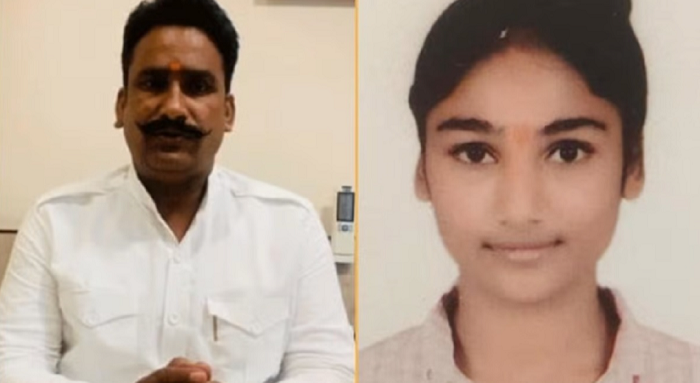
On Tuesday (November 8), the Ghaziabad police informed that a case has been registered against Dasna Devi temple priest Yati Narsinghanand for allegedly making derogatory remarks about Prime Minister Narendra Modi and other important figures in a viral video.
The case has been registered at the Masuri police station, Superintendent of Police Rural, Ghaziabad, Iraj Raja informed.
Yati Narsinghanand had in the viral video alleged that PM Modi is working on the ‘anti-Hindu’ lines of Prithviraj Chauhan and MK Gandhi and how Veer Savarkar and Nathuram Godse are labelled as traitors.
“What Modiji is doing is exactly what Prithviraj Chauhan did in his time; Chauhan did not leave any Hindu alive and did not spare the daughters of kings; instead, he abducted daughters of all the kings.” He even abducted his own brother’s daughter and did not leave a single prominent Rajput warrior but did not kill the Muslims, he deliberately forgave terrorist Mohammad Ghori in order to portray himself as a great king, however, ended up getting killed by Muslims only. This is exactly what Gandhiji did, and this is exactly what Modiji is doing. You laud Prithviraj Chauhan, Gandhiji, and Modiji as great, praise Modi, and applaud him for his foreign visits and achievements, but you have no idea what is happening to you. Gandhi becomes a hero, while Jaichand becomes a villain. This is a country of slaves, and Hindus are trapped in that mindset, which is why people like Jaichand, Veer Savarkar, and Nathuram Godse are labeled traitors and subjected to abuse,” he said in the viral video.
In a video message tweeted by the official Twitter handle of the Ghaziabad Police, SP Raja said, “A viral video doing rounds on social media in which Mahant Yati Narsinghanand made derogatory remarks about the Hon’ble Prime Minister and other great leaders has come to notice.” Taking cognizance of which, a case has been registered at Mussoorie Police Station.”
सोशल मीडिया के माध्यम से एक वायरल वीडियो संज्ञान में आया था जिसमे महंत यति नरसिंहानन्द सरस्वती मानीनय प्रधानमंत्री व अन्य महापुरुषों के लिए अभद्र टिप्पणी कर रहे थे। जिसका संज्ञान लेते हुए थाना मसूरी पर अभियोग पंजीकृत किया गया है। वीडियो बाइट- पुलिस अधीक्षक ग्रामीण@Uppolicepic.twitter.com/Urpkl3UAFa
Notably, the police have registered a case under IPC sections 153a (promoting enmity between different groups) and 295a (deliberate act intended to outrage religious feelings). Police have stated that further probe into the matter is underway and necessary action will be taken.
This is, however, not the first time that Yati Narisinghanand has made such demeaning and controversial comments. On August 29, 2021, a video of Yati Narsinghanand Saraswati went viral on social media platforms in which he was heard using derogatory language against women in politics, especially against those who are in BJP.
The Madhya Pradesh Police arrested a person named Saharukh under the state’s anti-love jihad law for hiding his religious identity from a 25-year-old Hindu woman and sexually exploiting her for over 5 months. The accused also abused the woman and threatened her to convert her religion to Islam, as per the complaint. The Police registered a case against the accused and arrested him on November 2.
According to the reports, accused Shahrukh (29) who was already married, had introduced himself as a Hindu person named Raju to the victim woman. The incident is said to have happened around January in Rajasthan’s Udaipur district. The woman, a resident of Indore, Madhya Pradesh had migrated with her friend to work as a housekeeping staff at a hotel in Udaipur.
The woman in the complaint confirmed that she met the accused when she had gone to Udaipur with her friend for a job. “On reaching the station, we booked an Ola cab to reach the hotel. Shahrukh was driving the vehicle. He introduced himself as Raju alias Rajkumar and tried to have a friendly conversation with us. We got acquainted and I started calling him every day to drop me from my residence to the hotel”, she said.
She added that they got married to each other after the accused proposed to her for marriage after three months or so. “We had become good friends in a short time as we used to meet daily. Later I realized that he liked me and also I had started liking him. He proposed to me for marriage one day and we got married after I agreed”, she stated. The accused and the victim got married seven months ago and started living together. The duo also registered their marriage in the court five months ago.
According to the woman, it is during the festival of Diwali that she discovered the truth about the accused. She discovered that her husband was a Muslim, his name was Shahrukh, and that he was already married to a Muslim woman. She also came to know that he was the father of two kids, one aged 7 and the other aged 4. “His wife had called during Diwali and I happened to talk to her. I told her that she had called the wrong number and that this cell phone number belonged to my husband Raju. But she argued and told me that the number belonged to her husband Shahrukh for years now. Later I checked his ID cards to discover that he was a Muslim and that I was cheated”, the victim woman was quoted.
On inquiring, the accused confessed that he was a Muslim and justified his crime by saying that a man is allowed to marry four women according to his religion. He also forced the victim to convert her religion to Islam and stay together with his family which included his first wife and two children. He also made her hostage and threatened her for life if she failed to accept Islam as her new religion.
The woman somehow managed to reach Indore and sought help from her family as the accused continued to threaten her over the phone. She also sought help from the members of the Hindu Jagran Manch and registered a Police complaint against the accused. The police then asked the woman to call the accused to Indore on the pretext of having a conversation, and later arrested him on November 2.
This is not the first case of grooming jihad that has been reported from the state of Madhya Pradesh. Earlier on October 29, in a similar case, the Madhya Pradesh Police had arrested a man identified as Sheikh Jahid under the state’s law against forced conversion attempts for hiding his religious identity from a Hindu woman and raping her for over 7 years. The accused had introduced himself as a Brahmin and had developed sexual relations with her.
Also, in August 2021, Aqib Ansari introduced himself as Aman Solanki to befriend a 21-year-old Hindu woman living on rent in his locality in the Dhar district of Madhya Pradesh. Reportedly, Aqib also visited temples to assert his ‘Hindu identity.’ He promised to marry the woman and established a sexual relationship with her and later forced her to convert her religion to Islam. The Police then filed a case against Aqib under IPC Section 376, Atrocities Act and Madhya Pradesh Freedom of Religion Ordinance, 2020 Act.
On November 8, Shahjahanpur Police informed the media that two persons, identified as Sikandar and Kichad, were arrested for alleged rioting after a copy of the Quran was found burning in the Farkh-e-Alam Miyan mosque. One Taj Mohammad burned a copy of the holy book on November 2. The police arrested him based on the evidence gathered using CCTV footage on November 3.
As per reports, hundreds of people from the Muslim community gathered outside the mosque after learning that a copy of the holy book was found burnt. They started protesting over the incident. The police reached the spot, after which the crowd got agitated and started rioting. They also tore posters and burnt them.
The rioters blocked the road. The shopkeepers immediately shut their shops to ensure their safety. People who were outside ran back to their homes and closed the doors. Superintendent of Police S Anand said the rioters caused hindrance in police work.
Beri Police Station in-charge Pranjal Singh Yadav filed a complaint in the matter at Kotwali Police station in the matter. An FIR was registered on November 5 under Sections 147, 186, and 341 of the Indian Penal Code (IPC) based on the complaint against Sikandar, Parvez, Irshad, Kichad, Danish and others. 300 unnamed rioters were also booked in the FIR. Out of the 18 named in the FIR, two accused, Sikandar and Kichad, have been arrested and sent to jail.
Additional Superintendent of Police (ASP) Sanjay Kumar said in a statement that raids were being carried out to arrest the other accused.
Taj Mohammad was arrested for burning Quran
On November 3, Shahjahanpur police arrested Taj Mohammad for burning Quran. When questioned, Taj Mohammad said it wasn’t him but his soul that committed this act. Syed Shah Fakhre Alam Mian Mosque is located in Mohalla Bavujai of Chowk Kotwali area of Shahjahanpur city. On Wednesday evening, two youths barged into the mosque and burnt the Quran kept there. When Imam Hafiz Nadeem and others arrived for evening prayers, seeing the burnt pages of the Quran, they informed the Imam of the mosque.
Taj Mohammad alias Munna lives in the Badjui area, which is located at a distance of 3 kilometres from the mosque. This area comes under the Sadar Bazar police station of Shahjahanpur.
‘My soul burnt the Quran’, says accused Taj Mohammad
Taj Mohammad said in his confession, “I don’t do any work. I’m always roaming around being jobless. My family is not getting me married. This keeps me upset.” When asked why he burned the religious text, accused Taj Mohammad said, “It is not me but my soul that has burnt it.” On Thursday morning, the District Magistrate took stock of the area. He appealed to everyone not to pay heed to rumours.
On Tuesday (November 8), BJP President JP Nadda slammed the Congress party for entertaining the derogatory remarks of its leader Satish Jarkiholi against the Hindu community and sowing divisions in the society. He made the remarks in an exclusive interview with psephologist Pradeep Bhandari of India News.
At about 4:25 minutes into the conversation, Bhandari remarked, “Congress party is engaged in its ‘Bharat Jodo Yatra‘. A senior leader from Karnataka, Satish Jarkiholi, has said that Hindu is a Persian word and it means dirty. How do you analyse such comments?”
JP Nadda responded, “This is not a ‘Bharat Jodo Yatra’ but rather a ‘Bharat Todo Yatra’. People like Satish are players in the Congress’ agenda. This is their job to divide people by making such remarks.”
The BJP President pointed out that Rahul Gandhi had earlier gone to JNU to show solidarity with those associated with anti-India sloganeering.
“After terrorists were assassinated in the Batla House encounter, Sonia Gandhi couldn’t sleep for nights. This is their level of affection…People like Satish are their foot soldiers,” Nadda concluded.
The Background of the controversy
On Sunday (November 6), Satish Jarkiholi made derogatory remarks against the Hindu community at Nippani in the Belagavi district of Karnataka. He said that the word ‘Hindu’ originated from Persia and was not an Indian term.
He claimed that the original meaning of the term was dirty and insulting and also wondered why people in India were taking the term ‘Hindu’ so seriously.
“Where did the term Hindu come from? Is it our own? No. It is of Persian origin. Where is that? It refers to countries like Iran, Iraq, Kazakhstan, and Uzbekistan. What is the relationship between India and such countries? How can it be an Indian term? There needs to be a debate on this,” he alleged.
“Please refer to sites like Wikipedia. If it is not an Indian term, why are some people taking it so seriously? If you understand its original meaning, you will be ashamed of yourself. The original meaning of the term is very dirty and insulting,” he further claimed.
The video clip of the incident went viral over social media with many including the Congress party criticizing the leader for passing controversial comments against Hinduism. On Tuesday (November 8), Satish said that he stood by his objectionable remarks.
JP Nadda lashes out at AAP
On being asked by Pradeep Bhandari about BJP leadership’s fierce attacks on AAP, he pointed out that it was necessary to counter the party’s propaganda in time.
“Ya banner-based party hai, hum cadre-based party hai (Aam Aadmi Party is a banner-based party while we are a cadre-based party,” he reiterated. The BJP President revealed how the Arvind Kejriwal-led party puts up large banners and gives a false impression of winning elections.
“It has lost deposits in Uttarkhand, and Goa and will lose deposits in Himachal Pradesh as well. AAP makes narratives through advertisements and people can now see through their administrative failure..”
JP Nadda also exposed the doublespeak of Arvind Kejriwal. “He has zero credibility left. He earlier promised to not fight elections, form a party, take support from congress or give tickets to criminals. Three of AAP leaders are now languishing in jail,” the BJP President emphasised.”
JP Nadda on upcoming elections
He also pointed out that the real competitor of BJP in the poll-bound States of Himachal Pradesh and Gujarat is Congress, despite its leaders treating the Vidhan Sabha elections as local elections.
The BJP president dismissed the ‘rebel factor’ in Himachal Pradesh and said that it would have negligible impact in such a ‘politically aware State.’ He pointed out how the top leadership of the Congress has refrained from campaigning in the State, leaving it up to local leaders to fend for themselves.
He informed that the saffron party will outperform itself in Himachal Pradesh as compared to the 2017 Vidhan Sabha polls and that the party is in a comfortable position in Gujarat (despite the surmounting anti-incumbency).
While highlighting the recent victory in the Gopalganj by-poll, JP Nadda said that it was proof enough that the BJP can manage to win elections despite Opposition unity and consolidation of its votes.
On Tuesday, Qatar which is all set to host this year’s Football World Cup slammed a cartoon published by a French satirical newspaper showing Qatari football players as terrorists. The caricature has sparked outrage on social media with many Qatari users calling it ‘racist and Islamophobic’.
According to the reports, the cartoon was published by a French newspaper named Le Canard enchainé in its October issue. The image specifically focused on Qatar and its role as the host of the FIFA World Cup 2022. The Qatari users on social media slammed the cartoon and also questioned the ethics of the publication for illustrating a derogatory depiction of racism, supremacy, and Islamophobia.
The image published by the French newspaper shows seven bearded men with “Qatar” emblazoned across their shirts above large numerals. They appear to be playing football through the dunes, armed with machetes, rifles, and rocket launchers. One can also be seen wearing an explosive belt. Five are dressed in blue robes, while the other two are dressed in black shirts and trousers with black masks concealing their faces, resembling ISIS terrorists. Five guys in white robes stand on the sidelines, watching the game.
The controversial image in the French magazine
One of the enraged users criticized the publication and said, “Le Canard Enchaîné published a despicable cartoon showing its blatant racism and hatred of Islam. They describe Qatar as an authoritarian emirate and its national team as terrorists”.
نشرت Le Canard Enchaîné الفرنسية كاريكتور حقير يظهر عنصريتها الفاضحة وكراهية الإسلام يصف #قطر على أنها إمارة استبدادية ومنتخبها إرهابيون. #قطر_2022pic.twitter.com/04T0iDNwtm
“A special issue issued by the French newspaper Cannar Enchaine about Qatar. You cannot imagine the extent of the hidden French hatred, contempt and insult to Qatar, its people, its government and its symbols. I wonder why the Qatari ambassador is still in Paris”, another user tweeted.
عدد خاص اصدرته جريدة لكنار انشينيه الفرنسية عن قطر لا يمكنكم أن تتخيلوا حجم الحقد الفرنسي الدفين والاحتقار والإهانة فيه لقطر وشعبها وحكومتها ورموزها. اتعجب لماذا لا يزال السفير القطري في باريس؟؟؟!!! pic.twitter.com/JwbtdOWdOP
Meanwhile, Hamad Al-Kawari, a minister of state and the president of Qatar’s National Library also took cognizance of the incident and asked France to show some sportsmanship. “Even caustic satire is welcome!!! But the Canard Enchaîné decided to resort to lies, hatred and grudges to attack Qatar and denigrate it,” he tweeted.
La satire même caustique est bienvenue!!! Mais le Canard Enchaîné a décidé de recourir au mensonge, la haine et la rancune pour attaquer le Qatar et le dénigrer. Gardez un peu de loyauté et d’esprit sportif au moins #france#FIFA2022pic.twitter.com/TfHjAsDxDb
Earlier last month, Qatar’s Emir Sheikh Tamim bin Hamad Al Thani had criticized an ‘unprecedented campaign’ of criticisms against the country ahead of the World Cup. “It became clear to us that the campaign continues, expands, and includes fabrication and double standards until it reached a level of ferocity that made many questions, unfortunately, the real reasons and motives behind this campaign”, he had said. He also added that no other country had faced this level of criticism in the past.
He also slammed several Western countries like Germany on November 8 after they called for a boycott of the upcoming event in the Arab country for its position on LGBTQ+ rights and use of ‘slave labor’. “It is ironic when this tone is struck in countries in Europe that call themselves liberal democracies. It honestly sounds very arrogant and very racist,” the minister was quoted as saying to the German newspaper Frankfurter Allgemeine Zeitung.
Reports mention that several cities in France, including the capital Paris, will not broadcast World Cup matches, citing concerns about migrant workers’ rights and the game’s impact on the environment. Qatar’s management of migrant workers and human rights record have been under question since the country has been given the privilege to organize the 2022 FIFA World Cup.
Recently, Qatar’s Foreign Minister Sheikh Mohammed bin Abdulrahman Al Thani accused Germany of ‘double standards’over the reports of criticism for the country being allowed to host the World Cup. He also reminded the people that the European countries have no problem with Qatar when it comes to energy partnerships or investments.
Qatar won the right to host the summer World Cup in December 2010 against all odds in 50 degrees celsius temperature, before FIFA moved the World Cup to winter for the first time in history to protect players from that heat. The tournament will now be held in the small Arabian country and about 1.2 million international visitors are expected in Qatar during the Nov 20- Dec 18 tournament.
It is notable here that Qatar has been linked with Islamic terrorism and has been accused of spreading Wahabism by many sources. Its links to numerous organisations that fund the Muslim Brotherhood, Hamas, Al Qaeda etc have been highlighted in recent times.
On November 8, Tamil Nadu’s Finance Minister P Thiagarajan downplayed the Coimbatore blast during an interview with India Today. He refused to call it a terror attack stating National Investigation Agency (NIA) investigation is underway in the matter, and he cannot comment without getting a report from them. His remarks came at a time when ISIS literature and other incrementing material have already been recovered from Jamesha Mubin, the 29-year-old accused who died in the cylinder blast.
During the 44-minute long interview, Akshita Nandgopal, Associate Editor and Anchor for India Today questioned Thiagarajan about the recent cylinder blast that happened in Coimbatore. She pointed out that during an investment summit in Karnataka, it was reported that the state might lose out on investments because of the communal incidents that happened over time. She compared it with the recent blast in Coimbatore and asked about his views.
‘Coimbatore had a much worse series of events’
Thiagarajan reminded Nandgopal about the past series of “much worse” incidents. He said, “One blast is not the basis for anything, and maybe you are relatively young, but you may not remember that Coimbatore had a much worse series of events than this in the past. So I think this particular blast, I would venture to say that Coimbatore is probably the second Hub in Tamil Nadu after Chennai and will continue to be that way. I am on the ground. I am responsible for administration. I am saying that it will continue to show results and deliver jobs and grow faster than almost any place in India. One blast notwithstanding or the politicisation of one, you know, was not even a blast it was a cylinder and a car going off in the middle of multiple attempts at other things.”
Minister refused to consider it a terror act
When asked if he maintained it was a cylinder blast, he said, “The record shows it was a cylinder in a car there is a video of the cylinders being loaded there are the people who are doing it. They have been arrested. The case has been transferred to the NIA. Some facts are not in question. The facts are not interpretable by political parties because they feel like it. Facts are facts. After that, you can interpret the consequences, the implications, the history, the future and all that, but facts are facts. You got to interpret facts if there is video evidence of the cylinder being loaded in the car and then that car being exploded. I do not understand why you assume that every party can have a different view of that fact.”
When asked about the Bharatiya Janata Party state chief K Annamalai stated that it was a terror attack, and Thiagarajan refused to answer the allegations. He was further asked about DMK not taking the blast seriously. He said, “There is no question of the DMK doing anything or not doing anything. This is not a political issue. [The question is if] a government has to take it seriously or not seriously. A government took it seriously and transferred it to NIA before they asked.”
Nandgopal questioned why there were alleged attempts to downplay the possible terror angle by calling it a cylinder blast. Thiagarajan lashed out at the anchor and said her information could not be superior to the state. He said, “Your information cannot be of superior quality than the government of Tamil Nadu receives. I do not think you have your own intelligence Department. Whatever the police have done has been done because the administration runs the police. So I am not sure why you believe you have any inside information beyond what the government says.”
‘Are you trying to add oil to the fire?’ Minister lashed at the anchor
He further questioned the anchor if she was trying to add oil to the fire. The anchor had asked him if there was an intelligence failure as the whole incident looked like “sheer luck” that the blast happened and police came to know about what had been cooking in the state. Thiagarajan did not like it being called “sheer luck”. He said, “I do not understand why that is luck. They plan to ignite a cylinder. Their cylinder ignites. Why do you assume there’s luck? I do not understand. I do not speculate on things I do not know, and that distinguishes me from you. I do not make assumptions about what it was or what it was not. It was an incident that is under investigation by the NIA. The NIA is not controlled by the government of Tamil Nadu. The NIA will give a report based on that we can have a conversation.”
When asked if, based on the available information, the Tamil Nadu government would call it a terror attack or not, Thiagarajan evaded the point. He said the investigation is under NIA, and they cannot do anything until the NIA returns and gives them information. “What is it that you want us to do? How can we? What is the point of giving the investigation to the NIA if we are going to run a parallel decision-making setup,” he said.
‘I do not take rabble rousers seriously’
When asked that BJP said they demanded that the investigation be given to NIA, Thiagarajan asked to show any document that said NIA approached them to take over the investigation. He said the state government handed over the investigation to NIA before any such request came. He also refused to comment on the allegations raised by BJP that the state government was trying to save a particular community. He said, “I do not take rabble Rouses seriously. I do not think instigators seriously. I take reasonable human beings seriously. I do not consider the individual [referring to Annamalai] you mentioned as one of them.”
Coimbatore Blast
On October 22, Jamesha Mubin was caught on CCTV loading a large object (LPG cylinder) wrapped in a white bag onto his Maruti 800 car. It was around 11:25 pm. Mubin was accompanied by three other men, namely, Mohammad Riyaz, Feroz Ismail, and Mohammad Navaz Ismail.
At around 4 am on October 23 night, the car carrying Jamesha Mubin exploded mid-journey in the Ukkadam area of Coimbatore. The incident took place adjacent to the Kottai Easwaran Temple.
Preliminary investigation revealed that one of the two commercial cylinders onboard the car had exploded while the other remained intact. As per reports, the remains of Mubin’s body were unrecognisable.
A total of 6 people, namely, Mohammad Thalka, Mohammad Azarudheen, Riyaz, Nawaz, Afsar Khan and Feroz, were arrested in connection to the case. It also came to light that the NIA interrogated Mubin in 2019 regarding the Easter bomb blasts.
It later came to light that Jamesha Mubin was motivated by the Islamic State and engaged in preparing for jihad. Reportedly, he was on a suicide mission to destroy a large area, including a Hindu temple using his car bomb.
On October 27, the case was transferred to the NIA by the Centre, following the recommendation of the Tamil Nadu Chief Minister. An official said, “The Union home ministry decided to hand over the Coimbatore blast case to the NIA.”
A clash broke out between a Congress leader and members of the Hindu organisation, Sri Ram Sene, over saffron flags put up on the occasion of Bababudangriri Yatra.
As per reports, the incident took place in the hill town of Sringeri in the Chikkamagaluru district of Karnataka on Tuesday (November 8) evening. Rafiq, a Congress leader and a member of the local masjid committee, took offence to the placement of saffron flags in front of the Masjid.
This led to a heated argument between him and Arjun, a member of Sri Ram Sene, which later escalated into a clash. The duo threw blows at each other and were admitted to the Sringeri Taluk Government Hospital for treatment.
Safrron flag put by Sriram Sene, image via Times Now
On receiving information, the police led by ASP Gunjan Arya rushed to the spot to pacify the situation. As per reports, no casualties were reported during the outbreak of violence.
Arjun has expressed fear for his life while Rafiq has demanded adequate security from the police. A First Information Report (FIR) was lodged against Rafiq and Arjun, based on complaints and counter-complaints.
The duo was promptly arrested and a peace meeting was also organised between the Hindu and Muslim communities by the police.
In a tweet, ‘journalist’ Imran Khan wrote, “Tying of saffron flags in front of #masjid in #Sringeri #Karnataka led to a fight between SriramSene members & masjid committee member Rafiq.”
“Case registered by Chikkamagaluru police against both Rafiq & sene member Arjun. Cops later called for a peace meeting of both communities,” he added. In a video shared by him, the cops were seen interacting with members of the affected communities.
Gujarat was recently designated a ‘Har Ghar Jal’ state, which indicates that all homes in the state now have access to fresh tap water. As part of the ‘Jal Jeevan Mission,’ the project has been completed in phases throughout the years. According to state officials, all 91,73,378 houses in the state now have access to tap water.
On August 15, 2019, Prime Minister Narendra Modi inaugurated the ‘Jal Jeevan Mission’ from the ramparts of Red Fort. The ‘Har Ghar Jal’ initiative is a component of the mission, which seeks to deliver sufficient quantities of quality water to every rural family in India by 2024.
मेरे लिए दो गुजरात हैं एक मोदीजी के मुख्यमंत्री बनने से पहले का और दूसरा बनने के बाद का!
The campaign attempts to free sisters and mothers from household water-fetching activities. The project provides residents in the country’s rural areas with comfort and dignity. As Gujarat’s journey is significant learning for all states, here is the account of how a drought-prone dry state became self-sufficient thanks to outstanding leadership and decision-making.
Gujarat prior to 2001
Gujarat only possesses 6.39% of India’s land area and 2.28% of its water resources. Again, intra-state distributional imbalances place restrictions on this. The state experienced periodic droughts as a result of its substantial coefficient of variation across time and location and average annual rainfall of 80 cm.
Prior to 2001, Gujarat’s human and cow populations were seriously at risk due to a severe drinking water deficit. In order to provide drinking water temporarily, governments were compelled to spend billions of rupees on road tankers and, in certain cases, special water trains. The State, which had a social culture that was typically peaceful and cordial, even had “water riots” because of severe water shortages that were made worse by insufficient management of water resources.
Additionally, due to the water crisis, residents of Gujarat’s drought-prone Saurashtra and Kutch (Western and South Western Gujarat) moved to the state’s Central and South areas. This human migration was usually followed by the movement of cow herds, and it led to the displacement of hundreds of thousands of people on economic, social, and cultural levels.
Gujarat saw 12 major droughts between 1980 and 2001, according to statistics from the India Meteorological Department from 2015. The average depth of the groundwater between 1975 and 1980 in the districts of Gujarat and Kutch was 30 metres. But by 2001–2002, it had dropped to 150–250 m. The groundwater level was dropping at a pace of 3-5 metres per year. The Saurashtra region, in particular Kachchh, was on the brink of turning into a desert in around two decades if the situation was not quickly addressed.
Narendra Modi becomes chief minister of Gujarat in 2001
The story of how a state like this came to be a national model for managing water resources began in 2001 when Modi was appointed Chief Minister. From his expertise as a social worker, Modi understood that the age-old issue in Gujarat could not be resolved by conventional approaches. It was necessary to implement a scientific strategy that made use of modern technology, astute planning, and assured delivery in a staggered manner.
Shortly after taking office, Modi instructed his team to improve existing canal systems rather than just rely on Narmada water, and he insisted on participatory management of drinking water and agriculture. He broke the administrative stranglehold on projects while including NGOs and water beneficiaries from the start. Most critically, Modi allocated money to build the infrastructure needed to distribute water while serving as chief minister because he understood how important it was to the social transformation he envisioned.
Birth of BISAG
The Gujarat government created the state-level Bhaskaracharya Institute for Space Applications and Geoinformatics (BISAG) to aid in the supply of services and solutions for the deployment of map-based GeoSpatial Information Systems. The BISAG, a specialised institute that used satellite remote-sensing technologies and GIS-based maps to aid expedite the Gujarat infrastructure development model, was founded in 2003 as a result of the scientific attitude, with an emphasis on the use of technology. When the concept was mastered, it was applied to the water issue.
The data on existing water bodies, dams, ponds, rivers, and canals in Gujarat state were compiled using high-resolution Indian Remote Sensing satellite data. A system was developed to visualise the data along with other crucial information, such as the road and rail network, administrative boundaries, slope, type of soil, land use, geology, landform, forest details, sanctuary and national park, etc., after the creation of the current data. A GIS-based platform was developed using the data to visualise the datasets.
Satellite images allowed for a better understanding of the landscape. By overlaying various civilian use datasets, such as administrative details, watershed and forest area details, kind of land and survey number details of landholdings, the data was further refined and important information was obtained. Finally, this data was used at ground level to execute projects.
Micro-level check dams
Check dams are a traditional way of replenishing groundwater, particularly in dry locations. Gujarat had about 6,000 such check dams when Modi became CM in 2002. One of the many reasons why this incredibly effective method of conserving and using water wasn’t expanded was a lack of understanding about where to build the dams to be more effective, as well as local political priorities. Space technology based on BISAG arrived to help.
Check dam. (Image: Telangana Today)
Due to this, the total number of check dams increased from just under 6,000 to over 100,000 in only a few years, reaching 166,062 by mid-2016 with a storage capacity of more than 28,408 million cubic feet (mcf). Check dams were put in place, which greatly boosted the water supply.
Macro-level projects
At the macro level, three significant initiatives transformed the landscape of Gujarat, particularly in the Saurashtra, Kachchh, and North Gujarat areas. The Narmada Main Canal, the Sujalam Sufalam Yojana, and the SAUNI Yojana are the three projects. Satellite-based planning and execution were also used in the deployment of these three major initiatives.
The first one is the Narmada Main Canal. The Narmada canal is the world’s longest irrigation canal, reaching 458 kilometres in length and transporting 40,000 cusecs of water. The system of branch canals, sub-canals, and distributaries, moreover, is what has made the Narmada canal such a transformational undertaking. PM Modi launched the Kachchh branch canal from this Narmada Main canal, which helps provide water to the most distant parts of Kachchh.
Narmada canal. (Wikimedia Commons)
Secondly, there is the Sujalam Sufalam Yojana. Although it also covers districts from other regions, the main goal of this initiative is to irrigate the areas of North Gujarat. Due to the deepening of lakes, check-dams, rivers, and reservoirs, which started in 2018 after a weak monsoon, the state’s water storage capacity has increased by 23,000 lakh cubic feet to date. It is a 332 km canal network that aids in bringing floodwaters from the Narmada and other rivers to the parched area of North Gujarat and supplies irrigation to around 2.2 million hectares of arable land.
Image: News18
The only region still in need of a solution was the Saurashtra region, as the Narmada Main Canal had already provided water to the Kachchh region and Sujalam Sufalam had resolved the water issue in North Gujarat. The SAUNI Yojana (Saurashtra Narmada Avtaran Irrigation Yojana), which means literally “reincarnation of the Narmada River in the region,” was thus introduced. In order to transmit the extra Narmada waters to more than 115 main reservoirs and irrigate more than 1 million acres of land, a 1,126-km network of four-link pipes was designed and constructed.
Image: News18
The organisational structure of water resource management was also altered by Narendra Modi, who replaced the umbrella organisation with functional divisions. The Gujarat Water Supply and Sewerage Board retained responsibility for constructing and regulating water supply and sewerage systems.
In order to give village-level institutions the competence to manage and maintain their own water supply infrastructure, the Water and Sanitation Management Organization (WASMO) was founded. Sardar Sarovar Nigam Limited was created as an independent organisation responsible for completing the project. To transport Narmada waters, Gujarat Water Infrastructure Limited was charged with developing bulk water pipe networks.
The work done by the Gujarat state government under Modi gave the state a new life, which could have turned into a desert if the issue of scarcity of water was not addressed. PM Narendra Modi can undoubtedly take credit for developing an effective water management policy as the chief minister of Gujarat.
Addressing a function in the national capital on the 553rd Prakash Parv of Guru Nanak Dev, Prime Minister Narendra Modi spoke about the importance of the Citizenship Amendment Act that was passed in 2020. He emphasised the importance of CAA as a means to help the persecuted Hindus and Sikhs affected by the partition.
PM Modi said, “In memory of the sacrifices by the people of Punjab and the country during the partition, the country has started commemorating the Partition Horrors Remembrance Day. We have also tried to create a way to give citizenship to the Hindu and Sikh families affected by the Partition by bringing in the CAA. You must have seen that Gujarat granted citizenship to persecuted Sikh families abroad. This has given them confidence that India is the home for Sikhs living anywhere in the world.”
Interestingly, on the 31st of October, the central government invited applications for citizenship from Hindus, Sikhs, Jains, Christians and Buddhists hailing from Afghanistan, Pakistan and Bangladesh who are currently residing in the Mehsana and Anand districts. The Modi government delegated its powers to grant citizenship to the collectors of the mentioned districts. While the rules under the CAA are yet to be framed, the MHA invoked the provisions of the Citizenship Act, 1955.
No sooner had PM Modi made these remarks about CAA, the opposition hit at PM Modi and started peddling the very falsehoods about CAA that led to widespread and organised riots against Hindus in 2020.
State Congress president Adhir Chowdhury said, “Citizenship cannot be granted based on a person’s religion. The Constitution of the country does not allow such a thing. It goes against the ethos of the country. This is nothing but an attempt to polarise the people of Gujarat ahead of the Assembly polls.”
Similar statements were made by TMC and CPM as well.
CPM leader Sujan Chakraborty said, “The country witnessed Partition 75 years ago. Are those staying in the country for last 75 years not citizens of India? If not then who is responsible for creating such a situation? They have been used as vote bank for so long. Now after not recongnising them citizens for so long, the Centre is now talking about granting them citizenship. It is nothing but politics”.
TMC leader Kunal Ghosh, according to Indian Express, echoed the same sentiments. He said that the centre was taking a discriminatory approach towards granting citizenship.
What Prime Minister Modi said is a fact – that Hindus, Sikhs and other non-Muslim denominations were persecuted after the partition in neighbouring Islamic nations and continue to be persecuted till date. However, the opposition used this opportunity to peddle the same dangerous tropes and falsehoods about CAA that led to anti-Hindu violence in 2020 in Northeast Delhi.
What is the Citizenship Amendment Act (CAA)
The Citizenship Amendment Act is a law passed by the Indian Parliament that is directed towards providing citizenship rights to people who belong to minority religions in the neighboring Islamic countries of Pakistan, Bangladesh and Afghanistan. The Act also reduces the minimum term required to stay in India before applying for citizenship by naturalization to five years instead of 11 years. Thus, the law applies to Hindus, Jains, Buddhists, Sikhs, Zoroastrians and Christians from the specified neighboring Islamic countries.
This Amendment adds proviso in section 2, in sub-section (1), in clause (b) in the Citizenship Act, 1955. The Proviso reads as “Provided that any person belonging to Hindu, Sikh, Buddhist, Jain, Parsi or Christian community from Afghanistan, Bangladesh or Pakistan, who entered into India on or before the 31st day of December, 2014 and who has been exempted by the Central Government by or under clause (c) of sub-section (2) of section 3 of the Passport (Entry into India) Act, 1920 or from the application of the provisions of the Foreigners Act, 1946 or any rule or order made thereunder, shall not be treated as illegal migrant for the purposes of this Act.”
Further, new section 6B added in the Citizenship Act, 1955 states that on and from the date of commencement of the Citizenship (Amendment) Act, 2019, any proceeding pending against a person under this section in respect of illegal migration or citizenship shall stand abated on conferment of citizenship to him, provided that such person shall not be disqualified for making application for citizenship under this section on the ground that the proceeding is pending against him and the Central Government or authority specified by it in this behalf shall not reject his application on that ground if he is otherwise found qualified for grant of citizenship under this section.
Further, it adds in the proviso that who makes the application for citizenship under this section shall not be deprived of his rights and privileges to which he was entitled on the date of receipt of his application on the ground of making such application.
The section 6B (4) adds that nothing in this section shall apply to the tribal areas of Assam, Meghalaya, Manipur, Mizoram or Tripura as included in the Sixth Schedule to the Constitution and the area covered under “The Inner Line” notified under the Bengal Eastern Frontier Regulation, 1873.
It is pertinent to understand that CAA is relevant only for Hindu, Sikh, Jain, Buddhist, Parsi and Christian foreigners, who have migrated from Pakistan, Bangladesh, and Afghanistan into India up to 31.12.2014, on account of persecution faced by them due to their religion. It does not apply to any other foreigners, including Muslims migrating to India from any country, including these three countries.
The falsehoods peddled by TMC, CPM and Congress on CAA after PM Modi’s statement
The common theme in the statements made by TMC, Congress and CPM leaders after PM Modi’s speech was that the central government was providing citizenship on the basis of religion and that the move was discriminatory. In fact, the CPM leader went a step ahead and insinuated that CAA would somehow affect the Muslim citizens of India by asking if the people living in this country for the past 75 years were not citizens at all.
These falsehoods have been debunked several times in the past and it is pertinent to note that it is these very falsehoods that led to mass violence against Hindus in 2020. While opposition parties peddle such tropes, it is important to remember that CAA does not pertain to Indian Citizens at all and therefore, to even ask the question about the citizenship status of the people (Muslims) living in this country for the past 75 years.
It is also disingenuous to claim that CAA is discriminatory in any manner. This is a law that aims to provide citizenship to those minority communities that have been persecuted by the majority Muslim community in Islamic nations who came to India as refugees up until 31st December 2014. It has nothing to do with the normal process of citizenship being granted – for example – a Muslim can apply for citizenship in India too and he will have to go through the normal procedure for his application to be accepted.
The present legal process of acquiring Indian citizenship by any foreigner of any category through Naturalization (Section 6 of the Citizenship Act) or through Registration (Section 5 of the Act) stays operational. The CAA does not amend or alter it in any manner whatsoever. Hundreds of Muslims migrating from these three countries have been granted Indian citizenship during the last few years.
If found eligible, all such future migrants shall also get Indian citizenship, irrespective of their numbers or religion. In 2014, after the settlement of Indo- Bangladesh boundary issues, 14,864 Bangladeshi citizens were given Indian Citizenship when their enclaves were incorporated into the territory of India. Thousands of these foreigners were Muslims.
The core argument that was made against the CAA was that the provisions do not apply to the persecuted Shias, Ahmadiyya and Rohingya Muslims of the neighbouring countries and hence, it is unconstitutional and ‘communal’. First and foremost, the law is dedicated to providing relief to the victims of religious persecution. Shias, Ahmadiyya and Rohingya Muslims are Muslims; they are all adherents of the Islamic faith. They only belong to different sects within Islam. Thus, the provisions of a law that is dedicated to providing relief to victims of religious persecution can, naturally, not apply to the said Islamic sects.
It is also a dangerous game that is being played by the opposition given that it was these very falsehoods that led to anti-Hindu Delhi Riots in 2020. There were repeated tropes about the citizenship of Muslims being affected adversely due to CAA. The opposition had also spread falsehoods saying that Muslims will eventually be deported from the country due to the combination effect of CAA and NRC – even though NRC was only a promise and not even a draft for national NRC has been released.
It is rather concerning that even after the deaths of over 50 people in an organised riot that aimed to “teach Hindus a lesson”, the very same falsehoods that were used to organise mass action and violence against Hindus in 2020 is being repeated again.
State Bank of India (SBI), India’s largest lender, reported its highest-ever quarterly profit in the second quarter. The bank’s net profit increased 74% year on year for the quarter that ended on September 30, as core income increased and bad loan provisions decreased as the non-performing assets (NPA) ratio dropped.
SBI standalone profit jumps 74 per cent to Rs 13,265 crore in the second quarter of FY23 as against Rs 7,627 crore a year ago
The net profit for the quarter was Rs 13,265 crore, up from Rs 7,627 crore the previous year. Net profit more than doubled from quarter to quarter. The recorded profit is way higher than Bloomberg’s estimates of Rs 10,262.
In Q2 of FY23 (year-on-year)
✅ SBI reports 74 % jump in profit to Rs 13,265 cr ✅ Canara Bank reports 89% jump in profit to Rs 2,525 cr ✅ UCO Bank reports 145% jump in profit to Rs 504 cr ✅ Bank of Baroda reports 58.70% profit of Rs 3,312.42 cr (2/2) pic.twitter.com/YiaspDnhws
The productive increase in quarterly profit was attributed to solid interest income growth due to a drastic increase in credit expansion. Net interest income (NII) or core income increased 13% year on year at Rs 35,183 crore due to a strong 20% increase in credit growth, nearly 200 basis points (bps) higher than the industry average.
Loan growth was pushed by both retail and corporate segments, with corporate loan growth outpacing retail loan growth (19%) by 21% year-on-year, led by the home loans portfolio surged 14.57% year-on-year, at Rs 5.94 lakh crore as of September 30.
SBI’s provisions fell 25% year on year to Rs 2,011 crore in Q2FY23, owing to improved asset quality, with the net non-performing asset (NPA) ratio falling to less than 1%.
According to Dinesh Khara, chairman of the State Bank of India, global economic activity is witnessing a slowdown with inflation higher in developed markets than in developing market economies. Despite these uncertainties, the Indian economy has proven to be resilient.
“Aggregate demand indicators show that the start of the holiday season and pent-up demand kept the growth impulses very strong,” he said.
SBI is witnessing corporate credit demand from infrastructure, renewable energy, and oil marketing companies. Non-bank finance companies are driving demand in the services sector, according to Dinesh Khara.
Khara also predicted a 14 to 16% increase in credit growth by the end of the year.
“Based on current trends, we will most likely see credit growth of 14-16% by the end of the year,” Khara stated.