Home Blog Page 2701

NCP leader forcefully stops screening of Marathi movie ‘Har Har Mahadev’ claiming it distorts history of Shivaji Maharaj, supporters manhandle audience

On November 7, NCP leader and former state housing minister Jitendra Awhad forcefully stopped the screening of the Marathi movie Har Har Mahadev in a Thane mall. He alleged that the movie showed a distorted version of the history of Chatrapati Shivaji Maharaj to stir political drama. Furthermore, he targeted the movie Vedat Marathi Veer Daudale Sath, alleging that Akshay Kumar, who is playing the role of Shivaji Maharaj in the film, is six feet tall while Shivaji was much shorter.

India Today’s journalist Aditya Bidwai shared a video where Awhad supporters beat up an audience member for opposing them.

MNS leader urged to restart the show

Maharashtra Navnirman Sena (MNS) Thane-Palghar district president Avinash Jadhav reached the multiplex soon after NCP workers left. He urged the multiplex to restart the show. He said, “It is wrong to manhandle an audience who had come to watch a movie. The police need to arrest the accused. In the meantime, I am going to sit in the theatre and watch the whole movie; whoever wants to come and stop the show is welcome to try and do so.”

‘distorted facts to create hype’

Awhad claimed in a statement that the movie makers wholly distorted the facts. He said, “Shivaji is shown sleeping on a bench while Afzal Khan is stabbing him. The actual history is different; Shivaji always knew Afzal would be stabbing him, and he was ready for it. Similarly, the relationship between Bajiprabhu Deshpande and Shivaji is defamed in the movie. People are influenced by the movies, and we will not let them change history.”

He further claimed that though they respect freedom of expression, they have the right to oppose distortion of history. “Artistic freedom is one thing, but we won’t tolerate complete distortion of facts,” he added. Furthermore, he claimed that the film portrayed the army and Shivaji Maharaj incorrectly. He said, “The film shows his soldiers dressed like goons. It shows Baji Prabhu talking about rebellion against King Shivaji. We won’t allow this.”

Speaking on how movies influence politics in states like Tamil Nadu, he added, “Even the characters are different, the Mavalas or soldiers were never fair and handsome. Even Akshay Kumar in another recent movie is nothing similar to the real Shivaji. Moreover, he is 53, and Shivaji died at 50.”

Audience demand refund

The audience demanded a refund after the show got cancelled. They also got into an altercation with the NCP workers.

Earlier, screening was stopped by NCP workers at a Pune theatre.

Delhi liquor scam: Deputy CM Manish Sisodia’s close aide, Dinesh Arora, turns approver

0

Trouble has mounted for the Aam Aadmi Party (AAP) and Delhi Deputy Chief Minister Manish Sisodia as the latter’s close aide Dinesh Arora, who is also a co-accused, told the court on November 7, that he is ready to turn approver in the Delhi excise policy case or the Liquor scam case.

Earlier today, the Central Bureau of Investigation (CBI) filed an application in Delhi Court under Section 306 Crpc to make businessman Dinesh Arora a witness in the ongoing money laundering investigation into suspected anomalies in the now defunct excise policy. 

During the hearing today, Dinesh Arora sought pardon in the case and said he has made the confessional statement under Section 164 (Recording of confessions and statements) of the CrPC.

Asked if there is any pressure from the Central Bureau of Investigation (CBI), Arora replied in the negative. “I am ready to give voluntary disclosure about my involvement in the alleged offences. I have earlier cooperated during the investigation of the case by the CBI. I am doing this without any pressure or undue influence upon me by the CBI or any other person,” said Arora.

The Rouse Avenue Court will record Arora’s statement on November 14 at 10:30 am. As per the court, due to the sensitivity of the matter, the case will be heard in-camera.

Notably, in the FIR filed by the CBI, the agency said that Amit Arora, Dinesh Arora and Arjun Pandey were “close associates” of Manish Sisodia, and were actively involved in managing and diverting the money collected from liquor licensees. Delhi DY CM and AAP senior leader Manish Sisodia is the prime accused in the case.

According to the First Information Report (FIR), co-accused Sameer Mahendru transferred Rs 1 crore to Radha Industries’ bank account, which is managed by Dinesh Arora.

All the accused persons including Delhi Deputy CM Manish Sisodia and Arora were booked under Indian Penal Code (IPC) Section 120B (criminal conspiracy) and 477A (falsification of accounts) and Section 7 of the Prevention of Corruption Act.

Notably, Arora was recently granted anticipatory bail by the trial court after the CBI did not contest his bail request. The court stated in its order that the businessman had cooperated in the investigation and divulged certain facts critical to the investigation, and hence the central agency had no issue to his being granted bail.

ED questions PA of Manish Sisodia in liquor scam case

Meanwhile, in another development in the case, on Saturday, November 5, Enforcement Directorate questioned Delhi Deputy Chief Minister Manish Sisodia’s personal assistant. According to the reports, the ED officials also conducted raids at Sharma’s residence.

The Central Bureau of Investigation (CBI) listed Sisodia as an accused in an FIR filed in August over suspected anomalies in the Delhi liquor policy. On August 19, the CBI raided 31 locations around the country, including Sisodia’s home. While Arvind Kejriwal’s Aam Aadmi Party (AAP) said it was an effort to coerce Sisodia and other MLAs into joining the BJP and destabilizing the government, the BJP denied the allegations.

The CBI summoned the Delhi minister for interrogation last month. Following this, Sisodia had claimed that after nine hours of questioning, he was forced to quit AAP and that the case against him was intended to ensure the success of ‘Operation Lotus’. 

However, the CBI later published a statement rejecting Sisodia’s accusations, claiming that he was examined only on the charges in the First Information Report and the material gathered throughout the investigation. The excise scheme came under scrutiny when the Delhi LG proposed a CBI investigation into potential anomalies in the execution of Delhi’s Excise Policy 2021-22. In addition, the LG suspended 11 excise officers.

‘Prostitutes’, ‘My p*bic hair’: Bangladeshi singer Mainul Ahsan Noble makes derogatory remarks against India after Bangladesh’s defeat in T20 WC

On Saturday (November 5), popular Bangladeshi singer, Mainul Ahsan Noble stirred the hornet’s nest by abusing India with the choicest of expletives. The development came three days after Bangladesh lost out to India during the 2022 edition of the T20 World Cup.

Following India’s victory on November 2, Bangladeshi cricket fans accused the ICC umpires of partisanship and deliberately overlooking the ‘fake fielding‘ by Virat Kohli.

Noble too joined his countrymen in questioning the integrity of the International Cricket Council (ICC). He wrote on his Facebook timeline, “ICC – Indian Cricket Council! F*ck you.”

Screengrab of the Facebook post by Noble

At the time of writing, the Facebook post had over 13,000 likes, 3,000 comments and 223 shares. The Bangladeshi singer, then, went a step ahead and compared India to ‘prostitutes’ and his ‘pubic hair.’

Salar Randiya (referring to India as a prostitute), salar Jounokesh amar (comparing India with his pubic hair),” he wrote underneath his Facebook post. His derogatory comment drew over 2.6K reactions and 560 replies.

Screengrab of the comment by Mainul Ahsan Noble

Mainul Ahsan Noble and his controversies

It must be mentioned that Mainul was relatively unknown to the Bangladeshi music circuit until 2018. He shot to fame after participating in the Indian Bengali edition of ‘Sa Re Ga Ma Pa’.

He was the second runner-up in the show, which helped him amass a large fan following in India. Since then, the singer’s popularity soared rapidly and brought him the necessary recognition in his home country.

According to a 2019 report by The Daily Observer, Noble lived in different districts of both Bangladesh and West Bengal in India. In fact, he completed his 10th Std from Kolkata and moved to Dhaka only in 2014.

However, this did not stop the singer from hurling abuses at India and its countrymen, which made him famous. Noble had been at the epicentre of several controversies.

In May 2020, he was booked by the Tripura police for making derogatory remarks against Prime Minister Narendra Modi. In August this year, he courted controversy for making objectionable remarks about Bengali poet Rabindranath Tagore.

A legal notice was thus served to him by advocate Mithun Biswas of Chattogram court. It read, “Noble from his verified Facebook page ‘Noble Man’ made two Facebook posts on August 10 and 11 defaming Tagore using hateful and baseless comments which hurt the sentiments of common people.”   
 
The notice added, “Noble has been asked to remove the Facebook posts and issue an apology to the public within seven days owing to his disrespectful act against Rabindranath.”

BJP leader Suvendu Adhikari accuses Mamata Banerjee govt of creating fake data to claim employment generation in rural Bengal, demands probe

0

On November 7, Monday BJP leader Suvendu Adhikari took to Twitter to share the letter he has written to Union Rural Development Minister Griraj Singh seeking an investigation against Mamata Bannerjee administration in West Bengal. Asking for a CBI probe or a probe by any central agency, the BJP leader alleged that the WB Govt was creating ‘fake’ jobs and misusing the job holder details to create false employment data.

According to the letter, the Mamata Banerjee government was engaging in a novel malevolent practise of manufacturing bogus data and portraying that her administration was creating jobs in the state. Adhikari asserted that this was done to deceive the people of Bengal, particularly those living in the rural zone, ahead of the state’s Panchayat elections.

Letter written by Suvendu Adhikari to Union Rural Development Minister

“The Administration is actively pursuing the malicious agenda to produce unsubstantiated data so that the West Bengal Government can claim that they have been effective in generating employment even after the Central Government; especially the Ministry of Rural Development has curtailed the funds for the MGNREGA Scheme,” read the letter addressed to Union Rural Development Minister Griraj Singh.

Alleging that the details of the Job Card holders are being used arbitrarily and at whim by the Mamata Banerjee administration, the BJP leader said that if an audit is conducted the following facts would certainly be revealed:

  • The Jobs/Works against such “so-called employment” has been generated are mostly fake. The Administration won’t be able to provide the Work Orders or Tender Details of the Jobs/Works to tally such employment.
  • The mode of payment to the labourers is questionable & lacks clarity. An inquiry must be done whether the payment has been made in cash. If so, then who made such payment & for which job? Whether the person/agency making such payment has been actually assigned to execute such a job. And if the payment has been made through account transfer, in that scenario the Administration must come clean regarding the money trail.
  • A large number of Job Card holders’ details seem to be fake. The figures for the Job Card holders are hugely exaggerated. If compared to the 2011 Census it would be found that the job cards issued in a Block seem to outnumber the people residing in that area.

Saying so, BJP Leader Suvendu Adhikari urged Union Rural Development Minister Griraj Singh to launch an investigation against Mamata Bannerjee administration in West Bengal.

UK Court approves extradition of Robert Vadra’s aide, Sanjay Bhandari, who is facing ED, CBI probe in PMLA case in India

0

On November 7, Monday, a court in the United Kingdom allowed for the extradition of fugitive arms dealer Sanjay Bhandari, whom OpIndia exposed as having links with Congress leader Rahul Gandhi, to India. His extradition has been ordered in an ED case initiated by Income Tax Dept under Black Money Act.

In India, Bhandari is being probed by the Central Bureau of Investigation (CBI) and the Enforcement Directorate (ED). There were two requests for the extradition of Bhandari. The first was related to tax evasion and the second was related to money laundering. ED had been fighting the case in UK court on behalf of the Indian government.

The ED launched its probe after Income Tax authorities filed a complaint against accused Sanjay Bhandari in court under the Black Money (Undisclosed Foreign Income & Assets) and Imposition of Act, 2015 [Black Money Act].

Bhandari, who is connected to Congress leader Rahul Gandhi’s brother-in-law Robert Vadra, fled India in 2016 after being raided at his home for allegedly possessing classified information about the country’s defence acquisitions.

Bhandari, who is now on conditional bail in London, reportedly asked for political asylum, citing persecution by the BJP-led government because of his ties to the opposition Congress party’s first family.

District Judge Michael Snow, who heard the case earlier this year at Westminster Magistrates’ Court in London, concluded that there are no legal obstacles to his extradition and decided to refer the case to UK Home Secretary Suella Braverman, who is authorised to order the extradition based on the court order.

Special court asks ED to expedite the extradition of Vadra’s aide Sanjay Bhandari from the UK

In October 2020, a Special Court in Delhi took cognizance of a complaint filed by the Enforcement Directorate against absconding arms dealer Sanjay Bhandari. The court issued summons to Sanjay Bhandari and others named in a case under sections 44 and 45 of the Prevention of Money Laundering Act and directed ED to expedite the process of extradition of Sanjay Bhandari which is pending before UK Authorities so that he can be brought to India for trial in accordance with the law.

On June 1 2020, ED filed a prosecution complaint, which is equivalent to a charge sheet, against Sanjay Bhandari and other co-conspirators, including various companies floated by Bhandari in foreign locations for the purpose of a money laundering case.

Earlier, a complaint under Section 51(1) of the Black Money (Undisclosed Foreign Income & Assets) and Imposition of Act, 2015 [Black Money Act] was filed against accused Sanjay Bhandari by Income Tax authorities. It was revealed that accused Sanjay Bhandari stashed black money abroad with the assistance of his accomplices to evade taxes, causing huge financial loss to the national exchequer.

Since the offence under Section 51 of the Black Money Act is a scheduled offence under PMLA, the investigation was handed over to ED. During the course of the investigation, it was revealed that Sanjay Bhandari owned assets in various foreign jurisdictions, incorporated various entities in UAE as an owner / beneficial owner and also had a financial interest in an entity incorporated in Panama. It was also revealed that all those foreign assets and entities were not disclosed by Sanjay Bhandari to Income Tax authorities in India.

Apart from the money laundering case, Sanjay Bhandari is accused in several other cases in India, like the Pilatus Aircraft scam and the ONGC/ONGO petro addition (OPAL) case. An FIR filed in July this year by CBI had alleged that Bhandari acted as a middleman and helped M/s Samsung Engineering in approaching unknown public servants working with ONGC/ONGO petro addition (OPAL) to show “undue favour” to the company.

Bengaluru Court orders blocking Twitter handles of Congress, Bharat Jodo Yatra in copyright infringement case filed by MRT Music

A Bengaluru Court has temporarily blocked the Twitter handles of the Congress party, Bharat Jodo Yatra in the copyright infringement suit in copyright infringement suit initiated by MRT Music (plaintiff) alleging that the handles illegally used sound records of the film KGF-Chapter 2.

The court stated that prima facie materials established that if the alleged illegal use of sound records was encouraged, the plaintiff would suffer an irreparable injury and would also result in encouraging piracy at large. The court further added that the plaintiff has produced a CD showing side-by-side, the original version of his copyrighted work with that of the illegally synchronised version.

“These prima facie materials available before this court at this stage establish that if the same is encouraged plaintiff who is in the business of acquiring cinematography films, songs, music albums etc., will be put to irreparable injury and further same leads to encouraging piracy at large,” the Court said.

The court, via an order of ex-parte injunction, restrained the defendants from unauthorisedly and illegally using the copyrighted work owned by the plaintiff till the next date of hearing.

The court also asked Twitter to remove three links from its platform and directed it to block the handles of INC and Bharat Jodo Yatra.

Advocate for MRT argued that an appointment of a Commissioner to inspect and conduct an electronic audit and to preserve the infringing material on INC’s Twitter account and Bharat Jodo Yatra’s Twitter, Instagram, YouTube, and Facebook account is imperative since the respondents were illegally using their music and infringing their rights.

Music label sues Rahul Gandhi and other Congress leaders for illegal use of KGF Chapter 2 music in Bharat Jodo Yatra promos

On Friday, MRT Music, a Bengaluru-based music company, filed a copyright infringement lawsuit against Congress leaders Rahul Gandhi, Supriya Srinate, and Jairam Ramesh. The company has alleged that the Congress party utilized songs from the Hindi version of the Kannada super-hit film KGF: Chapter 2 without permission to produce video content for the ongoing Bharat Jodo Yatra of the party led by Rahul Gandhi. It is notable that while Lahari Music and T-Series own the music rights for the South Indian versions of the movie, MRT owns the rights to the Hindi version.

The company mentioned in its complaint that it had spent a lot of money to attain the rights to the songs in the South Indian super-hit film KGF 2 in Hindi. Narasimhan Sampath, the music platform’s attorney confirmed that the music company had filed a suit against the Congress, represented by general secretary Jairam Ramesh, Supriya Shrinate, and Rahul Gandhi, for violation of copyrights belonging to MRT Music.

“The complaint mainly pertains to the unlawful fraudulent and illegal actions of the members of the steering committee in so far as violating the copyrights owned by MRT Music. The INC has created a video by unlawfully downloading and synchronizing and broadcasting the songs about the movie KGF Chapter 2 in Hindi and portraying it to be owned by the INC. They have also used a logo namely “Bharath Jodo Yatra” in the said video and have broadcasted the same on their official social media handles,” Sampath had quoted.

‘Chhatrapati a one-man army who stood up against invaders’: Author Medha Bhaskaran elaborates on Shivaji Maharaj’s life at The Ranveer Show podcast

Medha Bhaskaran, the author of the book Challenging Destiny, gave her insights into the life of Chhatrapati Shivaji Maharaj in a podcast with renowned YouTuber Ranveer Allahabadia on his YouTube channel BeerBiceps. On the podcast, she discussed Indian history, from the arrival of invaders to the emergence of Shivaji Maharaj as India’s greatest emperor.

In the podcast, which has been released on YouTube in three parts, Bhaskaran detailed how the invaders entered the country with the intention to rule through their atrocities and how Shivaji Maharaj became a one-man army to stand up to his people facing barbaric torture. Bhaskaran shared her insights referring to herself as an atheist and stating that she was not pulling in the religious perspective.

Times Before Shivaji Maharaj

In the first part, Medha Bhaskaran talks to Ranveer about how the invaders entered India due to its richness of all kinds of resources and how they tormented the native people to their benefit. She stated that the Mughal dynasty was full of brutality where every single personality was, at one point or another, waiting to eliminate the other to reach the throne. Upon this remark, the host of the show, Ranveer, says that it was all just a ‘Game of Thrones.’

Revealing the atrocities committed by the Islamic invaders, Bhaskaran said that they were always fighting a war of succession and were busy killing their kith and kin. She stated that the way and outcome of this war was either the throne or the grave.

The days were full of horror as the Mughal tyrants targeted Hindu natives very badly. They would abduct Hindu women and take them as sex slaves and torture them once they were done with the work. The Mughal rulers had Mansabdars with them who were ruthless warriors. They held the land and collected all the revenue punishing the residents in their area.

Bhaskaran also said that the Mughal emperor Akbar was not a great man. Rather, he was a cruel ruler who was always worried to secure his throne. Jahangir, the son of Akbar, got Khusrau Mirza, his son, blinded so that he does not ascend the throne.

Rise Of India’s Greatest Emperor – Chattrapati Shivaji Maharaj

Bhaskaran talked about Chhatrapati Shivaji Maharaj in the subsequent parts of the podcast. Shivaji Maharaj was born on February 19, 1630, three years after Jahangir’s death, in the Shivneri fort in the Junnar Taluka of Maharashtra’s present-day Pune district. His father, Shahajiraje Bhosle, was a commander of Ahmednagar’s Nizamashah. He then joined the courts of Adilshah of Bijapur.

Rajmata Jijabai, his mother, instilled dharmic and patriotic ideals in her son since infancy. She nurtured him by telling him stories from the Ramayana and Mahabharata, instilling in him the characteristics of heroism and morality. Bhaskaran said that Shivaji Maharaj had must would have had an IQ better that that of Einstein.

Major sections of Maharashtra were controlled at the time by several Shahis who had emerged as a result of the Bahamani sultanate’s constraints. The two major forces were Nizamshahi and Adilshahi. Many warrior Maratha families would either serve as Shahi commanders or sell swords. In any event, the outcome was the same: systematic Islamic persecution of native Hindus, particularly peasants. These Maratha soldiers would wield control in their allocated local regions called ‘Jagirs,’ and would exploit the populace as part of their duty for the Shahas. Because of the dread in the Deccan at the time, no one dared to protest this.

Shivaba, as he was known as a youngster, was a child when his father relocated to Bengaluru to serve Adilshaha of Bijapur. Shahajiraje Bhosle possessed a ‘Jagir’ of the Pune and Supe area in Maharashtra. It is bordered by 12 Sahyadri Mountain valleys. As a result, it is known as the Land of 12 Mawal, and a fighter from this region is known as a Mawla.

Rajmata Jijabai oversaw the region’s ruling affairs in the absence of Shahajiraje Bhosle. She taught her son Shastra and Shastra. Shivaba swore his oath at the temple of Rayareshwar at the age of 16 to build a Hindu state as the supreme Lord intended.

Maratha Empire’s Beginnings – Shivaji Maharaj & Aurangzeb

By 1659, Shivaji Maharaj had taken control of several forts in both the Adilshahi and Nizamshahi kingdoms. At this time, the Adilshahi court dispatched the mighty commander Afzalkhan to assassinate Shivaji Maharaj. However, at their face-to-face meeting in Pratapgadh, Shivaji Maharaj murdered him by piercing his intestine with his secret weapon ‘Tiger Claws.’ As a result, the 10th of November 1659 is known as Shivpratap Din. It is the day when the Islamic rulers were truly terrified by Maharaj’s heroism, and this occurrence increased Maratha’s confidence to unimaginable heights.

Six months later, Shivaji Maharaj was besieged at Panhalgadh by tens of thousands of Adilshahi warriors headed by Siddi Johar, Siddi Masood, and Afzalkhan’s son Fazalkhan. Baji Prabhu Deshpande and his 300 Bandal army men fought a rearguard fight to guarantee Shivaji Maharaj’s safe escape from the three-month-long siege of Vishalgadh. Baji Prabhu Deshpande, his brother Phulaji Prabhu Deshpande, and Rayaji Bandal were all martyred in this fight on the night of July 12th and 13th, 1660.

From this point on, Shivaji Maharaj did not look back. Aurangzeb assumed control of the Mughal sultanate in 1657. Messages from 1659 and 1660 were clear enough, so he dispatched his maternal uncle Shahistekhan to apprehend Shivaji Maharaj.

Shahistekhan wreaked devastation throughout the Deccan, particularly in Pune. Shivaba had spent his youth playing with his buddies at Pune’s Lal Mahal. Shivaji Maharaj invaded Lal Mahal three months later. Shahistekhan escaped the attack but lost three fingers when Shivaji Maharaj hacked them off to prevent him from escaping via a window.

Aurangzeb dispatched Mirza Raje Jaisingh and Dilerkhan to attack and finish the Swarajya in 1665-66. This was mostly due to the fact that Shivaji Maharaj had already begun his distinct autonomous administration at the time. Murarbaji Deshpande, another of Shivaji Maharaj’s valiant commanders, was killed at the battle of Purandar in 1665. Following this struggle, he was forced to form a pact with Mirza Raje Jaisingh.

According to this, he handed the Mughals 23 forts and an area with annual revenue of Rs. 4 lakhs at the time. Mirza Raje also invited him to Aurangzeb’s 50th birthday celebrations in Agra. Shivaji Maharaj was given the status of a Mughal commander in charge of a 5000-man army. Aurangzeb afterwards offered him a Jagir of 20,000 soldiers as a reward.

Shivaji Maharaj argued in front of everyone that comparing himself to those he had conquered in the past was an insult. Enraged Aurangzeb imprisoned Shivaji Maharaj in Agra for ten months, but he escaped.

On his way back to Maharashtra, he sent his son Sambhaji to Kashi for protection. During this period, Sambhaji Maharaj took a serious interest in Sanskrit and went on to produce outstanding Sanskrit poetries afterwards. In a span of seven years, Shivaji Maharaj recaptured lost areas and increased the number of forts to 350. On June 6, 1674, he was coronated as the first Chhatrapati of the Hindavi Swarajya employing Hindu religious ceremonies.

He was the one who recognised the value of naval ships in limiting British and Portuguese aggressions. His navy had around 70 warships. Swarajya also had a large number of ships for commerce. For centuries following the Chola kingdom, there was no substantial Hindu navy fleet of battle. Shivaji Maharaj reconstructed that strength. As a result, he is known as the “Father of the Indian Navy.”

Note: Some points not covered in the podcast have been added to improve reader’s experience.

Kerala: Muslim women burn hijab to show solidarity with the anti-hijab movement in Iran

0

On November 6, Muslim women in Kerala burnt hijab to express solidarity with the anti-hijab movement in Iran. The hijab-burning incident took place during a seminar organised by Kerala Yukthivadi Sangam titled ‘Fanos-Science and Free thinking’. The seminar took place in Kozhikode.

As a part of the event, a hijab was burnt by six women in support of Iranian women protesting against the Islamic theocracy’s strict diktats on wearing the veil.

Reportedly, this is the first such event reported in India where a hijab was burnt to express solidarity with women protesting over the death of Mahsa Amini, an Iranian women whose death after being held by ’morality police’ triggered a wave of uprising seen in decades in the Islamic country.

The members of the organisation raised slogans and held placards expressing solidarity with women protesting against the enforced hijab in Iran. The organisation is known for organising seminars that revolve around free thinking.

The Iranian anti-hijab protests

The anti-hijab protests in Iran started after 22-year-old Mahsa Amini died in police custody. She was picked by the moral police and received a beating for not wearing a hijab properly. The death of Amini sparked outrage across the country with women removing their hijab and calling for freedom from enforced hijab.

Pro-hijab movement in India

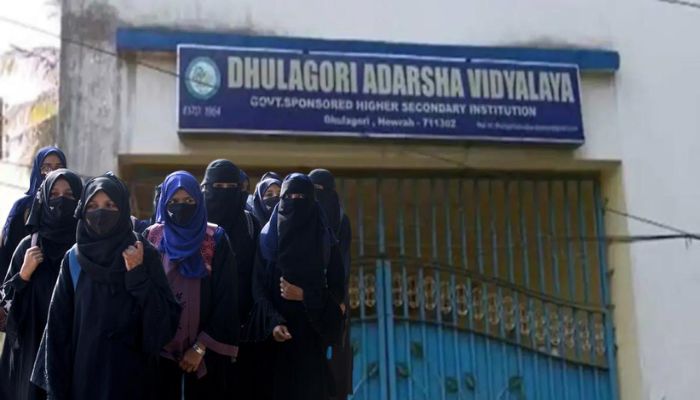
Women from across the world have come forward to express their solidarity with the women of Iran raising their voices against the hijab. However, in India, an opposite scenario has been running since early this year as Muslim college students from Karnataka have been demanding to let them wear hijab in college. On the contrary, the college administration was adamant about not allowing hijab. The state government stepped in and said as per regulations it cannot be allowed. The matter went to Karnataka High Court which upheld the government’s decision. The case is under trial in the Supreme Court.

Jungle Raj in Bihar: BJP leader now shot dead in Katihar. Here is what we know so far

0

On Monday (November 7) morning, a BJP leader was shot dead by two bike-borne assailants in Telta village in the Balrampur subdivision in the Katihar district of Bihar.

The deceased was identified as local politician Sanjeev Mishra. As per reports, two masked men reached the residence of the victim. Mishra, who was standing outside his house, was fired at by the assailants.

The BJP leader sustained injuries to his head and chest. On hearing the sound of bullets, his family members rushed to the spot. Sanjeev Mishra was taken to the nearby hospital, where he was declared dead on arrival.

After the news of the assassination spread like wildfire, the locals hit the streets in protest. Reportedly, roads were blocked and some vehicles were also vandalised by the protestors.

The Telta police reached the scene and tried to pacify the angry mob. A large contingent of police personnel was also deployed to control the law and order situation. The locals had meanwhile demanded the immediate arrest of the accused.

The body of the victim was sent for post-mortem and a probe was initiated. It is said that the assassination took place to avenge an old dispute. Sanjeev Mishra was a former district councillor and had been a member of the BJP (Katihar) Working Committee.

Sanjeev Mishra was also attacked a year ago

It has now come to light that the victim was also attacked a year ago. At that time, Sanjeev Mishra was badly injured but managed to survive. A First Information Report (FIR) was also lodged against Mo Mobid and 12 others.

The BJP leader, who was also a social activist, is now survived by his mother and sister. Mishra’s assassination was condemned by ex-Deputy CM Tarkishore Prasad. He lamented how Jungle Raj has been reinstated in the State, immediately after the RJD-JDU alliance.

Apparently, jungle raj has returned in Bihar as in the last few months attacks and targeted killings of traders, local leaders and general lawlessness are at their peak. In September this year, BJP leader and contractor Bablu Singh was shot in broad daylight by two masked criminals in the Arrah city of Bihar. Singh was shot from a very close range while he was on his morning walk. He was immediately shifted to the local hospital where he is undergoing treatment.

Gold trader kidnapped and murdered in Bihar

After a two-day search operation, the body of a gold trader kidnapped in Bihar’s Arrah was found on November 2. The gold trader identified as Hariji Gupta was murdered after being kidnapped, and his body decayed in water. Three people were arrested after the police launched an investigation.

“We discovered his body after a two-day search. After being kidnapped, he was murdered. Since the body decomposed in water, a post-mortem committee of doctors was formed,” Himanshu, the Assistant Superintendent of Police, stated on November 5.

Earlier, after Hariji Gupta went missing, his family suspected it to be a case of kidnapping. The family members tried but failed to locate him. It was only then that they filed a police complaint. Three suspects were detained by police.

Hariji Gupta was a resident of Bihar’s Arrah and owned three jewellery shops there. He also owned two shops in Patna. He also had a market on the Arrah bypass Road, where he ran several shops. Gupta was also a lawyer.

Acid poured into eyes, bottles inserted into vagina, victim left to die: SC acquits 3 convicts in 2012 Chhawala gang rape and murder case

On November 7, 2022, the Supreme Court acquitted all three convicts who had been awarded death sentence by a Delhi court for the 2012 rape and murder of a 19-year-old woman in the Chhawala neighbourhood of Delhi.

In February 2014, a Delhi court convicted three men to death after finding them guilty of brutally raping and killing a 19-year-old woman in 2012. On August 26, 2014, the Delhi High Court upheld the death punishment, declaring that the accused were “predators” roaming the streets and “looking for prey.”

The incident pertains to February 2012, about 10 months before the Nirbhaya incident took place, but it did not attract media attention to the extent that the latter did. The deceased victim’s family, who had been yearning for justice, said today that they were heartbroken by the verdict delivered by the Supreme Court. The bereaved mother of the 19-year-old expressed disappointment that the Supreme Court announced the ruling without providing any explanation for its decision and stated that they do not know which door to knock on now in order to pursue justice.

2012 Chhawala gang rape case

On February 9, 2012, three assailants kidnapped the girl from a spot just minutes away from their house in Qutub Vihar Phase-2 in Delhi. The girl was an immigrant from Pauri Garhwal in Uttarakhand, resided in Qutub Vihar, Phase II in Dwarka in southwest Delhi with her parents and two younger brothers. She wanted to be a teacher and was pursuing her graduation at a college in Delhi. She also worked in Gurgaon’s Cyber City as a data input operator to augment her father’s low salary. On that fateful night, the girl was on her way back home from work with three female colleagues who lived in the same neighbourhood. 

The girls were dropped off by a bus at around 8:30 PM in the evening. From there, they were supposed to walk through a mesh of lanes to reach their respective homes. When they reached a roundabout at Hanuman Chowk, three individuals in red Indica accosted them and started making lewd remarks to them. Unnerved by the men, the girls cried for help. But no one came forward to their rescue. Then three men hustled the girl into the car and sped away.

She was then taken to a mustard field some 30 kilometres away in the Haryana village of Rodhai where the three perpetrators- Ravi, Vinod and Rahul took their turns to brutally rape and brutalise her.

Perpetrators inflicted brutalities on the victim

It took the police three days to arrest the perpetrators. All three were residents of the same neighbourhood as the girl and had been released from Tihar Jail just a few days before the incident

The interrogation of the three accused revealed chilling details of the fate that had befallen the girl. The accused had reportedly mutilated and poured acid into the victim’s eyes, inserted a broken liquor bottle into her vagina and abandoned her in the mustard field in Haryana to die. According to the girl’s autopsy, she had died on February 13, a few hours before her body was recovered. For more than three days, the girl bled to death and the forensics test confirmed rape. 

Shocking callousness and apathy shown by the police and the then Delhi CM Sheila Dixit: Victim’s father

The victim’s family had reported the kidnapping on the very same night. The grieving father of the girl was taken aback by the apathy displayed by the police personnel who had come there to investigate the kidnapping. “Get us a car and then we will follow the kidnappers,” one of the police officials reportedly scoffed at the girl’s father. 

Enraged by this callousness, a raft of protesters decided to demonstrate outside the Chhawla police station. About 300 protesters staged a sit-in outside the police station for the next three days despite the police officials raining blows and lathis on them. 

The victim’s father ran pillar to post seeking justice for his daughter. He approached the then Delhi Chief Minister Sheila Dixit for help but was shunned away saying, “such incidents keep happening”. He claimed that the officials at the Chief Minister’s Office handed him a cheque of Rs one lakh and asked him to leave. Apart from this, no other assistance or compensation of any kind was given to him.

He also stated that neither Arvind Kejriwal, nor Rahul Gandhi took interest in a demonstration for his daughter. “I went to Delhi’s Jantar Mantar to mark my protest against the treatment meted out to my daughter. On one side, Arvind Kejriwal was giving a speech. On the other hand, Rahul Gandhi was participating in a sit-in protest. None of them came and expressed their solidarity with me,” he lamented.