Home Blog Page 3318

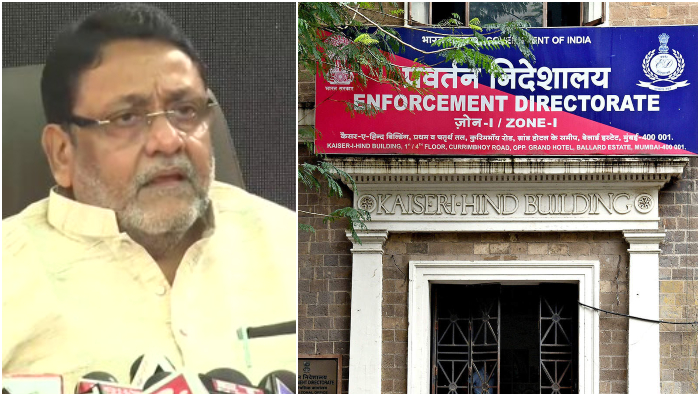
ED submits 5000-page charge sheet against NCP’s Nawab Malik, plans to file next charge sheet against sons Faraz and Aamir Malik

The Enforcement Directorate (ED) on Thursday submitted a charge sheet against NCP leader and Maharashtra minister Nawab Malik in Special PMLA court, in connection with the Dawood Ibrahim money laundering case. The charge sheet contains 5000 pages and includes a statement of witnesses and other documentary evidence.

According to the reports, the ED has also decided to file a charge sheet against Faraz Malik and Aamir Malik, sons of Nawab Malik, after they failed to appear before the agency for questioning in connection with the case.

Reportedly, the ED had sent three summons to Faraz Malik and two to Aamir Malik, but the duo failed to appear before the agency. The allegations posed by the ED against Malik are serious but the approach of the NCP leader and his sons seems to be informal and uninhibited in the case.

The ED had arrested him in the case of the Prevention of Money Laundering Act related to elements linked to Dawood Ibrahim and the underworld. There were reports saying that Malik was involved in the Hawala transfers operated by Dawood Ibrahim.

On February 15, the ED had conducted multiple raids in South Mumbai in connection with a money laundering case against the underworld don Dawood Ibrahim and his aides. Close to 9 places in Mumbai and 1 in Thane had been raided including the residences of Dawood Ibrahim’s late sister Haseena Parkar and brother Iqbal Kaskar.

The agency later took into custody Iqbal Kaskar on February 19 and presented him before the special Prevention of Money Laundering Act (PMLA) court. Also, the National Investigation Agency had said that Dawood Ibrahim was planning to launch terror attacks in India and that he was transferring funds through Hawala channels to provide financial help to all those involved in a planned attack.

Nawab Malik’s name appeared in the process of investigation after the intelligence inputs directed the agency to look into the Hawala transactions while probing a money laundering case against Ibrahim, Iqbal Mirchi, Chhota Shakeel, Parkar, and Javed Chikna.

ED recently has attached properties of Nawab Malik which include Goawala Compound, Commercial Unit at Kurla West, Mumbai, 147.794 acres of agricultural land in Osmanabad district, three flats in Kurla West, and two flats in Bandra West, Mumbai. His companies named Solidus Investments Pvt Ltd and Malik Infrastructure have also been seized.

Reportedly, the Supreme Court has stated to hear Malik’s plea filed against an order of the Bombay High Court which had rejected his interim application seeking immediate release in a case of money laundering being investigated by the Enforcement Directorate. The Bombay High Court had said that just because the special PMLA court’s order remanding him in custody is not in his favour, it does not make the order illegal or wrong. The hearing in SC is scheduled for Friday.
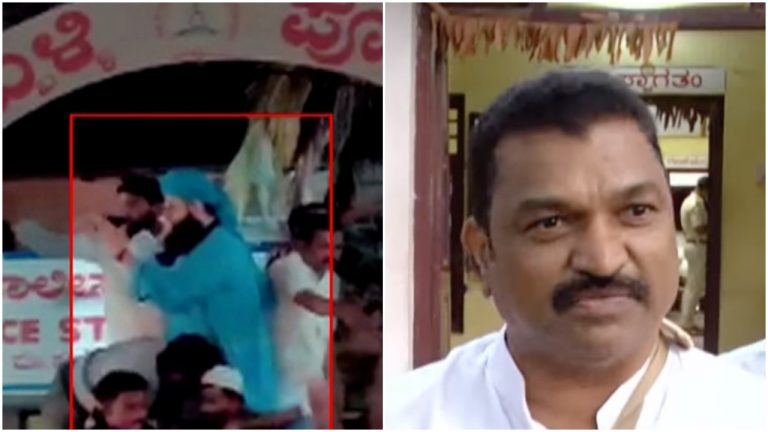
Hubballi riots: Police arrest Maulana Wasim Pathan, AIMIM leader who delivered hate speech standing on police commissioner’s car along with Congress leader

The Karnataka police have arrested Maulana Wasim Mobalik, alias Pathan, the main accused in the Hubballi violence case. The cleric had given a provocative speech outside the Old Hubballi police station that had enraged the Muslim mob culminating in attacks against the police station in Hubballi, Karnataka on Saturday (April 16).

According to reports, the cleric, also an AIMIM leader had been absconding after a Muslim mob went on a rampage, pelting at the old Hubli police station, a nearby temple, and a hospital in Hubballi, Karnataka on April 16. His last mobile location had been traced to Hyderabad. Finally, today he was detained by the Hubballi police team in Mumbai and brought to Hubballi. Pathan is likely to be produced before the court later in the day.

Earlier in the day, the police also arrested another AIMIM (All India Majlis-E-Ittehadul Muslimeen) leader, Mohammed Arif, who was also absconding after the incident. The two arrests have taken the total number of arrests in the Hubballi violence case to 126. 

Earlier, Irfan Nalvatwad, the husband of AIMIM Corporator Hussainbi Nalvatwad from Ward No 77 was also arrested by the Karnataka police in connection with the Hubballi violence.

OpIndia reported on April 19, Tuesday, how images and videos had emerged showing Maulana Wasim Mobalik, alias Pathan standing atop the Hubballi police commissioner’s car outside Old Hubballi police station, making provocative speeches. Wasim addressed an agitated mob, which had gathered to protest against a social media post. After his inflammatory speech, large-scale violence happened in Hubballi. Next to Maulana Wasim, the local Congress leader Altaf Hallur can also be seen encouraging him to deliver the provocative speech.

Police officials say the mob wanted to lynch them during Hubballi riots

The Karnataka police, meanwhile, revealed on Thursday that the bloodthirsty mob had attempted to kill the policemen. In their complaint, police constables Anil Kandekar and Manjunath from Kasaba police station described how they narrowly escaped being lynched by the irate fanatics.

Earlier, the Hubballi police registered two cases against the Muslim mob in connection with the attacks on the police station in Hubballi based on a complaint filed by police inspector Jagdish.

In the complaint, the police inspector Jagdish also said they were attacked and had to escape from the mob to save his life. He also said that the enraged mob threatened them to kill him and pelted stones at him and other police officials. Jagdish and his team were deployed to rescue the police personnel at the Old Hubballi police station, who was attacked by the Muslim mob.

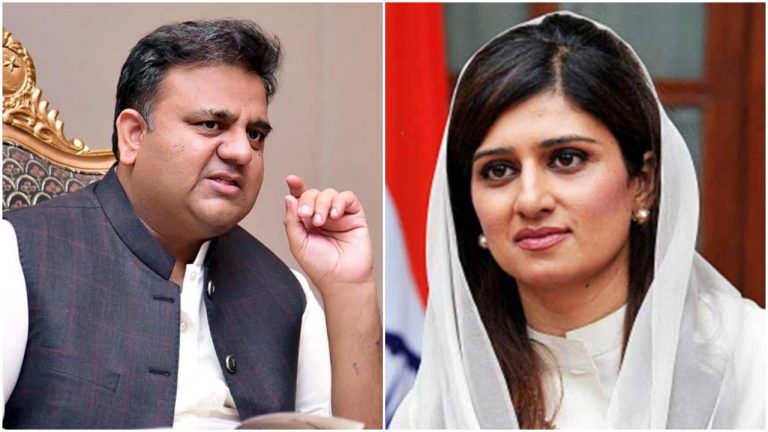
Former Pakistan Minister Fawad Hussain makes sexist jibe at Hina Rabbani Khar, says she is a ‘low IQ woman’ only known for ‘bags and eyeshades’

Pakistan’s former minister, Fawad Hussain Chaudhry, launched a sexist attack on Hina Rabbani Khar on social media after she was appointed as a junior foreign affairs minister in the Shehbaz Sharif cabinet. Chaudhry was the Information and Broadcasting minister in the Imran Khan government that fell after losing a no confidence motion earlier this month.

Sharing an old interview of Hina Rabbani Khar, Fawad Hussain described her as a “low IQ” woman whose only claim to fame is “Berkin bags and fancy eyeshades.”

“When you appoint a low IQ women whose only claim to fame is her Berkin bags and expensive eye shades such blunders ll become a norm, hope ll get rid of this lot sooner than later,” Fawad Hussain tweeted.

Hina Rabbani Khar was the youngest and first woman foreign minister during her tenure as a federal minister between February 2011 and March 2013. She has been once again appointed to the same position in the Shehbaz Sharif goverment, however, this time as a junior Minister of State in foreign affairs.

In that old interview with Al Jazeera shared by the PTI leader, Hina Rabbani Khar admitted that as the foreign minister, she had to face the accusation from allies that Pakistan was supporting terrorism, and there were “waves of truth” to those claims. Terming that state-sponsored terrorism was “relics of the past”, Hina Rabbani Khar also disclosed that Pakistan could not take on every terror network within the region all at the same time.

“As far as sponsoring and funding them was concerned, clearly, I would like to believe that under our watch, that was not the policy direction at all,” she said.

Essentially, Hina Rabbani Khan admitted that there was some truth in the terrorism allegation against Pakistan. However, the former minister faced immediate backlash from social media users for his vile sexist attacks on a woman.

It is important to note that Hina Rabbani Khan, who had visited India in 2011 for “peace dialogue”, had stoked a huge controversy by meeting pro-Pakistan Kashmiri separatist Syed Ali Shah Geelani, the hardline chairman of the Hurriyat Conference, even before meeting the foreign ministry officials miffing the Indian government.

Jharkhand: Pakistan slogans raised during rally, panchayat candidate Md Shakir Hussian and his two aides arrested after video goes viral

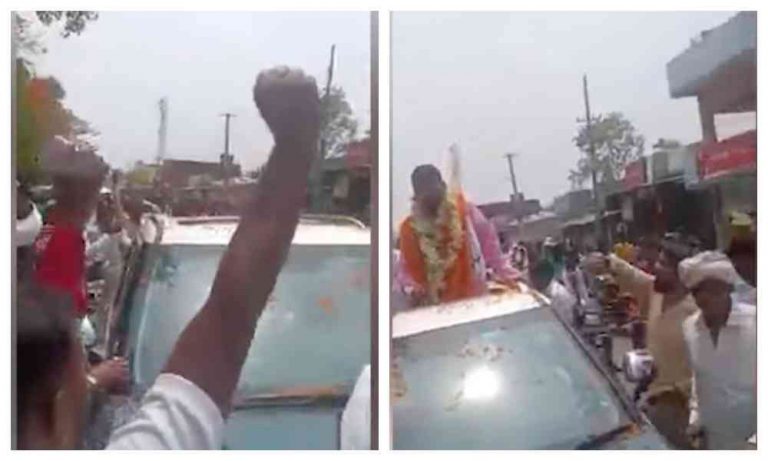
The Jharkhand police have arrested three people after videos of pro-Pakistan slogans being raised during a procession in the state went viral on social media. The viral video is said to be from April 20, Wednesday, during nomination filing for the Panchayat election under the Gandey PS area in Jharkhand’s Giridih district.

The arrested people include Md Shakir Hussian who is contesting elections for the Mukhiya from the Dokodih panchayat. Reports suggest that it was his procession during which the pro-Pakistan slogans had been raised. Along with him, his two aides, namely, Asif and Sohaib were also booked for spreading hatred and violating the model code of conduct.

Speaking about the case, Giridih Sub-Divisional Police Officer (SDPO) Anil Kumar Singh said, “a video went viral in which a pro-Pakistan slogan was raised (Pakistan Zindabad) during a procession of nomination filing for Panchayat election under Gandey PS area. The incident took place yesterday.”

Singh added that Md Shakir Hussian’s supporters were sloganeering in his support near the block office gate. Giridih police booked Shakir and his two supporters, Asif and Sohaib on charges of spreading hatred in the society and violating the model code of conduct. So far, a total of 10 people have been named in the FIR in connection with the viral video in which a pro-Pakistan slogan was raised, he said, adding that further investigation in the matter is underway.

He also informed that the three arrested would be sent to jail on Thursday after completing some procedures such as the COVID test.

According to reports, on Wednesday, April 20, Mukhiya candidate for Dokidih Panchayat Shakir Hussain had gone to file nomination papers at Gandey Block office along with hundreds of supporters. As Shakir entered the office, his supporters waiting outside began chanting slogans in his favour. First, they chanted “Dokid Panchayat Mukhiya Kaisa ho, Shakir Hussain Jaisa ho,” but all of a sudden, they began chanting ‘Pakistan Jindabad’.

As can be seen in the viral video, the supporters chanted Pakistan Zindabad in presence of the magistrate and police force not once but several times. Neither did Shakir Hussain stop them nor did anyone protest.

The Jharkhand police, however, sprung into action after the video went viral later in the night. SDPO Anil Kumar Singh reached Dokidih Panchayat and arrested Shakir Hussain and two others in this connection.

To keep the situation under control, a large police force has been deployed in the area.

Elon Musk calls out Wikipedia’s bias and its editors’ complicated relationship with facts: What he said

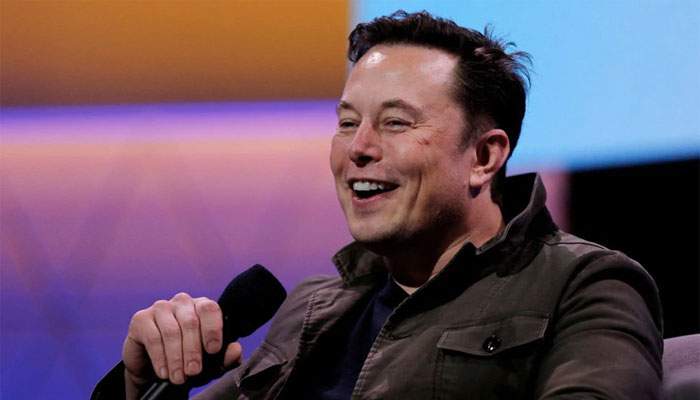
On April 21 (local time), billionaire Elon Musk called out Wikipedia’s bias and its editors’ complicated relationship with facts. While replying to a Twitter user about how he acquired Tesla and built the empire, Musk said, “They say history is written by the victors, but not on Wikipedia if the losing party is still alive & has lots of time on their hands!”

Musk was referring to the unavailability of the story behind the acquisition of Tesla, which was a shell company and turning it into a multi-billion dollar venture.

His statement came as a reply to a discussion where Vaibhav Sisinty of Growth School had said Musk was not the founder of Tesla, but he acquired it. A Twitter user Willy Woo countered how Musk changed the business model of a dying company and fired the found before it sunk.

Notably, Sisinty’s tweet was in a positive sense as he said in a follow-up tweet that he thinks Musk can unlock the potential of Twitter.

In a series of tweets, Musk said the statements made were incorrect. He said, “Not even close to that. It was a shell corp with no employees, no IP, no designs, no prototype, literally nothing but a biz plan to commercialize AC Propulsion’s Tzero car, which was introduced to me by JB Straubel, not Eberhard.”

He further added that the name ‘Tesla Motors’ was not owned by the company but by someone else. Notably, in 2021 Musk had revealed that the name was owned by someone from Sacramento, California.

Musk wanted the name badly, but the guy who owned the name was not interested in selling it. In an interview, he said, “I sent the nicest guy who was difficult to anger to his doorsteps and told him not to leave till he agrees to sell the name.” They paid $75,000 for the name.

He further pointed out that the company was earlier just a shell company. He said, “If filing a shell corp constitutes “founding a company”, then I’d be the only founder of PayPal since I filed the original incorporation docs for http://X.com (later renamed PayPal), but that’s not what founding means.”

Musk added Martin Eberhard was fired by the board unanimously in July 2007 for damning reasons. He said the fact matters a lot that no one left with him. He blamed Eberhard for “relentlessly pushing a false narrative about Tesla for 15 years.” Musk said, “he [Eberhard] is a compelling liar. Fooled me for almost three years.”

Questioning Eberhard’s leadership skills, he said, “But if he was actually capable of creating a company like Tesla, he would have done so after he was fired for lying outrageously about cost & progress of Roadster in mid-2007. We would’ve lost at least a few talented people if he was the real deal, but we lost no one.”

Musk has raised questions on Wikipedia before

This is not the first time Musk has raised questions about the content available on Wikipedia. In 2021 he had said, “My wiki is such a dumpster fire. That’s how you know it isn’t curated.”

Elon Musk and Twitter

Recently, Elon Musk offered to buy Twitter and make it private. He had said the company had a lot of potentials, and he could unlock it. The Twitter Board, however, rejected the offer and activated Poison Pill to stop him from acquiring controlling shares in the company. The tussle between Musk and Twitter continues as the fact is even though Twitter activated Poison Pill, it cannot stop him from acquiring the required shares to take over the company.

Emergency Files: Inside Sanjay Gandhi’s ‘beautification drive’ that bulldozed unauthorized settlements in Old Delhi

Even if the headline moniker of ‘Bulldozing’ ignites a spark relating to the recent developments in Jahangirpuri, this article, is no attempt to conflate the current nationwide anti-encroachment drives with the Turkman Gate demolition riots that flowered during the Emergency.

History has a tendency to be pulled out of frozen narratives to often justify or call out actions in the present. When Senior Advocate and Congress Leader Kapil Sibal argued before the Supreme Court that encroachments that have been demolished so far have been associated with Muslims in the country, he was reminded that the properties owned by Hindus were demolished as well.

The attempts of communalising the demolitions, while suggesting that encroachments have ‘no religion’, are itself demolished when one runs through the Emergency era’s Delhi Beautification campaign that drove off more than 7 lakh people from Delhi’s unauthorised slums in less than two years. Perhaps, one also needs to be reminded of the grim Turkman Gate massacre that saw the police opening fire on residents opposing the demolition of their homes.

Sanjay Gandhi’s Delhi Beautification Drive

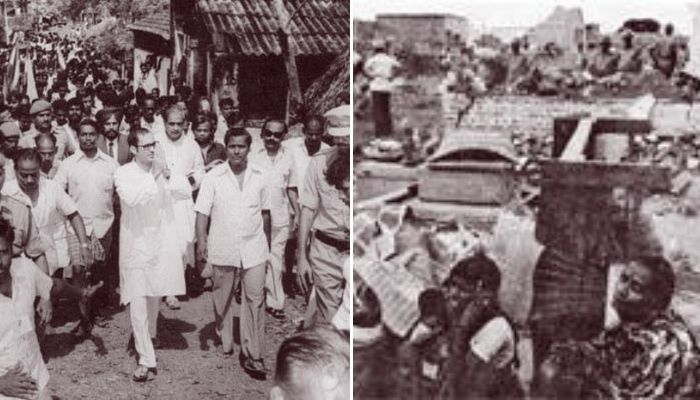
During the Emergency years, Sanjay Gandhi, whose only claim to power was being the Prime Minister’s son, launched the demolition drive to clear Delhi of unauthorised slums and settlements. This would force the poor to relocate to the nearby villages in large numbers. Vice-President of the Delhi Development Authority, Jagmohan Malhotra was prompted to carry out the demolition at Sanjay Gandhi’s behest. Many orders for the demolitions were given by Gandhi orally, while he did not hold any constitutional post to carry out the operations officially.

Demolitions in Karol Bagh, Jama Masjid area and Turkman Gate were carried out with a special interest. The growing support for the Jana Sangh from the shopkeepers of Karol Bagh had miffed Sanjay Gandhi. Muslim residents in Delhi’s old areas had also criticised Gandhi’s ‘Beautify Delhi’ plan. Bulldozers embarked upon the houses in Karol Bagh and shops were razed because Gandhi, once had not received a cordial reception during his visit. Reportedly, when the shopkeepers requested Sanjay Gandhi to take back the demolition, he returned back saying, “you shall pay for supporting the Jana Sangh.”

Emma Tarlo’s book “Unsettling Of The Emergency: Narratives Of The Emergency In Delhi”, estimates a total of 70,000 people being displaced from slums and commercial properties in large areas of old Delhi, within a mere 21 months. While no official record of demolition exercises is found, the authorities were actively involved in damaging evidence with the help of civic officials. Even the media was barred from reporting the incidents owing to the censorship imposed by the Indira Gandhi government during the Emergency.

The Turkman Gate Massacre

On 18 April 1976, the police opened fire on protesters opposing the demolition of their homes in the Turkan Gate area. With a clarification that they are living in the area since the Mughal times, the residents living in the alleys which run beyond the Darwaza refused to cooperate in the slum clearance drive. On the morning of April 18, around 15 bulldozers rammed through the Turkman Gate and started razing houses, and shops of the residents. Temporary shelters for the herdsman Ghosi community were also not spared. When people objected, police resorted to violence and started fire upon the dwellers.

There have been reports of stone-pelting on the demolition squad, which are counted as a trigger for the violence in some narratives. A local guide has claimed that nine of his friends were killed by police. The prelude to the Turkman Gate massacre however was the sterilization camp championed by Sanjay Gandhi in the area. His aide Rukhsana Sultana, also actor Amrita Singh’s wife, was tasked to carry out sterilization camps in the Turkman Gate area. The resentment against Sanjay Gandhi among local Muslims was triggered after attempts of Sultana to propagate the benefits of Nasbandi among the populace in the area, which is considered Haram in Islam.

According to the Shah Commission report, the bloody conflict took around 20 lives after the police resorted the arms and brutality against the residents. As bulldozers traversed through the dark area of Turkman Gate, with electricity cut off, the Turkman gate episode remains yet another whitewashed incident in India’s modern history. As Journalist Michael Henderson noted in his book, “Turkman Gate is where it came to grief. People speak the words now in the way that they spoke of Jallianwala Bagh after General Dyer’s massacre in 1919.”

The unrelenting demolition carried around by Sanjay Gandhi to settle personal scores is a grim reminder of the overreach of the state inside the lives of the citizens. Marked by Police brutality and political agony, the Emergency demolitions remind the authoritarian overtones of the Indira Gandhi regime in the 1970s.

UP priest not booked for reciting Hanuman Chalisan during Azaan time as claimed by media, only notice sent: Details

Since the morning of Thursday, the news of a UP priest being booked for reciting ‘Hanuman Chalisa’ during Azaan is doing rounds everywhere. News media portals have covered the case stating that the priest staged a fast-unto-death demanding action against the administrative officials. However, when OpIndia dived deeper into the case, it has been found that no FIR has been registered against the concerned priest.

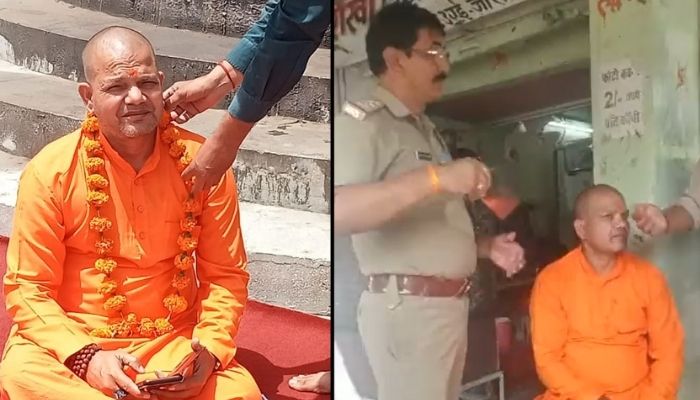
On Thursday, it was reported that a Hindu monk, Matsyendra Goswami from Uttar Pradesh’s Orai was booked for chanting Hanuman Chalisa during Azaan. The reports said that Uttar Pradesh Police took action against him for breaching peace. The priest in return accused the police of taking action against him without proper investigation and sat on a fast-unto-death protest in the city’s Gandhi Chauraha.

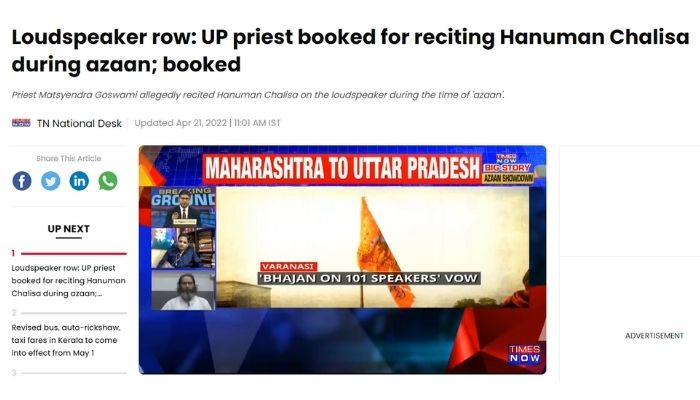
Newsreport from Times Now
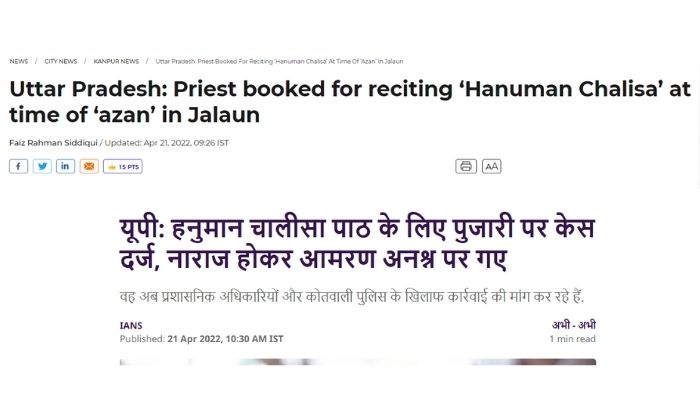
Newsreport from The Times of India and The Quint Hindi

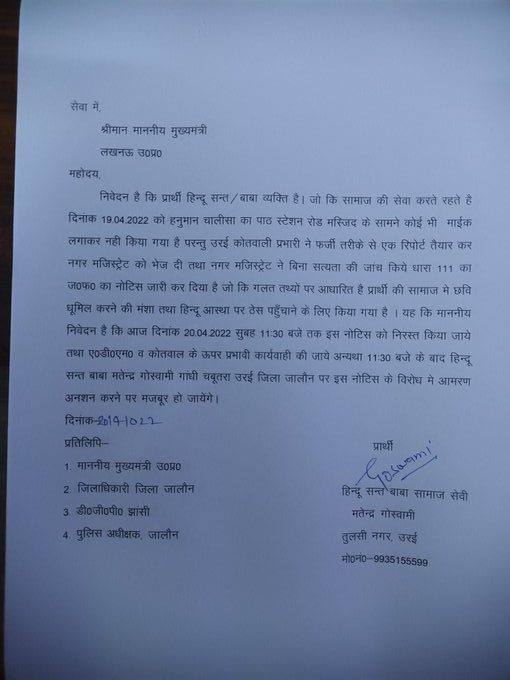
Apparently, the priest wrote to the Chief Minister Yogi Adityanath and other concerned officials stating that he did not use loudspeakers while chanting Hanuman Chalisa in front of the Station Road Masjid in the city. However, as claimed by him, the police officials took action against him and sent him a notice involving section 111 of the IPC. In the letter, he warns of sitting on a fast until the case against him is not taken back.

Letter written by the monk to CM Yogi Adityanath

On April 20, Matsyendra Goswami was seen protesting at the city square for a while.

OpIndia talked to a police officer at the concerned Kotwali Police station, Orai regarding the case. While speaking to OpIndia, a police official requesting anonymity said, “No case was registered against Matsyendra Goswami Baba. He was given a show-cause notice, addressing him to maintain peace and harmony in the area.”

The officer said that when Goswami sat on a protest at Gandhi Chauraha, The police asserted that no case was registered against him. According to the Police, the monk was requested not to indulge in any activity which would disturb the law and order situation after which he willingly ended his fast-until-death.

While Matsyendra Goswami was not booked under any provisions officially, he was only sent a notice by the local Police station. It seems, the enraged monk sat on a protest which he has ended by now. Earlier, according to the Times Now report, Kotwali police station in-charge Shiv Kumar Rathore claimed that action was taken against Goswami after a complaint was registered against him.

British Prime Minister Boris Johnson visits JCB’s new ‘bulldozer’ plant in Gujarat

On Thursday, British Prime Minister Boris Johnson visited JCB’s Bulldozer manufacturing plant at Halol in Gujarat.

According to the reports, Britain’s PM Boris Johnson visited the heavy construction machines giant JCB plant in Halol today to visit a new facility.

Gujarat Chief Minister Bhupendra Patel accompanied the British Prime Minister. He also climbed on top of a bulldozer at the newly inaugurated facility.

Interestingly, Boris Johanson’s visit to a bulldozer factory comes at a time when heavy machinery has become the new buzzword of India’s political landscape. The bulldozers, often used for razing down buildings, have become the symbol of law and order in the country as several state governments have used them to bring down illegal properties encroached by riot accused and mobsters.

It first started in Uttar Pradesh, now, the bulldozer phenomenon has reached other states like Madhya Pradesh and Delhi.

Boris Johnson arrived in India on Thursday to kickstart his two-day state visit. The British Prime Minister will spend the whole of Thursday in Gujarat and travel to Delhi in the evening. The UK PM will hold a discussion with Prime Minister Modi on areas of trade, the energy sector and defence. Ukraine issue is also expected to be among the topics of bilateral discussions.

JCB chairman Lord Bamford is reportedly one of the main donors for Johnson’s conservative party.

UK PM Boris Johnson visits MK Gandhi’s Sabarmati Ashram, spins Charkha, often cited as symbol of India’s freedom struggle from British Empire

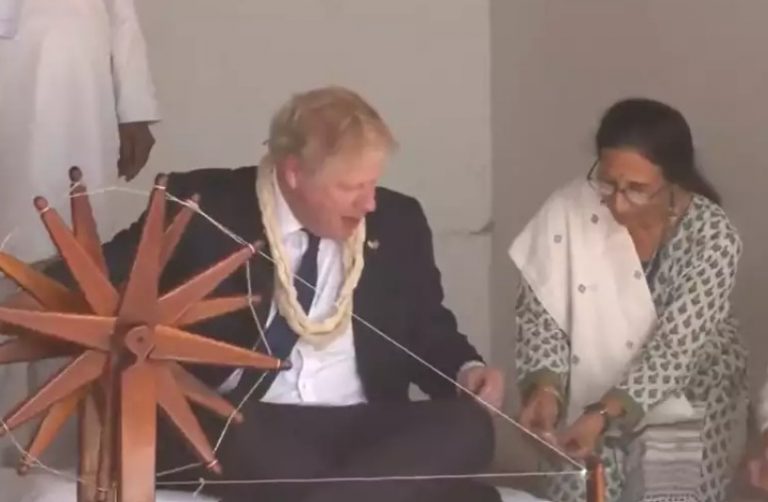
The UK Prime Minister Boris Johnson visited Mohandas Karamchand Gandhi’s Sabarmati Ashram in Ahmedabad soon after arriving in Gujarat on Thursday, April 21, for his maiden visit to India. At the Sabarmati Ashram, Johnson tried his hands at spinning the Charkha, a symbol of the 1905 Swadeshi movement- a part of the Indian Independence movement aimed at disbanding the British Empire.

A video of the same was shared by various media outlets. In the video, two women workers from the Sabarmati Ashram could be seen giving Boris Johnson a demonstration of the Charkha and how Gandhi used the wheel to weave.

Sharing a snippet of Boris Johnson’s attempt to spin the iconic Charkha, news agency ANI Tweeted, “Prime Minister of the United Kingdom Boris Johnson visits Sabarmati Ashram, tries his hands on ‘charkha’.” Gujarat Chief Minister Bhupendra Patel accompanied him on his visit.

Johnson, who was accompanied to the ashram by Gujarat Chief Minister Bhupesh Patel, penned a message in the visitor’s book. He wrote, “It is an immense privilege to come to the Ashram of this extraordinary man and to understand how he mobilised such simple principles of truth and non-violence to change the world to get better.”

Twitter users give Britain PM Boris Johnson a lesson in history

Interestingly, after the video of the British Prime Minister attempting to spin the Charkha went viral, many social media users remarked on the irony of the situation. They slammed the PM of Britain for experimenting with the charkha, which was once used as a symbol of protest against the British economic subjugation of India.

Loyal Lab, a Twitter user, requested that the British PM stop the theatrics. “Did @BorisJohnson apologize for his country Britain’s colonization and loot of India? Did he acknowledge the thousands of human beings his countrymen killed in India? Did he offer to return the $45 trillion looted from India between 1765 to 1938? If not, stop the drama,” wrote the Twitter user.

How Charkha played a pivotal role in India’s freedom struggle from the British Empire

Notably, the Charkha had played a pivotal role in India’s freedom struggle from the British Empire. In 1905, the charkha became a symbol of the Swadeshi movement – a part of the Indian Independence movement aimed at disbanding the British Empire by making the citizens of India more self-reliant.

The Swadeshi movement was officially proclaimed on August 7, 1905, at the Calcutta Town Hall, in Bengal. The Boycott movement was also launched along with the Swadeshi movement. The movements included using goods produced in India and burning British-made goods.

During the rule of the East India Company, the British used to ship the raw cotton from India to England and the finished material would come back to India to be sold at exorbitant prices, thus causing Indian farmers and commoners to suffer from huge losses and poverty.

Mohandas Karamchand Gandhi initiated the Swadeshi movement by taking up the charkha and encouraging the Indians to spin their own cloth. The cloth woven from the spinning wheel is known as Khadi or Khaddar, meaning course cloth. The charkha went on to become a symbol of self-sufficiency and freedom.

In 1909, the movement had spread across the country and people had started anti-partition and anti-colonial movements. This was a major economic blow to the British empire, and it played a significant role in India’s freedom struggle from the British autocratic regime.

Later, MK Gandhi’s freedom movements, such as the Satyagraha movement, the Non-Cooperation movement, and so on, which helped India get freedom from British rule, were also based on the Swadeshi movement.

Meanwhile, the ashram gifted the UK PM a copy of “Guide to London”, one of the first few books written by MK Gandhi which never got published. He was also given “The Spirit’s Pilgrimage”, the autobiography of Madeleine Slade or Mirabehn, the daughter of a British admiral who became MK Gandhi’s disciple.

Besides, Boris Johnson many international leaders have spun the Charkha at Sabarmati Ashram

Boris Johnson is not the first international leader to visit Sabarmati Ashram. In 2020, US President Donald Trump along with First lady Melania Trump visited the Ashram and tried their hands at spinning the Charkha. Besides, Chinese President Xi Jinping, Japanese Prime Minister Shinzo Abe and Israeli Prime Minister Benjamin Netanyahu, Canadian Prime Minister Justin Trudeau along with his wife Sophie and children Xavier, Hadrien and Ella-Grace too have in the past, visited the iconic Ashram wearing Indian ethnic clothes and also tried their hands on the Charkha during their visits.

Uttar Pradesh: Yogi Adityanath government forms Priest Welfare Board as promised before the elections

The Yogi Adityanath government in Uttar Pradesh is going to take a big step in the interest of elderly saints, sages, and priests. In line with the BJP’s promise of Lok Kalyan Sankalp, that is, the election manifesto of the party, CM Yogi Adityanath has ordered the formation of a Priest Welfare Board in the state. Similarly, ‘Eco and Rural Tourism’ and ‘Tourism and Culture Councils’ will also be set up in all the 75 districts.

Respecting the faith of the people in the state, Yogi Adityanath’s government took this decision. A board will be formed for the welfare of elderly saints, sages, and priests of temples. The Board will look after their welfare works.

It may be noted that ahead of the assembly elections, Yogi Adityanath had promised to form the Purohit Welfare Board, if BJP is re-elected to power. In an election rally, he had said, “We have decided to constitute a ‘Purohit Kalyan Board’. All Sanskrit students will get a special scholarship.”

CM Yogi Adityanath directed that within the next 100 days, with a view to facilitating the devotees and tourists, an online integrated temple information system should be developed which contains details of temples, history, and route map. Chief Minister Yogi Adityanath on Wednesday reviewed the presentation of the action plan for charitable affairs, tourism, culture, and language departments before the council of ministers and gave directions.

He said that under the guidance of Prime Minister Narendra Modi, a cultural renaissance is taking place in India in the 21st century. It is our endeavor to establish the State as a cultural destination by preserving, promoting, and popularising the unique cultural identity of the State.

He further said, “In line with the aspirations of the people, significant efforts are being taken which include the construction of Shri Kashi Vishwanath Dham Corridor, construction of Shri Ram Temple in Ayodhya, Ayodhya Deepotsav, Braj Rangotsav, Dev-Deepawali of Kashi, Vindhya Dham Corridor, Naimish Tirtha, Shuk Tirtha Revival, Statue of Maa Annapurna being restored after 100 years, Soron-Sukarkshetra Development, etc. It is going to become the identity of the new Uttar Pradesh of new India. With the efforts of the Prime Minister, Uttar Pradesh is becoming a confluence of nature, culture, and adventure.”

He added, “Development of 12 circuits identified in the State will be completed with commitment. Ramayana Circuit, Buddhist Circuit, Spiritual Circuit, Shaktipeeth Circuit, Krishna/Braj Circuit, Bundelkhand Circuit, Mahabharata Circuit, Sufi Circuit, Craft Circuit, Freedom Struggle Circuit, Jain Circuit, and Wildlife and Eco-Tourism Circuit will give a new identity to tourism in Uttar Pradesh.”