Home Blog Page 5632

I&B Ministry suspends broadcast of Kerala based news channels Asianet News and MediaOne for 48 hours for biased coverage of Delhi riots

Two Kerala based Malayalam News channels, namely Asianet News and MediaOne had been rewarded with 48-hour token ban by the Information and Broadcasting Ministry for their shoddy ‘coverage of the Delhi riot’.

Both these channels have been displaying a black screen since 7.30 pm on March 6 (Friday), when they were taken off-air. Both channels will resume the broadcast only at 7.30 pm on March 8 (Sunday) after completion of the 48-hour ban.

The order alleged that the two Malayalam News channels have indulged in biased coverage of the Delhi riots, being critical of the RSS and Delhi police and siding with a particular community, showing those who supported Citizenship Amendment Act in poor light.

It alleged that this kind of provocative coverage could further incite communal violence.


Govt suspends broadcast

“It appeared that telecast of reports on North-East Delhi violence had been shown in a manner which highlighted the attack on places of worship and siding towards a particular community. Channel’s reporting on Delhi violence seems to be biased as it is deliberately focusing on the vandalism of CAA supporters. It also questions RSS and alleges Delhi Police inaction. Channel seems to be critical towards Delhi Police and RSS,” the order said in relation to MediaOne. 

The Ministry has further alleged that MediaOne accused the Delhi Police of remaining inactive during the violence, and the channel also blamed police for vandalising shops and fruit carts.

“The channel also reported that violence took place mostly in Muslim dominated area of Chand Bagh, Delhi. While telecasting the news, the channel carried the news of stone-pelting, arson and injured people being taken to hospital,” the order says.

This kind of loose reporting could have ‘incited violence and posed danger to the maintenance of law and order situation, particularly when the situation is already highly volatile and charged up and riots are taking place in the area’, the order read.

Where Asianet News is concerned, its report by their journalist PR Sunil on the violence in Jaffrabad and about Delhi police being mute spectators led to this temporary ban.

Whereas for Media One, it is their bulletin carrying on a phone-in conversation with its Delhi correspondent, Hassanul Banna, reporting about the anti-Citizenship Amendment Act protestors being injured while Delhi police refusing to visit the spot and nab the rioters that led to the ban.

The order further read that Asianet News reported about how rioters blocked commuters and attacked them for their religion, attacking houses of Muslims in Hindu majority areas and rioters firing at each other with slogans of Jai Sri Ram and Azadi in the air.

The News channel also reported about shops, houses and vehicles being burnt and no action being taken as the violence continued for the third day, with the Central Government not acting to control the riots.

This report, the Information and Broadcasting Ministry order said, had been shown in a manner that highlighted the attack on places of worship and siding towards a particular community. It said the reporter alleged that central troops had not arrived on time and that he had witnessed the attacks on Muslims. The reporter had also said that rioters had asked which religion he belonged to. “While reporting such critical incidents, the channel (Asianet News TV) should have taken utmost care and should have reported it in a balanced way. Such reporting could enhance the communal disharmony across the country when the situation is highly volatile,” the order said.

Sunil’s story had in fact gone viral in Kerala and he had been lauded for his report that showed what happened through the day on February 25.
Both channels have been taken off air citing two rules under the Cable Television Networks Rules, 1994:
  • Rule 6(1 c)- says that no programme should be carried which contains attack on religions or communities or visuals or words contemptuous of religious groups or which promote communal attitudes.
  • Rule 6(1 e)- says that no programme should be carried which is likely to encourage or incite violence or contains anything against maintenance of law and order or which promote anti-national attitudes.

The I&B ministry had imposed a similar token 24-hour ban on NDTV in 2016 their coverage of Pathankot terrorist attack. The penalty of taking the channel off-air for one full day came after the IMC noted with “grave concern” that the channel had “revealed sensitive details like the location of ammunition depot and the place where terrorists were held up, location of the school and residential areas”.
Yogi government to turn Aala Hajrat Haj House in Ghaziabad into a 500 bed isolation centre for Coronavirus patients

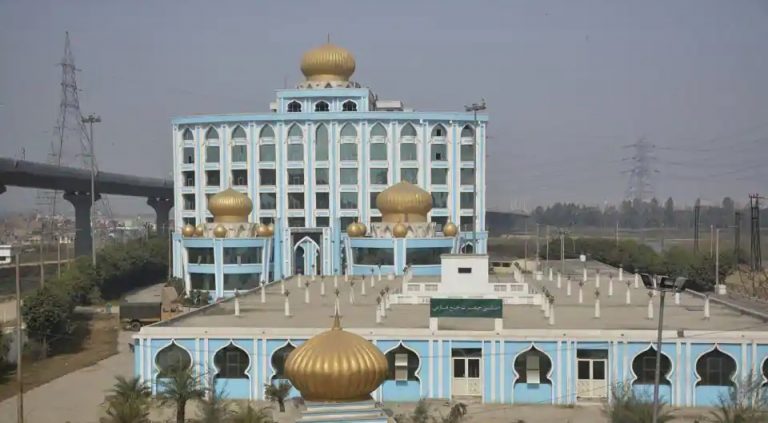
After several cases of coronavirus emerged from the state of Uttar Pradesh, the UP government is set to convert the giant Aala Hazrat Haj House situated in Ghaziabad’s Arthala into a 500-bed isolation centre in order to avoid any further medical repercussions in the sensitive environment. The coronavirus has already hit the country infecting 31 patients and around 30000 quarantined.

On Thursday, the district administration of Ghaziabad and officials from minority board inspected the Haj house, which will be soon turned into an isolation centre for coronavirus patients. Chief Medical officer of Ghaziabad, Narendra Gupta and ADM city Shailendra Singh told that the UP government is very serious regarding the epidemic. The Haj house comprises large dormitory halls that will be converted into wards. The Haj house isolation centre will have a capacity of 500 beds to quarantine and cure the patients of Coronavirus.

A health advisory has been released by the UP government creating awareness among the people to prevent COVID-19 novel coronavirus to spread and not to panic.

It is reported that only serious patients will be kept in the isolation wards of the Haj house so that they can stay a distance from the reach of others and avoid others getting infected. The Haj house will be converted into a fully furnished isolation centre in two-three days.

The Haj House in Ghaziabad was built at the cost of Rs 51 crore in order to give assistance to Muslims on a pilgrimage to Saudi Arabia’s Mecca. The complex, spread over an area of 4.3 acres, has ground plus six floors and includes 47 dormitory halls and 36 VIP rooms, and can accommodate 1,886 persons. The house was inaugurated by the then UP chief minister Akhilesh Yadav in September 2016. It was sealed by National Green Tribunal in February 2018, due to lack of a Sewage Treatment Plant.

Delhi riots: Naresh Saini breathes his last after being shot at from a mob of 400-500 rioters wanting to desecrate a Hindu temple

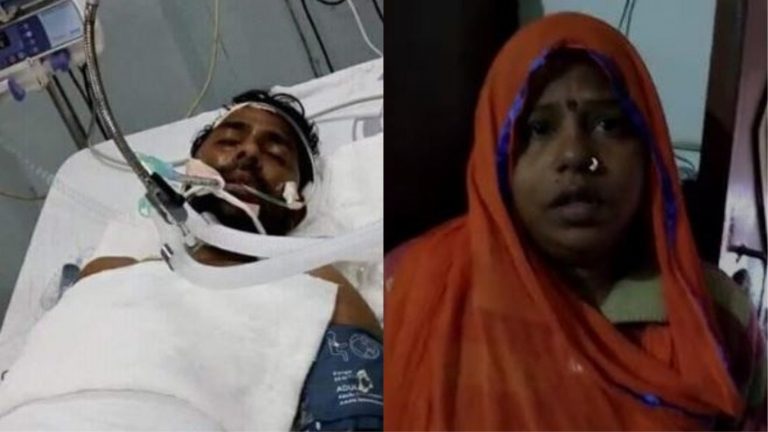
Neighbourhood in the northeast part of Delhi was racked with anti-Hindu riots as violent Muslim mob went on a rampage against the Hindus in the last week February. Many innocent people fell victim to the Muslim onslaught who were killed only because they did not profess the same faith as their assailants. One of those victims was Naresh Saini. Brought in a badly battered state at the GTB hospital, Saini put up a courageous fight with his injuries for several excruciating days in the ICU ward of the hospital before giving in to his injuries on March 4.

Naresh Saini, who lived on street number 1 of Brahmapuri area, was caught amidst the anti-Hindu riots in Delhi when he came out of his home to lend himself in safeguarding the nearby Hindu temple which had just come under attack from the ferocious Muslim mob. Naresh, along with other conscientious Hindus living on the same street came out at around 4:30 in the morning when they came to know that a legion of rabid Muslims has swarmed the region with the ulterior motive of taking down the nearby Hindu temple.

According to Naresh’s family, when he sprinted from their residence towards the temple, a mob of 400-500 frenzied people approached from ahead and shot a bullet at Naresh, grievously injuring him. Naresh was so severely injured from the bullet that he remained in an unconscious state until his death. He was also taken to GTB Hospital, where he was admitted in the ICU before he breathed his last on March 4, 2020.

The family of Naresh says that their son was unarmed at the time when the riotous mob attacked him. They added that Naresh had gone out to defend the Hindu temple from being vandalised by the mobsters but they had no inkling that the mob would wreak havoc on the family.

The anti-Hindu riots in Delhi have taken a huge toll, especially on beleaguered Hindus, who found themselves surrounded by murderous mobs baying for their blood and attacking their places of worship. In addition to Naresh’s heartrending tale of sacrifice, there are other agonising stories as well where innocent Hindus were killed by the bloodthirsty mob. In Gokulpuri, Nitin, just 15 years old, was brutally hacked to death. Another Hindu, Alok Tiwari, who had just gone out of his house for a leisurely stroll, was mortally wounded by the mob and abandoned to die. Another victim, Dilbar Singh Negi, suffered the most horrifying fate. On the 24th of February, when the violence erupted in Delhi, the same evening, a 20-year-old Dilbar Singh Negi was set ablaze by a mob of rioters after having his limbs severed by a sword.

NRI businessman lodges complaint against Shilpa Shetty and Raj Kundra for allegedly cheating investors in “Gold Card Scheme”

An NRI businessman named Sachin Joshi, who is currently residing in Mumbai, has lodged a complaint of cheating and fraudulence against actress Shilpa Shetty and her husband Raj Kundra. Joshi claimed that he was duped by both when they were directors of the Satyug Gold Pvt. Ltd., a gold-trading company.

Joshi has lodged a criminal complaint of cheating, fraud and other charges against Shilpa Shetty, Raj Kundra and officials of SGPL such as Ganpati Chaudhary, Mohammed Saifi, and others with the Khar Police Station in Mumbai.

The NRI has claimed in the police complaint that he was duped by SGPL’S ‘Satyug Gold Scheme’ that was launched in 2014. Joshi noted that under a five-year gold plan, the buyer of the gold which was sold under the ‘Satyug Gold Scheme’ was offered a ‘Satyug gold card’ at a discounted rate and promised a certain fixed quantity of gold redeemable after a five-year period.

As per Raj Kundra’s statements at the ‘gold dream’ launch, an investor who bought a certain sum of gold at the then-current rates with full advance payment will be entitled to ‘Satyug gold card’, that can be redeemable in stages with attractive discounts–15% after two years, 26% after three years, 30% after four years and 37% after five years.

Joshi’s spokesperson told IANS that he had purchased One kg gold for nearly Rs 18.58 lacs in March 2014 at then prices. It would be redeemable on or after March 25, 2019, at the promised discounts of the Satyug Gold Card.

The spokesperson explaining the scheme asserted that at current rates, the original investment would have fetched around Rs 44 lacs or more than double as today the gold prices crossed the Rs 4.4 million per kg mark.

When Joshi went to redeem his one-kg golden asset on the due date in March 2019, he found that the SGPL office in Bandra Kurla Complex in Suburban Mumbai was shut with no employees or representatives available there.

Upon enquiring, Joshi learned that the office of SGPL had been shut long ago, the website showed a new office address that is at Shalimar Morya Park in Andheri West. On visiting the new office, they were informed that the address did not belong to SGPL. After frequent searches on websites, Joshi eventually got the same response everywhere that office from where he bought gold don’t belong to SGPL.

In November 2019, Joshi’s representative happened to meet one of the company officials at the Malad West address who claimed that it was not possible to redeem the claim as the company was processing multiple claims, and suggested he should return in December 2019.

Joshi was more shocked after he searched on the website of the Ministry of Corporate Affairs when he learned that Shetty and Kundra had resigned as directors of SGPL in May 2016 and November 2017 respectively.

Joshi said, “It became clear from all these facts that SGPL was a fraudulent entity being used to run the fake ‘Satyug Gold Scheme’ using the name of celebs like Shilpa Shetty. I have suffered a loss of Rs 18.58 lakh on my gold investment.”

IFCN accredited ‘fact-checker’ Boom Live peddles fake news about Justice Muralidhar’s alleged “overnight” transfer days after it was debunked

Recently, an online portal Boom Live, which incidentally is accredited by IFCN (International Fact-Checking Network) as a fact-checker, ran a story about Justice Muralidhar’s transfer from Delhi court. The story was hosted by none other than the controversial journalist Faye D’Souza, who insinuated that Justice Muralidhar was abruptly transferred by the central government after he pulled up the government and the Delhi Police in a midnight hearing in the Delhi anti-CAA riots.

[youtube https://www.youtube.com/watch?v=PpmAXXdVueY]

In her video, Faye asserted that Justice Muralidhar was summarily transferred by the central government because of his critical remarks against the Delhi Police and his directives to the police to issue FIRs against politicians alleged of making provocative speeches.

“It was Justice Muralidhar who instructed the police to file an FIR against these politicians who made inflammatory speeches. What happened then? Justice Muralidhar was transferred overnight. The next day the case went to the different judge who basically reversed the decision by granting 4 weeks to Delhi Police to file an FIR into the case,” Faye said.

She also added that judiciary should be functioning without favour or fear but if the “judges are transferred overnight without notice”, that would cause some level of fear amongst the judges, imperilling their ability to carry out their jobs in the spirit of law.

There are multi-level lies and insinuations laced in Faye’s assertions published by ‘fact‑checker’ Boom Live. Faye has asserted that Justice Muralidhar’s opinion and consent was not sought before his transfer and that he was transferred abruptly by the government for his disapproving remarks.

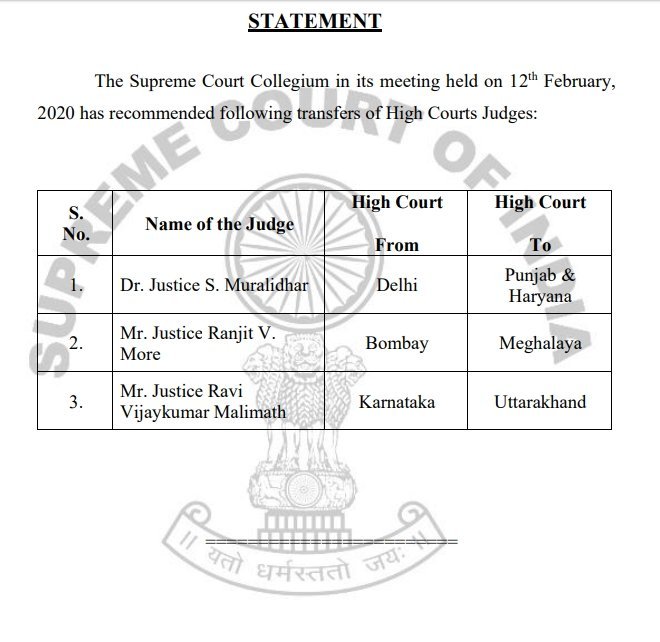
However, Boom Live clearly did not let the facts obstruct them from peddling propaganda against the government. The Union Government didn’t transfer Justice Muralidhar after an overnight decision, and the government can’t even transfer or appoint judges to the higher judiciary on its own. His transfer was recommended by the Supreme Court Collegium on February 12 itself, days before his midnight judgement after the Delhi riots, and the law ministry merely issued the notification as per the decision of the collegium. It may be noted that transfers and appointment in the higher judiciary are in the hand of the Collegium, and the govt has no role in it. Apart from justice Muralidhar, the SC Collegium had also recommended the transfer of justice Ranjit C More from Bombay to Meghalaya High Court, and justice Ravi V Malimath from Karnataka to Uttarakhand High Court.


Union Law Minister RS Prasad had rubbished several reports that said that the government has exacted revenge on Justice Muralidhar for his withering remarks in Delhi riots case by transferring him. Prasad tweeted that the transfer was done as per recommendation dated 12.02.2020 of the Supreme Court collegium headed by Chief Justice of India. He also informed that before transferring the judge, his consent was taken, and well-settled process in such matters have been followed.


In an article published in the Hindu on February 21, days before violence engulfed the National Capital, it was reported that Justice Muralidhar had agreed for transfer willingly. “His consent was taken before transferring him. It is a routine one,” the source quoted by The Hindu said.

Read- Here is how every claim made by left-liberals and opposition on justice Muralidhar’s transfer is a lie

Clearing the air around the unnecessary controversy surrounding his transfer, Justice Muralidhar yesterday claimed that he was informed much in advance about his transfer. “I was informed on February 17 from CJI about the Collegium’s recommendation of my transfer to Punjab and Haryana Court and I had no problems with it,” Justice Muralidhar said.

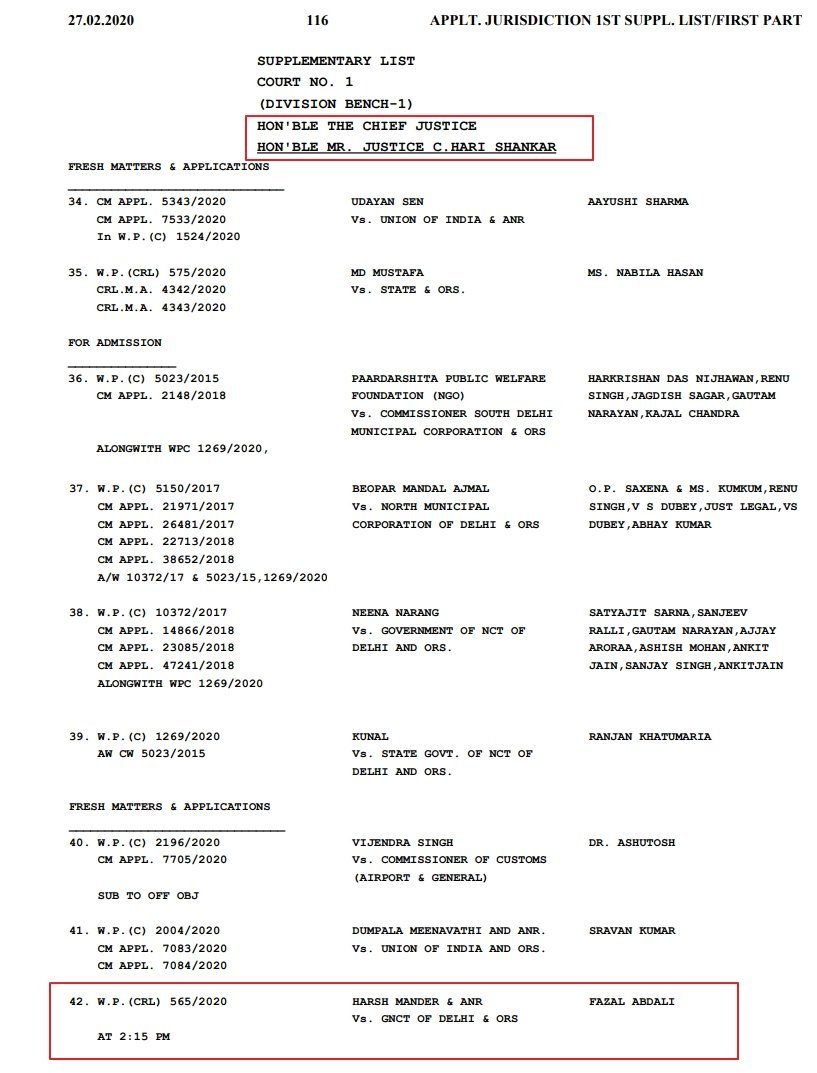
In addition, Faye also insinuated that Justice Muralidhar’s “sudden” transfer happened to remove him from Delhi riots hearing after his criticism of Delhi Police. However, this assertion too is a lie because even if he was not transferred, he was not scheduled to hear the case further. The reason is, the case was not even listed for Justice Muralidhar’s court. The case was listed before the Chief Justice of the Delhi High Court, and justice Muralidhar had heard the case in urgency as the Chief Justice was absent on that day. The case was not transferred to his court, it remained listed under the CJ, so subsequently the case was to be heard by the CJ only, even if justice Muralidhar had remained in Delhi High Court.

The cause list of the Delhi High Court for February 27 shows that the case was to be heard by the Chief Justice at 2 PM.

The above evidence, freely available in public domain should have deterred Boom Live, ostensibly a Fact-Checker, from fuelling unfounded apprehensions about the state of judiciary in India but they continued to malign the government, regardless of the facts suggesting otherwise. Ironically, Faye peddled these unadulterated lies on Boom Live on her show titled as “Truth as be told”.

It is pertinent to note that Boom Live is an IFCN accredited fact-checker and yet, it blatantly indulged in publishing fake news to attack the central government without bothering to verify the facts in the matter. Moreover, the lies surrounding Justice Muralidhar’s transfer were debunked on February 27 itself, by the law minister, OpIndia, and many others, but still Boom Live published the video with the same lies one week later. This calls into question the significance of IFCN’s accreditation and casts aspersions on standards observed by IFCN in granting recognition.

The International Fact-Checking Network (IFCN) recently came under severe criticism for its dubious and differing yardsticks to grant the Fact-Checking accreditation. While Indian portal Fact Hunt was rejected its partnership based on its founder’s old congratulatory tweets to PM Modi, the organisation had no qualms in continuing their association with habitual fake-news peddler Altnews, despite its owners’ overt support to political parties and flagrant violations of its policies.

Responding to the criticism, Baybars Orsek, director of IFCN, announced that they had asked AltNews a set of questions and after being satisfied with their response which was replete with lies, they concluded that there was no ground for any action against Altnews.

The accreditation from such a dubious organisation holds no value as not one but many of its signatories have been found showing scant regards for the facts on multiple occasions. Besides Boom Live and Altnews, Indiaspend is also one of the signatories of IFCN. Indiaspend was guilty of instituting a ‘Hate-tracker’ that notoriously displayed selective instances of communal violence in India to portray that violence against Muslims in India has increased after PM Modi came to power.

Congress members regard Lok Sabha chair as the Pope of Vatican: Congress leader Adhir Ranjan Chowdhury in Lok Sabha

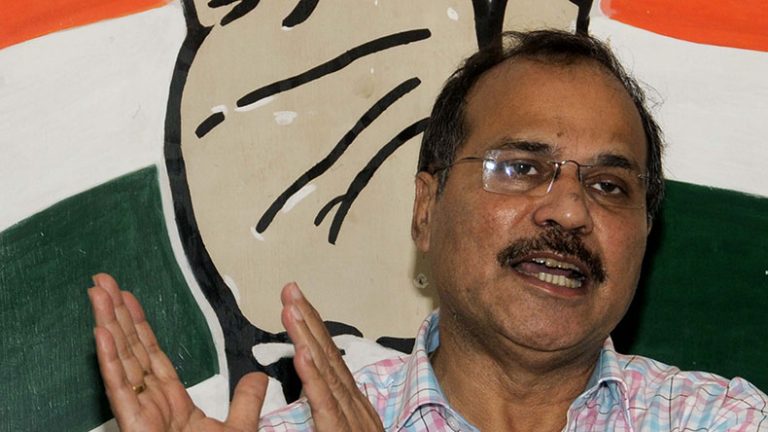
Congress senior leader Adhir Ranjan Chowdhury seems to have come up with a baffling analogy as he sought revocation of the suspension of seven Congress MPs in Lok Sabha Friday. The Leader of Congress in Lok Sabha said that the Congress members always regard chair in Lok Sabha as ‘Pope of Vatican’.

The Congress leader did not stop at that. He also said that a pickpocket cannot be sent to the gallows as he argued that the suspension of seven Congress members from the House was “disproportionate” and should be revoked.

Asking the house that on what basis the seven Congress members were suspended, Adhir Ranjan Chowdhury said, “Jeb katua ko phansi ke takhte pe nahi chadaya ja sakta hai (a pickpocket cannot be sent to the gallows)”.

This inane remark of his, however, boomeranged back at him as, JD(U) member Rajiv Ranjan Singh exclaimed that by referring to pickpockets, Adhir Ranjan Chowdhury was agreeing that the Congress members had made a mistake. Moreover, Parliamentary Affairs Minister Pralhad Joshi retorted by saying that “It is strange to compare the suspended MPs with pickpockets. It is most unfortunate. We don’t agree with this.”

Read: Lok Sabha suspends seven Congress MPs for snatching and throwing paper on speaker’s chair, barred from attending rest of the budget session

Speaking about the suspension of the seven Congress MPs Pralhad Joshi said the snatching papers from the Chair had never happened in the House in its history of more than 70 years.

On Thursday, seven Member of Parliament of the Congress party were suspended for disrupting the lower house even after Lok Sabha speaker had issued a stern warning against creating ruckus inside the house.

The Congress MPs were seen snatching and throwing paper near the speaker’s chair. Parliament Party Affairs Minister Pralhad Joshi had moved a resolution asking them to be suspended for the rest of the sessions.

Read: Govt may seek termination of Congress MP Gaurav Gogoi’s Lok Sabha membership for gross misconduct in the parliament

Gaurav Gogoi, T N Prathapan, Dean Kuriakose, Manicka Tagore, Rajmohan Unnithan, Benny Behanan and Gurjeet Singh Aujla were named by Meenakshi Lekhi who was presiding the house after the Lok Sabha reassembled at 3 pm.

Earlier in the day, the former Congress President Rahul Gandhi led a protest by senior Congress leaders on the premises of Parliament today against the suspension of seven congress MPs from the Lok Sabha yesterday.

Senior leaders of Congress including Rahul Gandhi, Gogoi, and Shashi Tharoor were seen with black bands, staging a protest in front of Gandhi’s statue alleging that the suspension was done to scare the Congress party.

Read: Rahul Gandhi leads protest outside parliament against suspension of 7 Congress MPs

The Congress leader Adhir Ranjan Chowdhury has been known for his controversial and outrageous remarks. Be it from using unparliamentary language in Lok Sabha against the BJP by calling its leaders Ravan ki aulad”, to labelling Amit Shah and Narendra Modi as ‘illegal immigrants’ while attacking NRC or be it using derogatory slang for European delegation that visited JK, calling them ‘kiraye ke tattu’, the Congress leader, somehow, does not know how to mince his words.

Phone Pe and Paytm engage in Twitter banter after YES Bank moratorium affects the former

In a hilarious tweet, Paytm invited PhonePe to work on its bank platform to restore its services and added that Paytm can “seamlessly scale manifold” to handle the latter’s business. PhonePe rebuked the former saying that they would have contacted them if their UPI platform was “so seamless.”


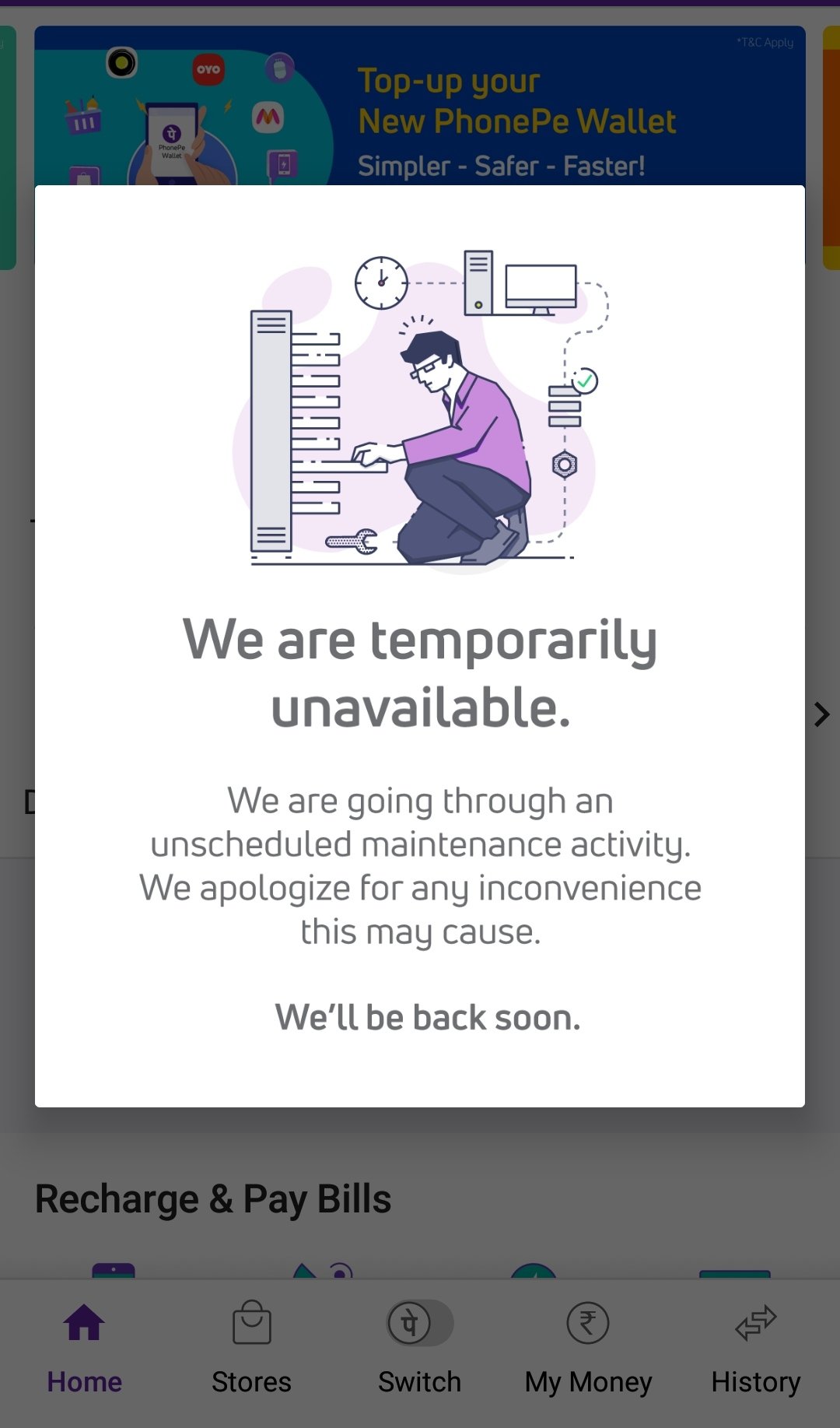
The Twitter confrontation happened after PhonePe was forced to temporarily suspended its services, following the moratorium imposed by the Reserve Bank of India on YES Bank. The popup reads, “We are going through an unscheduled maintenance activity. We apologise for any inconvenience this may cause.”

YES Bank moratorium sparks war of words between PhonePe and PayTM
Effect of the YES Bank Moratorium on PhonePe
While the PhonePe Chief Executive Officer (CEO), Sameer Nigam, has assured the Digital payments service will be live in a few hours, the Chief Technical Officer (CTO) thanks users for the patience and added that the company was disbursing merchant settlements.


The regulator has imposed a cap of ₹50,000 on withdrawals from accounts in the Yes Bank for a month. In case of medical expenses, higher education or marriage or other ceremonies in the family, or in any unavoidable emergencies, the limit will be extended to ₹5,00,000.

Read: RBI takes over management of Yes Bank and imposes restrictions on withdrawals: All you need to know about the latest crisis in banking sector

The YES Bank was the acquiring bank of PhonePe.The bank has been prohibited from granting or renewing any lean or advance, making any investment, incur any liability after March 5. The bank can make payment for regular expenses like salaries, rents, taxes, printing and stationery, premium payment etc, but will need RBI approval for any other expenses.

RBI has also suspended the Board of Directors of Yes Bank Ltd. for a period of 30 days “owing to a serious deterioration in the financial position of the Bank”. Prashant Kumar, ex-DMD and CFO of State Bank of India, has been appointed as the administrator of the bank.

RBI publishes scheme of reconstruction draft for Yes Bank, State Bank of India to pick up 49% stack at ₹10 per share

A day after placing Yes Bank under moratorium, the Reserve Bank of India today published a draft of scheme of reconstruction for the troubled private sector bank. Yesterday, the central bank had taken over the management of the bank, and limited withdrawals to ₹50,000 for a month. According to the reconstruction plan prepared by RBI, public sector bank State Bank of India will infuse capital in Yes Bank by acquiring 49% stack.

According to the ‘Yes Bank Ltd. Reconstruction Scheme, 2020’, the authorised share capital of Yes Bank will be altered to ₹5,000 crore, and the number of equity shares will be 2,400 crore, having a face value of ₹2, which means the aggregate value of shares will be ₹4,900 crore. As the Investor Bank, SBI will hold 49% stack in the bank by infusing fresh capital. SBI will buy the shares of the bank at a price of ₹10, which means it will be paying a premium of ₹8 on the shares of face value ₹2. SBI will not reduce its holding in the bank below 26% before three years from the date of investment.

After SBI picks up the stake, a new board will be constituted for the bank, and the administrator appointed by RBI will hand over the control of the bank to the newly formed board. State Bank of India will nominate two directors in the board of directors, while RBI may appoint additional directors exercising its powers.

After Yes Bank is reconstituted with capital infusion from SBI, all its schemes, contacts, deeds, bonds, agreements etc will remain effective, as they were before. All deposits and liabilities with the bank will continue as before, under the existing terms and conditions.

The scheme of reconstruction states that all the employees of the bank will retain their jobs, they will continue in their service with the same remuneration and same terms and conditions. The reconstruction will also not affect the existing offices and branch network of Yes Bank, and they will continue to function in the same manner as earlier.

RBI has sent the draft to both Yes Bank and SBI, and has invited suggestions and comments from members of public, including the banks’ shareholders, depositors and creditors on the draft scheme. The Reserve Bank will finalise the scheme after receiving suggestions till 9th March.

Earlier in the day, finance minister Nirmala Sitharaman had informed that SBI has expressed willingness to invest in Yes Bank. She assured that the revival scheme will be completed within the 30 days, and deposits and liabilities will remain unaffected. The finance minister also said that Yes Bank jobs and salary will be assured for at least one year.

Nirmala Sitharaman informed that RBI has asked to probe roles played by individuals in Yes Bank, and SEBI is also looking into the issue. “I want RBI to ensure that due process of law is set to roll with a sense of urgency so that we should find out as to who led to the problem of this size & magnitude,” she said.

The moratorium imposed on Yes Bank has affected not only its depositors, but a large section in the financial sector. A number of financial services companies that have Yes Bank as their partners have been affected, including payment firms PhonePe and BharatPe. Yes Bank is a major player in the UPI market, therefore, overall UPI transactions will come down as third party UPI apps with Yes Bank as partner have stopped working. A large number of small co-operative banks also use Yes Bank for their NEFT/RTGS/IMPS as a sponsor bank, and these banks will not able to transfer funds unless they move to a different bank.

Archaeologists discover a huge cache of ivory pieces in ancient Bhanbhore city in Pakistan’s Sindh

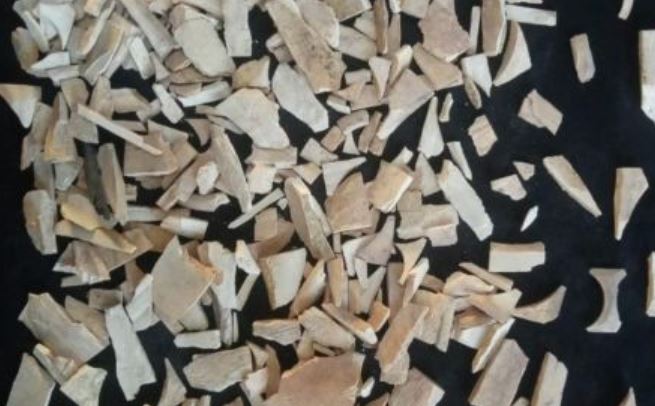
Amid excavation survey of Pakistan’s 2,100-year-old ancient port city of Bhanbhore in Sindh province, Archaeologists from Italy and Pakistan have discovered 40 Kg of Ivory remnants from the ruins of the ancient city.

This discovery had led the Archaeologists to believe that there must have been a big workshop for the commodity in that area, which might be dating back to 800 years, officials said on Thursday.

“Technical experts of archaeology from Italy and Pakistan have come to the conclusion that Bhanbhore was a trade and industrial city where a big factory of elephant ivory existed,” Sindh’s Director Heritage Muhammad Shah Bukhari told Arab News on Thursday, adding that the findings were disclosed in a technical seminar in Karachi a day earlier.

Sharing the findings with the participants of the technical seminar on Wednesday, Italian archaeologist Dr Simone Mantellini said that the antiquities recovered from Bhanbhore included 6,675 Ivory pieces, the largest such recovery anywhere in the world.

“Nowhere else in the world have ivories been found in such a large quantity. Ivories were found in Iraq but those were small in number,” Mantellini said, adding that such a huge recovery proved there was a factory for the commodity in the city.

No similar Ivory deposit or workshop has been found elsewhere in the Indian subcontinent. This discovery is unique, the archaeologists say.

Bhanbhore city in Pakistan’s Sindh province was found in the first century B.C.E. at the mouth of the Indus River and is located about 65 kilometres east of Karachi. Bhanbhore was controlled by Muslims from the 8th to the 13th century, after which it was abandoned. Department of Archaeology and Museums Pakistan has submitted the site’s name for UNESCO World Heritage Sites tag.

The city’s excavation began under Ramesh Chandra Majumdar in 1928, which was of course before the subcontinent’s partition into India and Pakistan. Following partition in 1947, extensive excavation of Bhanbhore resumed this time, under the direction of famed Pakistani archaeologist Fazal Ahmed Khan, from 1958 to 1965.

The strategic location of Bhanbhore city in the Indus River delta apparently made it a major port and commercial hub in antiquity, trading with peoples around the Indian Ocean and the Far East. Bhanbhore also featured a large fortified citadel around 14,000 square meters in area. The citadel was divided into eastern and western sections by a fortified stone wall in the centre. Previous excavations found buildings and streets beyond the walled city as well.

The city has also been tentatively identified as the starting point for the spread of Islam in Sindh during the Early Medieval period.

Based on the evidence now found of the vast Ivory industry, Italian archaeologist Dr Simone Mantellini presumed that the city possibly had a booming economy. Mantellini believed that working elephant tusks may have been a central pillar of the city’s prosperity. He added that earlier excavations in the 1950s and 1960s did find some finished ivory pieces too.

Youngsters at Rabindra Bharati University vandalise Tagore’s poetry, paint obscene words on their bodies during Basant Utsav celebrations

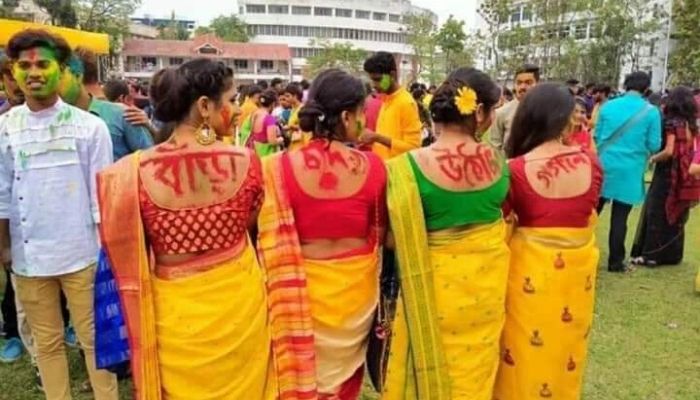
In a shocking incident, a group of youngsters at the Rabindra Bharati University in Kolkata were seen sporting cuss words and slangs disrespectful to Nobel Laureate Rabindranath Tagore on their bodies. The youths had sported the obscene text on their bodies during the Basant Utsav celebrations on the university campus.

While one body marking read “Dudu chai (I need b**bs)”, the other highlighted “F*ck you” in bold letters. Another group of girl could be seen sporting, “Bada Chada Uthalo Gogona (The d**k has risen to the sky)“. This line was made by distorting a famous song by Ravindranath Tagore, which had caused outrage from social media users.


It may be noted that a parody song using obscene language based on the Tagore song was originally made and uploaded on Youtube by a Youtuber named Roddur Roy. The girl students used the lyrics from that song to paint the words on their back. Roddur Roy’s songs had already created outrage earier, and a Change.org petition was also floated to take down his Youtube Channel and Facebook page. Roy describes himself as a novelist, poet, movie maker, spiritualist guru, YouTuber, artist and art and nature activist based in Delhi in his website.

A group of boys can also be seen carrying body markings that read, “Bal Chira Gecha (My p*bic hair is torn)”


The expletives were drawn using ‘Gulal’ during the Basant Utsav, which is held every year on the college campus. When the objectionable pictures went viral on social media, the University authorities swung into action. They began screening the youngsters to ascertain whether they belonged to the Rabindra Bharati University.

A Twitter user, Keya Gosh, highlighted the degrading culture manifested as a result of the Communist rule in West Bengal. She dubbed it as a “sad day for Bengal.”

Another user, Rupa Bhattachariya, wrote “This is Rabindra Bharati University. The Education System of the state has improved drastically (sarcastic).”


Another angry Netizen, Sandeep Aditya, said: “Possibly, she is also a gem of the same University,” posting another photograph.

As it turned out, it was an open-to-all event and the youngsters were not students of the esteemed university. Nevertheless, the incident sparked outrage on social media. After the incident drew the ire of the Tagore lovers, a formal complaint was registered at Sithi Police Station. Following it, 5 accused surrendered before university authorities and apologised. None of them has been arrested so far while the 6th accused is still on the run.