Home Blog Page 6110

Fact Check: Does the effective repeal of Articles 370 and 35A nullify the Instrument of Accession signed between JK Maharaja and India?

The Narendra Modi government today fulfilled one promise made in the manifesto for 2019 Lok Sabha elections by beginning the process of effectively scrapping the Articles 35A and 370 of the constitution, which gave special status to Jammu and Kashmir. The government also decided to make the Ladakh region a union territory, and downgrade the remaining part of the state to a union territory with a legislative assembly and government.

Since the time BJP had promised to scrap Articles 35A and 370, many politicians and journalists, especially Kashmir based politicians, have been claiming that the accession of the state was conditional upon these two constitutional provisions, and if these two Articles are abolished, the accession of Jammu and Kashmir itself would become null and void. Politicians like Mehbooba Mufti and Farooq Abdullah have been claiming that the moment these special statuses for Jammu and Kashmir are withdrawn, the state will automatically revert to its independent status prior to accession to India.

In a statement issued to media, former J&K CM Omar Abdullah said that Jammu and Kashmir’s accession was done on the basis of terms and conditions contained in the Articles 35A and 370. Former CM Mehbooba Mufti also tweeted the same, claiming now India will become an occupying force in the state.


But these claims are totally wrong and baseless, and the fact is that the accession of Jammu and Kashmir was never conditional on the two Articles of Indian constitution. The state, then ruled by Maharaja Hari Singh, had decided to join independent India in 1947. The princely state was included in the Dominion of India through the Instrument of Accession was executed by Maharaja Hari Singh on 26 October 1947. This document was signed under the provisions of the Indian Independence Act 1947, an act passed by the United Kingdom Parliament.

So, when the state had merged into India, the Constitution of India didn’t even exist, which means articles 35A and 370 also didn’t exist at that time. Article 370 was part of the original constitution that India had adopted on 26th January in 1950. This was part of Part XXI of the constitution, which is the Temporary and Transitional provisions. This means the article 370 was deemed to be a temporary provision from the beginning. Therefore, a temporary article can’t be the precondition of the accession of a state.

The article 35A, on the other hand, was inserted into the constitution later, in the year 1954.

On 14th May 1954, the president had issued the Constitution (Application To The State Of Jammu And Kashmir) Order 1954, superseding the earlier order issues in 1952. This 1954 order inserted the Article 35A into the constitution, giving the state the right to determine who is a permanent resident of the state.

It may be noted that although the Article 370 gives special status to Jammu and Kashmir, specifying which articles of Constitution apply to the state, it itself was under the Temporary and Transitional section of the original constitution adopted in 1950 itself. Neither of the Articles says that they are the preconditions of the accession of the state into India. Jammu and Kashmir had merged with India under the Instrument of Accession executed in 1947, and it is not depended on two constitutional provisions made in 1950 and 1954.

The Presidential order issued in 1950 had specified the subjects and articles of the Indian Constitution that corresponded to the Instrument of Accession, as required by Article 370. The presidential order of 1952 had superseded the 1950 order, which had amended the article 370 and had abolished the monarchy in the state. Another Presidential order issues in 1954 ha superseded the 1952 order, which was a comprehensive order implementing the provisions of Delhi Agreement 1952. This had inserted Article 35A into the Constitution.

Now the government has issued another presidential order, the Constitution (Application To The State Of Jammu And Kashmir) Order 2019, which supersedes the 1954 order.

One important fact to be remembered is that as per Article 370, other than defence, foreign affairs and communication, the concurrence of state government was required for any application of constitutional power pf central government. And this concurrence of state government was to be ratified by the Constituent Assembly of Jammu and Kashmir. But the Constituent Assembly itself was dissolved in 1956, after the adoption of Jammu and Kashmir constitution, this means the authority of the state government to give concurrence to any central government had lapsed. But this provision was soon abandoned and central government orders were implemented with the concurrence of the state government instead of the constituent assembly. This was being done without making the required change in the constitution. Now the government has decided to correct this anomaly, and has replaced the constituent assembly with the legislative assembly.

Congress opposes complete integration of Jammu and Kashmir with rest of India. Read their statements on Article 370 decision

As India witnessed history being made after Modi government, led by Home Minister Amit Shah announced in the Rajya Sabha that Article 370 has been effectively revoked by Presidential order, the Congress party has decided to protest against revoking of the controversial article.

Congress leader and Leader of Opposition in Rajya Sabha Ghulam Nabi Azad condemned the government’s proposal on Article 370, abrogating the special status to the state of Jammu and Kashmir.

Speaking to the media, senior Congress leader Ghulam Nabi Azad said that Jammu and Kashmir is a border state which is culturally, geographically, historically and politically different, which was bound together by Article 370. He said BJP drunk in power and to get votes, it has govt scrapped 3-4 things. “They’ve cut off the head of the country. Political parties will fight and stand with Jammu and Kashmir,” said Azad.


“In the history of India, this day will be written in black letters. they have abrogated Article 370 and Article 35A. Further, they have bifurcated the state of Jammu and Kashmir by making a Union territory. Even Governor is replaced by Lieutenant Governor. BJP does not understand the state as they have come to power now,” said Azad.

He further added that Kashmir shares borders with China and Pakistan. BJP has taken a treacherous decision and has destroyed democracy and the unity and integrity of the state. “The people of Jammu and Kashmir had fought the Pakistan Army with sticks. The BJP has now destroyed the people of Jammu and Kashmir culturally, politically, socio-economically,” added Azad.

Ghulam Nabi Azad said his party along with other ‘secular’ political parties will stand with the people of Jammu and Kashmir to protest against the historic decision of abrogation of Article 370 and bifurcation of state into two union territories.

Senior Congress leader P Chidambaram said that the disintegration of India has begun with the resolution on Article 370. “The govt has illegally disintegrated J&K. This will set a precedent and allow the govt to disintegrate any state as per its will and we will not stand by this,” said P Chidambaram.

He has also said that the future will realise what a grave mistake the Modi government has made.


Earlier in the day, the government of India proposed bifurcation of the state of Jammu and Kashmir. Jammu and Kashmir to be one Union Territory and Ladakh will be a separate Union Territory, according to this proposal.

The Congress party has clearly sacrificed national integrity and interest at the altar of petty politics. Articles 370 and 35A were the monsters hindering the complete and conditionless integration of Kashmir with the rest of India. By opposing this move, the Congress party has possibly damaged its electoral fortunes even more.

Unnao Rape case: Delhi court orders to shift rape accused Sengar and accomplice to Tihar jail

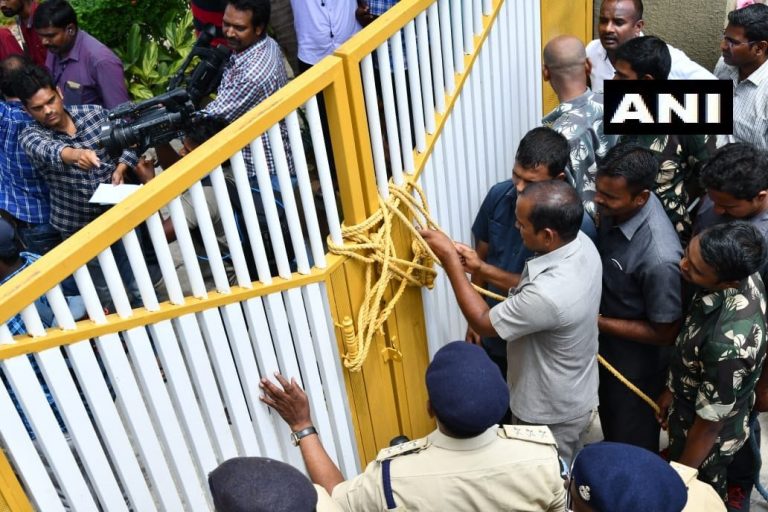
On Monday, Delhi’s Tis Hazari Court ordered to shift rape accused Kuldeep Singh Sengar and co-accused Shashi Singh to Delhi’s Tihar Jail. Both of them are in jail for their involvement in the much-publicised Unnao rape case.

According to the reports, the Unnao rape accused MLA Kuldeep Singh Sengar and his accomplice Shashi Singh were produced before Delhi’s Tis Hazari court on Monday amid tight security after the court issued production warrant against them on Friday. The court had also issued warrants against the other accused in the case for their presence on Tuesday.

Last week, the Supreme Court had transferred all cases from Uttar Pradesh to Delhi, while ordering interim compensation of Rs 25 lakh for the victim and CRPF security cover for the victim and her family including their lawyer.

The Supreme Court bench led by Chief Justice Ranjan Gogoi had asked the CBI to expedite the probe into the accident case and complete it within seven days and not later than 14 days.

Former BJP MLA Kuldeep Singh Sengar is the prime accused in the 2017 high profile rape case. The case pertains to an alleged rape committed by Sengar and his plot to silence the victim and intimidate her relatives by framing them in police cases based on flippant charges.

Last Sunday, the victim was travelling to Raebareli with her two aunts, and her lawyer Mahendra Singh when their vehicle was hit by a truck, rendering the victim and her lawyer critically injured. The vehicle collided with a truck going in the opposite direction towards Lalganj in UP. The victim is now battling for her life.

Two of her aunts were killed in the accident while her lawyer also sustained serious injuries. The CBI has later taken up the investigation into the car crash too. The victim’s family had alleged that they were being pressurised by Sengar’s men. and the car crash was orchestrated by Sengar himself.

5th August 2019: The death of Nehruvian Secularism and the dawn of a New India

There are moments in history the significance of which mere words cannot capture. Human language has not evolved enough to contain the vocabulary required to adequately describe the essence of their import. The 5th of August, 2019 is one such day.

It will go down in history as the day when the future of India was changed forever. The abolition of Article 370 and consequently, Article 35A, marks a new beginning for our country. Monumental days such as today have key players who are immortalized forever. A single decision taken by a few extraordinary men translates into a giant leap for an entire nation.

The Death of Nehruvian Secularism

In the second week of May, while the Lok Sabha elections were underway, OpIndia.com had made a prediction. We had said that Nehruvian Secularism shall not survive another term of Modi Sarkaar. Of course, we weren’t the first to make that claim. However, it does feel good to be vindicated.

So this is how Nehruvian Secularism dies, amidst chants of Bharat Mata ki Jai and Jai Hind. Nehru’s legacy didn’t die a simple death. The death of his legacy was cheered, celebrated and cherished by every single patriot of this country. And it’s merely the beginning. By the time the Modi-Shah duo is done, India will be completely unrecognizable from the country Nehru envisioned. And like we said before, it will be a good thing.

It has also become evident that Nehruvian Secularism is inherently detrimental to our national interests. The criminalization of Triple Talaq was the first blow that was struck at the heart of it. Within a matter of days, the abolition of the Articles 370 and 35A has destroyed it altogether.

A New India

The abolition of Articles 370 and 35A and the unprecedented developments that preceded it also heralds the dawn of a New India. This New India acts as a sovereign nation, this New India is not afraid to enforce harsh crackdowns on people who seek to threaten its territorial integrity. This New India reveres Gandhi but carries in its heart the revolutionary spirit of Veer Savarkar and Bal Gangadhar Tilak.

This New India is a major player in international politics. This New India is not cowed down by the West. This New India does not compromise its national interests in a deluded pursuit of the moral high ground. This New India has abandoned Nehruvian ideals for the virtues that drove Chhatrapati Shivaji Maharaj to glory. It’s a fundamental shift in the manner in which India perceives itself, it’s a shift that indicates a definitive change in the ideological conceptions of the political establishment.

India shall no longer be held hostage by a bunch of foreign-backed politicians. India shall no longer shy away from conflict. India does not hunger for war but recognizes that wars waged to uphold Dharma are virtuous. We shall no longer sacrifice our nation and its people to the false song of Secularism. This is not Nehru’s India anymore, this is Veer Savarkar’s India, Shyama Prasad Mookerjee’s India, Sri Aurobindo’s India.

Makers of a New India

Prime Minister Narendra Modi has often talked about a New India. After today’s decision, it almost becomes certain that he will go down as the maker of it. He has shown tremendous courage, colossal grit and enormous dedication in passing this order. The party won 303 seats in his name and the mammoth victory has manifested itself in even mightier consequences.

Union Home Minister Amit Shah is indispensable to Narendra Modi. Through thick and thin, Amit Shah has stood by Narendra Modi’s side and helped craft his gargantuan victories. It’s not for nothing that he is called the Modern Chanakya. Who could have ever imagined that one single friendship would have such an impact on the future of an entire civilization? It’s only fitting then when people shall speak of a New India, Amit Shah’s name will closely follow Narendra Modi himself.

NSA Ajit Doval is another individual who deserves great credit for the abolition of Articles 370 and 35A. It has been fairly obvious that the top two of the BJP work closely in tandem with Doval on all major issues concerning the nation. Doval, himself, has been targeted frequently by the Lutyens Cabal which indicates his importance in the government hierarchy. He has tasted several great successes in his career but surely, the abolition of Articles 370 and 35A is the most important issue he has ever worked. And that will be his greatest achievement.

There are a great many others who have worked behind the scenes to ensure that this momentous occasion comes to pass. And each of them deserves great praise. It’s also a victory for every single nationalist who was fortunate enough to be born in this sacred land of ours. It’s a collective victory of every single citizen of this country.

Delimitation exercise of Jammu and Kashmir to begin soon, Puducherry UT model to be emulated

In a historic move, Home Minister Amit Shah today announced a resolution assented by the President of the country, clearing the path for the abolition of Article 370 of the Indian constitution that granted Jammu and Kashmir a special status. Alongside, a bill to bifurcate the state into two Union Territories: Jammu and Kashmir with legislature and Ladakh region as another Union Territory without legislature.

As per reports, on the passage of the bill, delimitation exercise will also soon be initiated in the state to demarcate Ladakh region from the original Jammu and Kashmir state. The exercise will be managed by the Election Commission of India and seats in the Jammu and Kashmir legislative assembly will be increased to 114 from 107.


The Jammu and Kashmir Union Territory will follow the UT model adopted by Puducherry which also has its own legislature. Provisions of Article 239A that are applicable to Puducherry will be applicable to the UT of Jammu and Kashmir as well.

The Fourteenth Amendment of the Constitution of India, officially known as The Constitution (Fourteenth Amendment) Act, 1962, incorporated Puducherry as the ninth Union territory of India. The Clause 4 of the Bill sought to insert a new Article 239A in the Constitution, which would empower Parliament to create by law, Legislatures and Councils of Ministers for Union territories of Himachal Pradesh, Manipur, Tripura, Goa, Daman and Diu and Puducherry. Jammu and Kashmir will now join this list of Union Territories.

The bill garnered overwhelming support from disparate political parties in the upper house of the parliament. Various political parties such as YSRCP, Shiv Sena, AAP, BSP, BJD and other regional parties have extended their support to the government on the Jammu and Kashmir bifurcation bill.

Indian Army and Air Force put on high alert, Delhi Metro on red alert following govt’s announcement on Article 370

The Modi Government has come up with a historic move to change Kashmir’s destiny by revoking Article 370 in Jammu and Kashmir.

Apart from this, the govt has announced to bifurcate the border state into two separate Union Territories – one for Ladakh without a Legislative Assembly, and another for Jammu and Kashmir with a legislative assembly with curtailed powers.

Following the revoking of Article 370 and other decisions announced by Government of India, the Indian Army and the Indian Air Force have been put on high alert, reports ANI.


Moreover, the Delhi Metro has also been put on a Red Alert. “As advised by security agencies, a red alert has been imposed on the entire DMRC network. Please allow extra time in security checks,” the DMRC said.


Meanwhile, as a precautionary measure, more troops have been sent to Kashmir. Close to 8,000 paramilitary troops were airlifted and moved in from Uttar Pradesh, Odisha, Assam and other parts of the country to the Kashmir valley. Troops induction still going on.

Hours before the announcement, section 144 CrPc was imposed in Srinagar with effect from 1200 Hrs on 5th August 2019 which shall remain in force till further orders.

It is notable here that the LoC between India and Pakistan Occupied Kashmir has been tensed since days as Pakistan has reportedly been attempting to send BAT personnel with Islamist terrorists into the valley. There have been reports of continuous shelling at the LoC.

Previously, the Amarnath Yatra had been cancelled following the discovery of American M-24 sniper and Pakistan made mine in a terrorist cache.

Mobile internet has been suspended in the Valley. As a preemptive measure, several political leaders, including Mehbooba Mufti, Omar Abdullah and Sajad Lone, have been put under house arrest while Army personnel have taken to the streets of Kashmir.

Schools and colleges in Jammu, Kishtwar, Resai, Doda and Udhampur districts were also ordered to remain closed on Monday.

Know the difference between the new union territories: Jammu and Kashmir, Ladakh

In a historic decision, the union government today decided to bifurcate the northernmost state of the country Jammu and Kashmir into two union territories. Along with scrapping the Article 370 of the constitution that gave the state special status, the government decided that the state will be split into two regions, Jammu and Kashmir will be a union territory with a legislature, and Ladakh will be the other union territory without any legislature.

This decision reduces the number of states in India from 29 to 28 and increases the number of union territories from 7 to 9.

According to the Article 1 (1) of the Constitution of India says that India is a union of states, which includes states, union territories, and any other territory that may be acquired by India. The main difference between the two is that states are run by the respective state governments, while the union territories are areas under the administrative control of the central government.

But two of the union territories have the special privilege of having own legislature, National Territory of Delhi and Puducherry. These two union territories elect their legislators to the respective legislative assembly, and the party with a majority in the house forms a government, just like full-fledged states, but with some powers curtailed. The other five union territories, Andaman and Nicobar, Chandigarh, Dadra and Nagar Haveli, Daman and Diu, and Lakshadweep, don’t have any assembly and they are completely governed by the union government through the Lieutenant Governor. The governments of union territories with legislative assemblies have powers in most areas like full-fledged states, except control over police, law and order, municipal services and land.

Now the two newly formed union territories, Jammu and Kashmir, and Ladakh will belong to both the categories. Jammu and Kashmir become a union territory with a legislature, which means it will have a legislative assembly, and a state government. But the Lieutenant Governor will have greater power compared to the current governor. On the hand, the Ladakh region will become a union territory but it will not have any legislative assembly and state government, it will be completely under the control of the central government and its representative Lieutenant Governor will run the administration of the region.

The most important implication of this decision is that the police force in the current state will come under the control of the Union Home Ministry. In Jammu and Kashmir union territory, a tug-of-war for power between the state government and the centre can be seen, just like Delhi. Ladakh will not have any such issue as there will be no state government or legislative assembly.

Blast from the past: These past tweets of Kashmiri politicians daring PM Modi to scrap Article 370 are amusing

The Narendra Modi led BJP government today corrected the 70 year old wrong by effectively revoking Article 370 making Kashmir part of India without any conditions and riders. Union Home Minister Amit Shah today in the Upper House of the Parliament moved the motion of integrating Kashmir by its decision on Article 370 and hence by default Article 35A.

While celebrations erupted across the country for the historic move, these old tweets of Kashmiri politicians taunting the government about removal of Article 370 are quite amusing to read.


The last chief minister of the state of Jammu and Kashmir (because the state is now bifurcated into Union Territory of Jammu and Kashmir and Union Territory of Ladakh) Mehbooba Mufti’s tweets prior to the general elections are quite ‘amusing’, in her own words.


She had said that scrapping Article 370 is a ‘dream’. Guess dreams do come true.

Freelance protestor turned full-time politician Shehla Rashid had about a year ago dared ‘trolls ke papa’ to remove Article 370.


While on a discussion of airfares between Srinagar to Delhi and Mumbai, Rashid had dared ‘trolls ke papa’ (we are still not sure whom she meant) to remove Article 370. However, the man whose team ‘records it all’, was listening and her wish was fulfilled.


Bureaucrat turned politician Shah Faesal had offered PM Modi that he will watch PM Modi’s show with Bear Grylls if he ‘spares’ Article 370 and 35A.


Shah Faesal hasn’t yet updated whether he will still watch the show or not.

He had even threatened that the day Article 370 and Article 35A are scrapped, ‘we will move our watches 15 minutes away from Indian Standard Time’, instigating that the state of Kashmir will demand separate region and ‘independence’.


Well, that didn’t quite age well. Speaking of ageing well, former Jammu and Kashmir chief minister Omar Abdullah had also echoed similar threats. That if Article 370 goes, Jammu and Kashmir will cease to be part of Indian State.


Except, with today’s proposal of revoking Article 370, Kashmir, which had riders attached to it, is now part of India without any conditions.

India is finally one.

As Kashmir issue grabs the nation’s eyeballs, liberals learn two new words, ‘vulture’ and ‘glee’

0

The buzzwords for today’s liberal meltdown appears to be ‘vultures’ and ‘glee’. Anyone who is looking forward to the decimation of Pakistan sponsored Jihad factory in Kashmir is a ‘vulture’, it is being claimed. According to them, it is morally reprehensible for Indians to feel buoyed by the prospect of the government strengthening India’s territorial integrity.

Liberals are using the abovementioned two words with such uniformity that social media users are bound to think whether the ‘words of the day’ and context has been circulated among their ilk in a planned manner. This was right before the Modi government’s historic decision to dilute Article 370 and also, declare Jammu and Kashmir as a Union Territory, as well as Ladakh as a UT without Legislation.


The message from liberals appears to be quite clear. They want Kashmir to remain a hotbed of terrorism and separatism for eternity. They do not wish to see a solution to the Kashmiri problem. For reason we can only speculate, liberals appear to have a vested interest in keeping Kashmir forever in the throes of Jihadists and Pakistan-friendly terrorists.

In a weird twist of events, people who are openly supporting toxic Islamist agenda veiled as ‘Kashmiriyat’ are accusing others of being vultures. It’s not too different from liberals calling Sindoor a Patriarchal conspiracy while vigorously defending the oppressive practice of Triple Talaq and Nikah Halala.

The Indian government has shown will of steel and abolished the most divisive Article 370 that gives Kashmir a special status. It is indeed a cause for great celebration as the sacred land of Kashmir will inevitably be culturally enriched with diversity by the settlement of citizens from the rest of the country.

That liberals are advocating for the preservation of toxic homogeneity in Kashmir only reveals the fact that they are defined by their utter lack of a moral compass. Diversity is our strength, they keep saying and yet, they want to deprive Kashmir of the source of their strength. They call people vultures for merely wanting to share the source of our strength with Kashmir.

The episode also demonstrates that Indian liberals love radical Islam a lot more than they love diversity or feminism or any liberal ideal. They are forever willing to sacrifice every liberal ideal at the altar of Jihad.

PDP chief Mehbooba Mufti warns about ‘catastrophic consequences’ of stripping Article 370, calls it ‘darkest day of Indian democracy’

In a historic announcement, Home Minister Amit Shah has announced in Rajya Sabha that the government has decided to strip Article 370 of the Constitution which grants special status to Jammu and Kashmir.

The government has also decided to bifurcate the state into two Union territories – Jammu and Kashmir, which will have a legislature, and Ladakh, which will be without a legislature.

While the historic announcement would change Kashmir’s destiny, it was as usual not received well by the opposition. The announcement was immediately followed by a massive uproar in the Upper House with opposition MPs protesting in the Well of the House.

Congress veteran Ghulam Nabi Azad, who is currently addressing the House rues that by revoking Article 370 that accords special status to Jammu and Kashmir, the BJP-led government has murdered the Consitution of India. “We stand by the constitution of India…we are willing to give up our lives for the constitution, but we condemn any act against the Constitution,” he says.

Meanwhile, the PDP chief, Mehbooba Mufti, who is currently under preemptive house arrest amid a massive security-built up back in the valley, took to Twitter to criticise the resolution. Condemning the ‘unilateral’ move as ‘illegal and unconstitutional’ and highlighting how this will have catastrophic consequences, Mufti writes that the government of India has failed in keeping its promises in Kashmir.

SS of Mehbooba Mufti’s tweet

Mehbooba has earlier warned in a language not dissimilar to Hafiz Saeed (LeT) and Masood Azhar (JeM). She said if Article 370 is abrogated, the whole India would burn; a typical “tukde-tukde gang” delusion.

This was not the first time either. She once tweeted that if Article 370 is scrapped, “Hindustan-waalon, tumhari-dastaan bhi na hogi dastaano mein” (O Indians, history wouldn’t even remember you once existed).

Meanwhile, India celebrates this is a historic day as Modi government has re-written Kashmir’s history. Now, Kashmir will be a part of India without any riders.