Home Blog Page 6346

Obligated by the agreement with Modi, Swiss authorities to share details of 50 Indians nationals holding accounts in Swiss banks

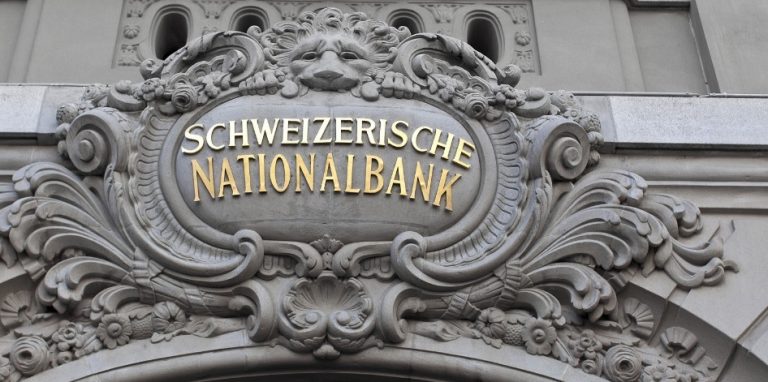
As a part of the massive clampdown on black money initiated by PM Narendra Modi during his first term, the Swiss authorities are in the process of sharing details of at least 50 Indian nationals having accounts in Switzerland-based banks.

Officials involved in the process of mutual administrative assistance between the two countries informed that these individuals largely include businessmen associated with companies, including the dummy ones, in sectors ranging from real estate, financial services, technology and telecom to paints, home decoration, textiles, engineering goods, gems, and jewellery.

In its endeavour to shed the long-standing perception of it being a safe haven for black money, the Swiss authorities had last month, shot notices to 11 Indians holding Swiss bank accounts. It notified that they have been given one last chance to appeal against sharing of their details with India. According to the federal gazette notifications issued by the Swiss government, 50 individuals had been sent such notices till date.

In these notices, the individuals or their authorised representatives have been asked to file their appeals, if any, within 30 days. They have to submit necessary documentary proof to support their case against providing ‘administrative assistance’ to India, which broadly means sharing of their banking and other financial details.

However, some of these notices have been sent after the preliminary appeals by the concerned clients of Swiss banks have already been rejected due to inadequate supporting facts and documents, leaving a limited chance of their further pleas getting heard, officials said.

While details of more than 100 Indians nationals have been shared in the past one year by the Swiss government with the Indian authorities, there is a high chance that a large majority of the cases currently under scrutiny would result in the administrative assistance being provided in the coming months, the officials furthered.

After assuming office in 2014, the Modi government had taken various steps to curb black money. As a part of this initiative, Switzerland had in 2017, ratified automatic exchange of financial account information with India which would facilitate immediate sharing of details about suspected black money. Adopting the Automatic Exchange of Information (AEOI) – a global convention on tax matters – the Swiss Federal Council had said that the implementation was planned for 2018 and the first set of data would be exchanged in 2019.

Earlier, the Swiss banks were widely known as an alleged safe haven for black money. Since Modi came to power, money parked by Indians in Swiss banks started reducing drastically.

According to data published by the Swiss National Bank (SNB) in 2017, the total funds held by Indians with Swiss banks in 2016 stood at a record low of 676 million CHF (Swiss francs), which was about Rs 4,500 crore.

In 2015, the total funds held by Indians with Swiss banks stood at CHF 1,206.71 million. In the year 2014, the total funds held by Indians with Swiss banks stood at CHF 1,814 million. 2017 was the third straight year of substantial decline of funds held by Indians with Swiss banks.

The funds held by Indians with Swiss banks stood at a record high of CHF 6.5 billion (Rs 23,000 crore) at 2006-end. In about a decade it went down to almost one-tenth.
Indian army conducts ‘Operation Sunshine-2’ with Myanmar army, camps of northeast militants targeted

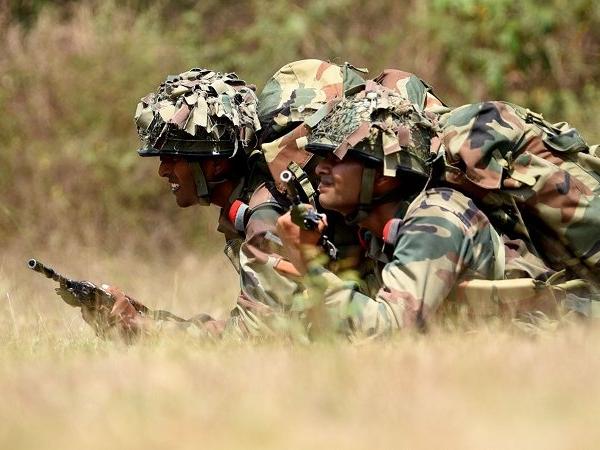
In a coordinated operation named “Operation Sunshine-2”, the Indian army along with Myanmar troops conducted a 3-week long operation targeting several militant groups operating in the border regions of Manipur, Nagaland and Assam.

The operation conducted between May 16 and June 8 targeted several militant outfits including the Kamtapur Liberation Organisation (KLO), the NSCN (Khaplang), the United Liberation Front of Assam (I) and the National Democratic Front of Boroland (NDFB).

Reportedly, around 70-80 militants belonging to these groups were nabbed and several of their camps destroyed during the operation. A third phase of the operation may also be launched depending upon on the actionable intelligence and ground situation.

Militant camps on the Myanmar side were cleared by four brigades of Myanmar Army. The fleeing militants were apprehended by Indian security forces. The Indian side had blocks of two battalions of the Indian Army — along with Special Forces, Assam Rifles and infantry Ghataks.

The two armies were careful not cross over the borders and at the same time were well coordinated, by placing liaison officers with the headquarters of the other each other’s army.

The Myanmar Army decided to stay in these areas to prevent the militants from regrouping. As their infrastructure is stretched heavily during the monsoons, the Indian Army would be providing logical support to these troops.

Myanmar shares a 1,640-km border with India and the thick forests in Myanmar near the border has been used to build camps by various terrorist organisations operating in northeast India. India has been pushing for better coordination between the two countries to handle the militants.

In June 2015, the Indian Army had carried out an operation against NSCN(K) militants in areas near the Indo-Myanmar border, days after militants killed 18 army men in Manipur.

This operation was a follow up of “Operation Sunshine-1” which took place in February where the Indian Army successfully destroyed Arakanese rebel camps that were working towards sabotaging the Kaladan Multimodal transit transport project.

Western Railways drops proposal of providing massage services to passengers in train

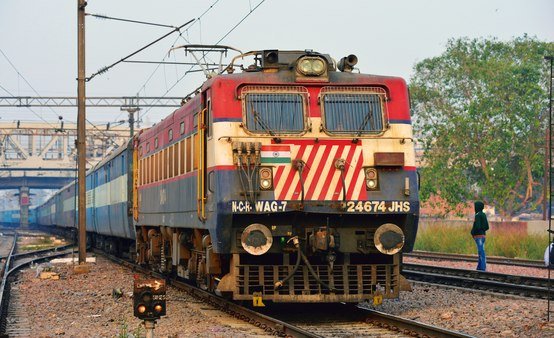
Western Railway has decided to withdraw the proposal of providing head, neck and foot massages to the passengers of trains originating from Indore.


In a press release, the Western Railway said, “As soon as this proposal came to the notice of higher authorities of Western Railway, it has been decided to withdraw this proposal of starting massage services in trains.”

There were other suggestions and representations made for improving passenger amenities which the Western Railway will now consider instead of the massage proposal.

Western Railway Senior PRO Jitendra Kumar Jayant informed that the proposal of providing head & foot massage services on 29 trains, that had been put forward by Ratlam Division. has been rejected by the Railway administration, respecting the views of the people’s representatives who had criticised it.

He added “They had criticised this proposal that it would create inconvenience for people, especially women. Berths have limited space so how would the services be even provided on a moving train? So Railway admin has rejected the proposal”, said the senior PRO of Western Railways.


The Ratlam division of Western Railway zone had on June 8, 2019, officially announced that they would soon be offering massage services for its passenger on board 39 running trains departing from Indore.

The trains included in the proposal were Malwa Express, Indore-Lingampalli Humsafar Express, Avantika Express, Indore-Veraval Mahamana Express, Shipra Express, Narmada Express, Ahilya Nagari Express, Panchvally Express, Indore-Pune Express.

Rajesh Bajpai, director, media and communication, railway board said, “This is the first time in the history of railways that we will provide massaging service for passenger comfort on running trains. It will not only increase revenue but also add passengers. Railways to earn an additional revenue of Rs 20 lakh annually and an estimated increase of Rs 90 lakh per year through the additional sale of tickets from about 20,000 passengers who will be the service providers”.

The Indian Railways had asked it’s zones and divisions to come out with new and innovative ideas to generate non-fare revenue, the message service would be the first idea want to be implemented after the suggestion of the Western Railway.

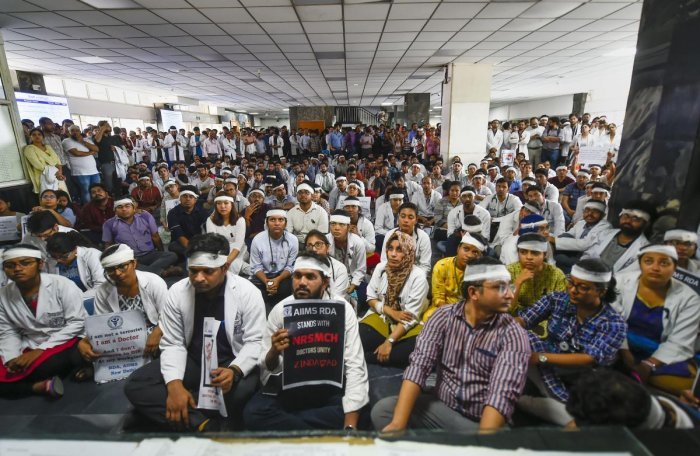
West Bengal: Agitating doctors ready to hold talks with CM Mamata Banerjee after deciding the venue

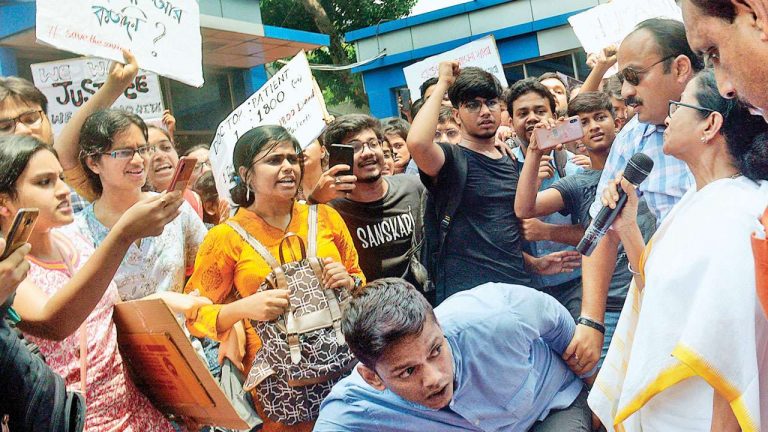
The gridlock between the agitating doctors in West Bengal and the state government reached its sixth day today. Yesterday, after the striking junior doctors rejected a proposal from West Bengal Chief Minister Mamata Banerjee for talks at the state secretariat Nabanna, today a beacon of hope appeared, as the agitating doctors asserted that they were open to talks with the government, the venue for which would be decided later in the day by a governing body of medical practitioners.

Earlier, the agitators had insisted that West Bengal CM should visit the city’s NRS Medical College and Hospital, the epicentre of the agitation, to resolve the issue.

However, after an internal meeting late on Saturday, the doctors have stated that they were ready to hold a dialogue in any form, but the venue of the meeting would be decided later.

“We will be deciding on our next step during a governing body meeting today. We are open to any dialogue as always. The venue for the meeting will be decided soon,” a spokesperson of a joint forum of junior doctors told the media persons here.

Initially, the West Bengal doctors crisis began as a small protest by a group of junior doctors at the state-run SSKM Hospital after doctors and interns at the NRS Hospital were brutally attacked by a mob on the premises of the hospital after a patient named Mohammed Sayeed reportedly died of natural causes. As the protest began attacks against doctors further escalated and mobs attacked students and interns at the Burdwan Medical College and Hospital as well. Due to the state government’s apathy towards the assaulted doctors, the protest gradually took a nationwide dimension with doctors from all across the country pouring in with their support and raising voices of dissent against the West Bengal government.

The CM aggravated the situation by threatening the doctors and by asserting that the doctors protesting are ‘outsiders’. Following which there were mass resignations from doctors across the state. Reports indicate that as many as 500 doctors have resigned from their posts so far. Indian Medical Association (IMA) has announced a pan-India strike from 17th June to 18th June.

Moreover, after the situation somehow seeming to slip out of hands, Mamata during a press conference on Saturday issued a fresh appeal to the doctors to get back to work.

Interestingly, while the doctors are insisting that Mamata Banerjee visits the NRS hospital personally to meet the protesting doctors, Banerjee on her part has not done that, she instead has been merely issuing appeals.

Earlier, a delegation of 5 doctors led by Sukumar Mukjherjee met Mamata Banerjee at Nabanna and offered to resolve the stand-off between the state and the striking doctors. It was owing to this that the CM’s secretariat had sent an invite to the striking junior doctors to meet at Nabanna which the doctors had subsequently rejected.

It was reported that the Bengal Governor had called the Chief Minister to discuss the ongoing crisis but got no response from her in return.

Meanwhile, the Calcutta High court had also questioned Mamata’s government on the doctors strike and strongly directed the state to meditate and find a solution to the crisis at the earliest.

The services, however, continue to remain affected in the emergency wards, outdoor facilities and pathological units of many state-run hospitals and private medical facilities in the state, leaving several patients in the lurch.

India v Pakistan: The game in numbers

Ashes may be the oldest rivalry in cricket, but the biggest rivalry in cricket is between India and Pakistan. A population of more than 1.5 billion people watching it every time these two teams play against each other.

In the World Cup, India has dominated Pakistan, but in overall games, Pakistan is way ahead of India. Both the teams have overall played 131 matches in which Pakistan has won 73 of those matches, a winning percentage of 57.48 %.

Team Span Mat Won Lost Tied NR %
India 1978-2018 131 54 73 0 4 42.51
Pakistan 1978-2018 131 73 54 0 4 57.48

Pakistan has dominated India in cricket in the 80s and 90s. Out of 85 matches, Pakistan won a whopping 52 times while India could win only 29. But the fortunes have been in India’s favour since 2003. In 46 clashes, India won 25 while Pakistan won just 21.

India’s first ever score of 300 runs in an ODI achieved in 1996 at Sharjah against their arch-rivals Pakistan. Since then India has smashed 14 times a score of 300 or more in ODI against Pakistan. India’s highest total was 356 for 9 when Dhoni cracked his maiden ODI hundred in 2005 at Visakhapatnam. Pakistan, on the other hand, has scored 17 times a score of 300 or more against India. Their highest total 344 for 8 came in a losing cause as Pakistan fall short of India’s score of 349 for 7 by five-run in Karachi. 2004. In World Cup history, India scored 300 for 7 in the previous edition, which is the only score of 300 in World Cup clashes between these two teams.

Both teams have been bundled out for less than 100 runs once only. India’s lowest is 79 against Pakistan (Sialkot 1978) while Pakistan’s smallest is 87 at Sharjah in 1985 when India was defending only a score of 125.

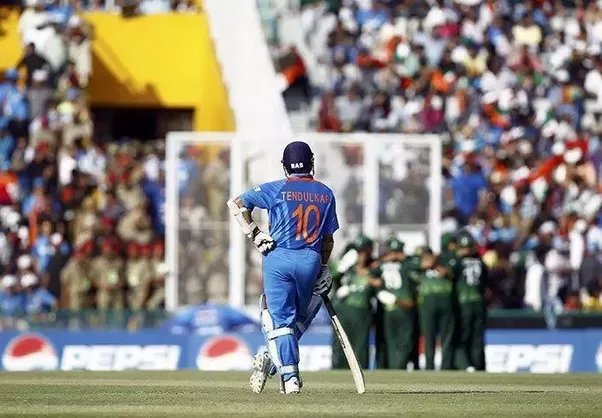
Indian batting maestro Sachin Tendulkar completely swaps all the batting records in between these two teams. He has scored most runs (2526), most hundreds (5), most fifties (16) and boundaries (323 = 294 fours and 29 sixes). Saeed Anwar (194) has the highest ODI score while Kohli (183) is second on that list.

TOP 10 Run Scorer in India v Pakistan ODI

Player Mat Inns NO Runs HS Ave SR 100 50 4s 6s
Tendulkar 69 67 4 2526 141 40.09 87.49 5 16 294 29
Inzamam 67 64 9 2403 123 43.69 78.55 4 12 208 35
SaeedAnwar 50 48 2 2002 194 43.52 90.58 4 8 216 34
R Dravid 58 55 3 1899 107 36.51 67.17 2 14 157 1
ShoaibMalik 41 41 4 1782 143 48.16 88.48 4 11 174 20
Azharuddin 64 59 7 1657 101 31.86 67.68 2 9 108 12
S Ganguly 53 50 3 1652 141 35.14 71.82 2 9 161 17
SaleemMalik 52 51 6 1534 102 34.08 77 2 8 107 6
Ijaz Ahmed 53 51 8 1533 139* 35.65 79.3 2 6 123 26
ShahidAfridi 67 64 4 1524 109 25.40 109.09 2 4 158 51

Tendulkar dominated the World Cup stats as well. He has scored 313 runs against Pakistan, the most by any player in World Cup history. From Pakistan’s side, Saeed Anwar (185) has scored most runs against India.

Pakistan is known for its bowling, especially its pace attacks. In the bowling list, Wasim Akram has taken most wickets (60) with an economy of 3.73 runs per over, which is the best among both the teams. Aaqib Javed’s 7 for 37 is the best bowling figure in an ODI between India and Pakistan. He also has three five-fer against India and a hat-trick (in the same game where he took 7 for 37, Sharjah 1991).

TOP 10 Wicket-takers in India v Pakistan ODI

Player Mat Inns Overs Mdns Runs Wkts BBI Ave Econ SR five-fer
WasimAkram 48 47 404.1 39 1509 60.00 4/35 25.15 3.73 40.4 0
SaqlainMushtaq 36 34 307.2 14 1390 57.00 5/45 24.38 4.52 32.3 1
A Kumble 34 33 304.4 18 1310 54.00 4/12 24.25 4.29 33.8 0
Aaqib Javed 39 36 299 27 1331 54.00 7/37 24.64 4.45 33.2 3
J Srinath 36 36 328.2 9 1657 54.00 4/49 30.68 5.04 36.4 0
BKV Prasad 29 29 266.3 13 1243 43.00 527 28.9 4.66 37.1 1
Kapil Dev 32 32 264.1 21 1113 42.00 3/17 26.5 4.21 37.7 0
Shoaib Akhtar 28 28 238.5 20 1098 41.00 4/36 26.78 4.59 34.9 0
Shahid Afridi 67 60 455.1 5 2300 38.00 4/20 60.52 5.05 71.8 0
Waqar Younis 26 25 196 12 906 37.00 5/31 24.48 4.62 31.7 1

Venkatesh Prasad has taken eight wickets in World Cup games, while Wahab has 6 in his name and he has a chance to surpass Venkatesh Prasad’s record.

In wicket-keeping, Moin Khan has record 71 dismissals, followed by MS Dhoni who has 44. In World Cups, Dhoni has four dismissals against Pakistan while Kamran Akmal has 3.

Mohammad Azharuddin (44) holds the record for maximum catches in India-Pakistan clashes, followed by Shahid Afridi (30). In world cups, Anil Kumble has taken five catches in 3 games.

Tendulkar and Sidhu added 231 runs for the 2nd wicket in 1996, the highest run partnership for any wicket between these two teams. There are eight double hundred runs partnerships in ODIs, while none in the World Cup. India has three 100 runs partnership in World Cup against Pakistan, while Pakistan has yet to achieve the milestone.

Times of India whitewashes Aligarh murder, downplays brutality, blames social media for ‘communal spin’

The brutal murder of two-and-a-half-year-old Tina Sharma (name changed) in Aligarh has shaken the collective conscience of the nation. However, over a week after the murder, mainstream media continues to whitewash the crime and downplay the brutalities the perpetrators carried out on the child.

In a report titled ‘How crime is getting a communal spin’, the Times of India today claimed that the ‘police investigation has confirmed neither rape not (sic) torture’. This statement is inaccurate on multiple levels. Police statement has claimed that the rape cannot be confirmed. That means, the child may or may not have been raped. The case is currently being probed under the Protection of Children against Sexual Offences (POCSO) Act. That means, rape cannot be conclusively ruled out yet. Moreover, the post-mortem report has been sent further to doctors. Only a swab analysis could reveal whether she was raped or not. Hence, this statement is false.

Moving on to the second part where Times of India claims that the police investigation has confirmed the child was not tortured is also an utter lie. The post mortem report has revealed that her right arm was amputated.

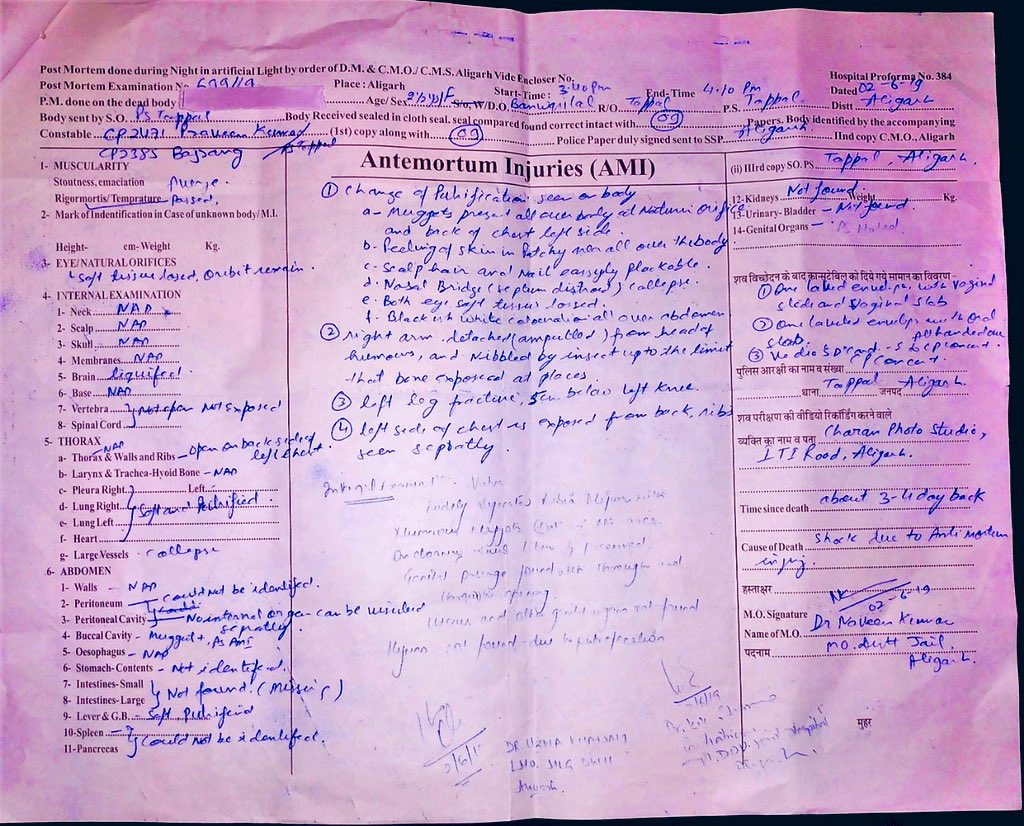
Post-mortem report on Aligarh case (image: journalist @anjanaomkashyap on Twitter)

OpIndia showed the post-mortem report to a couple of doctors and they said that the baby died due to injuries caused to her. “The injuries were severe enough to lead to shock and eventually death. Shock is confirmed by the collapse of vessels (antemortem sign). Major blood loss happened before death,” a doctor confirmed that there were brutalities on the child.

“The most important of all is that her abdominal organs are missing, including uterus and genital organs. She might have been subjected to extreme torture and this can also be the cause of excessive blood loss and collapse of the blood vessels. Other injuries include fracture of leg below knee and amputation of humerus (arm). These injuries point towards brutality. Vaginal swabs have been taken for examination but due to decomposition they are less likely to be useful. It should be made clear that negative results on swab does not rule out sexual act.”

According to the Times of India, amputated arm, fractured leg, excessive blood loss leading to collapse of blood vessels, missing abdominal organs including the uterus and genital organs, is not ‘brutal’ enough.

The Times of India report then says that the report was given a communal angle by those who demanded justice for the child, like those in the Kathua case and says how the perpetrator should not be judged on the basis of religion. Very conveniently forgetting that in Kathua case, it was the same so-called liberals who brought the communal angle by focusing on where the child was raped (Devisthan, or temple) instead of focusing on the crime itself (rape and murder).

The report then states the dubious propaganda outfit, ‘Hate Crime Watch’, a multi-organisation effort headed by FactChecker.in of IndiaSpend, in collaboration with Aman Biradari and NewsClick.in. Readers should also remember that the founding trustee of Indiaspend, factchecker.in’s parent organization, is now the Data Analytics head of Congress party and has reportedly fled after charging Congress Rs 24 crore for his flawed data analysis in recently concluded general elections.

It is pertinent to mention that the creators of the propaganda themselves admit that they do not aspire to be an exhaustive record of all hate crimes in the country. Such an admission allows them the opportunity to cherry-pick data to peddle their narrative.

They ignore cases where Hindus are victims, they label crimes where Muslims are victims as ‘hate crime’ even though there is nothing to suggest that the crime is motivated by religion and they attempt to create a narrative that portrays Hindus as aggressors and Muslims as victims.

To give readers an idea about the manner in which factchecker.in manipulates data, when Vidharam Katheria, a Dalit, was murdered by a group of Muslims over a family dispute, IndiaSpend did not consider a hate crime claiming that there was no evidence to suggest that the crime was motivated by religious hatred. But when one Azhar Khan was murdered for fishing near a Temple, it was treated as a religious hate crime although there was nothing to suggest that the crime was motivated by religion. This is merely a single instance. There have been several occasions where factchecker.in has indulged in such malpractice. You could read more about data manipulation by ‘Hate Crime Watch’ here, here, here and here.

We have also comprehensively exposed the manner in which factchecker.in concocts an agenda in an earlier report. The HCW is a concerted effort to manufacture what can only be described as sophisticated Fake News.

Moreover, there have been multiple reports on Aligarh case where they have given clean chit to the perpetrators claiming that the child was not raped. We have shown how self-proclaimed fact-checkers had based an entire fact-check on police statement which were later found contradictory to the post-mortem report. Despite that, the ‘fact-checkers’ stuck to their report and claimed that the child was not brutalised (something which even this TOI report claims). Since AltNews’ attempts to whitewash the crimes and downplay the brutality has failed, elements in mainstream media has taken it upon themselves to push the narrative.

Times of India’s reliance on dubious data and blatantly lying in its reportage on Aligarh murder case in this report displays shoddy and biased journalism.

In the biggest crackdown on terror funding, NIA registers cases against top separatist leaders, Hawala operators and stone pelters

In a major breakthrough, the National Investigation Agency (NIA) has registered a case against 13 accused including 7 top separatists, 2 hawala conduits and some stone pelters in the Jammu and Kashmir terror funding case of 2017. The separatist leaders who have been charge-sheeted include the co-founder of Lashkar-e-Taiba, Hafiz Saeed, and Hizbul Chief, Syed Salahuddin.


Earlier in 2017, the NIA had arrested Syed Shahid Yusuf, son of Hizbul Mujahideen head Syed Salahuddin, who was questioned in 2011 terror funding.

One of the main hawala conduits, Zahoor Ahmed Shah Watali, who used to receive and generate funds from Pakistan, through various shell companies, has also been charge-sheeted. Recently, the Enforcement Directorate(ED) was in the process of attaching 25 properties worth crores, which are part of “proceeds of crime” invested by Watali.

During the investigations, searches were conducted in various locations across Jammu and Kashmir, Delhi and Haryana as well. Evidence was recovered which pointed towards the pattern of raising, collecting, transfer and use of funds for terrorists and separatist activities.

The matter pertains to a 2017 case filed against terrorists belonging to Jammat ud Dawah, Duktaran-e-Millat, Lashkar-e-Toiba, Hizb-ul-Mujahideen and other separatist leaders in the State of J&K.

The investigation has revealed that the separatists have developed an organized network of stone-pelters and cadres who are incited to attack Indian sovereignty on Kashmiri soil. The investigation has also revealed that the separatists were receiving funds from Pakistani agencies through hawala conduits and that money was routed through fake and bogus companies floated abroad and remitted to Hurriyat leaders in Jammu and Kashmir.

The NIA conducted searches at over 60 locations and hundreds of damning documents and electronic devices were seized during the process. In addition, there are 300 witnesses in the case. The evidence collected has revealed that the persons accused were orchestrating violence against the Indian Army and stone-pelting and promoting and inciting other subversive activities against the Indian State. The investigation has also established an intimate link between separatists in Kashmir and their Pakistani handlers.

The 1279-page chargesheet was filed before the Court in New Delhi and permission has been sought to continue the probe.

The raids conducted by NIA in various locations across Jammu and Kashmir, Haryana and Delhi reflected the ‘No Tolerance’ policy adopted by the NDA government against anti-India activities. The screws have been tightening around the separatists and terrorists in Kashmir and they have been feeling the heat under the Narendra Modi government. The case was first registered by the NIA in May 2017 and the first arrests were made later in July.

The NIA had in April 2019 got the infamous JKLF chief Yasin Malik in custody for 12 days in the terror funding case. As per NIA sources, Yasin Malik had then admitted that he was instrumental in bringing together the disparate factions of Hurriyat conference and formed the Joint Resistance Leadership (JRL), which spearheaded the violent agitations in 2016 in Kashmir Valley, by issuing “Protest Calendars” leading to economic shut down for over four months.

Meanwhile, in the aftermath of the ghastly Pulwama attack, the NIA had tightened its noose on Kashmiri separatists. It also took the custody of Masarat Alam Bhat, the alleged kingpin of stone pelting and Chairman of the Jammu and Kashmir Muslim League, along with Shabir Shah and Asiya Andrabi.

Asiya Andrabi heads the women’s secessionist group Dukhtaren-e-Millat had then revealed that she had been collecting funds and donations from foreign sources and Duktaran-e-Milat had been organising protests by Muslim women in the valley.

Moreover, during the custodial interrogation, Shabir Shah, chief of the Jammu and Kashmir Democratic Freedom Party, was also confronted with evidence relating to the transfer of money by Pakistan based agents and representatives of APHC factions to parties affiliated to Hurriyat in Jammu & Kashmir.

Meanwhile, Masarat Alam Bhat, the so-called poster boy of stone pelters and violent agitations in Kashmir valley, had revealed that Pakistan based agents route the funds through hawala operators which were transferred to the separatist leaders including Syed Shah Gilani Chairman APHC (G).

Masarat Alam also revealed that there are rifts in the Hurriyat conference regarding collection and use of funds.

The NIA investigation attempts to identify other key players in the nexus of the terror funding, stone-pelting at the forces and vandalization of government institutes.

Following the Pulwama attack in February, the government had withdrawn security cover of 18 separatists including Mirwaiz Umer Farooq and Naseem Geelani and 155 politicians and ‘activists’, calling it a ‘wastage of resources’.

AAP MP Sanjay Singh exposes ignorance about symbolic protest, questions why protesting doctors have injury at the same place

After claiming that the income of Delhi Metro will increase due to free metro travel scheme for proposed by the AAP government in Delhi, party’s Rajya Sabha MP Sanjay Singh displayed his ignorance while reacting to a photograph of doctors demanding action against the goons who had attacked doctors in a Hospital in Kolkata.

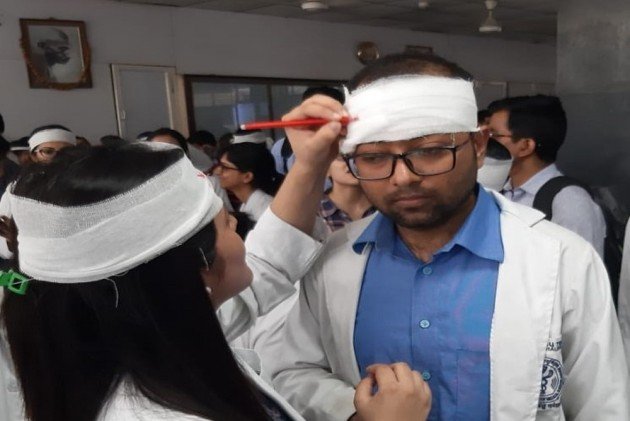
Reacting to a photograph with new agency ANI logo on it, Sanjay Singh wondered whether it is really an ANI photo or is it Photoshopped, since all the doctors in the photo seem to have injuries on the same place. All the doctors in the photo have bandages wrapped around their heads, with a red patch on the forehead.


It seems that the AAP leader is not following the news about the doctors’ strike in Bengal which has received support from doctors in the entire country with symbolic protests. And as a mark of protest against the attack on doctors at NRS hospital in West Bengal, doctors are wrapping red-stained bandages on their heads, and some were also seen wearing helmets. The image that Sanjay Singh reacted to is from AIIMS, where the doctors did the same. This is similar to the use of black bands used in protests, and everyone in the country knows that, except the AAP MP.

A doctor helps a colleague in applying red stain on bandage

Later Sanjay Singh tweeted that one journalist friend has informed him that doctors in AIIMS are protesting with fake bandages, and added that this is not right. He said that doctors should stay away from such protests because from such images a narrative can be created that doctors in the entire country are being beaten.


Mr Singh clearly does not understand the meaning of the use of symbols in protests, and he thinks that people will mistake the symbolic bandages as the result of real attacks on the doctors.

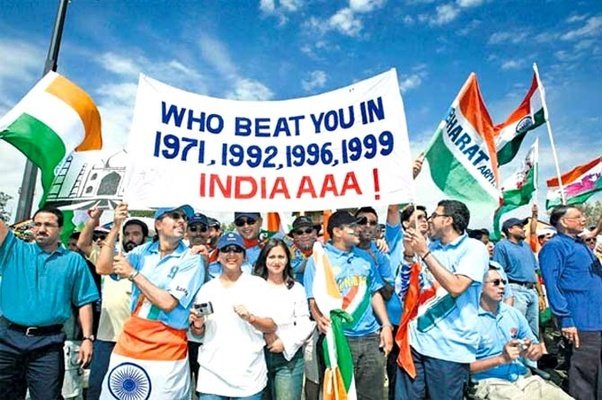
India and Pakistan clash is not just a game, but a culture war between two hostile countries, bigger than even the Finals

Across the world, it is often debated as which sporting event is considered to be the greatest rivalry in its history. Is it the El-Clasico or the historical rivalry between Manchester United and Liverpool in English football? Or was it the contests between Bjorn Borg and John McEnroe or Nadal vs Federer in Tennis?. Alain Prost vs Ayrton Senna in the Formula 1 or is it the Ashes between the oldest rivals in cricket- Australia and England.

None. It is India and Pakistan facing each other in a World Cup match. It is not just a sporting event but a sense of cultural war between two hostile countries which is indirectly manifested in the form of a cricket match. Both India and Pakistan have managed to keep these sporting events as a ‘Quasi-war’ despite the stakeholders claiming the rivalry as just a sporting event.

The battle between the two teams is so intense such that more than a billion people are stuck to their TVs with two economies stuck in a state of pause as the minds and hearts of the fellow countrymen stay glued on the scoreboard. It is not just typical sporting rivalries where two teams play out against each other. While one team loses after an intense game and all of them go home as the match ends and everybody ends up being happy ever after.

No, it is not the case with India-Pakistan rivalry. The clash between two countries on a cricket ground is beyond any sporting events. It is not just 22 players sweating out in the field. It is the hope of more than a billion people as players on the field will be representing a whole country while carrying the burden of almost every individual belonging to their respective homeland.

It is some sort of a cultural war which is being fought in a different way – maybe with a bat and ball. But, the favouring results give a sense of satisfaction and glory similar to a victory what it could have been on a battlefield. Most of Indians share a similar sentiment even if the victory is a small one, be it on a different arena all together which has no connect to geopolitics wars.

India and Pakistan fighting each other in ICC Cricket World is arguably modern era’s greatest sporting event, not because of the sheer amount of viewership it garners but also because of sharing an honour of a ‘war sport’. In fact, in modern day cricket, India-Pakistan clash in the world cup is considered to be so as it devalues the importance of the all-important ‘Finals’ match. In fact, the players, fans and fellow countrymen believe that defeating their neighbouring team is itself a larger goal than winning the world cup itself. Winning a world cup without defeating Pakistan would be tantamount to a defeat for India.

Today, it has been synonymous with one of the eternal truths that India has never lost to Pakistan in the world cup. Almost everyone who follows cricket in India knows this fact. India has defeated Pakistan six times previously in the world cup clashes while Pakistan is still yet to taste victory against India in world cup history.

Here is the summary of the clashes between India and its hostile neighbour Pakistan.

  • March 4, 1992, Sydney: The India and Pakistan clashed for the first time in the World Cup in 1992 in Australia. On March 4, 1992, India defeated Pakistan by 43 runs at Sydney Cricket Ground, registering its first victory over arch-rival Pakistan in world cup event.
  • March 9, 1996, Bangalore, Quarter-Final: The second victory came on March 9, 1996, Bangalore, in a quarter-final match, where India had won by 39 runs. Navjot Singh Sidhu had anchored the Indian batting and top-scored with 93 and Ajay Jadeja’s cameo of 45 of 25 balls by decimating Waqar Younis was the game-changer for India. Amir Sohail dismissal to Venkatesh Prasad has been one of the most celebrated events in India’s cricketing history.
  • June 8, 1999, Manchester: India’s third victory against Pakistan in World Cup came in 1999 world cup at Manchester, Jun 8 1999, the same venue in which India will be taking on Pakistan two decades later. India had won by 47 runs.
  • March 1, 2003, Centurion: Despite Saeed Anwar’s hundred in the first innings, Pakistan lost the match to India by 6 wickets thanks to a partnership between  Dravid and Yuvraj Singh. The 2003 world cup match is also an important clash as Pakistan had fielded its deadliest trio of legend Wasim Akram, Waqar Younus and Rawalpindi express Shoaib Akthar. The uppercut by Sachin Tendulkar to Shoaib Akhtar over the third man for a six still reverberates in minds of every Indian who had witnessed that.
  • March 30, 2011, Mohali, Semi-Final: Considered to be one of the closest and crucial victories for Indian side during its road to 2011 World cup victory, Pakistan was very close to defeating India during one phase of the game before displaying their usual instincts.  India won by 29 runs to reach its third world cup final.
  • February 15, 2015, Adelaide: With Virat Kohli scoring a century – 107 and considerable performance from Shikhar Dhawa and Suresh Raina’s had helped India posted 300 on board, making it the highest total for India in World Cup clashes against Pakistan. Pakistan fizzled out for just 224, making it as one of the easiest victories against Pakistan in World cup.

Despite the claims of peaceniks, that India and Pakistan clash on the field is just one of those everyday sporting events that occur across the world, the common folks in the country see it as a victory beyond a mere sporting exercise and are proud of the fact that India has the ability to show Pakistan its deserving place not only in war field but also in global non-military, cultural or sports events. For a common Indian, the fight against Pakistan is a war no matter in what form it is manifested.

Ajaz, a civil police officer, hacked to death his colleague Soumya Pushpakaran with a sword, set her on fire

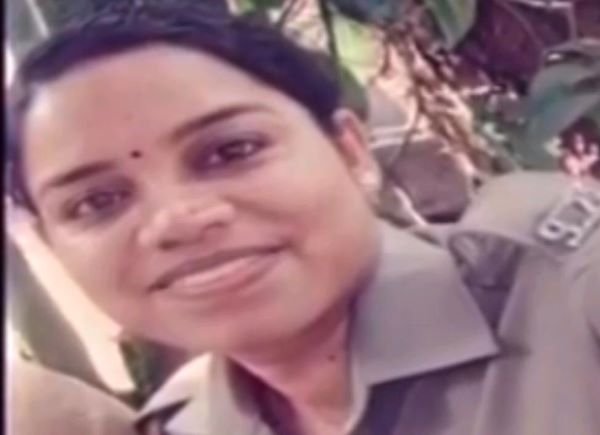
On Saturday afternoon woman police officer, Soumya Pushpakaran, died after being hacked with a sword and set ablaze by a fellow police officer, Ajaz, in Alappuzha district of Kerala.

Soumya is a Civil Police Officer (CPO) who worked at the Vallikunnam police station, aged approximately 35 years old was a mother of three children and her husband is working in the Middle East.

Reportedly, the victim after completing her duty with student police cadet members in a nearby school was returning home from the police station on a scooter at about 4 pm. Ajaz, who was waiting in a rented car near her house, on seeing her approach her house, proceeded to ram into her vehicle. The victim was knocked down and tried to run. However, Ajaz got up with a machete in his hand after which he chased her to a neighbouring house.

He hacked the victim, took out the petrol that he had brought along with him and set her on fire. Ajaz has suffered 40% burns after the victim had tried to resist him. He was admitted to ICU in Alappuzha Medical College Hospital.

As per reports, the 33-year-old N.A. Ajaz was posted with the Aluva traffic police. He had taken a 15-day duty leave, a week ago. Despite having joined the police station a year ago, his colleagues have said that Ajaz didn’t have a close relationship with any of them. Several reports also suggest that this was a love affair that had gone wrong. However, the police have said that the motive of the murder is still not clear.

Soumya was selected to train at the Kerala Police Academy, Thrissur on June 16, 2014. A friend of Soumya had revealed that the two had met during the last few months of training after which they became friends. Ajaz came as havildar for imparting training and had trained her team for 2-3 months.

An officer had also revealed that after Soumya’s husband went abroad, Ajaz tried to force Soumya to stay with him. She refused and kept her distance from him.