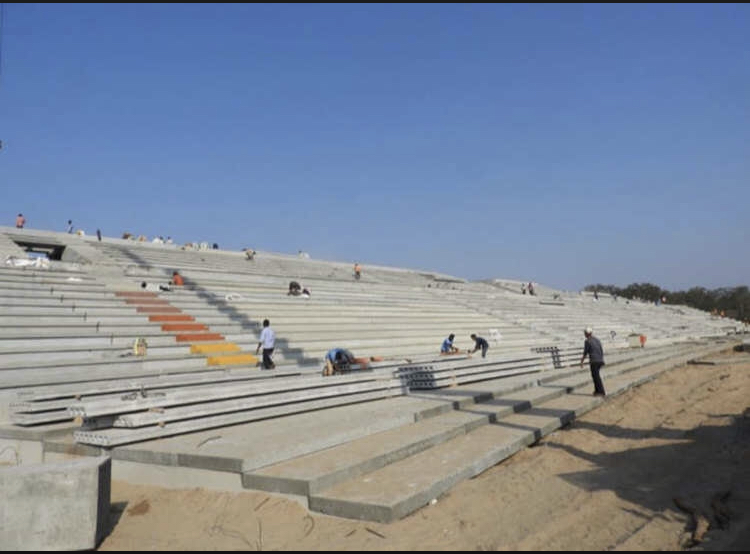
The ‘Urdu Gate’, built in Rampur district by controversial Samajwadi party leader Azam Khan has been demolished by the administration. It is alleged that while in power, Khan had forcibly appropriated the government land and transferred it to his university in contravention to the set norms.
On Wednesday, the district administration and police team reached Azam Khan’s Mohammad Ali Jawahar University. A bulldozer was used to demolish the gate that was built on the Jauhar Ali University road. DM Anjaney Kumar Singh said that this gate was made by the CNDS from the legislative fund. No rules were followed in the construction of this gate. According to him, no permission was sought before building this gate.
DM further told that the road on which gate was built connects Rampur district with Uttarakhand. Jauhar University falls in the middle of this road. To avert the traffic congestion, the road was diverted by creating a gate in the middle of the road. As a result, the road was closed and the people plying on that road had to take a rather circuitous route to reach their destination. The diverted route went through the middle of a populated area, generating traffic issues in the region.
DM Anjaney Kumar also expressed his shock over the misuse of funds by a legislator and the complicity of government institutions such as CNDS in the rampant corruption. A committee was formed in this case, after which the gate was razed down and a letter was being written to the government to take action against the officers of the CNDS. He said that the government is also writing that the misuse of legislator funds should be recovered from these officials. About Ra 40 lakhs were spent on building the gate.
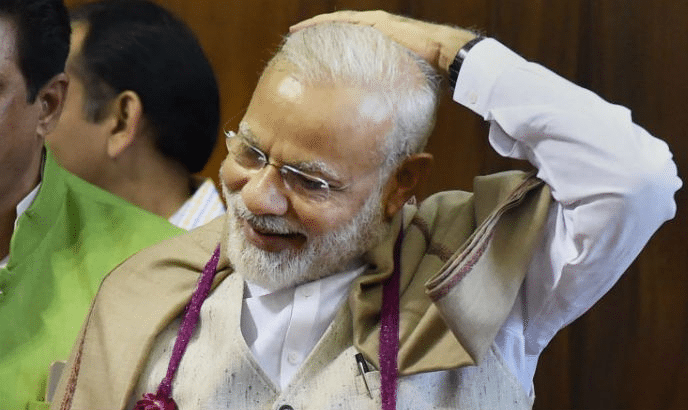
Today Prime Minister Narendra Modi has decided to donate Rs 21 lakh to Kumbh Safai Karamchari corpus, with his own personal savings. The fund is meant for those sanitation workers who were tasked with keeping the event of Kumbh Mela at Prayraj, clean. The Kumbh Mela concluded on March 4.
Prime Minister Narendra Modi donated Rs. 21 lakhs from his personal saving account to Kumbh Safai Karamchari Corpus Fund pic.twitter.com/XFWoyEb8n6
On February 24th, PM Modi had himself visited Pryagraj to attend the Mela where he had attended Swachh Kumbh Swachh Aabhaar event, organized by Ministry of Drinking Water and Sanitation. During his visit, PM Modi had washed feet of some of the sanitation workers of Kumbh to pay respect. The gesture had received wide appreciation and was seen as an exceptional way to pay respect to workers.
In order to generate money for the Clean Ganga initiative, PM Modi in January had sent gifts and mementoes that he had received to auction. More than 1800 items, which included paintings, sculptures, shawls, pagris, jackets and traditional musical instruments from across the country, had gone under hammer. As CM of Gujarat too, Modi had raised Rs around Rs 90 crore by auctioning all gifts he received as CM. This money was donated to the Kanya Kelavani Fund for the education of girls.
During PM Modi’s recent two-day South Korea visit, he was conferred with the prestigious Seoul Peace Prize for his efforts in changing lives of 1.25 billion people of India and promoting economic cooperation with other countries, in accordance with the ‘Modi Doctrine’ and the Act East Policy. PM Modi was presented with a plaque, award and an honorarium sum. PM Modi had decided to donate the Rs 1.3 crore, received with the award, to Namami Gange initiative.
Also, before PM Modi resigned as CM of Gujarat, he had donated the sum of Rs 21 lakh from personal saving for the education of daughters of Gujarat government staff.
The Pakistani government has extended the shutdown of its airspace by another day until the 7th of March. Limited flights have been permitted in Islamabad, Peshawar, Karachi and Quetta.
Pakistan Airspace will remain shut across the country until March 7 now. Limited flights allowed in Islamabad, Peshawar, Karachi and Quetta. Most important question: How much hit has the Pak economy taken in last 10 days due to this shutdown in fear? This is unimaginable loss. pic.twitter.com/CV2ATZYcFV
Pakistan, on the 5th of March, had announced that their airspace had fully reopened only to extend it to Tuesday, then again till Wednesday and now it has been announced that it has been extended till Thursday. Although things appear to have deescalated for now, Pakistan still remains wary as ceasefire violations continue at the Line of Control.
Pakistan had closed its airspace after tensions escalated with India in the wake of the Pulwama attack on February 14 by Pakistan-based terror group Jaish-e-Mohammad (JeM). The terror attack was followed by airstrikes on terror camps within Pakistani territory by the Indian Air Force.
According to flight tracking information observed on Flightradar24, all flights in and out of Pakistan was stopped and the airspace remained closed since then. Flights from carriers including Singapore Airlines, Finnair, British Airways, Aeroflot and Air India had to detour to avoid flying over Pakistan. Reportedly, about 800 flights a day use the India-Pakistan air corridor.
I’ll admit. I had never heard of GSP. So when I saw our media working itself into a sudden frenzy about America withdrawing our GSP privileges, I was a bit alarmed.
What did Trump do now? Closely on the heels came the usual attacks on Modi’s diplomacy from assorted members of the opposition and the liberal elite.
I am pretty sure none of them took the time to google what GSP is, because I did. It took me to the website of US CBP (United States Customs and Border Protection).
An American program, instituted in 1976, to promote “economic growth in the developing world.” Let me translate that diplomatic language for you. It is a handout from the US government for the poorest countries of the world.
Let us find out who are these “developing countries” that are in this GSP list. Here is the list from March 2018, from the office of the United States Trade Representative. Seems that India and Turkey will no longer be in this list from now on.
Iraq. Djibouti. Congo. Somalia. South Sudan. Yemen. Zimbabwe.
Now, I mean absolutely no disrespect to citizens of any country. But can I just say that this is not a list of countries in which I would like to see India’s name?
Even Bangladesh is not in the list.
Do you really want India to be in a list that seems to consist solely of the absolutely poorest African countries, a couple of basket case Latin American economies and some failed states from the Middle East?
No sign of China. No Japan, no Korea and no Europe.
Does it really suit India’s stature, a country that is a wannabe global power, nuclear armed and with a space program that stretches as far as Mars, to want to stay in this list?
It turns out that the withdrawal of GSP will raise import duties on Indian goods by $190 million.
India’s total exports are measured in the hundreds of billions of $$$! An amount of $190 million is around 0.05% to 0.1% of our export figure.
Sure, international trade, like any kind of diplomacy, is amoral and one should fight (however shamelessly) for every last penny. So, of course, India would not volunteer out of something like this.
But there comes a point when it becomes impossible to convince the world that our condition is so bad that we need a trade benefit that is a lifeline for an economy such as that of Ethiopia or Sierra Leone. The world finds that impossible to believe.
Shouldn’t we be celebrating?
Again, no disrespect intended to citizens of any country, but I do wish all the countries in that list well and hope that soon they will find a way to develop their economies and grow out of that sad looking GSP list.
Yes, not being in the GSP list any more comes at a tiny cost that is peanuts compared to the size of our $2.7 trillion economy. But surely we have to be willing to pay an entry fee for the world power club. One of these fees is giving up certain small handouts that are given to the poorest countries in the world. We should be happy that India will no longer line up for these small benefits. Time to celebrate.
Pakistan’s Prime Minister’s theatrics over his ‘peace’ initiative has been proven farcical after Pakistan continues to violate the ceasefire along the LoC. The Pakistan Army on Wednesday targeted dozens of forward posts and villages with artillery guns along the Line of Control (LoC) in Jammu and Kashmir’s Rajouri and Poonch districts.
Reports state that the Indian Army retaliated strongly and effectively and the exchange of heavy fire caused panic among the border residents.
The intense shelling and firing from across the border continued throughout the night in Sunderbani sector of Rajouri district. In Krishna Ghati sector of Poonch it started in the wee hours of Wednesday, army officials have confirmed.
However, there was no report of any casualty on the Indian side, officials were quoted saying. In an official statement, the Army has stated that any further misadventures from Pakistan will be responded in a befitting manner with dire consequences.
BIG: Indian Army categorically states Pak Army has employed ‘heavy artillery’ to target civilian areas in Krishna Ghati & Sunderbani sectors of the LoC in last 24 hours. pic.twitter.com/VustmdjeuE
Pakistan had resorted to cross-border firing at Nowshera and Sunderbani in Rajouri and Krishna Ghati in Poonch on Tuesday as well.
Prior to this, Pakistani troops had on Monday, violated ceasefire by targeting forward posts and villages along the Line of Control in Akhnoor sector in Jammu, breaking a two-day lull in cross-border skirmishes, officials said.
Pre-disposed by its impulse, Pakistan has violated ceasefire for over 60 times along the LoC in Rajouri and Poonch in the past week, killing four civilians, including three members of a family and had left several injured.
Though the number of ceasefire violations by Pakistan in 2018 is almost double of what it was in 2017, the highest in a decade, there has been a recent spurt in ceasefire violations by Pakistan after India’s preemptive air strike on a Jaish-e-Mohammed terror camp in Balakot in Khyber Pakhtunkhwa province on February 26 following the February 14 suicide bombing in Pulwama in which 40 CRPF personnel were brutally massacred.
Samajwadi Party patriarch Mulayam Singh Yadav has developed a soft corner for once arch-rival Rashtriya Janata Dal (RJD) chief Lalu Prasad Yadav who is undergoing jail term after being convicted by the court in the fodder scam. While addressing party workers at the party headquarters in Lucknow, Singh said that had he been in power Lalu Prasad Yadav would not have been in jail.
Without naming Lalu Yadav, Singh said that there was a time when parties having similar ideologies were in majority and it was his turn to become the Prime Minister. But his name was opposed by someone who is now in jail. Singh said that he does not want to take the name of the person as he is a relative now. He added that if he was in power he (Lalu Yadav) would not have landed in jail. The political rivalry between the two leaders had come to an end when Lalu Yadav’s youngest daughter Raj Lakshi was married to Mulayam Singh’s grandnephew Tej Pratap.
When Singh was asked had he been the Defence Minister what would he say to those leaders asking for evidence of airstrike in Pakistan, he evaded the question and said that at present he has not been made the Defence Minister by the people of the country, therefore he can’t say anything.
Rebel Congress MLA Umesh Jadhav, who had submitted his resignation from the party earlier this month, joined BJP today in the presence of party’s state President BS Yeddyurappa, former CM Jagdish Shettar and others. The joining happened before PM Modi’s address to people Kalaburagi.
“I am happy and proud joining BJP,” The newly-inducted leader said. He also asked people of Kalaurgi to elect Modi as PM Modi again.
Umesh Jadav, who has been two-time MLA from Chincholi constituency of Kalaburagi district, is also speculated to be BJP’s Lok Sabha candidate against Congress leader Malikarugan Kharge for the Kalaburgi seat. Kharge has been nine-time MLA from Gulbarga seat and two-time MP.
However, Jadhav’s decision to contest Lok Sabha elections will have to go through some legal hurdles, as his resignation letter has still not been accepted by the speaker and a petition asking for his disqualification is already pending.
“The petition to disqualify Jadhav is still pending. Without disposal of this petition his resignation cannot be accepted as per law, in my knowledge” Former CM Siddaramaiah, who is also a member of Congress Legislature Party, was quoted.
Jadhav belongs to state’s Lambani community, a group that has a strong presence in Kalburgi district.
He was among the four rebel Congress MLAs, Ramesh Jarkiholi, Mahesh Kamitalli, and B Nagendra who had kept Congress on heels. All of them had refused to attend Congress Legislative Party meetings on January 18 and February 8.
Following their absence even after the party whip, CLP chief Siddaramaiah had announced that he will approach the speaker to take strong action against them. On February 11, Congress had sought disqualification of four MLAs under the anti-defection law.
They had also skipped early part of the budget session in the Karnataka assembly. However, they had later voted in favour of the budget, to avoid harsh action.
The main reason behind Jadav’s disgruntlement with Congress is reportedly the alleged dominance of leaders like Malikaurjan Kharge and his son Priyank Kharge.
14th February 2019. A huge convoy of Central Reserve Police Force is moving from Jammu to Srinagar for deployment. There are 78 vehicles and 2500 troops in the convoy travelling on the National Highway 44. The highway had been shut down for the past few days due to snowfall and urgent repairs. The 175 km of the highway which runs through the valley is used for both civilian and military movement. This was not always so. In the militancy-infested state of Jammu & Kashmir, during the 1990s and most of the 2000s, civilian traffic was not allowed on the highway during military movement. However, Mufti Mohammad Sayeed had pleaded for opening up the roads to civilian traffic to ‘win over the hearts & minds of the Kashmiri people’.
Around 3:15 PM, at Loatoomode in Avantipur, a speeding car laden with RDX and other explosives appears from a side road and rams into the CRPF convoy. A CRPF bus and its occupants are blown to smithereens while militants posted around the site, open fire on rest of the troops. When the carnage is over, over 40 CRPF men are believed killed. Their bodies are badly charred, burnt and mutilated due to the intensity of the blast. Some body parts are found as far as 80 metres from the blast site. Soon, the Pakistan based terrorist organization Jaish-e-Mohammad (JeM) claims responsibility for the audacious and barbaric attack. The JeM Chief Masood Azhar is safely ensconced in Pakistan and receives security from the Pakistan security agencies. The bomber is Adil Ahmad Dar, a radicalized Kashmiri Muslim youth.
In the last 5 years, prior to the Pulwama attack, there had been other major terrorist attacks on Indian Armed Forces in Kashmir. Chief amongst them were the 2018 Sunjuwan attack, 2016 attacks at Nagrota, Uri, Pampore and Pathankot. In these attacks, the AFs had lost scores of men. A Nuclear Power State with the world’s 2nd biggest Army and 4th biggest Air Force was held hostage by several hundred armed and trained terrorists from Pakistan. India had responded to the Uri attack by using its Special Forces to conduct a surgical strike against militant launch pads inside Pakistan Occupied Kashmir inflicting heavy casualties. However, it was a one-off action with no follow up to keep up the heat on Pakistan based militants and their mentors. A Bollywood movie inspired by the strike captured the imagination of the nation with government ministers and even the Prime Minister invoked the ‘How is the josh’ line from the movie script.
The Aftermath
A stunned India watched in disbelief as coffins draped in tricolour started rolling out to various cities across India. As the images of wailing widows, little kids and distraught families went viral across various news outlets, a wave of deep anger and frustration swept across millions of Indians. The nation as one wanted the killings to be avenged and demanded retribution from its elected leaders. The nationalist government of PM Modi, nearing the end of its 5-year term in office was left with no other option than to retaliate militarily against Pakistan.
The beleaguered PM looked towards its Armed Forces for a solution to the immediate crisis.
Successive governments had neglected the Armed Forces and even reduced the defence budget, forcing the AFs to cannibalize and even go for junkyard and warehouses shopping to maintain its equipment. Even the Kargil war, where the Indian Army Chief, General V.P.Malik was forced to say ‘We shall fight with whatever we have’ had borne no major reforms or acquisitions for the Armed Forces. Things continued to be drastic. The 10 years of UPA government had set back the Armed Forces by over a decade. The holier-than-thou Defence Minister A.K.Antony had ensured that under his watch practically no defence deal went through. From basic equipment like bulletproof jackets, assault rifles, night vision devices, machine guns to howitzers to batteries and torpedoes for the Naval ships; there existed a gaping hole in India’s defence preparedness.
Not to mention the fast depleting strength of Indian Air Force and its usage of 60’s vintage Mig’s. In 2014, Indian Navy Chief, Admiral D.K.Joshi had resigned following an explosion and sinking of the Kilo Class INS Sindhuratna off the coast of Mumbai which had killed several sailors. A distraught Admiral stated in a TV interview “The operating environment was dysfunctional and I felt being a service chief is not just about preening about on national TV, taking a salute on Republic Day. People tell you, ‘oh you looked so smart in your uniform’, in actual fact you are unable to get a set of batteries for your submarines and to my mind, that was a completely untenable situation for continuation as chief, it had been building up.”
India lives in a hostile neighbourhood and wars are not won by choking the Armed Forces of funds for modernization and upgrades. India’s allocation for funds for Military expenditure has consistently fallen over the past 10 years and does not address the threats it faces. According to the Stockholm International Peace Research Institute ( SIPRI ), India’s Military expenditure (% of GDP) since 2010 is as the following:
Military ExpenditureSIPRI Data
That Indian Air Force is still using the ‘flying coffins’ or ‘widow makers’ Mig 21’s should be an eye-opener. For nearly 3 decades since Bofors were inducted in the Indian Army, no 155 mm Howitzer was acquired till the M177 was inducted last year. The scenario is equally alarming with the submarines. Clearly, lip service by our politicians is not enough for the Indian Armed Forces.
India’s covert ability to conduct intelligence-led operations in Pakistan also lay in tatters. It was on the insistence of PM I.K.Gujral in the 1990s that extensive human intelligence network was dismantled and the Pakistan special operations desk of R&AW shut down leading to a major gap in India’s intelligence capabilities.
Traditionally India had responded to any terrorist strike by snapping internet across major parts of the valley and by targeting & pounding Pakistan Army outposts by heavy artillery shelling and even by sending across soldiers to attack a particularly vulnerable enemy post.
However, it was clear that this time, the standard response was not enough to calm down public anger and avenge the horrific killings.
Suddenly the cupboard was bare when India was in the middle of an unprecedented crisis.
Indian Air Strike in Balakot
Around 3:30 AM on 26th February, a strike formation of Indian Air Force comprising of 12 Mirage 2000’s supported by four Sukhoi Su-30MKI, Netra, Phalcon airborne early warning and control aircraft, an IAI Heron UAV and 2 Ilyushin Il-78 aerial refuelling aircraft struck a JeM facility at Balakot in Pakistan’s north-western Khyber Pakhtunkhwa province. The Mirage’s used 1000 pound laser-guided bombs to pound the terrorist targets.
The air strike was the first strike launched across the LoC since the 1971 Indo-Pak war. Clearly, India had raised the ante in its fight against terrorism and had drawn a new red line.
Terming the strike as “non-military preemptive” strike, Indian Foreign Secretary Vijay Gokhale said
“Credible intel [intelligence] was received that JeM was planning more suicide attacks in India. In the face of imminent danger, a pre-emptive strike became absolutely necessary.” India also claimed that “a very large number” of JeM terrorists and their trainers were “eliminated”
As expected, Pakistan downplayed the air-strike and questioned its efficaciousness. Even some western media houses like the NYT, WaPo, Al Jazeera termed the casualty figures as grossly exaggerated.
Meanwhile, the Pakistan Army was fuming. Its air defence and response systems had been breached and it needed a strike of its own to maintain its credibility in the eyes of the people of Pakistan. Having a puppet PM like Imran Khan helped the cause.
Pakistan Strikes
On the morning of 27th February, a formation of Pakistan Air Force comprising of 8 F-16s, 4 Mirage-3 aircraft and 4 JF-17 struck positions in Jammu and Kashmir. The Indian Air Force intercepted using 4 Sukhoi 30 MKIs, 2 Mirage 2000s and 2 MiG 21 Bisons. In the ensuing dogfight, an Indian Mig 21 Bison and a PAF F16 were brought down. While the pilot of the PAF F16 was lynched by Pakistani villagers, the IAF pilot, Wing Commander Abhinandan was captured by the Pakistan Army. On 1st March, under immense International pressure, Pakistan returned Wing Commander Abhinandan back to India.
International Reaction
Post the horrendous Pulwama attack, Pakistan suddenly felt isolated at the international stage, with nearly every country unequivocally condemning the attack and calling upon Pakistan to rein in the terrorist groups.
France, US & UK moved a proposal in the UN Security Council to designate Masood Azhar as a global terrorist. The UN Secretary-General, UN High Commissioner for Human Rights, the European Union and many countries around the world condemned the attack on the CRPF convoy in the strongest terms.
Pakistan’s ‘stronger than steel and sweeter than honey’friend, China was caught off guard by the strong world opinion and could not spring to its rescue.
India’s growing economic clout had ensured that India won this round of international opinion & support.
Attacks and Casualties continue to mount
As the armies locked horn at the LoC, business continued as usual in J&K. Cross border firing and terrorist encounters continued. On 28th February, a woman was killed & an Army jawan injured in the shelling from by Pakistan Army. On 1st March 3 members of a family were killed and 2 others injured in the shelling. On 3rd March, 2 militants and 5 security personnel were killed in an encounter in Kupwara.
As the body bags kept piling, it became apparent that a single surgical strike or even an air strike across the border was not having the desired results for the Indian security establishment.
Opportunities lost and the way forward
Pakistan is a rogue state that uses nuclear weapons as blackmail to propagate its use of terrorism as a state policy. It realizes that it can’t match the hugely superior Indian conventional forces. So it uses the N word to hold the world to a ransom.
Declassified documents reveal how in 1981 and then in 1984, India in collaboration with Israel had planned to bomb Pakistan’s nuclear reactor at Kahuta. The attack would have severely crippled & delayed Pakistan’s effort to develop nuclear weapons. However, those operations were shelved and a golden opportunity lost.
Cold War strategist Herman Kahn who had coined the term ‘escalation dominance’had defined 44 “rungs” on a metaphorical ladder of escalating conflict. In 2011, Rodney Jones had drawn up 18 “rungs” on Nuclear Escalation Ladders in South Asia.
Rodney Jones Nuclear Escalation Matrix
However, Kargil war has amply demonstrated that a threshold exists for suboptimal limited war, short of full-fledged operations, without the risk of nuclear escalation.
Post the Indian and Pakistan air strikes, General V.P.Malik who had led Indian troops in Kargil & remains unconvinced by Pakistan’s nuclear bluff tweeted “Pakistan unwilling to take action against its terrorist assets. We should prepare ourselves for more preemptive strikes, proactive diplomacy & its economic squeeze. Silence those working for Pakistan in Kashmir. Strengthen our armed forces. Need continued political will & unity”
Meanwhile, General H.S.Panag PVSM, AVSM, ADC, who had formerly commanded the Northern Command urged Indians to not get disheartened by a few losses and stay on course for dealing effectively with the menace emanating from Pakistan. He tweeted “Friends war is a two-way street. There will be gains and there will be losses. These are just the opening rounds. No need to jump up in glee at success or be dismayed after setbacks. Indian Armed Forces have the capacity and capability. We shall prevail.”
India is in the middle of 4thGeneration Warfare as enumerated by William Lind & others in 1989 and expanded by Thomas Hammes in 2006. This will include mobilization of all the pressure points which will include Political, Economic, Social, and Military. It will also include psychological warfare and propaganda. Future conflicts are going to be characterized by these multi-models. This tactic was effectively used by China against India in the recent Dokalam crisis. India should similarly be prepared to deal with Pakistan.
The Indian air strike is clear proof of India losing patience with terrorism emanating from Pakistan soil. It is also a rare resolve by the political dispensation to order a strike across the LoC using air assets. India has also demonstrated to the world that its policy of ‘strategic restraint’with Pakistan is over now and that any Pakistani misadventure would invite punitive and even crippling Indian retaliation. This is a new and unexpected situation for the strategists in Rawalpindi who were convinced that their irrationality and threat of use of Tactical Nuclear Weapons (TNW) will prevent any tough Indian retaliation. If Pakistan were to breach the nuclear threshold, the stated Indian position of a massive second strike using nuclear weapons to take out entire cities will now give Pakistan sleepless nights. Pakistan can no longer count on international support to prevent its own self-destruction.
However, it would be naive to think that a single air strike by India can force a rethink in Pakistan and deter it from harbouring & supporting terrorists who strike India. India has historically let Pakistan off the hook while the heat is truly upon Pakistan. Pakistan, on the other hand, has adopted the ‘death by a thousand cuts’ policy towards India & is not going to mend its way anytime soon. India needs to respond to the terrorism emanating from Pakistan by employing the full spectrum of its capabilities. It would require a concerted effort by India which would call upon all elements of its statecraft to deal with a rogue neighbour. The Indian war strategy of Cold Start and the Tri-Service doctrine with integrated battle groups needs deployment. It would also require collective political will and national resolve to absorb some losses but continue to hit at the root of the terrorism in Pakistan. It is time to call Pakistan’s nuclear bluff & punish it for its active support to terrorism and thereby ensure a safe & peaceful existence for a billion strong Indians.
According to reports, the union government is considering bringing an ordinance to nullify the effect of a recent Supreme Court judgement on reservation in higher educational institutions.
In January this year, the Supreme Court of India had dismissed a petition of central government challenging an Allahabad High Court order to calculate the number of reserved posts in SCs, STs, and OBCs in Universities department-wise, as opposed to the earlier method of calculating the same institution-wise. This order had the far-reaching impact of reducing the number of reserved posts in higher educational institutions by at least 50-60%, and upto 90-95% in many institutions.
The Allahabad High Court order, issued on 7th April 2017, had changed the formula to calculate the number of reserved posts from the earlier 200 point to roster to a 13 point roster system. The order had said that every department in a university or college has to be taken as a separate unit while calculating the number of reserved posts, instead of the earlier practice of taking the whole institution as a single unit. UGC had immediately implemented this order, which had resulted in a drastic reduction in the number of reserved posts in advertisements issued for vacancies in higher educational institutions. Therefore, the government had filed a curative petition in the apex court challenging the Allahabad High Court order. When the Supreme Court rejected the petition, the govt had prepared a bill to restore the original reservation formula, but could not table it in the parliament due to lack of time.
Let us see in detail how the court order reduces the number of reserved posts. As per the current reservation policy, there is 27% reservation for OBCs, 15% reservation for SCs and 7.5% reservation for STs. Now, if the number of reserved posts for any category does not reach at least 1, no reserved post is offered for that category. For example, if there is an advertisement for only 3 posts, there will be no reservation as the number of reserved posts for OBC becomes less than 1. There have to be minimum 4 posts for a 1 reserved post for OBC, minimum 7 posts for 1 reserved post for SCs, and minimum 14 posts for 1 reserved post for STs.
This is how reserved posts are allocated under the current 13 point roster:
1
2
3
4
5
6
7
8
9
10
11
12
13
14
UR
UR
UR
OBC
UR
UR
SC
OBC
UR
UR
UR
OBC
UR
ST
*UR=Unreserved
When the entire institution was taken as a unit, there was enough reservation for reserved categories as the number of total posts in an average university or college far exceeds the number of 14. But things change drastically when departments are taken as units, because in many departments in many institutions, the number of teachers may be less than 14. Several less popular departments in average colleges have 2-3 faculty positions, which means these departments don’t have any quota in the current system. Not just caste-based quota, this also affects the newly introduced 10% reservation for economically weaker sections, as if the number of posts in a department is less than 10, there will be no quota under this category.
The situation is worse for universities, because not just departments, even different categories of teaching positions like Assistant Professor, Associate Professor, Professor, etc, are taken as separate units in every department, which means that practically there is no reservation at all in universities under the new formula.
To see how gloomy the picture has become under the new formula, we can see this advertisement for 52 teaching positions issued in April last year by Indira Gandhi National Tribal University.
Recruitment advertisement of Indira Gandhi National Tribal University
Under the old system, there would have been 20 reserved posts as it would have been calculated on the total number of vacancies. But under the new formula, only 1 post for OBC is reserved, while the rest 51 posts are under the unserved category. It’s a big irony that this is the only central university dedicated to tribal studies, but probably there will never be a reserved post for STs if the current formula continues.
Recruitment advertisements issued by several institutions over the last several months tell a similar story, a drastic reduction in the number of reserved category positions. The following table, compiled by Economic and Political Weekly based on recruitment advertisement issued by various institutions, show the effect of the new formula.
Number of reserved posts in job advertisements issued by various educational institutions
The Ordinance to be issued by the government will revert the court order to restore the old 200-point roster for reservation. Human Resource Development minister Prakash Javedkar has said that the ordinance will be brought in two days. The Union Cabinet is expected to recommend the ordinance on Thursday.
March 7, 2019 update: The Union Cabinet today okayed the proposal for ordinance restoring 200-point roster in faculty jobs.
The trouble for the fugitive diamond merchant, Nirav Modi just seems to be escalating as his posh bungalow in Alibaug which could not be razed earlier due to the high-grade materials used for construction will now be demolished through controlled blasting technique on 8th March.
The Raigad district administration has started preparing for the demolition of the illegal sea-facing bungalow of fugitive businessman Nirav Modi which was constructed on a sprawling area of 1071 square meters on Kihim beach, which was 674 sq meters more than the permitted area.
Raigad collector Dr. Vijay Suryawanshi has tasked additional collector Bharat Shitole to execute the blasting. Shitole, who has until now, blasted 40 illegal buildings in Bhayander, has deployed an excavator to remove tiles and plaster to expose the pillar on Tuesday. Three drilling machines will make holes in the RCC pillars to insert dynamite sticks.
Shitole, known as a ‘Demolition Man through blasting’ among official circles, said, “Non-arrival of some machinery led to a delay in preparation on Tuesday”. The building was slated to be demolished earlier in January but could not be razed due to its high stability construction. Reports say that there were also valuable furniture and decorative pieces inside the building which have been taken out and will now be auctioned by the state government.
RTI activist Dilip Jog said the bungalow alone costs over Rs 25 crore at market rates. “High-grade cement was used, so the excavators failed to raze the bungalow,” he added.
On December 7, 2018, the state government had filed an affidavit in the HC claiming that the illegal bungalow belonging to Modi on Alibaug has been razed and demolition notices have been served to another 58 illegal properties in the area. The buildings were constructed in violation of the coastal zone norms in Maharashtra.
Though this action is not related to the Punjab National Bank fraud, in which Modi is the accused, it dates back to 2010, when he received the demolition notice. Modi was permitted 376 sq meters in Kihim, but he constructed on 1,071 sq meters instead, which was 674 sq meters more than the permitted area.
Earlier the government had written to the Enforcement Directorate (ED), which has attached Nirav Modi’s bungalow as part of its probe into the PNB fraud, seeking permission for the demolition.
The absconding diamond tycoon has been facing troubles as the ED and the CBI has been in relentless pursuit of Nirav Modi and his uncle Mehul Choksi after the 13,000 crore PNB scam was unearthed. Interpol has issued red corner notices for Nirav Modi, Mehul Choksi, Purvi Modi and Nishal Modi, Nirav’s sister and brother respectively.
In India too, the ED had in May moved the special court in Mumbai requesting permission for ‘immediate confiscation’ of about 7000 crores worth assets of designer diamond jeweler Nirav Modi under the recently annunciated ‘Fugitive Economic Offenders Ordinance’.
The department has since then attached several of Nirav Modi’s properties and bank accounts worth thousands of crores.