Home Blog Page 6623

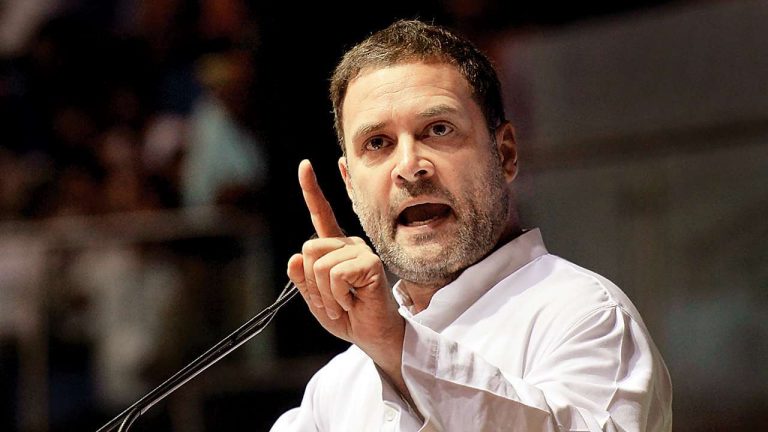
While Rahul Gandhi supports Mamata, WB Congress President rules out any possibility of alliance with TMC

Days after the Trinamool Congress chief Mamata Banerjee held a mega-rally to show a strength of unity among opposition parties, the mask of the superficial solidarity is off as the West Bengal state unit of Congress has expressed its strong disapproval of allying with Mamata Banerjee’s party.


The West Bengal Congress President has insinuated that the alliance with the Trinamool Congress is devoid of dignity and hence there won’t be any alliance with the party. Earlier, Rahul Gandhi had expressed his support for Mamata Banerjee to call upon the opposition leaders for “United India Rally”. Rahul had written a letter addressing the TMC chief as ‘Mamata Di’ and backed the latter’s decision to call for a united opposition front to fight the might of the BJP.

Though the Congress-High command has decided to forge an alliance with the TMC, the local cadres of the West Bengal Congress have long been opposing such an alliance and have periodically expressed their reservations on the prospect of getting into an alliance with the TMC.

The disillusionment among West Bengal Congress was evident when the state unit of Congress planned to organise a state-wide protest against the TMC government for the involvement of many TMC leaders in the chit-fund scams. The Congress state unit also emphatically cited the countless murders of INC supporters allegedly done by TMC workers to register their protest against the Congress-TMC alliance.

Though the central leadership of the Congress has been showing solidarity and even going to great lengths to seek their support, the state Congress unit has long been opposed to the TMC.

In the past, West Bengal Congress chief Adhir Ranjan Chowdhary had launched a scathing attack on Mamata Banerjee and went to the extent of comparing Mamata Banerjee to a “chameleon”. He also alleged that in 2005, Banerjee brought an adjournment motion against illegal migrants, but now, she has changed her stance. He also compared her to a ‘Trojan Horse’ who is hell-bent on dividing the opposition unity.

Rahul Gandhi himself has been duplicitous about his stance on the Mamata Banerjee led party. Gandhi’s stance on Mamata’s culpability in the various scams that have taken place in Bengal has wavered to suit his changing political ambitions. Having once accused Mamata Banerjee of looting Bengal, Rahul Gandhi today hails her as the saviour of the democracy while the Congress West Bengal Unit continues to reel under the TMC excesses.

Congress had even supported Mamata Banerjee when she had staged a Dharna opposing the CBI’s attempts to question the Kolkata police commissioner in the Saradha chit fund scam case. It is notable here that Nalini Chidambaram, wife of senior Congress leader and former finance minister P Chidambaram, is also one of the accused in the Saradha chit fund scam.

ED nails Robert Vadra’s link with arms dealer Sanjay Bhandari, confronts with 2016 I-T dept interrogation report

0

Robert Vadra has been questioned by the Enforcement Directorate for the third day today in money laundering and other cases against him. According to reports, today ED confronted him with the detail of Sanjay Bhandari’s interrogation by the Income Tax department in 2016, which show that Vadra has a link with the fugitive arms dealer.


In 2016, offices of Sanjay Bhandari were searched by the Income Tax department in a tax evasion case, when confidential defence ministry documents were found in his possession. The officials had also found emails exchanged between Bhandari and Vadra. Now, the ED has produced a portion of questioning of Bhandari by I-T department on 30th April 2016, where he had agreed that he had booked flight tickets from France to India on the instructions of Robert Vadra. This document was produced by ED when Robert Vadra had denied any link with Bhandari during his questioning. Vadra has been denying any link with Bhandari in the questioning by ED till now.

The document shows that Sanjay Bhandari was asked by the Income Tax officials whether a ticket for Robert Vadra to travel from Nice, France to Delhi in India was booked by him on behalf of and who had made the payment.  Answering to that question, Sanjay Bhandari had confirmed that he had booked the ticket on the instruction of Robert Vadra, although he said he did not remember who made the payment.

Earlier, copies of emails had emerged which showed that Sanjay Bhandari was working on the renovation of a property owned by Robert Vadra in London. One email sent by Sumit Chadha, close associate of Bhandari, had talked about payment for work done on the property. Vadra had replied to the same that he will look into the same and Manoj will sort out the matter.

Manoj Arora is Executive Assistant of Robert Vadra and he is also being probed by ED in the money laundering case. Copies of the emails were marked to one email ID [email protected], which is allegedly an email ID of Sanjay Bhandari.

Anti-right wing bias: Twitter refuses to appear before Parliamentary Committee on IT

The micro-blogging site, Twitter, which has been receiving a lot of flak over its bias against accounts with a right-wing ideology has reportedly declined to appear before the Parliamentary Committee on IT that had summoned them over the issue of safeguarding citizens’ rights on social media platforms.

According to Financial Express, Twitter Chief Executive Officer and top officials have declined to appear before the Parliamentary Committee on Information Technology headed by Anurag Thakur which had issued a summons to Twitter via an official letter on February 1st. The meeting was initially scheduled on February 7th but was later postponed to February 11 to allow the Twitter CEO and senior officials more time to make themselves available.

Apparently, Twitter has now cited “short notice of the hearing” as the reason, despite being given 10 days to travel, the sources said. The letter sent to Twitter clearly stated that “it may be noted that the head of the organisation has to appear before the committee”. It further said, “he/she may be accompanied by another representative”.

Twitter has displayed its disdain to rule of law by sending a junior employee to represent them at the Indian Parliamentary IT Committee. Reportedly, the parliamentary panel has not taken down this incident well as the junior authorities representing the hearing have no decision-making authority.

The committee reportedly received a letter on February 7 from Vijaya Gadde, Twitter’s global lead for legal, policy, trust and safety, stating, “No one who engages publicly for Twitter India makes enforcement decisions with respect to our rules for content or accounts in India.”

The curious case of Twitter censoring social media users for disagreeing to left-wing and ultra wing ideology at the time of crucial general elections has upset several social media users. With opposition parties and Lutyens media ecosystem backed by the Congress party indulging in false narratives and propaganda, right-wing users have expressed fear that more fake news may emerge in the social media platforms.

It is also accused that several prominent right-wing accounts are shadow-banned by Twitter. This means while the account is not blocked or suspended, the Tweets posted by that account do not appear on the timeline of the followers of that accounts. Tweets from such ‘shadow-banned’ accounts do not appear in search results also, effectively meaning that tweets of such persons remain invisible to users unless they visit the Twitter account page of such persons.

Kolkata police commissioner being grilled by CBI in Shillong for his role in chit fund scam

Kolkata Police Commissioner Rajeev Kumar appeared before the Central Bureau of Investigation in relation to the Sarda Chit Fund scam, today morning, in Shillong, Meghalaya. A ten-member CBI team is reportedly assigned for the questioning of the IPS officer.


Rajeev Kumar was accompanied by two senior police officers from West Bengal, including Deputy Commissioner of Special Task Force Murlidhar Sharma and a counsel. The team had arrived at Shillong on Friday, a day before Kumar’s grilling.

An Indian Express report states that Kumar has told CBI that he will not be able to stay put in Shillong for long, in the wake of Sarwasti Puja tomorrow, and board examinations starting on February 12. The two Police officials and Kumar’s counsel was asked to leave from the CBI office.

As per reports, a three-member team from Delhi is currently grilling the officer and the questioning is expected to be carried out in 3 phases.


Meanwhile, groups of TMC workers have reportedly staged a protest outside CBI national headquarters in CGO Complex, Delhi.

The CBI has alleged Kumar of tampering with crucial evidence related to Sardha ponzi scam, that allegedly involves various TMC leaders. The buzz around the scam escalated after on Kolkata Police had forcefully detained eight CBI officials who had gone to visit police commissioner Rajeev Kumar to obtain crucial information regarding the scam.

Following this, CM Mamta Banerjee had resorted to ‘dharna’ politics alleging Modi government of indulging in vendetta politics and using CBI to meet political ends.

CBI then approached the Supreme Court, alleging the state machinery and police of deliberately obfuscating facts and hampering the investigation into the Sardha Chit Fund Scam. SC had given CBI a big relief and had asked Rajeev Kumar to appear before the agency, in Shillong, a place which it deemed was politically neutral. SC had also directed CBI to not to exercise coercive actions like arrest against Kumar.

Airports, tunnels, hydel project, bridge, AIIMS, Bio Refinery: PM Modi launches a range of development projects in North East

Prime Minister Narendra Modi is visiting North East today where he inaugurated several development and infrastructure projects. The prime minister is visiting Arunachal Pradesh, Assam and Tripura today, after he attended a rally in West Bengal yesterday. Here are the projects that are being inaugurated by Modi today:

Arunachal Pradesh

Narendra Modi reached Itanagar in the morning from Guwahati, where he unveiled several development projects at IG Park. The prime minister laid the foundation stone for the construction of Greenfield Airport at Hollongi near Itanagar. At present the nearest airport from the Arunachal capital is the Lilabari Airport at Lakhimpur, Assam. In addition to providing better connectivity to the region, the airport will also unravel the tourism potential of the state. The airport will boost the economic growth of the region and will be of strategically important to the nation.

The upgraded Tezu airport was also inaugurated at the event. The airport has been retrofitted and a new terminal has been constructed for commercial operations under the UDAN scheme. Prime Minister Modi said that this perhaps the first time when an airport has been inaugurated and the foundation stone was laid for another on the same day in the same state.

Prime Minister also laid the foundation stone of Sela Tunnel in Arunachal Pradesh. It will provide all-weather connectivity to Tawang Valley for civilians as well as security forces throughout the year. The tunnel will reduce travel time to Tawang by an hour and boost tourism and related economic activities in the region.


He also dedicated a 110 MW Pare Hydroelectric Plant in Arunachal Pradesh to the nation. The project has been executed NEEPCO, which will harness hydro power potential of the river Dikrong, a tributary of Brahmaputra. This hydel project will provide cheap hydroelectric power to the North Eastern states, which will improve the availability of power in the region.

Apart from these, a dedicated Doordarshan channel for Arunachal Pradesh, DD Arun Prabha was launched by the prime minister at the event. The prime minister also inaugurated 50 health and wellness centers in the state through remote control.

Assam

After attending the event at IG Park in Itanagar, Prime Minister Narendra Modi reached Guwahati for next round of events. Assam BJP had organised a huge gathering of more the 3 lakh people to attend the rally at Changsari, in a crucial show of strength on the backdrop of ongoing protests against the government over the Citizenship Amendment Bill. There, he participated in Bhoomi Puja for construction of AIIMS at Changsari near Guwahati. The foundation stone for the AIIMS was laid by the PM last year, and preliminary earthwork at the site has been completed since then. The AIIMS in Assam will be constructed under the Pradhan Mantri Swasthya Suraksha Yojana at an estimated cost of ₹1,123 crore.


Prime Minister Narendra Modi will also laid the foundation stone for Guwahati-North Guwahati bridge over the Brahmaputra. The bridge will immensely help the people of North Guwahati, and also help in the expansion of the capital city on the north bank of Brahmaputra. The bridge will be built at a cost of ₹1,925 crores, and 80% of the same will be funded by BRICS New Development Bank (NDB). The 1600 meter long bridge has been designed as a Multispan Extradosed bridge.

Prime Minister also launched several oil and gas projects in Guwahati. This included the North East Gas grid, which will ensure uninterrupted availability of natural gas across the region, City Gas Distribution Networks in four districts, Modular Gas Modular Gas Processing Plant in Tinsukia, NRL Bio-Refinery at Numaligarh, and 729 km gas pipeline from Barauni to Guwahati, passing through Bihar, West Bengal, Sikkim & Assam.

Tripura

The last leg of PM’s visit to the region will be at Agartala in Tripura. There he will inaugurate the Garjee – Belonia Railway Line in South Tripura. PM will also inaugurate New Complex of Tripura Institute of Technology at Narsingarh. A statue of Maharaja Bir Bikram Kishore Manikya Bahadur will be unveiled by the PM at Maharaja Bir Bikram Airport, Agartala.

It is our duty to protect persecuted minorities from neighbouring Islamic nations: PM Modi in Assam

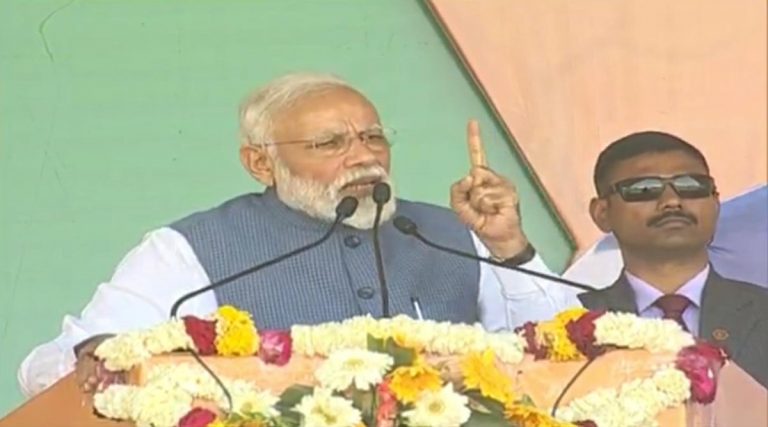
Prime Minister Narendra Modi addressed a rally in Changsari, Assam today where he targeted the Opposition over its failings to implement the Assam accord and spoke in defense of the Citizenship Amendment Bill.

The NDA government was committed towards the implementation of the Assam accord, Modi said. As per the provisions of the accord, a Bill has been brought to provide Scheduled Tribe status to 6 Assamese communities, he stated.


Taking a dig at the proposed Mahagathbandhan by the opposition parties, PM Modi asserted that the only thing that the ‘MahaMilavat’ coalition is concerned about is abusing him and that the corrupt are panic-stricken after the Chowkidar’s actions.


Narendra Modi also said that his government has always attempted to rid the state and the country of illegal immigrants and is working towards sealing the entire Indo-Bangladesh border. He also said Congress governments were unwilling to implement the NRC which the NDA government has done.


The Prime Minister also asserted that it was India’s duty to provide shelter to people who have suffered immense oppression in the neighbouring countries due to their non-Islamic faith. He argued that the Citizenship Amendment Bill was directed towards serving this purpose.


“Citizenship Bill issue is not related only to Northeast or Assam — it is for people who want to live by their faith and for that have to save their lives and escape and come to Maa Bharti. What they had to undergo you can understand when you meet them,” he said.

With elections approaching fast, Narendra Modi has escalated his attacks on the Opposition immensely. Yesterday, in a rally at West Bengal, he had targeted Mamata Banerjee for tarnishing the reputation of Bengal and labeled her government as the second coming of the Communist regime. And in his address in the Lok Sabha recently, he had directly accused the Congress party of undermining the defense preparedness of our Armed Forces due to vested interests.

Tamil Nadu: 5 Muslim men detained in connection with murder of Ramalingam who resisted religious conversions

0

The Kumbakonam Police in Tamil Nadu on Thursday arrested five people including one member belonging to Islamic militant organisation PFI in connection with the murder of activist V Ramalingam inThirubhuvanam.

According to the reports, a special team which was formed to arrest the accused in the case has now detained five people in connection with the heinous murder of 42-year old activist and PMK (Pattali Makkal Katchi) leader V Ramalingam. The arrested have been identified as S Nijam Ali, Sarbudeen, Rizwan, Mohamed Azarudeen and Mohamed Raiyaz.

The brutal incident had occurred on Tuesday night after 42-year-old Ramalingam was assaulted in Kumbakonam in Thanjavur district on his way back home by a group of unidentified people and his hands were chopped off.  Reportedly, he was brutally murdered by a group of people belonging to a Muslim community for opposing religious conversion.

On February 5th, it was reported that Ramalingam noticed a group of men said to be belonging to the radical Islamic organisation Popular Front of India (PFI), proselytising in a Dalit dominated neighbourhood. He confronted the men opposing the same, and the preachers retaliated, which started an altercation. Later the issue was sorted by some Muslim clerics.

Later in the day, on his way back home in his minivan, a four-member gang came out of the car and attacked Ramalingam’s hands with sharp weapons before fleeing. Ramalingam who was seriously injured was rushed to the Kumbakonam government hospital and later to Thanjavur Medical College Hospital where he was declared brought dead.

Madhya Pradesh govt invokes NSA for cow slaughter cases, Congress leaders express disapproval

0

The Congress Party and its veteran leaders are finding it difficult to come to terms with the decision of Madhya Pradesh government, which on two instances has invoked the National Security Act against people accused of illegal transportation of cow and its slaughter.

On February 3, the Kamal Nath government had invoked NSA against three accused of cow slaughter in Khandwa district. It is alleged that the locality where the slaughter was performed is a communally sensitive area and the act of cow slaughter could have threatened communal harmony there. On the heels of this incident, the MP government had invoked the NSA against two more people for ‘illegal transportation of cattle and disruption of public peace’ on 8 February, in Agar Malwa district.

The Congress leaders have started condemning its own state government, maybe so as to comply with the outrage of the liberal and leftist media.

Speaking at the launch of his book, “Undaunted: Saving the Idea of India”, Former Union Minister and Senior Congress leader P Chidambaram expressed disapproval over the action of MP government and also said that the party has pointed so to the state government. Not only this, but P Chidambaram also said that Congress President Rahul Gandhi also deems the action a mistake.

“The government has been told that was wrong. I think the Congress president has told the people concerned that was wrong… Use of NSA in Madhya Pradesh was wrong. That has been pointed out to the government in Madhya Pradesh.” P Chidambaram was quoted by Indian Express.

Former Chief Minister of Madhya Pradesh Digvijay Singh said that what section to invoke for what crimes, depend solely on police. But he added that he thought crimes related to cow should not invite the Act.

The unease of national Congress leaders became more apparent after its other leaders also condemned the invoking of NSA and also asked the state government to explain the same. Former Minister of External Affairs Salman Khurshid said that “prima facie it does not seem the right thing”. He also appealed to Kamal Nath government to clarify the move and explain its necessity.

Former Rajya Sabha MP Rashid Alvi said that NSA should only be invoked in cases where there is the real threat to the national security, and added that here the case is only about the cow, and NSA is not applicable.

Prior to Kamal Nath, the BJP government has used the Act to handle cow-related crimes. The last time NSA was invoked for cow slaughter, it was under the BJP government when Anwar Mev, the vice-president of the BJP’s minority cell was found guilty of cow slaughter and was booked under NSA with nine others. He was also expelled from the party.

Earlier, the Yogi Adityanath government had also ordered to invoke the NSA and the Gangster Act on persons guilty of cattle smuggling, illegal transportation of smuggled cattle and slaughter in all the districts of the state.

How Nehru led to agrarian distress and what could be the way forward for inclusive growth

Historical backdrop and policy impact:

In 1947 when Prime Minister Jawaharlal Nehru took over reins of Independent India, deeply influenced by Marxist-Leninist socialism, he strived to achieve India’s prosperity by creating mammoth public sector enterprises that were engaged in manufacturing steel to running forcibly nationalised airlines. He also borrowed the concept of creating government-run research laboratories and institutes like CSIR, CARI and many others to promote scientific research in India.

Here it would be insightful to understand that the western concept of development and innovation are inherently driven by the wish to forever reduce human intervention to minimal. Humans are recurring operational costs on any western economic system and measurement and everything is measured per capita. While west has no qualms in capital expenditures as these go into asset building.

So Nehru, trained and influenced in west, chose to devote scarcely available capital of a poor nation that was just released from Imperial forces, on highly capital intensive public sector undertakings and larger than life projects that had little immediate impact on vast agrarian society of that time. Mega steel plants, nationalised airline, new research and development laboratories that left existing universities teaching archaic syllabi where masses got education. He built a few IITs and IIMs which stood as small oasis of modern knowledge in the vast desert of ignorance and illiteracy.

This ensured that all the resources and energy of nation got diverted and sucked up in building isolated marvels of engineering, infrastructure and science, leaving behind whole country untouched by any development worth mentioning. Most of the labour that was illiterate and worked in farms never got a chance to participate in these temples of modern India that were being built in those days. Moreover, other priority areas like primary education, health provisioning, family welfare, and even rural infrastructure provisions that would have made a positive impact in the lives of poor remained unattended due to lack of resources. So British legacy of closing the old Gurukuls by Macaulean policy, ensuring majority of Indians remained illiterate, continued in post-independence Nehruvian era also. The abysmal rate of GDP growth achieved in those years was called ‘Hindu rate of growth’, as if to drive home the point that a Hindu Bharat could never grow above 2-3% GDP.

However, there was one area where Mr. Nehru’s policies had an unintended effect. In these PSUs was incubating a robust future middle class that worked and earned a risk-free salary in these highly inefficient enterprises. Children of these working-class studied in Central Schools and private English medium schools and later helped in the technology boom that India achieved later. The legendary dhoti and kurta clad common man was left stuck in unsustainable village economy, with dilapidated or non-existent primary and secondary schools and health systems.

Theoretical argument of why Nehru’s Capital intensive USSR model of development was catastrophic for India:

In 2001 World bank sponsored study NRI Report No: 2662 Rural Non-Farm Economy The Rural Non-farm Economy in India: A Review of the Literature, author Daniel Coppard writes

Rural non-farm employment is considered to be particularly important to the landless and small and marginal farmers, leading to the conclusion that the growth of real per capita non-agricultural output can have a significant impact in reducing rural poverty. Rising non-agricultural incomes can, however, also increase inequality as a consequence of differential access between as the less- and better endowed.

Hence spending meagre resources available with third world economy, on highly capital intensive activities like heavy industries and infrastructure, Nehru committed a crime against the poor and led them further into agrarian distress. A large swathe of rural and poor India was deprived of non-farm government expenditure. Only in the late nineties, when non-farm rural expenditure by governments picked up, this rural-agrarian distress reduced and started reflecting in rapid poverty reduction.

Today’s priorities:

It was PMRRY-Prime-Minister Rural Road Yojana of Vajpayee government which started pumping substantial funds for creating rural infrastructure across the whole country, that led to picking up of various non-farm economic activates in rural households. Better road connectivity meant every village was well connected to the market. At the same time, the mobile telephone revolution was taking place and communication infrastructure was also building at never before pace. Both these infrastructures, rural roads and rural-telephony, would have a substantial impact on Non-farm rural incomes. This had direct impact on poverty reduction in rural India. Though infamous for widespread leakages, to the extent money could reach actual beneficiaries, MNREGA and Mid-Day meal schemes of Manmohan Singh government also helped in giving a push to Non-farm activities in rural India.

I have no hesitation in inferring that the Nehruvian model of capital intensive growth had a similar effect on the rural populace of India as Mao’s Great_Leap_Forward had on China’s rural inhabitants. Both eliminated more poor than poverty itself.

Alternate model for inclusive growth:

Today, India is no more a country with ‘Hindu rate of growth’, whatever that meant to development economists. There are so many public projects in infra sector in progress in every nook and corner of the country. Even remotest places like Arunachal and Tripura are having massive infrasturucture building up at never before pace. National and State highways, metro rails in multiple cities, JLN urban renewable mission, dedicated freight corridors, railway expansion, high speed rail, Inland waterways, Namami Ganga for treating sewage waste of cities on river banks are some of the prominent examples. Most of these projects are using the latest cutting edge technology implemented by both Indian and foregin firms who are partners and stakeholders in these projects.

These new technologies brings time and cost efficiency and speed that is much desired. However, a serious impact of these technologies on low skill labor jobs is that Man is replaced wth machines in all such projects. As technologies have a western origin and influence the basic design parameter from all such technologies remain same output/person. So idea is to maximize output and minimise head counts. This runs counter to the idea of non-farm income generation by creating low skilled jobs in the economy, where millions of unskilled, illiterate and semi-literate people can participate in the New India growth story.”.

Possible Solution:

If the government of the day wants to give a massive boost to labour intensive jobs, then it should seriously think about creating a policy mechanism where all government funded projects should have minimum 30-35% (1/3rd) of project costs going in labor inputs. There should be a penalty on suplliers and contractors who supply goods and services to project where manpower costs are less than 1/3rd of value of total input.

This will force both foreign and Indian firms to proactively think and design India specific technologies that has more labor intensity per unit of output rather than think old ways about output per person.

I would only cite one example to drive home a point or two. In most of highway building work, lot of soil is transported and filled by big dumpers. A simple switching to tractor-trolley or even bullock carts for land filling in infrastructure projects like road and rail would create massive employment opportunity for rural people living nearby.

Prime-mister flagship scheme of subsidy on rural and urban housing is another case in point. In the state of Uttar Pradesh, the responsibility of building the house in rural area has been given to house owner itself, and payments of subsidy has been linked to submission of reports of various achieving various milestones. So house owner is stakeholder and participant in the construction of his own house. While in Andhra Pradesh big project construction firms have been handed over contracts to build mass housing for poor. With better and modern technology and more resources available, these firms have drastically cut labour intensity as a proportion of total project size. These houses, once build will be directly allotted needy and eligible by the state government.

One can only guess the better impact of UP model of rural housing projects will have on the local economy compared to mass housing projects being built by big firms. One must acknowledge that quality will be a big sufferer in case of UP scheme, due to lack of technical expertise available to small-time home maker.

Just a policy guided inversion in project implementation strategy of big firms, from anti to pro-people processes will create enough jobs in the economy for many more years. When a big project like Akshadham temple in Delhi can be carved out of millions of man-days of work with minimal use of heavy equipment and automatic machines, then increasing the labor intensity without compromising on quality can be achieved in most of Infra projects. It is not a difficult task as India has a rich tradition of carving grand temples and big cities in an era when modern technology was not there.

Here many potential voices would be raised citing cost and time in-efficiencies inherent in labor intensive technologies. These dissenting voices may be ignored for a larger picture of more equitable growth story rather than promoting jobless growth.

We need a paradigm shift in our approach while taking our nation from developing to a developed one. A metaphorical statement of above policy shift would be “Let India attain its 9 or 10% growth rate by moving material on back of donkeys’ back and bullock carts to build its bullet trains and highways”.

Unless a higher proportion of non-farm labour intensives opportunities in the infrastructure sector are created through government policy, the majority of India will once again miss the inclusive growth story in our progress. Mr. Nehru missed it due to his ideology of copying USSR, we will miss it now in blindly copying western technological advances that are inherently human phobic in nature. A suitable labour friendly adoption of new technology will go a long way in ensuring inclusive growth. A whole ecosystem of new generation entrepreneurs building human friendly machines will emerge in a short time.

Brief About Author: Pankaj Prasad is an Alumnus of DCE, working as technocrat in Oil and Gas industry, interested in human centric development of Bharat

Congress attacks Piyush Goyal citing media report, media admits it was fake news

Hindustan Times recently published a correction on a news report they had published earlier which spread fake news about budgetary allocation to infrastructure development. The fake news report claimed that there had been a 23% dip in infra funds when in reality, there had been an 8.2% increase.

Via Twitter

The clarification read, “A February 4 story, headlined ‘23% dip in infra funds despite emphasis in Goyal’s speech,’ erroneously reported that the budgetary allocation for infrastructure declined from Rs.5.97 lakh crore in the financial year 2018-19 to Rs.4.56 lakh crore in 2019-20. The story should have said the budgetary allocation for infrastructure rose from Rs.5.97 lakh crore in 2018-19 to Rs.6.46 lakh crore in 2019-20, including ₹4.63 lakh crore of extra-budgetary support. The headline should have mentioned an 8.2% rise. The errors are regretted.”

Of course, HT ‘regrets’ the error but the damage was already done. The official handle of the Congress party tweeted the fake news story to attack acting Finance Minister Piyush Goyal and the BJP.

Via Twitter

Pointing out the blatant media bias towards Congress and the lack of concern in retracting and apologising for erroneous reporting of facts, Twitter user Ankur Singh drew attention to the fact that the media outlet took several days to admit the error and correct their article. He also pointed it out that while the fake reports were actively promoted by Twitter, the corrected version was not.


The correction was offered by HT 5 days after the initial fake news report was published. That’s enough time for opposition parties to gain political mileage out of it. In a critical part of election season, 5 days is a lot of time. Such fake news reporting can have far-reaching consequences.

Piyush Goyal was also targeted by Indiaspend’s dubious ‘Factchecker’ after his budget speech. The ‘factchecker’ had claimed that Piyush Goyal’s claim of 268 mobile and parts manufacturing units was false. However, it was found that the ‘fact-check’ was fake news and Goyal’s claim was accurate.

Interestingly, such ‘errors’ always appear to benefit only one political party and harm their rivals. Only yesterday, The Hindu deliberately distorted a MoD document to spread misinformation about the Rafale deal. That gave Rahul Gandhi another opportunity to attack Prime Minister Modi only to have his lies busted once the full document surfaced.