More skeletons are tumbling out of the closet of media and entertainment industry over allegations of workplace sexual harassment. Yesterday, a journalist named Rakumini Sen has come out with allegations that India Today group CEO Arun Poorie and vice chairman Kalie Poorie did not take any action on her complaint of workplace sexual harassment.
Sen has shared a Facebook post detailing the neglect and inaction her complaint was dealt with within the media house. She has stated that her case was from 2012-13 and in the six years that have passed, her case is yet to see any substantial step taken with regards to her complaint.
Rukmini Sen has stated that after she had lodged a complaint against her then male boss Supriya Prasad in 2012, it took the legal and HR cell of India Today a year and a half to reply to her that the male boss was innocent because she had known him before. Sen further alleges that despite her complaint, the committee that was formed to inquire over her complaint did not have the mandatory external member who is required to be a legal or women’s rights expert. She has added that for this reason, she had refused to present her case because the internal committee would have been biased.
Sen admits in the post that the nature of the sexual harassment she faced was not physical but verbal. She says that Supriya prasad had used the worst kind of verbal and sexist insult for her. She adds that it is all a part of rape culture, sexist jokes, sexist insults, outbursts and sexist sidelining of women professionals at the workplace which are unacceptable and comes under serious harassment because it harms the well being of many female professionals like her. She says that She also admits that she had not filed a police complaint or went to court because she was busy taking care of her ailing father at that time.
Sen furthers that she had left India Today group in 2013 and has worked in several other media houses after that. She also claims that the sexual harassment committee in India Today group was formed because of her complaint. Sen has alleged that Supriya Prasad, the person who had harassed her verbally is a repeat offender and she knows of one employee of India Today whom Prasad had forcibly kissed. She claims that Prasad had been asked to resign at that time. She has also alleged that many of her former colleagues and mentors, despite being aware of the kind of behaviour she was subjected to from Prasad, chose to ignore and engage with Prasad on a professional and personal level.
Rukmini Sen has stated that Arun Poorie and Kalie Poorie are complicit with playing with the well being of female employees working for them. She has also added that there is no point of holding the India Today conclave every year discussing violence against women while the group itself has failed to identify workplace sexual harassment as a systemic violence.
Sen has also stated that if any woman professional who has been sexually harassed by Supriya Prasad wants to take legal action and needs her to testify, she will fully co-operate.
It is notable here that many senior professionals in the media and entertainment industries have been accused of workplace sexual harassment in the last few days after the allegations against All India Bakchod’s Utsav Mukherjee first broke out. A large number of women have been coming out with their experiences of harassment neglect by their colleagues and senior professionals towards serious allegations of sexual harassment.
So far many names from prominent media houses like The Times group, and portals like The Wire and The Quint have been accused of workplace sexual harassment. Several people from the entertainment industry including director Vikas Behl, stand up artists and many others have also been accused of sexually harassing women at their workplace.
Past few days have seen a storm on social media with many women calling out the mighty and powerful in the media and film industry and accusing them of inappropriate sexual behaviour towards them. Latest in the accusations is the film director Vikas Bahl, the director of Kangana Ranaut starrer Queen. Bahl was accused by an employee of Phantom Films, a production house started by Bahl, Anurag Kashyap, Vikramaditya Motwane and Madhu Mantena in 2015 of inappropriate behaviour during the shooting of film Bombay Velvet. She says that even though later on she told Anurag Kashyap about it, he did nothing and she had to eventually quit working there as Bahl would allegedly continue harassing her, making it an unsafe working environment for her.
Following the revelation, Queen actor Kangana Ranaut, who had worked with Bahl, came forward and backed the woman’s claims that Bahl he behaved inappropriately with her as well. Amidst all this, Sonam Kapoor, who otherwise identifies herself as a feminist and is known to have taken a firm stand in case of rapes and sexual harassment, after ‘expressing disgust’ at the allegations, belittled Kangana’s coming out in support by saying, “Kangana being Kangana Ranaut, she says a lot of stuff. Sometimes, it’s hard to take her seriously, but I love the fact that she has spunk and she says what she believes in.”
Furious with that, Kangana Ranaut slammed Sonam for being judgemental. “What does she mean by saying, “its hard to believe Kangana” When I am sharing my me too story, who gives her a right to judge me?” Taking a dig at the much prevalent nepotism in Bollywood, Kangana added, “I am known to be an articulate person, I have represented my country in many international summits, I am called as a thought and youth influencer to these summits, I am not known because of my dad I have earned my place and credibility after struggling for a decade.”
Meanwhile, many film personalities who had come forward to support Tanushree against her allegations against Nana Patekar, are maintaining uncomfortable silence on the allegations against Vikas Bahl and Anurag Kashyap who has admitted to having known about the incident.
Ashima chande beje uthe roop-lok o raso-lok e aane naba
bhabomadhurir sanjeeban,
Tai anandita shyamoli matrikar chinmoyi ke mrinmoyi te aabahon..
Aj chitchaktiroopini bishwajanonir sharodo-sribimondita protima;
Mondire mondire dhyan bodhita….”
The baritone voice of Shri Birendra Krishna Bhadra waking us up at 4 AM on the morning of Mahalaya is perhaps my first memory of Durga puja as a Bengali. Some three and half decades ago when the “Mahisasuramardini”(composed by Shri Pankaj Mullick) was still just a radio programme aired by AIR, my Dadu would wake us kids up along with the grown-ups to gather around the big wooden ‘Grandpa’ radio and listen to this musical narration of the ‘invocation of Devi Durga & eventual destruction of Mahishasur by her hands’.
The radio program “Mahisasuramardini” was first composed and aired in 1931 by AIR and till it was recorded in 1966, was an annual radio transmission on the dawn of Mahalaya which marks the end of Pitra Paksha and the advent of Devi Paksha( Lunar phase as per Hindu calendar) and the much loved Durga puja. Bengalis across the world are connected by this tradition of listening to this for over eight decades now.
Many versions and new innovative portrayals aside, it is this original composition in the voice of BK Bhadra that strums the heart-strings of each and every Bengali soul! But what before 1931 some may ask? Durga puja and Mahalaya is obviously not a new tradition. As far as I know through family elders, the Mahalaya day was traditionally observed with early morning puja (many people did final Pitra tarpan rituals) and recitation of the “Durga Saptashati” or as we call it “Chandi Paath”. My Dadu recited the entire Chandi/Saptashati every day during the Durga puja… a tradition my mother has tried to carry forward.
Today I, along with most of the Bengali community will again wake up in the wee hours and collectively invoke the Devi to descend on this mortal world and bless us with her divine presence. Mahalaya 2018. For a Pravasi Bengali kid like myself, in the absence of a ready-made community, staying rooted in my culture and heritage required extra efforts and dedicated participation.
Durga puja in its entirety, right from the planning phase a few months before till the “Bijoya Milonee”s after Vijayadashami is what my being Bengali has centred around. In Bengal Devi Durga is not only the divine mother but also the daughter of every household and Durga puja marks the annual visit of that beloved daughter with her four children to her “Baap-er Bari”.
So much time, effort, planning and preparation go into organising a Durga puja (even if one keeps aside the extravagance) that it is impossible to not feel heartbroken when she finally takes leave on Dashami. Having seen my grandparents, parents and elders giving tearful farewells to the ‘Ma’ (mother yes, but Bengalis often address daughters as Ma/Mamuni too) I used to often wonder as a kid, ‘what is wrong with these grownups?!’ but now my own eyes tearing up at every “Bhashaan”, I know why.
Durga puja is a lot of things for a lot of people – shopping, holidays, annual travel, food and hogging, pandal hopping, cultural entertainment and all the works. But before and even after all this and more, what people are slowly neglecting is the fact – that, first and foremost, Durga puja is a puja!!
Right from the “kathamo pujo” which is the puja of the of the basic wooden frame on which the Durga Pratima is constructed to the “khunti pujo” which is done before the Durga puja pandal is erected, each and every aspect of this grand festival is a puja/rituals. Some may prefer to ignore this aspect and only indulge in the “secular and fun” features of the festival, but I was lucky enough to be born in a family which though settled far away from the land of their forefathers, believed in passing the relevant traditions to the next generation.
Durga puja is such an elaborate and intricate puja that very few households would conduct it on their own, even in the past it was the rich Zamindars and merchant class who used to organize Durga pujas at their homes which would be attended by the entire surrounding community. Now the last few surviving “Bonedi Bari” (affluent) Pujos are our window to the past, and here unlike the baroari/community pandals, the puja starts from “Pratipad/Prathama” day (first day after Amavasya) with daily Chandipaths.
Growing up, our puja used to start from Panchami – the day our community puja would bring in the Durga Pratima amidst the divine beatings of the “Dhaak” and which was kept veiled until Shashti. Causing immense curious excitement amongst the young and old alike. After the “Bodhon” ritual the Panchami evenings were traditionally kept for “Anondo Mela” and the highlight would always be the ladies of the community putting up home-cooked food stalls followed by cultural programs performed by us kids. On the food note, I’d like to add – yes Bengalis, unlike many other communities, eat non-veg during the Durga puja. But there is always enough vegetarian options available for everyone to enjoy. We are traditional “Shaakts” and the puja involves a Bali/sacrifice (not an animal anymore, but done using fruit & veggies nowadays). Ashtami is vegetarian day and Navami is traditionally where meat is eaten. With our diverse heritage, I don’t see the need for any of the sides (veg and non-veg eaters during puja) to antagonize each other.
On Shashti in the morning, the Maha-Shashti puja is conducted under a Bel or wood apple tree (most community pujas create a makeshift “Bel Tola” using a branch of bel tree planted on a clean spot somewhere next to the Pratima). Then in the evening is when the Pratima is unveiled and the rituals of “Amantran & Adhibaash” are conducted. The Devi Pratima is adorned with her various ‘astra-shastras’ and other decorations.
Each day the pujas are conducted as per the muhurta timings specified in the panchang and hence, the timing changes every year. The Maha-Saptami morning is the day for the “Nabapatrika Prabesh and Mahasnan” before the Saptami puja followed by Anjali. Many of you may have noticed a freshly cut banana tree adorned in a white saree with red border and sindoor on it kept beside the Pratima of Shri Ganesha in the Durga puja mandaps.
‘Nabapatrika Pravesh’ on Saptami morning
This banana tree or which is commonly known as “Kola Bou” or literally the banana bride is the “Nabapatrika” that is assembled ritualistically on the Saptami morning. Nine trees(bel, banana, paddy, turmeric, pomegranate, Ashok, Jayanti, black Kachu, maan Kachu) representing the Nine forms of Durga are tied together and given a ritual bath (maha snan) and then adorned with a traditional Bengali red bordered kora saree and sindoor as a newlywed bride.
This entire mahasnan ritual is carried out by married women with the priest presiding over the puja and chanting of mantras. Then this Kola Bou is carried with much fanfare of ululations, conch shells and beatings of the dhaaks to the Ganesha Pratima and set beside him on his right side on a platform. This is followed by specific Saptami puja, Ghat sthapana and Pran Pratishtha, Devi bhog and offerings. Evenings would be all about Sandhya-arati followed by “Dhunuchi” dance, Dhaak playings and various cultural performances… and this is common for all 5 evenings of the Puja.
Maha-Ashtami is the biggest of the 5 days of festivities. The Ashtami puja is long and elaborate consisting of such exclusive and impossible items at times like – 108 small naivedyas, water from oceans and rivers, specific fragrances etc. etc. Most devotees offer personal pujas with offerings of saree/adornments-sweet-fruits and condiments to the Goddess and the puja mandap turns into a heap of offerings in no time.
My mother preparing the “kucho/smaller naivedya”
I remember, for years manning this entire process of – accepting devotee offerings, handing out tokens, assisting the Purohit to perform each individual offering puja and then handing back the puja prasad to the devotees – cycle at my local community puja… horsing around in a saree!
After the Ashtami puja and Devi bhog and pandal full of people offering Anjali mantras, comes the most important part of the day – “Sandhi puja”. Sandhi puja is the precise 48 minutes of overlap between Ashtami and Navami tithis. It is believed that Devi Dashabhuja slayed Mahishasur in this very time slot, making it immensely important a ritual.
A Sandhi puja requires 108 lotuses to be offered, oil lamps to be lit (all at very specific times) and bhog apart from a ton of other elaborate rituals like the “Bali” which finishes the Sandhi puja ritual.
108 oil lamps lit during “Sandhi Puja” arranged by my dad in the shape of Om.
An ash gourd, banana, sugarcane and cucumber is set on a freshly made mud “bali-bedi” and sacrificed symbolically.
Personally, this is my favourite part of the Durga puja and I’ve felt divinity up close and personal during these 48 minutes! Maha-Ashtami is also the day when “Kumari puja” is done by household Durga pujas and at Ramakrishna Mission Durga pujas. The Kumari is chosen each year and is prayed to ritualistically as a form of Durga on Ashtami and is a grand sight to behold.
The pujo on Maha-Navami is frenzy is at its zenith. Another elaborate morning puja ritual is followed by the afternoon bhog which on Navami is mostly a special platter at most community pujas. Maha-Navami puja also includes a ‘yagna’ after the Navami puja. Saptami and Ashtami puja bhogs are traditional Bengali khichudi-labda-chutney bhog which is savoured by thousands of people at across pandals. But Navami special bhogs draw the most crowd, perhaps that being the last puja bhog of the year also has a role to play! It’s not like only devotees enjoy the bhogs daily, but they enjoy the bhog-prasad once it’s been offered to the Devi first and the bhog offerings are cooked daily only by Brahmin women of the community keeping in line with the prescribed rituals.
Dashami puja in the morning is the final puja followed by “Dadhikarma & Darpan Visarjan”. Darpan visarjan marks the leaving of Devi’s essence from the ghat that was set and Devi’s pran pratishta was carried out in and is signalled by the breaking of the holy threads around the ‘puja ghats’ by the priest.
Devi is bid farewell by the married women through the ritual of “Sindoor Daan” and rest of men, women and children all offer their pranams to the Gods and Goddesses before the Pratimas are taken for Visarjan.
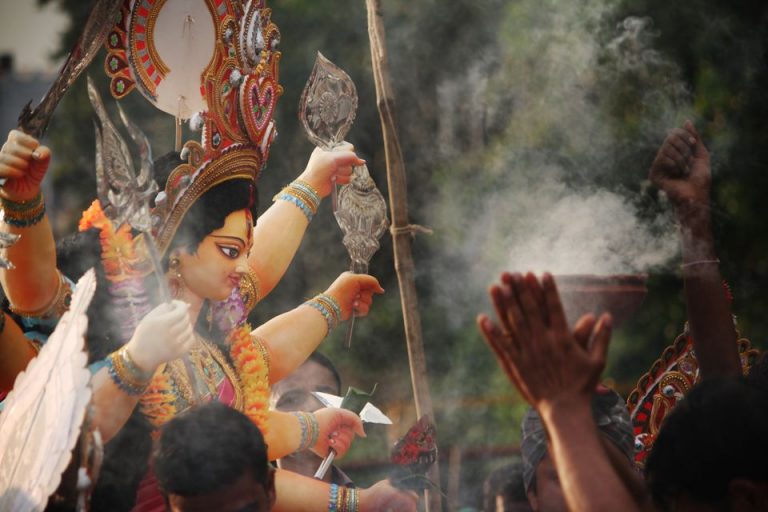
The Visarjan procession is a gala affair of hundreds of community puja pratimas and their participants dancing and frolicking on the trance beats of the dhaak proceeding slowly to the river ghat winding through the city amidst thousands of devotees lined up to offer their last prayers to the Devi. It’s a mix of immense joy and sadness… of love and devotion and of hope for Ma will come back again next year.
“Aashchhe bochhor abaar hobe…”
Visarajan
(Note: This write-up is my personal experience of Durga puja focusing on the ritualistic aspect of this expansive festival which is impossible to capture in totality in a few words)
Last week, in what is widely called as India’s #MeToo movement, many people came forward to share their stories of sexual harassment, especially by people in power. Soon enough the movement snowballed and the who’s who of the film and media industry were named. The latest name to come out today has been Sidharth Bhatia, co-founder and founding editor of the leftist propaganda website ‘The Wire‘.
Bhatia has been named by at least two different women, in two separate incidents and accused of having used his position of power of sexually exploiting women.
One woman has accused Bhatia of ‘propositioning young interns in DNA (where Bhatia was previously associated with) offering tips on writing’. The second Twitter user has accused Bhatia of licking his ‘lower lip seeing bra straps of young women’ in office.
In the tweets, the women have even asked another journalist, Ranjona Banerjee, who was Bhatia’s deputy when in DNA, to speak up, implying Banerjee knew.
Come on @ranjona , speak up, you were @bombaywallah Sidharth Bhatia’s deputy in DNA. How many times did his lick lower lip seeing bra straps of young women in office!?!
One of the woman even alleged that Siddharth Bhatia had ‘liked’ the tweet accusing him of sexual harassment. However, it seems like he had later ‘unliked’. If the woman’s assertions are true, it would mean that Bhatia was online and is now aware of the allegations being made against him.
Wow, look, he is even liked the tweet. Shamelessness takes a new level
Meanwhile, many Twitter users have accused Twitter of ‘shadow banning’ Twitter users like Sheena who are naming and shaming the alleged sexual predators for outing the names.
Bhatia, while still active on Twitter (his last tweet at the time of this report is at 8:25 pm, while the above tweets accusing him are before 2:30 pm today), hasn’t either confirmed or denied the accusations on him. Neither has The Wire issued any statement. We will update the article if and when such a statement is issued.
Update: At 10:17 AM on 8th October 2018, Siddharth Bhatia, the co-founder and founding editor of The Wire responded to the allegations levelled against him. He has categorically denied the allegations and even knowing the women in question who levelled these allegations.
Wild allegations about me are doing the rounds on Twitter. @thewire_in too has been dragged into it. Here’s my statement about it. I would also urge fellow professional journalists not to fall for rumour and innuendo. pic.twitter.com/6J4uCIOwnv
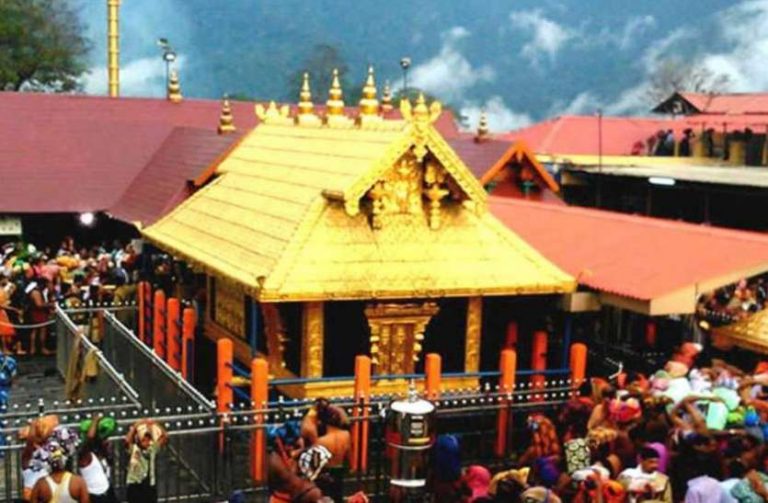
Following the Supreme Court verdict allowing women of all ages to enter the Sabarimala temple in Kerala, the state is facing massive protests against the judgement. While the ruling CPM has supported the SC order, other parties are opposing the order. Members of both Congress and BJP has hit the street in protests, along with members of various religious organisations and devotees of Lord Ayyappa.
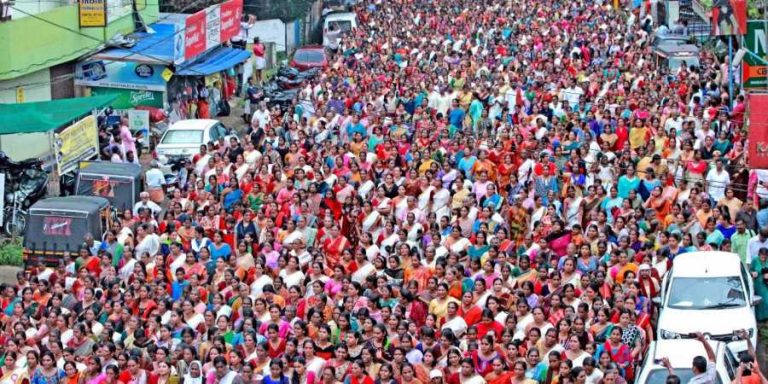
Most of the protesters are women, who seem to value tradition more than right to pray at a particular temple. Thousands of devotees, mostly women, took part in ‘namajapa’ (chanting the of Lord Ayyappa) marches in various places in the state. The protesters are demanding that the Kerala government should file a review petition on the Supreme Court verdict. Even though the state government invited the priests of the temple for a meeting with chief minister Pinarayi Vijayan, the priests have rejected that offer. The tantris, or the priests of the temple, has said that they will meet the CM only after the review petition is filed.
Although the state unit of Congress has joined the protests, this has come as a turnaround of their stand. Initially, the Congress had supported the verdict, saying they welcome the decision of the top court, saying it’s a progressive and far-reaching decision towards gender equality and has given a fresh expression to women’s rights. but traditions at religious places of worship must not be disturbed.
Congress spokesperson Randeep Singh Surjewala had tweeted this in support of the apex court judgement:
We wholeheartedly welcome this progressive and far reaching decision in case of entry into #SabrimalaTemple .
Suoreme Court decision has given a fresh expression to the rights of women and how they cannot be subjugated to any religious practice, no matter how sacred.
Although the central leadership of Congress had supported the verdict, its state unit had decided to take the middle path. Congress leader and opposition leader in Kerala had stated that while the SC verdict is welcome, traditions at religious places of worship must not be disturbed.
Perhaps after the widespread protest in the state and in fear of losing Hindu votes, Congress party has now overturned its position and has demanded that state government should file a review petition in Supreme Court and bring an ordinance to maintain the traditions of Sabarimala temple.
Protests are not limited in Kerala only, they have spilt over to other places in the country. On October 7, a huge protest was staged by Lord Ayyappaa devotees in national capital Delhi. A large number of devotees assembled at Jantar Mantar and shouted slogans against the apex court verdict.
Later the protesters reached Kerala House to submit a petition to the authorities. There, they blocked the car of Kerala Minister EP Jayarajan and didn’t let him enter the Kerala House.
Kerala Minister EP Jayarajan not allowed to enter Kerala house in Delhi by #AyyappaDevotees.
Meanwhile, the Pandalam Palace trust has decided to file a review petition themselves. The Pandalam palace is closely linked to the legend of the Sabarimala deity.
Kerala: Representatives of Pandalam Palace & Sabarimala priests will not attend the meeting called by Chief Minister Pinarayi Vijayan tomorrow to discuss the Supreme Court verdict over women’s entry in Sabarimala Temple. The Palace trust will file a review petition in the matter.
Amid this situation, the CPM finds itself in a somewhat tight situation. The party supports the SC verdict fully but now seems to be worried after seeing the widespread protest. The party is also worried that Congress and BJP will be able to take advantage of the public sentiment against the verdict and the party will be seen as anti-Hindu. Somewhat softening its position, the party state secretary on Friday said, “Women can go to Sabarimala in the wake of the SC order. Those who are not interested need not go as well”. But they seem to miss the point of protesters, as the protesting women are not “not interested” in going to the temple, but they are demanding the restoration of a long tradition related to the temple. The party has also asked the state government to talk with all the stakeholders in the issue to find a solution.
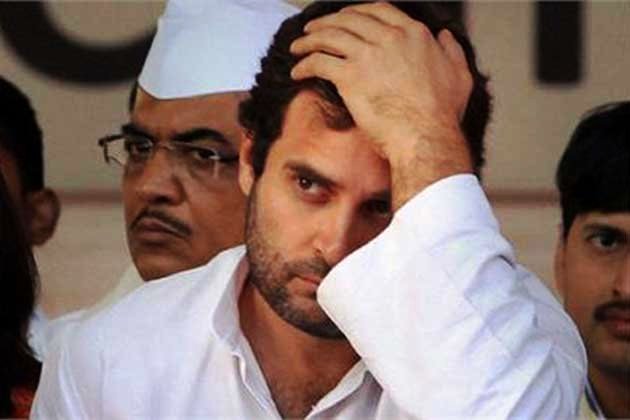
Congress President Rahul Gandhi on Saturday led an 8-kilometre roadshow in the poll-bound Madhya Pradesh’s Jabalpur district. The event was a close squeak for the party president as a major fire was averted as he waved at the crowd atop his open-roof vehicle.
The incident is said to have taken place at Model Road when the Congress’ cavalcade was passing through, as part of his road-show. Thousands of people were lined up along the main thoroughfare. As seen in the video below, a few Congress workers were holding an ‘aarti thali’ to welcome the Congress chief. In the brouhaha, some balloons which had been released as part of the celebrations, came in contact with the flame of lamp kept on the ‘aarti thali’. As a result, the balloons caught on fire and the gas inside the balloons created a big flash of fire for a moment.
Though no injuries have been reported, the blast left the Congress chief spooked for a while. The police and SPG soon took control of the situation and pushed behind all the workers of the party and the procession continued, deflecting the predicament.
Earlier too, the Congress president has evaded a somewhat similar situation. In 2016, Rahul who was on the Kisan Mahayatra in Uttar Pradesh had, had a narrow escape when his head apparently came in contact with an electrical wire.
Rahul has a history of facing several hiccups as he struggles to woo voters. In 2016, during the same month-long Kisan Yatra, in Sitapur, Uttar Pradesh while, on one hand, he had a man hurling a shoe at him, on the other he had seen people stealing the cots that had been rented for one of the events of the Kisan Yatra.
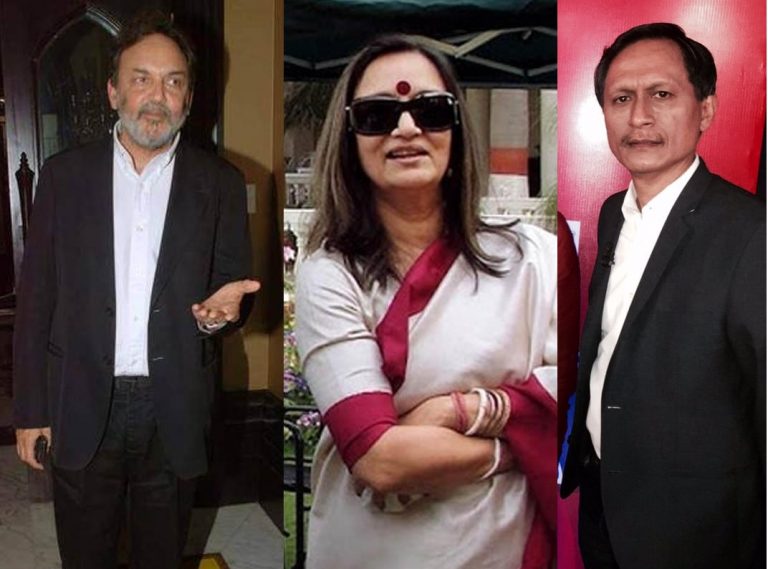
One former journalist of NDTV, Samarendra Singh, who had earlier revealed how NDTV used to take editorial orders from the PMO during the UPA government, is narrating what happened in the channel a decade ago, which according to him has led to the downfall of the controversial channel.
In a series of Facebook posts, two of which have been posted, he talks about how and why Dibang, then managing editor of the Hindi arm NDTV India, was fired by Pranoy Roy. Singh says that in the month of August in 2007, one day suddenly all the employees were asked to go to the studio. When everyone assembled, Pranoy Roy entered along with the management team. And in that meeting, Roy announced that Dibang has removed from the post of editor. While announcing the decision, Roy also emphasised that if someone wants to do something other than the news that they can leave NDTV.
According to Singh, such announcement of the editorial policy was bizarre. It was evident that Roy was not happy with some news program shown on NDTV India, and that’s why he has taken this extreme step of publicly firing the editor of the channel. Singh says that the reason of downfall of NDTV is such attitude of its owners. Pranoy Roy wanted to use the channels as a medium for spreading propaganda, not to show news. He decided what is newsworthy to be reported on the channels and what is not. Even if some breaking news is running in other news channels, Roy may prevent NDTV from airing it if it clashes with his interests.
Samarandra narrates one such incident which probably was one of the triggers that led to the removal of Dibang from NDTV India. It happened on 20th April 2007, during the wedding of Abhishek Bachchan and Aishwarya Rai. On the early hours of that day, a model named Janhvi Kapoor attempted to commit suicide by slitting her wrist. She had claimed that Abhishek had promised to marry her, saying Abhishek had even put sindoor on her forehead.
This was a stuff that happens in movies, and it happened with the most talked-about wedding at that time, therefore it became a big news for the news channels. After getting the information about the incident at 4 AM on that day, NDTV India decided to run only this news exclusively. Dibang gave his go ahead and the channel started covering the news from various angles, deploying several reporters for the story. This was being done by all other channels also, and most Hindi news channels had dropped other regular programs as NDTV India did. Samarendra had led the news as the shift in-charge for that morning shift.
As the day progressed, new information about the incident started coming, and the direction of news bulletins changed as they started maligning the girl. It was alleged that she was married, has a kid, and she was doing a publicity stunt. The entire news was presented in such a way that the Bachchan family is not shown in a bad light. After this, the management of NDTV started questioning the logic behind running the news. Singh claims Barkha Dutt sent a mail that English news channel NDTV 24X7 will not cover the news. Pankaj Pachauri, who had earlier supported running the news on the Hindi channel, did a turnaround and said that both the channels of the group should have the same editorial policy and news should be dropped from the Hindi channel also. By afternoon, Radhika Roy sent an email to all demanding to know who decided to run the news, instead of asking the editor directly.
What was the reason behind this sudden change in events? Samarendra notes that at that time Congress was in power in centre and Maharashtra, and UP was ruled by SP. All of them had good relations with the Bachchan family. Big B’s close friend Amar Singh was a powerful politician at that time. Image of the well-known family was at stake.
What was a news during the entire morning suddenly stopped being a news for the news network, and the news was dropped from NDTV India. Although other channels continued to run it for the whole day.
After the mail of Radhika Roy came, Samarendra proposed to Dibang that he will take responsibility for the news as he was in charge at that time. But Dibang declined, saying he had given his go ahead, and as editor he is anyway responsible for what is shown on the channel.
This is just an example of how the Roys intervened in programming decisions on NDTV. The former journalist is writing a much wider account of what happened inside the channel, which will be posted on his Facebook account. His posts can be followed here.
The Ballia police in Uttar Pradesh is investigating a matter where Gandhi Mohammad Ali Memorial Inter College in Ballia district, Uttar Pradesh has been allegedly punishing students for chanting ‘Bharat Mata Ki Jai’ slogans.
The Ballia district administration, taking serious note of a complaint received by them alleging that the students of an inter-college at Belthara Road area in Ballia district were punished for chanting ‘Bharat Mata ki Jai’ has ordered an immediate inquiry into the matter, as reported by various media houses.
After a video, showing a student being punished for singing ‘Vande Mataram’ and chanting ‘Bharat Mata ki Jai’, went viral on social media, members of a social welfare organisation, Manas Mandir, visited the GMAM Inter College on Bilthara Road and while speaking to the students of the institution did confirm that students were being punished for the same, reportedOneIndia.
According to the manager of the organisation, Shiv Kumar Jaiswal, not only the students but the teachers also complained about the same on camera. Jaiswal furthered that, “Economics teacher Sanjay Pandey told us that there was a ban on singing Vande Mataram and chanting Bharat Mata ki Jai in the school and anyone doing so is punished. Pandey told us that one student, who by mistake had chanted ‘Bharat Mata ki Jai’ after the assembly, was made to squat under the sun for hours”.
Shiv Kumar Jaiswal taking a serious note of this incident, wrote a letter, (dated October 5, 2018) and attached a copy of the complaint and the video recordings of the statements of the students and teachers, as proof to the Uttar Pradesh Chief Minister, Yogi Adityanath, and urged him to look into the matter and derecognise the Gandhi Mohammad Ali Memorial Inter College for such an shameful act.
Refuting the allegations, the college principal, Majid Nasir, called it “baseless and an attempt to malign the school’s reputation”.
When contacted, District Magistrate Bhawani Singh Khangaraut said the matter was serious and that District Inspector of School (DIOS) Narendra Dev Pandey was directed to look into it.
The police has now asserted that they couldn’t find definitive proof, but have asked their teams to be on alert.
Note: This story has been updated with new information that has come to light.
The recent Supreme Court judgement to permit women of all age to enter the Sabarimala shrine has attracted a lot of protest across the country. Various Hindu groups and women organisations have come on streets to protest against interference of the top court in the religious customs and traditions.
Similarly, According to News9, hundreds of Ayyappa devotees including several women have hit streets in Madiwala of Bengaluru to protest against the SC order to allow women to enter Sabarimala temple. These protests have intensified across the country in the past few days.
Recently, the members of Pandalam royal family, members of the People for Dharma movement, members of the ‘Ready to Wait’ campaign, various members of Tanthri families and devotees of Lord Ayyappan had taken out ‘namjapa’ protest march in Kerala not only against the top court but also against the state government for its inability to file a review petition in the Supreme Court.
The Kerala government has now invited the stakeholders, including the Chief priests of the Sabarimala and the members of Pandalam royal family to consult on the issue of entry of women inside Sabarimala shrine.
The Supreme Court in its recent judgement had ordered Sabarimala Shrine to open its doors to women of all ages, repealing the age-old tradition to not let women of a reproductive age of 10-50 enter the Sabarimala shrine.
Delhi often remains in headlines for the degraded air quality and level of contamination in the city. Garbage burning significantly contributes to polluting the air quality. Another major problem looming over the city is the number of exhausted landfills, which hardly suffices the daily production of 10,000 metric tonnes of municipal solid waste. In a fresh development, some images caught by the NASA satellites have exposed the worsening condition of pollution in Delhi along with cases of serious law noncompliance.
“Nasa satellites have picked up several red dots within Delhi, in areas such as Narela, Najafgarh and Bawana. Red dots have also appeared in Gurugram. These, however, can’t be incidents of stubble burning as agriculture is not practised in these areas. These dots mostly likely indicate burning of plastic and garbage in the open in industrial areas,” reported Bhure Lal, chairman, EPCA.
It has come after NASA has disclosed several satellite images that indicated red spots over the national capital, indicating the continual waste burning. This has backlashed the decision of Environmental Pollution (Prevention and Control) Authority to heavily crack down on garbage burning in Delhi. It made it an offence and issued a fine of Rs 5,000 for polluting air last year.
The Supreme Court-empowered EPCA had warned in a statement last year that the civic officials can penalize people with a fineRs 5,000 if they are caught burning garbage. The decision had come after the meeting of EPCA members to strictly implement the Graded Response Action Plan until March 2018. This was to ensure the quality of already poor and severe air pollution in Delhi and NCR.
This action was set to counter the air pollution but unfortunately, the situation is worsening day by day.
“A satellite won’t be able to detect small fires such as a burning matchstick or a chulla (oven) inside a house. The fire has to be big, generate a huge amount of heat and should continue for a few hours for satellites to detect it,” a senior official of the DPCC has reported.
The air quality of Delhi has declined since the retreat of monsoon on October 1. It has been registered as ‘poor’ for consecutive days. The AQI value for Delhi was 209 on Saturday. Meanwhile, farmers in Punjab and Haryana are gearing up to burn the stubble which will further deteriorate the air quality.