Home Blog Page 7160

In meeting attended by Manmohan Singh, Congress leader blames his party for NPA mess: reports

Recently a meeting was organized between the bankers and the Parliamentary Standing Committee on Finance, headed by Lok Sabha MP Verappa Moily to discuss the issue of mounting bad loans and various aspects of NPA’S and banking frauds. This was also attended by the former Prime Minister Manmohan Singh.

Some Congress members present in the meeting forthrightly admitted to the fact that “aggressive lending” during the successive UPA governments was the reason for the mounting NPAs in the banking system, especially in State-owned lenders. Many committee members present there gave their consent saying that this is one of the prime reasons for the escalating NPA’s.

Non-performing assets (NPAs) touched ₹8.31 lakh crore at end of December 2017, out of which gross NPAs of state-owned banks had crossed ₹7.77 lakh crore at the end of December 2017, according to official data. Members wondered why public money was being used to recapitalize the state-owned banks which are losing money due to frauds and defaults by corporates. They further speculated whether ‘nepotism’ by private banks was also the reason for this growing problem of NPAs.

A parliamentary panel on Monday asked the Indian Banks’ Association (IBA) to prepare a roadmap for addressing this issue. During this meeting between the bankers and the Parliamentary Standing Committee on Finance, it was emphasized that corporates should not be painted with the same brush as all are not wilful defaulters.

Banks usually categorize loans as Non-performing assets (NPA) after 90 days of nonpayment of interest or principal, which can occur during the term of the loan or at maturity.

Banks are required to classify non-performing assets in one of three categories according to how long the asset has been non-performing:

  1. sub-standard assets: an asset classified as an NPA for less than 12 months.
  2. doubtful assets: an asset that has been non-performing for more than 12 months.
  3. loss of assets: assets with losses identified by the bank, auditor, or inspector and have not been fully written off.

Last year the RBI Governor Urjit Patel had blamed the UPA regime, describing high performing assets as a ‘legacy issue’, as long gestation projects funded before 2011-2012 were responsible for it.

The Parliamentary standing committee had sought a forensic audit of restructured loans and suggested constituting empowered bodies like the RBI to keep an eye on loans of larger volumes.

2000 BC copper-bronze age chariots, weapons found by ASI suggest a highly sophisticated ‘warrior clan’ civilisation

In a recent excavation near the Sanauli village in UP’s Baghpat, the Archeological Survey of India has discovered the ‘First Ever’ physical evidence of chariots being used in a near 2000 BC period. As per reports, the excavation that has turned up royal burial sites with sophisticated weaponry, ornaments, pottery and other materials suggest that a highly sophisticated ‘warrior class’ civilisation in that region.

The 3-month long excavation was reportedly started in March this year is 120 metres away from a 2005 excavation site that had turned up 116 burial sites which were similar to that of Harappan civilisation. However, as per ASI experts, though further investigations need to be carried out to determine the race of the remains, the current findings do not belong to the Harappan civilisation. A total of 3 chariots have been reportedly found with decorated copper motifs. As mentioned by The Daily Pioneer, these findings are expected to add further insights into researches on the history and dates of Mahabharata period.

SK Manjul, the director of Institute of Archeology has reportedly stated that the wheels of the chariots rotated on a fixed axle linked by a draft pole to the yoke of a pair of animals. The superstructure attached to the axle contains a platform, protective side screens and a dashboard. The wheels and the pole are decorated with copper motifs symbolising the rays of the sun. Although the experts are yet to be certain on whether the chariots were pulled by bulls or horse, they are of the opinion that it was probably horses.

The coffins found have copper designs too, consisting of peepal leaf-shaped crowns, flower motifs and anthropomorphic figures, suggesting a royal burial. Manjul has added such burial sites have been found in the subcontinent for the first time. He reportedly added that though burial coffins have been found in Harappa, Mohenjo-Daro and Dholavira, they never had any copper decorations. The designs of the chariots and other items found are reminiscent of TV portrayal of mythological figures.

Amongst other findings are helmets, swords, daggers and shields. The swords have copper covered hilts and a medial ridge making it strong enough for warfare. The archaeologists have reportedly stated that the population that inhabited the region then was warrior class. ASI has also found steatite beads, combs, mirrors and pottery suggesting a highly sophisticated and culturally evolved civilisation. The findings have been dated to around 2200 to 1800 BC, showing that the civilisation was at par with Mesopotamia, Georgia and Greek civilisations.

Some of the burial graves reportedly contained full skeletal remains while some had partial remains and pots, suggesting secondary burials and even symbolic burials. Many semi-precious and gold beads have also been found. The experts state that these findings suggest that the civilisation was also theologically advanced and culturally, aesthetically sophisticated.

The archaeologist SK Manjul reportedly stated that the existence of a pre-iron age warrior clan civilisation that was so culturally-advanced gives a new dimension to our understanding of our own past history.

Political violence continues in Bengal; BJP supporter shot in Cooch Behar by alleged TMC workers

The political violence doesn’t seem to be abating in West Bengal, with an ANI report calming that a BJP worker was shot dead in Cooch Behar on Sunday evening by alleged TMC workers:


Unlike some of his peers, he though managed to escape alive and is currently admitted to a nursing home. As per a NewsX report, the youth identified as Narayan Sarkar is recovering in Siliguri.

A Telegraph report claims that a bullet hit his jaw while he was returning home after visiting a local BJP leader Nagar Sarkar. The district BJP president – Nikhil Ranjan Dey has been quoted as alleging that Sarkar is a relative of BJP leader who won in the recently concluded local body elections. Thus he claimed that he was shot by TMC workers.

The report though quotes the police has calming that Sarkar was accidentally shot when an individual named – Prahlad Sarkar, was holding a gun which supposedly belonged to the BJP leader Nagar Sarkar, who as per the report is also his relative.

This incident incidentally comes in the light of two reported deaths of BJP workers in Purulia. In the first case, an 18-year-old BJP worker named Trilochan Mahato was murdered in Purulia’s Balrampur. A further macabre angle was given to the crime when the shirt adorning Mahato’s body stated that he deserved to die for working for the BJP at such a young age.

Just a few days later another body of a BJP worker was found hanging from a high tension pole in the same region. Following this incident, the Bengal BJP pinned the blame on TMC goons, whom it accused of executing the order of Mamata’s nephew Abhishek Banerjee, who had promised to make Purulia “opposition free”.

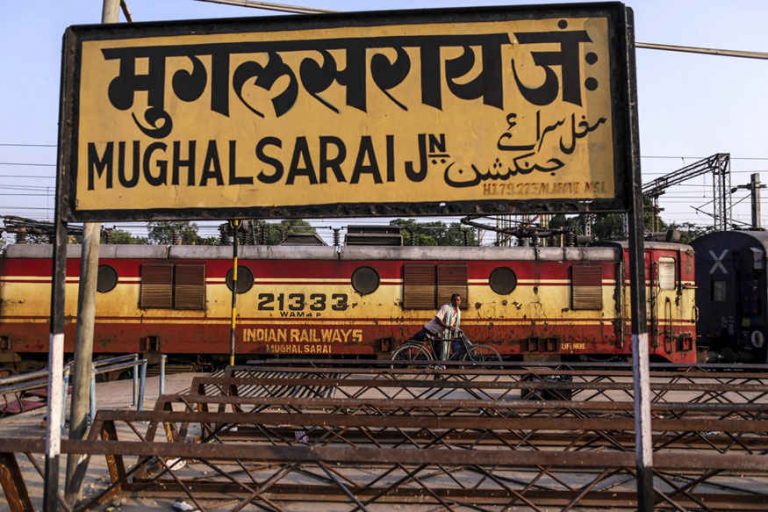
Here is why iconic Mughalsarai station has been renamed as Pandit Deen Dayal Upadhyaya Junction

In a bid to revive the legacy of Deen Dayal Upadhyaya, the government has decided to rename the iconic Mughalsarai railway station to Deen Dayal Upadhyaya Junction on Monday. The Uttar Pradesh government had sent a proposal last year regarding renaming the Mughalsarai station in 2017, and the proposal was approved by the centre on 4th June 2018.

The decision had not sat well with the opposition as the Samajwadi Party and Bahujan Samajwadi Party had protested against the decision in 2017.

The station is inextricably attached to the history of one of the tallest leaders of Jan Sangh, Deen Dayal Upadhyaya, who is an icon for many nationalists even today. Upadhyaya was found dead in 1968 at this junction, which had raised suspicion among people about the nature of his death.

Deen Dayal Upadhyaya’s death seems to be a mystery for most of his followers. Upadhyaya was travelling in a Lucknow-Patna train on February 11, 1968, when his dead body was found at a railway track near Mughalsarai station in eastern Uttar Pradesh.

The death was investigated by a CBI team constituted by the Indira Gandhi-led government and the investigating team closed the case declaring it as a case of theft resulting in an accident. Two men were arrested and they confessed to having pushed Upadhyaya out of the train because he had caught them stealing his bag and had threatened to report them to the police. But they were both later acquitted of the murder charge due to lack of evidence.

The government also appointed a one-man commission of Justice YV Chandrachud to inquire into the matter. The Commission also more or less agreed with the findings of the CBI.

There are many conspiracy theories about Upadhyaya’s death. Balraj Madhok, one of the founding members of Jan Sangh, has said categorically on many occasions that Upadhyaya’s was a murder, not an accident. In his memoir, he had written about the involvement of certain senior Jan Sangh leaders in the murder. In 1977, the Janata Party government had initiated a fresh inquiry, but it yielded no results.

The BJP had directly blamed Congress for the death of Deen Dayal Upadhyaya. The party believes that the growing hegemony of the Jan Sangh leader was a threat to Congress, and was the main reason for his death.

At the time when he brought leaders from the different parties including the likes of Lohia, Kriplani and others to challenge Nehru’s Congress, his death stunned the nation. The mystery of his death and the answers sought by many is yet to be taken to a logical conclusion. The Centre’s decision to rename the junction is a welcome step to honour one of tallest leaders of the country.

The ‘Golwalkar was a fascist who drew inspiration from Nazism’ propaganda must be exposed

0

Madhav Sadashiv Golwalkar died on June 5th, 1973. Today, on his 45th death anniversary, it is necessary to give context to some words that are repeatedly used to malign the RSS stalwart. Chances are he would be reviled by Leftists Sitaram Yechury, and “Liberals” Ramachandra Guha, for his alleged affinity with Adolf Hitler. It would help them paint Rashtriya Swayamsevak Sangh (RSS) as a Fascist and Nazist force, a virulent campaign meant to neutralize the sting out of Pranab Mukherjee’s upcoming visit to RSS headquarters on June 7.

Guruji as Golwalkar is known was in public eye for a long period between 1940-1973 as the second sarsangchalak of RSS. In his profuse writings, letters, articles, statements and interviews, there doesn’t seem to be a single sentence which declares Guruji’s admiration for Hitler. Not one. Yet libraries of articles and books repeat the lie to run down the world’s biggest mass organization.

This ocean of lies floats on a mere two paragraphs which appeared in Guruji’s maiden book in 1938, “We, Our Nationhood Defined”. The book has never been reprinted since 1947. It’s been over 70 years but these two paragraphs alone is the edifice around which an entire cottage industry of RSS-bashing, Hindu-mocking has flourished. One wonders how many careers have been launched, reputations air-brushed, funds transferred to crooks reaping the harvest out of these two paragraphs.

As an analogy, why Karl Marx is not Hitler-like for he too described Jews as “arch-exploiters”? Or John F. Kennedy, for he praised Fascism-for-Italy and Nazism-for-Germany in the 1930s? Or our own Pt. Nehru for he swore by socialism even as millions were being massacred in its name in Stalin’s Russia?

But let’s look at these two contentious paragraphs first:

FIRST PARAGRAPH

“From the standpoint, sanctioned by the experience of shrewd old nations, the foreign races in Hindustan must either adopt the Hindu culture or language, must learn to respect and hold in reverence Hindu religion, must entertain no idea but those of the glorification of the Hindu race and culture, i.e. of the Hindu nation, and must lose their separate existence or merge into the Hindu race, or may stay in the country, wholly subordinated to the Hindu nation, claiming nothing, deserving no privileges, far less any preferential treatment–not even citizens’ rights.”

Let’s look at key issues in the paragraph. One, there is no call for genocide for it says ‘minorities can stay in the country’. The sentence “not claim any privilege” isn’t objectionable either for that’s the decree of ‘secularists’ alone. All the democracies of the world are run by this maxim.

As for Citizens’ Rights, before we describe its context, let’s remember most Muslim countries till today exclude non-Muslims in its political decision-making system. Golwalkar’s prescription for Non-Hindus is vastly different from Sharia’s prescription for non-Muslims. Golwalkar isn’t stopping non-Hindus from bearing arms or riding a horse. So if Golwalkar/RSS are fascist, how would you describe the Quran and Sharia law?

Now, look at the context of this sentence. In 1938, the talk of a Muslim nation was gathering wind. Muslims advocated the two-nation theory in India. Such a theory had been applied on Austria-Hungarians, Ottoman and Czarist empires. Lenin has supported it and so had the USSR constitution. Muslims claimed they were distinct from Hindus by dress and customs, food and marriage, religion and holy days, to name a few. They also lived in separate neighbourhoods. So Golwalkar was only accepting the Muslim logic.

Those advocating a Muslim nation in 1938 unambiguously expressed and defined Muslim community as a separate nation (ummah). So if you are a separate nation, how could you be a full citizen in a Hindu state? As Dr Koenraad Elst says: “Remember, the same choice was given to Kennedy (John), the first Roman Catholic president of the (protestant) US. He was asked if he was loyal to Roman Catholic Church or country? He said country.”

Now let’s turn to the second paragraph in contention:

SECOND PARAGRAPH

“To keep up the purity of the race and its culture, Germany shocked the world by her purging the country of the Semitic races — the Jews. Race pride at its highest has been manifested here. Germany has also shown how well-nigh impossible it is for Races and cultures having differences going to the root, to be assimilated into one united whole, a good lesson for us in Hindustan to learn and profit by.”

This paragraph again must be viewed in the context of 1938. This was the year when Hitler was hugely popular in India and no less around the world. He had transformed Germany and challenged the order of colonial powers. Why, even after WW II, Charles de Gaulle was spewing anti-Jews views. Eugenic politics was on in US and Scandinavia till the 1970s. The “Hitler Salute” was fairly common well into the 1950s. Democratic countries were racists and publicly proud of it. Subhas Bose was hailed in India even though he had joined hands with Japan, an ally of Fascist-Nazist forces.

Just to highlight the double standards, look at how Mahatma Gandhi shed tears on the destruction of British Parliament and Westminister Abbey in WW II. But he had no such feelings for monuments destroyed in Germany. Was England’s record in India any better than Germany in other countries in 1940?

All Golwalkar said was that Germany proved two nations in one state was not feasible. He drew an analogy but never supported Nazism. He could’ve done so in 1938 since England was still not at war with Germany.

If Golwalkar was a Nazi, he wouldn’t have extensively quoted Western scholars in his work. For instance, he approved of John Stuart Mills’ words: “Free institutions are impossible in a country made up of different nationalities.” Golwalkar publicly believed in the authority of League of Nations (while fascist Italy left League of Nations in 1937).

Golwalkar never said Muslims must not hold public office, intermarriage must be clamped down upon or that “pogroms of Muslims” was the answer. He didn’t ask for Muslim professors to be removed from universities after the Partition. Golwalkar looked for assimilation of minorities and not dissimilation like Hitler did. What you would never be told is that the US, England and France etc, all democratic countries, had refused rights to minorities in League of Nations. They all stood for assimilation of minorities. And so did Golwalkar.

Golwalkar had seen how Muslims in India had appealed to foreign Muslim powers, like Amir of Afghanistan, during the Khilafat Movement. His appeal for their assimilation in the 1930s thus appears perfectly legitimate. Those criticizing Golwalkar, must tell us what was RSS’ position during WW II? They must also be asked: Why don’t you quote from Deendayal Upadhyay’s Integral Humanism, formulated in 1965 and the official ideology of RSS? Every BJP member has to swear by it.

In the same book, Golwalkar says: “The superiority complex of the White Man blurs their vision. (We.., Pg 6, 11).” Does it look like a comment of “White-Only” Nazi?

An American student who travelled Europe in the 1930s, wrote to his parents saying fascism is right for Italy, Nazism for Germany.” This student was no other than John F. Kennedy. Nobody calls Kennedy as Fascist or Nazist. Those who have no moral compunction while doing the same to Golwalkar and RSS, are at best agents of the Left-Liberal mafia. They feed on chaos and anarchy, bloodshed and genocide in a society. Spot them in the light of Pranab Mukherjee’s visit to RSS Headquarters on Thursday.


Days after ‘informal discussions’ of alliance, Congress leaders give Arvind Kejriwal’s iftar party a miss

Delhi CM Arvind Kejriwal has reportedly hosted an iftar party in the lawns of Palika Services Officer’s Institute in Chanakyapuri yesterday. According to reports, even though they were invited, Congress leaders and Delhi bureaucrats did not attend the party.

Only four of his ministers were reportedly accompanying Kejriwal. They were Satyendra Jain, Gopal Rai, Imran Hussein and Manish Sisodia. Some of his MLAs were also present but many were reportedly absent. Ministers Rajendra Pal Gautam and Kailash Gehlot were also reportedly absent. It is notable here that Kejriwal and his government has always been at loggerheads with the bureaucracy and the differences only intensified after an alleged assault on Delhi Chief Secretary Anshu Prakash by Kejriwal’s MLAs at his residence a couple of months ago.

According to reports, AAP sources have stated that even central government representatives in Delhi were invited ‘according to protocol’ but none of them turned up. Usually, the Vice President, Delhi Lieutenant Governor, opposition leaders, MPs and even diplomats are invited to the party. In the past, Congress leaders like Sheila Dikshit, former Vice President Hamid Ansari, Pakistan High Commissioner and senior leaders of other parties had joined Kejriwal’s Iftar parties. This year, though there were decent arrangements as per reports, the absence of prominent faces was quite noticeable.

Kejriwal reportedly addressed his party men saying that he believes God will help his party overcome all the obstacles because his ‘intentions are good’.

The absence of Congress leaders from Kejriwal’s Iftar party comes hours after it was reported that the AAP and Congress have begun their informal talks for a possible alliance ahead of 2019 general elections. AAP leader Dilip K Pandey had claimed that senior Congress leaders have sought AAP’s co-operation in Haryana, Delhi and Punjab. Both parties are expected to finalise some sort of agreement between them to consolidate anti-BJP votes. Rebel AAP leader Kapil Mishra had claimed in the past that Kejriwal will stab his Punjab party workers in the back and vacate Punjab for Congress while Congress will let AAP have Delhi.

‘Constitution is in danger’, writes Goa’s archbishop, advises Catholics to play an ‘active role’ in politics

With 2019 general elections around the corner, it is not just millennials who have woken up with interest in politics. If reports are to be believed, archbishops across the country have suddenly realised Indian Constitution is in ‘danger’. In a latest pastoral letter to Catholics in Goa, Archbishop Filipe Neri Ferrao said that there is a ‘new trend’ of mono-culturalism which demands uniformity in what and how one eats, dresses, lives and even worships, putting human rights at ‘risk’. He said that people are being uprooted from their lands in the name of development.


He further stated that human rights are under attack and democracy appears to be in peril and respect for law is on the decline in the country. Ferrao is the spiritual and religious leader of Catholics in Goa who account for 26% of state’s 1.5 million population.

This comes days after the Archbishop of the Archdiocese of Delhi, Anil Couto, wrote to the Catholics in India to ‘pray for the nation’ so that a ‘new government’ comes to power in 2019. When former Congress leader Savio Rodrigues expressed his shock on the Catholic church’s biased propaganda, he was threatened and was even asked to issue a public apology.

In recent times, the Church has been very active in Indian politics. Before the Gujrat elections, the Gandhinagar Archbishop sent a similar communique which urged the Christians to save the country from ‘nationalistic forces’. Before the Nagaland Assembly elections, the Nagaland Baptist Church Council had also urged the believers to choose between ‘Trishul and the Cross.’ Before the Goa elections, a Catholic magazine asked the voters in the state not to vote for the BJP and claimed that the country is facing a ‘constitutional holocaust’. Interestingly, recently Goa AAP leader had admitted that the Church in Goa has for decades interfered with politics of the state by using sermons to favour certain candidates. He had also urged the Church to now come out in the open and overtly back candidates.

The Supreme Court had laid down its verdict which tried to separate religion from electoral politics. It had said that either the candidate, or anyone on his behalf, should not demand votes based on religion, and this would be termed as a “corrupt practice”.

Setting example of ‘samajwad’, Akhilesh Yadav trashes his government bungalow before vacating it

Like a spoilt child who goes home with the bat as soon as he’s out while playing cricket because he owns the bat, former chief minister of Uttar Pradesh Akhilesh Yadav has reportedly trashed his government bungalow before he moved out of his government house to his own sprawling villa following the Supreme Court orders.

Villa Akhilesh Yadav has moved into with family after vacating government house.

As per reports, Akhilesh Yadav broke the gym he had built in his government house, in which he was living in on public money, before moving out. He even removed the plants, mirrors and marble tiles in the house before moving. Destroying public property because you are no longer entitled to it, is a little shocking. He even removed the tiles in the swimming pool. The villa he has moved into has been made by joining two villas, the market price of each is estimated to be around Rs. 3 crore.

Amusingly, before this move, Akhilesh Yadav was looking for a house on rent in Lucknow because neither he nor his father owns a house in Lucknow. Interestingly, this villa he has moved into is not the same he has mentioned in his affidavit filed in 2012, which he purchased in 2005 for Rs. 71,00,000.

Akhilesh residential property in Lucknow

Ironically, founded by his father, his political party is called ‘Samajwadi Party’, which describes itself as a democratic socialist party, which believes in the idea of equality.

The Yogi government had issued notices in May which directed six former state Chief Ministers to vacate their official bungalows within the next 15 days.

These six former Chief Ministers include Mulayam Singh Yadav, Akhilesh Yadav, Mayawati, Rajnath Singh, Kalyan Singh and N D Tiwari. Earlier, former Uttar Pradesh chief minister Mayawati had reportedly devised various ‘tricks’ to save her government bungalow including turning it into a memorial and ‘rest house’ naming it after BSP founder Kanshiram Rana.

‘Acting according to law,’ says SP Mallapuram on arrest of theatre owner who helped nab child molester

The Kerala Police has come under heavy criticism for arresting K Satheesh, the theatre owner, whose information eventually led to the arrest of the accused in the case of the molestation of a girl by Moideen Kutty, a businessman, with the consent of her mother in a cinema hall. The Kerala Police has arrested the accused and the mother under the POCSO Act. K Satheesh had informed the Childline instead of the Police.

According to the Superintendent of Police, Mallapuram, Pratheesh Kumar, the arrest was part of a routine procedure and that Satheesh was arrested for not informing the Police directly about the crime. Speaking to OpIndia, SP Pratheesh Kumar said, “The criticism is absolutely wrong. We are acting according to law. As per law, it is mandatory to inform the Police or the Special Juvenile Unit for anyone who has knowledge of such a crime. These are the only two options. The incident happened on the 18th of April and for 7-8 days the information was not passed to Police. Childline informed the Police on 26th. That’s how the Police came to know.” He went on to add, “It’s a part of ongoing investigation only.”

When asked about whether the Police plans to pursue the charges against K Satheesh or drop them, the SP replied, “It’s not a matter of whether we will pursue the case against someone or not. What we are doing is that we are investigating the case thoroughly. So whosoever is coming within the purview of this case who has committed an offence, we will take action against him. We are still investigating. There is also a general rumour going around that the man informed the Police, he did not.”

Section 19 of the POCSO Act mandates that the information should be passed either to the Special Juvenile Police Unit or the Local police. Section 21 of the same Act reserves a punishment extending up to 6 months in prison or a fine or both for failing to report the incident to the appropriate authorities mentioned above.

Addendum : 

The Kerala Police’s statement also raises questions that remain unanswered at this point. First, being was this arrest avoidable. As aptly pointed out by Journalist Dhanya Rajendran of TheNewsMinute in her Facebook post, Childline says that out of all the child molestation cases reported in the last 5 years, 80% have been reported to Childline first. In that case, the pertinent question to ask would be whether Kerala Police has to date, arrested and investigated everyone who first informed Childline and not the police directly. And if not, what was the specific reason to arrest K Satheesh who even provided the specifics of the vehicle registration information and CCTV footage. Also, unless the Kerala Police has evidence to prove Satheesh leaked the video to others (as alleged), the arrest would seem like a vendetta. The police have also been accused of sitting on the case for a long time before finally arresting MoideenKutty after the CCTV footage was aired on a local channel. Many have raised the question that if the police start going after the ones who bring such crimes to light, the adverse effect might be staggering. People might not come forward in the future for fear of being persecuted. How this case unfolds in the future, remains to be seen.

Congress asks D K Shivakumar, Siddaramaiah to stay away from Delhi as power tussle continues

The tussle for power seems to be far from over in the state of Karnataka. In a recent development, the meeting between the leaders of Congress high command and Karnataka Congress leaders have been cancelled. Even the Congress’s chief strategist D K Shivakumar and ex-CM Siddaramaiah have been asked to stay back in Bangalore.

In the light of allocation of ministries in the state, senior Karnataka Congress leaders were said to be travelling to Delhi in order to meet Congress party president Rahul Gandhi today. This meeting has been suddenly cancelled. Deputy Chief Minister G Parameshwara, former chief minister Siddaramaiah and the power-wrestler of state politics D K Shivakumar had requested for an appointment with Rahul Gandhi, but their request has been turned down.

It has been almost two weeks since the formation of the government in Karnataka but the coalition has not been able to develop consensus regarding cabinet formation. It is also said that there is a discontent among the leaders of Congress both internally and with the JDS regarding the power-sharing agreement. Even one of the most powerful leaders of the Congress, D K Shivakumar also seems to be upset, as he was denied the Power Ministry which he was holding onto in the last tenure. It is said that the Power Ministry is to be given to H D Revanna, another son H D Devegowda

JDS too has been playing it carefully, as it doesn’t want to concede much of the control to the Congress. There is a sense that the JDS leadership does not want to lose the perception of being the only Vokkaliga stronghold party to Congress and its de facto leader D K Shivakumar by giving him any powerful position in the state.

Even Congress leaders are not happy regarding the full five-year term given to H D Kumaraswamy as Chief Minister. Recently Deputy Chief Minister Dr G Parameshwara had raised some questions about it. Some leaders are of the view that there should be a review of the Cabinet posts after some time. Given that there are too many bigwigs in both parties who are all lobbying for various portfolios, the division of the ministries between the two parties has only heightened the tension within the alliance.

The elections to 222 seats of Karnataka state assembly has been conducted on May 12th and results were announced on May 15th. BJP had won 104 seats, while Congress and JDS had secured 78 and 38 seats respectively.