Home Blog Page 7326

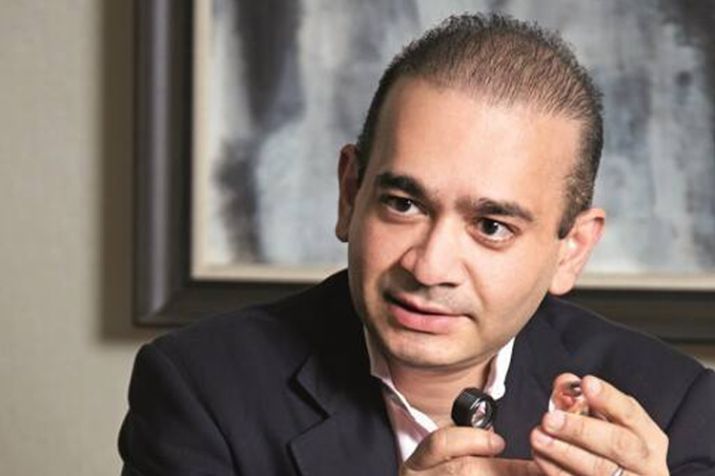
Trouble mounts for Nirav Modi as ED raids 35 additional locations, total seizure stands at Rs. 5,649 crores

0

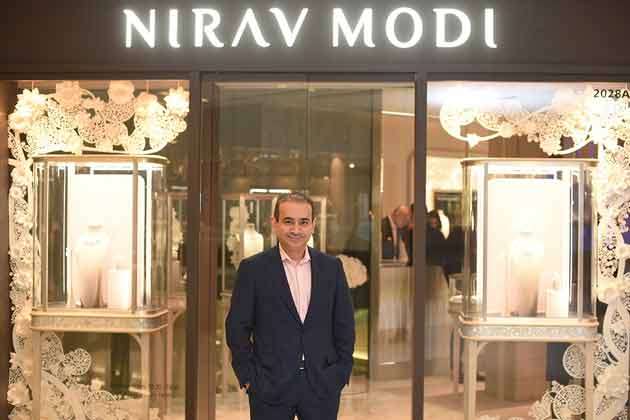
The nation was rocked on yesterday as the Punjab National Bank – Nirav Modi financial fraud case surfaced. Earlier today, we had also reported how stunning revelations had been made about how the Finance Secretary under the Congress Government had coerced a whistleblower into silence when he tried to warn about 1,500 crore loan that was being extended to Nirav Modi.

While the political blame game was on, the ED jumped into action and conducted raids on multiple properties connected to Nirav Modi. In raids that continued late into the night, the ED seized Rs. 5,100 crores worth of Gold, precious gems and Jewellery.

Today it was also revealed that summons had been issued to Nirav Modi and Mehul Choksi, in addition to their passports being revoked by the MEA.

The troubles have only mounted for Nirav Modi with ED raiding additional 35 properties related to Nirav Choksi.


The Enforcement Directorate tweeted about additional raids being conducted and that diamonds, gold and jewellery worth Rs. 549 crores (book value) have been seized.

In these two days, ED has seized material worth a total of Rs. 5649 crores.

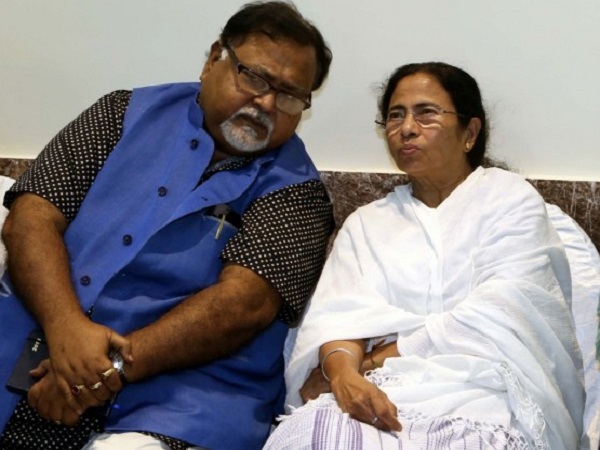
Saffron painted Bengal school in trouble for not switching to Mamata’s favourite colours

0

A school in West Bengal’s South 24 Parganas district has courted trouble after it has refused to obey the notice of Bengal’s Education Ministry to get itself repainted with Chief Minister Mamata Banerjee’s favourite colours. The present colour of the school’s exterior paint is saffron.

Under the notice issued by the Partha Chatterjee led Education Ministry, about 59,000 state-aided primary and 18,000 secondary, higher secondary schools would be painted with Blue and White coats of paint. To further egg the schools to switch to the common colour code, Partha Chatterjee has sanctioned Rs 500 crores to get the repainting done. The schools as a result were asked to get repainted in between 23rd February and 5th March.

Incidentally for some reason CM Mamata considers Blue and White as her favourite colours, with it being revealed when she inaugurated a riverfront painted with these colours in 2014. Since then, in order to possibly please her, other TMC functionaries decided to try and convert the state into these colours.

This includes Kolkata Mayor Sovan Chattopadhyay announcing a one year waiver on property tax if houses are painted using those hues, which has now been taken to the next level by the Education Minister.

Now as reported, the Principal of Krishnachandrapur High School present in South 24 Parganas district’s Mathurapur block has decided to protest against this diktat by writing a letter to the state’s education secretary.

As per the Principal Chandan Kumar Maity, saffron has been a colour of their school since its establishment in 1948 by the Ramakrishna Mission. The school continued to be run by the mission until it was brought under the state government’s ambit by the Left in 1977.

The headmaster though says that the school continues to have close ties with the Ramkrishna Mission and follows its traditional saffron colours. As per him, they won’t accept the imposition of Mamata’s colours, which he claims are in a bad taste and eradicate diversity.

As per a Swarajya report, Partha Chatterjee is now furious with this school, and has told the school education ministry officials that there shouldn’t be any room for dissent over this matter. He further has asked that the school be sent a letter asking that it implement the original order.

The report also hints at a possible arm twisting technique being employed in this matter, with Partha Chatterjee supposedly asking local TMC leaders to get in touch with school’s management committee, to ask them to “persuade” the Principal to fall in line.

If the defiance continues the Partha Chatterjee has allegedly asked that disciplinary action which includes possible removal, be taken against the Principal.

The Swarajya report claims that the Principal on the other hand is hoping that the Ramkrishna Mission which is respected by even Mamata Banerjee, wields its influence to get a positive resolution regarding this matter.

Incidentally, such an issue over a coat of paint was also recently noticed in Uttar Pradesh, where the walls of state Haj office received an overnight coat saffron, which was then subsequently repainted. As a result of this, the Yogi government removed the incumbent Haj Committee secretary, following a notice over how were the walls painted saffron and why were they repainted.

Uttar Pradesh Budget 2018: Focus on infrastructure, agriculture and jobs

0

Ahead of the Lok Sabha elections next year, the budget for the state of Uttar Pradesh was announced in the Assembly. As expected, the budget focuses, especially on infrastructure, welfare and job creation schemes. The budget for last year was Rs 3,84 lakh crore. However, this time, it was of 4.28 lakh crore which is the largest by any state government thus far.

Rs. 250 crore has been allotted to the Chief Minister’s One District One Product scheme. Another 100 crores have been allotted for CM Youth self-employment scheme. Such measures are expected to create much-needed jobs for the youth. Also, 150 crores have been set aside to provide power loom weavers electricity at concessional rates. In a first, 250 crores have been set aside to boost start-ups in the state.


Rs. 1000 crore has been allotted for the construction of the Poorvanchal expressway and another 500 crores have been allotted to the Lucknow-Agra expressway. Rs. 2873 crore has been earmarked for the PM Gram Sadak Yojana. Another 250 crores have been set aside for regional rapid transport. Rs. 1650 crore has been allotted for smart cities. Rs. 11000 crores have been earmarked for roads and 650 crores will be spent on state highways.

Rs. 2757 crore has been given for minority welfare and Rs. 404 crore will be spent on the modernization of Madrasas. Rs. 3780 crore has been allotted for the welfare and development of women and children. Rs. 7658 crore has been allotted to social welfare schemes and Rs. 1705 crore for the welfare of backward communities. Ahilyabaoi free education scheme to get 21 crore rupees and 18,167 crores will be spent on Sarva Siksha Abhiyan. The Mukhyamantri Awas Yojana has received 200 crores. Consistent Prime Minister Narendra Modi’s vision, the budget will look to provide 1.5 crore new electricity connections. The budget has also allocated 11,500 crores to Pradhan Mantri Awas Yojana (Rural) and 1040 crores have been allotted to National Rural Livelihood Mission.

Additionally, 1500 crores have been awarded to Kumbh Mela. 70 crores will be spent on the development of the Ramayan, Bodh and Sufi circuits. Over 7000 crores have been sought from the central government for the river Ganga.

Agricultural reforms have also gotten priority in this budget and special provision have been made for the dairy industry. Allocations have also been made to provide farmers with fertilizers for their land. The CM fruit horticulture scheme has been launched and around 5500 centres are expected to be opened where farmers can sell their wheat in addition to 20 new agricultural centres.

Along with expected lines, Samajwadi Party expressed disappointment with the budget. Party spokesperson, Rajendra Chowdhary, said, “The Budget is incomplete and once again there is nothing much for the farmers. The Yogi government has not done anything concrete to generate employment opportunities for the youth. The government is just playing with the figures.”

MLA of the Congress party, Ajay Singh Lallu, stated, “The public was hoping that some new schemes will be launched to benefit the youth and farmers but there’s nothing in it for them. Also, potato and sugarcane farmers have been ignored in this Budget and no special package was announced. The promise of generating 14 lakh jobs every year also does not look to be fulfilled by this Budget.”

In the world’s largest recruitment drive, Indian Railways to offer 90,000 jobs

0

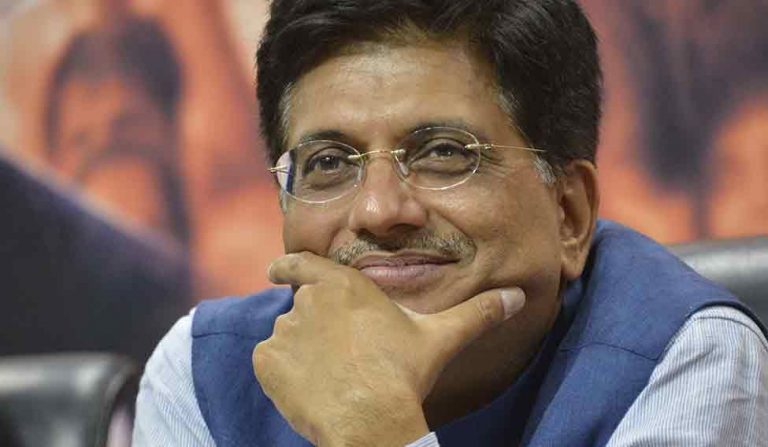
Indian Railways has announced that it will be seeking applications to fill 89,409 posts for lower lever staffers including Loco Pilots and Technicians. In what is being hailed as one of the world’s largest recruitment processes, the Indian Railways will hire Group C level I and level II employees.

Railways Minister Piyush Goyal has shared a tweet regarding this news:


Online applications are being sought for the computer-based test which is likely to be held in April/May 2018. The recruitment drive is aimed at hiring basic level staffers and technicians for the capacity improvement and performance of Indian Railways. Group C level 1 (earlier known as Group D) jobs include that of Track Maintainer, Pointsman, helper, Gateman etc while Group C level II jobs include technical jobs like Assistant Loco Pilots and technicians including blacksmiths and carpenters.

The recruitment process will be entirely online as there will be no interviews for Group C level jobs. the basic qualification required for class  10th pass and certificate of Industrial Training Institute (ITI). According to reports 26,502 people will be hired for Group C level II jobs while 62, 907 staffers will be hired for Group C level I jobs.

It is notable here that capacity improvement was the key focus of Railway Budget this year and the highest ever capital expenditure of 1,48,528 crores was announced by Finance Minister Arun Jaitley in the Union Budget.

Revitalising the agricultural sector under Modi government

0

A Single Death is a Tragedy; A Million Deaths is a Statistic! – Joseph Stalin

The agricultural sector which once contributed a huge 51.9% of the GDP in the 1950’s shrank to a measly 13% of GDP in 2016. With almost 86% of farmers subsisting on fragmented land, agriculture has traditionally been one of the largest employers and one of the most neglected sectors in independent India. Decades merged into each other leaving the Indian farmer to the vagaries of the rain Gods, year after year!

Many schemes stillborn or otherwise were launched for “farmer welfare” under successive Congress regimes. The implementation of these schemes, in most cases, was whimsical, leaving much to be desired.

In fact, tales of farmer suicides every year due to crop loss, droughts, floods became quite banal, providing fodder for movies such as Peepli Live which did much to fatten the pockets of its producers, but very little to alleviate the condition of the affected farming class!

Even though agrarian distress and farmer suicides is a global phenomenon, with over 2.5 lakh farmer suicide cases registered since 1995, it is quite an acute one for India. Just to give a perspective I have included a list of deaths across the last 16 years:

Grim Statistics: Farmer Suicides in the last 16 years
2000 2001 2002 2003 2004 2005 2006 2007 2008 2009 2010 2011 2012 2013 2014 2015 2016
16605 16415 17971 17164 18241 17131 17060 16632 16196 17368 15964 14027 13754 11772 12360 12602 11458

(Data sourced from (1) (2) (3) )

A detailed analysis of farmer suicides, reveals that the causes are many, varied and opaque. For instance, almost 40% or higher of such suicide deaths can be attributed to Bankruptcy, Indebtedness, Farm-related issues and poverty combined.

Yet if one were to analyse indebtedness as a cause, one comes to realize that over 40% of farm credit comes from informal sources. Thus making the problem of farmer bankruptcy, indebtedness sticky, despite the extended farm loan waiver schemes across states. It needs a systematic, consistent and sincerely executed policy initiative over many years, to be completely addressed.

Another long-term consequence of agricultural distress is large-scale population displacement. Decades of decay in the sector has led to large-scale migration. Generations of farming community sold their landed estate and shifted to cities lock, stock and barrel, with starry-eyed dreams of better living conditions and more money. The cities themselves were stretched, overpopulated with groaning infrastructure and festering slums, as more and more people gave up farming for a promised better income through “other means”. The “other means” never fully materialised, and overtime, the families displaced from farming, grew comfortable living in slums in large cities. Crime, mafia and seedy politicians grew in stature, promising land rights, employment opportunities among other things to these slum dwellers, exploiting their insecurities in myriad ways.

This government through its successive budgets is now trying to put agriculture back in focus and stem the tide of agri-distress and its dismal consequences.

Given that the dust has settled after Budget 2018, we did a sifting of the various speeches, schemes launched pre and post budgets. What impressed most was the attention to details. Through various speeches, throughout the last 4 years, both Mr Jaitley and Mr Modi have reiterated their focus on agriculture. In fact, budget 2018 was a shot in the arm for Agriculture, Healthcare, Infrastructure and Education sectors. A slew of technology-enabled schemes has been launched by the current government during its tenure, including this Budget. Some of the most prominent ones are as follows:

1. The Pradhan Mantri Fasal Beema Yojana: Launched in 2016, it provides crop insurance to all farmers for crop loss. Though crop insurance is hardly a new idea, this program is an earnest attempt at plugging the loopholes of all previous schemes. Since crop loss can often lead to more catastrophic eventualities, it makes a lot of sense to provide a comprehensive crop insurance to all farmers.

2. The e-NAM (National Agricultural Market) Portal: Launched in April 2016, the e-NAM portal has linked 470 mandis in 14 states and provided over 70 lakh farmers with an opportunity to check real-time prices of crops online and sell directly or via an intermediary. There is also a possibility of future and options trading being taken to the farmers directly, via the e-NAM portal and app. This will allow the farmer to protect his crops from sale price volatility in the future.

3. Promoting Energy Efficient Irrigation: The directive was issued in September 2014. Under it the government and specifically the power ministry have allocated Rs 75,000/- crores for the purpose of providing energy efficient pumps to farmers.

4. Paramparagat Krishi Vikas Yojna: Launched in 2015, this scheme encourages farmers to form groups, clusters and undertake organic farming on large tracts of land.

5. Setting a minimum MSP: The vagaries of demand and supply lead to price fluctuations across commodities which in turn affects the sowing of the crop and leads to further fluctuations. Keeping this in mind the FM, during Budget 2018 announced the minimum MSP ceiling at 1.5 times cost of production of Kharif crops.

6. Increase in agriculture credit limit: A much-needed hike announced during the Budget 2018 speech by our FM. This hike from 8.5 lakh crores to 11 lakh crores of Agricultural Credit Limit, is an acknowledgement of increased debt related distress in the farming sector.

7.Blue Revolution: Launched for providing an emphasis to promote aquaculture and fishery development across the country, it was allocated a budget of around 3000 crores, under this government. The whole idea is that coupling farming with aquaculture can lead to higher farm yields.

8. Additional Irrigation outlay: During Budget 2018 an additional irrigation outlay of Rs 2600 crores was announced under the Pradhan Mantri Krishi Sinchayi Yojana, with an intention to meet the irrigation requirements of the 96 most distressed districts in the country.

9. The outlay for Bamboo cultivation: To encourage farmers to grow Bamboo in peripheral areas and increase their overall farm yield through Bamboo production and export, an outlay of Rs.1290 crore was announced in the Budget 2018.

10. Emphasis on value addition: With an estimated future FDI investment of $33 Billion, the food processing industry has the potential to transform farm income. Therefore the government is looking at food processing as a great enabler that can add value to farm produce and provide a much higher earning per farm.

11. Launch, more widespread use of programs such as Soil Health Card to provide inputs on soil quality to farmers and Neem coating of Urea to prevent fertilizer pilferage, are also some other ways to reduce farm distress.

All the above schemes can now be coupled with pioneer government programs such as Jan Dhan Accounts and Aadhar linkages to ensure that the benefits reach the last mile consumer.

Through many such measures across budgets, the government is systematically trying to revive the prospects of agriculture. Since agriculture is one of the largest employers, it follows, therefore, that this will lead to higher employment opportunities and reverse migration from cities to villages. A robust agriculture sector will only add to the overall growth and strength of the economy in the long run.

Although the issue is long-standing and sticky, one hopes that this government will continue its focus on this sector post their re-election too. By strengthening the sector over time, this government is yet again trying to deliver on its slogan of Sab Ka Saath, Sab ka Vikas. For that to happen smoothly, the state governments and the central government need to work and deliver in tandem! Needless to say that India will only truly become a superpower when all farmers, even those sitting in some remote corners of the country, are able to enjoy the fruits of such development.


Rahul Gandhi doesn’t need to defend himself, loyal journalists would do that for him

0

Shehzad Poonawallah, the ousted Congress member has been accusing Rahul Gandhi of meeting Nirav Modi after the PNB bank fraud came to light. Though BJP or any party has not politicised it so far, he has questioned the Congress president regarding the matter.


However, Rahul Gandhi doesn’t even have to lift a finger to defend himself. There are many in the media who are willing to do that on the Congress president’s behalf.

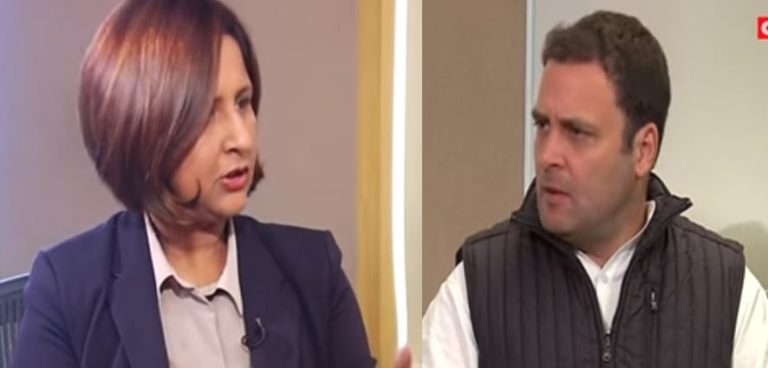
Pallavi Ghosh, a journalist from Network18, asked fellow journalists to “ignore” Shehzad:


Pallavi Ghosh’s defence of Congress party president was criticised by Twitter users. The journalist was asked if she was a spokesperson of the Congress party and wondered where this loyalty comes from.


Former Congress member Shehzad Poonawallah likened the journalist to a Kaurava dynasty’s generals. He had also commented that he was boycotted by the media houses that had good contact with the dynasty in an interview to OpIndia.


These instances raise serious doubts not only on the independence of the Media but also on the fact that the ones who bat for political leaders, especially the Congress Shehzada the most, are also the loudest when it comes to propagating principles of “speaking the truth to power”. It is no secret that Pallavi Ghosh is close to the dynasty, but to display such bias in the event of serious questions of political propriety is unbecoming, even for her.

Perhaps for Pallavi Ghosh, real journalism means asking Rahul Gandhi about Pidi.

Stunning Revelation: Finance Secretary Rajiv Takru under Congress government silenced PNB whistleblower in 2013

0

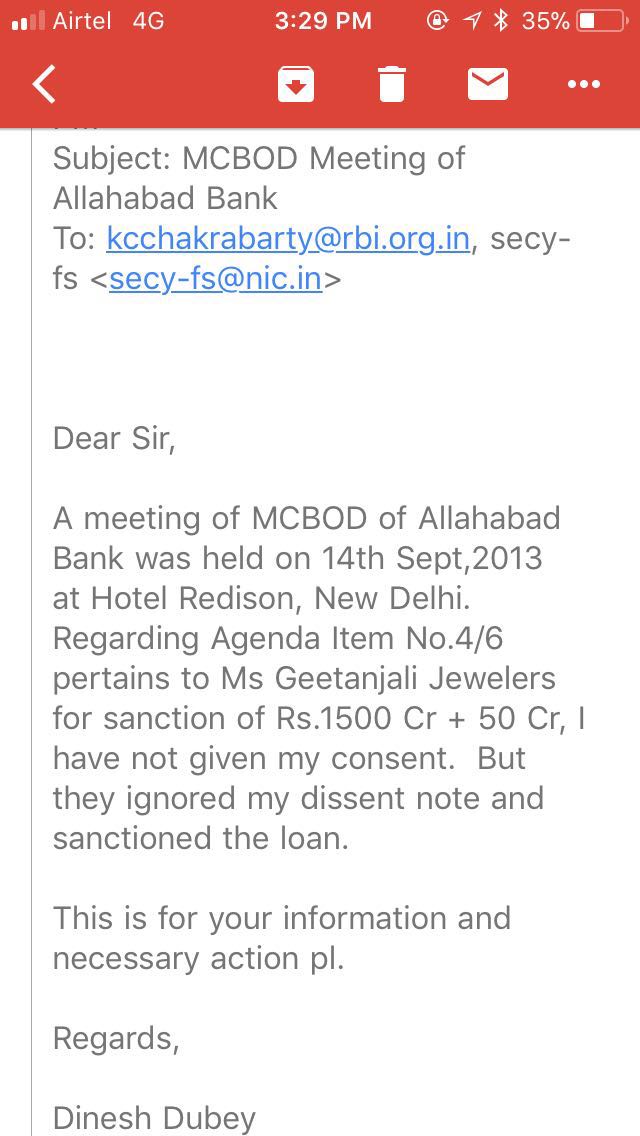
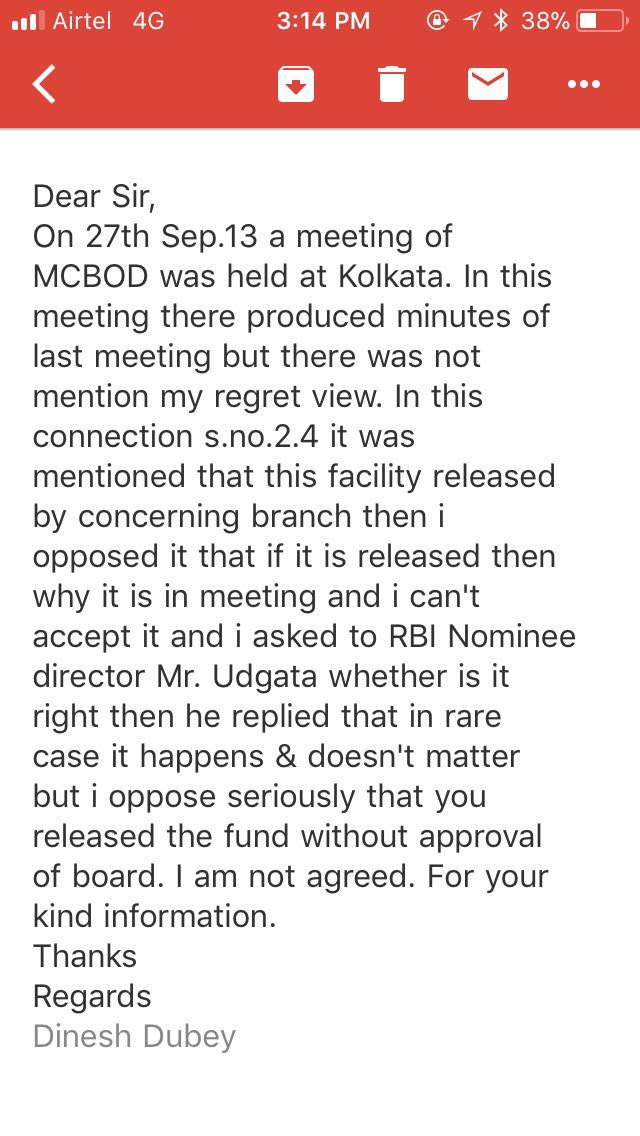
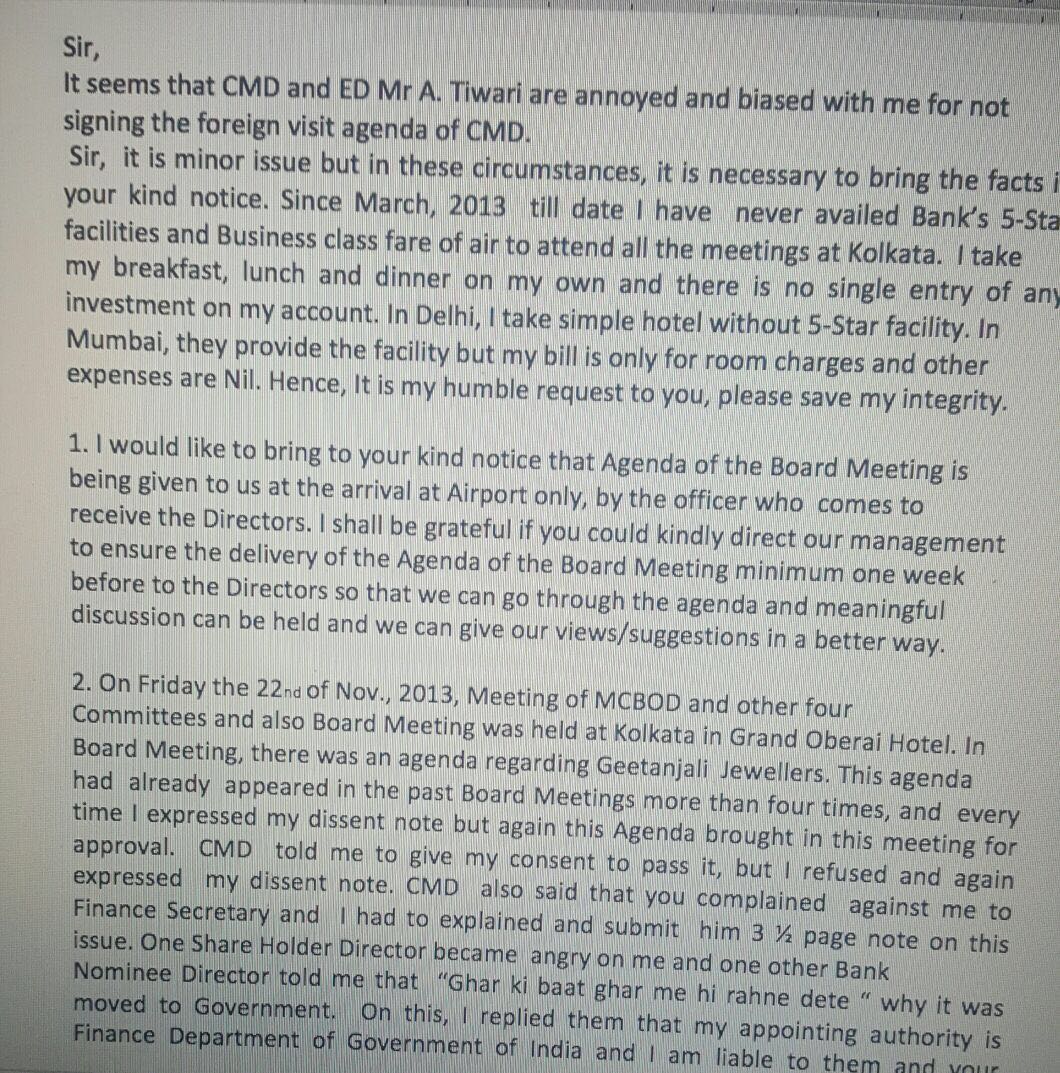
Documents accessed by OpIndia reveal that former Director of Allahabad Bank, Dinesh Dubey had informed then Deputy Governor of RBI, K.C. Chakrabarty of the scam in 2013. The emails reveal that a loan of Rs. 1500 crore was sanctioned to Gitanjali jewellers despite Dinesh Dubey’s dissent note.

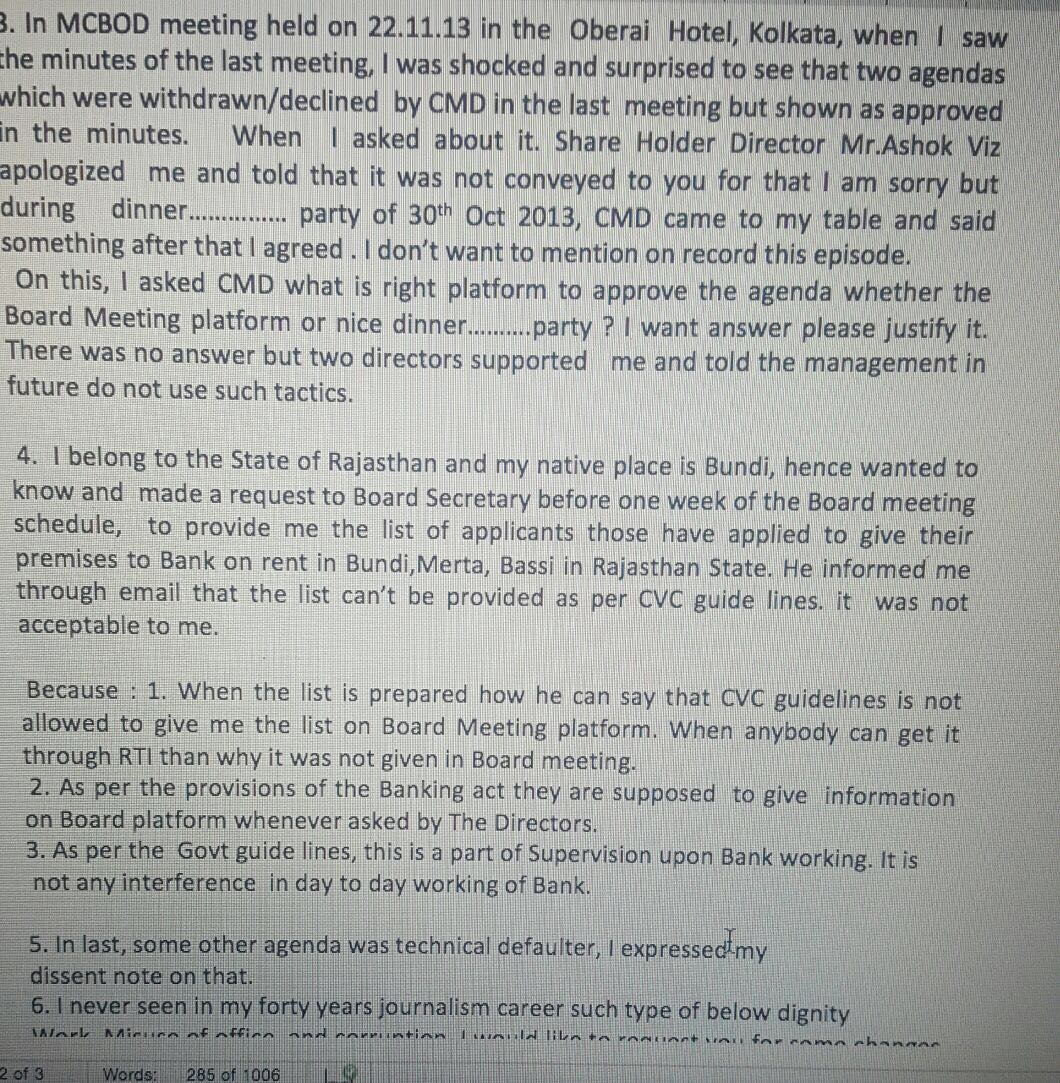
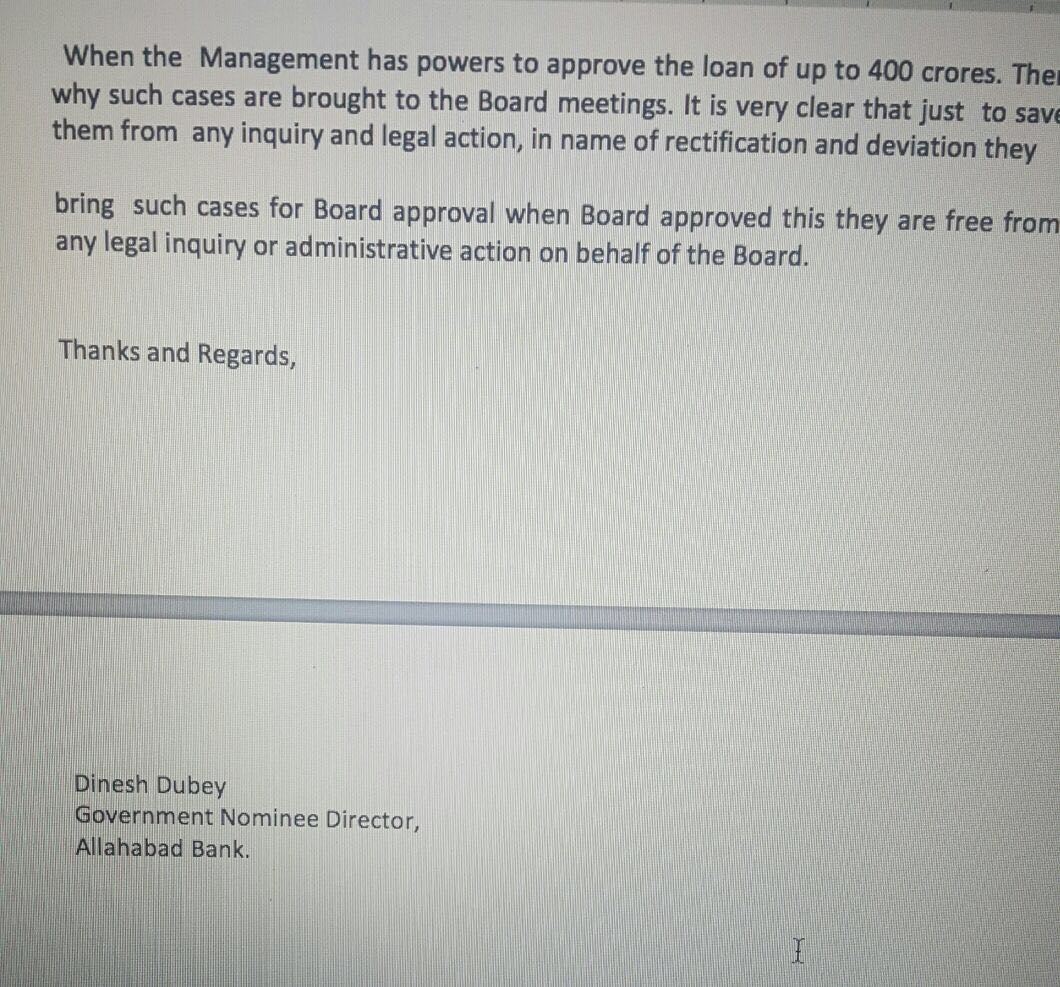
The emails also reveal despite several dissent notes from Dinesh Dubey, the issue of loans to Gitanjali jewellers was again and again brought before the Board for approval. And was harassed for informing then Finance secretary of the Congress government and was told by one other Bank nominee director “Ghar ka baat ghar me hi rehne dete”. He also remarks that the management brings certain cases for board approvals to escape administrative action and legal inquiry.

As the emails reveal, had senior officials heeded his warnings, the scam wouldn’t have snowballed into such a massive fraud. Mr Dubey has further alleged that he was threatened as a consequence of his dissent and was made to resign after only 11 months. He has also alleged that then Finance secretary, Rajiv Takru, created pressure on him for his dissent notes despite his repeated insistence on the potential scam that was unfolding.


The Congress Party, which was under the impression that it had been handed a golden opportunity to corner the NDA, will now have to explain why did senior officials under the UPA government not only ignore the warnings of Mr. Dubey but also silenced him by forcing him to resign from his post well before his tenure of 3 years was to be completed. Recently, Narendra Modi in the Lok Sabha remarked that the whole NPA mess was the UPA’s making. The PNB fraud might well prove to be further evidence of that.

Has Social Media become a ‘Heads you win Tails I lose’ situation for the Congress party?

0

In the run-up to the 2014 Lok Sabha polls, the BJP including its Prime Minister candidate Narendra Modi had upped its social media game which included a 14.86 percent increase in Modi’s Facebook fan base in little over a month. Besides this, the Modi related engagements also hit a record of over 15 lakh during the period of 19th April to 18th May 2014, when the election process was in full swing.

In a sharp contrast, the Congress’ social media strategy lacked vigour, which was signified by the absence of Rahul Gandhi, who didn’t even have a twitter account before 2015. The subsequent launch of Rahul on twitter too came with a caveat of it being a press release module from Rahul Gandhi’s office, and not really a personal account. Back in 2013 the Congress had realised that it was failing in the social media game but could do precious little, to stop the ship from sinking.

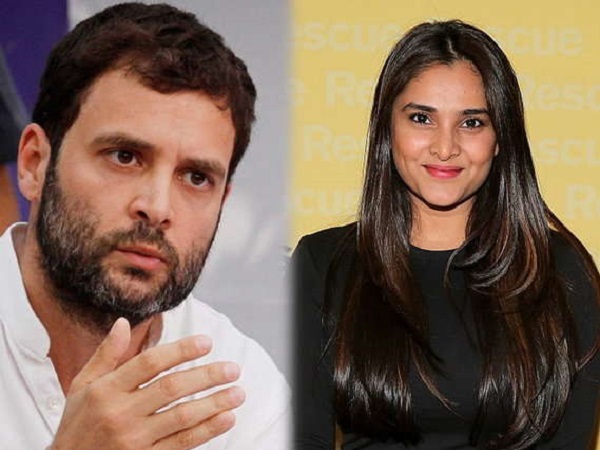
Come 2017 the party though finally looked like rectifying its mistakes with the appointment of actress Divya Spandana as its social media head in May of that year. She was hailed as a harbinger for the Congress party’s social fortunes and soon started getting praised for carrying out a so-called “resurgence” of the party.

Behind all the media paparazzi though, things weren’t straightforward. The Congress was being repeatedly trolled for silly gaffes like bringing back Indira Gandhi from the dead to give her credit for a bridge inauguration and killing Raja Ram Mohan Roy before he was born. Also, the social media outreach which also involves setting up a data analytics department has been criticised by the BJP which claims it to be a mirror image of its own strategy.

Things though weren’t limited to gaffes and both Divya Spandana and Rahul Gandhi were caught spreading outright lies oTwitterer. Besides this, Spandana was accused of asking her party workers to create multiple accounts and Rahul was accused of taking the help of bots to get retweets.

Ever since the new social media strategy for the Congress party was launched, it has also shown an amusing level of ‘obsession’ with setting up twitter polls, which has quite a lot of times been a bad experience for the party. Like the polls styled under the #KnowYourLegacy campaign, which were supposed to glorify the Gandhi family ending up trolling them, when people ensured that the silliest option won. Some of the examples being, people voting for a donkey when asked about the animal which Nehru rode to reach Bhutan.

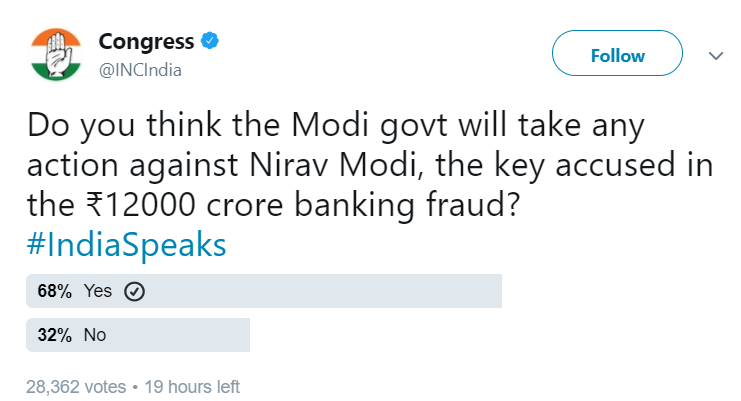
Even though the Congress was supposed to have become smart about social media, it failed to show enough dynamism to learn from its mistakes and again put up a poll today asking whether PM Modi would take action against Nirav Modi for defrauding Punjab National Bank. Whenever a political party puts up such polls, it is generally assumed that it is looking for a favourable result to attack its opponent, and in this case, the plan backfired with the voters showing confidence in PM Modi:

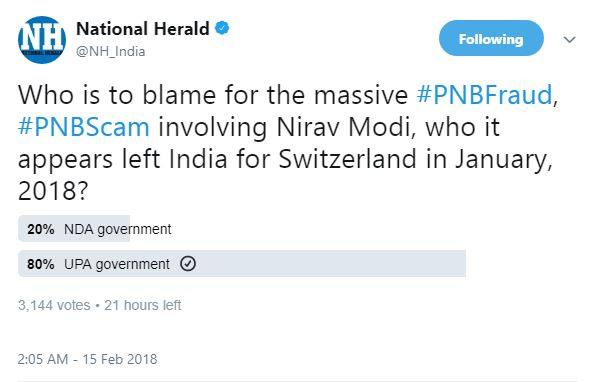
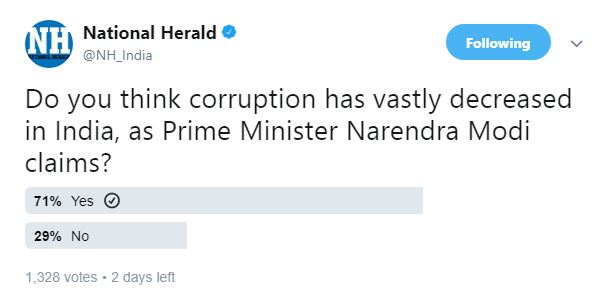
Just a day earlier, National Herald, the mouthpiece of the Congress party too tweeted polls which backfired: It though decided to brazen out things, by blocking influential Right Wing twitter users for preventing them from bringing the poll to their followers’ attention, but all in vain.

Based on the above facts, the Congress party in the past few years has had its before and after social media moments and both arguably have resulted in possibly monumental pitfalls. It has been well established that the lack of engagement prior to the Lok Sabha elections, resulted in a big negative for the party. After the party has indeed started to get in the game, it has allegedly tried to rig it to its advantage by spreading lies and misinformation in order to generate popular attention. When it tried to make things interesting via some polls, it ended up getting lampooned on.

Legacy wise comparing these two “eras” of the party, some might claim that the Congress party has been in a lose-lose situation in both ends: In the first case by being largely invisible to the public and in the second by making some people hope it wasn’t visible.

Summons issued to Nirav Modi and Mehul Choksi, passports revoked

0

The Enforcement Directorate has issued a summons for appearance to Nirav Modi and his business partner, Mehul Choksi, for their involvement in the Rs. 11,400 crore PNB fraud. The summons was issued under the Prevention of Money Laundering Act (PMLA) and the said persons have been asked to depose within a week’s time.

Meanwhile, the ED has raided several offices and showrooms of Nirav Modi and Choksi and recovered Rs. 5100 crore in gems, jewellery and gold. The case was registered against them after the Punjab National Bank had registered complaints with Law Enforcement authorities alleging fraud.

On January the 31st, CBI had booked Nirav Modi and others in a separate case of cheating worth Rs. 280 crore after a complaint by PNB. It is being probed whether the proceeds of the crime were converted into black money and used to create illegal assets. Mehul Choksi has been involved in shady dealings in the past. After an investigation by SEBI, Mehul Choksi and a set of firms were suspected of market manipulation and subsequently barred from trading for a period of six months.

Acting on the advice of the ED, the Ministry of External Affairs has suspended the passports of Nirav Modi and Mehul Choksi for four weeks with immediate effect. They have been asked to submit their replies within a week as to why their passports should not be revoked or impounded. The MEA shall go ahead with the revocation if the replies are not submitted within the stipulated time.