Home Blog Page 7421

Did you know about Nehru’s tribal ‘wife’?

0

On 6th December 1959, Nehru had visited a West Bengal village to inaugurate a dam. The Damodar Valley Corporation had chosen a 15 year old tribal girl called Budhni Manjhiyan for Nehru’s welcome. While Budhni was extremely happy, little did she know, that her life was about to take an extremely troublesome turn.

During the inauguration, since this was the first dam being inaugurated by a tribal woman, Jawaharlal Nehru gave Budhni a garland as a mark of appreciation. He had wanted the dam to be inaugurated by someone who had worked on the construction of it.

That night, the Panchayat of the Santhali society was called to discuss these ‘developments’. Budhni, to her horror, was informed that according to Tribal traditions she was now married to Jawaharlal Nehru, since garlands were exchanged. Also according to Tribal traditions, since Nehru, now declared her husband, was a non-tribal, she was boycotted by the Santhali community.

At that point of time, Budhni continued to work at the Damodar Valley Corporation but that didn’t last. She was soon, in 1962, thrown out of her job and found herself helpless.

She later moved to Jharkhand and struggled to make ends meet there for 7 years.

She even met a man, Sudhir Datta, whom she got close to. They wanted to marry but couldn’t because they feared the repercussions they might have to face in their society. However, they continued to live together and have three children together.

It is reported that in 1985, when Rajiv Gandhi came to know about Budhni, he tracked her down and Budhni even went to meet him. As a result of which, she got her job back with the Damodar Valley Corporation.

When asked in 2016 what her wishes were now, she said, “I appeal to Rahul Gandhi to get us a house and a job for my daughter, so we can spend the rest of our lives in peace.”

The person who inaugurated the dam along with Budhni, Ravod Manjhi had once spoken to BBC and said, “Jawaharlal Nehru had promised us free electricity and houses, but nothing happened”. When asked about Budhni, he said he didn’t want to recall the ordeal.

Sagarika Ghose blames former Prime Minister Shastri’s death for ‘dynasty politics’

0

In the temple of dynasty politics, Jawaharlal Nehru is the god, even for Sagarika Ghose, a ‘journalist’ who herself is a product of dynasty politics.

Today, on Jawaharlal Nehru’s birthday, Ghose was fangirling on Nehru, his good looks and his Prince Charming-eque demeanour alone led India to modern India.


She even went to say that if you abuse Nehru, you abuse yourself. (remember, India is Indira, Indira is India rhetoric?)


Everyone has their god. The unbiased, fourth estate bows their heads to the Church of Nehru.


So what if he did not focus on bringing India back on her feet after centuries of plundering by Mughals and the British. At least he could do shirshasana (headstand pose) like no other!

Nehru doing shirshasana

After all, If you look closely, and if you invert the picture, you could see that Nehru held the entire world on his head.

When a Twitter user wondered about Ghose’s love for the dynasty politics, you know, just because someone belongs to the same gene pool doesn’t mean they’re fit to run a nation, Ghose was quick to point out that Nehru was always against the idea of dynasty politics. That’s why he ‘chose’ former Prime Minister Shastri as his successor.


Not Nehru’s fault that Shastriji died, under mysterious circumstances in Tashkent, and Indira had to become Prime Minister.

If Shastiji wouldn’t have died, we would’ve been spared of The Family.

Shame on you, Shastriji, for dying on us.

National Green Tribunal slams Delhi Government, rejects odd-even exemption plea

0

In a major embarrassment to Arvind Kejriwal led Delhi government, National Green Tribunal (NGT), a special tribunal to dispose of the cases pertaining to environmental issues, rejected the request of Delhi government for the exemptions sought for implementation of Odd-Even rule in the national capital.


Slamming Delhi government, NGT asked Delhi government whether it considers the toxic air quality in Delhi a joke. On Monday, the Aam Aadmi Party government had asked the court to amend its 11th November order that refused to exempt cars driven by women and two-wheelers when the odd-even scheme is put in place. On Tuesday, the government withdrew the petition for modification and the tribunal asked the government to provide logical explanations for its request the next time.


The Arvind Kejriwal led government had come under fire on Monday as well, with the NGT asking if the measures taken by the government was “just a stunt.” Rebuking the Delhi government, NGT asked it to declare a health emergency and apply necessary measures without delay after dangerous levels of particulate matter PM 2.5 and PM 10 persist for over 48 hours.

Meanwhile, Delhi Chief Minister continues his drama on Twitter by retweeting passive aggressive tweets blaming the governments of neighbouring states, Haryana and Punjab, for the air pollution over Delhi. Perhaps it is about time Kejriwal keeps his victim card aside and takes some concrete steps in curbing the air pollution instead of spending his time tweeting and retweeting anti-Modi tweets.

Nehru’s legacy – The Somnath Temple treachery

“Mr. Jawaharlal Nehru returned from Cambridge with notions of how an all-governing interventionist state can force people into happiness and prosperity through socialism…He sticks to this bias in spite of the demonstration of world experience against it…I hate the present folly and arrogance as much as I hated the foreign arrogance of those (British) days.”

-Rajaji

As is the basic tenet of democracy, perhaps the greatest sin against the citizenry is controverting their right to know. Especially about men who have led their country. Men, who they have been told, the citizenry owe a debt of gratitude to. Much like Jawaharlal Nehru. India’s first Prime Minister who is often tom-tom as the maker of modern India. As the architect of our little world, as we know it.

History, it is said, is written by the victor. What is to be inferred, is that history is written by the loyalists of the victor. By court jesters and poets who write ballads in praise of the emperor. Unfortunately, our politicians and their voguish history is no better.

We are told ‘Chacha Nehru’ was a decent man. A just man. An honest man. An honourable man. A nationalist. A visionary. And perhaps he was. But the measure of politicians and leaders past, lies in his failure. Failures so carefully immersed in hollow flattery, that they have been lost in the pages of obscure books. What needs to be weighed is whether the leaders decency, justice, truth, honour and vision was what his country needed. Was what his country deserved, or even, what his country is told they got.

It is time perhaps, for the sake a divine future, to evaluate the past with integrity, sans the sycophantic lens donned by our intelligentsia. And it for that purpose, I intent to write this series detailing the Himalayan blunders of an honourable man, and to start with, I intend to focus on some of the blunders which have faded from the public memory.

After the Nawab of Junagarh had fled to Pakistan on 26th October 1947, the Indian army moved into Junagarh on 9th November 1947. How the accession happened, Nehru and Patel’s role in the process, is the subject of a different article. But after the famed uprising, Sardar Patel arrived in Junagarh on 13th November 1947 to a massive reception from the people of the state and had vowed to rebuilt the dilapidated Somnath Temple that was attacked 17 times in its existence, most brutally by Islamic invaders.

When Sardar Patel returned to Delhi, the decision to rebuild the Somnath temple was passed in a cabinet meeting and decision was made for the state to dole the expenses. A decision later overturned due to MK Gandhi’s insistence, that the people be asked to pay for it.

Gandhi was assassinated in 1948 and Sardar Patel’s soul departed in 1950. After the demise of Sardar Patel, the task of Somnath Temple’s restoration was to be undertaken by then cabinet minister, KM Munshi, who was the Chairman of the Advisory Committee of the Trust formed for this purpose.

Jawaharlal Nehru has been famed to tell KM Munshi, in 1951, “I don’t like your trying to restore Somnath. It is Hindu Revivalism.”

Mr. LK Advani, BJP patriarch, detailed KM Munshi’s letter to Jawaharlal Nehru in this regard :

“Yesterday you referred to Hindu revivalism. You pointedly referred to me in the Cabinet as connected with Somnath. I am glad you did so; for I do not want to keep back any part of my views or activities….I can assure you that the ‘Collective Subconscious’ of India today is happier with the scheme of reconstruction of Somnath sponsored by the Government of India than with many other things that we have done and are doing.

The intention to throw open the temple to harijans has evoked some criticism from the orthodox section of the Hindu community. However, the objects of the Trust Deed make it clear that the temple is not only to be open to all classes of the Hindu community, but, according to the tradition of the old temple of Somnath, also to non-Hindu visitors. Many have been the customs which I have defied in personal life from boyhood. I have laboured in my humble way through literary and social work to share or reintegrate some aspects of Hinduism, in the conviction that that alone will make India an advanced and vigorous nation under modern conditions.

It is my faith in our past which has given me the strength to work in the present and to look forward to our future. I cannot value India’s freedom if it deprives us of the Bhagavad Gita or uproots our millions from the faith with which they look upon our temples and thereby destroys the texture of our lives.  I have been given the privilege of seeing my incessant dream of Somnath reconstruction come true. That makes me feel – makes me almost sure – that this shrine once restored to a place of importance in our life will give to our people a purer conception of religion and a more vivid consciousness of our strength, so vital in these days of freedom and its trials.”

VP Menon, the civil servant who had helped Sardar Patel in the task of integration of princely states wrote a communique to KM Munshi. He said :

“I have seen your masterpiece. I got one would be prepared to live and, if necessary, die by the views you have expressed in your letter.”

Upon the restoration of the Somnath Temple in 1951, at the time to ceremonially install the Jyotirlingam, KM Munshi invited Dr. Rajendra Prasad to inaugurate the temple and install the Jyotirlingam ceremonially. That Jawaharlal Nehru was vehemently against Dr. Prasad attending the ceremony has been detailed by many.

Former Indian bureaucrat, Madhav Godbole writes in his book, “The God who failed : An assessment of Jawaharlal Nehru’s leadership :

The reference cited by Mr. Godbole is that of MJ Akbar’s “Nehru the making of India”, page 462.

The reference of Nehru’s disdain for the reconstruction of the Somnath Temple also comes up in RNP Singh’s book – “Nehru, a troubled legacy,” on page 53.

In another book by Rajnikant Puranik, there is a detail of the letter Nehru wrote to Dr. Prasad detailing why he was opposed to him attending the inauguration of the Somnath Temple.

Nehru wrote :

“I confess that I do not like the idea of your associating yourself with a spectacular opening of the Somnath Temple. This is not merely visiting a temple, which can certainly be done by you or anyone else but rather participating in a significant function which unfortunately has a number of implications..”

While Dr. Prasad still attended the inauguration because for him, the state should be neither religious or irreligious, his grand speech at the ceremony was blanked out by official channels on Nehru’s insistence. Such was Nehru’s inexplicable hatred.

I say inexplicable hatred, because ‘secularism’ didn’t explain his behaviour. Secularism would typically mean separation of religion and state. Or as Dr. Prasad had put it then, the state not being religious or irreligious. While Nehru was opposed to the reconstruction of the Somnath Temple to preserve the ‘secular fabric’ of the country, it was him, Pandit Jawaharlal Nehru, who continued the Port Hajj Committee Act of 1932, enacted by the British and expanded it to the Hajj Committee Act of 1959. It is also inexplicable that while Nehru was against the restoration of the Somnath Temple which was being done from public money, he had no qualms when the Government paid for the subsequent restoration of Sanchi and Sarnath, the Buddhist places of worship.

This baffling dichotomy can’t be seen in isolation. In Jawaharlal Nehru’s book, “Glimpses of World History”, written by him in 1934, there is an interesting passage that not only gives us a coup d’œil into his skewed thinking, but also his blatant disregard for history.

In Chapter 51 of his book, titled “From Harsha to Mahmud in North India”, Nehru writes :

Jawaharlal Nehru gives himself away. This blatant misrepresentation of history to glorify a brutal invader such as Mahmud Ghazni can be either written off to unscholarly pursuits, or his deep need to glorify the Muslims invaders so as to cater to a specific section of the Indian society.

To showcase his blatant distortion, I attach herewith pages from ‘Lives of Indian Images’ by Richard Davis, 1999 (Princeton University Press).

To start with, Ghazni refused to view the idol of Somnath as an economic commodity. He insisted that it was primarily a Hindu religious object and his first duty was to destroy it.

A couple of other snippets taken from the same book, pages 105-106, reveals the misrepresentations in Nehru’s book.

(Credit – TrueIndology)

The historian refers to how the Brahmins offered Ghazni vast wealth if he spared the idol, but Ghazni refused. Ghazni even broke the Somnath idol and took its pieces to be trod over the footsteps of Jama Masjid in Ghazna, Afghanistan. In such an event, it is unfathomable for Nehru to call Ghazni non religious and a brave soldier, no less. While the other historical facts mentioned by Nehru are also dubious, they make a discussion for another day.

His treachery as far as the Somnath temple is concerned and the psychology behind it can be understood from what he said in a completely different context. When the Hindu Code Bill was being discussed, Dr. Rajendra Prasad thought it was discriminatory to alter personal laws of Hindus and not Muslims. Dr. Prasad was in favour of the idea of ‘Indian Code’ that applied to all Indians.

While sponsoring the Hindu Code Bill, Nehru said :

“The Bill, which has given rise to so much argument which became the symbol of the conflicts between progress and reaction in social domain…the spirit of the Bill…was a spirit of liberation and freeing our people, more especially our women folk from the outworn customs and shackles which have bound them..”

However, in the same matter, Nehru also said :

“We have passed one of two laws recently and we are considering one… in regard to Hindu marriage and divorce..these are personal faith ingrained in custom, habit and religion..now we do not dare to touch the Muslims because they are a minority and we do not want the Hindu majority to do it. These are personal laws and so will remain for the Muslims until they want to change them…we do not wish to create the impression that we are forcing any particular thing in regard to Muslims”

(-Nehru, A Troubled Legacy, Page 52)

It is evident that Nehru was far from being a secularist. He treated the minority with kid gloves while the onus of secularism was enforced on the majority with impunity. Whether in his narration of history or in the laws he enacted, or even the right to worship. The legacy of appeasing the minority at the expense of the majority was indeed a creation of Jawaharlal Nehru.

It is indeed a tragedy of our modern times, that a leader who sought to oppress the majority in a bid to appease the minority is tom-tomed as the beacon of secularism. Of honour. Of justice and of morality. The Somnath Temple was and always will be a symbol of Hindu resilience. A symbol that the Hindu faith weathers through. That it will survive inspite of invaders and ‘secularists’.


Demonetization: Impact on Direct Tax data

0

A lot has been said in the media by many economists and bureaucrats in last few months regarding the adverse impact of Demonetization and Goods & Services Tax on the economy. Many have gone on record to say that the Economy has been destroyed. However IMF defers from it in spite of revising the growth from 7.3% to 6.7% and calling it a blip. Even the global financial service, Morgan Stanley, firm has stayed positive on the economy. These contradicting views still keeps the doubt in mind if the exercise was really good?

From the point of view of direct taxation, the story seems a bit different.

If history of direct taxation is analysed it can be seen that something was not right. The average rate of growth in direct tax collection for past seventeen year was 17%. However, if the same is seen for past 8 years, it was only 10.65% or for past 5 years, it was only 8.74% or for the matter of past 3 years, it was further down to 6.89%.  After demonetization, however, it has gone up drastically to 15.3% for one year, considering the provisional figures as presented in the Union budget. This clearly explains that income tax was not being declared by many, in spite of rising working class and wages in last 17 years.

Further, if one analyses Direct tax as a component of Total Tax revenue collected as on date, it also shows an irregular trend.

It was on constant rise till 2010, but after that it has been falling in an irregular manner. However, after the exercise of demonetization, it seems to have shed the trend of fall and has started to rise which again points back to the corrupt practices which existed earlier.

If the number of individual taxpayers are seen, then one can easily see that the number is on constant rise. For instance, the number of individual tax payers has gone up from 2.22 Cr to 2.79 Cr, a rise of 25%, as on 7th August 2017 as per the official press release of Central Board of Direct Tax. The data maintained by the IT Department shows that during 1st April, 2017 to 5th August, 2017, 2.79 crore e-returns of Individual taxpayers were received as against 2.23 crore e-returns received during 1st April, 2016 to 5th August, 2016. Thus, the additional ITRs received in 2017 works out to be 56 lakh. During the same period of 2015, 2.00 crore e-returns were received, meaning thereby, that in 2016, only 22 lakh (rounded off)) additional e-returns were received by the due date of filing.

The total tax Direct Tax collected in the financial year 2016-17 was INR 8.46 Lakh Cr., in which the rise in the last quarter from its previous one stood at 29.6%, which may be attributed to the exercise of demonetization. Even the provisional figures for the current year’s budget stands at INR 9.80 Lakh Cr. If the till date collected figures for the Quarter ending in September 2017 are seen, it stands at INR 3.86 Cr, 18% more than the collection for the same quarter in the previous financial year.

If we extrapolate the same as per average growth rate from April 2016 to Dec 2016 (as beyond that, demonetization impacted the collections) on accounting rising number of individual taxpayers and IT Department’s ‘Operation Clean Money’ drive , the value goes past INR 9.80 Lakh Cr comfortably.

If we assume the collection as projected, i.e. INR 10.48 Lakh Cr, it is around 70,000 Cr. more than the projected figures by government in the union Budget, which means we can actually expect the government to abolish the Income Tax for people earning up to INR 9,00,000 per year (AY 2014-15 data considered as latest authentic data is unavailable) which may come as a big relief to the people and may also help governing political party in future elections. Also this will increase spending and will give industries a much needed push. Although this is just an interpolation of an assumption, but the possibility cannot be ruled out as well as the exact data regarding the number of tax payers were not clear during the preparation of union budget.

On a holistic view, the exercise does seem to have created some short term jolts to the economy but the long term benefits seem to be much favorable, to the government in terms of revenue which can be spent on various social schemes and if the trend continues, to the middle class population as well if government relaxes the limit of the taxable income by certain amount.

Sources of Data :
Individual Taxpayers Data: Multiple Press Releases 
Assessment Year 2014-15 Data
IMF Report

Rahul Gandhi pays tribute to his great grandfather, Twitter doesn’t disappoint

0

On anniversary of Jawaharlal Nehru’s birthday, Congress Vice President Rahul Gandhi paid his tributes to his great grandfather in a tweet with Nehru’s quote on “stupidity in action”.


Those who have seen Rahul Gandhi in action in could not agree more that this seems like a moment of enlightenment for Rahul Gandhi. Twitter users were quick to chime in with their thoughts on Rahul Gandhi’s moment of truth.


People also reminded Gandhi of the blunders made by Nehru which were detrimental to India’s progress.


With his grandmother Indira Gandhi’s birthday round the corner, we can again brace ourselves for more such pearls of wisdom from him.

Sardar Patel’s descendant destroys Congress’ attempt to project Hardik Patel as modern Sardar

0

Following the surfacing of Hardik Patel’s alleged sex video ahead of polls in Gujarat, Gujarat Congress leader Shaktisinh Gohil has come under fire for saying Hardik has Sardar Patel’s DNA in him.

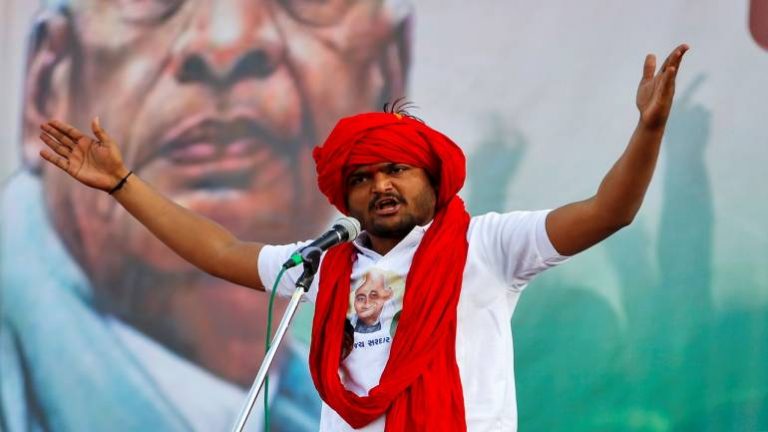
According to news portal DeshGujarat.com, Sameer Patel, great grandnephew of Sardar Patel has slammed Shaktisinh Gohil and other Congress leaders for playing divisive politics. In a video interview in Gujarati, Sameer Patel says that Sardar Patel always tried to do unite the nation and do good work for India but Congress didn’t like that. Hence, people like Shaktisinh should not be taken seriously. Reacting to the Patidar reservation agitation leader Hardik’s comparison to Sardar Patel, Sameer laughed and said, it is very convenient for people to gain publicity piggybacking on Sardar Patel’s name. Slamming Hardik Patel, Sameer said Hardik is trying to divide India while Sardar tried to unite India. Hence, there is no comparison between Sardar Patel and Hardik Patel.

Commenting on the importance media and Congress has given to Hardik on his reservation agitation, Sameer said that people like Hardik should not be taken seriously.

He further added that people should support Narendra Modi and strengthen his hand.


It is unfortunate that in an attempt to gain a few political brownie points, Gujarat Congress leaders would stoop to such level that even fringe elements like Hardik Patel would start getting compared to leaders like Sardar Patel, to whom we owe the united India.

Citing OpIndia report, BJP attacks Congress over ‘fertilizer scam’ involving Ashok Gehlot’s brother

0

Last week, OpIndia.com had carried an exclusive report about how the brother of Ashok Gehlot – the former Chief Minister of Rajasthan and current in-charge of Gujarat Congress – was fined by Commissioner of Customs, Kandla for being involved in a syndicate that was found guilty of exporting subsidized fertilizers illegally.

Agrasain Gehlot, the brother of Ashok Gehlot, was accused by the Commissioner of Customs of selling Muriate of Potash (MOP) – a soil nutrient used in non-urea fertilizers – to a middleman who subsequently put fake labels on MOP and exported it to buyers in Malaysia and Taiwan. The order by commissioner stated that Gehlot was willingly part of this syndicate that operated between 2007 and 2009, when both Rajasthan and the center were ruled by the UPA.

Government provides duty exemptions and subsidies for importing MOP on the condition that it is sold only to farmers and for agricultural use only. Any other sale is deemed unauthorized and illegal. However, some individuals and firms, including Agrasain Gehlot, were found to be camouflaging MOP as salt and exporting it.

The commissioner of customs had imposed a penalty of around 5.5 crore rupees on Agrasain Gehlot, though harsher punishment could have been imposed given that order by the commissioner also indicted Gehlot of falsifying documents to show that MOP was sold to farmers. The case is currently pending in an excise and service tax appellate tribunal.

You can read our exclusive report about the above scam by clicking here.

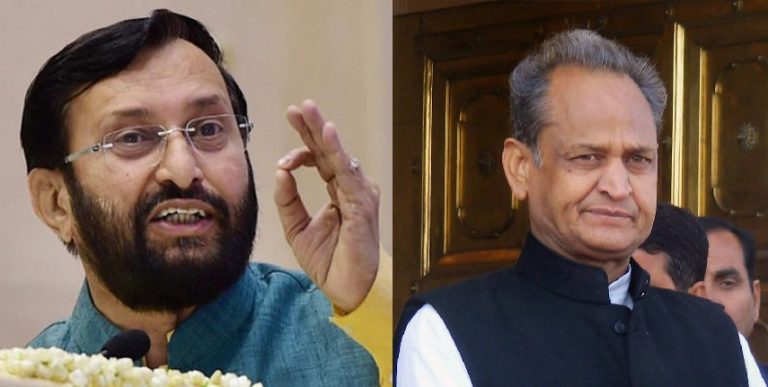
Citing the above OpIndia report, BJP today attacked Congress calling it a party synonymous with corruption. Senior BJP leader and Union Minister Prakash Javdekar told reporters in Delhi today that Congress indulged in doublespeak over issues of farmers.

“On one side Congress and its leaders talk about farmers and their issues, but the relatives of their party’s Gujarat in charge is stealing the farmer’s subsidy,” Javdekar reportedly said further asking if the Congress top leadership will take any action against Ashok Gehlot.

“This is a clear case of theft of subsidy and all this happened between 2007 to 2009, when Congress-led UPA was in power at the Center and during the period Gehlot had also assumed charge as the Rajasthan chief minister,” the union minister further said.

Javdekar further said that the way imported MOP was camouflaged as salt and exported at higher prices to make profits, one can’t rule out even money laundering involved in this case.

It should be noted that Ashok Gehlot is currently leading election campaign for the Gujarat unit of Congress and the state goes to polls next month. Given that Rahul Gandhi has been raising the issue of farmers welfare often, BJP could use this chink in armor of Ashok Gehlot to attack the Congress Vice President.

New York Times calls saree a ‘tool of Hindu nationalist campaign’, draws flak

0

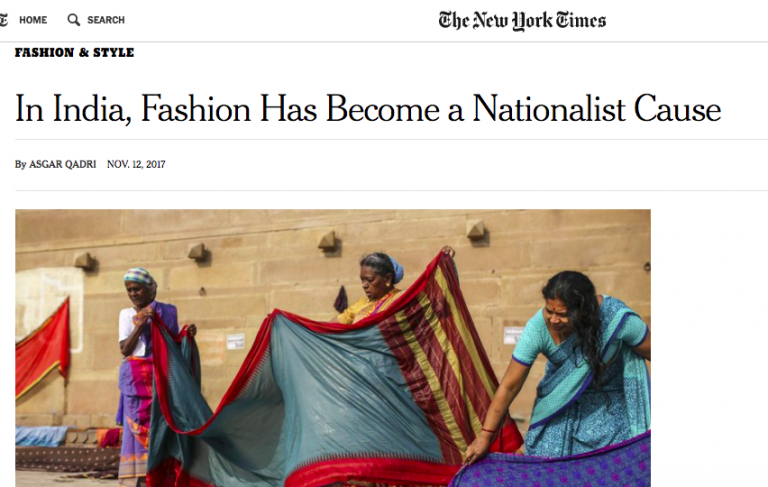
As if whitewashing of barbaric Mughals by foreigners in Indian publications wasn’t enough, we now have foreign publications like New York Times (NYT) publishing outrageous claims about post-2014 India. One Asgar Qadri, who writes frequently in NYT wrote an article which claims that the saree is a symbol of Hindu nationalism.

He writes that promoting saree is an effort to align ‘party’s broader political program: to project multi-faith India, a country of more than 1.3 billion, as a Hindu nation.’ Amongst other claims, the author links journalist Gauri Lankesh’s murder and says that those who disagree with Prime Minister Modi are “branded as “anti-national,” some shot and killed by Hindu nationalist activists.”

Sample this paragraph from the article full of propaganda and exaggerations:

“And with Narendra Modi, the party’s strongman of Hindu nationalism, as prime minister, fears that the country would head into a phase of aggressive nationalism have largely come true. Members of minority communities, accused of being disrespectful to cows, sacred to Hindus, have been lynched. Critics of Mr. Modi have been branded as “anti-national,” some shot and killed by Hindu nationalist activists.”

There are multiple things wrong with the article, especially the above paragraph; like how there is no conclusive evidence on who killed Gauri Lankesh, but for now, let us focus on the saree as symbol of Hindu nationalism. It is the same publication which publishes the regressive hijab gives women self confidence, but saree is a tool to increase ‘Hindu nationalism’.

Social media called out NYTimes asinine reporting which was completely devoid of facts.


Earlier, when Raveena Tandon had posted a picture of herself wearing a saree with a sarcastic tweet on whether she will be labeled a ‘Bhakt’, the condescending term used for supporters of Narendra Modi, she was trolled for the same, showing how it is not the right wing, but the so-called liberals have communalised the Indian attire.


The rot is so deep that now an attire which has been worn by Indian women through centuries is suddenly communalised just became Modi and his government is revive the industry? This just seems like a hateful propaganda gone international wherein every symbol of Indic traditions, or anything that is viewed as remotely Hindu is being vilified. Perhaps their idea to malign a leader who doesn’t fir in the grand leftist world order is to malign a majority population, however ridiculous that might sound. What they fail to perhaps understand, is that Hindus and Hindu traditions have survived far worse than pompous media. It has and it will.

Tharoor slammed for farrago of pseudo secularism and vote bank politics

0

Congress leader Shashi Tharoor yesterday tweeted an image of a dance performed by school children in Parassala in Thiruvananthapuram, the constituency he represents in the lower house of the Parliament. While sharing the same, in his attempt to come across as secular, he identified the little girl playing the role of Bharat Mata by her religion.


He immediately got called out for his communal mindset masquerading as secularism.


Shockingly, in his rush to find out the religion of the girl, he forgot to notice that the girl dressed as ‘Bharat Mata’ is not even holding the Indian flag correctly.

He got called out on that as well.


Perhaps this is a good time for Tharoor to put an end to his virtue signalling.