Home Blog Page 7446

Why shaming Hindus for alleged pollution on Diwali is completely misplaced

0

It is that time of the year when all Hindus are shamed for celebrating one of their most important festivals – Diwali. Apart from lights, the festival is celebrated with fireworks. The common point of accusation against the Hindus is that the festival causes pollution, and serious harm to health of kids and adults alike. Plus we are also reminded of animals getting disturbed by loud noises and being hazardous to birds.

While smoke is an issue on Diwali day, let us take stock of the facts about pollution – and Diwali’s contribution to it. There are few threads in this problem:

  • The overall pollution levels and the source thereof
  • The persistence of firecracker pollution
  • The economics of fireworks in the recent years.

A Greenpeace report claims that all around the year, the Indian metropolis are uninhabitable with respect to air quality. Particularly Delhi, has the distinction of being the most polluted city in the world. Average year round air pollutant levels in Delhi were more than 5 times the safe levels as specified by India and were 10 times higher of that as specified by WHO.

The report identified construction and vehicular traffic to be the two largest contributors of pollution. The third largest contributor was practice of burning paddy husk in nearby states. While such a detailed analysis has not been done for other cities, anecdotal evidence suggests that construction dust may be the biggest culprit, when it comes to air pollution.

Besides construction dust and vehicular pollution, bad infrastructure (as in bad roads) creates suspended particular matter that are effective respiratory pollutants. This is particularly true of metros where civil amenities are more of a wish than a reality. From the above points, it is clear that majority of the pollution in our cities is a persistent year round issue and is not singularly caused during Diwali.

There was a research paper published by IIT-Kanpur in 2016, which studies the issue of pollution and its causes in great detail; in and around the National Capital Region. One particular figure in this report is educative. The figure has been reproduced below:

The time series graph shows the pollution levels in Delhi during the month of November (year) 2013. The first data point is Diwali day – and one does see that the pollutant levels were much higher than the mean [red and blue dotted lines]. What is interesting however, are the pollution level spikes on the 5th of November, on the 9th and 11th, and on 21 through 23rd.

In fact, the pollution levels on the 23rd of November are far higher than on Diwali day. One may argue that the Diwali pollution persists for three weeks, but the data falsifies such a hypothesis. In fact, we find that the pollutant level on Diwali day falls well below the mean levels by the next day. Furthermore, the median pollutant levels across the month also seem to be well below mean levels. These two data together suggests that the pollution caused by Diwali is extremely short-lived (less than 24 hrs), and is no worse than the usual sporadic spikes of pollutants that are observed in Delhi.

Another aspect of Diwali that gets condemned is the noise pollution. While firecrackers used to be noisy (upto 140 dB) in the past, continuous revisions in acceptable noise levels have brought down the overall noise levels to less than 100 dB – and that was the maximum noise by a firecracker. In fact, the overall noise levels across several cities were measured to be between 60 dB and 90 dB (far lesser than the 100 dB of the noisiest cracker). Compare this with a typical noise level in a city junction: honking creates noise in excess of 100 dB.

A look at the differential noise between a normal day and Diwali noises shows that in many places, the differences are marginal. In fact, in some cities, the differences are so marginal that one may consider it to be well within expected variation.

This figure is from a Central Pollution Control Board study on pollution during Diwali across India (2014). Sadly, this report doesn’t provide confidence intervals for the noise levels; nor does it provide any P-values for the differences in noise between normal and Diwali day. What is clear, is that Diwali is likely to be as noisy as any normal working day in Indian cities:

A statistical test for Bangalore for Normal and Diwali days (screen shot below) shows that the mean difference in noise between a normal and festival day in the city is barely 2 dB. In other words, the difference is negligible. Diwali doesn’t create any extra-ordinary noise pollution than an normal day
Last but not least, we come to the question of economics. Several reports such as this one point out that fire cracker sales have been falling drastically, on an annual basis. This particular report cites a 20% reduction YoY in sales for five consecutive years. Such drastic reduction in fire cracker sales would mean at least a halving of total sales (taking a base line of 100 INR, -20% CAGR for 5 years leaves us with 32 INR – or a 68% reduction).

In one particular year, 2015-2016, the fall was 25%. Yet, some newspaper reports claimed a 40% increase in pollution on Diwali due to firecrackers. This doesn’t compute: how can one cut down firecracker purchase by almost 70%, and still end up with 40% increased smoke?

Does it mean that firecrackers are creating 3 times as much smoke as before? While it is “possible”, it is not probable. And the jury will be out on this one until specific studies are done. On the other hand, given the first graph we saw – one could argue that majority of the pollution is due to other causes, and Diwali smoke only marginally adds to it. This seems to be the more likely scenario – at least for Delhi.

In summary, pollution increase during Diwali – of both the air, and noise, is likely marginal, and more importantly, extremely temporary in nature. Vilification of both the festival and those who celebrate it on environmental grounds, seems like vested hatred than anything else.

Editor’s note: This article was originally published on Author’s blog “Rumbles of a Lonely Mammoth” and has been re-published here with due permissions.

The truth about No PAN requirement for jewellery sales above Rs 50,000

0

A few hours before yesterday’s much awaited GST Council press briefing, a news began circulating in media circles: That jewellers can now sell gold and other jewellery items worth more than Rs 50,000 without asking for PAN cards of buyers.

Many media houses reported the news. Even business news channels tweeted the same from their social media handles. An illustrative screenshot is as below:

Instinctively, this move felt wrong and against the overall principles of the Central Government. On the one hand, PM Modi has repeatedly stressed on strong measures to curb black-money and tax evasion. On the other hand, when such steps are taken, it defeats the purpose.

Gold is long known to be an asset preferred by black money hoarders. Hence, the reactions on social media, based on such reports were understandably expressing anger:


Some even ascribed this move to the upcoming Gujarat state elections:


What most people did not realise that, some in the media had reported only half the facts in this case. In fact, a few media houses like ABP news, did report the entire news, in full context:

The full background of the story goes like this: From December 2015 onwards, jewellers had to obtain PAN cards for selling jewellery above Rs 2 lacs. Towards the end of August, jewellers having turnover of Rs 2 crores or more, were brought under the PMLA Act as “reporting entities”, on par with other institutions such as banks. The limit for reporting transactions under PMLA was Rs 50,000 and this was by default applied to the jewellers as well. Thus, the limit of Rs 2 lacs had now become Rs 50,000.

This had caused resentment among the jewellers community. The threshold of Rs 50000 was found to be too low since ordinary gold ornaments would easily cross the threshold. After the GST Council press meet, Revenue Secretary Hasmukh Adhia explained that the PMLA notification was withdrawn since they need to reconsider the threshold limit. Thus, the Rs 50000 limit was no longer in force.

Most media reports mentioned this removal of Rs 50000 threshold. But they failed to mention that although this threshold was removed, the erstwhile threshold of Rs 2 lacs still continued. This half-reporting created an impression that any sale of jeweller above Rs 50000 had been taken out of the net of PAN reporting.

The Hindu receives show-cause notice from Press Council for its Elphinstone molestation story

0

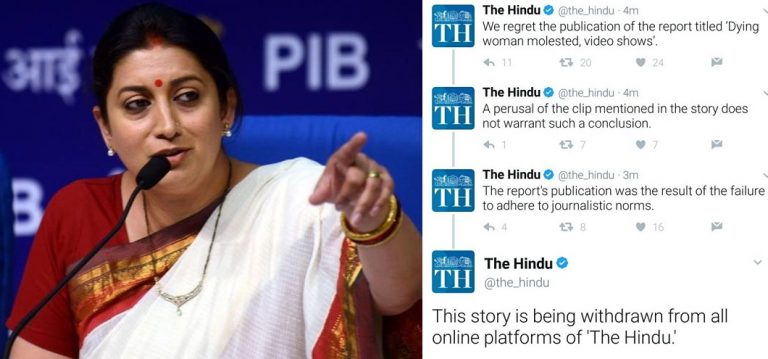
Smriti Irani, the union minister for Information & Broadcasting has decided that she will not treat ‘fake news’ by the mainstream media outlets casually. Within days of her assuming charge of the ministry, she had taken news agency PTI to task for spreading fake pictures of flooded Ahmedabad airport.

PTI was taken to task again by the Press Information Bureau for spreading misleading information about compulsory Aadhar ID for obtaining death certificate, and they received flak from Ms. Irani yet again when they had tweeted an absurd photograph of Prime Minister Narendra Modi and Bihar Chief Minister Nitish Kumar.

Now the minister and ministry are back in action, and this time it is due to the newspaper The Hindu, which recently drew a lot of flak on social media for claiming that a dying woman – a victim of stampede at Elphinstone railway station of Mumbai suburban rail network – was molested by a bystander. Later, it was found that the bystander was actually trying to help the dying woman, not molest her.

The Hindu reporter had used just an 8-second video clip to make this sensational claim, whereas it was found that a longer 40 seconds video was available, which showed that the bystander was not trying to molest any stampede victim. In fact, he was a good samaritan trying to help the stampede victims.

Whether the video was maliciously edited by the reporter, or the reporter fell for the edited video is not known, but The Hindu apologized and withdrew the story after massive outrage.

But was a simple apology enough? That’s what most of the social media users asked, and it now appears that Smriti Irani too agrees with the common users. The Ministry of Information & Broadcasting is believed to have expressed their displeasure at the whole turn of events and conveyed the same to Press Council of India, which is a central statutory authority for preserving the freedom of the press and for maintaining and improving the standards of press in India.

Earlier today, Press Council of India issued a ‘show cause notice’ to the editor of The Hindu and asked the newspaper to explain their position within 14 days in writing.

In a separate press release, the council noted that the molestation story was “highly irresponsible” and subsequent action (withdrawal of the story and issuing of an apology) was not enough to mitigate the damage done.

The show-cause notice by the council has been issued under Section 14 of the Press Council Act, 1978, which empowers the council to hold an inquiry if the council believes that the standards of journalistic ethics or public taste has been offended, or that an editor or working journalist has committed any professional misconduct.

Although press council of India will decide on any action after The Hindu responds to the show-cause notice, OpIndia.com has learnt that the ministry believes that the newspaper should be penalized by stopping government ads for a period of two weeks as an exemplary action.

Media and Politicians spread sensational lies about renewed Chinese aggression in Dolam

The security landscape of India is a complex one with two aggressive neighbours to the East and to the West. While problems with our western neighbor is widely reported, a sense of ignorance among the citizenry regarding our Eastern neighbor leaves several lacunae where our overzealous, sensationalist media is free to sow seeds of doubts.

The Chinese, staying true to its policy of creeping advancement over smaller neighbours, had been pressurizing Bhutan to settle boundary disputes between the two nations. The dispute lies in 3 areas, but it’s the tri-junction that the Chinese deemed most vital.

source: https://3.bp.blogspot.com/-7N5UwMk89qg/WVoO41k5CyI/AAAAAAAARzU/7ZyQm-z9akU2ZzPvqeE0ASdoYfMwJPECwCLcBGAs/s1600/Picture1.jpg

On 16 June 2017, Chinese troops with construction vehicles and road-building equipment began extending an existing road southward in Dolam, a territory which is claimed by both China as well as India’s ally Bhutan and directly borders India. On 18 June 2017, around 270 Indian troops, with weapons and two bulldozers, entered Dolam to stop the Chinese troops from constructing the road. On 28 August, both India and China announced that they had withdrawn all their troops from the face-off site in Dolam.

But as is the norm for Indian media and political opposition, it doesn’t take a lot of time for these elements to turn a security debate into a slug fest infested with lies and misrepresentations to score petty political points.

Today, we woke up to an article in NDTV, written by journalist Vishnu Som that read – “With 500 Soldiers On Guard, China Expands Road In Doklam”.

The headline itself fallaciously screamed that the very Doklam standoff that took weeks to resolve, was knocking at our door yet again, when nothing could be further from the truth and bereft of nuance

Vishnu Som proceeded to write –

“Barely a month after the winding down of an aggressive stand-off with India at the Sikkim border, the Chinese army is back to building a road on the Doklam Plateau, just 10 km from the location of the last conflict. The Doklam Plateau is claimed by both Beijing and Bhutan as their territory. India backs Bhutan’s claim.

In mid-June, Indian soldiers crossed the Sikkim border to stop the construction of a Chinese road near the “Chicken’s Neck”, a thin strip that links India to its northeastern states. After nearly 70 days of soldiers from both sides staring down at each other just 150 metres apart, the conflict, described as the worst in decades, subsided with both countries accepting that they were withdrawing their troops, though details were sketchy.”

Mr. Som is incorrect on several accounts here. Firstly, the government said that India and China had accepted to ‘disengage’, not withdraw. Also, the status quo ante was agreed at 150 meters. Hence, details being ‘sketchy’ is really out of the question.

He continues –

Now, barely 10 kilometres from the location of the stand-off, China is expanding an existing track, reinforcing its claim to the disputed and remote Doklam Plateau. India backs Bhutan’s claim to the region and has made it clear that it will not tolerate any infrastructure that would allow China access to the Chicken’s Neck, located just south of Doklam. 

Now, Mr. Zorawar Daulet Singh, Fellow at Center for Policy Research says that only if the build up is in the south of the Sinchela ridgeline, would this ‘new’ Chinese construction activity be in ‘disputed territory’.

To that, Associate Editor of The Indian Express, Mr. Sushant Singh asserted that the PLA had made permanent shelters there some 14 years ago and that area is de facto Chinese territory, not linked to India in any way.

It is thus to be noted here, that none of the news reports that assert fresh build up are willing to give the location of such build up and have mostly resorted to cheap and vague infographics. When the area is located on Google maps, this build up can be easily marked if information is true and available, considering Google maps in India provide locations as per Indian status quo.

None of the journalists discussing this issue are willing to mark the exact location despite repeated requests. Even without that information, it would seem that the alleged construction is happening on Chinese territory and it doesn’t affect status quo ante post Doklam standoff.

Interestingly, it wasn’t only Mr. Vishnu Som who resorted to vague assertions to imply that the government assertions of the standoff ending were unsubstantiated. Mr. Sushant Singh today tweeted –

Interestingly, Mr. Singh tried to hedge his argument here by subtly hinting that the presence of Chinese troops were somehow breaching status quo.

In his article he writes :

This assertion is correct. The status quo ante was agreed at 150 meters from the sight of the flashpoint.

He goes on to write –

Now, since the status quo ante was agreed at 150 meters, Chinese troops being present “A few hundred meters” from the site of the standoff shouldn’t be a point of debate at all. Specially in the context of the standoff that was resolved a few months ago.

Sushant Singh’s use of the word “still” points towards him implying that the troops that were meant to be pushed back post the standoff ending, in fact, haven’t been pushed back and continue to camp out on the same area thereby violating status quo and negating the claims of the Indian Army and the Indian Government.

Mr Singh, in his conversation with Ms. Suhasini Haider, who was also way off the mark in her understanding of the situation acknowledged that Dolam and the tri-junction area is the face-off sight and that the current track improvement by the Chinese is some 15 Km North East of the face-off sight. But surprisingly, in his very next response, goes back to plugging in Indian Express article that subtly insinuates that Chinese troop presence beyond the 150 meters agreement, maybe a violation of status quo.

Since the discussions revolved around questionable conclusions, I asked Mr. Sushant Singh to point out on the map where this alleged troop buildup was taking place.

When Mr Singh says that the troops would be approximately 800-1000 meters to the north of the turning point, It reaffirms the fact that the 150 meter status quo ante hasn’t been violated.

He also says that that Chinese Division is present in Phari Dzong. He had earlier asserted that Phari Dzong is an area ‘opposite Sikkim’ and post Dolam, that stationing is significant.

When researched further, one realized that Phari Dzong is actually deep into Chinese UNDISPUTED territory and that it doesn’t face Sikkim but is closer to Bhutan with several mountain ridges blocking it from Sikkim – a few days if not weeks trek.

The Associate Editor of The Indian Express also asserted in his initial response to me that he never said that a “Permanent battalion” was present in the territory at all. The evidence pointed to the contrary:

Mr Sushant Singh had earlier pointed out that this confusion is because of the loose usage of the terms “Doklam” and “Dolam” and that Dolam was the actual face-off sight in the Doklam Plateau. When asked, that if his earlier explanation of confusion between the terms ‘Dolam’ and ‘Doklam’ hold true, wouldn’t it then be wrong of him to assert that the Chinese troops are deployed in ‘Dolam’, which was the disputed location, while the government had confirmed that the troops were in ‘Doklam’, the larger plateau?

He contested my question by denying that he had any knowledge of the government confirming that the troops were in “Doklam” and not “Dolam”, which was the disputed sight, when in fact, it was an article authored by him that made the assertion:

I then repeatedly (twice) asked Mr. Sushant Singh a simple question. Was it his belief that the Chinese troops were present in the DISPUTED TERRITORY. Both times, Mr. Singh craftily shifted goalposts without giving a straight answer, which could either be yes or no – instead asking me if I considered Tibet or Dolam to be disputed.

Mr Singh of course knows quite well that India accepts Tibet as a part of China, and what matters here of course is the Indian, Bhutanese and Chinese states interpretations – specifically as popular blogger Rohit Vats has pointed out the area between the blue and red lines is what is disputed .

Despite repeated requests to him to mark the areas and trooping levels out on a high resolution Google Earth map, he simply refused. Which means that he himself seem confused on firstly where the actual face-off was and what is in dispute, and the fact that he was himself muddling the situation because he categorically refused to state that any of the troops mentioned either in his or Vishnu Som’s article were in the actual standoff area in Dolam, that come under the purvey of the India-China disengagement agreement.

It is of course completely unsurprising that this ‘news’ with gaping information holes, unsubstantiated conclusions, clever word plays and perverse rhetoric made its way to the political class and other members of the united opposition who care little for facts:

When I spoke to Colonel Danvir Singh Chouhan, Gallantry award winner Veteran of the Indian Army and Associate Editor of Asia’s largest defence magazine, he thought that the Dolam standoff was a thumping victory for India not just militarily but also in thwarting China’s nefarious designs of aggression and supremacy. India kept her nerves and refused to blink regardless of repeated provocation and that was also a massive psychological victory over a neighbor that sought to place itself as an aggressive eastern superpower and there is no question that the status quo ante is being maintained.

Chinese troops have been present on the Doklam Plateau since a long time, but as long as the 150 meters agreement is adhered to, and no ‘pakka construction’ happens on the area we pushed them back from, the issue stands resolved for now. He was of the opinion that this sudden chatter is owing to vested interests trying to give issues of national security a political color and score a brownie point over the government of the day.

This begs the question – is the job of a journalist to give clarity or muddy the waters? Today, we saw journalists from NDTV, The Hindu and The Indian Express join hands with uninformed politicians to build a narrative – based on nothing but their own uncertainty and lack of either facts or knowledge, with significant geopolitical consequences for the country.

Surprisingly there was no such claim of China being back in business in the disputed region in Chinese mouthpiece Global Times or such state controlled media outlets. Perhaps they don’t need to do that, as some elements in the Indian media are doing their job.

Dalit youth faked attack on himself after being ‘inspired’ by speeches of NGO people

0

On Tuesday, a shocking news was reported from a Limbodara village near Gandhinagar where a 17 year old Dalit boy named Digant Maheria was allegedly stabbed by upper caste men for sporting a moustache.

Later the report claimed that the boy was taken to the Gandhinagar civil hospital where several stitches were made on is back. The family members of the boy even claimed that he also been previously attacked but back then, they had refrained from lodging a case.

Such an incident was one of the three which had been reported from the same village in quick succession and as a result had raised concerns about the possible caste clashes in the region.

The police as a result lodged a complaint against the unknown assailants via various provisions like the prevention of atrocities against the SC, ST act. In the complaint, the boy claimed that at about 4:30 PM he was returning home from school after appearing at an exam, when two unknown assailants came up behind him on a bike. They threatened him and later attacked him with a knife.

This resulted in outage on social media and also an attempted protest outside the state secretariat by Dalit leader Jignesh Mewani for demanding the resignation of the Gujarat Home Minister for reportedly having failed to protect the Dalits. A social media campaign involving putting one’s own pictures with mustache was launched too.

Now 3 days after the incident, the Gujarat Police via its probe has concluded that the whole incident was fake and the boy had made up the allegations to generate publicity after being convinced to do so by an influential NGO.

According to local news portal Desh Gujarat, the police probe revealed that:

  • There were no signs of blood in the location where the attack was supposed to have taken place
  • CCTV footage and clothes were checked and they did not support the version of events recounted by the boy
  • A paan shop owner near the given location too claimed that no such incident had occurred there
  • Even questioning and checks failed to corroborate the incident

Later as stated in the Desh Gujarat report, while interrogation the boy broke down and confessed to setting up the whole incident. He confessed that he and his two friends brought a sharp shaving blade and he in-turn asked them to attack him with it.

The two friends as well corroborated this version by stating that they caused the injury after being pressurised by the boy. The boy later also confessed that he escalated the issue by talking to the media persons for getting coverage. He claimed he was inspired to do so by some NGO people. According to him, he used to visit and speak with them which inspired him to carry out this stunt.

Now such a revelation raises a couple of questions.

One, what role did the NGO exactly play in motivating the boy. Did it have an ulterior motive of diving the society based on caste lines? Also what action would the police now take against both the boy and the NGO?

Secondly, what is the reason that the state has suddenly seen a spurt of such atrocities, and whether there are other cases as well that could be fabricated. Also is there a deeper conspiracy behind this whole thing after especially considering the fact that state elections are just a few months away?

What media won’t admit : Yogi Adityanath is destroying Dengue, Malaria, Japanese Encephalitis and Chikungunya in UP

Earlier this week, when Yogi Adityanath threw stats about Kerala’s health situation in the face of the CPI(M), the secular brigade exploded in anger. First the BJP makes the Communist policy of mass murder in Kerala a national issue and now it is trying to rip apart the carefully constructed web of lies around Kerala’s “prosperity” by sympathetic media over the years.

In extreme panic, Scroll published right away this booming headline…

Untitled.png

With a headline like this, Scroll must have big stats to back their words up. The left was getting ready to debunk Yogi Adityanath all over the place, with Catch, Wire, Newslaundry and Altnews joining the party.

But you know things aren’t going well when Scroll has to admit this in the article:

Untitled.png

This sad admission is hilarious for several reasons. So the way that Scroll is trying to save the CPI(M) government from the BJP’s onslaught is by saying two things:

(1) UP may be doing better this year after BJP coming to power, but things used to be much worse in UP last year under the secular government of Akhilesh Yadav!

(2) Kerala may be doing badly this year under CPI(M), but it did better last year when CPI(M) came to power only in the late summer!

Is Scroll trying to debunk the BJP or its own secular liberal friends?

Untitled.png

I’m not kidding. This is still from the Scroll article “debunking” Yogi Adityanath. Is Scroll debunking him or debunking itself? LOL

And watch this :

Untitled.png

Would you believe I am still quoting the leftist propaganda blog Scroll?

So, will Scroll graciously admit defeat and congratulate Yogi Adityanath for his stellar performance? You’ll never guess what Scroll does next:

Untitled.png

Whoa! What a thing to say!

Who is in charge of public sanitation and control of mosquitoes in Uttar Pradesh? Rahul Gandhi?

So, they discover that Yogi Adityanath lied when he claimed he made the hospitals in Uttar Pradesh better. When in fact Yogi Adityanath only made sure that people didn’t fall sick and have to go to hospital in the first place!

Yeah some lie they have caught!

So, I decided to go to the website of the National Vector Borne Disease Control Program and take a look at the stats for myself.

Here [pdf] are the numbers for Malaria:

Untitled.png

Here [pdf] are the numbers for Japanese Encephalitis (till Aug 31, 2017):

Untitled.png

Here are the numbers for Dengue (till Aug 20, 2017):

Untitled.png

And finally, here are the numbers for Chikungunya (till Aug 20, 2017):

Untitled.png

If you are an actor or artist who plans to return an award to protest against the “intolerance” of Yogi Adityanath, this would be a good time, now that he seems to be carrying out a genocide in UP … of mosquitoes.

And if you are a journalist, just reject all the data above, and say that it’s the “maahaul” that matters, not data.

Kerala’s Model of Growth is far different from what it is advertised to be

0

Enough of this “Kerala model of growth” which economist Amartya Sen has put his dubious stamp upon and with which Leftists louts thump their chests on an hourly basis.

No sir, Kerala doesn’t have the highest literacy rate in the country — Tripura and Mizoram are ahead — and if jobs is the end goal of all literacy, Kerala sucks: It has three times the national average of unemployment rate. Thousands of MBBS graduates are without jobs, according to Kerala Medical Post Graduates Association. Kerala’s graduates are so unemployable that the state is 10th in the rankings of 16 states in the IT services sector.

The so-called high literacy still doesn’t stop people from falling prey to the “quick-fixers” selling his wares on the street. If the high-literacy was real, authentic research wouldn’t have shown that (a) 35% can’t identify alphabets; (b) 85%  of Class VII have no idea of basic science; (c) 73% same in mathematics.

The study, conducted among 4,800 students of Class IV and VII, showed that as many as 19% students in Thiruvananthapuram scored zero in geometry! Most of this high-literacy tag doesn’t go beyond secondary schools as there is a dramatic fall in higher education.

And to think that 80 per cent of the education budget is spent on schools. Mind you, this is no ordinary sum — it’s 37% of the state’s total annual budget. In case you are wondering where all the money goes, there is a clue: the glut of teachers: almost a teacher on every two students!

Apologists please also save this “model healthcare system” lollipop in your termite-infested drawers. Those attending your health are unlikely to have cleared the nursing or paramedical courses. The pass percentage in 90 colleges is as low as 5% in pharma and 6% in physiotherapy.

Oh yes, The God’s Own Country! (Scamster Leftists are atheists on paper but have no problem in promoting God as their brand ambassador). Kerala’s 44 rivers are facing existential crisis due to continuous sand extractions. Munnar, one of its showpiece, suffers from lack of accommodation, public facilities, pollution and poor hygiene as conceded by no less than Kerala Tourism.

To be a woman in Kerala is almost a curse. As many as 47.4 of state’s women have no jobs. As a woman, being outside of home after 6 PM isn’t approved by an average Malayali male. Any young couple who roams around in terrible jammed streets of Kerala would have his or her own story to tell. We are not even coming to “Love-Jihad.”

Ah economy! Kerala has no funds left in the state treasury for capital expenditure, Kerala’s governor P. Sathasivam had said last year. The state has about Rs 10,000 crore immediate liabilities to meet in the short term, said the White Paper, as presented by Kerala finance minister Thomas Issac last year.

Indeed, Kerala’s Debt-GDP ratio is almost 29 percent! (Wondering how Communists fared in Bengal? It was around 43% of GDP in 2009-10, after which the Bengalis finally booted out the Leftists). But then how do you expect industries to grow in a state where bandhs and strikes happen every single day!

We are not getting down the financial scams road even though the 2013 Solar Panel Scam is wanting itself to be heard at some corner of my brain. Kerala has been ruled since 1970s either by Congress-led United Democratic Front (UDF) or Left Democratic Front (LDF) of communists — one Left the other Extreme Left. Congress is seen effectively controlled by the Christian community; while LDF leans towards Muslims and other minorities. Almost all top jobs in the state, Hindus allege, are controlled by minorities.

The dangerous policy of communalization is best reflected in Malappuram which is said to be a hotbed of Islamist terror and where law and order is practically absent. The ecosystem of NGOs, churches, madrasas and the Leftists in power feed each other.

Political violence against RSS and BJP workers is now unprecedented in Kerala. The presence of BJP chief Amit Shah is making the present dispensation in Kerala nervous. More so since BJP’s growing clout — they obtained 15 percent of vote share in last assembly elections — is unmistakable.

So while we wait for the political drama to unfold, let’s throw all the good news on Kerala to dustbins and remind ourselves once again how “intellectuals” never bring such facts to our attention and why political violence in Kerala goes unreported by Lutyens’ Media.

Banks provide shocking data relating to demonetization activities of suspected shell companies

0

In a major boost to the crackdown on black-money, data from banks regarding the demonetisation period has just begun pouring in and the details have proved to be shocking.

We had argued long back that a higher percentage of cash returning to banks during the demonetisation period was not actually a bad sign, and in fact could strengthen the hands of the Income Tax Department.

“Black” money can turn “white” only once you pay taxes on it. As such, all the money deposited in banks will have to be explained by the depositors by showing the source of income (on which tax has already been paid) or, the depositors will have to now pay tax on these deposits. Further, since all the money has come into banks, there is a trail as to who deposited the cash. From here, it is a simple process of identifying the suspicious transactions and scrutinizing them.

The Government now is finally moving to this stage.

After multiple crackdowns and using information from the banks, the latest set of data received by the Government is shocking. A press release by the Government of India stated that vital information had been received from 13 banks regarding the bank account operations and post-demonetisation transactions of some of the suspicious companies that had been struck off the Register of Companies earlier this year.

It  may be recalled that earlier this year, the government had advised banks to “put restrictions” on the operation of bank accounts of the 2,09,032 companies delisted by the Registrar of Companies. Most of these companies are suspected to be shell companies.

The data received from the banks says that these companies had a meagre balance of Rs 22.05 crore to their credit on 8th November, 2016. However, from 9th November, 2016 i.e. after the announcement of demonetization, till the date of their being struck off, these companies had altogether deposited a huge amount of Rs. 4,573.87 crore in their accounts and withdrawn an equally large amount of Rs 4,552 crore. With loan accounts, there was a negative opening balance of Rs 80.79 crore.

The release further speaks of specific cases:

  • One of the company reportedly had 2134 bank accounts, followed by others having accounts in the range of 900, 300 etc.
  • In one of the Bank, 429 companies having zero balance each as on 8th November, 2016 have deposited and withdrawn over Rs 11 crore and are finally left with a cumulative balance of just Rs 42,000 on the date of freezing.
  • Similarly in the case of another Bank, more than 3000 such companies, most having multiple accounts, have been located. From having a cumulative balance of about Rs. 13 crore as on 8th November 2016, these companies have deposited and withdrawn about Rs 3800 crore, leaving a negative cumulative balance of almost Rs 200 crore at the time of freezing of their accounts.

The best part of all this is the fact that, the above is only the First instalment of data.

As of now, the banks have provided data only for about 5,800 companies which is only about 2.5% of the total number of suspected companies. This indicates that this is just the tip of the iceberg and one can only wonder what the final figures would look like!

It is expected in the coming days that the Income Tax Department will now start investigating these companies and it remains to be seen what action is taken against their promoters.

8 newborns die within 24 hrs in Assam hospital and the cause might be bizarre

0

The Fakhruddin Ali Ahmed Medical College and Hospital in Barpeta, Assam was struck with tragedy after 8 newborns died within 24 hours.

According to local reports, 7 infant boys and 1 girl were being treated in the neonatal care unit of the hospital. All these infant deaths happened since Wednesday and as a result of that, the Director of Medical Education and a UNICEF Consultant rushed to the hospital for auditing the deaths.

Soon after the deaths, the families of the deceased attributed the deaths to the lack of proper diagnosis and inadequate followup. The unfortunate mothers in this case include, Safatan Begum, Hasina Khatun, Rufia Khatun, Jaigan Begum, Jabeda Khatun, Dipika Das, Helmina Khatun and Nirala Barman.

Such deaths in quick successions also resulted in allegations of wrong treatment, lack of life-saving drugs, shortage of doctors and unavailability of basic facilities for infants. The government and hospital administration on the other hand denied such allegations.

As per reports, the Principal cum Chief Superintendent of the hospital, Dr. Dilip Kr. Dutta claimed that almost all the babies died due to birth asphyxia which is caused as a result of lack of oxygen in the newborn. He further claimed that the babies were born with a precariously low weight of 1 Kg, 2 Kg, 2.2 Kg and the mothers were admitted late in the hospital which led to the situation.

The hospital has since then even issued a press-release. Apart from Dr. Dutta’s claims, the release also claimed that the hospital is fully sufficient to take care of such cases via the Special Care Newborn Unit (SCNU). It also claimed that even the mothers were seriously ill and the delivery was made as per protocol and the newborns too were so critical that they couldn’t be saved.

In this whole affair another angle has emerged, which is the possible lack of awareness among the locals in the region when it comes to medical care. This supposedly is a Muslim dominated area, and this may have made health care even more complicated, in a rather bizarre way.

In May it was reported that this Barpeta region was engulfed by a crazy rumour that a “RSS vaccine” would be administered in the region’s schools which would make the children infertile. As a result, the parents were refusing to send their children to schools.

This rumour came at a time when the state government was carrying out a vaccination drive against Japanese Encephalitis (JE) in various districts of the state but there was no such drive being carried out in the state’s schools.

The reports had even quoted the parents as alleging that administering such vaccines had killed a few children and as a result, they won’t allow its administration on their kids.

Such an affair now raises the question as to whether the delay in getting admitted in the hospital was a result of lack of awareness in the region when it comes to medical treatment or whether the hospital authorities had failed to get them admitted in time. A high level inquiry might reveal the answers.

FIFA U-17 World Cup – A golden chance for India to get onto the global football map

0

Football which is arguably the most popular sport in the world has unfortunately never been a go-to sport for India. The nation which until recently displayed an almost unilateral passion for cricket has in the past few years been warming up to football thanks to the homegrown Indian Super League and extensive television coverage of European tournaments.

Even though such measures have resulted in increased popularity outside the traditional football crazy bastions of West Bengal, the North East and Kerala, it still felt as if Indian Football needed a break to make it to the big time.

This might finally be realised with the FIFA Under-17 World Cup which kicks off from Friday for which India had won the hosting rights in December 2013 after beating the likes of Republic of Ireland, Uzbekistan and Azerbaijan in the draw.

The prospect of the nation hosting a FIFA tournament for the first time elated Indian Football fans and at the same time put added responsibility on the football officials to ensure that the tournament infrastructure was as per global standards. In order to ensure that, a budget of about Rs 76 crores was sanctioned by the AIFF and FIFA. On top of it the Union government was expected to spend about Rs 120 crores on infrastructure.

After all the spending, optimistic reports came out which claimed that, unlike the last minute scramble which was seen during the 2010 Commonwealth Games, the infrastructure this time round would be ready well in advance. Apart from stray reports of lack of preparedness, things on that end have remained normal.

Of the 6 designated venues of the tournament in New Delhi, Kolkata, Guwahati, Margao, Kochi and Navi Mumbai, the Yuba Bharati Krirangan in Kolkata is pegged as the most high profile venue which is scheduled to host the Final of the event. It certainly didn’t disappoint in that regard and this is the end product of the roughly Rs 100 crore which have been spent by the Mamata government:

Coming to the main aspect, our Indian Football Team.

The 21 strong player squad is captained by Amarjit Singh Kiyam who hails from Manipur and is a product of Chandigarh Football Academy. Other stars of the team include experienced Goalkeeper Dheeraj Singh, striker Aniket Jadhav and most importantly midfielder Komal Thatal who has famously scored goals against footballing giants like Brazil and Uruguay.

The demographics of the players are certainly interesting with 14 of the 21 players coming from the traditional football bastions and a whopping 8 coming singularly from Manipur. Even Punjab, which has come into the football map via top Indian goalkeeper Gurpreet Singh Sandhu, has contributed 3 players.

Image via Bengaluru FC 

Many of the team’s players have come from very humble backgrounds, with defender Sanjiv Stalin’s mother selling clothes on a footpath, striker Aniket Jadhav’s father an auto-rickshaw driver, defender Jitender Singh’s father a watchman and defender Anwar Ali who himself used to graze cattle in his younger days.

The financial situation of many of the player’s family was so fragile that, many of the parents were unsure as to whether they would be able to afford a trip to Delhi, to see their sons making the nation proud. They have since then been assured an all expense paid trip the AIFF.

Such stories in football are nothing new and world famous footballers like Arsenal forward Alexis Sanchez, Manchester City striker Sergio Aguero, Diego Maradona and Arsenal legend Ian Wright all grappled with poverty in their early days.

The performance of the Indian team has been encouraging so far with a memorable victory against Belarus and draws against top teams like Chile. Even though the team has lost a few matches, most have been by a difference of 1 goal.

The team is currently coached by Luís Norton de Matos the Portuguese coach who has previously coached the Benefica’s B team and also coached, Étoile Lusitana, a youth football academy founded by famous football manager Jose Mourinho. Some reports have even claimed that it was Mourinho’s reference and subsequent praise of Matos which gave him the job.

This post of Coach hasn’t been without its drama. In January erstwhile coach Nikolai Adams was sacked by the AIFF after there were reports of a player mutiny against him. It was reported that the players had complained about him physically assaulting them which led to the AIFF dismissing him.

Coach Matos while speaking about the tournament has said that things certainly won’t be easy for India as after all they would be facing far superior teams in USA, Ghana and Colombia during the group stages. The games won’t be easy and India would have to pull off a very solid defensive performance to give itself a chance.

What the Indian team has going for itself is the home support which in many cases can make a huge difference. The best example of it might be the hosts South Korea reaching the Semi Final of the 2002 FIFA World Cup.

As a result of that, the decision to give group A matches (the default group of the host nation) to Delhi ruffled a few feathers. Many felt that Kolkata with its electric atmosphere would have been a much better option than Delhi, which became infamous for poor spectator attendances during the Commonwealth Games. Also there have been reports that the tickets for the India vs USA game on 6th October haven’t sold out yet. One hopes that the crowd which does turn up, ends up creating a proper atmosphere to back the lads.

Also it is imperative that TV spectators too view to matches in huge numbers. Such high TV rating would enabling better sponsorship deals for the team, players and a higher flow of money into the game to contribute to its overall development.

For the individual players such a big stage would be a golden opportunity to showcase their talents on a global level and possibly secure a move to an European Club. For the football fans too it would be a good chance to observe the team and speculate as to how peak Indian football would look like after a decade or so, when most of these players would be in their prime footballing years.

Win, lose or draw it would be a joyous occasion for the whole nation as it comes under the spotlight of global football and these 23 days from 6th to 28th October should be a celebration of the game and those who play it.

The tournament starts on 6th October with India playing against USA, Columbia and Ghana on 6th, 9th and 12th respectively from 8 PM. You can also catch India’s matches on DD Sports.