Home Blog Page 7523

ISI agents in India – arrests in Uttar Pradesh and Mumbai hint at active network

On 3rd May, the Anti-Terrorism Squad (ATS) of Uttar Pradesh had arrested a suspected ISI agent named Aftab Ali from Faizabad who was reportedly involved in running an espionage racket in the state. The report had also claimed that Aftab had received training in Pakistan from the ISI and was also in constant touch with the Pakistani High Commission officials.

Reportedly one of the tasks of Aftab was keeping a close eye on our Army troop movement between Faizabad and Lucknow and the deployment of army battalions. It was also claimed that Aftab had gathered information on several army cantonment areas and defense establishments in UP. Aftab was sent to a 9 day police remand on 5th May.

This incident seem to be only the tip of the iceberg with further arrests being made in relation with ISI agents operating in India. According to reports, a man named Altaf Qureshi was also arrested on 3rd May from South Mumbai. Qureshi is reportedly been touted as a hawala operator who also used to work for the ISI.

This collusion apparently doesn’t end here. Qureshi apparently was part of the Hawala business at the behest of a man named Jawed Naviwala, who is also a Hawala trader and possibly the boss of Qureshi. This led to the arrest of Naviwala on the following day from Agripada. Naviwala reportedly is a relative of Aftab Ali, the suspected ISI agent who was arrested in Faizabad, and had also transferred  Rs 15,000 to his account.

It was also reported that Naviwala used to get direct instructions from Pakistan and he in turn used to frequently instruct Qureshi to transfer money into Aftab’s account. Though according to ATS sources Navivala has called himself innocent and claims that the Rs 15,000 which he had gotten deposited were for an apparent medical charity.

The presence of ISI and Pakistani spies in India is well known and the authorities keep making frequent arrests in this regard. In October 2016 an employee of Pakistani high commission named Mehmood Akhtar was expelled from India after it was revealed that he was involved in procuring critical details including the deployment of BSF troops along the Indo-Pak border. During that time reports claimed that as many as 50 Pakistani spies have been arrested in India since 2013.

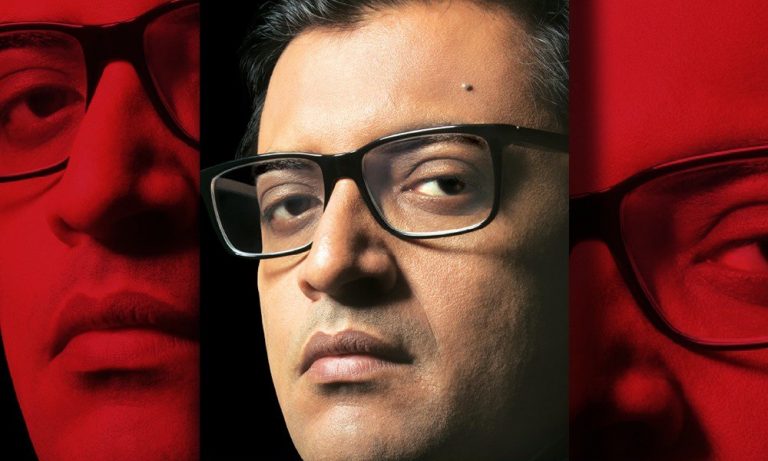
Arnab is back – 6 rules he rewrote as a television journalist

0

Arnab Goswami is back on TV. This morning, his new venture Republic TV went live and he started with a bang exposing a telephonic conversation between RJD supremo Lalu Yadav and jailed mafia don cum former RJD MP Mohammad Shahabuddin. The incident is already creating ripples in Bihar and national politics, but Arnab being back on TV is poised to create some ripples in the mainstream media too.

Arnab, in his previous avatar, was the one man machine of Times Now. He headed Times Now almost a decade ago, and has left a lasting impact on not only the channel, which owes practically its entire success to him, but also on the media industry. He may not have aimed at being such a strong and eventually “polarising” figure, but today, he is that figure.

It is because he broke and re-wrote many rules of a television journalist. Here are six of them:

1. The “neutral” host

This is a very interesting proposition. Firstly, the rule is that a media personality hosting a chat or debate, should be a “neutral” person facilitating the debate. It can be argued that most TV journalists and channels are hardly “neutral”, but at least they pretend to be so by not taking a stand on any issue. Arnab changed that.

If we look at the micro-level, analysing each of Arnab shows by itself, the template is clear: He picks a topic, makes up his mind on it, calls guests from across the spectrum of views, and proceeds to bash the guests who are of opposing views. So in any show of Arnab, you will find him harping only on one side of the debate, obliterating his opponents, by volume of by data.

Is this good or bad? It is bad if you believe TV journalists are genuinely neutral. If you are past that stage thanks to the obvious leanings of many Prime-Time hosts, then it is a good thing. Why? While Arnab wears his allegiance on his sleeve for every debate, other anchors prefer to mask it under a veil of “neutrality”. Who is more likely to mislead you? A person who “claims” to be neutral but secretly peddles his own narrative? Or someone who clearly tells you where he stands?

In fact, this is the model followed by most western media outlets especially in the US. The people know the political leanings of every media house, and accordingly alter their sense of scrutiny for news and views of a particular channel. Indian media houses haven’t moved in that direction, but Arnab may have forced at least some to shed their pretense.

2. The journalistic Omerta

It is an unwritten rule which all of media follows: No media person or organisation speaks about the doings or wrongdoings of another media house. Only when the smoke is too much to be contained (e.g. the Radia tapes or sexual assault by Tarun Tejpal) do we hear of such things from media houses. Or else it is just swept under the carpet.

Here too Arnab has changed the rules. Sure, he doesn’t name and shame, but he does enough for all to get the hint. Take for example the time when he referred to Barkha Dutt ever so slyly by saying “those who are using the killing of a terrorist, trying to project Burhan Wani, as an innocent son of an headmaster”. That was enough for Barkha to throw a fit on social media writing multiple blogs, tweets and railing about it for days on end. And he hadn’t even named her. He didn’t even spare journalists from the Times Group, as was seen when he hit-back at Sagarika Ghose who works for the Times of India.

3. Super-prime-time

Everyone knows what Prime-Time is. It is generally the time when maximum eyeballs are glued to the TV screens,  the block of broadcast programming taking place during the middle of the evening. In India, it traditionally meant between 8 pm to 9 pm, after which people are supposed to take dinner and go to bed.

Arnab’s show on Times Now starts at 9 pm and contrary to most TV shows which wind up in a maximum of 60 minutes, Arnab goes on beyond 11 pm on some occasions. This, he termed as “Super-prime-time”. Running two back-to-back TV debates on high octane for well over 2 hours was something unheard of and Arnab pulled it off day-in-day out for years on an end. He eventually began owning the 9 pm slot, even forcing competitors like Barkha Dutt to re-schedule he flagship show.

Even today as Republic TV launched, he chose a rather irregular time slot of 10 AM of a weekend to break an important story. And guess what, he forced at least two news channels – Times Now and CNN-News18 – to follow the pattern and announce their own important story breaks at the same time.

4. Calm, nuanced debates

One of the pitfalls of Arnab’s style of anchoring is there is no place for nuance, no place for the grey. You have to black or white, and depending on which side Arnab is, either get thrashed by Arnab and his panelists or be on the winning side. And more often than not the debates of extremely loud, noisy and unruly.

One reason being the host himself is loud, the second being his panelists may also be those having polar views, and thirdly because he just has too many panelists! (5 times when Arnab went ballistic on the Newshour)

This again can be argued to be not a welcome development, but do note that this article is about what Arnab changed, not for whether that change was good or bad.

5. Being in Delhi

It is called the “Lutyen’s media” for a reason. Most of India’s leading media houses are based in New Delhi, close to the action, where the Central Government is based. And most of India’s leading journalists, have their residences, some even having plush mansions, in the up-market Lutyen’s zone, frequenting the high-society cocktail party circuit.

Times Now though, was headquartered in Mumbai, and so is Republic TV. Arnab beams his views across the world every night from a place that is far away from the political power center. Perhaps being even physically away from Lutyen’s circle of journalists has enabled him to take them on and change the rules as he does.

6. Breaking away from the owner’s ideology

Let’s face it, nobody is 100% neutral. Everyone has their own preferences, leanings etc. So does the Times Group which owns Times Now. In fact, Jains, who own the Times Group, owe their entire current earnings to one decision taken by Indira Gandhi. Leave aside political viewpoint, Times of India also has a clear editorial stance. Take for example the Aman ki Asha initiative championed by Times of India.

Arnab Goswami at Times Now though steered clear of this agenda. He was so harsh on the Congress (as he is with any body who is against him) that the Congress party boycotted his show for many times. Even on Indo-Pak relations, Arnab has a diametrically opposite stand, and doesn’t have any Asha for any sort of Aman. In fact, this difference of opinion between Times Group and their former employee had now taken an ugly shape with the media group serving a string of legal notices to Arnab Goswami.


Army launches ‘Operation Clean Up’ to flush South Kashmir of terrorists

It is the biggest operation undertaken in the troubled Kashmir valley, since 1990s, to flush out the terrorists. Named ‘Operation Clean Up’, the ongoing operation in Shopian district of South Kashmir involves door-to-door search of houses. Around 4,000 troops of Army, CRPF personnel and Jammu & Kashmir police are participating in this massive operation.

The massive operation was launched in the wake of an increase in terrorist activities in South Kashmir. The operation came days after terrorists had attacked a cash van of J&K Bank and shot dead five policemen and two bank guards in Kulgam district in south Kashmir.

On Thursday (4 May), after carrying out the search operation, security forces carried out a ‘reverse sweep’ of the entire region in order to ensure that none of the terrorists had slipped in.

In Delhi, Army chief General Bipin Rawat has indicated that security forces had beefed up the counter-infiltration postures in the valley.

No arrest, however, has been made during the search operation so far. Even as the search operation was the going on, the terrorists, on Thursday, attacked an Army patrol in Shopian leaving a civilian dead and two security personnel injured. Incidents of stone-pelting have been reported in Turkawangan village.

Meanwhile, J&K Police has recovered a diary and a mobile phone belonging to terrorists who attacked soldiers, returning from the combing operation, on Thursday. The diary and the mobile phone yielded reference to three local terrorists and a number of over-ground workers who had helped the terrorists in reaching the spot and carry out the attack, Shopian SP Tahir Khan was quoted as saying.

Stone-pelting on security forces near the encounter sites in Kashmir has been causing major operational problems. Ever since the recent bypoll to Srinagar Lok Sabha constituency, a fresh spurt violence broke out in the valley. There is a palpable tension in the valley with the separatist forces call for a 2016-like protests. This is not to dispute that the stone pelters are deputed by the separatists, who work in tandem with the terrorists.

In response to the violent protests in the Kashmir valley, the government blocked the mobile web access. The move came following reports that as many as 300 WhatsApp groups were being used to mobilise stone-pelter mobs against security forces in Kashmir.

A report states that Pakistani and Saudi channels are beaming into Kashmiri homes, via private cable networks, stroking fires in the valley. The channel includes Peace TV of Islamist Zakir Naik, and many other Pakistani and Saudi channels preaching radical Islam.

Mind-boggling figures of inflows and outflows of illicit money to and from India

When Prime Minister Narendra Modi announced demonetisation of the old Rs 500 and Rs 1,000 notes and replace them with new Rs 500 and Rs 2,000 series in November last year to choke the supply of black money stacked inside the country, detractors had back then said that all black money were stashed in Swiss bank.

Recently, a report by the US-based think tank Global Financial Integrity (GFI) has estimated that a staggering $770 billion black money has entered India during the period of 2005 to 2014. The report titled ‘Illicit Financial Flows to and from Developing Countries: 2005-2014’, is the first global study on outflows and inflows of illicit money.

During 2014 alone, about $101 billion black money entered the country, while $23 billion was taken out, the report said.

The report stated that the total illicit financial outflow in India between 2005-2014 period was about $165 billion, which is 3 per cent of the country’s total trade of $5500.744 billion during the same period.

But since accounts in Swiss banks are largely secret, the question is how the data was calculated.

But, this ET report states that the GFI estimate stands out from its previous estimations for adopting “rigorous method” of collecting and analysing information on international trade and balance of payments. Besides using IMF global data on direction of trade, the GFI report has included information from other sources to plug gaps.

The Supreme Court had said that black money was nothing but a plunder of the nation with serious security ramifications. While experts are still working out the final figure, a conservative estimate pegs India’s black money stashed overseas at Rs 400 lakh crore.

After assuming office in 2014, Prime Minister Narendra Modi had set up of a Special Investigative Team (SIT), headed by former Supreme Court Judge MB Shah, to unearth illegal money stashed in tax havens. The MB Shah Commission had submitted five reports to the Supreme Court on methods to curb black money. Citing the disclosure of Panama Papers, the Commission said unless there is the deterrent provision, it would be difficult to get back the stashed money outside the country.

To curb the flow of black money, the Centre in the last three years has taken several initiatives. Of the 175 reported cases of black money allegedly stashed overseas, the CBDT has already filed 164 prosecutions following assessments of sums that add up to Rs 8,000 crore.

In Maharashtra, you can’t install a statue even on your private land if ‘minorities’ object

0

In a policy decision that has raised many eyebrows, Maharashtra government has virtually given a veto power to minorities over installation of statues in public and private spaces in the state.

The General Administration Department headed by the Chief Minister Devendra Fadnavis posted a controversial Government Resolution (GR) [pdf] on 2 May, which explains the new “statue policy” of the government. The GR includes guidelines to be followed while erecting any statue.

There are two contentious points in the GR which are discriminatory in nature and are bound to be misused.

1. The guidelines says, “No person or organization shall be allowed to erect a statue on a land owned by government, NGO or by a private entity without the permission of the District Collector”

Point #1 from GR circulated by GAD, Maharashtra Government

2. It further says, “Local police station in-charge must submit a no-objection certificate after ascertaining that installing the statue will not create law and order issues or increase communal tension in the future. Additionally, a no-objection certificate which clearly mentions that local residents and minorities are not opposed to installation of the statue must be obtained.”

Point #6 from GR circulated by GAD, Maharashtra Government

These two points combined together give a virtual veto power to minorities over installation of any statue on any public or even private land.

It means that a person can’t install a statue in his/her home or a private organization can’t install a statue in its premises if some minority community in the locality is opposed to it. The GR also mentions a Supreme Court order [pdf] dated 13/01/2013 which put an interim ban on installation statues on any public utility places.

However, this flawed statue policy of Maharashtra Government is also applicable to public recreational places like parks and more shockingly to private land.

This policy seems to be inspired from a similar policy that was formed by the then Cong-NCP government in 2005. OpIndia columnist Ashutosh Muglikar pointed this out on Twitter.

However, the 2005 policy did not require explicit ‘no objection’ from minorities, rather it said that the wishes of minorities should be mentioned in the NOC. Which means that as per the old policy, an NOC could be given for a statue even if a minority community was opposed to it (the local administration needed to have the political will).

Also, unlike the latest policy, private land was left out of the scope of the 2005 policy. Lastly, that a similar policy was formed by the previous government cannot be a justification to giving more teeth to that flawed policy.

Interestingly Maharashtra government wants to build a 210 meter tall statue of Shivaji Maharaj in the Arabian Sea. Could the Rs. 3600 crore project get stalled if some minority community members oppose it? Perhaps this particular project will be safe as the latest GR may not be applied retrospectively, however there could be similar challenges in future.

Former PM Manmohan Singh had (in)famously said that minorities had the first right on India’s resources. Now Maharashtra CM appears to have said through this GR that minorities have the first right on all statues in Maharashtra.

Equally worrisome is the fact that this policy has empowered organizations like Sambhaji Brigade who often use muscle power to push their divisive agenda. This could act as stimulant for other groups to flex muscles by claiming to represent some minority community and claiming threat to communal harmony or public order. It could prove almost as bad as the first amendment (to constitution) restricting free speech, which was introduced by Pandit Nehru.

This GR comes close to an earlier decision by the Fadnavis government, where a law to protect journalists was passed. That law is also prone to misuse. One hopes that the state government realizes these threats and takes corrective steps.

UPDATE (7th May 2017): The Maharashtra government has now removed the clause that mandated the NOC from minorities. 

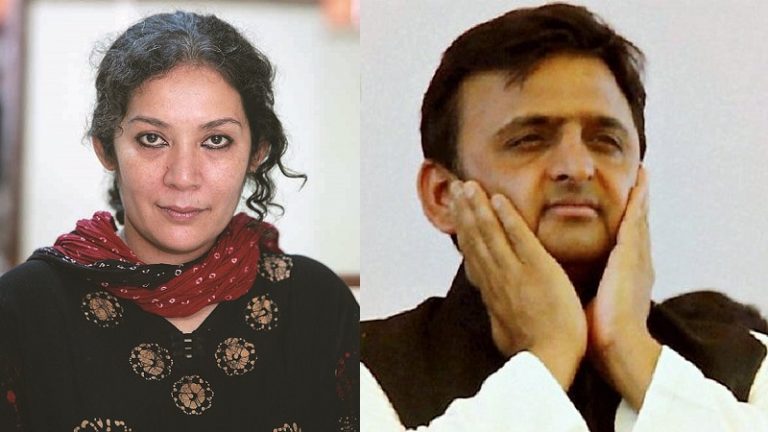
Has Saba Naqvi just spilled the beans on Akhilesh Yadav and EVMs?

By now, the right-wing is all too familiar with the continual left-wing whining at motley of websites that have mushroomed after BJP’s 2014 general election victory led by Narendra Modi. They are basically the same old cabal of usual suspects raising the same old talking points over and over again on a medium (internet) they thought was dominated by the right-wing in India. There have been many left-wing propaganda websites like Scroll, Wire, Catchnews… you know the list.

Therefore at first glance, the recent article “The Opposition’s Guide to the BJP” published here in The Wire might seem entirely routine. It’s written by Saba Naqvi, one of the usual suspects. I like to refer to them as “history-sheeters of secularism”.

But there is one very interesting, very juicy tidbit that Ms. Naqvi lets us know in her article:

screenshot from the article

Interesting! Very very interesting! Let’s dissect what Saba Naqvi has said here.

(1) It seems that Saba Naqvi is telling us that at least one pollster who worked for Akhilesh Yadav had predicted a BJP landslide.

(2) Saba does not give precise information about exactly when the surveys were conducted, but she says that “he kept predicting a BJP wave”. This suggests there was more than one survey and those surveys all pointed to the same result.

(3) Saba tells us that “as the elections began, he polled 96 seats … and again threw up a BJP landslide”. The key parts of that sentence are “as the elections began” (which gives us a rough timeline for when the survey was done) and “again threw up a BJP landslide” (which tells us that the predicted BJP landslide tied up with previous findings).

(4) Saba mentions that at least one survey involved 1000 people each in 96 seats. That’s a total sample of 96000, which means this was a fairly expensive and detailed survey.

This is why Saba Naqvi concludes that “it is possible that Akhilesh acted with better information than Mayawati did“.

Why is this so interesting?

Because, if there really was a pollster working for Akhilesh who had repeatedly predicted a BJP landslide in multiple surveys, where does this leave Mr. Akhilesh Yadav’s public positioning with respect to EVMs?

Akhilesh blames EVM

If the result on March 11 from Uttar Pradesh was on the same lines as the feedback that Akhilesh Yadav had received internally, why was there an effort to muddy the waters over EVMs? Was it a deliberate lie?

We have always known instinctively that questioning EVMs is the gambit of a sore loser. But this is the first time, we seem to have some direct evidence that a loser might be lying deliberately.

Of course, I have no independent way to verify whether Akhilesh Yadav was deliberately lying. For that matter, I have no way to independently verify whether Saba Naqvi is telling the truth, or what she knows or doesn’t know regarding this matter. But from reading Ms. Saba Naqvi’s little revelation, we certainly are entitled to the suspicion.

The election process is the cornerstone of our democracy. It is now up to the personal ethics of Ms. Saba Naqvi to come out and clear the air. A deliberate effort to undermine public faith in the process is a very serious matter.

If Ms. Saba Naqvi is in possession of information that will definitively expose the lie of someone trying to undermine faith in our elections, she should come forward and disclose it as an act of public service in the highest national interest.

But we know she will not do that, because “sources” are more important than the nation.

Stone for a stone – Kanpur residents to go to Kashmir to throw stones at stone pelters

A couple of weeks after some tribal youths from Madhya Pradesh had offered to hit back stone pelters in Kashmir with their traditional slingshots, a group from Kanpur in Uttar Pradesh has come up with a similar intent.

This newly formed group calling itself “Jan Sena” (public’s army) has started ‘practising’ stone pelting in Kanpur and have declared that they will leave for Kashmir on 7th May and help the Indian army and CRPF jawans in tackling the Kashmiri stone pelters.

The recent videos showing CRPF jawans kicked and humiliated and pelted with stones have reportedly inspired this Jan Sena to offer help to the security forces, who can’t retaliate in the same manner.

Jan Sena has been formed by a local saint named Balyogi Arun Puri Chaitanya, who said that the stone pelters in Kashmir should be ‘replied in the same language’. He claimed that at least one truck full of bricks and stones is ready and hundreds of youths and saints will leave for Kashmir day after tomorrow to pelt stones at the stone pelters in Kashmir.

A video of volunteers of these Jan Sena practising stone pelting at effigies of stone pelters was shared on social media earlier today:


In all probability, the government or the security forces will not allow these people to enter Kashmir as its akin to taking law into one’s own hands. As army veteran Major Gaurav Arya had told OpIndia.com in an interview, “You think the Army will allow your group of friends to go fight in Kashmir even if you want to? This is liberal silliness. The Indian Army is not Nainital.”

Comparatively the tribal youths from the Bhil community of Madhya Pradesh had offered a better solution – they had suggested the government to form a ‘slingshot battalion’ and deploy them in Kashmir to give stone pelters a taste of their own medicine.

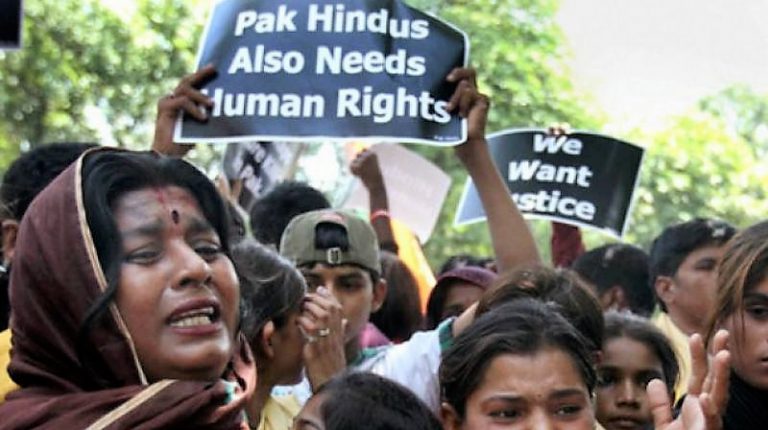
Mob attacks police in Pakistan demanding ‘blasphemous’ Hindu man handed over to them

A Hindu man in the Balochistan province of Pakistan was arrested on charges of blasphemy and sent to jail on Wednesday. 35-year-old Prakash Kumar, a shopkeeper in Lasbela district, was accused of sharing ‘blasphemous’ content on WhatsApp and was subsequently taken into custody for further interrogation.

When the news about the same was published in local newspapers today, crowds started gathering outside the police station where Prakash was lodged. Shops and offices were reportedly closed in protest as people demanded action against the accused, which included shutting down his shop that was operated by his family members.

Blasphemy, especially any insult to the Prophet of Islam, is punishable by death as per the constitution of Pakistan, and has resulted in many instances of public lynching in the past few years. Only last month, a student was beaten to death on his university campus as he was suspected to have made some blasphemous comments on Facebook.

It appears that the mob in this particular incident wanted a similar lynching of Prakash as they demanded that he be handed over to them so that they could deliver ‘justice’ and ‘punish’ him.


When police refused to hand over the accused, the mob turned violent and attacked the police station. They could catch hold of Prakash and injure him, but the police rescued him and dispersed the mob. As least three police officers also sustained injuries in the violence.

Shops belonging to Hindus have especially been closed in the area fearing communal retribution while all roads in the area connecting Sindh to Balochistan have also been closed until further notice.

Incidentally a similar incident had taken back in India in Mumbai’s eastern suburbs in March this year.

Cabinet approves ordinance that gives teeth to RBI to recover bad loans

It is a significant development on India’s fight against bad loans and non-performing assets (NPAs). Kicking off a long-awaited initiative, the Union Cabinet has approved promulgation of an Ordinance to amend the Banking Regulation Act, which will give teeth to the Reserve Bank of India (RBI) to speed up the recovery of bad loans.

Bad loans have increased over the years, thanks to the willful defaulters, bleeding the Indian economy. The development assumes significance at a time wilful defaulter Vijay Mallya is in his safe haven in London after siphoning up over Rs 9,000 crore of loan taken from different banks in India over a period 11 years.

“The Cabinet has approved a major decision related to the banking sector, which has been sent to the President,” Finance Minister Arun Jaitley told reporters on 3 July without divulging the details of the framework.

The new framework envisages setting up multiple oversight committees under the aegis of the RBI to deal with the menace.

Reports suggest that changes are being made to the Section 35A of the Banking Regulation Act and certain provisions of the Bankruptcy Code. These changes will give an explicit mandate to the RBI to act against the loan defaulters on behalf of the banks.

According to available data, private sector banks have been jostling with stressed assets of a staggering Rs 10 lakh crore as of December-end. Similarly, the stressed assets of public sector banks are pegged at a whopping Rs 6.07 lakh crore till December end.

Experts say the new framework will help speed up the recovery of bad loans and clean up the balance sheets of the banks.

The NDA government has inherited a legacy of bad loans from the UPA dispensation. Since 2014, the Union Finance Ministry and the RBI have been drawing up strategy for the recovery bad loans.

Kumar Vishwas placated. But has the AAP crisis blown over?

The ongoing crisis in poll-battered Aam Aadmi Party (AAP) has been temporarily averted on Wednesday (3 May) after a compromise formula was reached out between the party’s two warring factions – Arvind Kejriwal-Manish Sisodia at one side and Kumar Vishwas at the other.

As part of the compromise formula, Kejriwal gave in to Vishwas’s demand to suspend party MLA Amanatullah Khan. In addition, Vishwas has been made party in-charge in Rajasthan, where Assembly election is due next year. The decision was taken at a meeting of party’s Political Affairs Committee. Vishwas, a founder member of AAP, is currently a member of the party’s political affairs committee and is charge of overseeing the funding of the party.

It could be noted that Okhla MLA Amanatullah Khan had called Kumar Vishwas a “RSS-BJP agent” and said that he was plotting a coup against Arvind Kejriwal.

On 2 April, poet-turned-politician Vishwas had hinted at quitting the party. Blaming the “coterie” within AAP for a series of poll debacle, Vishwas had alleged that a section of party colleagues were hatching conspiracy against him.

This was the second attack by Kumar Viswas on party leadership following the MCD poll debacle. Speaking to a private TV channel, Viswas had earlier questioned Kejriwal’s move to hide behind his imaginary “EVM tampering” blabber for the party’s poor show.  Following this AAP supporters hurled filthy abuses at each other on Twitter over Kumar Vishwas.

After the Arvind Kejriwal-led suffered a series of drubbings – Punjab Assembly elections, Goa Assembly polls, Delhi byelection, MCD polls – the crisis in the party was deepening day by day.