Home Blog Page 7633

An appraisal discussion amid growing intolerance

0

Consider an IT company where annual Appraisal discussion is taking place between an employee (say Ravi) and his manager (say Mahesh)

Mahesh: Hello Ravi, how are you?

Ravi: Hi Mahesh, I am good. Thank you.

Mahesh: So shall we start?

Ravi: Yup (takes a deep breath).

Mahesh: So Ravi, let me start with thanking you for all your efforts during last 12 months. It was a challenging year for both, the company as well as the team. Although we acknowledge the various appreciations you got from customers worldwide but somewhere we feel you were not up to the mark.

Ravi: What? Not up to the mark? May I know which mark are you talking about?

Mahesh: See that’s not the point. The thing is you did not deliver a quality product.

Ravi: Mahesh, I delivered it on time and with minimum defects.

Mahesh: See you are accepting that there were defects.

Ravi: But when you write big and complex software that has more than 1.2 billion lines of code, it is bound to have few defects. What about our earlier releases, were they free of bugs? I joined the team when there were severe escalations from customer’s side. C-SAT (Customer Satisfaction Rating) was at all-time low. Within one year I managed to bring it to acceptable levels.

Mahesh: Now please don’t indulge in ‘what-about-ism’. Managing C-SAT is part of your job. But can you deny that QA found defects in your release?

Ravi: WTF… Narindra-Modi

Mahesh:  Not only that, there has been high attrition in your team. This excellent coder Dabholkar put his papers, another guy Pansare resigned. An architect Kalburgi moved to sales. All these count as attrition.

Ravi: Dabholkar left even before I started managing the team and Pansare was in Testing team. That team doesn’t report to me. How are you attributing these resignations to me?

Mahesh: See, they might have their reasons but the fact is that they were not comfortable working in a team where some of your close friends are working.

Ravi: And what about Kalburgi? He was under mainframes and moved to sales, I have nothing to do with his career aspirations. Ask mainframes team why he left the team.

Mahesh: Do you see? You have excuse for everything. You never own up your mistake that is another thing which goes against you.

Ravi: But there have been resignations in past as well when Akash was the team lead whole team of 15 people resigned within a quarter. Why he got promotion after that?

Mahesh: Look, everyone around feels that your performance is going down.

Ravi: But tell me how you determine my performance is degrading. The number of defects was reduced by 5% in this release. Customer satisfaction has improved from below 5 to 7.5; we got 2 new deals from the same customer and will soon start working on the project.

Mahesh: The delivery manager, the account manager and even the HR believe that you are not delivering. Surely they have right to express their opinion.

Ravi: But they always have been against me. They even denied providing any type of help when we were under severe resource crunch. On what basis are they judging me? Surely they have motive against me.

Mahesh: Look, I cant dismiss their feedback as a motivated one. Even the Cigarette shop owner at the corner was expressing concern.

Ravi: What does that Cigarette shop owner knows about my project? I am a non-smoker; I don’t have any business to do with him.

Mahesh: That won’t change anything Ravi. Fact is they want you out of the project.

—End—-
Raveena Tandon threatened and abused by Journalists and Trolls

Bollywood Actress Raveena Tandon has a twitter account and isn’t afraid of using it. She has taken a stand on numerous issues like Award Wapsi, Dadri killing etc and has recently been very vocal. This is in line with other creative people coming up and saying what they feel and it is a welcome sign that we have more people discussing and debating issues. On the back of her social media exploits Raveena often finds herself of TV debates as well. Celebs on social media often get flak from trolls, but this time even journalists joined in the abuse.

Yesterday Raveena Tandon tweeted the following:


//platform.twitter.com/widgets.js

Soon, Priyanka Chaturvedi, a national spokesperson of Congress, instead of debating Raveena’s arguments, decided to attack Raveena directly and dismissed her as a “BJP sympathiser”. Raveena quickly pointed out that she had campaigned for Congress on numerous occasions and was offered prime seats from many parties so it is unfair to slot her with one party. 

//platform.twitter.com/widgets.js


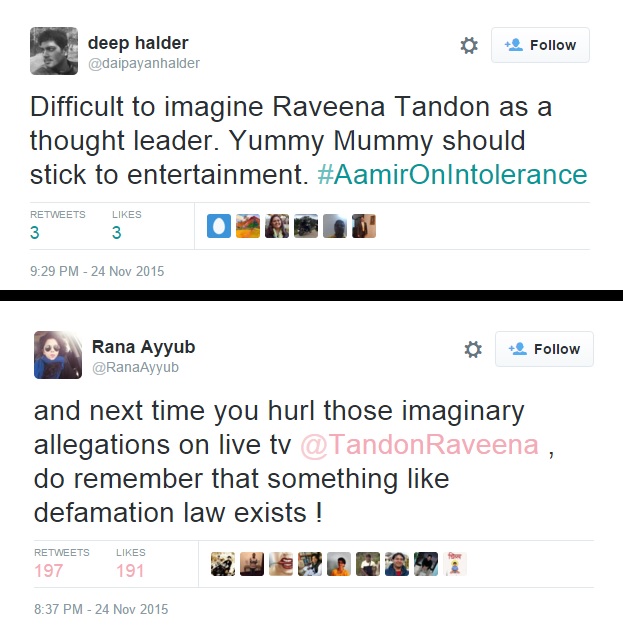
A few weeks ago, Journalists Rana Ayyub and Barkha Dutt, while discussing about Raveena, had made a few uncharitable remarks about her:


Raveena apparently mentioned this on a TV debate and immediately was theatened with a defamation suit by Rana Ayyub:


Ironically this defamation suit threat comes from the same Rana Ayyub who screams intolerance is rising, and from the same Rana Ayyub who had defamed Mohan Bhagwat saying he was behind the Bengal Church “attack”, whereas fact is, it was done by Bangladeshis.

//platform.twitter.com/widgets.jsAs the day progressed more journalists came out attacking Raveena Tandon. Assisstant Executive Editor at Mail Today had these distasteful, sexits remarks about Raveena Tandon, calling her a “Yummy Mummy”:

If journalists are showing the way, how can trolls be far away? Raveena also received abusive messages from scores of faceless trolls. 

//platform.twitter.com/widgets.js


//platform.twitter.com/widgets.js

//platform.twitter.com/widgets.js


//platform.twitter.com/widgets.js//platform.twitter.com/widgets.js

//platform.twitter.com/widgets.js//platform.twitter.com/widgets.js

Shramdaan for Swachh Bharat: A Citizen’s Initiative (23-25 November)

0

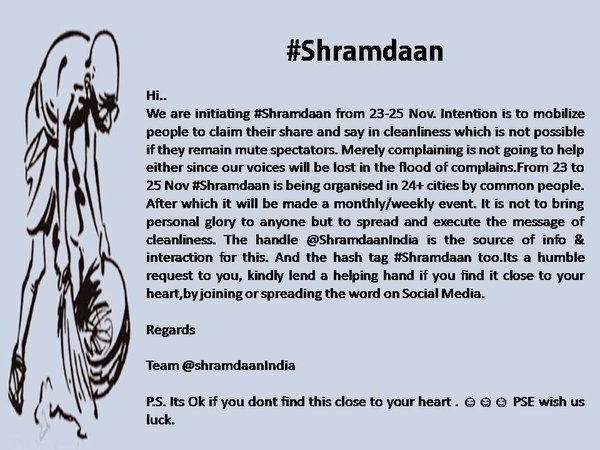
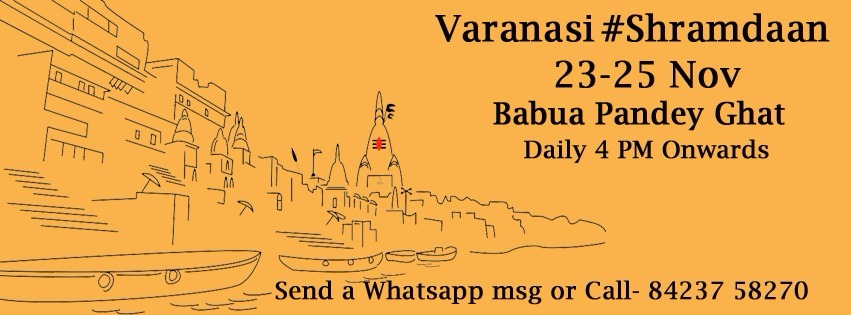
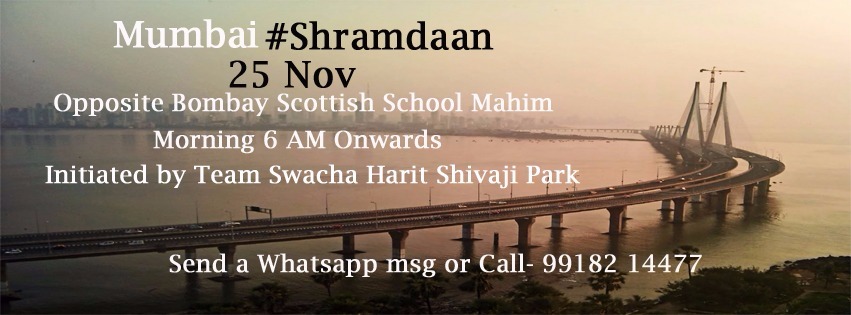
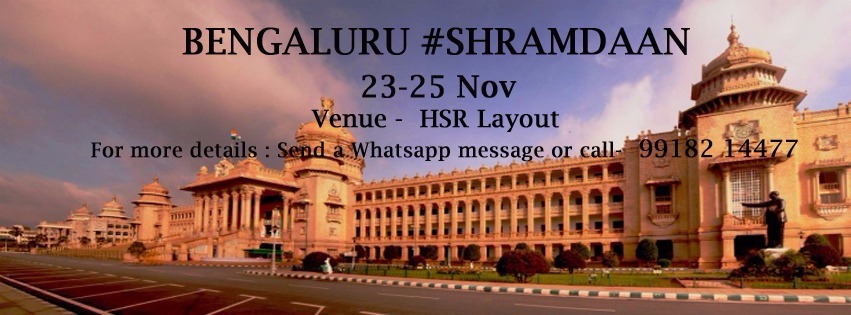
After the spectacular success of Varanasi Ghat cleaning, a group of conscious individuals, including Temsutula Imsong are planning to take the Clean India mission to the next level. Starting 23rd November, individuals across 35 cities of the country are starting a collective effort towards fulfilling the dream of Swachh Bharat. In a mission which is being called #Shramdaan by involved members, different groups in different cities would voluntarily be adopting public places, cleaning them and then maintaining on a regular basis.

The cities where plans are already in place include Delhi, Mumbai, Bengaluru, Chennai, Varanasi, Kohima, Pune, Ahmedabad, Kanpur and Kochi along with various others.

In the inception phase, technology and social media are playing vital roles in connecting these like-minded people who want to contribute to the Swachh Bharat. People are using hashtag #Shramdaan on twitter to spread their message. Despite knowing the fact that Monday may not pull lot many people, these people are excited, hopeful and optimistic.

Volunteers for the mission can be reached out through #Shramdaan hashtag on twitter and following numbers:

Swaccha Bharat IMG-20151121-WA0001 IMG-20151122-WA0000 IMG-20151122-WA0001 IMG-20151122-WA0002 IMG-20151122-WA0003 IMG-20151122-WA0004 IMG-20151122-WA0005 IMG-20151122-WA0007 IMG-20151122-WA0009 IMG-20151122-WA0008 IMG-20151122-WA0010 Shramdaan

Arvind Kejriwal hugged Lalu Yadav, social media made a sweet deal out of it

0

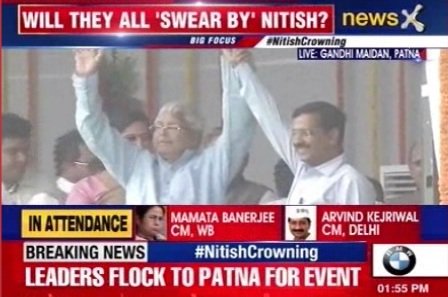
On 20th November 2015, many national leaders were invited for the swearing-in ceremony of Nitish Kumar. The event was highly anticipated. However, like always, Arvind Kejriwal, the Chief Minister of Delhi, snaffled all the limelight.

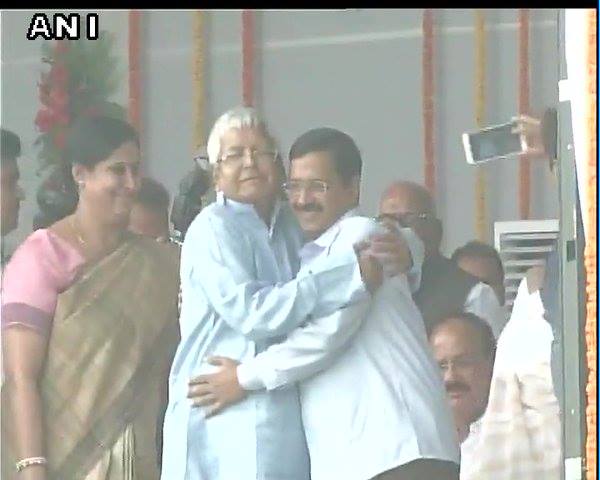
Arvind Kejriwal started grabbing eyeballs as soon as he was seen sharing the stage with Lalu Prasad Yadav:

Arvind and Lalu

In 2013, Arvind Kejriwal made several attacks on Laloo Yadav on the charges of corruption.


Social Media went crazy after seeing the jubilant photo of Lalu Yadav and Arvind Kejriwal hugging each other.

Arvind and Lalu

Here are some very interesting tweets:


There were many other funny tweets still being published when this article was finished. If you find some of them, or if you think we missed some good ones, please put those in the comments section.

Madrassas are a threat to liberty: Tufail Ahmad at India Ideas Conclave 2015

0

On the third and last day of India Ideas Conclave 2015, Tufail Ahmad not only raised many thoughtful questions but also gathered a huge applause from the crowd. Tufail was one of the speakers for the topic ‘Semitic Ideas –Orthodoxy, Modernity & Reform’

After briefly talking about his educational journey from a Madrassa student of Champaran, Bihar to a journalist who now addresses distinguished crowds in many nations, Tufail advanced to the core of the topic by floating following two serious questions:

  1. Is peaceful Islam compatible with the 21st century’s ideas of liberty?
  2. Since the Koran and the Hadiths are not going to change, is there a way to introduce change among Indian Muslims? He further added that by 2050, India will have the world’s largest Muslim population, about 311 million. Therefore, the modern democratic Indian state must undertake some concrete steps now.

Tufail drove the discussion forward through his second question first and emphasized the weakness of the Right to Education Act, which is often superseded by all other rights. His principal concern around the education of Muslims in India was primary education through madrassas, for the reason that madrassas are not exposed to science and other material sciences which students from mainstream schools study.

Tufail Ahmad

Tufail argued that the phase between the age group of 6-14 years is a very crucial phase of life, and if during that phase students are asked to study religion instead of mathematics and science, they can’t be empowered. He further added that if people in India are not allowed to vote before the age of 18, are not allowed to have sex before the age of 18, why should they be allowed to study religion – a subject which required more maturity than what a 6-14 year-old group is supposed to have?

Tufail expressed his dismay against those secular Hindus who tell the Muslims that they will provide them secularism and 5% quota. He requested such secular Hindus to promise him that Muslim kids will be taught mathematics and science. His question to Muslim parents was:  If you can teach the Koran from LKG [lower kindergarten, two years below Grade 1], why cannot you teach mathematics from Grade 1?

To answer his first question, Tufail suggested that until there is a proper education, reformation can’t find a space. He said that the argument for compatibility must stay within the ambit of the Right to Education Act. To support his point, he stated that the Arab Spring failed because there was no infrastructure of liberal democratic ideas in Muslim societies. The Islamic State, or ISIS, gains support globally because conducive ideas already exist in our societies.

His suggestion to the government was: The Indian government must introduce three textbooks from Grade 1 through 12: One on Indian classics such as Upanishads, Mahabharata, Gita and classical Indian thinkers; a second primer on the Constitution’s ideals; and a third primer containing good points from all religions.

While expressing his concerns regarding Islamic Reformation, Tufail asked:

Is it possible that an entire generation of Muslim youths can abandon ideas inherited from their parents and Islamic clerics? Fortunately, history gives us hopeful lessons: In Italy and Germany, a generation of youths abandoned their parents’ beliefs in Nazism and Fascism. In India itself, Hindu youths abandoned castes and Sati. Christianity and Judaism went through their internal conflicts; the Bible and the Torah are removed from public life. In India itself, the Manusmriti has been abandoned. Since Islam is the youngest of the Middle Eastern religions, there is hope. The role of the Koran must be limited to mosques. We must study peaceful Islam, and the cause of Islamic Reformation in India must begin in the age group of 6-14 years.

During the question-answer session, when someone asked about the role moderate Muslim, Tufail took a jibe and said, “A Moderate Muslim is one who is sleeping all the time. A Moderate Muslim wakes up just in time, to criticize both the Liberal Muslim and the Extremist Muslim when a Liberal Muslim takes up a fight with an Extremist Muslim”

Note: The speech can also be read at: http://www.memri.org

From Dadri to Haryana to Manipur, how stories about crimes against Dalits and Minorities have panned out

0

In the run-up to the Bihar elections, media reported many atrocities and crimes taking place all over India, and most of such stories which were heavily highlighted by media related to crimes against minorities and dalits. As the dust settled though, much like the unfolding of the “church attacks” bogey, many of these stories revealed some alternate versions which question the premise of rising intolerance and communal violence

1. Dalit family stripped by police.

A facebook page named as “DALIT Parivar – The Rising Shudra – dedicated to Dr. Bhim Rao Ambedkar” posted a video claiming that a Dalit family in UP was stripped by police. This was first picked up by a site called Daily Sikh Updates, (who later deleted the story) and later by news sites like The Hindu and DNA . The video in fact was inconclusive and could not prove that the family had been forced to strip. DNA did mention this in their piece, but only as a byline. India Today however carried a story that the family had stripped on its own accord, as a sign of protest. A ground report from Caravan also supported this theory and also revealed that Sunil Gautam, a member of the family was commonly found doing such antics. Eventually SP Noida also clarified that the family was not stripped by the cops but it was done by themselves. We had covered this in our “Media lies” post for October.

2. Dadri Mob lynching of Akhlaq over beef

We are all too familiar with this news, which was a sort of inflection point for the entire “intolerance” debate. We were told that a lynch mob, on the basis that a Muslim had eaten beef, attacked him and beat him to death. Today a story has emerged from Dadri, with an eyewitness saying beef may not have been the reason. He says the murder was orchestrated by a handful of people and not a mob. He says the main motive was some personal enmity. He asks why Akhlaq’s son Danish, who had suffered injuries and was the prime witness, hasn’t been approached by the cops even though he is out of hospital now. He asks why the piece of cow hide was so far away from “beef eater” Akhlaq’s house. While this may not be enough to conclusively prove anything, these are pertinent questions which raise doubts about the original narrative.

3. Khap orders rape of Dalit sisters

Amnesty International, the human rights group, hosted a petition to help 2 dalit sisters in UP, who were apparently ordered to be raped by a Khap Panchayat. According to a news report, one of the sisters also moved court. But after the story gained much international traction thanks to Amnesty, some issues began coming up. BBC visited the said village and the villagers said there was no such order passed. The local police also said that their investigations revealed that there was no such order passed. The village council also denied such allegations. When asked, Amnesty spokesperson Gopika Bashi said:

“We have not been on the ground, we have not visited the village, We still believe that whatever has occurred, regardless of allegations being thrown back and forth that it’s very important that the family is safe and the girls are safe.”

Apparently Amnesty’s petition, which went viral all over the world, was based solely on the application made by one of the sisters to the court. In such cases it is hard to say which version is the truth, but fact remains that it wasn’t a clear cut case as it was made out to be by Amnesty.

4. Man killed for ‘stealing’ calf in Manipur

This story said that the headmaster of a school, Md Hasmad Ali was beaten to death after he was seen with a calf that was missing from the shed of one of the villagers. This lynching story was picked up even by NY times to further their anti-India propaganda. Even though the media had made up its mind, Ali’s elder son said something different:

It’s a cold blooded murder because of some land dispute. The murderers shift the blame on another community and take advantage of the (sensitive) functioning of the society.

The son further blamed his father’s death on a personal land dispute with his neighbour and also distant relative, Mohammad Amu, and Amu’s brother. The family said that Amu tried to mask his personal enmity by using communal overtones to shift the blame elsewhere even as he was settling scores with his enemy. Also, the “Meeteis” have been characterised as Hindus, by national media, who killed a Muslim. But a member of the Meetei ethnic group staunchly opposes  being homogeneously identified with being Hindu or Hinduism. In his detailed account of the incident, he mentions how no-one in the village bought the cow story and that Ali, the deceased, was a well to do, respectable citizen who would never need to steal a calf.

5. Dalit children burnt alive by Upper castes in revenge killing

News channels went into overdrive discussing this revenge murder of dalit children by upper caste Rajputs. TV debates were centred around growing intolerance and rising incidents of violence. An angle was dug which said this murder was a revenge for the children’s family being involved in some murder, a year back. But a few days later, as investigations went ahead, initial theories were trashed. Forensic experts who investigated the crime scene concluded that the “origin and source of fire was from inside the room and not from outside”. They found a half-burnt kerosene oil plastic bottle under the partially burnt bed and a burnt matchstick lying on a slab next to the window of the room. The report also apparently mentioned that there were “no traces of outside entry” into the premises. There are many other inconsistencies between the forensic report and the version which was publicized. Again, too early to say either ways but premature outrage won the battle.

6.  90-yr-old Dalit man burnt alive for trying to enter temple in UP

The story claimed that an old Dalit man was killed because he tried to enter a temple in Uttar Pradesh. Embedded image permalinkThis was subsequently picked up by various media outlets. But other media houses reported that the Dalit man was in fact killed by a drunkard. They reported that the Dalit man was going to the temple, when he was asked for money by a drunkard. When he refused, the drunkard hit him with an axe, and later burnt his body. This was also confirmed by the District Magistrate. Indian Express also confirmed the money angle and further reported that the deceased was in fact coming out of a temple and that too a temple built by members of the SC community. So the bogey raised by Hindustan Times was proved to be totally untrue. We had covered this in our “Media lies” post for October.
Pakistan is the original “Islamic State”, much before ISIS: Tarek Fatah at India Ideas Conclave 2015

0

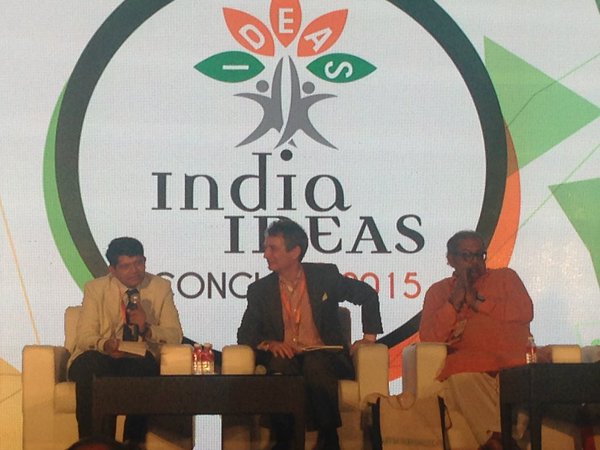
The second edition of the India Ideas Conclave 2015 is being held in Goa, from November 15th to November 17th. It is organised by the India Foundation, and brings together a luminary gathering of policy makers and public intellectuals from around the world. Over 350 intellectuals, professionals, scholars, journalists and social activists participated in this conclave.

One of such sessions was on the topic ‘Rise of Radicalism – Future of Civilisations’. One of the speakers was Canadian author and columnist Tarek Fatah. His searing attack on radical Islamism in Pakistan was the highlight of the session.

Mr Fatah came down heavy on the “Idea of Pakistan” calling Pakistan the original “Islamic State” much before ISIS (Islamic State of Iraq and Syria) came into existence earlier this decade. He declared it a waste of time and utterly useless an activity to engage with Pakistan hoping that it will bring peace and stability in the region or in the world.

Mr. Fatah said that he respected Prime Minister Narendra Modi’s motives, but added that the government of India was being foolish if it thought that Pakistan has any interest in dialogue or peace. Instead of a dialogue, Mr. Fatah argued for an aggressive policy to dismember and dismantle Pakistan, as the current idea of Pakistan was incompatible with modern global ideas of peaceful coexistence.

He argued that it was a grave mistake by India to let Pakistan off easily after the crushing defeat in Bangladesh liberation war. India should have gone for total annihilation and liberated even Baluchistan back then, he argued.

aaa

Justifying his aggressive and combative approach towards Pakistan, Mr. Fatah said that Pakistan was more cunning and dangerous than ISIS as it had nukes, and because it was the only group in the world that has successfully been fooling India, US, and China at the same time.

He mocked people for believing in “aman ki asha” type of efforts and expressed shock and dismay that some people recently went to Pakistan believing that that country could help bring peace to the region. He reiterated that Pakistan represented that radicalism that is now being witnessed as global terror in different parts of the world, most recently in Paris.

He said that it was unfortunate that many Muslim youth across the world were getting drawn into this radical version of Islam, which finds its roots in Wahhabi version of Islam. This version is also about superiority of the Arab race, and that’s why people in Pakistan are increasingly trying to ape the Arabs.

Apart from dismembering Pakistan, he had another solution to fight radical Islam – promotion and propagation of the Indian version of Islam – which is so heavily intermingled and married to Hinduism, that divorce is not possible.

Subramanian Swamy’s allegations against Rahul Gandhi, and the other things they reveal

0

In his latest expose Subramanian Swamy has fired a fresh set of allegations at Rahul Gandhi, but unlike mudslinging by others, he has hard facts and documents to back his case. He has revealed a letter  which he has written to the PM, in which he alleges Rahul Gandhi has:

  1. Violated Article 9 of the Constitution by accepting citizenship of UK while holding Indian citizenship
  2. Has incorporated a company abroad, without taking prior permission

For the above, he says, Rahul Gandhi must be stripped of his Indian citizenship. He also makes  a claim about Rahul Gandhi having an illegal undeclared account in Zurich to stash black money, but this point is not backed up by documents. To be fair, it would be extremely difficult for a layman to access such documents, but for the first two allegations, Swamy has strong proofs.

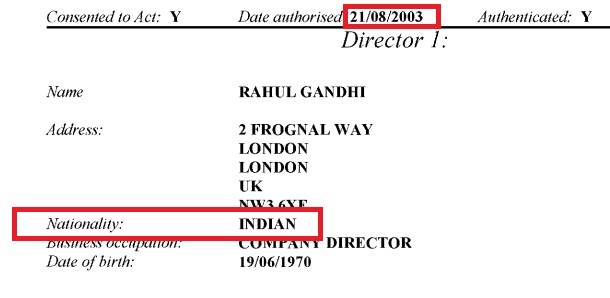
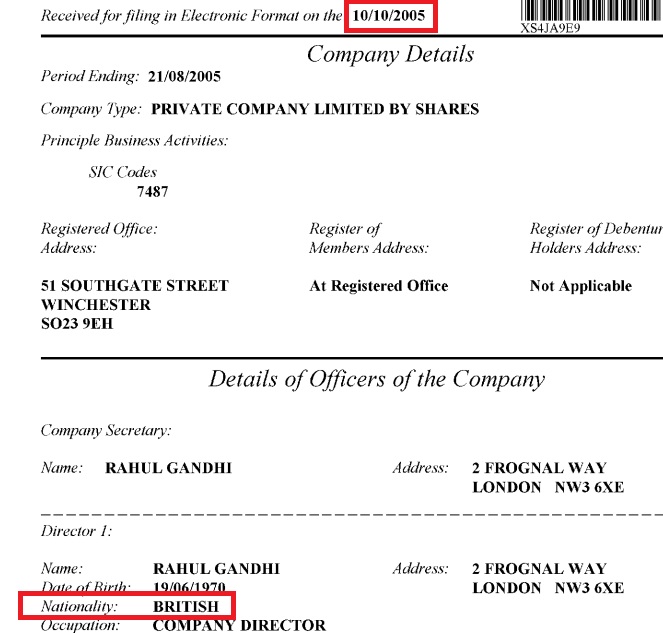
Swamy has dug deep and found that Rahul Gandhi had incorporated a British Company called Backops Limited. The regulatory site for companies in UK indeed shows the company Backops Limited and Rahul Gandhi as one of its Directors. According to Swamy, if Rahul Gandhi had not taken prior permission to set-up this company, it is a violation. The picture gets murkier as we look into the details. In 2003, when the company was formed, Rahul Gandhi declared his nationality as Indian.

a
Company Filings from 2003

But in 2005, some details of the directors were changed and Rahul Gandhi’s nationality was made British!

b
Company filings from 2005

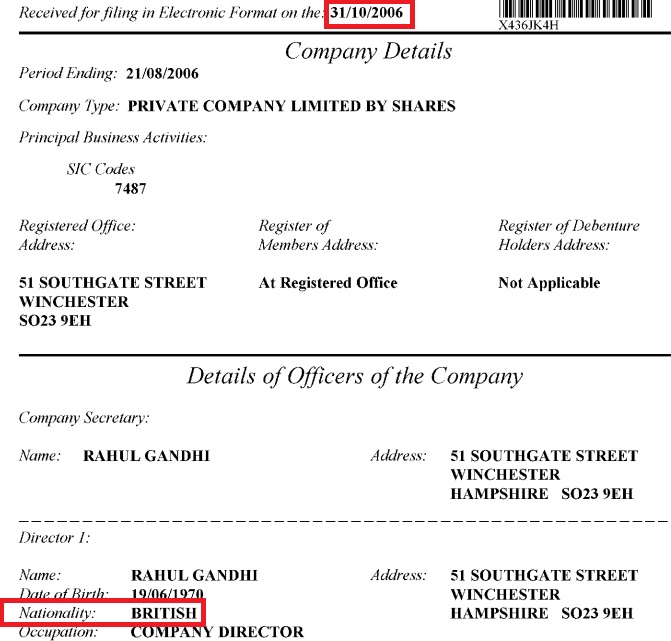
So how did this happen? Was this an error? Was it deliberate? Did Rahul Gandhi accept British citizenship? Can a company handling the information of such a high profile leader make a mistake? If it indeed it was a clerical error, surely such a mistake can be corrected soon, but in 2006 also, when the company filed their data, Rahul continued to be shown as a British national.

c
Company filings from 2006

Eventually the company was shut down. So did Rahul Gandhi hold two passports at at a time? If yes, he may find himself in a similar position as Devyani Khobragade’s children. Devyani had obtained US passports for her children even as they held Indian passports. The Indian Government, had in its affidavit mentioned that this raises serious questions about her “trustworthiness and integrity”.

Rahul Gandhi also does not seem to have disclosed this fact that he was a director in the above company, in his affidavit filed for General elections of 2004. The disclosure made by Rahul Gandhi says, he owns 83 shares in a “firm” called “Backop Services”. Firstly, the term “firm” is not used for a company. Secondly, “Backop Services” by itself cannot be the name of a company, since it has to be appended with Limited or Private Limited. So was there a partnership “firm” by the name “Backop Services”? Probably not. Rahul Gandhi also had an Indian company named “Backop Services Pvt Ltd”, in which he did own 83%, to which the affidavit was probably referring. So clearly, the affidavit only mentions his interests in the Indian company and not the British company Backops Limited.

The other director in this company is Mr Ulrik McKnight, an American. Who is he? He is journalist and NYT columnist Sonia Faleiro’s husband. And who is Sonia Faleiro? She is the daughter of Eduardo Faleiro, who has been a Congress politician all his life, and has even been a Union Minister for 5 years. Nothing illegal here, but now we know how Rahul Gandhi might have met Ulrik McKnight.

Another interesting angle which comes up is the address which Rahul Gandhi used as his own, for the company formation. In the initial filings, Rahul gives his address as “2 Frognal Way, London”, which is the same address Ramola Bacchan gave, in some of her company filings, but back in 1998. Ramola is Amitabh Bacchan’s sister-in-law. McKnight also used the same address.

As we discussed earlier, Rahul Gandhi owned  83% in an Indian company called Backops Services Pvt Ltd. In 2012, it was reported by Outlook that that the registered address of the company led to a chartered accountancy firm and the employees of the firm had not heard of Rahul’s company’s name, and in fact “became a little nervous when queried further.” When they contacted Rahul Gandhi to know more about the same, “he was livid” and accused the reporter “of breaching his privacy and claimed he wasn’t obliged to speak to the media about his private affairs before hanging up”. Shortly, a calmer Rahul Gandhi called back and gave some answers.

In 2004, a Deccan Herald report had claimed that Rahul’s Indian Backops company, had landed high value projects, like “construction of International Airport Terminal Building at Mumbai, container freight station for Maersk Sealand, Training Centres for RBI, headquarters of Wochhardt Ltd and Wockhardt Hospital in Mumbai, IPCL township at Nagothane, meditation hall at Osho Commune of Pune”. In his response to Outlook, Rahul also rubbished these claims and said it was a small company.

Interestingly, in 2012 itself Swamy had alleged number of frauds done by this company too. In a press conference, he had alleged that this Indian company too had flouted Indian laws and regulations. The progress of this case is however unknown.

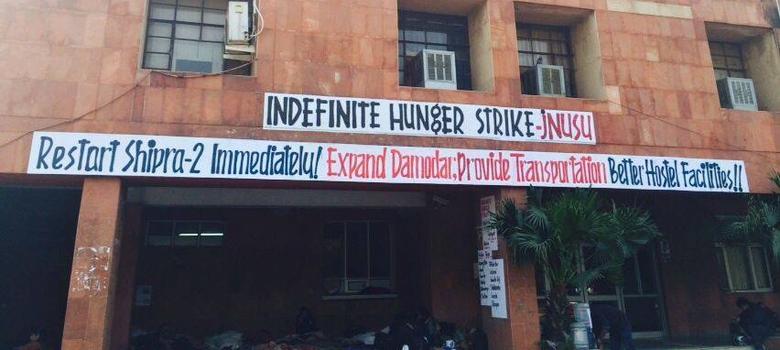
A JNU student speaks: I hope one day my Alma Mater stops being “a communist hell-hole”

0

Navneet N, who goes by the Twitter handle @navfrn, has been a contributor on OpIndia.com before. He co-wrote the interesting take on why Bihar deserved much more than the economic package given to it, because of the severe neglect it has faced over the years. Recently, his series called “JNU chronicles” on Indiafacts.co.in caught our eye. We decided to ask him about why he chose to suddenly speak about his college days, which were spent on the campus of JNU. Here are excerpts from our conversation:

Q. How did you end up in JNU, i.e. are you a Marxist who gave up or a Right-minded youth who ended up in a Marxist institution?

Navneet: I am not a Marxist and I never was a Marxist. Every year more than 800 new students join different courses in JNU which include Foreign Languages, Hindi, International Studies, Social Sciences and various courses in Science stream.  It is true that communists occupy the teaching space of JNU. They work to create new crop of communists every year who grab teaching space in several Indian universities, jobs in media-houses and NGOs. But, JNU also has a strong presence of nationalist forces which could be possible only after continuous struggle by nationalist students who challenged the Left in their own bastion.

Q. When did you study there, and why are you only now coming up with these stories?

Navneet: I studied at JNU during 2003 to 2008 in French Center. The stories I share are from the period I spent there and many of them shall be about the incidents which happened earlier or in last few years, but they can always be corroborated with several JNU students.

The purpose of #JNUStories was to break this stereotype that every JNU student is a Marxist. The motive is not to malign any individual wrongfully. This is the reason I rarely use names of people involved in those stories. The purpose is to expose the malaise of Communism that is hidden behind the cool Ché T-Shirts and bearded faces.

Another reason these stories are getting out in public is because of emergence of the social-media as a strong tool which can be used to expose the hypocrisy of the left. I would consider it successful if 18 years old girls and boys read these stories before taking admission to JNU as it helps them understand the Communist modus-operandi in advance so that they don’t fall into the trap. This is why I ask people to share these stories as much as they can so that anyone who has a sister or a brother or someone known to them who is to get an admission to JNU shall share it with them so that they would know in advance what they can anticipate what could happen in the JNU Campus. It would help in decreasing the number of new comers who fall in the trap.

Q. How do you respond to people who say this is just college gossip?

Navneet: It is a good question as many stories may sound like gossip with no authenticity. The stories that I share are already in public space and most JNU students who have spent few years in the campus already know about them. To believe or to reject them is the reader’s choice but if they enquire of these stories, they can easily find connections which would prove the authenticity.

Q. In the age of FIRs for defamation, do you not fear retribution?

Navneet: I doubt if any of the Communists who appear in my stories would dare filing an FIR as it will give me a legal weapon through which I can dig into the old files of the sexual harassment committees where they did not follow the procedure to protect their comrades. There are so many such examples where procedures were skipped, just to recruit professors with left-leaning bias and bypassing students in interviews by checking their left-credentials. There also was rampant corruption in seminar funds and JNU infrastructure funds. This will be nothing less than stirring up the hornet’s nest. I would appreciate if someone files a defamation suit.

Just to add some perspective, the protagonist of the first story was confronted by many women on Twitter and even Kavita Krishnan confirmed about the authenticity of the story, but he never challenged me directly and I was not blocked by him as he might have calculated that blocking me may be counterproductive. He works for a humanitarian NGO based and he has enough clout to challenge it legally but he chose to remain silent.

Q. Why do you think the current situation of JNU being a communist bastion is undesirable?

Navneet: JNU was created as a gift of Congress to Communists so that they don’t create issues for them. JNU is heavily subsidized by the taxpayer’s money and it is ironical that the money is used to build an army of leftist foot-soldiers who work against Indian sovereignty. It sounds quite bizarre when JNU students invite SAR Geelani of Parliament attack case to speak on topic of independence of Kashmir and students who belong to Bengal, Kerala, UP and other states shout slogans of Azadi. JNU has got infrastructure to produce the best brains of India who can work in administration, media etc.

Q. What do you think has led to JNU becoming what it is?

Navneet: The principal reason is the well-protected system which does not allow anyone as teaching staff who does not believe in a leftist ideology. The day left control gets loosened, many so called leftist professors shall come out in open with their stories of how they were asked to take unethical steps like destroying career of students who would try to challenge the leftist control in the campus. When readers follow the hash tag of #JNUStories, they shall get a much clearer picture about how left system sustains itself and remains like a red patch in the capital of India.

Q. How do you think JNU can be salvaged from its current state?

Navneet: JNU needs continuous focus of several years to untangle the knots and make it a university which is known for its excellence rather than left hooliganism. Many JNU centers like Urdu, Persian, Arabic and Hindi have disproportionate number of seats. They hardly provide any job opportunities and students end up driving autos, running canteens in JNU and typing thesis of other PhD students of JNU to make a living. UGC should ensure that streams of other Foreign Languages, Sciences or Sanskrit etc get approval to double their seats. JNU professors should be transferrable so that they don’t spend their whole life in the comfort of JNU campus. If they are not allowed to gang up at one place, they won’t be able to maintain the hegemony.

I am sure that one day my Alma Mater shall not be known as ‘Communist Hell-Hole’ and its nationalist tradition shall get more exposure.

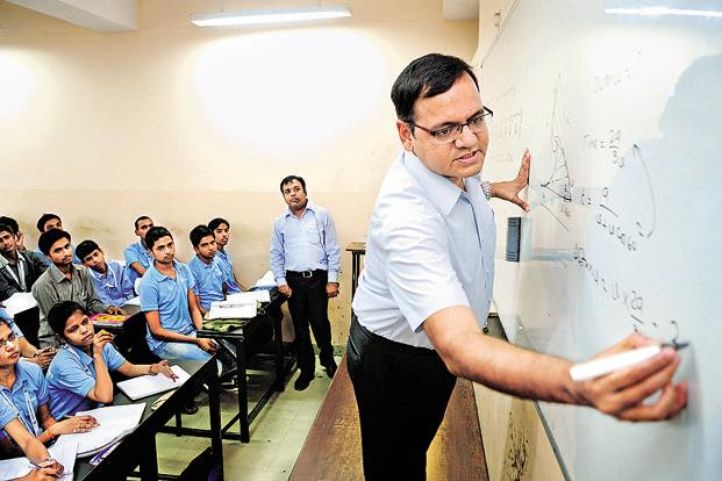
Does Smriti Irani’s HRD ministry have plans to regulate private IIT coaching centres?

0

For some reason, news related to the HRD ministry often gets reported in a not-so-factual manner. Take for example last month, where Minister Irani herself had to take to twitter to call out false news being peddled by The Hindu. This time, we have another news story doing the rounds. This relates to IITs, which come under the purview of HRD ministry and are in a fair bit of controversy for various reasons.

First the news being reported:

Economic Times said: “HRD Ministry….plans to check influence of (IIT) coaching centres”

A similar news item was in TheNewsMinute.com: “Government could now regulate fees in IIT JEE coaching centres “ .To be fair to them, they merely aggregated a news-report from The Hindustan Times

The Hindustan Times also said: “If the human resource ministry (HRD) ministry has its way students may have to shell out much less for JEE coaching.”

Although the above lines gave the impression that the Government was planning such a move, all the stories in their opening lines itself clarified that this “move” was suggested by a panel set -up by the HRD ministry. So the assertion made my media, that the Government or HRD ministry is doing something like regulating coaching classes is misleading. Further, these are only recommendations by a panel, which have been made public for widespread consultation and feedback. So jumping the gun and saying the HRD ministry is planning something is too far off the mark.

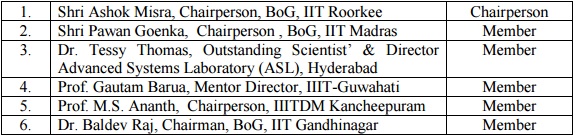
The panel itself is made up of very eminent people including 2 chairpersons of Board of Governors of 2 IITs. So the panel, its credibility, its apolitical nature, should not be a matter of debate.

Committee of Eminent Persons

The problem with this “suggestion” of the panel, to regulate coaching classes and their fees is the fact that it goes starkly against the principle of free markets. The Government has no role regulating how much private businesses charge a student. A free market dictates that such decisions be left to the market. So the question arises, why does the Government have to ask a panel to give “recommendation” on such issues?

This is where there is a twist in the tale. If one looks at the Report of the committee, which is available in public domain, it clearly says that the panel was formed for “to review the current JEE system for admission into IITs“. Going into the exact terms of reference:

The terms of reference of Committee of Eminent Persons review the current JEE system for admission into IITs is as under:

  1. To recommend structure of a single exam that tests the understanding, conceptual clarity, and innovative thinking of students for admission to IITs and NITs.
  2. To find means in the exam structure that would reduce the pressure on students and reduce dependence of students on the coaching centres, without diluting the quality of testing.
  3. To appreciably reduce the time taken from conduct of the entrance exam to declaration results, from the current 3 months.
  4. To review and recommend reforms if any needed in the common counseling process so that admissions in IITs, NITs, IISERs are completed without any difficulty.

As can be seen, the Terms of Reference state that the panel was set up to give recommendations related to exams and admission processes. Nowhere does it mention that it was asked to give “suggestions” on regulating fees at private coaching institutions. Then why did this panel “recommend” something which it was never asked for? Did it even recommend something like this?

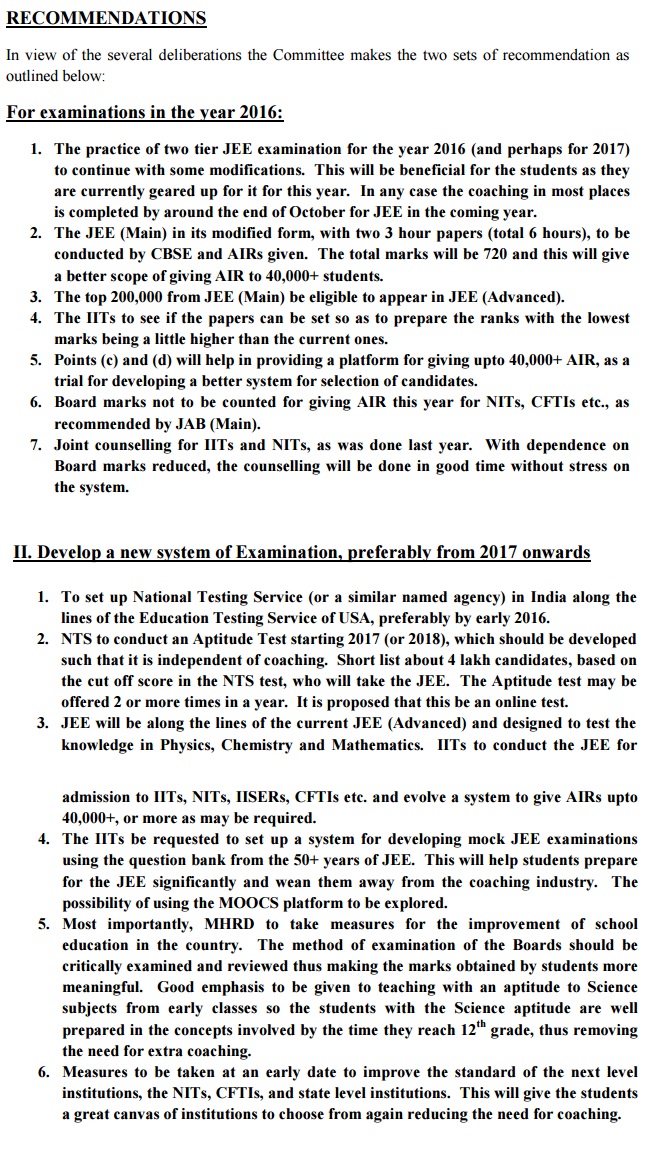
If we scroll down to the end of the report, we see a section titled “Recommendations”:

Untitled
Recommendations of the panel

As can be seen, all the recommendations are only in the field of examinations and there is not a single clause which talks about “regulating fees of coaching institutions”. Even the press release issued by PIB, lists out the recommendations and again has no mention of the “regulation fees of coaching institutions”. So from where did this “recommendation” come?

A deep dive into the report takes us to the section titled “Deliberations on reducing the effect of Coaching Institutions”. It is from here that all the quotes on coaching industry have been picked up. The terms picked by media: “ lucrative ‘industry’”, ” not always mindless profit”, “regulatory body for the coaching institutions“, are all picked from this section. The specific paragraph under this “Deliberations” part which talks about regulation is:

3. It is suggested that it would be helpful if there is a regulatory body for the coaching institutions. As an example, An All India Council for Coaching for Entrance Examinations (AICCEE) maybe established with the demand that Coaching Institutes are well equipped and maintain healthy and best practices as well as charge regulated fees.

This is where there is a slight confusion. Although the paragraph starts with “It is suggested”, the paragraph itself is in the “Deliberations” part of the document and such a topic does not find even a remote mention in the “recommendations” part. So is it fair to say these are “recommendations”? Considering the fact that as the terms of reference state, it was never within the scope of the panel to opine on anything related to this?

So to sum up, deciding on regulation of fees of private coaching institutions was not part of the mandate of the panel. The panel, made up of experts, deliberated on this, but explicitly left this out of their recommendations. The PIB release, which summarised the recommendations did not mention this as a recommendation. Even if someone were to take a stand that it was a recommendation, it is only that, just a recommendation, which is kept open for public consultation. And in-spite of all this, some sections of the media reported that the Government plans to do something like this!

P.S. As of now, since the suggestion to regulate coaching classes is neither a part of recommendations, nor a part of the scope of the committee, nor considered as a recommendation by the Government in its press release, it is far too premature to bring up this issue. But if in the future any such action is taken, it needs serious thought.