Home Blog Page 7634

Anti-Modi group refuses to apologize for distorting “Om” into Nazi symbol

0

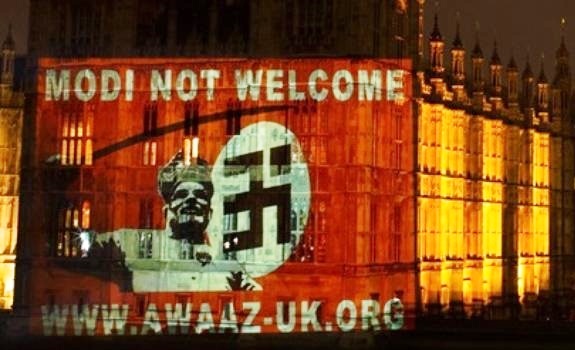
A group opposing Prime Minister Narendra Modi’s visit to United Kingdom has come out with a statement on its activities after it was criticized for distorting the sacred Hindu symbol “Om” into a Nazi symbol to show Modi as a fascist leader.

Anti Modi poster
The poster showing a distorted Om

The group, calling itself Awaaz Network, has reiterated in its statement that Modi is a leader following fascist policies, but has offered no apology for distorting the “Om” symbol.

Earlier on Sunday this week, the group had claimed to project an image showing Narendra Modi with a sword onto the Palace of Westminster (part of UK Parliament) in London and distorted “Om” to look like the Nazi Swastika.

While calling or depicting Modi as a fascist violent man is hardly new or controversial among the group of people believing themselves to be liberals in India, the distortion of “Om” was surprisingly called objectionable by some of them.

Among others, the objection was registered from former Jammu & Kashmir Chief Minister Omar Abdullah, who has been rather toeing a hard-line stance since his electoral defeat and even a left-leaning blog such as Scroll published an article calling it offensive.


Needless to say, many Hindus, regardless of their political leanings, too protested the distortion of “Om”. However, such objections and protests seem to have had no effect on the group, which didn’t offer any apology, or even regret, for its act.

In fact, in its statement, the group brazenly declared that “the image was chosen carefully and deliberately” and tried to reason that since Hindutva groups like RSS use Hindu symbols, they too were justified in doing it.

The statement by the group further makes the allegation that Mahatma Gandhi was murdered by an RSS member. This is factually incorrect as Nathuram Godse had left RSS accusing it of not being militant enough and had formed his own organization.

While RSS is known to allow defamation and misrepresentations against itself, this is one of those occasions when a group has decided not to care about allegations of defamation to a Hindu sacred symbol and insulting Hindu sentiments.

We at OpIndia.com believe that this act could well be protected under free speech laws (though a similar distortion of Islamic symbols can attract criminal case under IPC 295A in India) and we are not demanding any action against the anti-Modi group in India or in UK, but this act has to be highlighted as it comes at a time when anti-Modi groups are accusing Hindus of “growing intolerance”.

The agenda appears to provoke, and then claim intolerance when a person falls for the provocation.

Series | Decoding Indian Belief Systems: Is this world just a dream?

Dreams can sometimes be very powerful. They can send you into a state of deep introspection eliciting the deepest of questions from you once you are awake. It was one such vivid dream that made me question: What I had just experienced felt so real; was it a mere concoction of my mind? Over time, I figured that I was not the only one with this question. In many a philosophical conversations, I was amazed to see that so many other people had discovered this same deep philosophical question within them, and were moved by it. It was only eventually that I discovered Ashtavakra Gita, an entire Upanishad (philosophical scripture), had been triggered by one such dream and the question that followed: Is the dream world real, or is this ‘real’ world real?

Not just dreams, but even our so-called real world is pregnant with similar philosophical questions. One of the most famous ones is: “If a tree falls in a forest and no one is around to hear it, does it make a sound?” Does observing something make it real, and hence the truth isn’t objective (or same for everybody) but dependent on the observer (subjective reality)? Similar questions around the nature of reality and truth occupy a large space in Indian philosophical discourses.

What is then the nature of reality? This question takes us back to our previous article and the idea of how Indian philosophers have viewed life. In Indian thought, the nature of life is like a circle, where you die to be born again, and the circular process is an infinitely repetitive one. For a moment I would recommend you, the reader, to suspend your beliefs about life for a moment. Maybe you believe in a linear life maybe you don’t, maybe you believe in God or maybe you don’t, maybe you believe in objective reality maybe you don’t – but to understand how Indian thought has evolved, let us just forget our philosophical identity for a moment. And then let us understand this question from the Indian philosopher’s perspective – the one who thought life was like a circle.

What if life really was a circle? What if the point of dying was to just be born again? What if the same rut of life had to repeat itself over and over and over again? What would then be the purpose of this life? And the next one? And the next? It certainly wouldn’t be achieving great material outcomes in this lifetime, as you would again begin a new life from square one. Great money, fame, or power in any one lifetime then become worth nothing in the (infinitely) long run. In fact, nothing is worth anything in this worldview. What would life really mean then if it was a circular phenomenon?

An equally deep and closely linked question that arises from the circular worldview is around the nature of our identity itself. If I would be reborn into another body, then am I not this body? Is this body just a vehicle for who I really am? Who am I really then? What is my truth?

In their quest for these answers, Indian philosophers spent a lot of time in observation of their own mind, and introspection of the world around them. If I will be born again and again into newer bodies, then this body is not my truth. Also, the world will keep continuously changing itself then this world is not my truth. Anything that will change can just be my temporary form of existence but it cannot be my real truth – something which is true forever. It could just be my temporary form of existence. Who am I, and what is my purpose in life thus closely became connected to other fundamental questions: What is my eternal truth? Is there an eternal truth or is everything falsehood?

But, to be able to say something is false, one should also intuitively know what truth is. One needs to have a frame of reference which can distinguish the two. To observe the change and call it untrue, there needs to be an unchanging observer who is observing the change. But if this observer is unchanging, then wouldn’t this observer himself be eternally true? It is this observer then who would change bodies, and see the false world unfolding around him.  This observer is not something outside of us then, but something unchanging at the very core of our existence. Who is this observer/entity which is constantly unchanging in its essence? Does such an entity even exist? Where is this entity located? The answer to this question has been explored differently by different philosophers leading to multiple viewpoints emerging. These viewpoints have led to the development of various strands of Hinduism, Jainism, and Buddhism.

While we will delve into each of these philosophies in detail in a later post, we can explore one key similarity here. The purpose of the lives of the Indian philosophers was the exploration of the eternal truth. And the eternal truth was not to be found in the world outside, but the world within. The eternal truth could only be discovered by understanding the observer who was witnessing the falsehood of everything outside of him. The eternal truth could only be understood by understanding who we ourselves are. The path to the eternal truth, if such a truth exists, was only through self-realization. In a circular worldview, that became the goal of all human existence.

For many an Indian philosopher the real world lay within and the world outside was just an illusion. This is the understanding of the oft-repeated and even abused term ‘Maya’. The world is Maya or Mithya (untruth), and this illusion can only be unraveled by knowing the real truth – by knowing our own selves.

Such an understanding then immediately leads to a flurry of many more questions: How can we know ourselves fully and become self-realized? If the world is Maya and untrue, does it mean one should stop interacting with the world outside? What is the nature of the relationship between truth and Maya? If this bodily self is Maya, how should one interact with his own body?

While I leave you in the hope that you start exploring these questions on your own, and also in the anticipation for some of these answers in upcoming posts, I would like to close this post with one piece of advice from an Indian philosopher’s perspective: If anything is bothering you and taking away your mental peace while you can’t do anything about it, just think about whether whatever issue is bugging you will be significant enough to remember 20 years from now?  Everything changes and so will this. And in this constantly changing circle of life, the only unmoving thing is your very own inner centre. Knowing this, become totally centered in your own being. Peace.

–@shreyansmehta

(Disclaimer: The opinions expressed within this article are the personal opinions of the author. OpIndia.com is not responsible for the accuracy, completeness, suitability, or validity of any information on this article. All information is provided on an as-is basis. OpIndia.com does not assume any responsibility or liability for the same.)

The elitist side of the firecracker debate

0

As a child growing up in the rural Maharashtra in the late 80s and 90s , I heard exotic colloquial phrases used by elders around me almost constantly.  More than a few were colourful enough not to risk reproduction here, but a relatively mild one comes to mind while opening the fire cracker controversy. When translated it meant “everybody wants Bhagat Singh to be their neighbour’s child”, which meant- people like martyrs, just not in their own family.

In the 21st century this thought process has taken an aggressive turn where on occasions,people are making the ludicrous demand  that their neighbour’s kid be a martyr. Nowhere this tendency is as obvious as in the environment protection movement.

Before we begin the argument on whether fire crackers be banned in earnest, allow me to trace my way back all the way to 1963 (some 15 years before I was born) and to another environment protection controversy. It will serve as a good example of how when it comes to sacrifices, environmentalists are often guilty of “neighbour’s son as martyr” and also how mankind’s hubris of playing God often has disastrous consequences.

Briefly the facts- A scientist named Paul Muler discovered DDT which was found to be effective against mosquitos when sprayed. It was used aggressively to control malaria and had great success. By 1970 WHO announced that malaria has been eradicated from 37 countries. However, 7 years prior to that a marine biologist (suffering from terminal cancer) Rachel Carson wrote a book called “Silent Spring” that claimed DDT caused various ailments and had detrimental effect on wild life as well as human beings. The book was well received and the pressure caused EPA to ban DDT in 1970. Developing countries were told they would stop receiving donations if they continued DDT use. Malaria made a powerful return. Some estimates peg deaths due to Malaria since 1970 to now to between 20 and 50 million. To put this in perspective, Hitler’s infamous concentration camps had 6 million victims.

There are many sides to this story and the scope of this article prohibits me from going in details. However two points to ponder if you don’t mind me playing armchair psycho-analyst. 1. Ms. Carson was a best-selling author already when she wrote Silent Spring. Would malaria, a disease often caused by conditions typically found in people of lower income have any resonance with her? For an urban, well to do woman the threat of malaria even in 50s would be about as real as the threat of a STD to a celibate monk. 2. The underlying theme of Silent Spring was DDT as a carcinogen, without any disrespect to Ms. Carson and her life’s work, do we really think the thinking of a terminal cancer patient on this topic would have remained objective all the time?

It is on the first question I raised above that I would like to, at lengths, arrive on my discussion about the firecracker ban efforts being made. These efforts are on round the year but intensify during this time when the nation is celebrating Diwali. Recently, 3 lawyers on behalf of their infant children lodged a PIL (that SC eventually dismissed) for banning fire crackers, citing clean air as a fundamental right.  I refuse to use the newspaper version of “infants lodging the PIL thought their parents”. It is stupid and it assumes facts not in evidence. At worst, as the late George Carlin would say it was a sophisticated form of child abuse.

Without getting into too much stereotyping, most of the people who oppose firecracker ban are from the upper socio-economic strata of the society. I do not know of any mill worker’s association or a rickshaw driver’s union opposing firecrackers as yet. Let us also be clear the most of the people who oppose fire crackers have stopped bursting those years ago. So in their personal lives the ban on crackers is already in place. Now under the guise of protection of their fundamental right to clean air, they are moving on the territory of other people’s fundamental right of choice. The question to ponder is which one of these rights supersede the other?

To have any resonance, the ban fire cracker lobby must also turn an uncritical and unforgiving eye on automobile and air travel and lifestyle. Because only then we are discussing an area where an additional restriction would also mean a change in their lifestyle, a fair demand to make of those making a similar demand on other people’s lives. We cause pollution directly through use of electricity, fuels and transportation. In each area the economically well to do people would be ahead of their lesser fortunate counterparts.

1. Single passenger car travel- Anecdotally, this is the most popular means of transportation to and from work in urban areas. It is a double whammy since we cause both pollution and deplete fossil fuel resources which in itself is limited for the world. How will the ban lobby feel if they are not allowed to travel in car unless accompanied minimum by 2 other people?

2. Parking lots in the gyms and health clubs- Remember the joke about if you can’t drink and drive why bars have parking lots? Well, in gyms and health clubs the joke is on all those living around those gyms since people would sit in their expensive sedans, turn the a/c on full crank and drive to the gym so that they can ride the stationary bikes for 30 minutes. Aren’t the people who live in the surrounding areas paying a cost for your health consciousness? Can we support a zoning regulation that would prohibit builders from selling parking place to gyms?

3. Air-conditioners- We use them in cars, in offices and in a lot of homes. It is scientifically proven that cooling agents such as HCFC deplete the layer of Ozone in the atmosphere. Even more alarming , due to booming demand for air conditioners in countries such as India and China, the output demand for HCFS is upped by 25 to 25 % in developing countries and that is setting back ozone recovery by as much as 25 years. HCFC is banned in US since 2010, but developing countries would be allowed to use it till 2040. Or to put it in other words- relatively affluent people in developing countries will be allowed to damage the ozone layer in environment till 2040. Why can’t we at least start by banning a/c in cars during the months from say Sept to January to start with? Will the ban fire cracker lobby go along with me on this?

4. Recreational travel- Since I am a marathoner, allow me to quote an example from my own field. Each year marathons like TCS NYC marathon and the fabled Boston marathon attracts people from all over the globe to compete. Now here is the flip side- a single transatlantic flight has the same carbon footprint as a automobile constantly running for 5 years. Aeroplanes cause greater damage to ozone layer than the road transportation vehicles. And yet nobody questions if air travel should be allowed for recreational purposes at all or not. In fact it would be interesting to see how much pollution is caused by tourism since the underlying theme of all tourism is asking people to travel when not needed.

5. Beef eating- Studies after studies have shown, growing meat (beef in particular but generally any meat ) leaves a far bigger carbon footprint on the earth than veg food of equal weight. To grow one pound of beef, for example, requires seven pounds of veg feed. Compared to wheat and potatoes, beef requires 160 times more land and produces 11 times more greenhouse gas emissions. Ironically, the same people who demand ban on firecrackers are also the most vocal opponents of beef ban on the grounds of personal liberties. Will we be willing to impose a nationwide ban on beef for the harmful impact it has on the surroundings.

Each of the above examples meet the basic criteria used in the firecracker ban argument of those not using something have a stake in those using it if environment is involved. In fact since firecrackers are burst only on occasions but usage of cars, a/cs, planes and consumption of beef goes on year round, the positive impact of these moves would be far greater than banning firecrackers.

So we stop driving to work unless we car pool, we deal with dust and pollution present in air for about seven months a year since a/c is not allowed , we do not travel unless we have to and we go veggie. Doesn’t sound like much fun, does it folks? Now imagine you are the kid of a factory worker. You have to work incredibly hard all year round and live in conditions that many of us would find unliveable. Now imagine the kid looking forward to 4 days if fun blowing stuff up (I mean what boy does not like watching explosions folks?) and we go and tell him “sorry kid, no can do. My kid has a right to clean air and your right of having fun in an otherwise dreary, hard scrabbled existence must be taken away”.  I like to think that before we tell this to that kid, we need to tell our own kids to walk to the schools every day, not ask for pleasure rides in our cars and accept that exotic locations like  Alps and Kenya are only for watching over television. Travelling over there will cause too much pollution.

And that precisely is the root cause of the ban fire crackers movement and its hollow rhetoric. Most of the people who demand firecrackers to be banned are not protesting because of the effect it has on environment, they are protesting because they don’t like firecrackers. It is a blatant attempt to legislate your tastes under the guise of fundamental rights. As HBO talk show host Bill Maher says “this is lazy liberalism where scolding (for doing things) other people replaces actually doing something”.

Giving up travelling by cars, not going to malls and not travelling abroad will demand a fundamental change in our own selves. Unfortunately today’s lazy liberal only wants to see others making that kind of change.

Mahatma Gandhi who said be the change you wish to see, would not have approved.

– Mayur Didolkar

(Disclaimer: The opinions expressed within this article are the personal opinions of the author. OpIndia.com is not responsible for the accuracy, completeness, suitability, or validity of any information on this article. All information is provided on an as-is basis. OpIndia.com does not assume any responsibility or liability for the same.)

“Why, How, and When” of the successful #MarchForIndia

0

November 5, 7.30 AM

It was a chilly morning in Mumbai when I got a call from Madhur Bhandarkar. He asked me if I would like to join an impromptu get together of some eminent award winning artists in Delhi to discuss the misguided propaganda of ‘intolerance’. I felt I must listen to their point of view.

November 6, 10.30 AM

I read a tweet in which Anupam Kher gave a call to all like-minded artists for a march to Rashtrapati Bhavan. Anupam’s idea was to highlight that a lot of artists believe India is tolerant. I questioned myself: Where do I stand? What does my inner being feel?

I believe that India, despite being a polytheist society, has always welcomed, tolerated and accepted monotheist religions. We are one of those rare democracies where Communism, Marxism, Naxalism, Maoism and extreme religious parties are welcomed in mainstream politics. With the plethora of religious beliefs, spiritual practices, rituals, customs, political ideologies, social hierarchies, traditions and 100s of cultural and linguistic divides, India has survived.

It has survived invasions, loots, massacres, genocides, emergency, corruption, forced vesicostomy, oppression, exploitation, social evils, abject poverty and unemployment. With such inhuman living conditions on one side and unlimited wealth on the other, we have survived.  The culture which has nurtured tolerance for years, decades and centuries can’t become intolerant in just 1 year. There was no clear evidence, visible or suggested by the ‘intelligentsia’ that this balance was disrupted by the Modi’s government in 15 months.

I took the next flight to Delhi.

Delhi, 8.00 PM

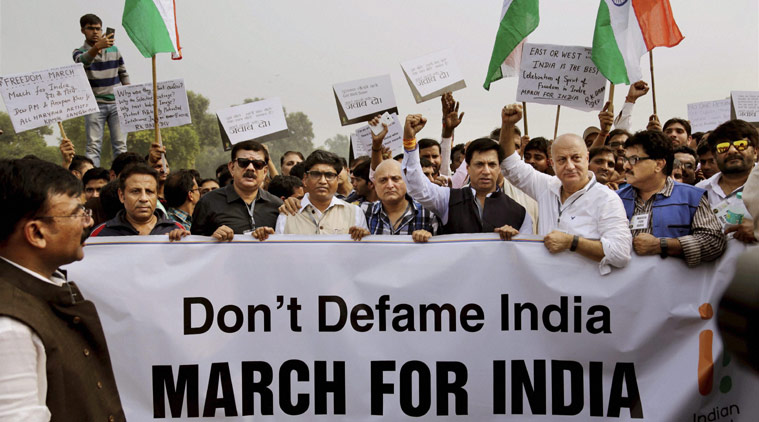
When I met Anupam with 50 other prominent artists on the eve of the march, a general feeling was that few hundred people would gather. Hence, there were no arrangement, no plans and no organization. Soon we got messages from Bharat Ratna Lata Mangeshkar, Padma Vibhushan Birju Maharaj, Padma Vibhushan Sonal Mansingh, Mahakavi Gopaldas Neeraj, Dagar bros. National award winner Mohanlal, Rajan & Sajan Mishra, Maharashtra Ratna Shri Paunddhare and almost 500 more jewels of India. Apart from that there was a huge support from the social media. People trended #MarchForIndia and #IndiaIsTolerant. We were not alone. As they say, Karvaan banta gaya….

November 7, 8 AM

When we got up in the morning, we read on twitter and FB that this march was taking place in 23 cities in India and a few cities in US and Canada. I also started spreading my messages through #MarchForIndia which soon became the number 1 trending topic worldwide.

10.30 AM

When we reached the venue, all we could see was people. There was no dais, no security and no place to move. Everything was organic. In no time 500 award winning artists from various parts of the country joined in.

11AM

Encouraged with the response, Anupam, me and several others requested PM on twitter to meet us. We had an idea that it won’t be possible as he was in Kashmir.

12 noon

Some people came to me and complained that some media people were unnecessarily intimidating them and when they refused to answer they were called Modi’s Bhakts/Gunde. I reminded them that ‘it’s their job and they are paid for it’. I even saw few media reporters fighting with each other on unethical journalism practiced by their channels. But we were not there to solve competing media’s intolerance with each other.

12.30 PM

There were screams of ‘VandeMatram’ all around. I have never been in the midst of so many patriots. I won’t put any number on the supporters, but the SHO Walia of India Gate told me on record that this was the largest mobilization of a voluntary crowd since the Anna Movement.

2PM

By the time we came out of the Rashtrapati Bhavan, Anupam received a message from PM Modi asking us to meet at 6.30PM.

March For India

6.30PM

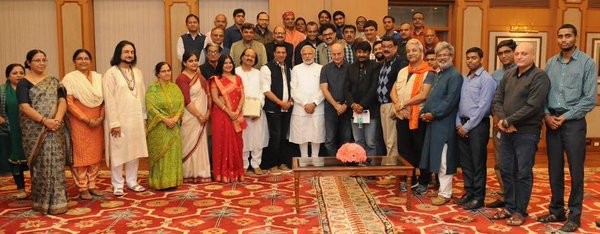
While waiting in a small hall in 7RCR, I could feel meticulous professionalism and humility all around. We weren’t sure if PM would make it on time as he was travelling back from Kashmir and it was also the eve of Bihar election results. 6.30 sharp he arrived in spotless white kurta payjama and his trademark jacket. He listened to us, one by one, with absolute concentration and then he spoke with wit, humor, concerns, anecdotes and hope. I have never heard a better half hour speech on tolerance. Some highlights:

  • He told us about his belief that cultural space shouldn’t be ‘rajya aashrit’ (Government dependent) as it takes away the voice of reason but it should be ‘rajya puraskarit’ (Awarded by the state). And without ‘fearless cultural evolution’ we would be a robotic society.
  • He clarified that he never received any request from any ‘kalakar’ to meet him. “One day I saw on TV that Shri Munnawar Rana was saying that ‘if PM invites us, we’ll go and tell him about our concerns’ so I immediately called my secretary and asked him to invite Shri Rana at his convenience but till date no one has come’. As a PM, he can’t go beyond this.  Home Minister Rajnath Singh has publicly extended invitation, twice, but no one has responded.
  • On Kalburgi and Dadri, he said that no one has met the Governors of respective states and lodged their concerns in order to be channeled to him as he can’t interfere in State’s issues. He had asked the Karnataka Govt. to send him all the files on Kalburgi murder but they have not sent them as yet.
  • He illustrated an example of administrative intolerance. During the last days of AB Vajpayee’s government, it was decided to make 6 AIIMS. The then health minister Sushma Swaraj named the Patna AIIMS Jaiprakash Narayan Institue and similarly other 5 were also named on non-Congressi national leaders. Vajpayee’s government lost and Congress came in power. UPA passed a bill in the parliament and ‘banned’ these names to be used for any Government project. That was the level of intolerance, he cited.
  • He was concerned about ‘political concern vs national interest’. He cited that 54 Heads of African countries were in India for the Indo-African summit. “So many heads of state don’t even attend a state funeral’ he said sarcastically.  “1/3rd of the world’s population, its concerns and aspirations were represented yet in our media and public discourse this event was absent’.  He said emphatically ‘If there is a loss to the country due to my mistake, please criticize me which you must… punish me… but just to oppose me or any other political rival, one shouldn’t forget national interest’.
  • He quoted how Galileo was killed for opposing a belief but in India, when Charvak, an atheist, challenged Vedas with logic and rejected the idea of reincarnation he was given the title of ‘Rishi’. Indian thought isn’t about tolerance, its’s about acceptance. He reminded that the societies, which championed the cause of human rights, are the ones who initiated two world wars whereas India has been the most peace generating country, in global context. He said ‘I have absolute faith that ‘tapasya’ of thousands of years can’t be destroyed by you and me’.
  • I proposed to him that he should talk to people from ‘cultural sphere’ including those who don’t agree with him. I told him that I’d want to hold such interaction in Mumbai as in Delhi ‘culture can’t be without politics’. Amidst laughter, he instantly agreed. I said we would organize it whenever he has time to which he said ‘…then it will never happen… you tell me the time and I’ll adjust’.

This wasn’t a one-way speech. This was informal, interactive chat filled with humor, ideas and positivity. And of course, there was chai along with chaas, dhokla, idlis and veg kathi rolls which were literally forced down on us by the Prime Minister himself.

My takeaway from the meeting was that he has immense faith in Indian youth. In him I found a man who is eager to talk to everyone and is ready to solve problems. I hope that disappointed artistes will accept his invitation and make him aware of their concerns. Maybe, he can help.

Top Lies spread by Indian Media in October 2015

0

Big Lies:

 1. 28 September 2015 – Hindustan Times: Modi changes clothes four times in a day

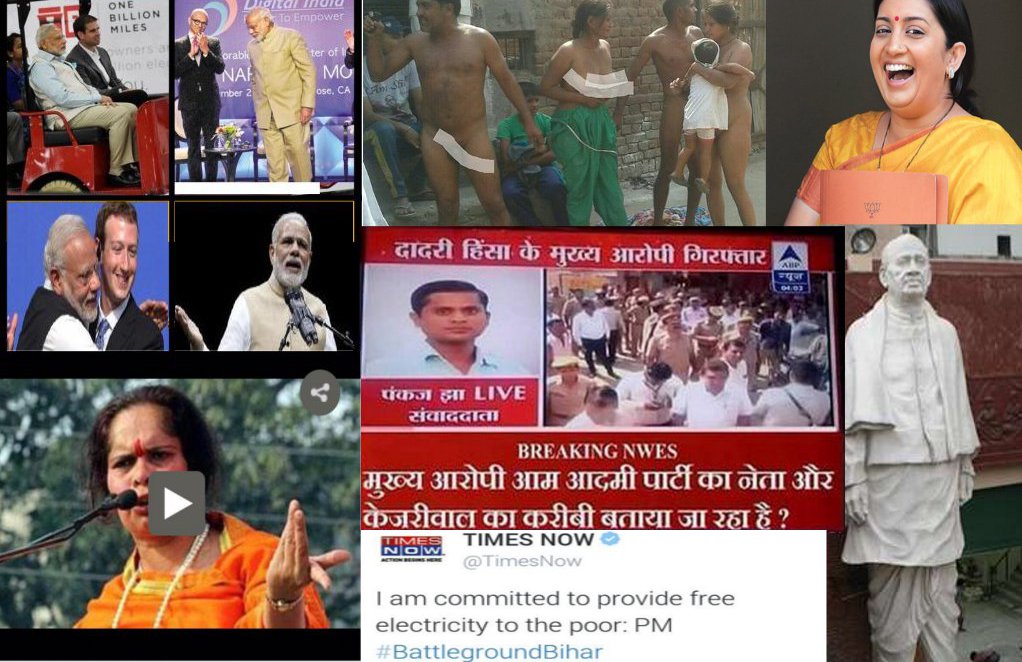
This lie appeared in September but it came to our notice only this month. We had written a detailed post this here. In short, HT claimed that Modi had changed his clothes 4 times in a day, i.e. for four events: Tesla Motors Visit, Digital Indian Dinner, Facebook Townhall and his speech at SAP Center. Not only is the topic extremely puerile, even the facts are wrong. As is evidenced in our detailed piece, it is clear that contrary to HT’s claims, Modi was at Tesla Motors and Digital India meet on Day 1, and was at Facebook Townhall and SAP centre on Day 2. Thus the he changed his clothes twice a day and not four times as reported by HT.

2. 8 October 2015 – Multiple media houses: Dalit family stripped by police. 

A facebook page named as “DALIT Parivar – The Rising Shudra – dedicated to Dr. Bhim Rao Ambedkar” posted a video claiming that a Dalit family in UP was stripped by police. This was first picked up by a site called Daily Sikh Updates, (who later deleted the story) and later by news sites like The Hindu and DNA . The video in fact was inconclusive and could not prove that the family had been forced to strip. DNA did mention this in their piece, but only as a byline. India Today however carried a story that the family had stripped on its own accord, as a sign of protest. A ground report from Caravan also supported this theory and also revealed that Sunil Gautam, a member of the family was commonly found doing such antics. Eventually SP Noida also clarified that the family was not stripped by the cops but it was done by themselves.

3. 2 October 2015- Hindustan Times/Others: 90-yr-old Dalit man burnt alive for trying to enter temple in UP

The story claimed that an old Dalit man was killed because he tried to enter a temple in Uttar Pradesh. Embedded image permalinkThis was subsequently picked up by various media outlets. But other media houses reported that the Dalit man was in fact killed by a drunkard. They reported that the Dalit man was going to the temple, when he was asked for money by a drunkard. When he refused, the drunkard hit him with an axe, and later burnt his body. This was also confirmed by the District Magistrate. Indian Express also confirmed the money angle and further reported that the deceased was in fact coming out of a temple and that to a temple built by members of the SC community. So the bogey raised by Hindustan Times was proved to be totally untrue.

4. 16 October 2015: Outlook and the rest of Media –  Sardar Patel statue to be made in China. 

In a rather sensational news break, Outlook claimed that L & T, had given the work of constructing the statue to a Chinese Foundry. This even though their own report quoted an L & T spokesperson, who outright denied the story:

The statue obviously will be built at the site itself at Sadhu Bet (near the Sardar Sarovar Dam). This is not just a statue; it is a memorial. It cannot just be shipped in from somewhere. It will be constructed at workshops which we will create. The foundry and workshops will be created close by.

To clarify the position, L & T was forced to issue another statement a few days later, which assured that the statue would be made in India:

The entire statue itself is being built in India at the site and only the bronze cladding in the form of bronze plates is being sourced from China, which constitutes a negligible amount of less than 9% of the total value of project

5. 22. 4 October 2015: India.com – AAP leader and close aide of Arvind Kejriwal behind Dadri lynching case?

Although the headline has a question mark, the headline should have never existed. The entire report trying to point to an AAP leader was based on some fabricated and photoshopped screenshots of an ABP news report, which were circulating on social media. It is highly surprising to see a site chose to believe rumours on social media and make an entire report on it.

6. 6 October 2015 – The Hindu: U-Turn: German to be taught again in Central schools

We had a separate post on this here. The Hindu claimed that now, Smriti Irani had gone back on her earlier decision earlier decision to discontinue the teaching of German in Kendriya Vidyalayas (KVs) and had now allowed students in KVs to opt for German as an additional foreign language, because Chancellor Merkel visited India. In effect, they claimed it was a U-Turn and this was echoed by Deputy Resident Editor at The Hindu, Suhasini Haider. Fact is that last year, German was only removed from the third language slot and transferred to foreign language slot as an additional subject and this was then reported even by The Hindu. Hence since German was never removed, question of it coming back and a “U-turn” did not arise. And as the Minister Smriti Irnai explained, the recent Joint Declaration of Intent signed with Germany, allowed Indian languages to be taught in Germany and formalised the already existing framework to teach German in KVs as an additional foreign subject.

7.  15 October 2015 – Multiple media houses:  Modi cancels three rallies in Bihar scheduled for October 16

BJP denied these reports that Modi’s rallies for October 16 were cancelled. October 16 was also the day for 2nd phase of polling in Bihar. The rationale give was that the third phase of polling is on October 28 and addressing rallies early made no sense. There is no media report from before this news which says rallies were scheduled for October 16. And whichever articles had a broad schedule of Modi’s rallies made no mention of a rally on 16th. This article for egs claimed Modi is expected to campaign in Sasaram and Jehanabad before October 16, not “On”.

8. 12. 9 October 2015 – The Week, India.com – Modi government to de-recognise orphanages run by Mother Teresa’s missionaries

We had written a separate post on this. Some sections of the media claimed that the Government was derecognizing orphanages run by Mother Teresa’s Missionaries of Charity (MoC). But fact is, MoC clarified by its own statement saying that more than 2 months back, they had voluntarily closed down adoption work in India and have given up our recognized status to run adoption centers. The official statement did not give any specific reasons but Sister Amala from a New Delhi orphanage run by the Missionaries of Charity stated that they had a problem with the new guidenlines which would allow single parents to adopt children. The problem arose because they feared homosexual couples may adopt children and this was not permitted by their religion. Which is why, Sister Amala said:

“The new guidelines hurt our conscience. They are certainly not for religious people like us, may be they are for secular people as the minister says. But we are concerned about children and their future. What if the single parent who we give our baby turns out to be gay or lesbian. What security or moral upbringing will these children get? Our rules allow only married couples to adopt,”

9.2 October 2015: Times Now – PM Modi promises free electricity to the poor. 

While live tweeting one of Modi’s speeches in Bihar, Times Now claimed  that he had promised free electricity to the poor. Actually he had only referred to electricity and housing. When it was pointed out to them, Times Now accepted the mistake and deleted the tweet. But by then the screenshot was being circulated as gospel truth.

10. 7 October 2015: IndiaToday – Sadhvi Prachi is a BJP MP

This lie has been repeated so often that now it has become subject to Goebbels law. This was first propounded by PTI in March 2015 and by other media houses in May 2015. On both occasions we had pointed this out, but MSM continued with this lie even in October 2015. This time it was the turn of India Today. They had a news story plus a tweet which claimed Sadhvi Prachi is a BJP MP. Fact is she has never been elected from any post on a BJP ticket. At best she could have been a BJP MLA candidate from UP, provided she is the same person who is mentioned here. Eventually India Today deleted the tweet and story and apologised for their mistake.
12. 9 October 2015: Hindustan Times – BJP MLA Sangeet Som is a director in a meat processing unit. 

We had a separate post on this issue. What HT did was, they claimed that Sangeet Som is a director in a company called Al-Dua Food Provessing Pvt Ltd and that this company was into meat-processing. Facts are that firstly, Sangeet Som resigned from the company way back in 2008. So HT was wrong in saying he “is” a director in the company. Secondly, the company began the business of meat processing only in 2012. So it is completely wrong on HT’s part to claim he had a connection with Al-Dua the meat processing company. And in another major obfuscation facts, HT did not mention that Sangeet Som, in 2008, was affiliated with BSP and not with BJP. This, even though HT’s own report from 2008, written by the same journalist who filed the latest report, clearly identified Som as a “BSP leader”

11. 18 October 2015: Newslaundry.com  – Sadhvi Prachi in list of BJP MPs and MLAs

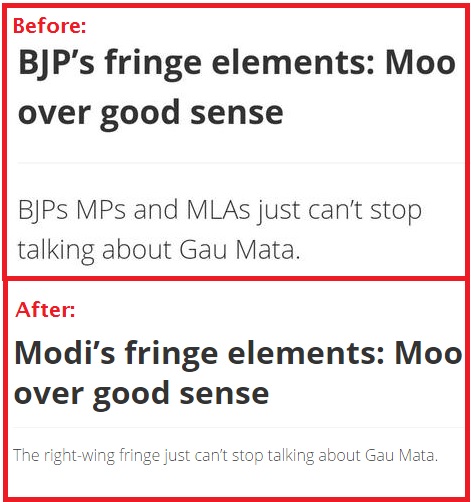
This lie has been repeated so often its not even funny anymore. Although Newslaundrylii is not “Mainstream Media” by any stretch of imagination, since we are on the topic of media and lies, we have included this instance here. The article was titled: “BJP’s fringe elements”. The bye-line spoke about “BJPs MPs and MLAs”. The Intro of the article also mentioned BJP MPs and MLAs. But for some reason we found a Sadhvi Prachi in the list. In the pic used for Sadhvi Prachi, Newslaundry themselves mentioned she was a VHP leader. Then why was she in the list? Surely not an error then? Once this was pointed out, Newslaundry surreptitiously made some changes. The title and byline were changed as per the picture attached. And further in the piece, these lines were inserted:

Now, I know she’s not a member of the BJP. But since I am on the subject of beef and dying, I couldn’t resist adding her comment

Thats a pretty candid admission that Newslaundry very well knew that Sadhvi was not a “member of BJP” yet wanted to include her in their BJP MPs and MLAs list.

12. 13 October 2015: The Hindu – First time since partition, rumours of killing a cow have led to a man’s murder

In its editorial, The Hindu casually used this line, without offering any data to back this claim:

“After all, since Partition this is probably the first time that rumours of a man killing a cow have cost him his life, in his own neighbourhood”

This was in reference to the Dadri incident. Fact is, such unfortunate incidents have happened time and again in India. In 2012, Cow slaughter report led to violence in Punjab. In 2010, violence broke out in Shimla when news of alleged cow slaughter broke out. In 2006, Mangalore saw riots based solely on rumours that a trader was carrying cows for slaughter. 2 people were killed in the aftermath. In 2002, The Hindu itself ran a story about the killing of 5 dalits in Haryana, for skinning of a cow. Yet in 2015 The Hindu claimed that this was the first incident of its kind. (This is not to justify any murder, but only to dispel the lie in The Hindu that murder over cow slaughter has happened for the first time in India)

Miscellaneous Lies

1. 16 October 2015: The Hindu – Modi set to travel 60,000 km in 30 days

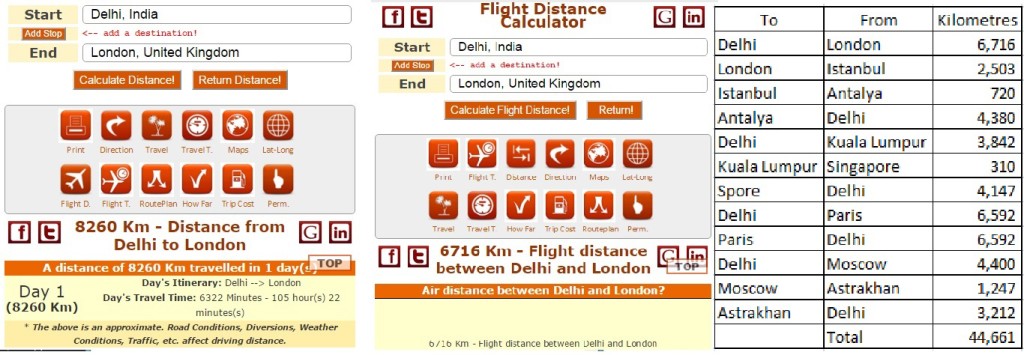
First of all, the report was based on a “if”: “If all the visits being discussed fructify”, Modi could clock 60000 km. But the headline had no such mention. Secondly, the 60000 km figure was shown to be off the mark. When users questioned the figure, for example when they claimed that the flight distance for New Delhi to London is around 6800km, Suhasini Haider the author of the piece, chose to show some site which calculated the distance as 8260km. What she did not count for was that the link she gave probably showed the road distance, and the same site had a separate “flight distance” calculator, which showed that flight distance was just 6716 km. Based on this very site’s data, it emerges that even “if” all the trips being discussed do materialise, the flight distance in total would be just around 45000 km, i.e. almost 25% lower than what the report claimed:

aaasaa
1st Image shows screenshot shared by Suhasini Haider which actually refers to road distance. 2nd screenshot shows flight distance as shown by same site. 3rd shows total flight distance

2. 13 October 2015: PTI – Ajay Devgn arrives late at a Bihar poll rally

Based on PTI reports, Indian Express carried a story titled “Violence at BJP rally in Bihar as Ajay Devgn arrives late”. It further said Devgn “came around 1 PM instead of the scheduled 10:30 AM”.  Times of India too had a similar report. There was indeed some violence at the rally, but the argument that it was because Devgn came late seems to be unfounded because Devgn wasn’t really that late. As per BJP’s ads in local newspapers on the day of the rally, Ajay Devgn was scheduled to come at the rally at 12.00 pm and not at 10.30 am as reported by PTI. This is corroborated by a pic tweeted by an Ajay Devgn fan much before the rally. This pic is of what seems to be an internal note/circular of BJP which says Ajay Devgn’s scheduled arrival time at the rally venue is 12.30 pm. This would seem to suggest that the 12.00 pm time was declared for public so that they arrive by the time Ajay Devgn actually comes at 12.30 pm. Nowhere does this corroborate with PTI’s claim that the scheduled time is 10.30 am.

3. 14 October 2015: Hindustan Times – Prasoon Joshi says Sahitya Akademi winners must be in great pain

HT this time claimed that Prasoon Joshi, who worked on Modi’s campaign in 2014, had said that Sahitya Akademi winners must have been in great pain. This was in reference to the “Award wapsi” campaign and this news was important because it showed a former associate of Modi, now speaking against him. Of course, the truth is Joshi never made such a statement. By its own admission later, HT said that these views were actually of Shantanu Moitra and not of Joshi. By then many other media houses had already picked up the original story.

4. 15 October 2015 – Economic Times – Two Jan Sangh-educationists Ashutosh Mukherjee, KM Munshi to figure with 8 others in UGC anthology

As is clear from the headline of this article, Economic Times claimed that Ashutosh Mukherjee was a Jan-Sangh educationalist who would be featured in the UGC anthology. Sir Ashutosh Mukherjee was a prolific Bengali educator. He had been the VC of University of Calcutta for 5 terms, was honored by the British Crown with the title of ‘Sir’ and he was a member of the Royal Asiatic Society of Bengal, a fellow of the Edinburgh Royal Society, and that of Royal Astronomical Society, Member of the Royal Irish Academy, Member of the Mathematical Societies of London, Edinburgh, Paris, Palermo and New York. By all accounts a stellar educationalist. He died in 1924. The year is important because, as per Economic Times, he was also affiliated with the Jan Sangh, which was formed 27 years after his death in 1951! From this it is clear that the Economic Times wrongly added a Jan Sangh affiliation to him. It was Mukherjee’s son Syama Prasad Mookerjee, who had in fact founded Jan Sangh. And curiously, Economic Times itself, says this in the body of the article. They why was the headline misleading? Was it because they were desperate to link another person to Jan Sangh so as to show a “saffronization” of UGC Anthology? Because without falsely claiming Sir Ashutosh was associated with Jan Sangh, the headline would fall flat since only 1 out of the 8 people would have links to Jan Sangh?

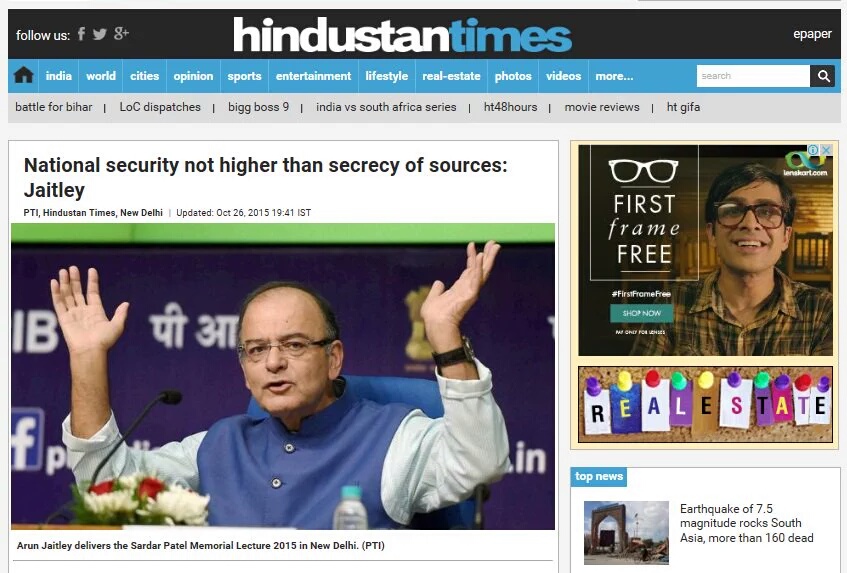
5. 26 October 2015: Multiple Media houses – National Security not Higher Than Secrecy of Sources: Jaitley

This headline implied that Jaitley said that secrecy of sources IMG_20151026_214506was more important than national security. But, in case of the article in The New Indian Express, the first line itself contradicted the headline:
Journalists have the right to conceal and protect their sources in public interest but when it comes to national security, secrecy of sources cannot be of higher importance, Information and Broadcasting Minister Arun Jaitley today said

Similar stories with same headline and same contradictory paragraphs also appeared in Zee News  and Business Standard and Hindustan Times. The common link was all these stories were based on a PTI report.The correct version of course is the body and not the headline. Jaitley clearly said “national security will be considered much higher than the secrecy of sources itself”, but for some reason PTI and PTI based reports could not comprehend the same. To be fair, a Times of India report, although based on PTI, had the correct headline.

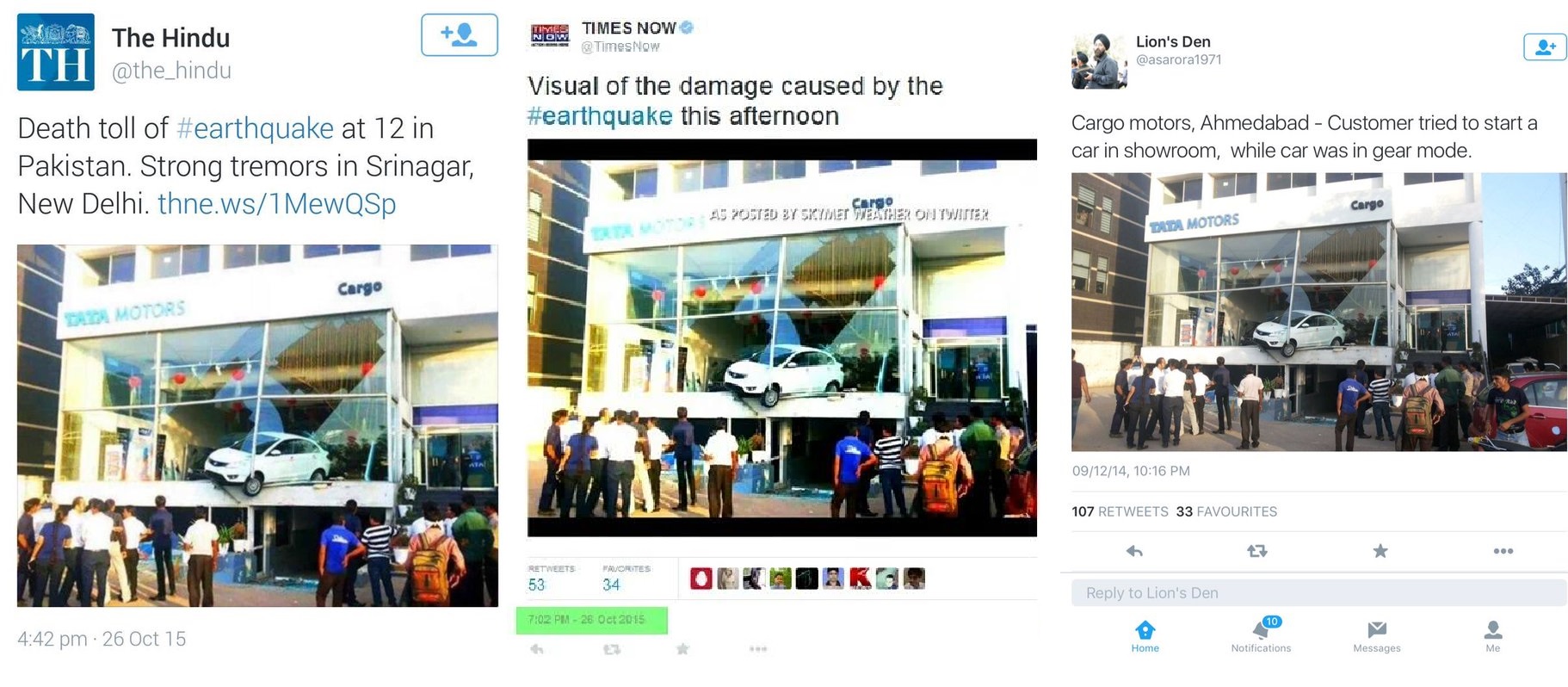
6. 26 October 2015: The Hindu and Times Now – Picture from a 2014 Earthquake at Ahmedabad used as a picture of 2015 Earthquake in North India

On 26 October, parts of North India felt tremors from an Earthquake. Times Now and The Hindu chose to use a picture from 2014, which showed the damage caused by an earthquake at Ahmedabad, and projected it as if the image is of the latest earthquake

1

Both media houses were forced to rectify this once they were called out on twitter.

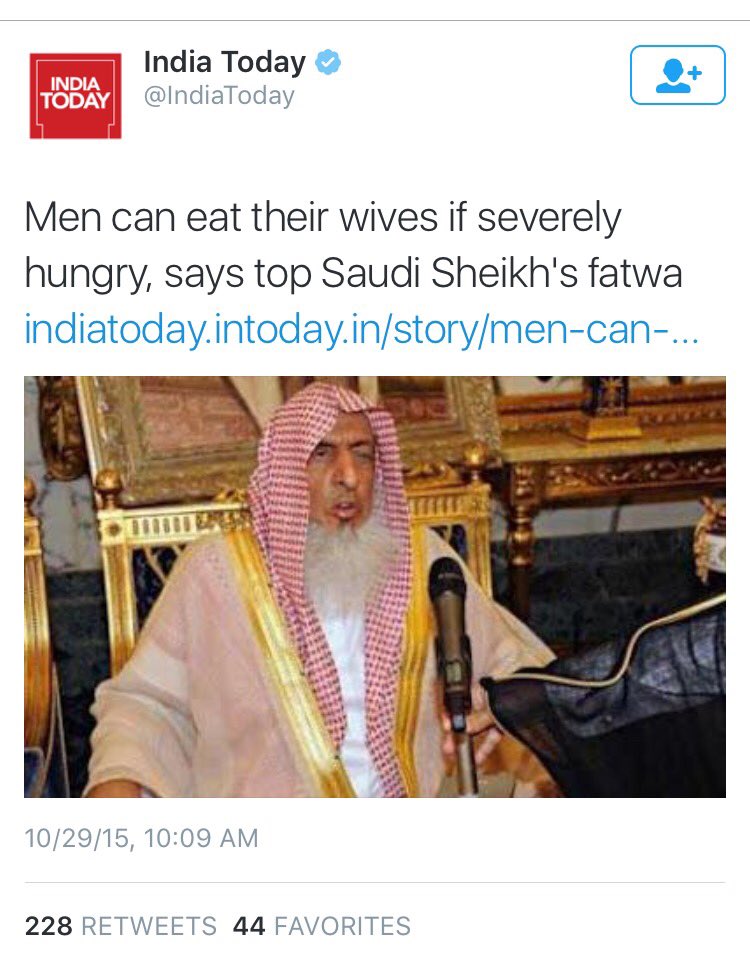
7. 29 October 2015 – India Today: Men can eat their wife if severely hungry, says top Saudi Sheikh’s fatwa

In the theatre of the absurd Media world, anything can happen. India Today reported this news itdy in all seriousness, based on a report in the international “Mirror”. The report in Mirror was from April 2015, but for some reason India Today felt it should pick it up now. While India Today, did mention at the bottom that this “Fatwa” was in fact froma  sarcastic column written by a satirist, Mirror made no such claim. However, India Today ran this story and tweets as if the news is a true event. After it was discovered on social media that the “Fatwa” was in fact a piece of satire, India Today deleted the tweet. But the story still existed as at the time of writing this.

8. 19 October 2015: Indiatimes.com – Australian Couple Harrassed By BJP MLA
It is true that an Australian couple was harassed in Bengaluru. One of them sported a tattoo of a Hindu Goddess on his shin, hence the flare up. But the person who harassed him was not a BJP “MLA”. He was surely associated with BJP for a long time but had never been an MLA.

9. 8 October 2015: Moneycontrol.com – Tesla plans to build assembly unit in India for its Model III

In what was a story supposed to be a follow-up on Modi visiting Tesla Motors in US, Moneycontrol claimed that “Tesla is exploring building assembly unit in India for its Tesla Model 3. This model is currently assembled in Netherlands and sold in the Europe market”. Fact is just a month back, Elon Musk, Tesla chief had announced on twitter that Tesla III would only be unveiled in March 2016. He further said that production would begin in “about 2 years” i.e. 2017, while Moneycontrol claimed that this model was already being assembled and sold!

10. 8 October 2015: NDTV – Lata Mangeshkar’s younger brother Hridaynath Mangeshkar is dead.

In a news item mentioning that A R Rahman was to receive the Hridaynath Mangeshkar Award, NDTV said that he would receive the same on the “Birth anniversary of Pandit Hridaynath Mangeshkar, the late younger brother of…“. Of course Hridaynath Mangeshkar is very much alive and NDTV later corrected the story.

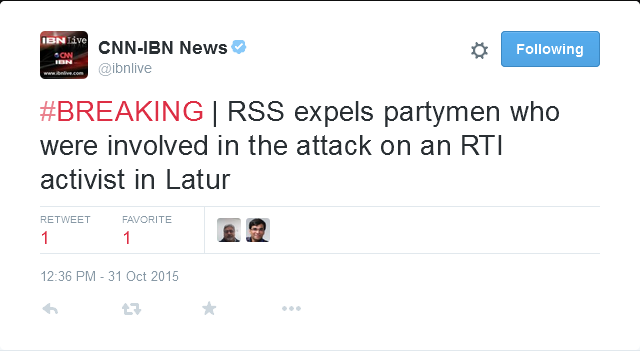
11. 31 October 2015: CNN-IBN: – RSS expels partymen who attacked RTI activist 

In a tweet, CNN IBN claimed that “RSS expels partymen who were involved in the attack on RTI activist in Latur”. This tweet had multiple fallacies. First of all RSS is not a “party” hence it does not have “partymen”. Secondly, the people who attacked the RTI activist were not RSS men but those of Shiv Sena, and Shiv Sena eventually did expel them. Its odd why RSS appeared in this tweet in the first place. Later the tweet was deleted.

January 2015: 7 Lies

February 2015: 8 Lies

March 2015: 9 Lies

April 2015: 18 Lies

May 2015: 20 Lies

June 2015: 20 Lies

July 2015: 27 Lies

August 2015: 25 Lies

September 2015: 24 Lies

Introducing discussion forums for OpIndia.com readers

0

It’s been less than a year since OpIndia.com launched but we have been able to make a mark among the digital publications in India. Even though the resources at our disposal were very limited and our team is the smallest among all the players, we attracted huge attention and support from our readers.

Many of our posts went viral and almost all of them saw interesting discussions around them in the comments section. We realized the potential to have discussions on OpIndia.com but they were limited by the number and kind of articles we were publishing.

Hence we are announcing open discussion forum at OpIndia.com – please visit forums.opindia.com and start the debate!

You will need to create an account with a valid email ID and choose a password. You can also login through your Facebook or Twitter accounts, but will need to provide the email (not necessarily the one linked with your social media profile) for the first time.

The email requirement is to make you a member of the OpIndia.com community, and enable you to publish posts on OpIndia.com community in future.

So go on, register on Forums of OpIndia.com and get your friends along too. You can start posting and discussing as soon as you register.

Let’s have a healthy debate.

Hindus’ freedom from intolerance : A reply to the news peddlers of the West

0

Isaiah Berlin, a British Jewish socio-political theorist, explained how negative liberty could be defined as freedom from coercion and positive liberty as the opportunity to strive to fulfill one’s potential. Berlin pointed out that these two different conceptions of liberty could clash with each other.

Hindu’s struggle for freedom from coercion started when Mahmud of Ghazni invaded the Indian subcontinent during the early 11th century to propagate Islam and extirpate idolatry. Apart from the massive loot, he was welcomed with the honors and accolades in the Islamic world for desecrating Hindu temples and idols. The Mughals ruled most of India in the 16th and 17th centuries. Calcutta came under the control of the East India company in 1696, and in the decades that followed Europeans and Europeans – backed by Hindu princes,most of the Mughal territory were conquered. As it turned out, India became the jewel in the crown of the British Empire. And, it took another 200 years, until 1947 when Labor government headed by Clement Attlee announced that Britain would leave India, divided, for Hindu majorities to initiate and achieve a negative liberty through non-violence.

The Swaraj, Patel-Gandhi’s idea, that Nehru dismissed as it was “out of tune with the economic and scientific requirements of India”, was to exert passive resistance, reasons that Swadeshi (self-reliance) be exercised by Indians, not under the English or Western heel, but under that of modern civilization. This brought one face to face with oft repeated, and Nehru and Patel sparred, over issue of ‘idea of India’.
After years of suppression and exploitation, Hindus have gradually started rising to mark their existence. When the clever ploy of British kept the Hindus and Muslims of India divided, the ordinary Hindus were learning how to fulfill their potential. When Congress was fighting each other over their religious differences, allowing the British rule to continue unimpeded and suppressing education for masses, the ordinary Hindus were studying in school, becoming educated to strive economic progress. When Congress Party came into power, they continued to ignore Hindu-Muslim conflicts in post-independence India, and all blame was conveniently heaped, in absentia, on the former colonists. The India’s so called secular party silently witnessed Maindai massacre in Agartala, Marichjhapi incident in West Bengal, ethnic cleansing of Hindu Pandits in Kashmir, Wandhama Prankote, Chapnari and Chamba massacre in J&K, Bagber massacre in Tripura, Kandhamal riot, Naxal massacre of 1971 in Calcutta, Sikh massacre of 1984 in Delhi and Mumbai massacre of 2008. During this phase, the ordinary Hindus were progressing to strive in agriculture, medicine, engineering, advertising, architecture, art, fashion and, above all, information technology revolution.

When India’s so called national party leaders were stashing Swiss bank accounts by selling Bofors and thereby India’s national security or allowing Hindus to be targets for religious conversion or using underworld mob financing Bollywood films or institutionalizing corruption to the extent there’s a parallel black-money economy or humiliating a prime minister and dedicated person like Manmohan Singh as puppet for their own economic expansion, the ordinary Hindus were selling tea, producing grains and vegetables, teaching students, manufacturing goods, offering services, exploring scientific discoveries, creating new ideas and avenues to strive to fulfill their potential.

The potential, as in Tagore’s word, “bharat abar jagat sobhay srestho ason lobe (India will become the leader of world again)

Yet again, their version of negative liberty has always transformed itself what Berlin had warned against. It became a version of its opposite – the positive liberty. These political leaders had the power to decide what is the “right” kind of free individual and punish those who do not conform to their ideal. Therefore, no one was surprised when the followers of that so-called secular party had chosen Sonia to maintain the dynasty and govern the nation. It was that hopelessness, support to uneducated mob with conflicting ideas and submission to their political whims and volition in the name of nationalism were as intolerant as they were with British.

So British media: if you want to promote and celebrate tolerance in India, you better stick the US and their allied losers who lead to corruption, manipulation of violence and tyranny, because ordinary Indians are way out of your league.

Today, when most freedom-seeking individuals are driven by a vision that freedom is for something – freedom to do or become something new out of which a better world would come, Hindus who practice negative liberty have no such vision. Their freedom is not for anything. At its heart, it has no purpose, other than to be free from unnecessary constraint and harm. It is still portrayed, as in Vedic culture, as universal absolute. Hindus escape from these limited worldview that re-discover progressive positive ideas of freedom that realize Isaiah Berlin was wrong and that not all attempts to change the world for the better necessarily lead to tyranny. As Berlin said, “Injustice, poverty, slavery, ignorance — these may be cured by reform or revolution. But humans do not live only by fighting evils. They live by positive goals, individual and collective, a vast variety of them, seldom predictable, at times incompatible.”

And, you know that. Don’t you?

– written by Prabir Sen
(Prabir is a management scientist in the US and Canada, a former Chief Data Scientist of Singapore Govt.)

Modi Wave – the double edged sword of BJP

As Bihar election enters the final phase today, another long and bitterly fought campaign among rival camps of political parties ends now, pending the mandate due in a couple of days from now. A victory for BJP and its allies would make them reinforce their run of victories starting from late 2013 for the state assembly elections through the Loksabha elections of 2014, barring the odd defeat in Delhi state elections this year. A victory for JD(U) and its allies would make them turn a new leaf among the “secular coalition” that could then think of a coming together of such forces in all future elections to counter the “Modi wave”. Either way, one thing is sure. The polarisation between the ruling party in the Centre and the Opposition parties is only going to get starker and the divide wider, aided by the mainstream media that ironically hypes every election (even local body elections) as an ultimate test for the legitimacy of the incredible mandate BJP won in the last Loksabha elections.

Well, partly this is also BJP’s problem. Since September 2013 when Narendra Modi was declared by BJP as their presumptive Prime Minister candidate for the 2014 Lok Sabha elections, Modi has been relentlessly doing only one thing, almost for two years now – that is campaigning for the party! After a hectic six months of nationwide campaigning that saw him get an absolute majority on his own, he had to continue doing the campaign then for Maharashtra elections, Haryana elections, Jharkhand elections, J&K elections, Delhi State elections and now Bihar elections. While there is no doubt that BJP would like to use their star campaigner and crowd puller to the maximum, this in effect has turned the discourse in the media to a test of Modi wave for every State election also, regardless of the clear mandate BJP has in 2014. Moreover, this has also resulted in the rising resentment among the Opposition parties that made even the fiercest of rivals like Nitish and Lalu to join hands to fight the Modi wave.

The fall out of this has already started in terms of the logjam in Parliament on even such trivial non-issues like Lalit Modi case that literally put the monsoon session and lot of important legislative business like GST bill in a limbo. And before the winter session, the march of protest citing “rising intolerance” has already begun in the background of Bihar elections and Dadri incident, that could very well be the next alibi to put winter session also in turmoil. Besides, Modi as PM, is also now pitted against every regional or local leader of the Opposition, like Nitish, Lalu and Kejriwal due to this campaign mode and absence of a strong local leader in BJP, to lead the campaign in these states during elections. And that is the second problem.

While States like Madhya Pradesh, Chattisgarh, Rajasthan and such had incumbent Chief Ministers or strong local leader who was a presumptive CM candidate to campaign, states like Maharashtra, Haryana, Jharkhand and Bihar were new territories for BJP to win on their own, hence they couldn’t take a chance, so had to put Modi – Shah machinery at work in full steam to get it going. Maharashtra, post Munde’s death was different though. The void created by Munde’s demise and Gadkari’s move to the Centre was filled by Fadnavis as the State unit President quite well, and his energetic campaign and assured posturing with Shivsena, emboldened Modi and Shah to risk going all by themselves after the break-up with Sena and then almost won the State on their own. The only question post-election was if Gadkari could be a compromise candidate in case NCP’s support was required to form the government, but Fadnavis emerged as the clear leader of choice and managed to pull it well. Such a strong local level leader is not emerging for BJP, during pre-elections in other States, so much so, they have to project Modi’s face for each of these elections. A last minute inclusion of Kiran Bedi as a lateral entry choice of CM in Delhi didn’t work either, as an experiment last time. So they have now reverted to the original model, to not risk such a failure this time. So the PM is back to full campaign mode in Bihar along with Shah as the only faces of BJP in the State, that resulted in the “Bihari vs Bahari” debate in this election.

Yet contrast the number of rallies (30) the PM had to undertake during this long campaign period which is phenomenally high for any PM to campaign for, in any State election, to almost 242 rallies that Lalu did during this campaign or close to 200 rallies that Nitish did, virtually covering every constituency, and in many constituencies even more than once. The only BJP leader to come close to this level of wide and extensive campaigning was Sushil Modi with about 190 rallies, and one is not sure even now, if he would be the CM, incase BJP wins. It would be impossible for the PM to match this level and scale of campaigning so he had to depend on the entire army of Central Ministers, other BJP state CMs and such to up the ante. Going forward, as more and more Assembly elections will come, especially the UP elections in 2017, which is a much larger state than Bihar, or West Bengal elections, this is going to be even more challenging with even more formidable local rivals.

Therefore, it is imperative for BJP to rethink their strategy on putting Modi ahead for every State elections and local body elections, as the only face of BJP, and start working towards developing strong local leadership and a possible presumptive CM candidate, well in advance for such a leader to run his own campaign, much like how they did in 2013 to announce Modi as the PM candidate for the 2014 Loksabha elections as opposed to Congress which was still reluctant to name Rahul Gandhi or anyone else for that matter as their candidate. This would surely ease the campaigning burden on the PM (if he really thinks it is taking a toll on him), would help reduce the resentment and build bridges with Opposition parties at the Centre to constructively work together and more importantly give much less fodder to mainstream media to make every election as a “do-or-die” battle for Modi and Amit Shah and then keep that as the only issue the nation faces, as though nothing else matters!

Above all, win or lose any State, the PM can have more time and energy to focus on what he is supposed to do – which is to carry on with his work, given the mandate for five years until 2019 before he launches his re-election campaign, rather than being in a continuous campaign mode.

India “shining” as per multiple ratings issued by International agencies

0

Even as the clamour from some sections of media and “eminent intellectuals” in India claims India is seeing “bure din” on various counts, International agencies are giving India the thumbs up in a variety of sectors. In the last month or so, a host of rankings have been released by various International bodies which rate countries on various aspects and parameters such as brand value, financial transparency and internet freedom. In almost all of such ratings, India has shown an improvement, in some, a big surge.

Top of the league for greenfield FDI

Modi’s aggressive foreign relations bid and marketing of Make In India seems to be have paid off, when one sees that India has topped the world rankings as far as FDI is concerned. Financial Times reported that India was set to pip both US and China this year, after being ranked 5th in the FDI rankings in 2014. India is well ahead of where it was last year, and has more than doubled its investment levels by June 2015. This, even when globally emerging markets like Brazil saw a sharp decrease in FDI.

Biggest Improvement among top 20 countries in the World’s most valued brands ratings

This week Economic Times reported that India has moved up one position to become the world’s seventh most valued ‘nation brand’, with an increase of 32 per cent in its brand value to $2.1 billion. What was remarkable was that India had surged 32%, which is the highest increase for any country in the top 20 spots. India is also the second most valued among emerging economies after China, followed by Brazil, Russia and South Africa.

Jump in World Bank’s Ease of Doing Business Ratings

After seeing its rank slip from a high of 116 in 2007, to a low of 142 (134 as per revised methodology) in 2014, for the 1 year ended June 2015, India saw its rank improve to 130 in 2015. The jump in rankings can be considered as 12 if one strictly compares the ranks from year to year (which is also said by Onno Ruhl, Country Director, World Bank India) or 4, if factors the revised rankings for 2014. Either way, the rank has definitely improved and shows a change in trend of past many years.

Jump in Global Competitiveness ranking

India’s rank in the global competitiveness ranking has constantly fallen for last 4 years, and this year it showed a huge jump of 16 places. The rankings released by World Economic Forum showed India ranked 55 out of 140 countries. In its Global Competitiveness Report 2015-16, WEF said this dramatic reversal is largely attributable to the momentum initiated by the election of Narendra Modi, “whose pro-business, pro-growth, and anti-corruption stance has improved the business community’s sentiment toward the government”.

Continued improvement in Internet freedom rankings

According to the Freedom On the Net 2015 India improved on its rankings on Internet Freedom in 2015 registering a small increase of 2 points. This improvement, was seen when across the world censorship and surveillance of the Internet increased leading to decline in overall online freedom for the fifth year in a row. It is not a huge jump but certainly goes against the “popular” opinion

Improved position in Financial transparency. 

According to the global financial secrecy index (FSI) report released by Tax Justice Network (TJN) India ranked 45 in the list of 92 countries in 2015 in comparison to 32 in 2013. A “fall” in rankings in such a methodology is good as a higher rank indicates lower financial transparency and higher secrecy.

Leads Consumer Confidence Index for 3 straight quarters of 2015

According to Nielsen, a global information and insights provider India continued to lead the global consumer confidence index in the third quarter of this year. Previously, India had topped these global rankings in the first as well as second quarter of the year. The index measures perceptions of local job prospects, personal finances and immediate spending intentions.

Moody’s “Report”?

As it turns out now, the much hyped “Moody’s report” which asked Modi to “Rein in BJP members or risk losing global credibility” was not a “report” per se but a commentary by an associate economist at Moody’s Analytics named Faraz Syed working out of Sydney. A blog in Huffington post says Moody’s Analytics is a subsidiary of Moody’s Corporation which is distinct from Moody’s Investors Service, the global rating agency. Further, the said “report”, “was not even visible on the main Moody’s Analytics web site. It was found on an auxiliary microsite called “Dismal Scientist” under the commentary section.” The main Moody’s site does incorporate the above commentary, but only partly and completely skips the political part.

Long list of authors, artists and scientists who have slammed Award Wapsee

0

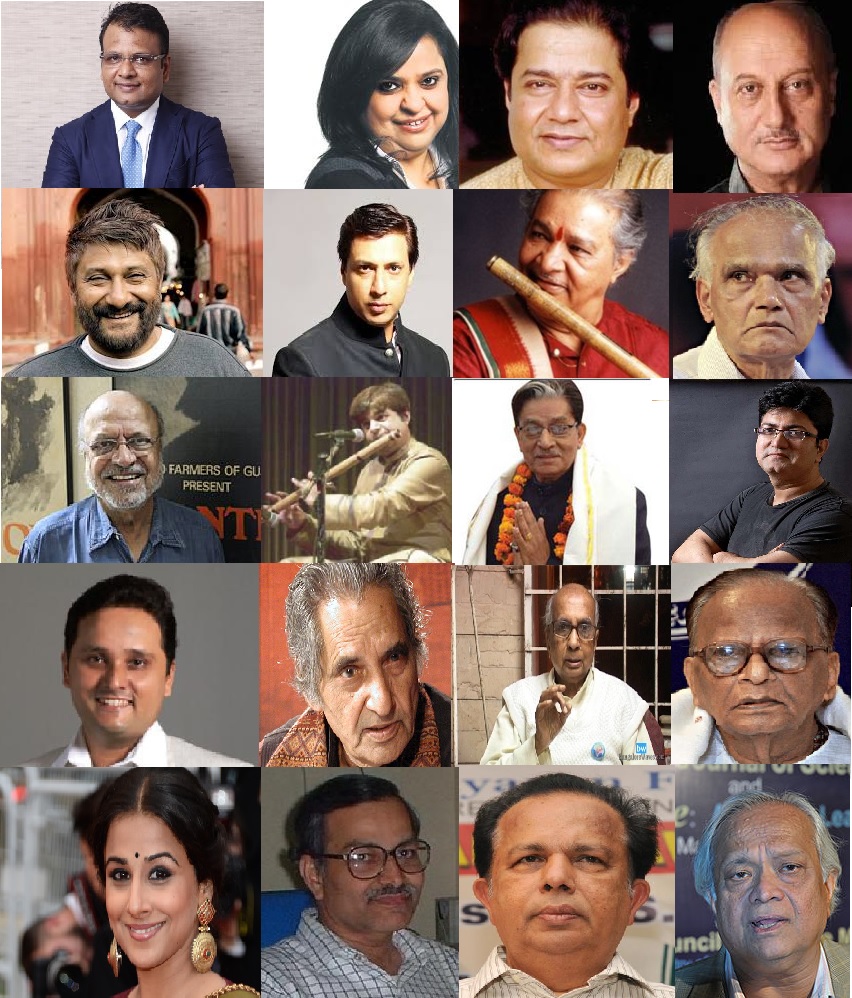
Artists who have opposed Award Wapsee:

1. Prasoon Joshi – Lyricist and adman Joshi attacked the award returnees saying he was feeling uncomfortable about the political dimension that the protest had acquired and that a writer “should not be jumping and jousting”. He also said, “It will be more dignified if a litterateur expresses herself through her creation”

2. Savita Raj Hiremath – Hiremath is the producer of Dibakar Bannerjee’s debut film Khosla ka Ghosla. Bannerjee had chose to return the National Ward this film had won. Hiremath, has now come out and slammed Bannerjee, saying he was desperate for media attention. She further said that Bannerjee had no right to return the award without speaking to her, since it is given for the film that includes everyone actors, producer. She further said:

“But there are other ways to protest too. It is very clear that he is trying to get media space for his film which has just released. He is desperate”

She also opined he did not return the award he received for his film Oye Lucky Lucky Oye because it was a Disney film and he wouldn’t take a risk with someone as big as Disney

3. Pandit Hari Prasad Chaurasiya – Multiple Padma Awardee, Pt Chaurasiya has also attacked the Award returnee brigade. He called the entire award returning episode, a”political game”. He said he has no idea why artists are doing such a thing (returning awards) because an award is given by a Government, not a party. He also said there various other methods to protest against an incident. He also said that returning awards is in fact sending a wrong message and that its a wrong trend. He also said that the award returnees are spoiling the country’s image and his deeply hurt by it.

4. Madhur Bhandarkar – National Award winning filmmaker Madhur Bhandarkar also opposed the charade of Award Returns. He said that returning an award is not only an insult to the honour but to one’s craft as well. He also wondered whether the people who are returning their awards now, will accept any honours for their work from the current Government. He also attacked the returnees for “selective activism”:

There cannot be cherry picking on any issue. This is selective target, activism. You cannot react to only those things which suit you. There was no outrage when Salman Rushdie was not allowed for the literary fest, when Taslima Nasreen was facing backlash, when Kamal Hasaan’s movie ran into trouble.

5. Vidya Balan – Balan who received her national ward for “The Dirty Picture” also refused the Award Returnee brigade. She said:

“This honour (the award) is by the nation and not the Government. So I do not want to return it,”

6. Vivek Agnihotri –  Agnihotri, who is the director of the Award winning film “Buddha in a Traffic Jam” came down hard on the Award returning business. He said:

“India is the first and the only country where people don’t refuse awards but return awards after milking them to their advantage,”

7. Anupam Kher – Senior actor and husband of BJP MP Kirron Kher has also time and again slammed the returning of awards. He said:

“This is politically motivated, it’s not like violent incidents are happening in nation for the first time. I think this is mostly to discredit the PM. If they want to return why not return everything?”

8. S L Bhyrappa  – Eminent Kannada writer & Sahitya Akademi awardee SL Bhyrappa called it a “publicity stunt” and said that the time has come to distinguish between “political litterateurs” and “pure litterateurs”. He said:

“It is a ploy to destroy the democratic fabric of the country and the functioning of the Sahitya Akademi, which is an autonomous body. I condemn Kalburgi’s killing and the Dadri lynching. But what does the Modi government have to do with these incidents? Dadri is in Uttar Pardesh where Samajwadi Party is in power. Kalburgi’s killing took place in Karnataka, which is under Congress rule. There is a political agenda behind what writers are doing which needs to be examined and publicly discussed

9. Shyam Benegal – Multiple Padma awardee Shyam Benegal too criticized the returning of awards saying that the National award is given to individuals by the nation, by the state, not by the government. He also said:

Returning national award is not the only way, it doesn’t make any sense; there are many ways that you can protest

He also said that by returning the awards, they are disrespecting the National Award.

10. Anup Jalota – Veteran artist Anup Jalota said that the trend of returning National and Akademi Awards was an “insult” to the nation. He said that instead, the community could sit together and meet the President of the country in order to express their protest to ease the situation.

11. Manish Mundra – Mundra is the producer of award winning films like Masaan and Aankhon Dekhi and has also acted in a few films. Mundra hit out at the “sickulars” slamming them for their hypocrisy. In a tweet he said:

“Ok what is excessive intolerance sickulars are talking of? That those who never chose to speak, now are voicing against pseudo secularism!”

Besides being a producer, Mundra is also the CEO of pharmaceutical company. He also expressed his anger “when India is suddenly portrayed as place worse than Saudi Arabia or governed by people worse than ISIS.” and called it a “a trap”

12. Pt Chetan Joshi – Flautist Pt Chetan Joshi, has said: “We have been artists for several years now and suddenly there is a fistful of people who are saying that there is no freedom in the country , but we don’t see or feel any such thing on the ground.” He will be part of the “Jawab Do” counter movement.

13. Daya Prakash Sinha –  Playright Daya Prakash Sinha has also attacked the Award returnees. While lending support to the “Jawab Do” campaign, he said “Where were these people when Kashmiri Hindus were being thrown out of their homes, during the Emergency or the anti-Sikh riots? This is selective sensitivity that is mostly against PM Modi, just to malign him and deliberately tarnish his international reputation,”

14. Amish Tripathi – Celebrated author Amish Tripathi broke ranks and attacked the Award Wapsee brigade. He said the authors received awards from a society and not the government and by returning these awards, they have insulted the society. He further added that the data does not support the claims made:

“The authors received awards, recognition, or money from the Indian society and not from Indian government. So far as the matter of returning awards are concerned, data says, 1.25 billion people living in the country are not communal”.

15. Gopaldas Neeraj – Multiple Padma Awardee and veteran poet Gopaldas Saxena ‘Neeraj’ accused the Award Returnees of playing politics against Narendra Modi. He further alleged that all this people had received awards during the Congress rule and now the Congress it self was making them return the same.

16. Chidananda Murthy –  Sahitya Akademi Awardee and  Kannada writer, researcher and historian Murthy also slammed the returning of awards. He said that such tactics do not serve any purpose

“It is the responsibility of the investigation agencies to apprehend the killers of MM Kalburgi and other rationalists. It is not correct to put pressure on the State and the probe agencies. Such pressure tactics do not serve any purpose,”

17. Patil Puttappa – Writer and veteran journalist ridiculed writers who were returnng awards. In a release, he said  that Kalburgi’s murder was highly condemnable but the reaction of the litterateurs in returning the awards was not justifiable. He asked why writers were mute when hundreds of farmers committed suicide in the State and incidents of rampant corruption, sexual assaults and atrocities were being reported from various parts of the country on a regular basis.

18. Ashok Chakradhar – Renowned Hindi poet and author Ashok Chakradhar has hit out at those returning Sahitya Akademi awards to protest against alleged rising intolerance in the country. In a Facebook post, especially aimed at his colleague and one of the award returnees Munawwar Rana, Mr. Chakradhar has questioned the wisdom of those who are taking this route to protest against the claimed issues of tolerance and free speech.

Chakradhar suspects that there was mix of political and communal pressure on Rana, which forced him to go back on his own conviction and return his Sahitya Akademi award. In his post, Chakradhar claims that minds of Muslims have been poisoned into believing that they are not safe in India, and this aspect might have forced Rana to return the award. Chakradhar also indirectly blames the media for exaggerating events and creating an atmosphere of fear in the country. He says that poets and writers should make common people aware of this ‘game of TRP’.

Updated on 04/11/2015:

19. P Valsala – Valsala, a decorated Malyalam novelist has also hit out at Award Returnees. She said it was “childish” to return an award given for literary merit. She also said that the people who had “bought the awards” are now returning them and that the protest is politically motivated:

“those who had bought the awards are now returning it, but the people who were selected for the awards will not return it. The current protest by a group of writers is politically motivated aiming to attract media attention.”

20. U A Khader – Sahitya Akademi Awardee and veteran novelist Khader also denounced the practice of returning Awards. He said he will not be part of any move to “appease any political party” by returning awards:

“the returning of award is aimed at appeasing certain political parties. I am not ready to return the award to appease any political party as part of any political agenda.”

21. P Narayan Kurup – Kurup, an awardee of the Kerala Sahitya Akademi and a noted literary critic  criticized the act of returning the honours by the award winners. He alleged that the writers like Sara Joseph, Satchidanadan and Paul Zacharia were trying to appease the minorities through their protest. He also said:

“There is no treat to religious harmony or secularism in the country as propagated by pro-left writers,”

22. to 34. Bollywood and south Indian movies director Priyadarshan, famous Malayalam writers Akkitham, S.Ramesan Nair, P. Parameshwaran, Thuravur Viswambaran, Prof Melathu Chandrasekharan, Madambu Kunjikuttan, K.B Shreedevi, Actor Sureshgopi, Major Ravi, Musicians Alleppey Ranganath, K.G.Jayan (Jaya Vijaya), Artist Kanayi Kunjiraman jointly issued a statement against the Leftist intellectuals who returned awards. the statement says:

“those who shout India’s culture fell down based on random incidents actually show their double standards. if there is any problem in some place one must protest against it going there. Holding an umbrella in Kerala when it rains in UP is ridiculous. those who belittle awards should have shown their courage by refusing to take it in the first place. Such people are not idealistic but selfish.”

35. Kamal Hassan – Multiple Padma Awardee Kamal Hassan refused to return his awards. He said that intolerance has been in India ever since 1947 and returning awards now not achieve anything. He said:

Returning awards won’t do anything, except that you will insult the Govt or people who’ve given award. Nothing will happen by returning awards. There are sensible politicians in every party and returning awards is a futile exercise.

36. Raveena Tandon – Bollywood actress Raveena Tandon also spoke against the Award returnees. She asked why there was “selective outrage”. In a tweet she said:

Why only selective protests??Why has there been silence so long??whether Godhra-kashmir delhi mumbai bomb blasts all should’ve been protested

She also said it hurts her deeply when her country is suddenly portrayed for what it is not.

37. Sudarsan Patnaik – Padma Shree Awardee and renowned sand sculptor Patnaik also stood against Award Wapsi. He said returning award is not the solution to protest intolerance. He created a sand sculpture on the ‘Award Wapsi’ issue with a message ‘Please express views creatively’ on Puri beach.

Updated on 05/11/2015:

38. Salim Khan: Noted writer Salim Khan said that there is no place better than India for any minority. He also said that those returning awards are free to do so, but at the same time they should write to the government to resolve the issue. He also said that Narendra Modi is not responsible for communal incidents:

“these incidents have nothing to do with PM Narendra Modi – he is not a communal person at all. He totally disapproves of whatever is happening from either side, Hindus or Muslims.”

He also condemned the beef party conducted by Engineer Rashid in Jammu and Kashmir and also said that if Muslims want to live in India, then they should respect Indian culture.

39. Vikram Sampath – Historian and Sahitya Akademi Yuva Puraskar awardee Sampath slammed the award returnees saying he did not understand why they were doing so:

I fail to understand why they are barking up a wrong tree and insulting a jury of compatriots—writers and scholars—who have selected their work. The Akademi is not a political or an activist body

He also asked whether there were any protests from the Akademi during Emergency. He lists out many literary works which have been banned by Government for decades and asks whey the Sahitya Akademi did not find its voice then.

40. Amritanshu Gupta – Gupta, an award winning radio journalist has also come out againts Award Wapsee. Gupta though chose and innovative way by returning his award against “the rising intolerance of dynasty stooges” and wrote a satirical piece where he was interviewed and went on to slam the utter hypocrisy of all those involved in this campaign.

41. Rajendra Talak – National Award winning director Talak said that Award Wapsi was a totally wrong way of protest. He asked why there were no awards returned in the past when there was a fatwa against A R Rahman or during Sikh Riots.

42. Laxmikant Shetgaonkar – Shetgaonkar, a National Award winner said he did not feel Award Wapsi was a valid form of protest. He said it amounted to insulting the jury and does disservice to the institute that has been established for the good of society. Speaking on the issue of intolerance he said this issue has often been there in history.

Updated on 06/11/2015:

43. Anil Kapoor – Senior actor Anil Kapoor said that returning awards in protest against growing intolerance in the country was not justified. He said intolerance always existed in the country and is not happening for the first time –

“My stand is this thing (intolerance) is not something that’s happening only in this government or in the previous government. We have been telling this irrespective of whether it was the Congress government or the BJP, that we should live together in harmony”

44. Raza Murad – Senior actor Murad tore into the Award Wapsi gang and also took a dig at Shahrukh Khan. He said that Shahrukh Khan and other Khan’s wouldnt have been ruling Bollywood if India was an intolerant country. He also called the protests a “publicity stunt”

It is a publicity stunt by few people, people in India have nothing against any community

45. to 48. Dr Agnishekhar, Dr Kshema Kaul, Gokal Dembi and Shiban Khebri representing Sanmukh (a Forum for Writers  & Artists in Exile): These authors and artists, representing Sanmukh, expressed their grave shock and disapproval of the systematic campaign unleashed by a segment of writers and artists to project very selective and biased perspectives of happenings in the country during recent times. Shiban Kebri said:

“Among the writers who returned awards some were from Kashmir and they are witness to our genocide but they remained mum. It is a conspiracy against the nation when big investors from abroad are coming to India for investment”,

49. to 54.  to  Professor Sumatheendra R Nadig, poet, author, Karnataka Sahitya Akademi  Awardee, former UGC Emeritus Fellow, former Chairman National Book Trust, Mrs. Sreekumari Ramachandran, Novelist, short story writer,  Shri T.S.Nagabharana, Film Director, Karnataka, N. Kuttikrishna Pillai, author, Kerala Sahitya Akademi Awardee,  Dr. Madusoodhanan Pillai, Academic Director, Bharatiya Institute of Research, Prof Meleth Chandrasekharan, Writer, Author – All of the above signed a petition titled “Intolerance in Contemporary India – a Statement” which slammed the Award Wapsi gang as a “section of nation’s intelligentsia” who are nothing but “Congressmen of various hues – Marxists, Leninists and even a handful of Maoists”, with only Narendra Modi as their target. The petition questioned their how the Centre is being blamed for crimes in states in which other parties are ruling. The petition also asks why they were silent when the nation went through much greater pain such as in 1984.

Scientists & Academics who have opposed Award Wapsee:

1. Bikash Sinha – Mr Sinha, who is a Padma Bhushan awardee and a Physicist has said that returning awards in such a manner is “an insult to the country“. He further said that such a charade of returning awards will not solve the problem. Instead, he said the awardees should show their protest in some other form and attack the source of the problem.

2. G Madhavan Nair – Former chairman of ISRO and Padma Bhushan awardee G Madhavan Nair, has termed the Award-Wapsee routine a mere “show“. He said that awards are mostly given to people for their life-time achievements and “you cannot belittle that (by returning them). The individuals should be proud that the nation has honoured them and that (award) stays with them until they leave this world.” He slammed the behaviour of scientists and writers saying

“Matured people like scientists and writers should not react like this; they should respond constructively. We have to be pro-active and take corrective action rather that making such….I will say it’s only a show“

He said that a few incidents can happen in a large country like India, and for the Government cannot be held responsible for the same. When asked about the timing of the protests, he said: “There could be some political agenda (in returning the awards). It cannot be ruled out. There are always some people following some philosophy or the other. There could be some political motives also behind that,”

He said the issue was being “over-hyped“ and ” because of the large publicity through electronic media and also through social media” it is spreading like wild fire. He further said that such action “only creates news for one day” and serves no purpose, and  instead of this, people should talk to the “concerned people“, convince them and bring them back to “normal stream”.

3. Harish Chandra Verma  – Prof HC Verma,  an Indian experimental physicist and professor in the Department of Physics at IIT Kanpur passed a terse remark hinted at the Award Wapsee gang. In a facebook post he said, a few years ago he had received an award from IIT Delhi, and that sometimes he wondered whether he too would counted among “eminent intellectuals” if he returned the said award.

Updated on 06/11/2015:

4. to 28.  to Professor Kapil Kapoor, former Pro-VC JNU, Chancellor, Mahatma Gandhi Antar-rashtriya Hindi Viswavidyalaya, Wardha, Professor Dilip K. Chakrabarti, Professor Emeritus University of Cambridge, Professor Jayanta Kumar Ray, National Professor,  Professor Aswini Mohapatra, JNU, Professor Santisree Pandit, University of Pune, Professor C.I.Issac, Member ICHR,Dr. Lokesh Chandra, President ICCR, Professor Purabi Roy, Member ICHR, Dr. Meenakshi Jain, Member ICHR, Professor Sacchidanand Sahai, Member, ICHR, Dr. Saradindu Mukherjee, Member ICHR, Dr. Nikhilesh Guha, Member ICHR, Professor Mohan Kashikar – University of Nagpur, Dr. Inakshi Chaturvedi – Associate Professor University of Rajasthan, Professor Sanjeev Kumar Sharma, Chaudhuri Charan Singh University, Meerut, Dr. Dodda Range Gowda, academician, Dr. Prakash Shah, Associate Professor, Queen Mary University, London, Dr. Gautam Sen, former Professor LSE, Professor K.Gopinath, IISC, Professor Gopala Reddy – Osmania University, Professor G.Ram Reddy – Osmania University, Professor K.K.Mishra – Banaras Hindu University, Professor Maduraiveeran – University of Madras, Dr. R.Radhakrishnan – Asst Professor, Symbiosis University Hyderabad, Professor Ramakrishnan – Madurai Kamaraj University – All of the above signed a petition titled “Intolerance in Contemporary India – a Statement” which slammed the Award Wapsi gang as a “section of nation’s intelligentsia” who are nothing but “Congressmen of various hues – Marxists, Leninists and even a handful of Maoists”, with only Narendra Modi as their target. The petition questioned their how the Centre is being blamed for crimes in states in which other parties are ruling. The petition also asks why they were silent when the nation went through much greater pain such as in 1984.

(This list will be updated as and when more intellectuals voice their opinion)