Home Blog Page 921

Laos releases world’s first-ever stamp depicting Ayodhya’s Ram Lalla: How Hinduism is woven deeply into the rich tapestry of Southeast Asia’s multireligious culture

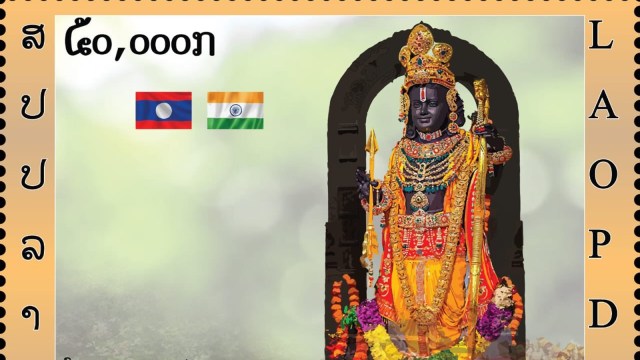
Lao PDR (Lao People’s Democratic Republic) has released a postage stamp showcasing Shri Ram Lalla of Ayodhya, becoming the first nation globally to feature this revered deity on a stamp. This issuance coincided with the visit of India’s external affairs minister, Dr. S Jaishankar, and underscores the profound civilisational and cultural connections between Lao PDR and India.

The statue of Shri Ram Lalla, depicting Lord Ram in his child form, is a significant element of the Ram Temple in Ayodhya. Made from black stone, this statue stands 51 inches tall and was ceremoniously placed in the temple’s sanctum sanctorum on January 22, 2024.

Laos is a landlocked country bordered to the north by China and to the northeast and east by Vietnam. Cambodia lies to the south of Laos, Thailand to the west, and Myanmar to the northwest. Laos is considered part of India’s extended neighbourhood, with only Myanmar separating it from India’s North East.

India’s External Affairs Minister, Dr S. Jaishankar, and Lao PDR’s Deputy Prime Minister and Foreign Minister, Saleumxay Kommasith, jointly unveiled the special commemorative postage stamp set during a ceremony in Vientiane, the capital of Laos. India’s ambassador to Laos, Prashant Agrawal, was also present at the event, which took place during Dr. Jaishankar’s visit to the Southeast Asian country for ASEAN meetings.

The stamp set includes two distinct stamps: one featuring Lord Buddha of Luang Prabang, the ancient capital of Laos and a significant Buddhist site, and the other depicting Lord Shri Ram of Ayodhya.

Buddhism and Hinduism have long served as a strong bridge between India and Lao PDR, with India being the birthplace of the two faiths and home to many important sites associated with them, which have a significant following in Southeast Asia.

The Ramayana is a revered epic in India and holds a special place in Laotian culture as well. In Laos, the Ramayana is known as Ramakien or the Story of Phra Lak Phra Ram and is often performed during auspicious occasions. The theme of the stamp set, “Celebrating Shared Cultural Heritage of Lao PDR and India,” symbolises the longstanding historical ties between the two nations.

According to some historical accounts, the Lao people’s original belief system was animism, which was later influenced by Indian culture. Hinduism followed, and subsequently, Buddhism became prominent. Buddhism has played a significant role in Lao history and influences nearly all aspects of Lao life today. Currently, about 65% of the Lao population practices Hinayana (Theravada) Buddhism, although animism still coexists with Buddhism.

The exact period of cultural contact between India and Laos is unclear due to a lack of historical records. However, it is generally accepted that Hindu and Buddhist practices were introduced to Laos in the early centuries of the Common Era, despite local traditions suggesting Buddhism arrived in Laos before Christ. According to these traditions, a Buddhist shrine (That) was built in Laos during Emperor Asoka’s reign, around the mid-third century BCE.

The Ourangkharittan chronicle mentions that Luang in Vientiane was originally constructed by a Buddhist monk, Phra Chao Chanthaburi Pasithisak, to house a relic from Rajgir in India.

Hinduism and Buddhism quickly became the official religions throughout Southeast Asia, with Sanskrit often serving as the main court language. In Laos, Buddhism and the Ramayana are the primary symbols of Indian culture.

The appeal of Hinduism and Buddhism in Southeast Asia was both political and spiritual. Southeast Asian states were chiefdoms with temporary rulers and uncertain succession lines. Although Hinduism and Buddhism were introduced peacefully, they inspired aspirations for universal kingship among Southeast Asian rulers. These rulers emulated King Asoka of India’s Maurya dynasty, who was regarded as a chakravartin, or universal ruler, and a role model in Southeast Asia. Hinduism and Buddhism provided an elaborate system of beliefs and rituals that enabled Southeast Asian rulers to claim divine legitimacy by identifying with Vishnu, Shiva, or Buddha, and to build larger, more organised polities or empires.

This led to the establishment of a more organised and enduring political order in Southeast Asia, though some elements of the previous political fabric remained. This transformed Southeast Asia into a region of mandalas (a Sanskrit word meaning ‘sacred circle’). In daily life, rituals, customs, and public ceremonies still show traces of Hindu influence. For example, the traditional greeting to learned persons and religious teachers by joining hands at the heart level is similar to the Indian practice of Pranam.

Underscoring the shared cultural heritage that spans the Southeast Asian region for millennia and deepening ties between India and Laos, the Archaeological Survey of India (ASI) commenced the restoration of the fifth-century Wat Phou Hindu Temple, recognised as a UNESCO World Heritage Site.
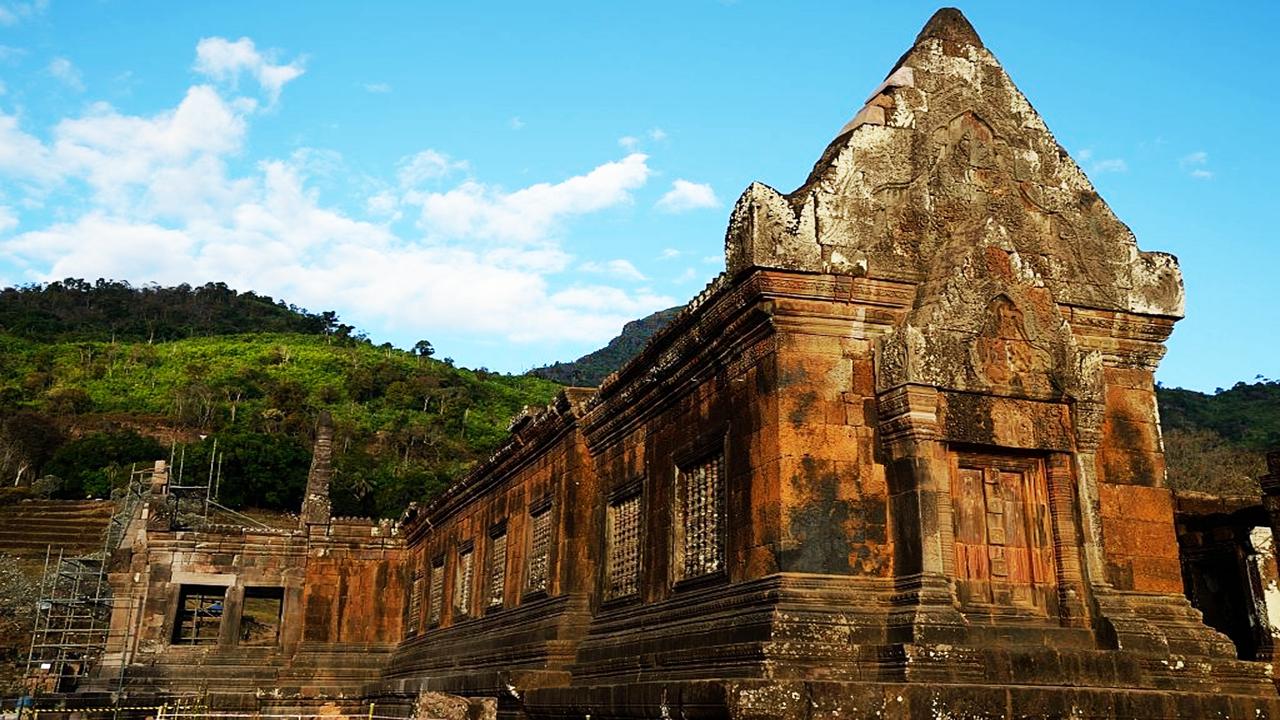
Wat Phou Temple

UNESCO describes the temple complex as embodying the Hindu concept of the connection between nature and humanity. The site also includes two planned cities along the Mekong River and Phou Kao Mountain. The Wat Phou temple, which dates from the 5th to 15th centuries, is primarily linked to the Khmer Empire.
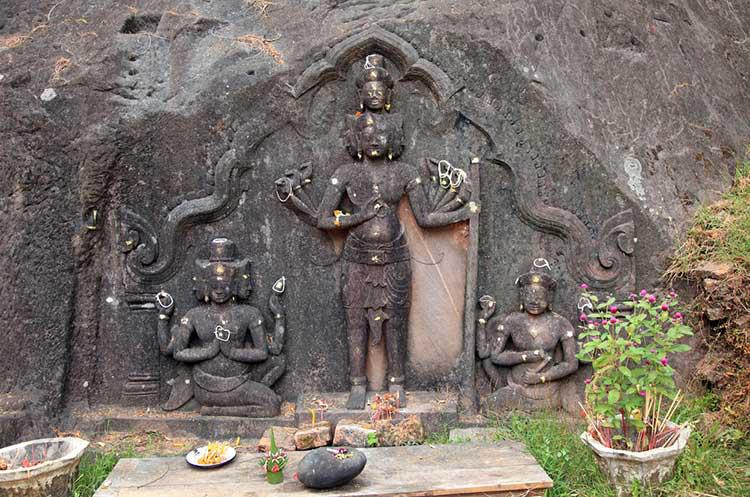
Carvings on the walls of Wat Phou temple in Laos

Wat Phou temple was reportedly constructed for Lord Shiva in the fifth century. The site features mythological scriptures dedicated to Lord Brahma, Vishnu, and Mahesh. However, with the spread of Buddhism in Southeast Asia, the temple was converted into a Buddhist shrine.

In 1955, Laos released a set of 6 stamps on Ramayana depicting Lord Rama, Sita, Raavan & Hanumaan.
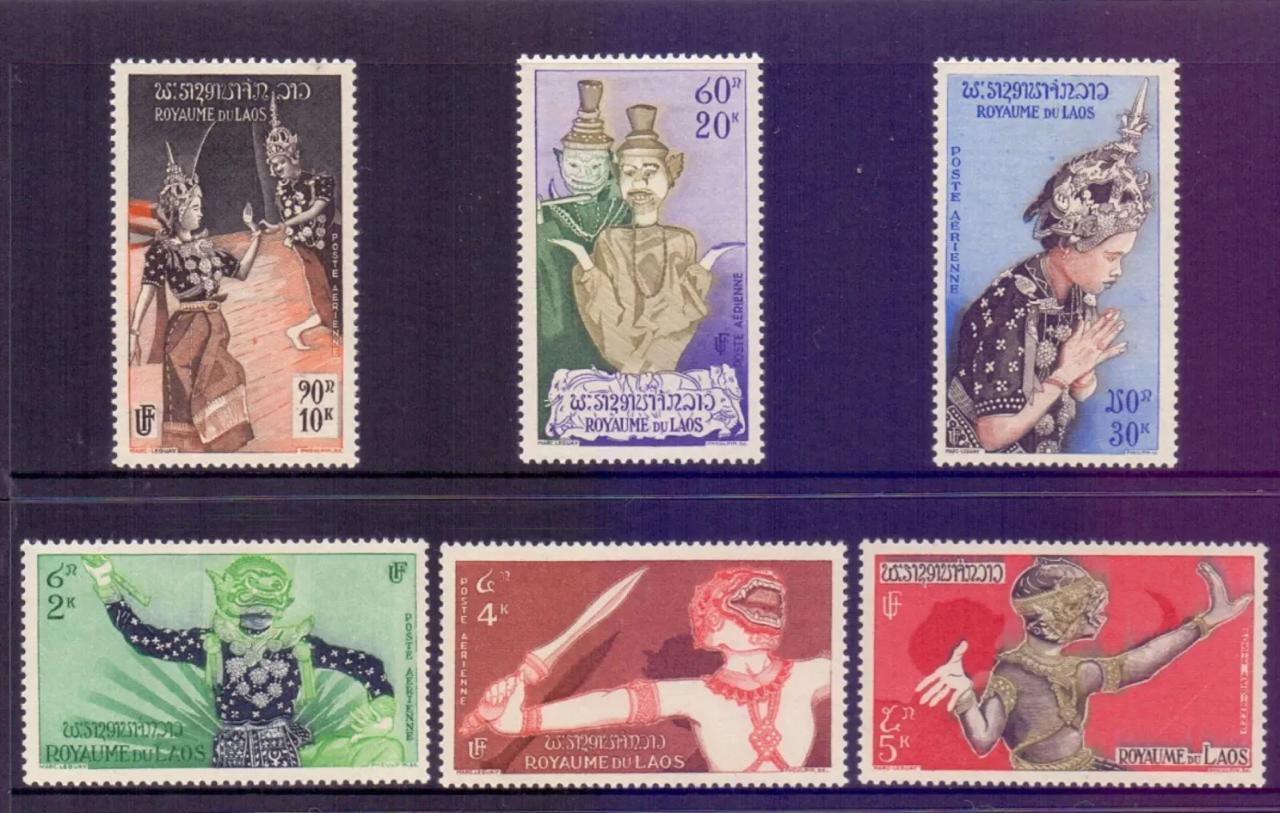
Laos 1955 -Sita, Rama, Ravana, Hanuman

In 1971, it issued another stamp that depicted Matsya fighting with Lord Hanuman.
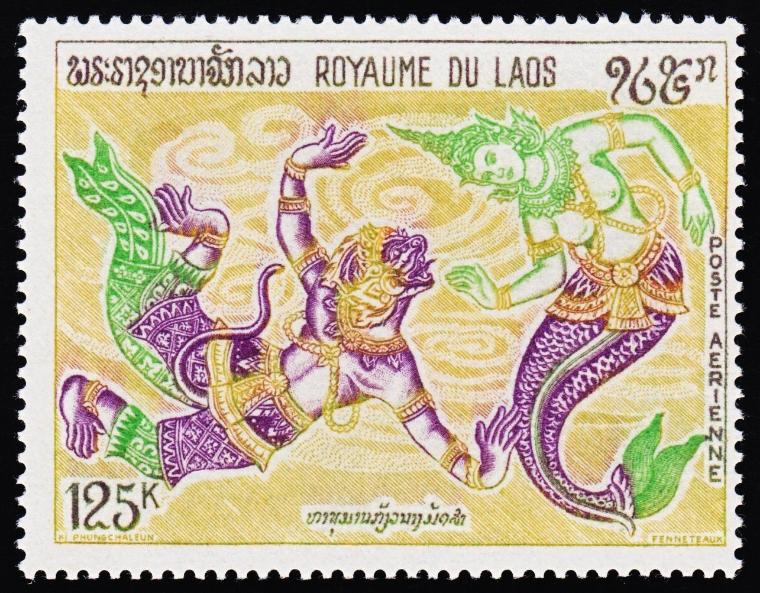
Laos 1971 Matasya fights with Hanuman

Cambodia

Not just Laos but South Asia shares its cultural heritage with India, its traditions, and religions that have spawned from here. To the south of Laos lies Cambodia, another nation whose cultural and social fabric has been deeply influenced by Hinduism and Buddhism.

The roots of Hinduism in Cambodia date back to the Funan Kingdom, which ruled from 100 BC to 500 AD, with kings worshipping Vishnu and Shiva during this era. Hinduism continued to be the dominant religion when the Khmer Empire rose to power, maintaining its prominence until the reign of Jayavarman VII (1181-1218). Nothing testifies it more prominently than the Angkor Wat Temple, located within 402 acres sprawling within the ancient Khmer capital city of Angkor, it is considered as the largest religious structure in the world by Guinness World Records. It is one of the few temples in the world dedicated to Lord Brahma.

Cambodia-Angkor Wat Hindu Temple

Hindu iconography is prevalent in many of the temples within the park, offering historians insights into the Kingdom’s religious history. This includes Khmer representations of Ganesha and Hanuman, as well as bas-relief carvings illustrating scenes from the Ramayana, known as the Reamker in Cambodia, which remains a significant element in traditional performances.

As a mark of tribute to its Hindu past, Cambodia brought out several stamps on Hindu deities. While Buddhism is the main religion (nearly 97% of the population is Buddhist) of Cambodia, Hindus account for less than 0.2% of the overall population. However, Cambodia has clung to its Hindu past and issued several stamps on the same. In 1964, Cambodia issued a set of 5 stamps on Hanumaan.
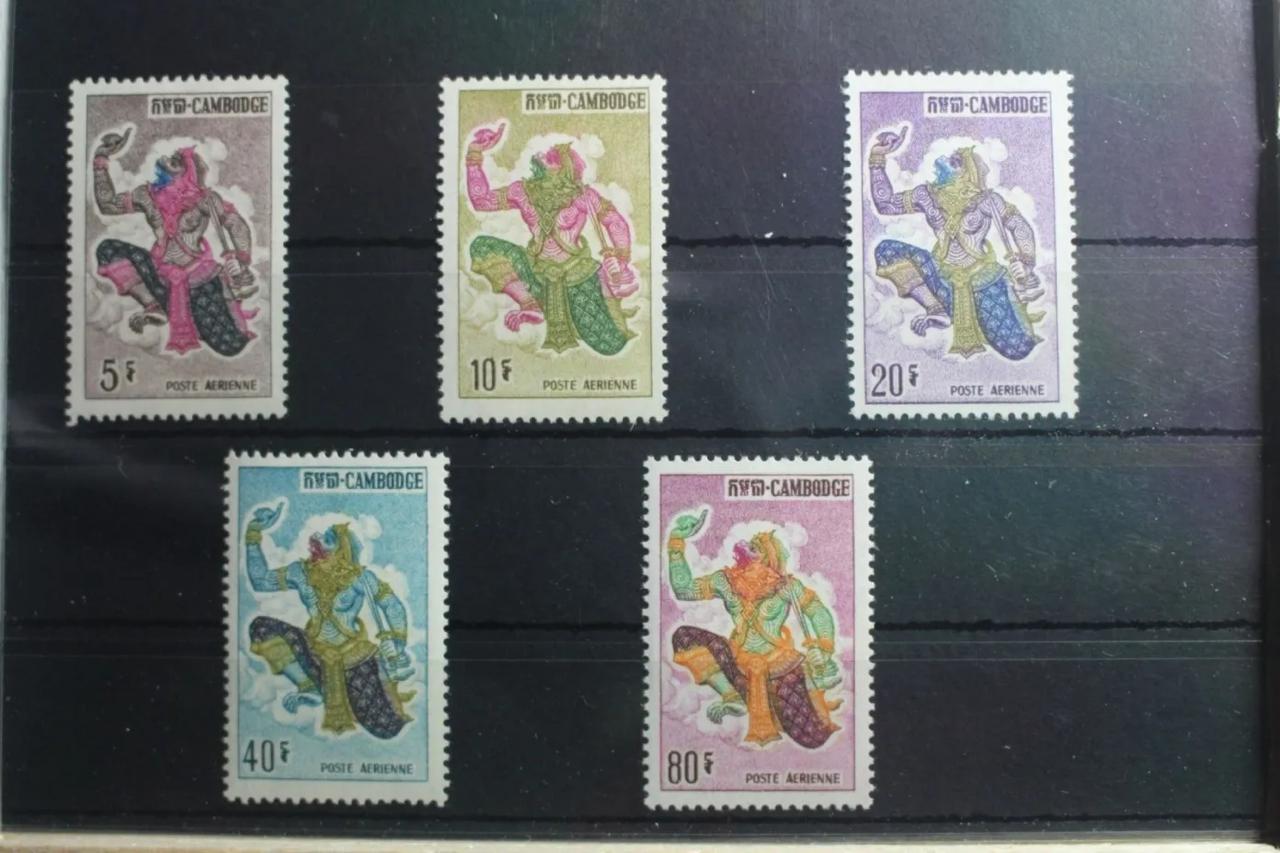
Cambodia issued Hanuman stamps

In 2006, Cambodia issued a set of 5 stamps depicting Luv Kush, Lord Rama, Sita, Raavan and Hanumaan. It also issued a miniature sheet featuring Matasya with Hanumaan.

Thailand

Thailand, another Southeast Asian country, has nearly 95% of its population practising Buddhism. Hindus constitute around 0.03% of the total population.

Hinduism in Thailand dates back to more than 2,000 years ago. Several factors, including immigration from India, trade and cultural ties have contributed to the growing influence of Hinduism, and later of Buddhism in Thailand. The famous Thai epic Ramakien is derived from the Buddhist Dasaratha Jataka, a Thai adaptation of the Hindu epic Ramayana. Thailand’s national emblem features Garuda, the mount (vahana) of Vishnu.

The city of Ayutthaya, located near Bangkok, is named after Ayodhya, the birthplace of Rama. Many Hindu rituals are still observed, including the use of holy strings and the pouring of water from conch shells. Additionally, many Thais worship Hindu-Buddhist deities, such as Brahma at the renowned Erawan Shrine, along with statues of Ganesha, Indra, and Shiva.

The effect of the Hindu culture on Thai society is also heavily reflected in its philately. In 1973, Indonesia issued a set of 8 stamps depicting various scenes from Ramayana which included Ashoka Vatika, Ravana’s Parasol, Vanara Sena crossing the sea etc.
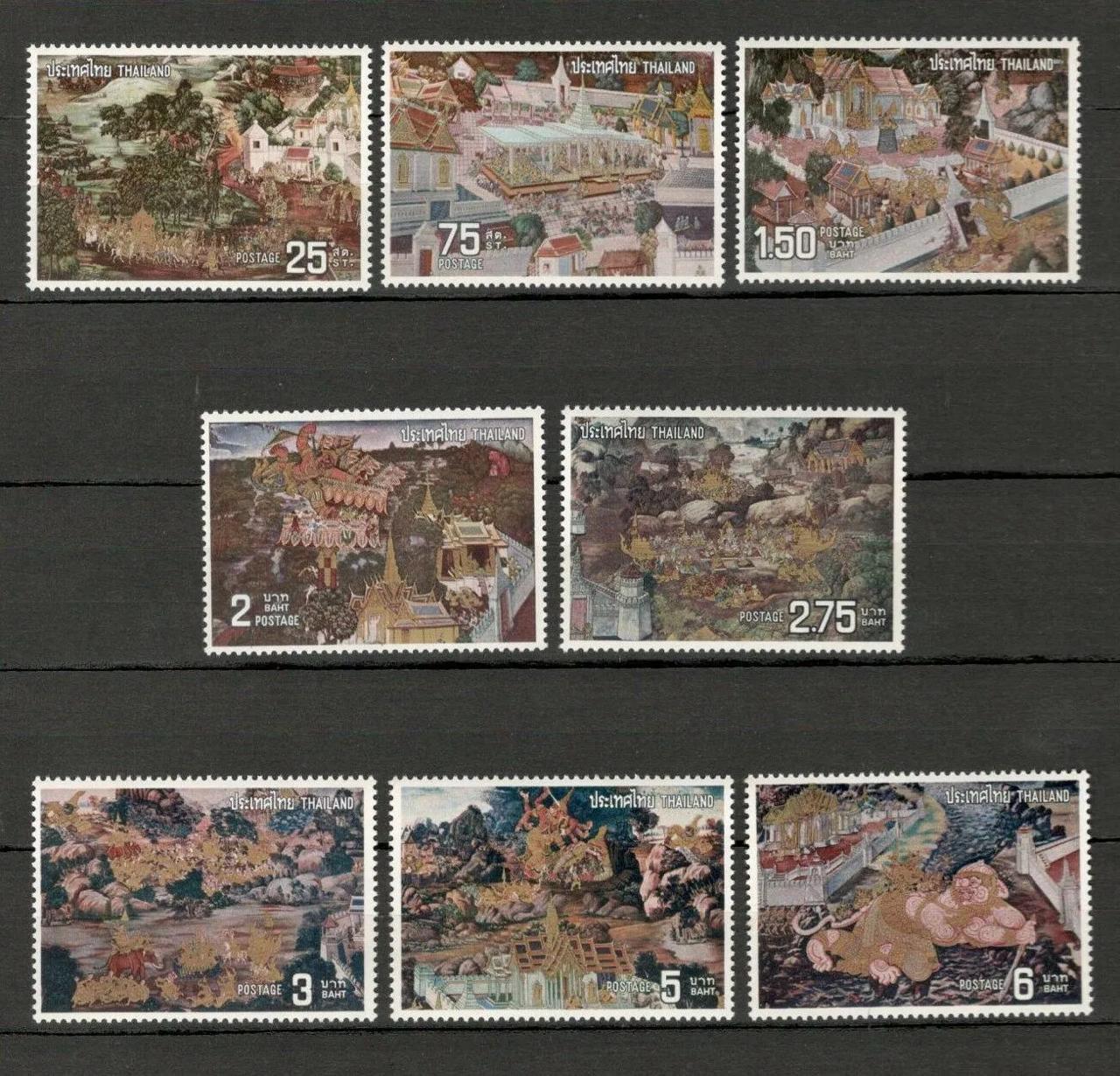
Thailand issued stamps that depicted scenes from Hindu epic Ramayana

In 2005 it issued a set of 4 stamps that depicted Rama meeting Sita, Ravana, Hanumaan and Ram fighting Ravana.

Thailand 2005 – Ram meeting Sita, Ravana, Hanuman, Ram fighting Ravana

In 2014, it issued a set of 2 miniature sheets depicting Ganesha. (Pic 17). In 2016, it issued a set of 2 stamps as part of a joint issue with Indonesia, depicting scenes from Ramayana.
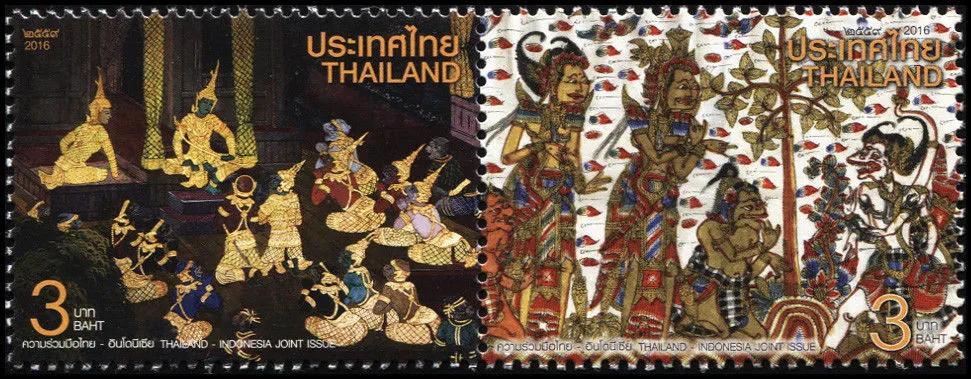
Thailand issues stamps on Ramayana in 2016

Whether it is India, Thailand, Cambodia, Laos, or Indonesia, every country has a unique Hindu tradition that adds to the rich tapestry of the multi-religious societies these nations embody and give a glimpse into the diversity and tolerance of multiple interpretations of the faith that Hinduism uniquely offers.
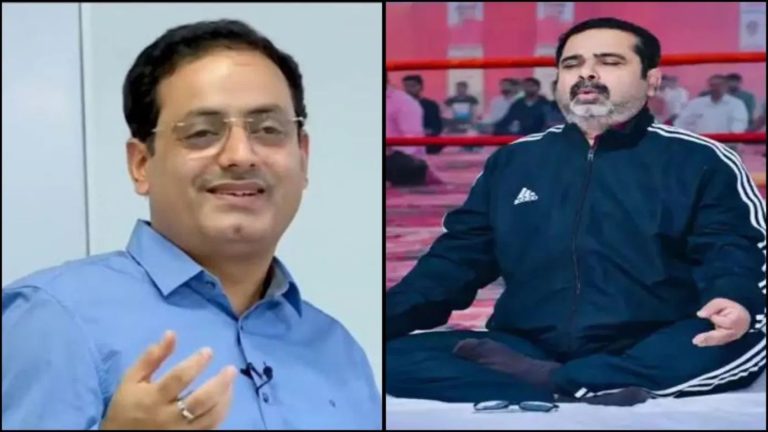

‘Ojha to bhai Bojha hai’: Following Rajender Nagar tragedy, students ask where are the biggest dealers of IAS dreams, Vikas Divyakirti and Avadh Ojha

Three students died due to drowning in the basement of Rau UPSC coaching institute in Old Rajender Nagar, Delhi, on 24th July 2024. After this incident, the students preparing for UPSC living in this area are angry. Along with the police administration, they are also raising questions on the silence of those teachers and coaching institute owners who are generally found flaunting their knowledge on every issue.

The most questions are being raised on Vikas Divyakirti, head of Drishti IAS coaching institute, and Avadh Ojha, a history teacher. This is because their reels and videos go viral the most when it comes to UPSC preparations. Students are running a campaign against them in Rajender Nagar as well as on social media.

In one such X (earlier Twitter) post, a poem made against Avadh Ojha and Divyakirti has been posted. Taking aim at Avadh Ojha in the poem, it was written, “Ojha to bhai bojha hai. Gyan jhaad ke sota hai.” Regarding Vikas Divyakirti, it was written, “Vikas ne bas khud vikas kiya, mafia ne coaching vyapaar kiya“.

The students who are raising questions on Vikas Divyakirti are using his own lines to target him. Now the students are against him following the same line.

Vikas, a student, is protesting outside Divyakirti’s Drishti Coaching Institute by carrying placards with the lines, “Why be afraid of what will happen in life, if nothing happens then you will have experience”, and demanding the Drishti owner to speak on this topic. Students have been protesting for many days against these coaching centre owners.

It is worth noting that after the incident in Rajender Nagar, all coaching institutes in the area are under investigation. In this investigation, Vikas Divyakirti’s institute Drishti was also found to be operating in the basement in violation of the rules. After this, it was sealed. Since then, students have been asking questions to Vikas Divyakirti, who otherwise speaks on every issue.

Students are also looking for history teacher Avadh Ojha, who used to tell stories of hooliganism in his student life to UPSC aspirants. Avadh Ojha is usually active on social media preaching to students. Now students are looking for him.

Meanwhile, no new statement has come from Vikas Divyakirti and Avadh Ojha. They have not even expressed their condolences to the students who died due to the negligence of the Rau coaching institute. Due to this, the anger of other students is increasing.

Ace shooter Manu Bhaker creates history, becomes first Indian to win 2 medals at same Olympics as she wins bronze with Sarabjot Singh in 10 m Air Pistol mixed team event

India’s shooting ace Manu Bhaker scripted history on Tuesday when she became the first Indian to win two medals at the same Olympics.

Bhaker and her partner Sarabjot Singh secured bronze in the 10 M Air Pistol Mixed team event. Earlier, Bhaker had won bronze in the women’s individual 10M Air pistol event.

Manu-Sarabjot beat South Korea’s Lee Wonho and Oh Ye Jin 16-10 in the Bronze Medal play-off match. With this medal, India’s medal tally increases to two in the Paris Olympics. Both Bhaker and Sarabjot shot consistently with regular 10s in the series against the Koreans.

The NRAI celebrated the success saying “India wins bronze in the mixed team 10m air pistol as @realmanubhaker and @Sarabjotsingh30 beat Korea’s Oh Ye Jin & Lee Won Ho 16-10 in the bronze match. Second medal for Manu at the Games. History!”

Earlier on Monday, Manu-Sarabjot secured 580-20x points in total to finish third, The gold medal match will take place between Turkiye (582-18x) and Serbia (581-24x).

In the qualification round of the mixed team 10 m air pistol event, each member of a team got to shoot a total of 30 shots in a time span of 30 minutes. Each series of shots consists of 10 shots per player and 20 in total. The top four teams got the privilege of qualifying for medal rounds, with the top two teams playing for gold and third and fourth-placed teams locking horns for bronze.

Manu-Sarabjot, sat at six with 193 points, with Manu getting 98 points and Sarabjot getting 95. In their second series, Manu and Sarabjot secured a total of 195 points, with Manu getting 98 and Sarabjot getting 97.

In their third series, Manu-Sarabjot secured 192 points, with Manu getting 95 points and Sarabjot getting 97 points. At the end of all three series, Manu-Sarabjot had the final score of 580-20x. 

(This news report is published from a syndicated feed. Except for the headline, the content has not been written or edited by OpIndia staff)

Yashashri’s brutal murder was act of revenge? Arrested accused Dawood was jailed in 2019 for stalking and harassing minor victim: Exclusive FIR details

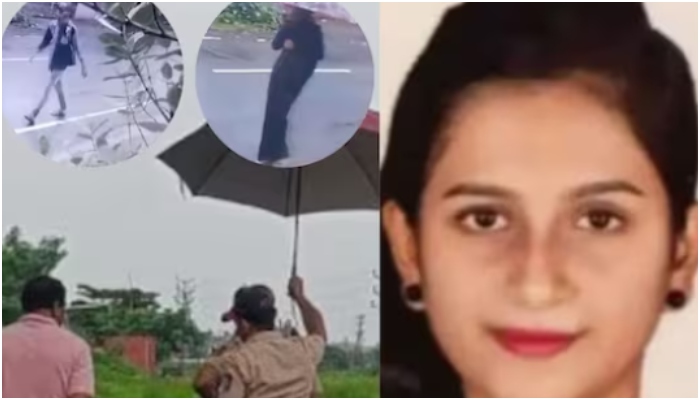
On Tuesday, 30th July, the Maharashtra Crime Branch arrested Dawood Sheikh who brutally murdered a 20-year-old girl identified as Yashashri Shinde in Uran area of Navi Mumbai. As per the reports, the accused was arrested from his hometown, Gulbarga in Karnataka.

The police had created eight teams to launch a manhunt for Dawood who had fled from Mumbai after he brutally killed Yashashri on 26th July. According to a crime branch officer familiar with the case, Dawood admitted to killing Yashashri Shinde because she had rejected advances earlier and he feared she was in a relationship with another man.

As reported earlier, the dead body of Shinde was found lying in a pool of blood on an isolated road near a petrol pump in Kotnaka of Uran taluka in Navi Mumbai on 26th July. Her private parts had been brutally stabbed and her face was smashed using a rock so that she could not be identified. The parents of the girl identified the accused as Dawood Sheikh. Sheikh reportedly confessed to having murdered the girl as an act of revenge.

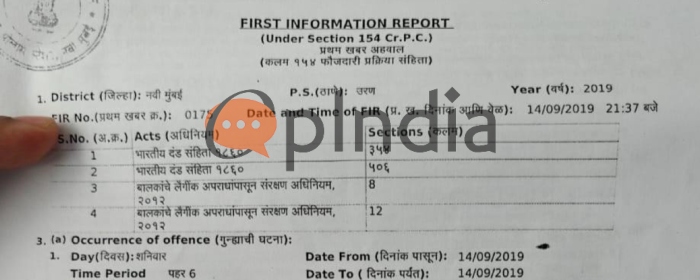
Notably, in 2019, the victim’s father had registered an FIR against Dawood Sheikh for molesting and harassing his daughter. As she was a minor, a case under Sections 354 and 506 of the Indian Penal Code (IPC) and Sections 8 and 12 of POCSO were registered. Dawood was arrested and sent to jail. After coming out of jail, he went to Karnataka and later returned to Mumbai to take revenge. The family has alleged that Dawood was in contact with Yashshri.

CCTV footage related to the incident has also been accessed by local media which reported that the accused had been keeping watch on the victim in the Uran area. Yashashri in the video can be seen passing through the Uran area street on 25th July. In the same footage 10 minutes later, the accused can be seen following her, hinting at the possibility that the entire incident may have been planned and that the victim was stalked by the accused on the day of the incident.

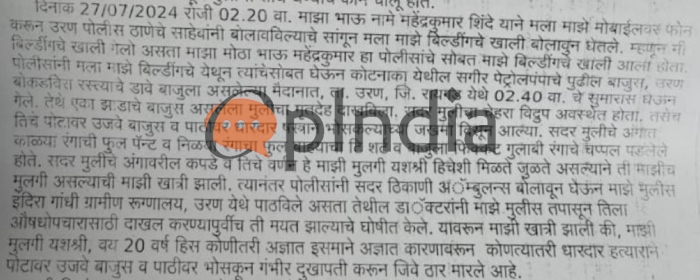
Team OpIndia has obtained the FIR copy of the incident filed on 27th July against an unidentified person. As per the complaint copy, Yashashri had gone missing on the 25th of July. She worked at AMII Business Support Solution in Belapur but was on work off that day. She had left her home saying that she would be with one of her friends and be home soon. However, she failed to be back by 7:45 pm after which the family members of the deceased victim filed a missing person’s complaint (40/2024).

After some time at around 2:20 am the police called the family and said that a dead body was found near a petrol pump in Kotnaka of Uran taluka in Navi Mumbai. The body had been brutally mutilated and the face of the body was also destroyed. The father of the girl, however, identified Yashashri from her clothes and accessories and confirmed that it was his daughter.

“The body was stabbed in several places including her private parts. Her face was ruined. Injury marks could be seen on her stomach and chest. It was Yashashri. She was taken to the Indira Nagar Local Hospital where she was declared dead,” the, father of the deceased victim mentioned in the FIR.

Yashashri sustained three stab injuries on her waist and back. A TV9 report suggested that there were several injuries on her private parts. Her bones were broken and stab wounds were found on her stomach and back. Several injury marks were found on her chest as well. The face was smashed using a rock so that she could not be identified. The father of the victim later identified a suspect in the case as Dawood Sheikh and stated that his daughter was murdered as an act of revenge.

Senior inspector Rajendra Kote had confirmed the suspect saying that the victim girl’s parents had alleged that Shaikh murdered their daughter as she had registered an FIR of molestation and POCSO against Shaikh in the year 2019, after which he was arrested by Uran police and sent to jail.

Team OpIndia also obtained the claimed FIR from the year 2019 which was filed by Yashashri’s father under sections 354 (uses criminal force against a woman to outrage her modesty) and 506 (criminal intimidation) of the Indian Penal Code, 1860 and 8 and 12 of the POCSO Act, 2012.

As per the complaint, the accused Dawood had followed the girl to her classes and once threatened her to spend time with him. He had tried to coerce her into a relationship. The accused was also caught red-handed forcefully talking to the girl and harassing her. “He had forced my daughter, 15 years old to talk to him and spend time with him. My daughter resisted. He also molested her and forced her to come close to him. He ignored constant resistance from my daughter,” Surendra mentioned in the complaint filed in the year 2019.

As per the information exclusively gathered by OpIndia, the accused Dawood was then arrested by the police and sent to jail for 6 months. After his release, he went back to Karnataka. However, he returned to Mumbai recently intending to murder the girl.

While the 2019 FIR suggested Dawood molested Yashashri, some media reports stated that it was a case of a “love affair gone wrong”. Call records released after the brutal incident suggested that she had been in contact with the accused. Free Press Journal report noted that the police said the victim had a tattoo of the accused’s name on her body.

Administration of Gokarna Temple: Supreme Court grants veto powers to Justice (retired) BN Srikrishna on decisions concerning the historic temple

On Monday, 29th July, the Supreme Court of India granted veto powers to former apex court Judge, Justice BN Srikrishna, to take administrative decisions of the Gokarna Mahabaleshwar Temple. The decision by the apex court came in response to the report submitted by Justice Srikrishna stating that he was facing difficulties in managing the temple affairs amidst non-cooperation from committee members. The order was passed by a three-judge bench comprising of Chief Justice of India (CJI) DY Chandrachud, Justice JB Pardiwala, and Justice Manoj Mishra.

The court acknowledged former Judge Srikrishna’s concerns who reported that there was a potential contempt of court orders if the current state of affairs persisted. The apex court also emphasised the importance of strictly maintaining ancient traditions and forms of worship in the temple that date back centuries.

The court said, “The suggestions of Justice Srikrishna should be accepted”. Consequently, the court also issued several directives to ensure the smooth functioning of the temple administration. The court said that the District Judge of Karwar is to be inducted into the committee with an Additional District Judge (ADJ) as an alternate if there is a need. The ADJ, however, will not handle the matters related to the temple.

The court asserted that the decision-making authority regarding the temple administration will be constituted by the District Judge in case Justice Srikrishna is not available. However, consulting Justice Srikrishna before making any decision is essential, the court said. The chairperson of the committee will frame the procedural rules.

The apex court granted Justice Srikrishna, the appointed chairperson of the committee, the veto power of a casting vote while other members will serve only in an advisory capacity without any such power.

The Supreme Court granted permission to the State Government to re-nominate four private members (Upadivantas) to the committee.

Senior Advocate Devadatt Kamat representing Math objected to the veto power granted to Justice Srikrishna stating that the judge had not personally visited the temple since 2021. The apex court, however, expressed confidence in Justice Srikrishna’s impartiality and reiterated the necessity for all committee members to function in an advisory role.

Background of the Gokarna Mahabaleshwar Temple case

In 2021, the Supreme Court of India appointed Justice Srikrishna as head of the overseeing committee. The judgement came in response to an appeal filed against a 2018 Karnataka High Court judgment that quashed the state government’s decision of 2008 which transferred the temple management to Ramachandrapura Math.

It all started when the Gokarna Mahabaleshwar Temple was included in the list of notified temples under the Karnataka Hindu Religious Institutions and Charitable Endowments Act, of 1997. In 2008, the then-Karnataka government de-notified the temple name from the list and handed over the administration to the Ramachandrapura temple leading to a public interest litigation.

In 2018, the Karnataka High Court quashed the 2008 order of the Karnataka Government and reinstated the temple as a notified institute. The court also established an oversight committee. The matter was challenged in the Supreme Court of India by the Ramachandrapura Math. In the 2021 Judgement, the Supreme Court of India appointed BN Srikrishna to lead the committee and emphasised the need for an independent administration pending final adjudication.

In January 2024, the Karnataka High Court quashed the attempts made by the Congress-led State Government to alter the composition of the oversight committee by changing the members appointed by the previous BJP-led government. The High Court noted that to make such changes, the Karnataka Government should have sought permission from the Supreme Court and deemed the move an attempt to bypass the Court’s orders.

The matter is scheduled for the next hearing in September 2024.

‘Grave misconduct’: Odisha govt suspends IPS officer, who forcibly tried to marry woman inspector and assaulted her husband

On Tuesday (30th July), the Odisha government suspended an Indian Police Service (IPS) Officer named Pandit Rajesh Uttamrao on charges of ‘grave misconduct.’

Uttamrao served as the Deputy Inspector General of Police (DIG) in the Department of Fire Services & Home Guards in Odisha.

The disciplinary action comes three days after he assaulted the husband of a woman, with whom he had an alleged extra-marital affair. The incident took place on Saturday (27th July).

As per reports, the IPS officer forcibly entered the house of the woman in an intoxicated state, vandalised the furniture and attempted to drag her out to marry her.

He also assaulted the husband of the woman. Interestingly, the woman is a police Inspector in the Bhubaneswar Economic Offences Wing and has had an affair with Pandit Rajesh Uttamrao for 5 years.

The IPS officer is also married and has two children. He was taken into custody when cops were informed about the matter.

Action against Pandit Rajesh Uttamrao

Following the incident, the Odisha government directed the Director General of Police (DGP) to submit a confidential report on the matter.

The government thereafter suspended Pandit Rajesh Uttamrao with immediate effect for ‘grave misconduct’ as a member of IPS. He has been directed to not leave Cuttack without the permission of the DGP.

During the period of suspension, Uttamrao will be allowed to draw subsistence allowance after he furnishes a certificate proving his non-engagement in any other employment, business, profession or vocation.

After Yashashri Shinde, two more incidents of brutal sexual assaults reported from Mumbai; accused Galib Sheikh, Talib, and Dr Asif Khan booked

After the shocking murder of Yashashri Shinde in Navi Mumbai, two more cases of brutal sexual assaults have come to light from the Mumbai area. Notably, Shinde was found lying in a pool of blood on an isolated road near a petrol pump in Kotnaka of Uran taluka in Navi Mumbai.

On Sunday, 28th July, the Maharashtra Police booked two individuals identified as Mohammed Galib Sheikh and Talib Sheikh for harassing, threatening, and sexually assaulting a 17-year-old girl in the Penkarpada area of Mumbai. The accused persons have also been charged for forcing the girl to commit suicide.

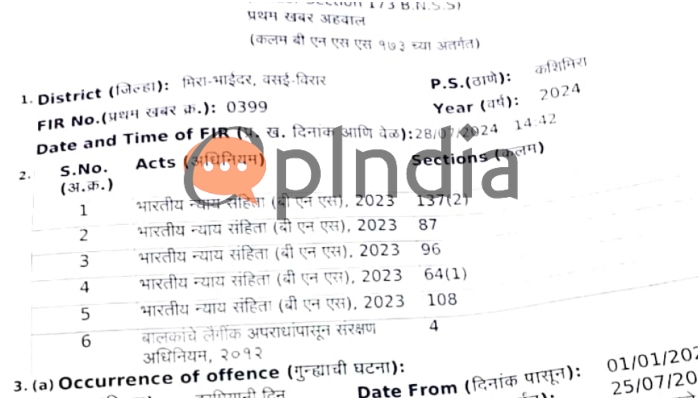
The incident is said to have taken place in the last week, however, the FIR in the case was filed at Kashmira Police Station in Mumbai on 28th July. The victim was a minor and belonged to the Phulpur area of Uttar Pradesh’s Azamgadh district. As per the FIR copy exclusively obtained by OpIndia, the girl was allegedly abducted by the accused Galib who brought her to Mumbai.

The girl had gone missing from her village on 22nd July. While the family of the girl was looking for her, they were informed by one of the villagers that she had committed suicide on 25th July, and that she was last seen with the accused Galib Sheikh in Mumbai.

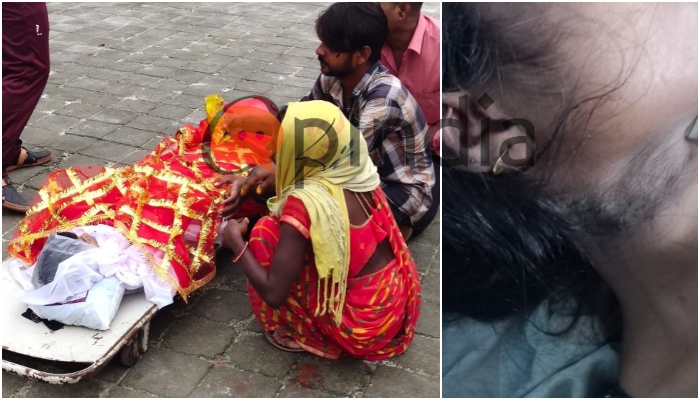
The girl committed suicide (Image obtained by OpIndia)

As per the mother of the girl who filed a complaint in the case, the accused Galib, who belongs to the same village, had been following and harassing the victim. “He (Galib) used to follow my daughter to her school. He used to threaten her to leave the school and marry him. He used to harass her and say that he would continue harassing her even if she got married to some other person,” she said.

“I was worried about my daughter’s safety so I dropped her off at school, because he had threatened my daughter that he would abduct her and marry her. He had also taken her to Mumbai earlier. I had then complained at Nizamabad Police Station but his threats continued. However, my daughter went missing on 22nd July. Somebody then informed me that she was last seen with Galib Sheikh. He is the one who has forced my daughter to commit suicide. She has ended her life being fed up with Galib and his brother’s (Talib) harassment,” the mother said.

As per the complaint, the accused is said to have sexually assaulted the minor girl in the Penkarpada area of Mumbai after which she committed suicide. As per the family, the girl was sexually assaulted previously by Galib who had threatened her to keep quiet about it.

The police have charged Galib Sheikh and Talib Sheikh under sections 137(2), 87, 96, 64(1), 108 of the Bharatiya Nyay Samhita, 2023, and section 4 of the Protection of Children from Sexual Offences (POCSO) Act, 2012.

Dr Asif Khan lures, sexually assaults 34-year-old Hindu, flees

Another horrifying case of sexual assault was filed by a 34-year-old woman at Mira Road Police Station on 22nd July saying that one Dr Mohammed Asif Khan lured her into a relationship first, and then sexually assaulted her on the pretext of marriage. The accused, as per the FIR, assaulted the woman several times and forced her to abort her pregnancy three times. He promised her that he would marry her and also made her talk to his mother Rajiya Khan for assurance.

The accused and his mother are said to have made fake promises to the woman, after which the accused fled from Mumbai, and went to Vapi, Gujarat, his home. The woman in the complaint said that the accused later stopped taking her calls and also refused to marry her.

The sexual assaults continued from February 2023 to June 2024. The police have booked the accused under sections 376(2)(n), 313, and 420 of the Indian Penal Code, 1860 read with section 173 of the Bharatiya Nyay Samhita, 2023. Further investigations are underway.

Concerns about women safety in Mumbai

The safety of women has become in new concern in the state of Maharashtra. This is after the dead body of a 20-year-old woman identified as Yashashri Shinde was found lying in a pool of blood on an isolated road near a petrol pump in Kotnaka of Uran taluka in Navi Mumbai on 26th July. Her private parts had been brutally stabbed and her face was smashed using a rock so that she could not be identified. The parents of the girl identified the accused as Dawood Sheikh who is believed to have murdered the girl as an act of revenge.

Notably, in 2019, the victim’s father had registered an FIR against Dawood Sheikh for molesting her daughter. As she was a minor, a case under Sections 354 and 506 of the Indian Penal Code (IPC) and Sections 8 and 12 of POCSO were registered. Dawood was arrested and sent to jail. After coming out of jail, he went to Karnataka and later returned to Mumbai to take revenge. He is believed to have trapped the girl in a ‘love’ affair and then murdered her. The family has alleged that Dawood was in contact with Yashshri. Investigations in the case are underway.

OpIndia Exclusive: ‘Dara Singh was denied parole on the death of his parents, sister, his surrender was misrepresented as arrest’, family narrates how they were harassed

In the year 1999, Australian pastor Graham Staines and his two sons were killed by a mob in Manoharpur, Odisha, on suspicion of converting locals to Christianity. Dara Singh’s name made the news in this case. Dara Singh was arrested as the main accused in 2000 by Odisha’s then-Congress government. Dara Singh has not been granted even a single day of parole since then.

Dara Singh’s arrest took place 24 years ago. Dara Singh’s family has undergone significant changes during the last 24 years. Despite efforts by his family to apply for a few days of parole on important occasions of grief or joy, Dara Singh was denied parole. OpIndia has spoken with Dara Singh’s family and acquired information about the case from the beginning to the present status.

How Ravindra Pal became Dara Singh

Notably, Dara Singh’s real name is Ravindra Kumar Pal. Speaking to OpIndia, Ravindra Pal’s brother, Arvind Pal, said that his family are devout Hindus. Ravindra’s father used to start his day with pooja-paath [worship]. Following the completion of his intermediate schooling, Ravindra Pal began working in Noida due to help his family financially.

Ravindra Kumar Pal was always punctual with his work. The company’s staff and management began referring to Ravindra Kumar Pal as Dara Singh after noticing his hard work and dedication towards his work. During those days, a wrestler named Dara Singh was well-known both nationally and internationally. This is how Ravindra Pal earned the moniker, Dara Singh.

Dara Singh shifted from Noida to Odisha

Arvind Kumar Pal also told us that while working in Noida, he met a friend from Odisha. Dara Singh and that person were such good friends that they started visiting each other’s homes often. Dara Singh developed a fondness for Odisha, and after a few days, he left his work in Noida with a friend and moved to Odisha.

Dara Singh took up a private job teaching children in the Keonjhar district. He taught the Hindi language and values of Hindu Dharma to the children. It is worth noting that Ravindra Kumar Pal, alias Dara Singh, is originally from Auraiya, Uttar Pradesh. However, he had made Odisha his karmabhoomi.

How Dara Singh joined Bajrang Dal

Dara Singh’s family members said that the Dharmic discussions he led at school spread to neighbouring villages. Following this, several parents started discussing with Dara Singh about Hindu Dharma. He eventually became popular in the districts of Keonjhar and Mayurbhanj.

After school, he began visiting tribal areas and educating people about Hinduism. Dara Singh soon learnt the Odia language as well. Because of his popularity, members of Hindu organisations approached him, and Dara Singh eventually joined the Bajrang Dal.

‘Christian missionaries were actively converting locals in Odisha‘

Arvind Kumar Pal went on to tell OpIndia that when Dara Singh became Bajrang Dal office bearer, Christian conversions in Odisha were on a dramatic rise. He said that entire villages were being converted to Christianity. Graham Staines, a Pastor from Australia was claimed to be the mastermind of this conversion nexus. 

It is reported that around 25 years ago, Graham Staines spent a lot of money on enticing people. He used to travel in a vehicle similar to those used by MPs and MLAs at the time. As per Arvind, his brother began warning locals about religious conversion. Consequently, he became the target of numerous conspiracies.

‘When Dara Singh was not found, police detained his brother‘

According to Arvind Kumar Pal, after the murder of Graham Staines in 1999, when the Odisha Police and CBI team could not apprehend Dara Singh, the authorities caught him. Then, local press reported that Dara Singh’s brother had been arrested.

Arvind Kumar says that the police and CBI treated his family very badly at that time. The CBI agents also harassed his mother, father, and sisters. Arvind claims that they were held in detention for a long period without being charged with a crime and paraded around Odisha forests.

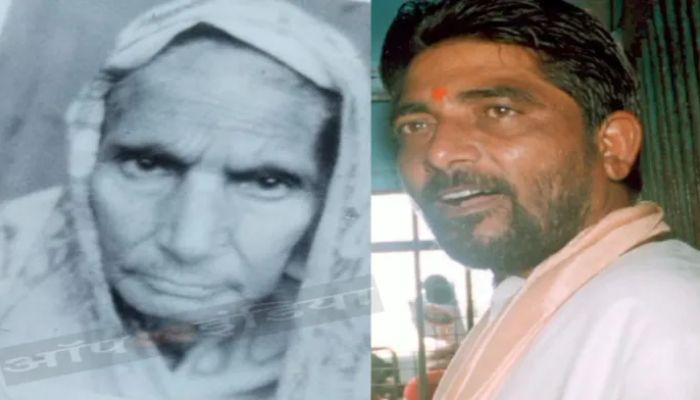
Dara Singh’s brother Arvind Pal (left), his nephew Golu (right)

‘Dara Singh’s surrender was misrepresented as arrest‘

Dara Singh’s brother claimed that after receiving false information about his detention, Dara Singh surrendered at an Odisha police station. It is claimed that the government placed a bounty of lakhs of rupees on Dara Singh, and in order to obtain it, the concerned Odisha police station misrepresented Dara Singh’s surrender as his arrest.

Concerning the police station where Dara Singh surrendered, his family members claim that its officers led him to the bush and then attempted to make the surrender appear to be an arrest. However, the conspiracy was eventually uncovered and it is said that no one has received the reward money as of yet.

First picture of Dara Singh after alleged arrest (surrender)

‘Dara Singh was denied parole even on mother and father’s death‘

Arvind Kumar Pal claims that the CBI and Odisha police tortured his brother Dara Singh severely. Dara Singh’s family protested, but no one heard them. It is argued that at the time, no political leader, media, or court took a favourable position on any petition presented in support of Dara Singh.

According to Arvind Kumar Pal, Dara Singh was swapped between Keonjhar, Cuttack, and another jail. Moreover, a separate FIR was filed in Cuttack jail regarding a dispute naming Dara Singh. In the last 24 years, his father, mother, and sister have all died prematurely. Everyone was always concerned about Dara Singh.

They all hoped to meet Dara Singh once before he died. However, their wish could never be fulfilled. After the death of his father, and his sister, Dara Singh applied for parole but his application was always rejected. At some point or the other, Singh’s plea was obstructed.

‘Dara Singh’s nephew Golu says he will get married in the presence of his uncle‘

​Dara Singh’s niece got married last year. Despite his best efforts, Dara Singh was not permitted to attend this wedding. Dara Singh’s 24-year-old nephew and another 22-year-old niece are set to marry soon. Both of them want their weddings to take place in the presence of their uncle Dara Singh.

Dara Singh’s niece aspires to become a police officer, while nephew Golu is doing a private job in a local company due to the family’s financial challenges. Golu insists that irrespective of how long he has to wait, he will marry only in the presence of his “bade pitaji”, Dara Singh.

‘Ashes of parents buried in the soil, immersed in Ganga after 20 years of wait’

Dara Singh, alias Ravindra Kumar Pal, was unable to meet his father and mother before their deaths. The ashes of his parents were kept in a pot and buried in the fields for a long period. Dara Singh’s parents’ dying desire was that after being released from jail, he pour their ashes in the Ganga. This wish remained unfulfilled.

After nearly 20 years, Dara Singh’s brother finally immersed his parents’ ashes in the Ganga, as per custom. Arvind Kumar Pal explained that he needed to get his oldest daughter married, and according to Hindu religious norms, ashes buried in family property, instead of being immersed in the Ganga as per Hindu customs, are considered inauspicious for sacred rituals to take place in the home.

‘Only a few people helped’: Dara Singh’s brother thanks OpIndia

Arvind Kumar Pal thanked OpIndia for sharing his grief with the rest of the world. He expressed his emotions, saying that very few people have supported his family in the last 24 years. He and his family have faced various forms of persecution over the last two decades.

According to Arvind Kumar, his family is hopeful that Dara Singh will spend his final days with his family and at home after serving more than two decades in a prison sentence. Presently, the Supreme Court is slated to hear Dara Singh’s plea for parole in August this year.

Kerala: Devastating landslides kill 19 in Wayanad, NDRF rescue operation underway, PM Modi announces compensation for victims

On Tuesday (30th July) morning, the hilly areas of Meppadi village in Wayanad district of Kerala were hit by massive landslides. The catastrophe claimed the lives of 19 people, including an infant.

A large number of victims are feared to be trapped. In the meantime, search and rescue operations are carried out by the Kerala State Disaster Management Authority (KSDMA) and National Disaster Response Force (NDRF) teams.

The rescue operations have been hindered due to heavy rainfall and the destruction of a bridge. An additional NDRF team and 2 teams of Kannur Defence Security Corps are on to their way to Meppadi/

While taking cognisance of the matter, PM Modi tweeted, “”Distressed by the landslides in parts of Wayanad. My thoughts are with all those who have lost their loved ones and prayers with those injured.”

He emphasised, “Rescue ops are currently underway to assist all those affected. Spoke to Kerala CM Shri Pinarayi Vijayan and also assured all possible help from the Centre in the wake of the prevailing situation there.”

PM Modi also announced ₹2 lakh compensation for the kin of those individuals who died in the catastrophe and ₹50000 for victims injured during the landslide.

It must be mentioned that Wayanad is the Lok Sabha constituency of Gandhi scion Rahul Gandhi, who has been recently been appointed as the Leader of the Opposition in the lower House of Parliament.

Uttar Pradesh: CM Yogi tables bill to make anti-conversion law more stringent, life sentence proposed as maximum punishment. Read details

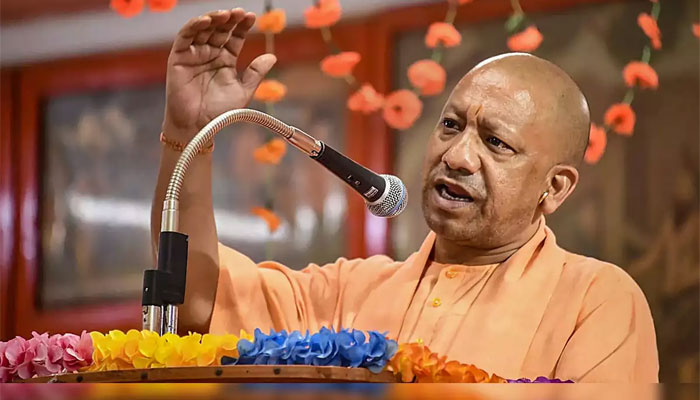
On 29th July, Chief Minister of Uttar Pradesh, Yogi Adityanath, tabled the Uttar Pradesh Prohibition of Unlawful Conversion of Religion (Amendment) Bill, 2024, in the State Assembly. The proposed bill, when passed, will increase the maximum punishment from 10 years to life imprisonment. Furthermore, any person can file a complaint, and bail in such matters will become more difficult.

The government of UP has said that the existing provisions under the Prohibition of Unlawful Conversion of Religion Act, 2021 are not sufficient. Bill’s statement of reasons read, “Keeping in mind the sensitivity and seriousness of the crime of illegal religious conversion, the dignity and social status of women, and the organised and planned activities of foreign and anti-national elements and organisations in illegal religious conversion and demographic change, it has been felt that the amount of fine and penalty provided in the Uttar Pradesh Prohibition of Unlawful Conversion of Religion Act should be increased and the bail conditions should be made as stringent as possible.”

It further read, “As the existing penal provisions of the Act are not sufficient to prevent and control religious conversion and mass conversion in respect of minor, disabled, mentally challenged person, woman or person belonging to Scheduled Caste or Scheduled Tribe, thus there is a need to amend the Act above. It has been decided that, in addition to the above, it has also become necessary to resolve certain difficulties that have arisen in the past in various cases regarding legal matters… (related) to Section 4 of the Act.”

The key changes proposed in the bill tabled by CM Yogi Adityanath

As per the existing provisions, any aggrieved person, his or her parents, siblings any other blood relative, and anyone related by marriage or adoption can file a complaint in the matter. However, the bill tabled by CM Yogi Adityanath proposes that the ambit be widened to “any person”. The proposed legislation read, “Any information related to violation of the provisions of the Act can be given by any person”.

As of now, the maximum punishment in such cases is 10 years. However, the bill proposes that any person intending to cause religious conversion can be put behind bars for life. Furthermore, assaults, use of force, promises or instigating marriage, conspiring or inducing any minor, woman or person to traffic or otherwise sell them or attempting on this behalf will lead to rigorous imprisonment not less than 20 years that can be extended to life imprisonment. The bill proposes that the onus to prove the conversion has not been done forcibly will lie on the accused and the person who has been converted. Those who seek to convert must notify the district magistrate using a prescribed form two months in advance. In case anyone fails to comply, he or she may face a jail term of six months to three years.

The fine imposed under the Act would be paid to the victim for medical expenses and rehabilitation. The bill tabled by CM Yogi Adityanath read, “The court shall also approve appropriate compensation payable by the accused to the victim of the said religious conversion, which may be up to Rs 5 lakh, which shall be in addition to the fine.”

The bill further proposed to increase punishment for anyone who receives foreign funding or funds from illegal institutions in connection to unlawful religious conversion to at least seven years of rigorous imprisonment that can be extended to 14 years. In addition to it, the person will be liable to pay a minimum fine of Rs 10 lakh.

The bill further proposed that whoever contravenes the provision about a minor, disabled or mentally challenged person, woman or SC/ST, will face rigorous imprisonment for up to 14 years and will be liable to pay a fine of a minimum of Rs 1 lakh. As per the current provisions, the maximum imprisonment is up to 10 years and the minimum fine is Rs 25,000.

In case of mass religious conversions, the person may face punishment of 7-14 years with a minimum fine of Rs 1 lakh. Currently, there is the provision of 3-10 years of imprisonment and a minimum fine of Rs 50,000.

A sub-section under Section 7 of the current Act has been proposed to make it more stringent. Section 7 states, “Notwithstanding anything contained herein, all offences under this Act shall be cognizable and non-bailable and shall be triable by the Court of Session.” The proposed sub-section states, “A person accused of any offence punishable under the Act, if in custody, shall not be released on bail unless the public prosecutor is given an opportunity of opposing the application for bail for such release, or where the public prosecutor opposes the bail application, the session court is satisfied that there are reasonable grounds for believing that he is not guilty of such offence and that no offence can be committed by him while on bail.”

The bill tabled by CM Yogi Adityanath is expected to get passed in UP Vidhan Sabha on 30th July 2024.