The Congress government in Karnataka is facing severe backlash over its decision to rename Ramnagara as Bengaluru South District as the BJP branded the move as yet another manifestation of Congress’ anti-Ram and Ram Mandir stance. Earlier, several senior Congress leaders had turned down the invitation to the Pran Pratishtha ceremony of Ram Mandir in Ayodhya.
Speaking on the Karnataka government’s decision to rechristen Ramnagara as Bengaluru South District, BJP MP Pralhad Joshi said, “This shows their allergy towards Ram and Ram Mandir, even to the name of Ram. They are quite allergic. They used to do it while we were constructing the Ram Mandir. But with the decision to rename Ramanagara, the Congress party and Congress Government have proven that they are against Ram.”
#WATCH | Karnataka cabinet has approved to rename Ramanagara district to Bengaluru South district.
Union Minister and BJP MP Pralhad Joshi says, "…This shows their allergy towards Ram and Ram Mandir, even to the name of Ram. They are quite allergic. They used to do it while… pic.twitter.com/eJvJ9Dj2IR
“Nobody had demanded this. MP Manjunath had also written that the name should not be changed. But this is being done for vote bank politics and greed for real estate. Siddaramaiah says that when it comes to Ram, he has Ram in his name. If that is the case, why are you doing this? I strongly condemn this and I ask, demand and urge them to withdraw this proposal, otherwise, the BJP will strongly oppose this and the local unit will agitate for this,” Joshi further said.
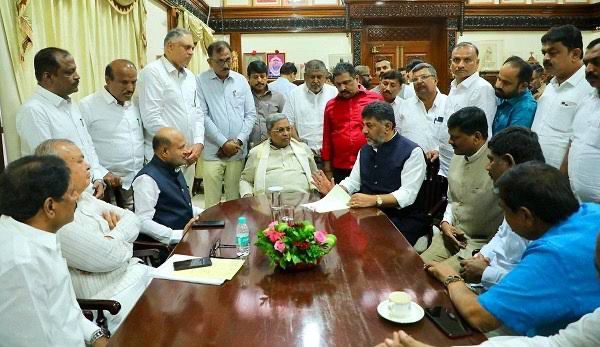
On Friday, the Karnataka state cabinet approved the renaming of Ramanagara district to Bengaluru South. “We have decided to rename Ramanagara district as Bengaluru South based on the demand of the people there. The Revenue Department will initiate the process,” said state Law and Parliamentary Affairs Minister H K Patil.
After the Cabinet meeting, he told the media, “Only the name of the district will change; everything else will remain the same.”
The decision was made during a Cabinet meeting chaired by Chief Minister Siddaramaiah.
The Central Bureau of Investigation (CBI) in coordination with FBI and law enforcement agencies in multiple countries through INTERPOL, arrested 43 accused as a part of an ongoing Operation CHAKRA-III, said an official release from CBI.
The operation was conducted to dismantle a sophisticated cyber-enabled financial crime network that has been operating across multiple countries since 2022.
The International Operations Division of CBI registered a case on July 22, 2024, for offences of cheating and online fraud.
Searches were conducted at seven locations across Delhi, Gurgaon and Noida. It was revealed that transnational cyber-enabled financial crimes in this network were being coordinated across distributed centres mainly directed from a Call Centre Operating from DLF Cyber City, Gurugram.
During these searches, live cyber-criminal operations were intercepted and substantial incriminating evidence has been gathered.
Investigation teams have so far recovered 130 computer hard disks, 65 mobile phones, 5 laptops, incriminating documents, financial transaction details, call recordings, victim details, and transcripts used for targeting victims.
Victims were contacted by impersonation and induced to click on Pop Ups for download of malicious software onto their systems and subsequently induced to make payments for restoration of their system. It is revealed that proceeds of crime were channelised from multiple countries to Hong Kong.
Further investigation is ongoing.
(This news report is published from a syndicated feed. Except for the headline, the content has not been written or edited by OpIndia staff)
The United States may be engaging in political censorship in India under the pretext of combating disinformation in the country through its embassies and consulates.
The revelation was made by the popular OSINT handle ‘Disinfo Lab’ in a 36-tweet thread on Thursday (25th July).
It exposed how the US government had been conducting workshops on ‘counter disinformation’ in various Indian cities, Kolkata, Lucknow, Hyderabad, Chennai, and Mumbai, since 2019.
The US Embassy in India has taken a keen interest in ‘fighting disinformation’ and ‘hate speech’, conducting multiple workshops through its consulates and mission. However, the manner and the individuals engaged, raise some questions.
One such workshop on identifying ‘fake news’ was conducted in Lucknow by a Berlin-based ‘activist’ named Tina Lee.
According to screenshots shared by ‘Disinfo Lab’, Lee has a history of amplifying misleading stories, peddling anti-Trump narratives and engaging in partisan behaviour.
“Could US taxpayers’ money be used on such partisan individuals? That’s not all,” the OSINT handle pointed out.
As to how 'reliable' she'd be as an expert? She's very 'liberal' in calling political opponents 'Fascists'. Could US taxpayers' money be used on such partisan individuals?
That's not all. This 'counter disinformation' expert was also found spreading #fakenews –literally.
In 2022, the US consulate in Kolkata had also roped in Brittani Kollar – the Deputy Director of MediaWise (digital media literacy project of Poynter).
Interestingly, the Poynter Institute received a whopping $3,00,000 (₹25.12 lakhs) in 2017 from far-left billionaire George Soros’ Open Society Foundations (OSF). Soros had been eyeing a colour revolution in India for a long time.
The US consulate in Hyderabad had also invited Alanna Dvorak, the International Training Manager of the Poynter-owned International Fact-Checking Network (IFCN).
OpIndia had recently reported how the US State Department has set aside a whopping $2,00,000 (~₹1.67 crores) to recruit fact-checkers in India as part of its ‘Empowering Media Savvy Youth.’
Through this project, the Executive Department of the US federal government claims to confront ‘online manipulation’, combat ‘external influences’, secure digital landscape and reinforce regional security.
As pointed out by ‘Disinfo Lab’, the US is using ‘counter disinformation’ to censor free speech on an “industrial scale.” The US House Committee on Weaponization of Federal Government has published a 98-page report in May this year, documenting political censorship.
We are not claiming this.
The US House Committee on Weaponization of Federal Government, that is documenting the #censorship in media and social media by the US Administration, says so.
(that there was a need for such a committee itself is a story)
According to ‘Disinfo Lab’, there were secret conversations between the CIA and FBI with Facebook officials to censor political posts.
The censorship in the name of combating disinformation extended to Google, Instagram, YouTube and X (formerly Twitter) as well.
Everyone would have heard of #TwitterFiles –internal Twitter communication revealed by #ElonMusk– which documented how the US Govt agencies- #DHS#FBI#CIA etc. had been running the #censorship industry from within Twitter– in collusion with Twitter senior functionaries.
The OSINT handle pointed out that the US government also forced the likes of Reddit, Amazon and Wikipedia to take down, promote certain forms of literature and make content changes.
“The censorship goes far beyond social media. The manipulation is at all levels and through all platforms. #Biden #WhiteHouse forced #Amazon to selectively promote (or not) certain kinds of books or literature. Manipulation of #Wikipedia is also well discussed– reports say FBI has been ‘editing’ Wiki pages since 2008. Its co-founder Larry Sanger calls it most bias encyclopaedia. Other co-founder Jimmy Wales has been co-opted by the ‘censorship regime,” it emphasised.
Manipulation of #Wikipedia is also well discussed– reports say FBI has been 'editing' Wiki pages since 2008. Its co-founder Larry Sanger calls it most bias encyclopaedia. Other co-founder Jimmy Wales has been co-opted by the 'censorship regime'.
“Therefore, you would forgive us for not being mighty convinced that the US missions in India have suddenly developed passion against disinformation – and liberally throwing US taxpayers’ money for the benefit of Indians?!” Disinfo Lab tweeted.
Therefore, you would forgive us for not being mighty convinced that the US missions in India have suddenly developed passion against disinformation – and liberally throwing US taxpayers’ money for the benefit of Indians?!
It is interesting to note that the US Embassy has been working closely with the Ford Foundation-backed organisation called the International Research and Exchange Board (IREX), also funded by George Soros’ OSF.
In 2015, the Government of Gujarat, while investigating Teesta Setalvad’s embezzlement case, came across funding by the Ford Foundation to her entities. It was found that her trust had violated FCRA norms.
Disinfo Lab stated, “In other words, US govt entities (Embassies and consulates) are engaging the non-govt (IREX – almost entirely peopled with former US govt) – which in turn are funded by other US Govt entities (US Embassies from Israel to Pakistan).”
The organization is headed by Kristin M Lord, who had been associated with several ‘non-government’ organizations – USIP, USAID, and CFR. Interestingly, IREX is funded, amongst the long list of donors by #Soros.
It is thus possible that the US government is following its homegrown model of political censorship and exporting it to countries such as India by arm-twisting social media companies in the name of fact-checking.
US Embassy invites Akash Banerjee and Sayema
On Thursday (17th July), the US Embassy in India informed about its event for Indian social media influences and content creators to learn about boosting social media engagement on social issues and learn about “active citizenship”.
However, for this “Influence to Impact” event, the US Embassy chose the YouTuber “DeshBhakt” Akash Banerjee who has earned notoriety for peddling leftist and anti-BJP propaganda.
While on the face of it, the US Embassy’s promotional content reeked of political interference in India’s internal political discourse.
Earlier in March, OpIndia reported how the US Embassy’s choice of ‘personality’ for Women’s History Month sparked outrage on social media with people pointing to Sayema’s anti-Hindu, regressive and Islamist views. Despite this, the US Embassy was undeterred from promoting Sayema on their social media handles.
US State Dept works with ‘fact-checkers’ to peddle its narrative
In May 2023, ‘America First Legal’ (AFL) exposed how the Global Engagement Centre (GEC) of the US State Department was working with private media outlets to peddle deep state propaganda.
A centre-right non-profit organisation, AFL, secured documents against the GEC under the Freedom of Information Act (FOIA). It noted that millions of conservative Americans were targeted for their social media posts on vaccine mandates, election integrity, and Covid-19 vaccines.
The organisation revealed that the Global Engagement Centre (GEC) of the US State Department continues to work closely with George Soros-funded ‘fact checkers’, associated with the International Fact-Checking Network (IFCN) to control the global media narrative.
America First Legal pointed out that the fact-checkers, currently coordinating with GEC, are also funded by the likes of Omidyar Network, Google, Facebook, and the Bill & Melinda Gates Foundation.
The GEC had been working with IFCN affiliates in countries such as Tunisia and propagating their ‘fact-checking methods’ to censor politically incorrect narratives. According to America First Legal, email exchanges show IFCN pestering the US State Department to ‘fund’ more of their programmes in Egypt.
Email transcripts, accessed by America First Legal, show the GEC threatening journalists to compile its talking points in the form of a report and publish it imminently.
In Gujarat’s Bhuj, a Vishwa Hindu Parishad activist was brutally assaulted by two Muslim youngsters on 22nd July, leaving him gravely injured. When the injured Hindu youth went to settle a dispute of his friend, in a ‘Sar tan se juda’ [beheading] attempt using a knife, the Hindu youths were attacked by accused Nizam and Irfan. Both the injured youths are being treated at a hospital. Meanwhile, the police have filed a case and initiated an investigation.
The victim Bhavesh Parmar resides on Mundra Road in Bhuj city of Kutch district and runs the Bajrang Tea House. The incident began on 19th July, when Madhapur police took some rickshaws into custody for operating rickshaws illegally. Meanwhile, local journalist Raju Prajapati captured images of the police action. Nizam and Irfan then called Raju to arrange a meeting. Raju conveyed this to his friend and VHP worker Bhavesh Parmar, who then went to meet Nizam-Irfan.
OpIndia has obtained a copy of the FIR. In his complaint, Bhavesh stated that he, Raju Prajapati, and another friend arrived at Jubilee Circle, where Nizam and Irfan also came. Subsequently, Nizam attacked Raju in the chest. Bhavesh attempted to settle the tension, but Nizam pulled out a knife and stabbed him in the throat. Bhavesh tried to flee in this attack, but the knife stabbed his left shoulder. Nizam and Irfan fled as he called for help after bleeding profusely. Before escaping, they both threatened to kill Bhavesh if they spotted him anywhere. Later, both of Bhavesh’s friends brought him to a nearby hospital, where he is receiving medical care.
गुजरात के #कच्छ में बढ़ती इस्लामिक आक्रामकता- “विश्व हिंदू परिषद” के गौ रक्षक पर Gहादीयो ने किया जानलेवा हमला।
Notably, victim Bhavesh Parmar is a Hindu rights group Vishwa Hindu Parishad (VHP) member and is actively involved in Gau Raksha work. Speaking to OpIndia, Bhavesh said that he had no idea that the accused Muslim youths would attack him. Bhavesh told us that Nizam and Irfan were aware that he is a VHP member and a Gau Rakshak. The victim said that the accused may have deliberately attacked him due to his pro-Hindu and cow protection-related activism. Bhavesh added that the authorities are taking action in the matter, however, stringent action should be taken on those attacking Gau Rakshaks and Hindu activists to set an example. The Hindu victim demanded that the authorities raze down the houses of the accused Muslim youths.
In this case, Bhuj-B Division Police has registered a case and arrested Nizam Mughal and Irfan Baloch. A case has been registered against them under BNS sections 109, 115(2), 296(B), 351(2), 61(2)(B) and section 135(1). Both the accused have been sent to jail in judicial custody.
However, questions have been raised of police action since despite the seriousness of the matter, the police did not seek the remand of accused Nizam and Irfan due to which the duo has been sent to judicial custody. Meanwhile, it has emerged that the accused duo has other cases filed against them and there is a demand to invoke the Prevention of Anti-Social Activities Act, 1985 (PASA) against them. OpIndia tried to obtain further information from the police, however, they could not be contacted. This report will be updated if and when a police response is received.
On Friday, 26th July, the Ahom dynasty’s “Moidams” mound-burial system in Assam was added to the UNESCO World Heritage List. The decision was made during the 46th session of the World Heritage Committee (WHC), which is taking place in Delhi, the national capital.
“This was made possible through the efforts of the Assam government and the leadership under Prime Minister Narendra Modi, we are proud and grateful for the 43rd Indian addition to the World Heritage List”, said Union Minister of Culture Gajendra Singh Shekhawat during the meeting.
A matter of immense joy and pride for India!
The Moidams at Charaideo showcase the glorious Ahom culture, which places utmost reverence to ancestors. I hope more people learn about the great Ahom rule and culture.
Assam Chief Minister Himanta Biswa Sarma also made the statement via his official X (previously Twitter) account. “THIS IS HUGE. The Moidams make it to the #UNESCO World Heritage list under the category Cultural Property – a great win for Assam Thank You Hon’ble Prime Minister Shri Narendra Modi ji, Members of the UNESCO World Heritage Committee, and to the people of Assam,” he said.
THIS IS HUGE ?
The Moidams make it to the #UNESCO World Heritage list under the category Cultural Property – a great win for Assam
Thank You Hon’ble Prime Minister Shri @narendramodi ji , Members of the @UNESCO World Heritage Committee and to the people of Assam ?
On July 21st, Prime Minister Narendra Modi stated that Charaideo Moidam would become India’s 43rd UNESCO World Heritage Site, the first in Assam and the northeast area in the cultural heritage category.
About Moidams – the Mound-Burial System of the Ahom Dynasty
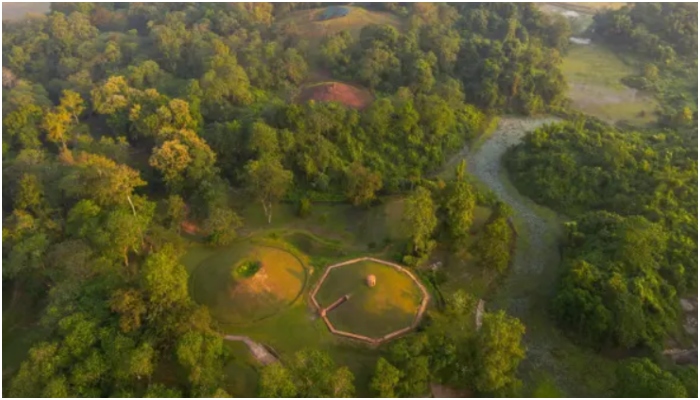
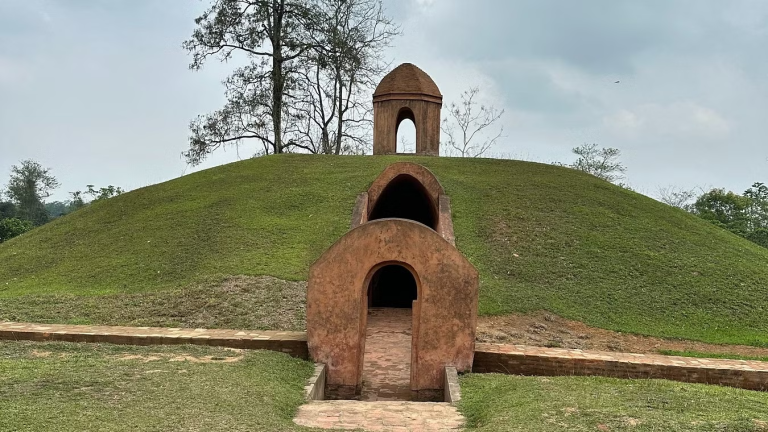
Moidams were burial mounds utilized by the Ahom dynasty, who controlled Assam between the 13th and 19th centuries. The mounds are predominantly located in the Sivasagar district, the former capital of the Ahom dynasty. Each moidam houses the remains of Ahom royalty and other notable individuals. The building entails forming a dome-shaped mound with a surrounding wall.
Building a moidam normally involves multiple processes, including placing the corpse in a precise posture, adding offerings, and covering the structure with the soil. As per the International Council on Monuments and Sites (ICOMOS), the World Heritage Committee’s advisory organization, the selected site has 90 modiams of various sizes that were built during 600 years, as well as other cultural assets such as ceremonial routes and sources of water.
They state that the moidams are an unusual example of an Ahom necropolis that portrays burial practices and accompanying beliefs tangibly.
According to the website of the United Nations Cultural Agency, the Ahom clan established their capital in various regions of the Brahmaputra River Valley between the 12th and 18th centuries after migrating from China. They founded the first capital in the Patkai highlands of eastern India and named it Charaideo, which translates to a dazzling city above the mountain in their language. Even though the clan travelled between towns, the burial site they established was considered the most hallowed sanctuary for the royals’ departed souls.
Around 27 nominations were examined by UNESCO before including Moidams of Assam’s Ahom dynasty in the UNESCO World Heritage List. The list of 27 nominations included Beijing Central Axis (China), Schwerin Residence Ensemble (Germany), Sado Island Gold Mines (Japan), Umm Al-Jimāl (Jordan), The Historic Town and Archaeological Site of Gedi (Kenya), The Archaeological Heritage of Niah National Park’s Caves Complex (Malaysia), Saint Hilarion Monastery/ Tell Umm Amer (Palestine), The Colonial Transisthmian Route of Panamá (Panama), Brâncusi Monumental Ensemble of Târgu Jiu (Romania) among others.
As informed on the UNESCO official site, it is believed that ninety moidams – hollow vaults built of brick, stone or earth – of different sizes are found within the site. “They contain the remains of kings and other royals together with grave goods such as food, horses and elephants, and sometimes queens and servants. The Tai-Ahom rituals of “Me-Dam-Me-Phi” and “Tarpan” are practised at the Charaideo necropolis. While moidams are found in other areas within the Brahmaputra Valley, those found at the property are regarded as exceptional,” UNESCO stated.
India- home to the sixth-largest number of UNESCO World Heritage Sites in the world
UNESCO World Heritage Sites in India are extraordinary locations with cultural, ecological, or combined importance. They highlight India’s contributions to human civilization and have a huge impact on tourism, education, and the local economy. These landmarks play an important role in protecting and promoting India’s identity and heritage on a global scale. Notably, India has the sixth-largest number of UNESCO World Heritage Sites in the world.
India has a broad range of UNESCO World Heritage Sites that showcase its rich cultural heritage and breathtaking natural surroundings. These sites include ancient temples, historical cities, intricate stepwells, lush animal sanctuaries, and revered mountain ranges, all of which provide a view into India’s rich cultural and ecological fabric. As of 2023, India had 42 UNESCO World Heritage Sites. Of these, 34 are cultural, seven are natural, and one is of mixed ancestry. Now a new one has been added to the list making the total 43.
The total 43 World Heritage sites recognized by the United Nations are- Agra Fort, Ajanta Caves, Ellora Caves, Taj Mahal, Group of Monuments at Mahabalipuram, Konark Sun Temple, Churches and Convents of Goa, Fatehpur Sikri, Group of Monuments at Hampi, Khajuraho Group of Monuments, Elephanta Caves, Great Living Chola Temples, Group of Monuments at Pattadakal, Shantiniketan, Buddhist Monuments at Sanchi, Mountain Railways of India, Humayun’s Tomb in Delhi, Humayun’s Tomb in Delhi, Mahabodhi Temple Complex at Bodh Gaya, Rock Shelters of Bhimbetka, Champaner-Pavagadh Archaeological Park, Chhatrapati Shivaji Terminus (formerly Victoria Terminus, Red Fort Complex, Jantar Mantar, Hill Forts of Rajasthan, Rani Ki Vav (The Queen’s Stepwell), Archaeological Site of Nalanda Mahavira at Nalanda, The Architectural Work of Le Corbusier, an Outstanding Contribution to the Modern Movement, Historic City of Ahmedabad, Victorian Gothic and Art Deco Ensembles of Mumbai, Jaipur city, Kakatiya Rudreshwara (Ramappa) Temple, Dholavira, Sacred Ensembles of the Hoysala, Sundarbans National Park, Western Ghats, Nanda Devi and Valley of Flowers National Parks, Manas Wildlife Sanctuary, Great Himalayan National Park, Keoladeo National Park, Kaziranga National Park, Khangchendzonga National Park and now, the newly added Moidams – the Mound-Burial System of the Ahom Dynasty located in Assam.
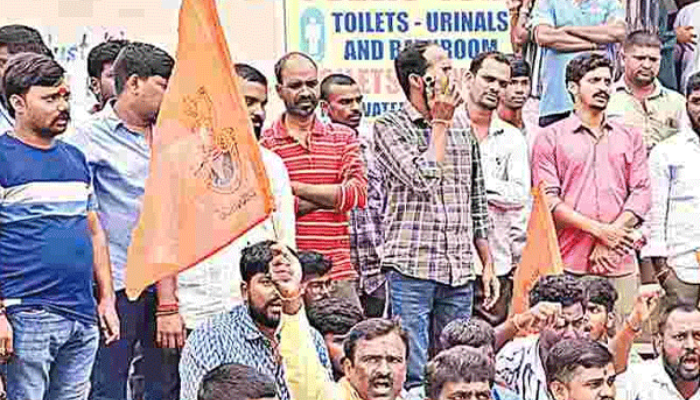
The Congress administration has been warned of severe consequences by the Bajrang Dal if it compromises the sanctity of the Chilkur Balaji temple in Telangana. The Hindu organisation demanded the demolition of the unlawfully under-constructed mosque near the place. The protesters staged a protest charging that attempts were underway to portray a plot of property in the Chilkur neighbourhood as waqf land. They insisted that no construction related to any other religion should take place in the area surrounding the Chilkur Balaji temple.
CS Rangarajan, Archaka of Chilkur Balaji Devasthanam expressed, “The ground surrounding the Chilkur Balaji temple is holy and has existed for a very long period. Just like the land surrounding Tirupati Balaji temple is revered, the area surrounding Chilkur Balaji temple is equally sacred and the Lord is the rightful owner because Lord Venkateshwara has manifested himself in Cilkur. This is not a place for houses of worship for other religions.” He noted that it is the responsibility of police, revenue and other departments to implement the same.
He further added, “There is a new masjid (mosque) being built within two kilometres of the temple. They are our brothers as well, and we love and respect them, but this is a request to the government and those building masjids that the land’s sanctity and proprietorship be upheld. This is our respectful plea to the administration and collector’s office. The government should ensure that no new places of worship for any other religion are permitted to be built here.”
— Vinayak R Gujjeti (modi ka parivar) (@GujjetiVinayak) July 25, 2024
As per a report by VSK Telangana, Bajrang Dal leaders demanded the removal of the mosque which was illegally being built around the sacred place. They accused the incumbent Congress administration of Muslim appeasement and declared that the oppressive action of the party which is biased towards Mulsim would be exposed. The authorities eventually took down the structure after a large number of Hindu activists demonstrated against the move under the banner of Bajrang Dal.
The state convenor of Bajrang Dal, Shivaramulu, asked that the local tehsildar be suspended immediately for fabricating a report claiming that the private land was waqf land. He accused that after bowing before the Muslim MLC and digging borewells at the site, the police themselves were present and terrorising the locals while carrying out construction work. He warned that the Hindu community would respond to the conspiracy against it.
After the protest by Hindu activists and CS Rangarajan who asked for the authority to pay heed to their request, the District Collector immediately took cognizance of the matter and halted the mosque’s construction. The protestors had warned that a demonstration would be launched if the construction continued.
Arson attacks and other “malicious acts” have hit France’s high-speed train network, disrupting the transport system, the country’s national rail operator said on Friday, hours before the opening ceremony of the 2024 Paris Olympics.
French railway operator SNCF reported acts of vandalism on several of its high-speed train routes, DW said. The TGV high-speed rail network was disrupted on lines to the country’s west, north and east, with service being cut off on some sections, causing delays, local media reported.
⚠️ Due to coordinated acts of malice in France, affecting several high speed lines, several high speed trains are being diverted or cancelled. Our teams are fully mobilised in stations, in the call centers, and onboard to ensure that all passengers are informed and can reach… https://t.co/IRXQK6lCtu
“Coordinated malicious acts targeted several TGV lines last night and will seriously disrupt traffic until this weekend. I strongly condemn these criminal actions which will compromise the vacation departures of many French people. A big thank you to the #SNCF teams, on the bridge to restore traffic conditions as quickly as possible.,” the country’s Transport Minister Patrice Vergriete said on X.
Des actes de malveillance coordonnés ont visé cette nuit plusieurs lignes TGV et perturberont fortement le trafic jusqu’à ce week-end. Je condamne fermement ces agissements criminels qui vont compromettre les départs en vacances de nombreux Français. Un grand merci aux équipes de…
The country’s Sports Minister Amelie Oudea-Castera condemned the attacks and was cited by the BFM TV, a French news broadcast television and radio network, as saying “To play against the Games is to play against France, against your side, against your country.”
She said that the impact for travellers, Olympic athletes, and the general public was currently being assessed while assuring “smooth transportation of all delegations to the competition sites.”
The rail operator SNCF said that train traffic on the Atlantic, North and East area had been disrupted. This situation should nevertheless “last at least the whole weekend, while the repairs are carried out” the operator said in a statement.
The attacks occurred as Paris was under high security ahead of the Summer Olympics’ opening ceremony, which was scheduled to attract 300,000 spectators and a VIP audience. On Friday evening, up to 7,500 contestants will go along a six-kilometre (four-mile) stretch of the Seine during a parade aboard an 85-boat flotilla.
Latest reports say that over 800,000 people have been affected by the widespread attacks. President Emmanuel Macron has said that the attacks were carried out in a prepared and coordinated manner.
Notably, this is the first Summer Olympics to take place outside of the main athletics stadium, which reports say is a risky decision at a time when France is on high alert for terrorist attacks. Reports say that the Normal traffic is expected to resume on 29th July.
In a major vindication for Rashtriya Swayamsevak Sangh (RSS), the Madhya Pradesh High Court ruled on 25th July that Office Memorandums (OMs) passed by the Congress government in the years 1966, 1970 and 1980 to ban RSS was “arbitrary” and lacked any substantial material to conclude that the association of government employees with RSS should be banned for the sake of India’s communal fabric and secular character.
The Division Bench comprising Justices Sushrut Arvind Dharmadhikari and Gajendra Singh ruled that executive-framed official memorandums cannot prohibit RSS membership since they are not the law of the land under Article 13(3)(a).
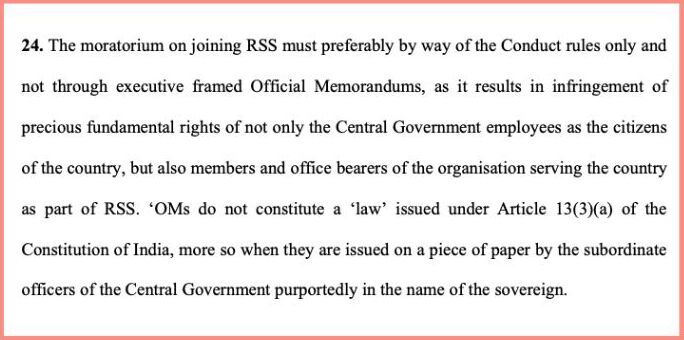
“The moratorium on joining RSS must preferably be by way of the Conduct rules only and not through executive framed Official Memorandums, as it results in infringement of precious fundamental rights of not only the Central Government employees as the citizens of the country, but also members and office bearers of the organisation serving the country as part of RSS. OMs do not constitute a ‘law’ issued under Article 13(3)(a) of the Constitution of India, more so when they are issued on a piece of paper by the subordinate officers of the Central Government purportedly in the name of the sovereign”, the court said.
The court also said that even though the Central Government during the pendency of the present writ petition has decided to review and remove the name of RSS from the list of ‘don’t join’ organisations, the court holds that any such exercise of proposing and restoring its name in the of ‘don’t join’ list ever in future must be preceded by a profound thought process, intensive deliberations backed by substantial material and evidence that indicates why RSS and its subsidiaries should be banned from participation by any of the Central Government employee.
“Other than political, why its religious, social, educational, health-related community services also invite a similar treatment to be also delved deep into, before holding the same to be a facet of misconduct under Rule 5 of the CCS Rules, 1964,” the court order reads.
The court also commented extensively on the apolitical nature of the work performed by RSS and its umbrella groups and NGOs, as well as how the Central Governments were wrong in including it on the “don’t join” list.
“The issuance of the OMs painting the whole universe of even the apolitical activities of RSS as communal, anti-secular and against national interest is a decision having drastic consequences, not only for the organisation but also everybody aspiring to associate with it with the noble interest of rendering community & public service,” the court said.
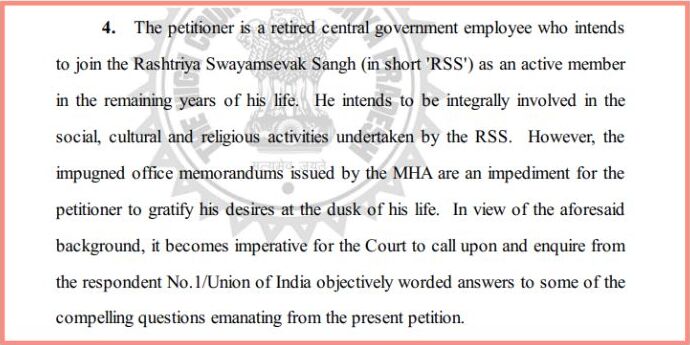
The High Court made these observations while hearing the plea of a retired central government employee Purushottam Gupta seeking permission to join the RSS. Gupta, through his counsel Manish Nair had moved High Court in September 2023. In his plea, Gupta contended that the rules that stopped him from joining the RSS were “an impediment for him to gratify his desires at the dusk of his life”.
Notably, petitioner Purushottam Gupta has also challenged the constitutional legality of subrules 12, 12A, and 13 of Rule 5 of the CCS(Conduct), 1965, arguing that they are extra vires as it include the RSS.
It is pertinent to mention that on the 10th of July, a day after the Modi government issued a notification dropping the RSS as a political party with which government officials cannot be linked, the Union of India submitted an affidavit in this court informing it of the order.
MP High Court questions on what basis RSS was placed on “don’t join” list
The Madhya Pradesh High Court raised the question of any empirical data, survey or any sort of report suggesting that the activities of RSS and its subsidiaries precipitate “communal bias” or that the involvement of government employees in RSS activities could be deemed “anti-secular” was relied on before placing RSS on the “don’t join” list. Expressing displeasure over the failure of the Union of India (UoI) to file a reply in this regard despite repeated inquiries, the court observed that there was no such material evidence that the governments that banned RSS in 1966, 1970, and 1980, relied on to decide that central government employees should be barred from partaking in RSS activities to uphold the communal fabric and secular character of the country.
“…perhaps there was never any material, study, survey or report at the relevant point of time based on which the ruling dispensation arrived at a satisfaction that involvement and engagement of central government employees even with the apolitical/non-political activities of RSS must be banned for maintaining the communal fabric and secular character of the country,” the court said.
Notably, on the 6th of May, the court expressed its dismay that the case had been pending for ten months since the Union of India had not filed a response to Gupta’s petition. On the 22nd of May Solicitor General of India Tushar Mehta appeared via video conferencing before the court, requesting time to file a response.
Coming back to the final order dated 25th July further stated that on 5 different dates during the hearing of Purushottam Gupta’s petition, they questioned the basis of issuance of the impugned circulars/ OMs that “handcuffed the freedom of lakhs of Central Government employees of the country for almost five decades from the 1960s till 2024.”
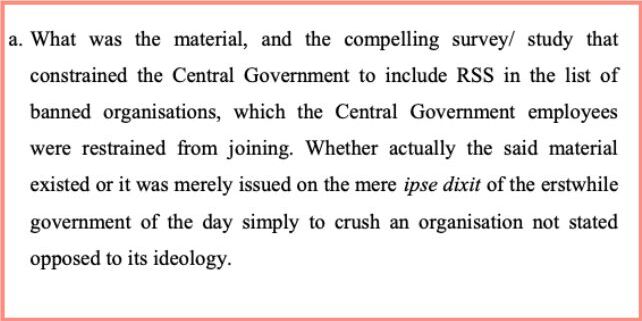
In its order, the court listed three questions that arose in their mind. The first was whether any compelling material, survey or study was taken into account suggesting that RSS should be included in the “don’t join” list and if such material actually existed or the decision was solely based on the ipse dixit of the relevant Central governments to crush an organisation ideologically opposed to them. In simple words, “ipse dixit” means any assertion or statement made by someone based solely on their authority, without any supporting evidence whatsoever.
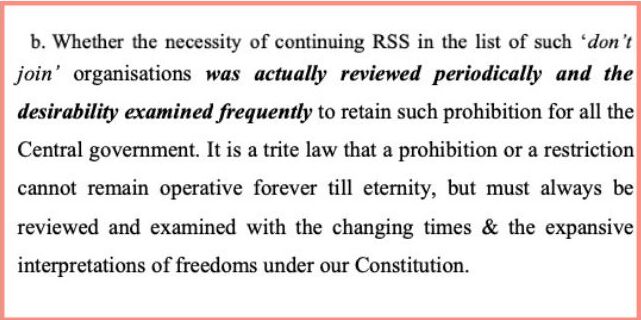
In its second question, the court asked whether the requirement of continuing RSS in the “don’t join” list was periodically reviewed and the desirability examined frequently to retain such prohibition for all the Central government.
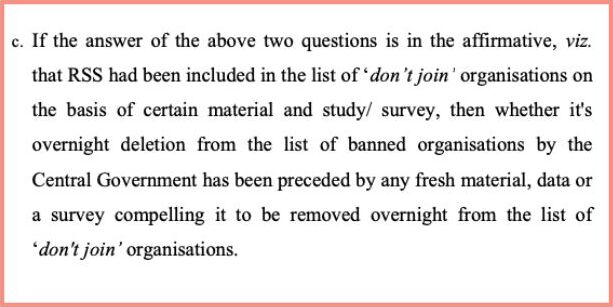
Thirdly, the court asked if indeed certain material, survey or study was relied on to put RSS in the “don’t join” list, then whether the current Central government considered any fresh material before removing RSS from the list “overnight”.
The court observed that if any material or evidence has been collected before removing RSS from the list of “don’t join” organisations then in future, the government must take into consideration compelling reasons backed by data to push RSS back into the list. If RSS is re-added to the list otherwise, then it will “plainly play foul of Articles 14 and 19 of the Constitution of India of the concerned employee, who has emotional and ideological alignment with the RSS.”
MP High Court highlights the social, educational and philanthropic activities of the RSS
The court noted that Rashtriya Swayamsevak Sangh is the only nationally established self-driven voluntary organisation outside the governmental bureaucratic hierarchy attracting the highest membership from various districts across the country actively partaking in “religious, social, educational, health and many apolitical activities, under its umbrella, which have no pertinence to political activities of RSS.” The court noted that the majority of the activities of RSS are not related to politics but varied social arenas. For this, the court cited the example of Rashtriya Seva Bharti (RSB), which works to “organise a peer group with nationalist thoughts and patriotic sentiments under one umbrella”.
The court also mentioned Saraswati Shishu Mandirs, “where lakhs of students from impoverished backgrounds receive primary and higher secondary education”. The court also highlighted the social and philanthropic facet of RSS saying that its field volunteers 11 actively engage in large-scale rehabilitation, resettlement, and disaster management support programs, especially the flood relief support being provided nowadays in many States. “Even this social and philanthropic wing of RSS may not identify itself with its political face, but concerns only with the philanthropic face of the organisation,” the court said.
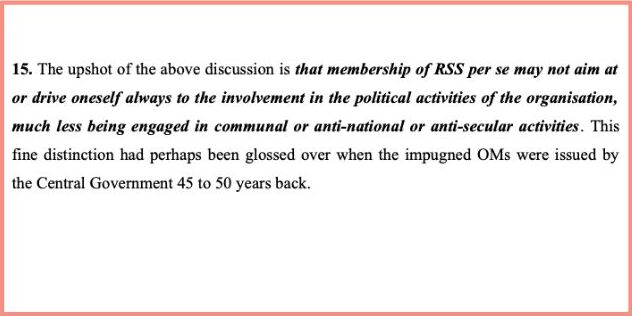
“…that membership of RSS per se may not aim at or drive oneself always to the involvement in the political activities of the organisation, much less being engaged in communal or anti-national or anti-secular activities,” the court observed.
The court emphasised that RSS and its sister organisations undertake several apolitical activities purely out of community service without any political ambitions.
“It took five decades for Centre to realise its mistake in banning RSS”: MP High Court blasts Centre
After pointing out the vast contributions of RSS in nation-building through its apolitical activities, the court, though not involving RSS, mentioned several past cases to observe that “voluntary membership of a national & internationally famed organisation like RSS, for activities other than political in nature, like religious, social, philanthropic, educational cannot be proscribed through executive instructions.”
Furthermore, the Madhya Pradesh High Court bench sitting in Indore lamented the fact that it took five decades for the Centre to rectify the mistake of the erstwhile Congress government of wrongly placing an internationally famed organisation like RSS on the list of banned organisations. Moreover, justices S.A. Dharmadhikari and Gajendra Singh said that the aspirations of numerous central government employees were “diminished” due to this arbitrary ban.
“The Court also laments the fact that it took almost five decades for the Central Government to realise its mistake; to acknowledge that an internationally renowned organisation like RSS was wrongly placed amongst the banned organisations of the country and that its removal therefrom is quintessential. Aspirations of many central government employees to serve the countries in many ways, therefore got diminished in these five decades because of this ban, which was removed only when it was brought to the notice of this Court vide the present proceedings,” the High Court bench said.
To raise awareness about the removal of RSS from the list of ‘don’t join’ organisations, the Department of Personnel and Training and the Ministry of Home Affairs, GOI has been directed by the court to post the contents of a recently issued circular on the Home Page of their official websites. Within nine days, the circular shall be distributed to all relevant ministries and undertakings of the Central Government, the court said.
Source: MP High Court
Modi government lifted the 58-year-old RSS ban and how RSS Swayamsevaks were persecuted for years by Congress
As reported earlier, the Modi government lifted a 58-year-old ban on government employees participating in the activities of RSS on 9th July 2024. This prohibition was enacted in November 1966 during the tenure of then-Prime Minister Indira Gandhi. Notably, the 1966 banning order by the Indira Gandhi government came right after the RSS-backed Cow Protection/ Anti-Cow Slaughter Movement on 7th November 1966.
OpIndia reported how Congress hounded people who were actively associated with RSS or had participated in its activities in the past were prevented from joining government jobs or were removed from their posts. The authorities used to stop candidates from joining government services after it turned out during police verification that they had or had in the past, links with RSS.
The mound burial system of the Ahom dynasty in Assam Moidams was included in the UNESCO World Heritage List under the category Cultural Property on Friday. The decision was taken during the ongoing 46th session of the World Heritage Committee (WHC), held in the national capital, Delhi.
UNESCO will examine the proposals of 27 sites for inscription on the World Heritage List, the state of conservation of 124 sites already inscribed on the World Heritage List, and the List of World Heritage in Danger. The World Heritage Committee is one of the two bodies governing the Convention for the Protection of the World’s Cultural and Natural Heritage. It is composed of the representatives of 21 states, elected from the 195 states parties to the Convention.
In the ongoing session, from July 23 to July 25, the Committee will examine the state of conservation of the 124 sites already inscribed on the World Heritage List, 57 of which are also on the List of World Heritage in Danger. Similarly, from July 26 to July 29, the Committee will examine the dossiers of 27 sites proposed for inscription on the World Heritage List. The sites will be examined according to three categories. The three categories are natural, mixed, and cultural.
Reacting to the news Assam Chief Minister Himmant Biswa Sharma said, “The Moidams make it to the UNESCO World Heritage list under the category Cultural Property. A great win for Assam Thank You Prime Minister Narendra Modi ji, members of the UNESCO World Heritage Committee and the people of Assam.”
“The Moidams of Charaideo embody the deep spiritual belief, rich civilisational heritage and architectural prowess of Assam’s Tai-Ahom community. Apart from the fact this announcement has been made from the soil of Bharat, its entry also stands out for 2 more reasons,” he added in a post on X.
THIS IS HUGE ?
The Moidams make it to the #UNESCO World Heritage list under the category Cultural Property – a great win for Assam
Thank You Hon’ble Prime Minister Shri @narendramodi ji , Members of the @UNESCO World Heritage Committee and to the people of Assam ?
“It is the first time a site from the North East has made it to the UNESCO World Heritage List under the Cultural Category. After Kaziranga and Manas National Parks, it is Assam’s 3rd World Heritage Site. I urge all of you to come and experience Awesome Assam,” he further said.
The Moidams are the burial mounds of the Ahom kings, Queens and Nobles. The word Moidam is derived from the Tai word Phrang-Mai-Dam or Mai-Tam. Phrang-Mai means to put into the grave or to bury and Dam means the spirit of the dead.
Though Moidams are found in all the districts of upper Assam, Charaideo, the first capital of the Ahoms was the necropolis of almost all the Ahom Royals. Charaideo is situated 28 km east of Sivasagar. The first king of the Ahoms Chau-lung Siu-ka-pha was buried at Charaideo after his death observing all the Tai-Ahom religious rites and rituals.
(This news report is published from a syndicated feed. Except for the headline, the content has not been written or edited by OpIndia staff)
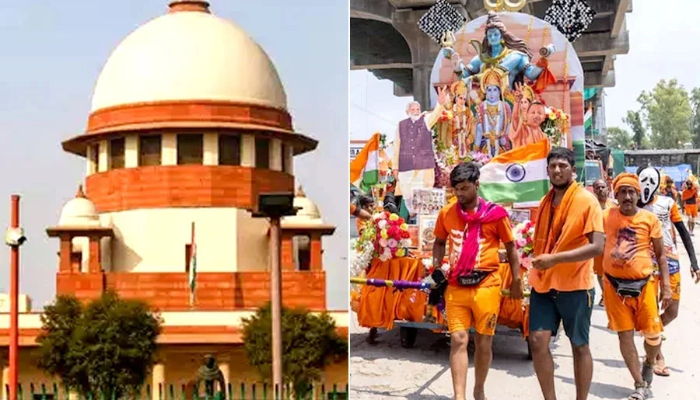
The Uttar Pradesh government strongly defended its directive requiring owners of eateries along the Kanwar Yatra route to display their names, in the Supreme Court. The state administration challenged the petitions contesting the order, arguing that it was given to facilitate a peaceful and orderly pilgrimage and prevent any accidental hurt to the religious feelings of Kanwariyas, in a submission made to the highest court on 25th July.
The Yogi Adityanath administration stated, “It may be noted that the idea behind the directives is transparency and informed choice of the consumer/Kanwaria regarding the food they eat during the period of the Yatra, keeping in mind their religious sentiments so that they don’t, even accidentally, fall foul of their beliefs. Such situations would lead to flare-ups where lakhs and crores of people are walking barefoot carrying holy water.”
The state government provided the Supreme Court with a comprehensive petition in which it noted that the order was issued in response to complaints from Kanwariyas regarding the confusion caused by the names of the eateries and shops. Moreover, the affidavit pointed out unequivocally that these instructions are not discriminatory because they apply to all food vendors along the Kanwar Yatra path, regardless of their ethnic or religious affiliation.
It conveyed, “The directives are also aimed at ensuring public safety and order during the Kanwar Yatra, given the large number of participants and the potential for communal tensions, it is imperative to take preventive measures that ensure a peaceful and harmonious pilgrimage. Past incidents have shown that misunderstandings regarding the type of food being sold have led to tensions and disturbances. The directives are a proactive measure to avoid such situations.”
The state government further stated that shops are “free to conduct their business as usual” and that the order has no restrictions on the selling of non-vegetarian food. The requirement to list the identities of owners is “just an extra precaution” to maintain openness and prevent any misunderstandings. The authorities also mentioned that Kanwariyas’ religious feelings could be harmed by even slight misconceptions about the type of food they are served and it could result in tense situations, particularly in a communally vulnerable region such as Muzaffarnagar. the state arrested, “It is imperative to take preventive measures that ensure a peaceful and harmonious pilgrimage.”
Furthermore, the government has justified its orders by maintaining that they are in line with the fundamental responsibilities of citizenship as stated in Article 51A of the Constitution, which obliges all Indian citizens to foster unity and a sense of fraternity. The instructions promote peace, a sense of fraternity, and harmonious cohabitation by guaranteeing that the religious beliefs of the Kanwariyas be honoured.
On 22nd July, the Uttar Pradesh government issued an order mandating that the names of the proprietors of eateries along the Kanwar Yatra route be displayed. The rule was put into effect following complaints from some Kanwariyas regarding confusion caused by store and eatery names. Pilgrims had reportedly voiced reservations about the food that was being served along the way, and the authorities acted to ensure a smooth experience for the pilgrims. However, the Supreme Court issued an interim ruling over the decree and stayed it until 26th July.