

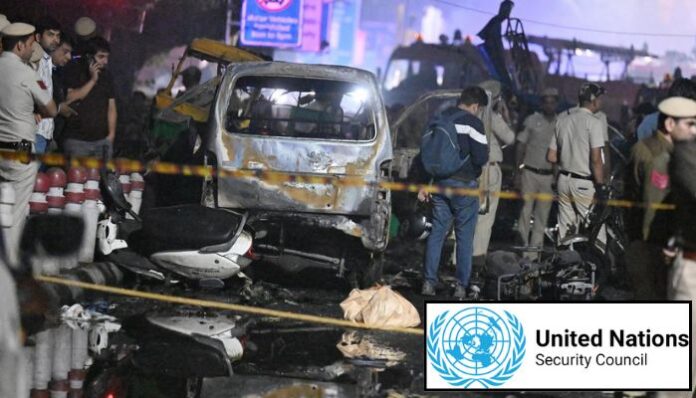
The United Nations Security Council has officially attributed the November 2025 blast near Delhi’s Red Fort to Al-Qaida in the Indian Subcontinent (AQIS), according to the 38th report of the Analytical Support and Sanctions Monitoring Team.
The report [pdf], released on Monday, 10th August, said AQIS had continued to develop from a fragmented outfit into a regional terrorist organisation with logistics and financial networks operating through small, decentralised cells.
The UN report said, “The attack in November 2025 on the Red Fort in Delhi was officially attributed to AQIS. There was some concern about AQIS trying to exploit Bangladesh to establish cells there.”
It further added, “AQIS formed the backbone of Ittihad-ul-Mujahideen Pakistan (IMP)…The AQIS leadership reportedly remained in Kabul, having been issued tazkiras suggesting close cooperation between the Taliban and AQIS.”
The development is significant as the National Investigation Agency (NIA) had already linked the accused in the case to Ansar Ghazwat-ul-Hind (AGuH), an offshoot of AQIS. In May 2026, the agency filed a 7,500-page chargesheet against 10 accused in connection with the blast, which killed 11 people and injured several others.
What happened in the Red Fort blast?
The blast took place on 10th November, 2025, when an explosives-laden Hyundai i20 exploded near the Red Fort area in Delhi. The NIA later identified the deceased driver, Dr Umer Un Nabi, as the main perpetrator. According to the agency’s chargesheet, all 10 accused were linked to AGuH, an AQIS offshoot.
Investigators found that the attack was not an isolated incident but was connected to a wider terror network. According to the investigation cited in the reference material, Nabi had been in contact with handlers after entering Delhi, and different possible targets, including Mayur Vihar and Connaught Place, were discussed before the Red Fort area was selected.
The Red Fort was considered because of its symbolic importance and the expectation of a large crowd. However, the monument was closed to visitors that Monday. The explosives were subsequently assembled, and the vehicle was driven towards Netaji Subhash Marg, where the blast took place.
The explosion killed 11 people and left several others injured. The NIA described the incident as a high-intensity vehicle-borne improvised explosive device (VBIED) attack and said it caused extensive damage in the area.
Doctors emerged as key part of the terror module
The investigation also brought several medical professionals under scrutiny. The accused included doctors from Jammu and Kashmir who, according to investigators, used their professional backgrounds as a cover while remaining connected to the terror network.
Among those named in the investigation were Shaheen Saeed, Muzammil Shakeel Ganaie and Adeel Ahmed Rather. Umer Un Nabi, who died in the explosion, was also a doctor. The NIA chargesheet named 10 accused and linked them to Ansar Ghazwat-ul-Hind.
Two of the doctors had links with Al-Falah University in Haryana. Investigators said that the wider module operated through locations in and around Faridabad, where materials connected to the conspiracy were stored and assembled.
The probe also led to the seizure of a large quantity of explosives. According to the investigation cited in the case, nearly 2,900 kg of explosive material was recovered from a location associated with Muzammil Ganaie.
The NIA’s chargesheet described the network as being connected to a larger conspiracy and said the accused were associated with AGuH, an organisation linked to AQIS.
AQIS operates through smaller, decentralised cells
The latest UN assessment places the Red Fort attack within the wider evolution of AQIS. According to the monitoring team’s report, the organisation has moved away from relying mainly on large formations and has instead developed smaller, more dispersed cells supported by logistics and financial networks.
The finding also adds an international dimension to the investigation into the Delhi blast. While Indian agencies had already established links between the accused and an AQIS-linked organisation, the UN monitoring team’s attribution now identifies the attack as part of the threat posed by AQIS in the region.
The NIA’s May chargesheet had similarly established the AQIS connection through AGuH and named 10 accused in the case.
