

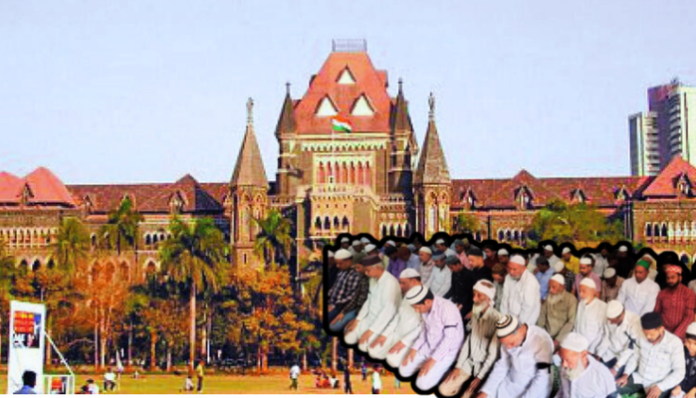
Bombay High Court on Thursday (5th March) declined a plea by taxi and autorickshaw drivers requesting a space to offer namaz under a temporary shed near the Chhatrapati Shivaji Maharaj International Airport in Mumbai during the month of Ramazan. Dismissing the plea, a bench of justices BP Colabawalla and Firdosh Pooniwalla said that the security of the airport could not be compromised “even a bit”. The Bench also asked the petitioners not to cause unnecessry issue.
The petition was filed by the Taxi-Rickshaw Ola-Uber Men’s Union, claiming that a temporary shed in the vicinity of the Chhatrapati Shivaji Maharaj International Airport (CSMIA). The petitioners said that a prayer facility existed near the airport for about 30 years. It was relocated in 2020 and was subsequently demolished in April 2025 by the Mumbai Metropolitan Region Development Authority (MMRDA). The petitioners alleged that the demolition of the prayer facility was carried out “arbitrarily and without giving any notice”. In the petition, they requested to be allowed 1,500 square feet within the airport premises or be allotted another site in the same area for drivers to offer prayers during Ramzan.
The temporary Namaz site posed a security concern: State government
Last week, the court directed the police and the airport authorities to consider an alternate site to be temporarily allotted for offering namaz. However, Additional Government Pleader Jyoti Chavan submitted a report before the High Court on Thursday, informing that the temporary structure, which was close to a VIP entrance gate, was demolished after several agencies, including the anti-terrorism cell, flagged security concerns.
Moreover, senior advocate Vikram Nankani, appearing for Mumbai International Airport Limited (MIAL), apprised the court that the airport authorities surveyed seven other sites, but none were found suitable for offering prayers due to congestion, security concerns and airport development plan constraints. The State also informed the court that there are mosques and religious facilities within walking distance of the drivers’ parking area.
No right to offer namaz at any place: HC
After hearing both sides, the High Court observed that while Ramzan was an integral part of Islam, Muslims cannot claim to have a religious right to offer namaz (prayers) at any place during the holy month. The High Court stated that security overrides religion. “When there is a security risk, security comes first, irrespective of religion. When it comes to security, we will not compromise one bit,” the High Court said.
The court added that after examining the report, it cannot pass an order for the allocation of a space near the airport for offering namaz. “Once we are faced with this report, we are unable to direct the respondents to allot any space to the petitioner association, even for a temporary period to undertake namaz during the month of Ramazan,” the High Court noted.
You can’t say you’ll carry your prayer only here: HC
The High Court pulled up the petitioners for raising the issue now during Ramzan, while the demolition was carried out in April 2025. The court pointed out that despite the delay on the petitioners’ side, the authorities made efforts to find an alternative site for prayer. “It’s difficult for us to say that all of them are only targeting you,” the court remarked. “You can’t say you’ll carry your prayer only here. No one is stopping you to offer your prayer five times a day. We have to look at the larger picture. We can’t go by one community or the other,” the High Court added.
The petitioners’ argument that a temple exists in the area was rejected by the High Court, saying that the existence of another structure does not justify the petitioners’ wrongful claim. “Even if we assume there is a temple, two wrongs do not make a right. If someone comes to us saying that the structure is illegal, we will order them to demolish that structure also,” the High Court remarked.
The High Court clearly stated that taxi drivers cannot insist on offering prayers at a specific location. The court clarified that the right to religion does not automatically translate into a right to use any public or sensitive space.
