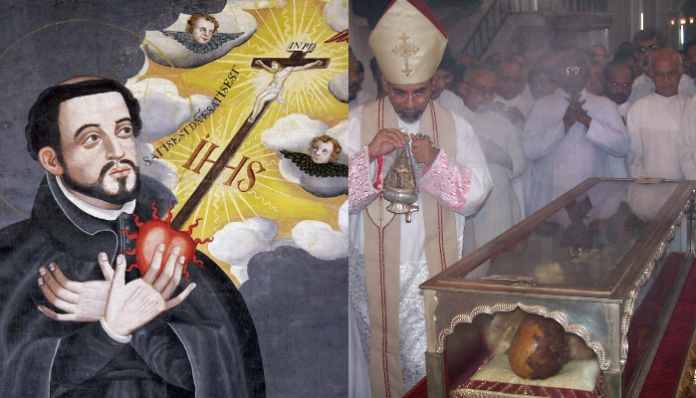
Francis Xavier, a divisive figure in Indian history, who landed in the country on 6th May 1542 when Goa was converted into a Portuguese colony, to pursue his missionary agenda, has once again grabbed attention following the allegedly contentious remarks made by Hindu activist YouTuber Gautam Khattar and his brother Madhav Khattar. Notably, the “patron saint” of Goa left a distressing legacy defined by torture, forced religious conversions and the persecution of the native Hindu population in a terrorising attempt to bring them closer to the Christian God.
He emerged as one of the most notorious symbols of the Goa Inquisition, which aimed to enforce Catholic orthodoxy, suppress the local traditions and punish individuals in the name of heresy. However, this controversy did not end with his death. Instead, the events surrounding his passing and its aftermath have similarly been clouded by mystery and debate, with conflicting statements persisting to this day.
Xavier was driven and prepared to travel to each nation to convert all people to Christianity. He sowed the seeds of proselytisation in India and Japan throughout the majority of his career. Nevertheless, he was far from satisfied and therefore embarked on a journey to China, as his ultimate goal was to push the entire region towards the Abrahamic faith. Unbeknownst to him, this would mark the conclusion of both is missionary activities and life.
A desperate endeavour to convert China triggered the beginning of the end
A translation of “his work on Christianity into the Chinese language” was among the multiple preparations Xavier undertook for his voyage. He organised each step of his expedition and spent a lot of time figuring out the logistics. Interestingly, the Portuguese were against his move because they were concerned that their trade relations would be broken. They made every effort to prevent him from heading to China, but he remained firm and refused to be put off his decision any longer.
“He had been much attracted by the Chinese merchants whom he met in Japan. He thought them quite as intelligent as the Japanese and as eager to acquire knowledge, if indeed they were not superior in intellect. From his inquiries, he found that China was a rich land full of religious sects, though he did not believe there were any Christians there. It was likely to prove a fruitful mission, and if the Chinese embraced the true faith, the Japanese would soon forsake their paganism,” wrote MT Kelly in “A Life of Saint Francis Xavier: Based on Authentic Sources.”
Xavier contracted a fever on one of the islands where his ship halted, but recovered after 15 days. However, he was preoccupied with his single desire and “thought of nothing else and could think of nothing day and night but of converting China. He often walked along the shore, turning his eyes to China, and he said to friends that his only wish was to be set down at the gates of Canton and that he would not trouble himself with what might happen afterwards.
He touched the island of Shangchuan (Sancian), recognised as a location for local fishermen and Portuguese smugglers, in late August or September 1552 and sought refuge in the rough hut of a man named Jorge Alvares. The newcomers, who were accustomed to a warm climate, suffered due to the piercing cold owing to the north wind. Their supplies were exhausted, and hunger began to take hold. Meanwhile, Xavier found himself alone with Antonio (a Chinese convert) and Christovao (his Indian servant), as Alvares had been murdered by robbers.
They were left without anyone to assist them in the desolate region. There were just 2 ships, and a small number of Portuguese continued to reside on the strand in their makeshift shelters. Xavier occasionally had to dispatch Antonio to plead with them for bread or other provisions, but they were also experiencing an acute shortage because the mandarins were hindering their exports from the mainland.
On 19th November, a Chinese trader was supposed to secretly carry the Spanish Jesuit priest to Canton. The latter waited for him every day, but he never arrived. This was the closest he ever reached China, as he fell ill again. His condition deteriorated without any food or other supplies, and he eventually died on 3rd December of that year without making it to the mainland.
His body was exhumed nearly two months after his death in February of the next year and subsequently conveyed to Malacca, where it was temporarily buried in Saint Paul’s church on 22nd March. Furthermore, it required more than a year for his remains to find their way to India, where they were initially placed in Saint Paul’s College on 15th March 1554. It was the first building erected by the Jesuits in Goa.
The remains were relocated to the Casa Professa, also known as Professed House, a Jesuit residence which is adjacent to the basilica around 1613. They weren’t transferred to the Basilica of Bom Jesus until 1624, when word of his canonisation spread to the area.
The possible scientific rationale behind the “preserved” body
Xavier was put inside a lime-filled coffin, which might have produced an alkaline environment that restricted bacterial growth and stopped the normal breakdown process. Similar to refrigeration, the chilly winter temperatures in Sancian around that time might have served as a natural preservation.
The body might have been even more desiccated due to frequent excavations and exposure to different settings. Body tissue drying out could resemble the consequences of mummification, in which microbial activity, a vital aspect of decomposition, is inhibited by the dearth of moisture. The same could also be attributed to his physical state during the last moments.
His body fat might have drastically fallen, and its biochemical structure changed due to years of fasting and physical deprivation. Putrefaction is less common in individuals with less fat because fatty tissues break down faster than lean tissue. His body’s pH (Potential or Power of Hydrogen) levels could have been impacted by chronic illnesses and starvation, rendering it harder for bacteria that usually degrade organic matter to survive.
Xavier’s death sparked a new dispute concerning the “relics”
The prolonged duration from the death to the final resting spot of the co-founder of the “Society of Jesus” resulted in many raised eyebrows, suspicions and questions. Buddhists from all over the world, including Sri Lanka, have been asking for an examination of his “relics” and maintain that they actually belong to a highly revered 15th-century Buddhist monk, Rahula Thero. The Sri Lankan activist outfit “Rahula Thero” also wrote an open letter to the Indian government and Mahinda Rajapaksa, the country’s president at the time, in 2014.
“We, the signatories, as concerned and right-thinking citizens of India and Sri Lanka and the rest of the world, request you to kindly intervene in resolving the long-standing dispute regarding the true identity of the remains of a body kept in a glass coffin in a church in Goa, India,” it read.
They further submitted, “There is a widespread belief in Sri Lanka, particularly among Buddhists, that the body in question is that of a highly respected literary giant and learned monk of Sri Lanka, Acharya Ven. The remains belong to Sri Rahula Thero (1409-91), while Catholics have been led to believe that it is the body of Francis Xavier, a controversial Christian Jesuit missionary who was accused of committing crimes against humanity by starting the infamous Goa Inquisition.”
The letter added, “We believe that DNA testing or blood sample testing of the descendants of both families will satisfactorily put an end to the centuries-old debates and theories. We demand that the body lying in Goa be returned to France, and the controversial remains should no longer be kept in Goa as neither Goa nor India is a colony of foreign countries.”
According to the petition, India emancipated Goa in 1961. A statewide campaign and an appeal to the Indian government have been started by the descendants of the Konkani Christian victims of the Goa Inquisition, which was first proposed by Xavier. WTJS Kaviratne, a journalist from Sri Lanka, published a piece in February 2014 on the issue and highlighted that Buddhist monks and devotees from his nation consider the remains to be those of Thero and endorsed DNA analysis to identify the truth.
Buddhists in India call for validation of the claims
The prayer had also been backed by organisations within the Indian Buddhist community, which maintained that resolving any contentious situation by scientific investigation is beneficial to peace. OpIndia had met with Dhamma Dhiru, alias Prema Phante, of the management committee of Mahabodhi Temple, a well-known Buddhist pilgrimage destination in Bodh Gaya of Bihar. He expressed that the members of the community also hoped for a review of Xavier’s purportedly preserved remains in Goa.
According to him, Thero was a famous Buddhist saint and if an inquiry is recommended to address the problem, then it should be conducted. He stated that the nation’s Buddhist groups would discuss this, and if necessary, a memo is going to be delivered to the president and prime minister.
Christians invoked Xavier’s cruel deeds and opposed the exhibition of his remains
The Goan Christian community also objected to the public display of Xavier’s remains in a grand program which was scheduled to take place in the state between 22nd November 2014 and 4th January 2015. A group, “Konkani Christian Victims of Francis Xavier’s Atrocities” had been formed at that time by a section of the Christian community. They asserted to be the heirs of his victims and had warned of unrest against the showcasing.
The organisation pointed out that it has been 53 years since the Portuguese authority collapsed in Goa and insisted that the body should be returned to its native nation because preserving it in India is disrespectful to the country. They had launched a national signature campaign to support this demand. These people wanted to approach both the centre and state governments.
Xavier, despite a carefully crafted public persona and “sainthood,” was responsible for the oppression of the indigenous population of India and their Hindu beliefs. He was consumed by an unwavering hunger to spread Christianity to every corner of the globe, whether through coercion or force. He achieved his ambitions, especially in Asia, but his violent quest paved the way for a dismal fate.
It is even more poetic that his death is marred by controversy and fiercely contested claims, much like his life, as if destiny would have it no other way.