
The Chhattisgarh High Court refused to quash a criminal case against Dilip Jha, a professor at Guru Ghasidas Central University in Bilaspur, for forcing Hindu students to offer namaz during an NSS camp in March 2025.
Dilip Jha sought quashing of the FIR against, State counsel argued against it, Chhattisgarh HC rejected the plea
In an order dated 16th April 2026, a division bench comprising Chief Justice Ramesh Sinha and Justice Ravindra Kumar Agrawal held that there was prima facie sufficient evidence in the charge sheet to warrant trial against Professor Dilip Jha.
Jha’s counsel, Arjit Tiwari, argued that the entire case against his client should be quashed as the impugned FIR and the consequential proceedings are “wholly frivolous, vexatious, and manifestly mala fide.”
The court, however, rejected this argument, stating that there was no evidence to establish that legal proceedings against Professor Dilip Jha were initiated with mala fide intentions.
The petitioner’s counsel had also contended that the complainant and other witnesses had stated that he was not present when Hindu students were forced to offer namaz, and the materials collected during the investigation show no evidence connecting him to the acts. It was stated by the petitioner’s counsel that he was a Project Coordinator for the NSS programme, had no operational or supervisory role at the camp site at the time when Hindu students were forced to offer namaz.
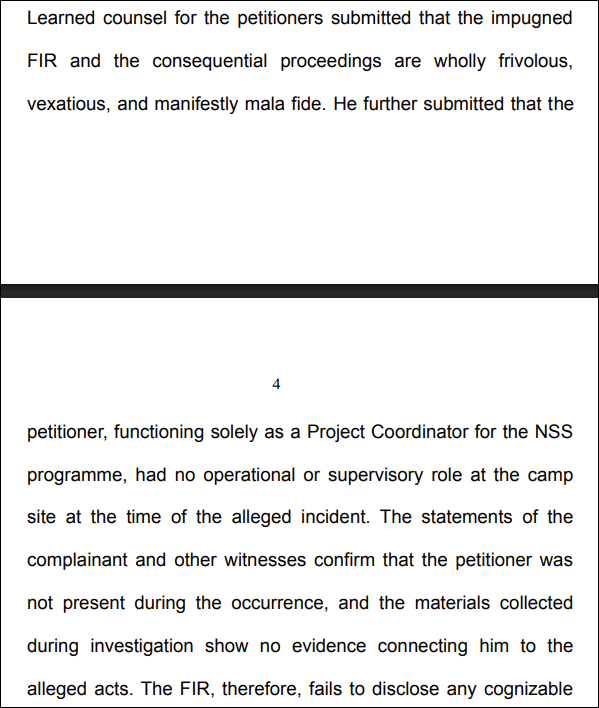
“The FIR, therefore, fails to disclose any cognizable offence against the petitioner and amounts to an abuse of the criminal process. Continuation of proceedings would cause irreparable harm to the petitioner’s professional career, reputation, and personal liberty,” the petitioner argued.
“The present case falls squarely within these principles, as the petitioner has been selectively implicated despite the institutional nature of the NSS programme, and no evidence implicates him in any operational wrongdoing, as such, the impugned FIR as well as the order taking cognisance, so far as it relates to the petitioner, be quashed,” Jha’s counsel added.
Meanwhile, the State counsel contended that the petition seeking quashing of the FIR and proceedings against Professor Dilip Jha “is not maintainable at this stage, as the charge-sheet has already been filed following a detailed investigation.”
The State counsel submitted that the filing of the charge-sheet demonstrates that the probe agency has found sufficient material to proceed against the petitioner, and it is now for the court to examine the evidence and determine the petitioner’s liability.
“Interference at this stage would amount to pre-judging the merits of the case, which is impermissible, and could impede the statutory criminal process,” the State counsel said.
After hearing arguments of both sides, the court observed that the investigation in the matter is completed and that sufficient material has been gathered against the accused.
Rejecting the petitioner’s “mala fide intentions” argument, the court said that while it takes note of the submission that the proceedings against Dilip Jha are “frivolous or vexatious”, quashing of proceedings is justified “only n exceptional circumstances where the allegations on the face of the FIR do not disclose a cognizable offence or where the proceedings are manifestly mala fide.”
“In the present case, the charge-sheet indicates that the investigation revealed prima facie evidence warranting trial, and there is no conclusive proof at this stage that the proceedings were instituted with ulterior motives,” the court stated.
Regarding the petitioner’s contention that he was not present when Hindu students were forced to offer namaz during a NSS camp, the court said that Dilip Jha’s absence from the scene or the question of his administrative role can be addressed during the trial. The court opined that interfering at this stage would amount to pre-judging issues of fact and evidence.
“It is evident that the petitioner has already been granted anticipatory bail. The petitioner’s contention regarding absence from the scene or administrative role is a matter that can be fully addressed during the trial through cross-examination and presentation of evidence. Interference at this stage would amount to pre-judging issues of fact and evidence, which the Court is not empowered to do,” the court said.
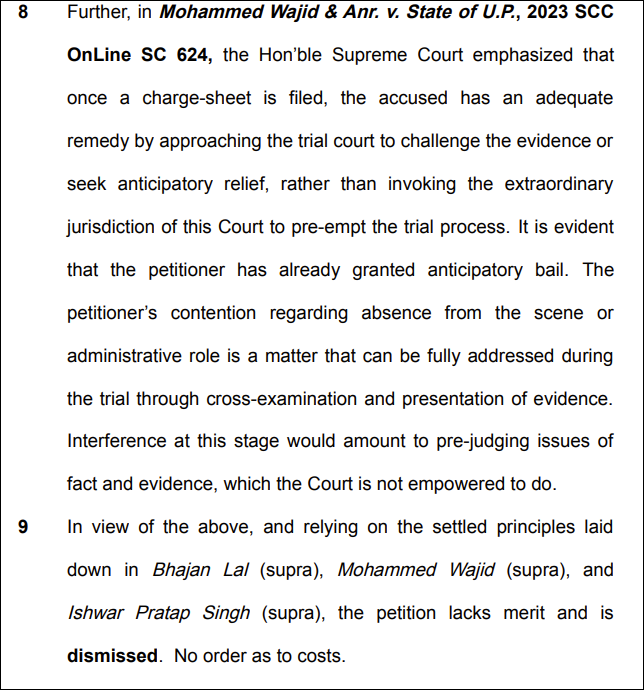
Dismissing the Jha’s plea, the court ruled, “In view of the above, and relying on the settled principles laid down in Bhajan Lal (supra), Mohammed Wajid (supra), and Ishwar Pratap Singh (supra), the petition lacks merit and is dismissed. No order as to costs.”
Background of the case
Back in March-April 2025, a massive row had erupted in Bilaspur’s Guru Ghasidas Central University after over 150 Hindu students narrated that they were coerced into offering namaz during an NSS (National Service Scheme) camp.
The students had filed a formal complaint at the Koni police station, accusing camp officials of religious coercion, manipulation, and threats of withholding participation certificates.
It was reported that the incident occurred during a week-long NSS camp (March 26–April 1) in Shivtarai forest. On 31st March, Eid-ul-Fitr, the coordinator reportedly invited four Muslim students to pray on stage, and then forced Hindu students to offer namaz without their consent. It was stated that this move was part of a larger effort to influence their beliefs under the guise of cultural exchange.
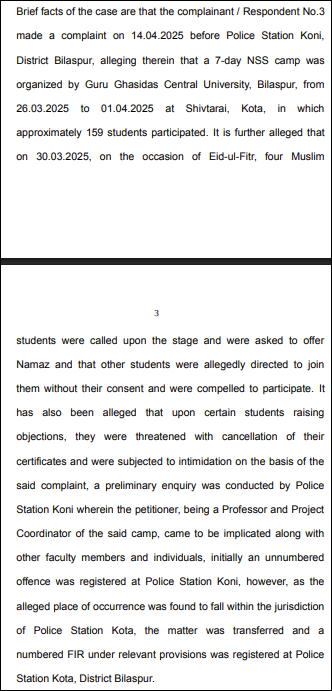
Despite objections, the students informed that they were threatened with disciplinary action if they refused. Phones were confiscated, preventing documentation of the incident.
Consequently, a complaint was filed against program officer Dr Basant Kumar, coordinator Dilip Jha, and others.
In May 2025, the Chhattisgarh High Court refused to quash 2 FIRs against 7 professors at Guru Ghasidas Central University. A petition seeking cancellation of the FIR was filed by Professor Dilip Jha, who was arrested in this case. However, he was later granted bail. The second petition was filed by six assistant professors. These people were named as accused in this case.
Back then, Chief Justice Ramesh Sinha and Justice Rakesh Mohan Pandey of the Chhattisgarh High Court dismissed the plea, stating that the veracity of the allegations in the FIR cannot be commented upon during the investigation. The court allowed the police to complete the investigation into the matter.
Now, on 16th April 2026, the Chhattisgarh High Court has once again rejected Jha’s desperate plea seeking quashing of the FIRs and proceedings against him.