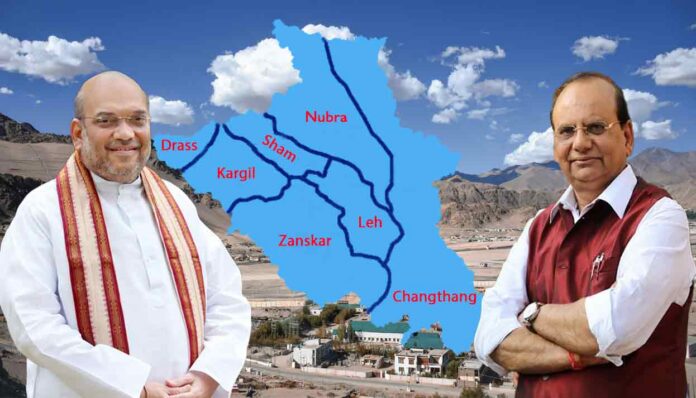
The Lieutenant Governor of Ladakh, Vinai Kumar Saxena, notified the creation of five new administrative districts on 27th April 2026. The creation of districts, Nubra, Sham, Changthang, Zanskar, and Drass, has increased the Union Territory’s total from two districts, Leh and Kargil, to seven. This historic administrative overhaul, however, has irked local Muslim organisations and political parties, who have labelled the move ‘gerrymandering’ by the Central government to ‘weaken’ the statehood movement.
Before delving into the invocation of the Muslim victimhood bogey, it is pertinent to understand why Ladakh has been divided into five new districts.
From 2 districts to 7: Why Ladakh needed an administrative district division
On 27th April 2026, Ladakh L-G, Vinai Kumar Saxena, notified the creation of five new districts, “to meet the aspirations of the people of Ladakh and to fulfil their long-pending demand”. The Central government had approved the formation of these new districts back in August 2024.
A historic day for Ladakh.
— LG Ladakh (@lg_ladakh) April 27, 2026
I have approved the notification for creation of five new districts in Ladakh, fulfilling the aspirations and long pending demand of the people of Ladakh.
With creation of five new districts – Nubra, Sham, Changthang, Zanskar and Drass – Ladakh will…
Back then, Union Home Minister Amit Shah had said, “In pursuit of PM Shri @narendramodi Ji’s vision to build a developed and prosperous Ladakh, the MHA has decided to create five new districts in the union territory. The new districts, namely Zanskar, Drass, Sham, Nubra and Changthang, will take the benefits meant for the people to their doorsteps by bolstering governance in every nook and cranny.The Modi government is committed to creating abundant opportunities for the people of Ladakh.”
In pursuit of PM Shri @narendramodi Ji's vision to build a developed and prosperous Ladakh, the MHA has decided to create five new districts in the union territory. The new districts, namely Zanskar, Drass, Sham, Nubra and Changthang, will take the benefits meant for the people…
— Amit Shah (@AmitShah) August 26, 2024
As per the new administrative division, the Leh district will have 44 revenue villages, while Nubra will have 30 revenue villages, and Changthang will have 24 revenue villages. Similarly, Kargil district will have 80 revenue villages, while Sham district will have 27 revenue villages, Zanskar will have 26 revenue villages, and Drass will have 19 revenue villages.
Now, the Buddhist-majority areas account for Leh with 151 villages, and the Shia Muslim-majority areas account for Kargil with 99 villages.
The Nubra, Sham, and Changthang districts were carved out of the existing Leh district, while Zanskar and Drass were formed out of the existing Kargil district.
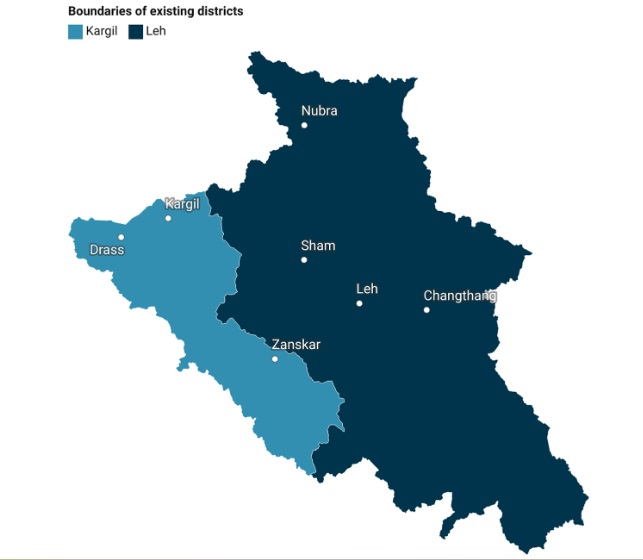
This is the biggest administrative restructuring Ladakh has witnessed since it became a separate Union Territory in 2019.
Despite being India’s second-largest Union Territory by area, Ladakh is one of the most sparsely populated, with a population of over 2.74 lakh people as per the 2011 Census. The UT is projected to have over 3 lakh people at present. The Ladakhi populace is spread across vast, high-altitude terrain, with limited road connectivity, remote valleys and plateaus, and extreme weather. With the multi-faceted challenges, the two-district structure, with Leh covering Buddhist-majority areas and Kargil covering the Muslim-dominated areas, was becoming unwieldy for local day-to-day governance.
One of the most important reasons for the now-notified administrative division is decentralisation. The Central government aims to bring administration, development schemes, healthcare, education, and grievance redressal close to remote villages in places like Nubra Valley, Changthang Plateau, Zanskar Gorge, and Drass Sector. These areas earlier fell under distant district headquarters.
The creation of separate districts has been a longstanding demand of the local people in these sub-regions, to boost infrastructure, tourism, employment and economic opportunities.
With Ladakh divided into small districts, there will be a more focused district-level machinery including police, collectors, etc, for a region having its own set of challenges such as border sensitivities and fragile ecology.
Muslim organisations and political parties give the creation of five new districts in Ladakh a Muslim victimhood spin
It has become ritualistic for Islamist political parties to peddle Muslim victimhood propaganda regarding almost every policy decision taken by the Modi government. In this vein, the All-India Majlis-e-Ittehadul Muslimeen (AIMIM) chief Asaduddin Owaisi describes the creation of five new districts in Ladakh as an attempt to “divide the unified statehood movement of Buddhists and Muslims.”
Citing the 2011 Census data, Owaisi argued that Muslims have been turned into a minority, having only 2 districts, while now there will be five Buddhist-majority districts. Highlighting that Ladakh has 46.40% Muslims and 39.65% Buddhist population out of the total population of 274289, and yet there will be only 2 Muslim-majority districts, Owaisi accused the Modi government of ‘gerrymandering’.
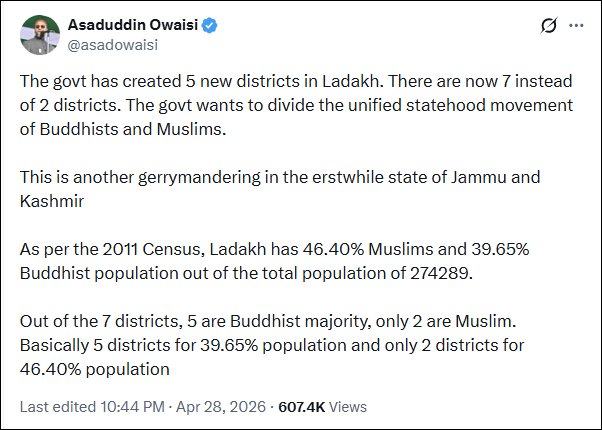
“The govt has created 5 new districts in Ladakh. There are now 7 instead of 2 districts. The govt wants to divide the unified statehood movement of Buddhists and Muslims. This is another gerrymandering in the erstwhile state of Jammu and Kashmir. As per the 2011 Census, Ladakh has 46.40% Muslims and 39.65% Buddhist population out of the total population of 274289. Out of the 7 districts, 5 are Buddhist majority, only 2 are Muslim. Basically 5 districts for 39.65% population and only 2 districts for 46.40% population,” Owaisi wrote on X.
Meanwhile, Kargil Democratic Alliance (KDA) has called the creation of five new districts a “calculated attempt” to “divide the unified statehood movement of Buddhists and Muslims, who have been seeking full statehood for Ladakh and inclusion under the Sixth Schedule, which guarantees tribal safeguards.
The KDA argues the new notification creates two Muslim-majority districts, Kargil and Drass, against five Buddhist-majority districts, Leh, Nubra, Sham, Changthang, and Zanskar, even as Muslims are slightly higher in population compared to Buddhists.
KDA’s Sajjad Kargili said, “This disproportionate distribution reflects a deeply skewed and discriminatory approach. The process has clearly ignored regional sensitivities, demographic realities, and principles of equitable representation.”
Similarly, Mohammad Jaffer Akhoon, Chairman and Chief Executive Councillor (CEC) of the Ladakh Autonomous Hill Development Council-Kargil (LAHDC-K) has called the Centre’s decision “an arbitrary and one-sided decision”.
“This is an arbitrary and one-sided decision which deepens the faultlines here. A Muslim majority UT has been administratively reduced to a minority. Areas like Sanku subdivision and Shakar Chiktan Shargole Sub-Division, with Muslim majority have been ignored and areas with much lower population have been given districts. This is unacceptable to us and we urge the Prime Minister and Home Minister to address our concerns and demands. One district with a Muslim population has 80 villages while another district has just around 40 or even less villages,” Akhoon said.
Regarding funds allocation for the new districts, Akhoon said, “Tomorrow, when funds will be allocated to districts or posts advertised, it would be heavily skewed in favour of a section of the population, which is unfair and unjust.”
Is Modi government trying to kill Ladakh statehood demand by ‘breaking’ the supposed Buddhist-Muslim unity for statehood demand?
Contrary to the narrative being pushed by Islamists and their political patrons, the new boundaries carved out strictly follow existing demographic and geographic realities of sub-regions. The Leh region has historically been Buddhist-dominated. Its sub-areas like Sham, Changthang, and Nubra are also overwhelmingly Buddhist. Kargil, on the other hand, is overall Muslim-majority, with only Zanskar being Buddhist-dominated, while Drass is Muslim. These religion-based pockets have already existed, and it is not the case that the Modi government has manufactured these pockets to separate both religious communities into distinct, designated areas.
Pertinently, district creation is not proportional representation, as is the case with assembly seats. District creation is essentially about efficient administration. Of course, population density is an unignorable factor, but not the sole decider. This process is not an election-related redraw. In fact, Ladakh does not even have an assembly, and the entire Ladakh is one Lok Sabha constituency. This means that no matter how many administrative districts are created, they have zero impact on elections, unlike in the case of the delimitation of constituencies. While Islamists in general and political opponents of the Central government continue to cast aspersions on their intentions, there is no communal engineering at play.
If we talk about Zanskar, which has been carved out of Kargil, the Buddhist residents have, for decades, demanded a separate district. In fact, when Ladakh was bifurcated into Leh and Kargil districts back in 1979, the local Buddhist population was kept under the Muslim-majority Kargil for ‘administrative convenience’. Was that not unfair? Over the years, allegations of developmental neglect, poor connectivity and discrimination from Kargil headquarters have emerged.
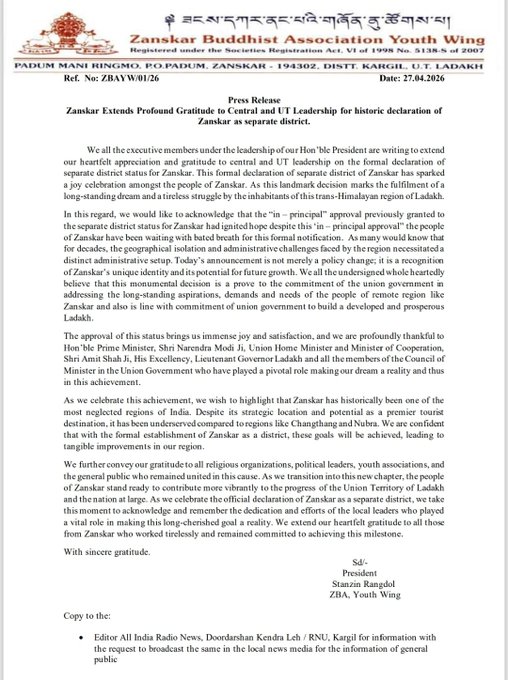
While the Muslim outfits in Ladakh are dubbing the creation of five new districts as some ‘anti-Muslim’ conspiracy and attempt to break Buddhist-Muslim unity, Zanskar Buddhist Association Youth Wing has welcomed the creation of the new districts, calling it a “landmark decision”.
“We all the executive members under the leadership of our Hon’ble President are writing to extend our heartfelt appreciation and gratitude to central and UT leadership on the formal declaration of separate district status for Zanskar. This formal declaration of separate district of Zanskar has sparked a joy celebration amongst the people of Zanskar. As this landmark decision marks the fulfilment of a long-standing dream and a tireless struggle by the inhabitants of this trans-Himalayan region of Ladakh,” the group said.
“…The approval of this status brings us immense joy and satisfaction, and we are profoundly thankful to Hon’ble Prime Minister, Shri Narendra Modi Ji, Union Home Minister and Minister of Cooperation, Shri Amit Shah Ji, His Excellency, Lieutenant Governor Ladakh and all the members of the Council of Minister in the Union Government who have played a pivotal role making our dream a reality and thus in this achievement,” it added.
Similarly, the Buddhist-dominated sub-regions of Nubra, Sham, and Changthang in Leh have also been demanding better administrative management to ensure development and proper grievance redressal.
The allegations that the creation of five new districts will create fissures between Buddhists and Muslims who have joined forces to demand statehood for Ladakh are devoid of any factual merit since statehood is a political demand. The statehood demand remains untouched by the recent district creation process.
In recent weeks, ‘gerrymandering’ has become a catchword for politicians, particularly ahead of the tabling of the now-defeated Delimitation proposal.
Notably, the term gerrymandering means redrawing electoral boundaries to concentrate or dilute votes for political advantage. This term essentially has zero applicability in the case of the district creation process in Ladakh.
Ladakh is a Union Territory, directly under the Central government. It has no assembly and its parliamentary constituencies are not being altered. The newly created districts are purely administrative units.
In short, no elections or voting power is being manipulated, and thus, the term ‘gerrymandering’ makes no sense in Ladakh’s context.
The district creation process followed existing sub-divisional and geographic realities and did not come up with arbitrary lines to somehow ‘manufacture majorities’. Zanskar has always been a Buddhist valley, while Drass has for quite a long time been Muslim-dominated. Districts are not population-proportional political units. While the Muslim population is indeed slightly higher than that of Buddhists overall, Ladakh’s geography has always comprised compact Muslim-majority pockets in the west or the Kargil side and massive Buddhist-majority in the east, that is, the Leh side.
The fresh split only formalises the pre-existing sub-regional realities. It Muslims are upset that they are not getting additional Muslim-majority districts at their whims, the government cannot help them. Also, district creation is not done on the basis of religion.
Ladakhi Muslim organisations have constantly highlighted how “one district with a Muslim population has 80 villages while another district has just around 40 or even less villages”. However, what they don’t mention is that with 80 villages, Kargil alone has more villages than any of the five new districts or even the residual Leh district.
Leh, having a far larger area with scattered high-altitude settlements, is the government’s fault. While in recent days, the Modi government has been blamed even for the rising temperatures, it is in reality not capable of twisting geography in its favour.
Mohammad Jaffer Akhoon, Chairman and Chief Executive Councillor (CEC) of the Ladakh Autonomous Hill Development Council-Kargil (LAHDC-K) claimed that the Finance Commission rule says that “when new districts are formed, population should be the major criterion–90 percent. Here, everything has been ignored.”
The fact that Akhoon himself ignored is that the 15th Finance Commission (2021-26) uses population, among other factors, for tax devolution to UTs and States and for grants to local bodies. It does mention the 90:10 ratio wherein a weightage of 90 percent assigned to the population and 10 per cent to the areas of the States, but it does not lay down the criteria for the creation of new districts.
District formation is strictly an administrative power exercised by the appointed Lieutenant Governor for efficient governance.
Moreover, contrary to the claims that new districts will skew resource allocation, after the creation of new districts, they will receive dedicated district-level budgets and resources will not be skewed but decentralised to far-flung villages, be it the Buddhist majority Zanskar or the Muslim-dominated Drass.
Cherry-picking disparities to accuse the Central government of gerrymandering for religion-based electoral gains, that too in a region where there is no legislative assembly, no electoral constituencies, no voting wards, etc., is ridiculous.
From Jammu and Kashmir to Assam, Islamo-leftists have consistently been cherry-picking numbers and blending them with a Muslim victimhood narrative to villainise the Modi government and create panic. Apparently, the Islamists are pre-emptively establishing a narrative that the Modi government ‘fixed’ electoral outcomes with the creation of new districts in case the statehood demand is accepted in future and state assembly elections are held in Ladakh.