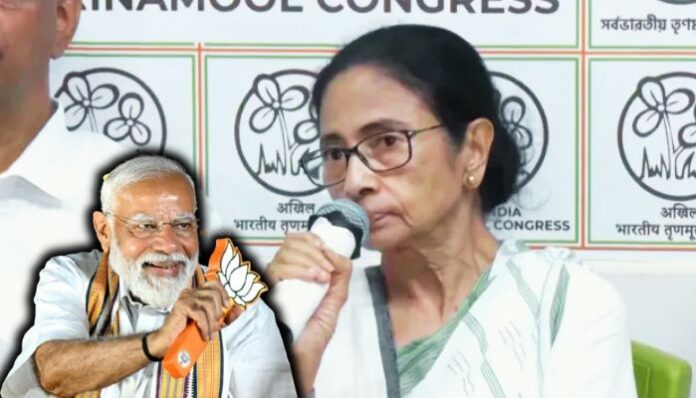
Mamata Banerjee, who ruled West Bengal for 15 years, has slipped into denial mode after the Bhartiya Janata Party handed her the most spectacular electoral eviction notice. Aghast by the loss in Bhabanipur at the hands of BJP’s Suvendu Adhikari and TMC’s humiliating diminution to mere 80 seats, Mamata Banerjee is manufacturing a disgraceful and utterly needless constitutional crisis.
The outgoing Chief Minister has refused to resign. Short on numbers, Banerjee has accused the BJP of ‘rigging’ and claimed that the TMC has won the elections ‘morally’.
‘I will not go to Raj Bhavan’: Flabbergasted by electoral drubbing, Mamata Banerjee resorts to victimhood drama
Following the BJP’s 207-seat historic win, it was expected, as per the constitutional and democratic norms, that the outgoing Chief Minister would tender resignation to the Governor. However, out of what is evident as sheer frustration and disrespect for the public mandate, Mamata Banerjee resorted to victimhood theatrics and refused to resign.
Addressing the media on 5th May, Banerjee said, “If I had lost, I would have resigned. But if anyone thinks I will step down under pressure, that is not going to happen. We did not lose the election; it was a forceful attempt. Morally, we won the election.”
Banerjee went on to accuse Prime Minister Narendra Modi and Home Minister Amit Shah of “interfering” in Bengal elections. Furthermore, she called Chief Election Commissioner, Gyanesh Kumar, the “villain of this election”.
Kolkata, West Bengal: Outgoing West Bengal CM Mamata Banerjee says, "…If I would have loose, I would have given my resignation. But if anyone thinks I will resign under pressure, that is not going to happen. We did not lose the election, it is there forceful attempt…" pic.twitter.com/5PUvp8j9bk
— IANS (@ians_india) May 5, 2026
Self-declared moral victory does not extend the tenure of the defeated: What the Constitution says about post-election power transfer
Beyond Mamata Banerjee’s gimmick to appear strong in the face of a probable career-ending defeat, it is a norm that after the declaration of election results, the incumbent Chief Minister shall tender resignation to the Governor. The Governor’s role is very important here.
According to Article 164 of the Indian Constitution, it is the Governor who technically appoints and can dismiss the Chief Minister and the state cabinet.
“The Chief Minister shall be appointed by the Governor and the other Ministers shall be appointed by the Governor on the advice of the Chief Minister, and the Ministers shall hold office during the pleasure of the Governor,” Article 164 states.
Furthermore, Article 164 (1B) states, “A member of the Legislative Assembly of a State or either House of the Legislature of a State having Legislative Council belonging to any political party who is disqualified for being a member of that House under paragraph 2 of the Tenth Schedule shall also be disqualified to be appointed as a Minister under clause (1) for the duration of the period commencing from the date of his disqualification till the date on which the term of his office as such member would expire or where he contests any election to the Legislative Assembly of a State or either House of the Legislature of a State having Legislative Council, as the case may be, before the expiry of such period, till the date on which he is declared elected, whichever is earlier.”
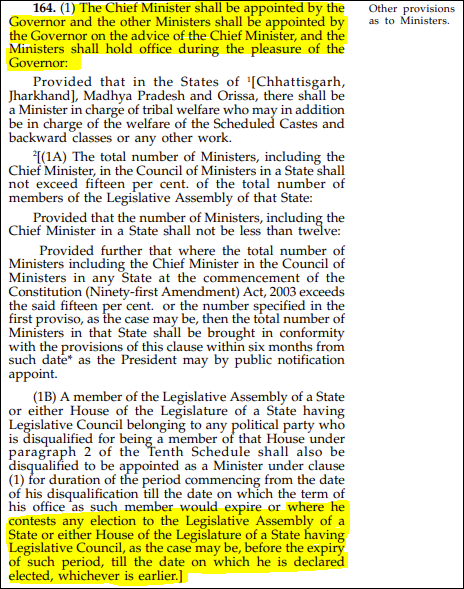
This essentially means that a state Chief Minister can be dismissed by the Governor, though there are constitutional safeguards to prevent the arbitrary exercise of power.
In cases wherein the Governor invites one candidate to form a government and asks the incumbent to resign while the Assembly’s tenure is not complete, a floor test is conducted. Whichever side proves the majority, it gets to form the government. In case no clear majority emerges, President’s Rule under Article 356 is imposed.
Coming to the crisis Mamata Banerjee is stoking, if she remains adamant about not voluntarily resigning as the Chief Minister, West Bengal Governor R.N. Ravi can direct her to resign. Her tenure as Bengal’s current CM is anyway expiring on the 7th of May 2026, as the TMC government’s tenure began on the 8th of May 2021.
In fact, even if TMC had won the elections, Banerjee would still have had to resign since the rules state that the sitting cabinet shall tender its resignation following the elections as a formality before being re-sworn in.
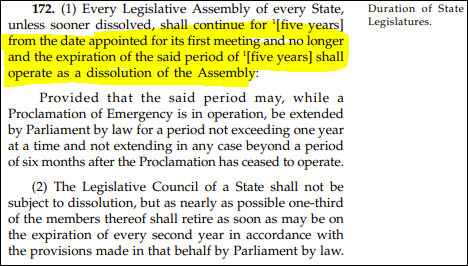
Regarding the duration of a state legislature, Article 172 of the Constitution states, “Every Legislative Assembly of every State, unless sooner dissolved, shall continue for five years from the date appointed for its first meeting and no longer, and the expiration of the said period of five years shall operate as a dissolution of the Assembly.”
After Banerjee’s tenure officially expires, the Governor shall commence the process of constituting a new Assembly. This process involves the appointment and oath-taking of new elected MLAs and Chief Minister and the victorious side will form a government.
At best, Mamata Banerjee can request the Governor to allow her the opportunity to prove a majority on the floor of the House. Since the TMC has won just 80 seats, falling short of a clear majority by 68 seats, and the BJP has won a massive 207 seats, Banerjee will fail to prove a majority.
Also, since Mamata Banerjee is no longer an MLA after losing Bhawanipur to Suvendu Adhikari, after the dissolution of the current assembly, she can’t be in the assembly as an MLA.
However, it is not that a political veteran like Mamata Banerjee, who ruled West Bengal for three consecutive terms, does not know the futility of her gimmicks. She knows her party lacks a majority. Banerjee knows that she does not get to cling to the Chief Minister’s chair just because she has grown used to and fond of it.
When UP had two CMs in office: The Jagdambika Pal-Kalyan Singh drama
UP in February 1998 saw a major political drama when the then-governor Romesh Bhandari dismissed Kalyan Singh’s coalition government. Jagdambika Pal, the then leader of the UP Loktantrik Congress, that was a part of the coalition, was declared as CM by the governor, saying that he has the support of majority MLAs.
Sitting CM Kalyan Singh objected to the governor’s decision and moved to the Allahabad High Court. The HC declared the governor’s decision unconstitutional and ordered a stay on the governor’s order of dismissing Kalyan Singh’s government and ordered status quo, meaning reinstating Kalyan Singh as CM.
Finally, the Supreme Court ordered a composite floor test in the assembly, asking Kalyan Singh and Jagdambika Pal both to test their majority. Kalyan Singh comfortably won the floor test with majority support, and Jagdambika Pal’s CM post failed to last more than 3 days.
What happened in 1998 when UP briefly had two Chief Ministers?
— OpIndia.com (@OpIndia_com) May 6, 2026
Despite a crushing defeat, Mamata Banerjee is reluctant to step down.
If she doesn’t resign, could Bengal also end up with two Chief Ministers?
What do the constitutional provisions say? @jayeshmatiyal explains. pic.twitter.com/G5ccVB7TWI
Mamata Banerjee goes the Congress way of declaring victories as genuine mandate, dismissing defeats as ‘BJP’s conspiracy‘
West Bengal’s Janadesh is clearly and decisively against her. What Mamata Banerjee appears to be trying to pull off is akin to the situation of the flame that flickers before it goes out. Banerjee wants to leave power not as a loser but as a ‘martyr’.
Her accusations of election rigging, the BJP-ECI conspiracy to manipulate the electoral roll in the BJP’s favour, and the supposed Modi-Shah ‘interference’ in Bengal elections are all but her attempts to project strength and keep her party united.
By refusing to gracefully accept the people’s mandate and resign, Banerjee wants the State to remove her in accordance with the constitutional procedure. The TMC supremo wants to mint martyrdom because nothing in this country is more effective than over-dramatised victimhood. Banerjee has taken a page from Congress’s playbook.
The Left-liberal ecosystem conveniently accepts people’s mandate in states where it wins, or the BJP loses, like Kerala and Tamil Nadu recently, but cries “Election Commission is compromised”, ‘vote chori’, ‘EVM hacking’, ‘VVPAT tampering’, ‘voter inflation’ and whatnot instead of accepting defeat and moving on. These parties know that they have been defeated by their political nemesis, and the public doesn’t buy their lies and yet they recycle the same bogey post every electoral defeat because accepting defeat is demoralising, while playing ‘Hum hare nahi humein haraya gaya hai’ card gets them unity, relevance, and most importantly, the headlines to stay relevant.
While Mamata Banerjee was dreaming about bolstering her claim to Prime Ministerial candidature after she won West Bengal, the TMC’s defeat has not only rendered her powerless in the state but also crushed her national ambitions. In this wake, it makes all the more sense for Mamata Banerjee to play all the ‘saam, daam, dand, bhed’ tactics to remain relevant and gain sympathy by coming across as a ‘martyr’.