The Indian National Congress and its entire ecosystem have been engaged in a concerted effort to undermine Indian democracy and Constitutional institutions since it was ousted from power in 2014, which was followed by their persistent inability to win over voters despite multiple efforts. The party and its supporters resolved to criticise the Bharatiya Janata Party and the Election Commission of India after consistently falling short of their own expectations in various elections.
They have made several claims, ranging from a compromised electoral body to the manipulation of Electronic Voting Machines (EVMs) and registered strong objections to the Special Intensive Revision (SIR) drive, contending that their losses are orchestrated by the ruling party rather than being a natural outcome. However, they have failed to sway public sentiment in their favour. Hence, an alternative strategy has been devised to cast aspersions on the integrity of the nation’s electoral system, as their usual propaganda could not resonate with the people.
Bengali “Netra News” used to glorify Bangladesh’s election system
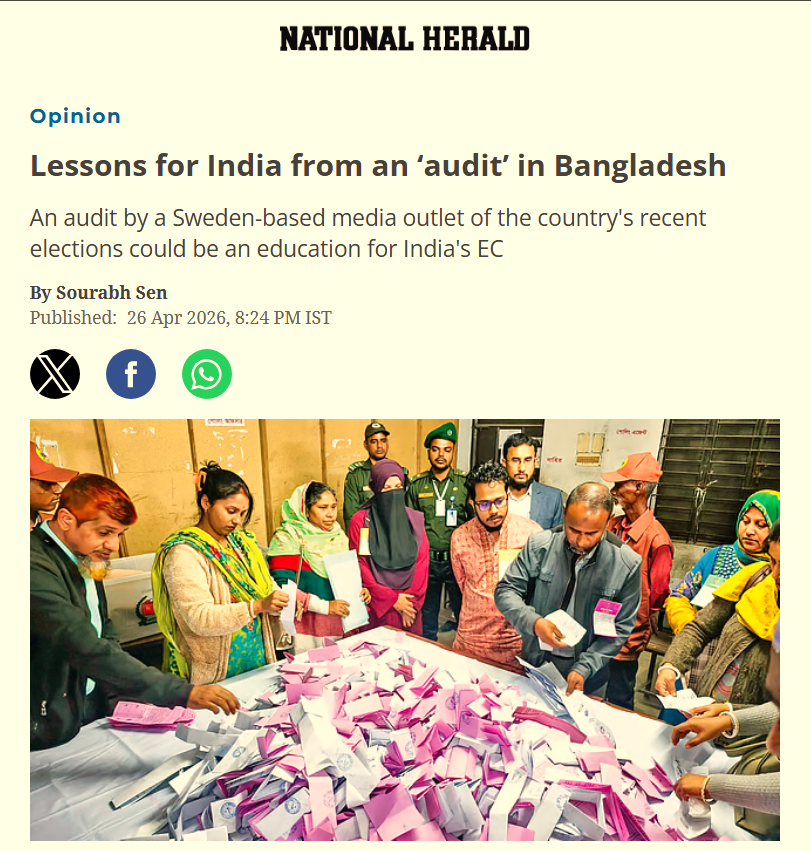
Now, comparisons are made with fractured democracies, and sermons are delivered to “learn” from them in a renewed, desperate initiative by this group. On 26th April (Sunday), the Congress mouthpiece “National Herald” published a column titled “Lessons for India from an ‘audit’ in Bangladesh” by Sourabh Sen, which directed the Modi govt to draw insights from the recently concluded national parliament polls in the neighbouring country.
The glorification was founded on an audit conducted by a Sweden-based Bengali media outlet, “Netra News,” and concluded that it could serve as an “educational moment” for the Indian Election Commission. According to the author, the organisation discovered that the elections marked by a notable ascent of the Bangladesh Nationalist Party (BNP) to power were “free and fair.”
Das asserted that it was determined after the Bangladesh Election Commission (BEC) official data was compared to the information acquired independently by the company on the polling day which was 12th February. The investigation reportedly found nearly no discrepancy, dismissing charges of rigged elections.
The article highlighted that the matter was brought up by Jamaat-e-Islami (JeI), which challenged the election’s legitimacy because it did not achieve the desired results and accused that the defeat was the product of “extraordinary engineering.” It referenced Mia Golam Parwar, the secretary-general of the party who stressed that alterations took place “between the counting of the votes and the declaration of results” alongside other party leaders who raised similar allegations against the BNP.
Parwar was could not win from his stronghold, Khulna-5 constituency. The piece quoted him, declaring, “They sidelined a mainstream political party (JeI) through election engineering. We have raised the issue publicly through official statements and press conferences and have also lodged complaints before the tribunal about this.”
The irony is either evidently lost on Das or he has intentionally chosen to disregard the parallels between the statements of the hardliner party and the Congress-led opposition, which also takes refuge in conspiracy theories and finds faults with the election procedure in India after each setback. The latter attacked the election commission with provocative comments to foster distrust and even insult the voters instead of addressing its own shortcomings and policies.
The subtle advocacy for the execution of ballot boxes
The article stated that News Netra dispatched hundreds of “correspondents” around Bangladesh in the months preceding the elections. “The election, in over 43,000 polling stations across 300 constituencies was held with paper ballots,” it outlined before delving into the rigorous process undertaken by the platform.
Afterwards, Das expressed, “The audit matches the party-wise number of ballots present in the boxes before the BEC’s final counting. But, as critics point out, election engineering can still occur if ballot boxes were stuffed during polling or if the numbers are deliberately manipulated by the BEC. Parwar points out that the audit cannot reveal whether voters were intimidated before they cast their votes.”
Interestingly, he again failed to mention that this measure was employed to facilitate elections in India but the shocking images of the ballot boxes being looted by members and thugs of the parties of the current I.N.D.I. Alliance continue to linger in the memories of many citizens. These scenes came to an end with the implementation of the EVMs.
However, their reintroduction would revive the perilous scenario where hooliganism and brazen exercise of authority would influence election turnout in place of the rightful adult franchise, as was visible during the panchayat elections in West Bengal, where political “workers,” specifically from the All India Trinamool Congress (AITC or TMC) were charged with stealing ballot boxes.
Das then sprang onto the objective for which he had set the frivolous stage and wrote, “Is there a lesson for India here? The Election Commission of India has the experience, resources and manpower to initiate an even more robust, independent and transparent audit of elections and election results, if it wants to restore the severely eroded credibility of elections conducted under its watch.”
He predictably did not mention how the “credibility” has been diminished, aside from the usual rhetoric from the opposition, as neither the people have endorsed these groundless allegations, nor has the judiciary suggested any such inclination. On the contrary, it has reinforced the commission’s independence and decision-making capability.
Surely, Das did not imply that the authenticity of the body can be called into question because the grand old party and its allies are not succeeding in elections? However, how can it be surprising when this cabal’s dedication to constitutional institutions is contingent upon decisions that align with its interests and support?
Furthermore, the Election Commission, on many occasions, asked the opposition to prove their assertions about the EVMs through hacking and manipulation. However, they could not provide any solid or empirical proof to back the charges apart from doubling down on the demonisation and disparagement.
A temporary “arrangement” to replace 33% women’s reservation
After the assault on the election commission, the article proceeded to condemn the Bharatiya Janata Party for having the audacity to present the “previously-gazetted women’s reservation bill through Lok Sabha, knowing full well they did not have the numbers to push it through just to generate talking points before the elections in Tamil Nadu, West Bengal, Kerala and Puducherry.”
It inadvertently exposed the Congress and other parties by conveying that even the critical subject of women’s representation is not beyond politics for them and the BJP can enact the bill when it achieves a majority in the Lok Sabha.
Interestingly, the Congress had been lashing out at the Modi government for making insincere promises to lure women voters, only to conveniently refuse support when the centre acted on its assurance. This is clearly more indicative of the reality of its pro-women posturing than of the saffron party’s motivations.
“Bangladesh, on the other hand, has quietly allocated the 50 seats reserved for women in the Jatiya Sangsad (House of the Nation), over and above the 300 contested seats to winning parties. These seats were allocated in proportion to the number of general seats each party won. Women nominated to these seats are full members of parliament, with the same rights and privileges as those in general seats, though they do not represent any specific geographic constituency,” Das pointed out in yet another deceptive analogy.
He added that women will be around 16% of Jatiya Sangsad with 57 out of 350 members and proposed, “A similar experiment could be carried out in India, by raising the strength of the Lok Sabha to 643 or 743 and allowing each state to nominate women for the additional seats. Similarly, the Rajya Sabha can fix the number and criteria for nominated seats for women. This arrangement for the next 15 years is well worth trying without the complications involved in reserving 33 per cent seats in parliament at its existing strength.”
The piece first tried to downplay the massive complexities, in terms of both size and population, of a massive country like India in relation to Bangladesh which has a substantially different parliamentary system. It then demonstrated how Congress and its cheerleaders can not only swiftly forsake their commitments but defend the same with nonsensical explanations, as their lofty proclamations seem to be election ploys that are never aimed to be realised.
This stands as one of the key reasons for the opposition bloc’s rapidly declining trust among the populace. However, this faction has opted to use the Election Commission as a scapegoat and vilify the BJP, instead of confronting the truth. They illustrate an example of a country where the blood of vulnerable minorities, particularly Hindus, was spilt on the streets during an absolute collapse of law and order instigated by the Islamists and a sitting prime minister was forced to escape to protect her life.
Therefore, it is not India that requires correction or guidance from others. However, the opposition does need to introspect instead of ignoring blunders and hunting for targets or unnecessary illustrations elsewhere just to conceal its continuous hypocrisy alongside incompetence.