

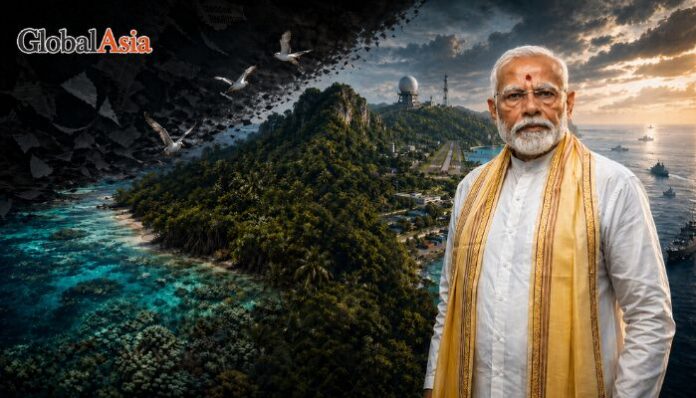
The article in GlobalAsia by Nirmal Ghosh is finely written, intensely felt, and practically pointless as a policy critique. He characterises the Great Nicobar project as a ‘Faustian bargain’ in which India sells its ecological soul in exchange for strategic benefits that he describes as ‘theoretically persuasive though tactically questionable.’ It’s a remarkable display that he dismisses environmental safeguards as insufficient in one breath and then questions whether the strategic rationale really makes sense in the next. He leaves the reader with an atmosphere rather than an argument, one of romantic environmental sadness that, no matter how deeply felt, cannot serve as the foundation for a country of 1.4 billion people making decisions about its sovereign development and territorial security.
Let’s take a careful and in-depth look at his real claims since they are worthy of more than a dismissal and because the facts as a whole provide a totally different story.
‘Rushed through safeguards’: A claim that cannot survive scrutiny
The project was ‘rushed through various safeguards,’ according to Ghosh’s worst claim. This is now the standard statement used by all project critics, and it is said so frequently that it is taken for granted. It isn’t.
On November 11, 2022, MoEF&CC granted the Environmental Clearance, which is a 30-page document with 42 specific conditions. These include conservation of leatherback sea turtles, protection of Nicobar Megapodes, coral translocation, management of saltwater crocodiles, mangrove restoration, tribal welfare for the Shompen, three independent monitoring committees, and a 30-year wildlife conservation program that is fully funded by the project proponent. Independent, long-term research tasks were given to the Wildlife Institute of India (WII), the Zoological Survey of India (ZSI), the Botanical Survey of India (BSI), and the Salim Ali Centre for Ornithology and Natural History (SACON) until 2052, the project’s completion year. These exercises don’t include checking boxes. They are institutionally endorsed, financially protected, and legally bound.
As part of the mitigation efforts, three new wildlife sanctuaries were created. A leatherback turtle sanctuary on Little Nicobar Island, a Megapode Sanctuary on Menchal Island, and a Coral Sanctuary on Meroe Island. Water withdrawals from the Galathea River were strictly prohibited. Eight wildlife corridors were established along the east coast. A Special Medical Unit with a budget of ₹100 crore was established to protect tribal communities from invasive diseases.
Then, in February 2026, a six-person National Green Tribunal court led by Justice Prakash Shrivastava considered petitions contesting these very clearances and rejected them, concluding that there was no good ground for intervention. The NGT is not a rubber-stamp organisation; rather, its purpose is to resist when governments take shortcuts. It found no cut corners here. It discovered both substantive and procedural compliance to Indian environmental law. Referring to something as ‘rushed’ is not environmentalist. That’s revisionism.
The coral argument
Corals are a key component of Ghosh’s and his intellectual camp’s most sentimental exhibit. The optics are striking, coral reefs inspire colour, fragility, and irreplaceability. Again, however, the science is more complicated than the rhetoric.
The ZSI conducted its own investigation and discovered no substantial coral reef formations inside the proposed port building zone. There are dispersed coral colonies within 15 metres of the project area, totalling roughly 16,150 colonies that are suggested for relocation. Importantly, ZSI referenced its own previous experience; effective reef systems were created through coral translocation in the Gulf of Kachchh, which had over 90% survival rates. The NGT accepted the evidence. The tribunal urged MoEF&CC to ensure coral regeneration using ‘proven scientific methods’ and ZSI, which is familiar with these waters, has a track record of successfully achieving precisely that.
Sovereignty, UNCLOS, and the strategic argument Ghosh cannot quite dismiss
This is when Ghosh’s analysis becomes most intellectually evasive. He describes the national defence justification as ‘theoretically persuasive though tactically questionable,’ but he does not present the tactical case. He dismisses the strategic case without addressing it.
So, let us confront it. Great Nicobar Island is around 40 nautical miles from the Strait of Malacca, across which nearly 80% of China’s oil imports pass. According to the United Nations Convention on the Law of the Sea (UNCLOS), India’s Exclusive Economic Zone extends 200 nautical miles from its baseline. Without sufficient infrastructure in Great Nicobar, India cannot meaningfully exercise its sovereignty over this zone. A country’s exclusive economic zone (EEZ) is more than just a legal concept; it is an economic and strategic reality that requires physical presence, monitoring capabilities, and maritime enforcement. Without a port or an airport, India’s EEZ in the southeastern Indian Ocean is essentially an unguarded frontier.
China’s People’s Liberation Army Navy has progressively expanded its presence in the Indian Ocean through what strategists refer to as the ‘String of Pearls.’ Gwadar in Pakistan, Hambantota in Sri Lanka, and Kyaukpyu in Myanmar. These aren’t hypothetical threats. They are recorded infrastructural investments that allow the PLA Navy access to the Indian Ocean’s littorals. Against this backdrop, India’s development of its own island its own territory, within its own sovereign powers, does not constitute aggression. It is basic strategic prudence that is perfectly in tune with international law.
This is the headquarters of the Andaman and Nicobar Command (ANC), the only tri-service integrated command in India. By upgrading Great Nicobar, it becomes a real force multiplier rather than just a symbolic outpost. Ghosh may refer to this as ‘tactically questionable,’ but he should explain to the reader what exactly is dubious about protecting one’s own maritime frontier in a period when global power competition is fierce.
The 8000 people nobody talks about
The 8,000 people, out of which 7,000 are settlers from the mainland, who truly reside on Great Nicobar must finally be taken into consideration in any article regarding the island’s biodiversity. At the moment, they lack dependable road access to the rest of the island, are only reachable by air and water, have subpar medical services, and almost no economic opportunities. By 2052, the project’s Environmental Clearance anticipates 51,000 direct jobs and more than 1,28,000 potential jobs. The 160 MLD water system being constructed, township development, and water supply infrastructure are not abstract advantages, rather, they are the difference between an isolated population and one that is linked to the country’s mainstream.
Ghosh’s perspective leaves no room for these 8,000 people. Inhabited islands are sometimes viewed in the conservation literature as issues that need to be resolved rather than as communities with rightful development claims. That framing, however unintended, indicates whose interests the environmental critique eventually serves.
The monitoring architecture
A truly ‘rushed’ environmental clearance would not require a project monitoring committee led by the Chief Wildlife Warden, three independent monitoring committees that meet twice a year with site visits, biodiversity committee reviews before any road expansion, and six-monthly compliance reports submitted to the MoEF&CC Regional Office. It would not require the project proponent to pay and maintain WII research stations in Campbell Bay and Kamorta for a period of 30 years. It would not be necessary to install 150 satellite tags on leatherback turtles in the first five years of the initiative.
This oversight architecture is imperfect; no document is perfect, but it is not insignificant. It is hardly an honest environmental analysis to attack it as a ‘Faustian bargain’ without first acknowledging its existence.
Conclusion
Ghosh concludes with grief, which is an understandable reaction to large-scale change in ecologically valuable environments. However, grief alone cannot be used to shape policy. The government’s choice to develop Great Nicobar is not a concession to development lobbyists. It is the result of a collaborative process that included WII, ZSI, BSI, SACON, the EAC, the NGT, a public hearing in Campbell Bay, and the courts. Every institution under Indian environmental legislation was used. All agreed that the project, with its conditions, was acceptable.
A nation’s sovereignty over its own area, whether biological, economic, or strategic, is not negotiable. It’s a right. The challenging, unglamorous, institutionally controlled task of simultaneously pursuing security and the environment is what India has attempted at Great Nicobar, not a choice between the two. Critics who fail to acknowledge the problem do not safeguard nature. They’re simply making noise from a safe distance.


