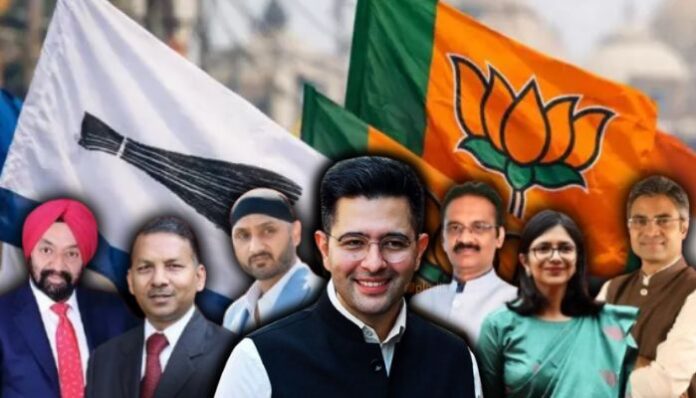
The resignation of Rajya Sabha MPs Raghav Chadha, Ashok Mittal, Sandeep Pathak, Harbhajan Singh, Rajinder Gupta, Vikram Sahney, and Swati Maliwal, from the Aam Aadmi Party (AAP) and merger with the Bhartiya Janata Party (BJP) has not only stirred a political storm but also triggered a constitutional debate. This debate centres on the Anti-Defection Law and its applicability in the present case of seven MPs defecting from AAP and merging into the BJP.
AAP Rajya Sabha MPs invoke provision of the Anti-Defection Law
An internal power tussle was ongoing among the top echelon of the Aam Aadmi Party for months. From early speculations that former Delhi CM Arvind Kejriwal was growing insecure about Raghav Chadha’s supposedly surging popularity to AAP formally removing him as its Rajya Sabha deputy leader, the infighting came out in public.
Before this, Swati Maliwal already had a public spat with Kejriwal, and people actually wondered why she was still in the party. She had alleged that she was assaulted by the CM’s aides in his official residence in May 2024.
Days after, AAP began “silencing” him amidst his growing clout, Rajya Sabha MP Raghav Chadha announced his resignation from the party and merger with the BJP on 24th April. Whether the meteoric rise in Chadha’s online popularity is fully organic or not could be a discussion; his departure would have been a big blow for AAP. However, Chadha decided to inflict an irreversible shock and took away six more MPs, including Swati Maliwal, who has been at loggerheads with Kejriwal over alleged harassment by his aide Bibhav Kumar in May 2024.
The seven MPs, constituting more than two-thirds of AAP’s 10-member Rajya Sabha contingent, submitted signed letters and documents to the Rajya Sabha Chairman this morning, formally triggering the merger under the anti-defection law’s exception for two-thirds splits.
During a press conference, Chadha said, “We have decided that we, the ⅔rd members belonging to the AAP in Rajya Sabha, exercise the provisions of the Constitution of India and merge ourselves with the BJP.”
Speaking about the legality of the merger with the BJP, Chadha said, “As per the Constitution, two-thirds of the total MPs of a party can merge with another party. We have submitted a letter to Rajya Sabha Chairman C P Radhakrishnan in this regard today… submitting all the documents required.”
The AAP leadership, however, not only accused Chadha and other defectors of ‘betraying’ the party but also announced plans to challenge what they described as an “unconstitutional defection”.
AAP Rajya Sabha MP Sanjay Singh said the party would petition the Rajya Sabha chairman seeking the disqualification of the defected MPs under the anti-defection law. Singh contended that this was not a case of a genuine party merger but of individual defections that should be penalised.
“Anti-defection law clearly states that no form of split is permissible in the Assembly, Rajya Sabha, or Lok Sabha… It does not carry any legal recognition, even if it’s a two-thirds majority… Therefore, the defection of these seven Rajya Sabha MPs from the AAP is entirely illegal, incorrect, unconstitutional, and against parliamentary rules. Even if the number rises from seven to eight members, it would still have no legal validity under the Tenth Schedule. It has no legal recognition, and this has also been clearly established in the Shiv Sena case,” Sanjay Singh said.
The AAP leader, however, conveniently forgot that in the Shiv Sena Eknath Shinde faction versus Uddhav Thackeray faction case, the Shinde faction never claimed a formal “merger” with the BJP or any other party. Instead, they claimed to be the “real” Shiv Sena and not defectors at all. Although the Supreme Court deemed the actions of the Shinde faction as ‘defection’, the decision was left with Maharashtra Assembly Speaker Rahul Narwekar, who decided in favour of the Shinde faction since they had the majority number.
While a disgruntled Aam Aadmi Party is desperate to have the membership of the seven MPs terminated, citing the anti-defection law, the same legislation has provisions that ensure that Chadha and six others will most likely remain unaffected.
Anti-Defection Law
Brought in the Tenth Schedule of the 52nd Amendment to the Constitution of India during the Rajiv Gandhi Government in 1985, the Anti-Defection Law is aimed at stopping what is colloquially described as the “Aaya Ram, Gaya Ram” style defections that previously toppled governments. This law was further tightened by the 91st Amendment in 2003, which removed the earlier one-third split exception.
Back in 1967, when Lok Sabha elections were held, out of 3,500 MPs that were elected to legislative assemblies of various states and union territories, around 550 later defected from their original parties. To tackle this political opportunism-based defection, a committee was formed under Congress leader Yaswantrao Chavan. However, a proper legislation to address this issue could be brought only after Rajiv Gandhi-led secured a majority in the 1984 elections and introduced the Anti-Defection Bill in 1985.
When it comes to elected representatives, the Anti-Defection Law recognises two types of defections. First, wherein members voluntarily relinquish membership of their party and the other in which an independently elected member joins a political party.
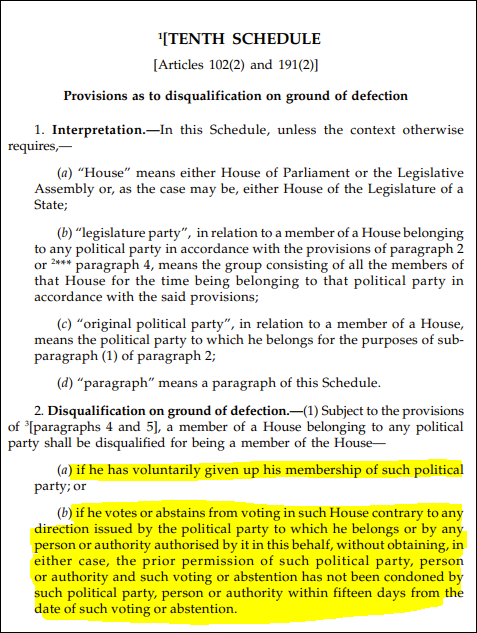
As per Paragraph 2 of the Tenth Schedule, a Member of Parliament or state legislature is disqualified if she or he voluntarily gives up membership of the party on whose ticket she or he was elected, or votes or abstains from voting in the House contrary to any direction or whip issued by the party, unless the party condones it within 15 days.
“(a) if he has voluntarily given up his membership of such political party; or (b) if he votes or abstains from voting in such House contrary to any direction issued by the political party to which he belongs or by any person or authority authorised by it in this behalf, without obtaining, in either case, the prior permission of such political party, person or authority and such voting or abstention has not been condoned by such political party, person or authority within fifteen days from the date of such voting or abstention,” the law states.
Apparently, the Aam Aadmi Party is placing its hopes on having the defected MPs disqualified, in the provision “An elected member of a House who has been elected as such otherwise than as a candidate set up by any political party shall be disqualified for being a member of the House if he joins any political party after such election.”
Clearly, Raghav Chadha had the legal aspects of defection and merger analysed beforehand. Out of 10 AAP MPs, one resigning would have made no big difference; however, with 7 defecting and merging with the BJP, they secured both their Rajya Sabha membership and political interests.
The question arises as to how their Rajya Sabha memberships could remain unaffected when the Anti-Defection Law says that an elected MP will be disqualified if he or she was elected on a ticket of one party but defected to another after winning the election?
The answer to this lies in the Anti-Defection Law’s provision that disqualification on the grounds of defection does not apply in the case of merger.
Paragraph 4 of the law states, “A member of a House shall not be disqualified under subparagraph (1) of paragraph 2 where his original political party merges with another political party and he claims that he and any other members of his original political party
- have become members of such other political party or, as the case may be, of a new political party formed by such merger; or
- have not accepted the merger and opted to function as a separate group, and from the time of such merger, such other political party or new political party or group, as the case may be, shall be deemed to be the political party to which he belongs for the purposes of sub-paragraph (1) of paragraph 2 and to be his original political party for the purposes of this sub-paragraph.
(2) For the purposes of sub-paragraph (1) of this paragraph, the merger of the original political party of a member of a House shall be deemed to have taken place if, and only if, not less than two-thirds of the members of the legislature party concerned have agreed to such merger.”
The entire game relies on the word “deemed” as the law does not require the national party leadership or party president to formally announce a merger. Basically, if two-thirds or more of the MPs or MLAs of a party in a specific House agree, the merger is automatically considered to have happened.
In the present case, the concerned party is AAP’s Rajya Sabha group. With 10 MPs, two-thirds means at least 7. In a well-calculated move, the seven MPs who left AAP satisfy this legal threshold exactly. Therefore, the law deems that AAP’s Rajya Sabha legislature party has merged with the BJP. If the number of rebel MPs was less than the two-thirds threshold, then they would have been disqualified under the Anti-Defection Law.
Paragraph 4 (2) essentially kills AAP’s argument that a ‘real’ merger must involve the national party structure and not just one House’s lawmakers. This constitutional provision rejects the interpretation of the Anti-Defection Law, AAP leadership is putting forth.
While the final decision regarding any disqualification petition AAP moves, remains with the Rajya Sabha Chairman, the statutory text and legal reading of the law go easily in favour of the seven MPs.
Interestingly, the Tenth Schedule also bars the jurisdiction of the court regarding the disqualification of a member of the House in this context. The law states, “Notwithstanding anything in this Constitution, no court shall have any jurisdiction in respect of any matter
connected with the disqualification of a member of a House under this Schedule.”

In short, the seven MPs who joined the BJP are protected, and no sword of disqualification hangs over their head. In accordance with the provisions of the Anti-Defection Law, Raghav Chadha, Ashok Mittal, Sandeep Pathak, Harbhajan Singh, Rajinder Gupta, Vikram Sahney, and Swati Maliwal shall legally retain their seats.
Past cases of defections based on the merger provision
While the 1985 Anti-Defection Law was brought with the intention of curbing defections, the practice has continued over the years. It is obvious that the anti-BJP parties and ideological ecosystem is framing the defection and merger of seven AAP MPs into the BJP as some exploitation of constitutional provisions as loopholes, political leaders across parties with varying ideologies have indulged in this practice.
Back in 2019, when state assembly elections were held in Goa, ten Congress MLAs, who constituted more than two-thirds of the INC’s legislature group in the 40-member assembly, voluntarily gave up their membership and merged with the BJP. Just as it happened in Raghav Chadha and others’ case, these Congress MLAs had also invoked Paragraph 4 of the Tenth Schedule. Their merger with the BJP was deemed valid by the Goa assembly Speaker and later upheld by the Bombay High Court’s Goa Bench. In fact, from 1970, 2019 to 2022, Goa has a history of defections This essentially confirmed that the consent of two-thirds of a legislature party alone suffices for protection from disqualification even without a formal full-fledged national-level party merger.
In 2018, six Bahujan Samaj Party (BSP) MLAs representing the entire BSP legislature group in Rajasthan’s state assembly announced their merger with the Congress party after elections. The BSP MLAs had cited the two-thirds merger exception in the Tenth Schedule, and their move was accepted without attracting any penalties.
In June 2019, 12 of the 18 Congress MLAs resigned and joined the Telangana Rashtra Samiti (TRS) after elections, invoking Paragraph 4 of the Tenth Schedule. The Telangana Assembly speaker has also endorsed their merger with Congress since the defectors constituted two-thirds of the legislature party.
Conclusion
The history of defection and merger cases shows exactly why the defected AAP MPs collectively and publicly emphasised the “two-thirds” figure because they knew that their move fell squarely within the merger exception of the Tenth Schedule and would not invite disqualification. The ‘damage’ AAP and the anti-BJP cabal can inflict is online criticism, run an ‘unfollow Raghav Chadha’ campaign on Instagram and performative political manoeuvres.