

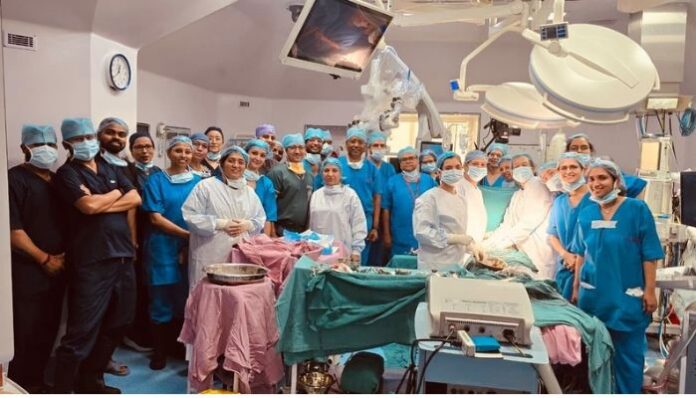
The doctors at All India Institute of Medical Sciences (AIIMS) Delhi successfully performed an open foetal surgery to mend a serious spinal defect in an unborn baby at 25 weeks of pregnancy. The complex surgery was conducted free of cost under the Janani Shishu Suraksha Karyakram. In a medical first for India, a team of doctors at AIIMS Neurosciences Centre in Delhi carried out a six-hour procedure on 12th November to treat a lumbosacral myelomeningocele, the severe open form of spina bifida.
What is myelomeningocele and why is it operated on before birth?
Myelomeningocele (MMC) is the most severe form of spina bifida, a defect wherein the neural tube, which develops into the brain and spinal cord, does not close during the first month of pregnancy.
The opening stays in the backbone, allowing the protective membranes and some spinal cord tissue to protrude. This neural tissue is susceptible to damage during pregnancy.
The child may experience severe weakness or paralysis in their legs, have difficulty walking, and have problems controlling the bladder and bowel, depending on the defect’s location and severity.
In some cases, the affected children may develop hydrocephalus. It is a condition wherein excess fluid accumulates in the brain. To repair it, doctors may have to perform surgery to insert a shunt.
In other cases, portions of the hindbrain may extend toward the spinal canal.
Those affected by Myelomeningocele may either become independently mobile or end up requiring braces, walkers or wheelchairs and continued medical aid, depending on the condition’s severity.
Usually, surgeons repair the spinal defect after the baby’s birth; however, the rationale behind foetal surgery is that the exposed spinal cord might sustain further damage during pregnancy via continued exposure to amniotic fluid and mechanical irritation.
Doctors say that closing the spinal defect before birth is a better way of protecting the neural tissue from further harm.
How is a foetal surgery for Myelomeningocele conducted?
An open prenatal MMC repair or foetal spina bifida repair is conducted between 23 weeks and 25 weeks and 6 days of gestation.
In a traditional open foetal repair, the mother is administered anaesthesia. An incision is made in the mother’s abdomen to reach the uterus.
Surgeons use ultrasound guidance to identify the position of the foetus and placenta before executing a controlled opening in the uterus. This is to ensure that the foetus stays linked to the placenta via the umbilical cord.
The team of surgeons carefully position the foetus to access the defect.
Following this, the paediatric neurosurgical team use microsurgical techniques to close the opening and cover the exposed tissue.
In the final stage, the mother’s uterus and abdomen are closed. This allows the pregnancy to continue under observation of doctors.
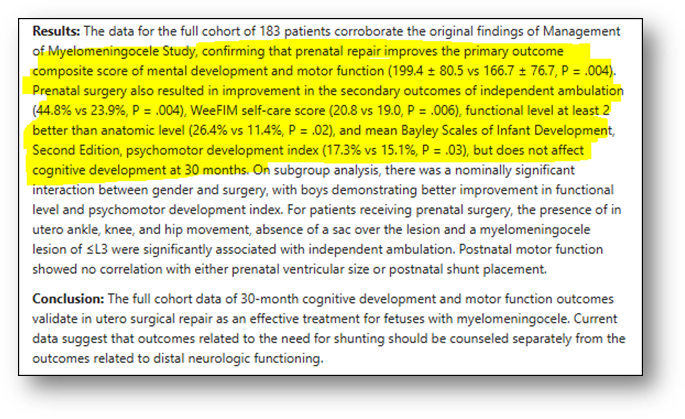
As per the 2011 Management of Myelomeningocele Study (MOMS), the first formalised research trial which compared the results of foetal or prenatal surgery against postnatal surgery for MMC, the prenatal repair registered about a 50% reduction in the need to perform shunting treatment for hydrocephalus.
For neurological conditions like Chiari malformation type 2 at age 1, the foetal surgery registered nearly a tenfold reduction compared to postnatal repair.
Prenatal surgery for MMC does not guarantee 100% success
A follow-up study showed that 29% of children who underwent prenatal surgery could walk independently without braces or assistive devices. On the contrary, only 11% of those who had undergone postnatal repair reported independent walking without braces or other assistive devices.
However, doctors don’t interpret the findings as indicative of foetal surgery guaranteeing independent walking.
Outcomes in each case are contingent on the severity of the spinal defect, the extent of neural damage before surgery, muscle function and complications like hydrocephalus.
Prenatal intervention comes with its own set of risks for the mother and the baby.
The mother undergoing the prenatal MMC surgery can be exposed to myriad risks, including bleeding, infection, complications from anaesthesia and premature contractions.
Moreover, there is also a risk of premature rupture of membranes, reduction of amniotic fluid, and premature delivery. In extreme cases, pregnancy loss might also occur.
In addition, there is a possibility that uterine incision might affect future pregnancies due to increased risk of uterine rupture.
For the baby, the prenatal intervention does not fully remove the possibility of paralysis, bladder and bowel dysfunction, hydrocephalus, spinal cord tethering or other orthopaedic complications. In some cases, children might require continued neurosurgical, urological, orthopaedic and rehabilitation aid.
Who are the AIIMS surgeons behind India’s first successful foetal surgery for Myelomeningocele?
A team of over 30 doctors, nurses and healthcare professionals were involved in the six-hour procedure to repair the spinal defect in an unborn c conducted at AIIMS Delhi on 12th November.
The team comprised neurosurgeon Dr Deepak Gupta, Professor of Neurosurgery at AIIMS Delhi, and maternal-foetal medicine and obstetric specialists Dr Neena Malhotra and Dr K Aparna Sharma.
Speaking about the importance of the successful prenatal MMC surgery, Dr Deepak Gupta told The Indian Express, ” This achievement reflects our capacity to bring globally established, highly complex foetal care within reach of Indian families through science, teamwork, ethics and public-sector commitment.”
Notably, the idea of setting up a dedicated foetal-surgery programme at AIIMS Delhi first emerged in 2012, right after the outcomes of the landmark research, MOMS, were published.
Explaining why it took about 14 years to carry out a foetal surgery for MMC, Dr Deepak Gupta told IE, “The intervening years were needed to develop the institutional expertise and infrastructure required for such a complex intervention. Foetal surgery cannot be treated as a single operation. It requires a complete maternal-foetal care programme, including rigorous patient selection, non-directive counselling, ethical oversight, established operative protocols, emergency preparedness and long-term follow-up planning.”
This essentially required an amalgamation of paediatric neurosurgery, maternal-foetal medicine, obstetrics, obstetric and neuroanaesthesia, foetal imaging, neonatology, intensive care, nursing and related specialists. In addition, the ethical concerns also need to be appropriately addressed.
Dr Gupta said that for the case question, the team conducted detailed imaging review, counselling, simulation and multidisciplinary preparation for over five weeks.
Speaking about whether other government hospitals can replicate the dedicated foetal-surgery programme, Dr Gupta said that it is possible, however, only through meticulously developed designated tertiary referral centres.
India needs audited regional centres for foetal surgeries since about 1.2 lakh babies are estimated to be born with neural tube defects annually, with about 20,000 to 30,000 babies with open defects like Myelomeningocele.
Janani Shishu Suraksha Karyakram
The Janani Shishu Suraksha Karyakram (JSSK) was launched in June 2011 with the aim of eliminating out-of-pocket expenses for both pregnant women and sick infants.
In 2014, the JSSK programme was extended to all antenatal & post-natal complications of pregnancy, and similar entitlements have been put in place for all sick newborns and infants (up to one year of age) accessing public health institutions for treatment.
The JSSK initiative entitles all pregnant women delivering in public health institutions to absolutely free and no-cost delivery, including caesarean section. The entitlements include free drugs and consumables, free diagnostics, free blood wherever required, and free diet for 3 days during normal delivery and 7 days for C-section.
In 2014, the Ministry of Health and Family Welfare extended these entitlements to all antenatal &post-natal complications of pregnancy.