

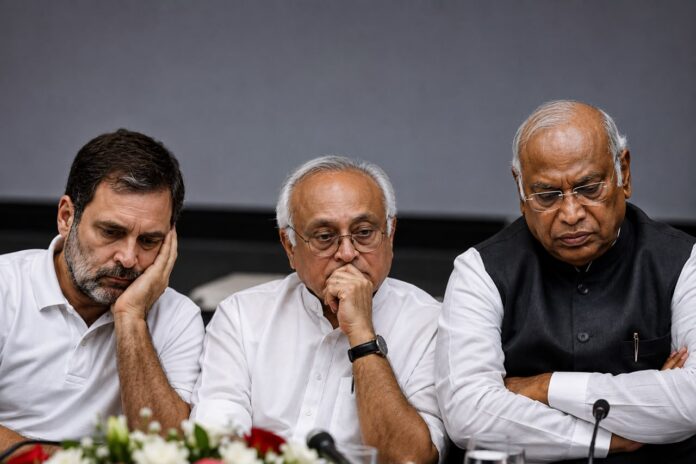
The INDI (Indian National Developmental Inclusive Alliance) bloc’s latest meeting in Delhi has once again brought the Opposition coalition’s internal cohesion under scrutiny, with several prominent allies choosing to stay away from the gathering.
Among the most notable absentees was actor-politician Vijay’s Tamilaga Vettri Kazhagam (TVK), which reportedly snubbed the meeting despite growing speculation about its future role in Opposition politics. More significantly, the ruling DMK, one of the alliance’s most important southern partners, was also absent.
The optics were particularly striking because no political party from Tamil Nadu participated in the meeting. The absence of both the DMK and TVK highlighted the lack of representation from a state that sends 39 MPs to the Lok Sabha and has traditionally played a crucial role in coalition politics at the national level.
The Delhi meeting was expected to showcase Opposition unity at a time when the alliance is attempting to consolidate its position against the BJP-led NDA. Instead, the absence of several regional players has fuelled speculation about growing unease within the coalition.
Adding to the perception of disunity was the decision of other major regional allies to skip the meeting. Apart from the DMK, the Aam Aadmi Party (AAP) and Shiv Sena (UBT) were also not represented, raising questions about the alliance’s ability to bring all its constituents onto a common political platform.
Political observers have also pointed to the electoral trajectory of several INDI bloc constituents since the alliance’s formation. Parties such as AAP, TMC, RJD, DMK, Shiv Sena (UBT), NCP (SP), and the Left have either suffered electoral setbacks, witnessed a decline in political influence, or faced organisational challenges in recent years. Critics of the alliance argue that the coalition has struggled to translate its anti-BJP positioning into sustained political gains on the ground.
Supporters of the alliance, however, contend that occasional absences from coordination meetings do not necessarily indicate a breakdown of the coalition. They argue that regional parties often prioritise state-specific political considerations and electoral calculations, particularly when crucial state elections are on the horizon.
Nevertheless, the latest meeting has once again underscored a recurring challenge facing the INDI bloc. While the alliance continues to project itself as a national alternative to the BJP, repeated instances of key allies skipping important meetings have created an impression of fragmentation.
With AAP, DMK and Shiv Sena (UBT) staying away, and no representation from Tamil Nadu, the Delhi gathering has provided fresh ammunition to critics who claim that the alliance’s biggest challenge is not confronting the NDA, but maintaining cohesion among its own partners, who are often at odds with each other vying for being the face of the opposition.
