

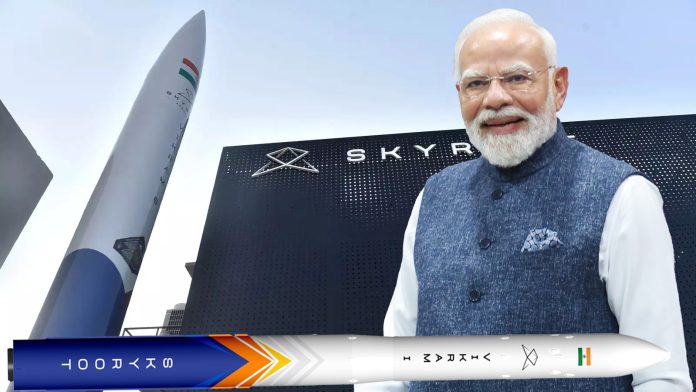
Prime Minister Narendra Modi inaugurated Skyroot Aerospace’s Infinity Campus in Hyderabad on Thursday, 27th November. During the event, he unveiled Vikram-I, India’s first privately built orbital launch vehicle that can send satellites into space. The rocket is named after Dr Vikram Sarabhai, the founder of India’s space program.
STORY | PM Modi inaugurates Skyroot's facility in Hyderabad, recalls govt's 'historic' space reforms
— Press Trust of India (@PTI_News) November 27, 2025
Prime Minister Narendra Modi on Thursday virtually inaugurated Indian space startup Skyroot's Infinity Campus in Hyderabad and highlighted the government's 'historic' space… pic.twitter.com/2JXnB3zjPd
What makes Vikram-I special
Vikram-I can carry payloads of around 300 kg to Low Earth Orbit(LEO). It has an all-carbon-fibre body, which makes it stand out from other rockets in its class. The Vikrams series aims to grab a share of the multi-million-dollar small satellite launch market and offer multi-orbit insertion and interplanetary missions for customers in India and abroad.
One key feature is its ability to place multiple satellites into orbit at the same time, a first for India’s space sector. Skyroot says the rocket can be assembled and launched within 24 hours from any launch site. This puts India among global leaders in satellite deployment tech.
Infinity campus details
The new Infinity Campus in Hyderabad covers 200,000 square feet and handles everything from development to testing of multiple launch vehicles. It has the capacity to produce one orbital rocket every month. PM Modi spoke virtually at the event, praising ISRO for building India’s space reputation through its skills and value.
He also highlighted how young innovators, risk-takers, and entrepreneurs are pushing the space sector forward, especially with private companies growing fast. The campus shows India’s new mindset and youth power, helping the country become a leader in global satellite launches.
Skyroot’s past achievements and future goals
Skyroot Aerospace was founded by former ISRO scientists and IIT alumni Pawan Chandana and Bharath Dhaka. In 2022, they made history with Vikram-S, India’s first private sub-orbital rocket launch. The company has raised over $95 million and partners with groups like Axiom Space to improve access to low-Earth orbit.
Policy changes since 2023 have opened up India’s space sector to startups in launches, satellites, and analytics. Vikram-I targets the small-satellite market to boost local launch options, with experts predicting a $77 billion opportunity by 2030.
