

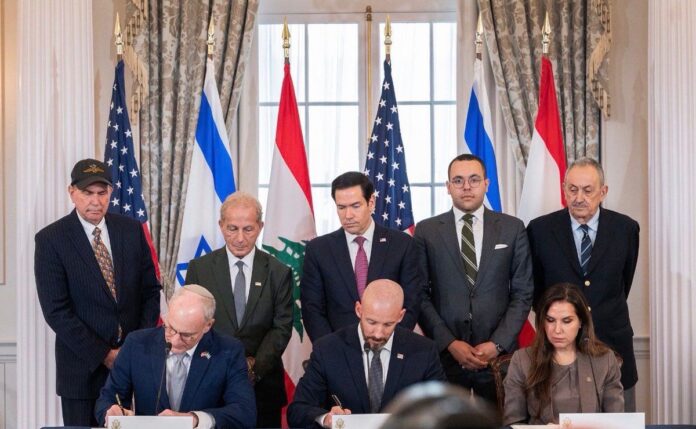
In a significant diplomatic breakthrough after months of cross-border hostilities, Israel and Lebanon have signed a US-backed framework agreement aimed at reducing tensions along their shared frontier and paving the way for a broader peace process. The agreement, brokered by the United States after multiple rounds of negotiations, is being described by officials as an initial step towards ending one of the region’s most volatile conflicts.
According to CNN, the framework was formally signed in Washington by Israeli Ambassador Yechiel Leiter, Lebanese Ambassador Nada Hamadeh, and US State Department Chief of Staff Dan Holler.
Rubio calls the agreement “the beginning of the beginning”
US Secretary of State Marco Rubio welcomed the development but cautioned that it was only the start of what is expected to be a long and difficult process.
“Today is the beginning of the beginning,” Rubio said, adding that while the agreement marks meaningful progress, considerable challenges remain before a lasting peace can be achieved.
The framework lays out a phased security arrangement under which Israel will initially withdraw from two areas in southern Lebanon. The Lebanese Armed Forces will assume control of those territories, while additional Israeli withdrawals will depend on progress in dismantling Hezbollah’s military infrastructure in the region.
‘Road to peace begins here’
Lebanese Ambassador Nada Hamadeh described the agreement as a crucial step towards restoring Lebanon’s sovereignty and securing a permanent cessation of hostilities.
Calling the framework a milestone, she said it could help re-establish Lebanon’s territorial integrity and open the door to long-term stability.
Israeli Ambassador Yechiel Leiter echoed that sentiment, saying the ultimate objective of the agreement was full peace between Israel and Lebanon.
“The final destination of this framework is peace between the two countries,” Leiter said, adding that reducing the influence of Iran and Hezbollah was central to achieving that goal.
Netanyahu says Israel will retain military presence
Israeli Prime Minister Benjamin Netanyahu said Israeli forces would continue maintaining positions in parts of southern Lebanon until Hezbollah is fully disarmed. He also described the agreement as a strategic setback for Iran, arguing that it weakens Tehran’s influence in Lebanon.
The phased nature of the framework reflects Israel’s insistence that further territorial withdrawals will be tied to verifiable security developments on the ground.
Hezbollah rejects the framework
Hezbollah, which did not participate in the negotiations, swiftly rejected the agreement.
Senior Hezbollah lawmaker Hassan Fadlallah accused the Lebanese government of making unilateral concessions that favour Israel and warned that the framework could deepen political divisions within Lebanon.
The group’s opposition highlights the complex political and security challenges that could complicate implementation of the agreement.
Months of conflict preceded the breakthrough
The latest round of fighting began after Hezbollah launched rockets into Israel following the Israel-US military campaign against Iran earlier this year. The conflict has claimed thousands of lives in Lebanon and resulted in the deaths of dozens of Israeli soldiers, further destabilising the border region.
Despite the challenges ahead and Hezbollah’s rejection of the deal, diplomats view the framework as the most significant diplomatic opening between Israel and Lebanon in years. Whether it evolves into a comprehensive peace agreement will largely depend on security conditions on the ground and the willingness of all stakeholders to sustain the momentum generated by the US-mediated negotiations.
